Homeless advocates, residents and students continued their fight Tuesday, Feb. 10, against the Riverside City Council’s rejection of $20.1 million to remodel the Quality Inn Motel on University Avenue.
A reconsideration of the council’s January vote would have needed to be placed by Friday, Feb. 6, onto the Tuesday agenda to comply with the state’s open-meeting law.
It was not, meaning the project is officially dead. Tuesday was the deadline to reconsider the vote.
“This item is over,” Councilmember Sean Mill said Tuesday morning in a text message. “There will be no reconsideration.”
Riverside City Council members listen Tuesday, Feb. 10, 2026, to speakers urging them to reconsider a vote against converting the Quality Inn Motel into homeless housing. (Photo by Anjali Sharif-Paul, The Sun/SCNG)
Dan Hoxworth, a board member of the Inland SoCal Housing Collective, speaks Tuesday, Feb. 10, 2026, to the Riverside City Council. (Photo by Anjali Sharif-Paul, The Sun/SCNG)
Dan Hoxworth, a board member of the Inland SoCal Housing Collective, speaks Tuesday, Feb. 10, 2026, to the Riverside City Council. (Photo by Anjali Sharif-Paul, The Sun/SCNG)
Riverside Mayor Patricia Lock Dawson listens to speakers Tuesday, Feb. 10, 2026, during the Riverside City Council meeting. (Photo by Anjali Sharif-Paul, The Sun/SCNG)
Sammie Burgess, of the College Working Families Party at UC Riverside, speaks to the Riverside City Council on Tuesday, Feb. 10, 2026, in support of a proposal to convert the Quality Inn Motel into housing for homeless people. (Photo by Anjali Sharif-Paul, The Sun/SCNG)
The Riverside City Council listens as Thomas W. Moore speaks during the Tuesday, Feb. 10, 2026, urging the council to reconsider its vote against converting the Quality Inn Motel on University Avenue into homeless housing. (Photo by Anjali Sharif-Paul, The Sun/SCNG)
Berry Dawes speaks Tuesday, Feb. 10, 2026, to the Riverside City Council, asking the council to reconsider its decision against converting the Quality Inn Motel into homeless housing. (Photo by Anjali Sharif-Paul, The Sun/SCNG)
The Riverside City Council listens to a speaker during its Tuesday, Feb. 10, 2026, meeting. Residents urged members to reconsider an earlier vote against converting the Quality Inn Motel into homeless housing. (Photo by Anjali Sharif-Paul, The Sun/SCNG)
Riverside City Councilmember Philip Falcone listens to a speaker Tuesday, Feb. 10, 2026, as residents urge the council to reconsider its decision to convert the Quality Inn Motel into homeless housing. (Photo by Anjali Sharif-Paul, The Sun/SCNG)
Alex Atilano, of the College Working Families Party at UC Riverside, speaks Tuesday, Feb. 10, 2026, to the Riverside City Council. (Photo by Anjali Sharif-Paul, The Sun/SCNG)
A Riverside resident speaks Tuesday, Feb. 10, 2026, during the Riverside City Council meeting, urging the council to reconsider a vote not to convert the Quality Inn Motel into homeless housing. (Photo by Anjali Sharif-Paul, The Sun/SCNG)
Sammie Burgess, of the College Working Families Party at UC Riverside, second from left, is seen at the Tuesday, Feb. 10, 2026, Riverside City Council meeting where speakers urged the council to reconsider its decision not to convert Riverside’s Quality Inn Motel into housing for homeless people. (Photo by Anjali Sharif-Paul, The Sun/SCNG)
1 of 12
Riverside City Council members listen Tuesday, Feb. 10, 2026, to speakers urging them to reconsider a vote against converting the Quality Inn Motel into homeless housing. (Photo by Anjali Sharif-Paul, The Sun/SCNG)
Still, advocates for the project refused to back down.
Nearly 30 spoke to the council at Tuesday afternoon’s meeting, lambasting its decision against accepting the state money to remodel the Quality Inn Motel, at 1590 University Ave., into 114 studio apartments for residents who are homeless.
“I support the project irrevocably, and so should you,” resident Patricia Verwiel said at the meeting. “Remember: It’s OK to change your mind — especially when you find out the truth.”
Because the issue was not on the agenda, council members could not directly respond to the speakers.
Only a council member who voted on the winning side of a proposal could have brought it back to the council Tuesday, which did not occur.
Councilmember Chuck Conder, who was absent from the May meeting that resulted in a split vote on the city’s application for the state funds, last month voted along with Councilmembers Philip Falcone, Steven Robillard and Mill to oppose the project. In May, Mayor Patricia Lock Dawson cast the tie-breaking vote to apply for the state dollars.
Councilmembers Clarissa Cervantes, Jim Perry and Steve Hemenway voted last month to accept the money, as they did last year in voting to seek the grant.
Mill said that his opposition to the project comes from his belief that the “housing first” model to address homelessness has failed. “Housing first” is a method to reduce homelessness by providing permanent housing without prerequisites — including treatment for potential substance abuse — on those needing a place to live.
Also on Tuesday, the council discussed in closed session two potential legal actions related to its denial of the grant, but no action was announced afterward.
The city received a letter from the American Civil Liberties Union Foundation on Monday, Feb. 2. The letter said the council’s vote to reject the money raised legal questions and that it and other groups were investigating. It also urged the council to revisit its decision and raised concerns that denying the grant may conflict with the city’s housing needs and fair housing laws.
The city also got a Feb. 2 email on behalf of the owner of the Quality Inn that said the seller may hire attorneys to sue due to “interference”with the transaction now that the motel will not be purchased and transformed into the project.
The University Terrace Homes project was proposed to the city by Riverside Housing Development Corp., a Riverside-based nonprofit organization.
Despite the deadline for reconsideration having passed, speakers at Tuesday’s meeting still asked for a change.
UC Riverside student Sammie Burgess told the council that it was “fruitless” to hope for their minds to change, but Burgess still hoped members would reconsider.
“Nearly every student I told about the rejection of this funding was at least confused, if not appalled, by this decision,” Burgess said after the meeting, adding that due to the session’s time, students who wanted to speak had to skip class to attend.
Another UCR student, Urban Cross, told the council: “I just want to remind you that it’s OK to change your mind, and I urge you to do so.”
Rachel Williams, a 67-year-old Riverside resident, had a question for the council.
“Do you all sleep in a bed with a pillow under your head each night?” Williams asked. “Shame on you for leaving some of our neighbors on concrete each night.”
Joe La Croix said he was at a loss as to what to tell council members.
“Because obviously everybody’s appealed to your heart, your kindness, your sense of whatever … There’s absolutely nothing that moves you on this thing.”
Kris Lovekin told the council: “In business, they say, don’t leave money on the table. That’s what we’re doing here. This money will go to some community, but it won’t be Riverside. That is heartbreaking as I look around and see so many people on the streets.”
Dan Hoxworth, a board member of the Inland SoCal Housing Collective, pointed to the rejection of about $20 million.
“This is fiscally irresponsible for Riverside,” he said. “We have no plan for the Quality Inn.”
One resident pointed to the next Election Day.
“The constituents of Riverside will remember your hypocrisy,” Ruth Wong said. “Don’t expect to be reelected next year.”
Staff writer Israel J. Carreón Jr. contributed to this report.
HANOI, Vietnam — Indonesia is tightening state control over the world’s largest nickel supply after years of betting the metal would anchor a homegrown electric-vehicle industry, and just as global demand begins shifting away from heavy reliance on nickel.
The move could still ripple through global EV supply chains as the United States and China compete for critical minerals. Indonesia sits at the center of the nickel market: its share of global supply jumped to about 60% in 2024 from 31.5% in 2020, according to S&P Global Market Intelligence, after former President Joko Widodo banned raw ore exports, drawing a surge of Chinese-backed investment into refining.
Jakarta hoped that control over nickel would underpin a fully domestic EV industry, from mining and batteries to finished cars. Experts say that promise was used to justify forest clearing and mining expansion in the name of the energy transition, even as climate risks deepened.
In 2025, Indonesia cracked down on what it called illegal exploitation of natural resources, saying many mining and plantation licenses were tainted by bribery or never properly approved. Authorities say they have seized more than 4 million hectares (9.8 million acres) of mines, palm oil plantations and processing sites, levied $1.7 billion in fines, and could seize another 4.5 million hectares this year.
But analysts warn the crackdown is coming just as nickel’s payoff is starting to fade, with many Chinese EVs shifting to battery chemistries that use far less of the metal, relying instead on iron-based designs.
“The forests have been exploited to the brim,” said Putra Adhiguna of the Jakarta-based Energy Shift Institute. “But you never got the electric-vehicle value chain.”
China plays the leading role in Indonesia’s nickel sector, using the metal to underpin its stainless steel and clean-energy industries.
The world’s largest nickel reserves are concentrated on the Indonesian island of Sulawesi, which accounts for more than half of global nickel mine production, according to the U.S.-based Institute for Energy Economics and Financial Analysis or IEEFA.
China has sourced nickel from Indonesia for decades, but the relationship deepened after Jakarta banned raw ore exports in 2020, drawing a surge of Chinese investment into smelters.
Nickel shipments to China jumped, with imports of nickel matte — a semiprocessed material used in battery chemicals and alloys — rising nearly 28-fold between 2020 and 2023, more than 90% of it from Indonesia, according to trade data. Over the same period, North and South America’s combined share of global nickel output fell from 16% to 7%, while Europe’s share dropped from 35% to 10%, according to the International Nickel Study Group, a Lisbon-based intergovernmental organization.
Meanwhile, mining drove the loss of about 370,000 hectares (roughly 914,000 acres) of Indonesian forests between 2001 and 2020 — more than in any other country — according to an analysis by the World Resources Institute. More than a third of that loss was old-growth rainforests which hold vast carbon stocks and are crucial for limiting climate change.
The heavy use of coal to run Indonesia’s nickel smelters has also slowed the country’s energy transition, adding new fossil-fuel demand even as it tries to cut emissions. A 2024 analysis by the IEEFA found that major nickel producers emitted about 15 million metric tons (16.5 million U.S. tons) of greenhouse gases in 2023, largely because of coal reliance.
In one of the most public nickel-related seizures last year, Indonesian soldiers accompanied by a local television crew, took control of part of the world’s largest nickel mine.
Mostly owned by Chinese metals giant Tsingshan Holding Group, the mine has caused deforestation, air and water pollution and increased coal-fired emissions, while displacing communities, harming livelihoods and exposing residents to health risks, according to a 2024 report by the nonprofit group Climate Rights International.
The move wasn’t aimed at environmental protection or restoring forestry safeguards, said Bhima Yudhistira, with the Jakarta-based Center of Economic and Law Studies or CELIOS.
“There is no guarantee things will get better,” he said. They could get “even worse.”
Indonesia’s effort to turn its nickel reserves into the backbone of a domestic EV industry drew early interest from investors in South Korea and China but has fallen short of expectations.
In July 2024, South Korea’s Hyundai Motor Group and LG Energy Solution opened Indonesia’s first EV battery-cell plant, with annual capacity to supply more than 150,000 electric vehicles. But in April 2025, LG Energy Solution withdrew from a larger $8.4 billion battery investment, citing market and investment conditions.
An EV plant is still being built by Chinese automaker BYD. China’s CATL, the world’s largest EV battery maker is constructing a battery factory with Indonesian state firms.
Indonesia’s EV market, is growing quickly but remains small.
The country sold more than 43,000 electric vehicles in 2024, accounting for about 5% of total car sales, according to the Indonesian Business Council. Public charging infrastructure is limited, with around 1,500 stations nationwide in 2024.
Even if Indonesia produced 1 million EVs a year — equal to total annual auto sales — and favored nickel-rich batteries, that would still consume less than 1% of its national nickel output, according to the Energy Shift Institute.
EV makers are shifting to lithium iron phosphate, or LFP, batteries, reducing the need for nickel and cobalt. LFP batteries are cheaper, more stable and longer lasting. They’re used in nearly half of all EVs, the International Energy Agency found.
Analysts say Indonesia’s nationalization drive could loosen Beijing’s grip on parts of the supply chain, potentially giving Jakarta more leverage to court U.S. buyers and investors.
One potential concession by Indonesia in long drawn-out trade negotiations with the administration of U.S. President Donald Trump, expected to wrap up soon, would be to lift the ban on raw nickel exports to the U.S.
Indonesia already has invited the U.S. to invest in its critical minerals sector as part of ongoing tariff negotiations between the two countries, though it’s caught in a tricky position.
“How does Indonesia straddle between the two superpowers who both want to gain control of the national resource that Indonesia has?” said Li Shuo, director of the Asia Society Policy Institute’s China Climate Hub.
Other Southeast Asian countries similarly “sandwiched” between the U.S. and China are watching Indonesia closely, Li said.
“Make no mistake, it’s going to be very difficult,” he said.
Indonesia’s land seizures risks further destabilizing its nickel industry, added Yudhistira with CELIOS. Foreign investors monitoring the situation are likely to hesitate before committing new capital to Indonesia-based mining and processing projects, he said.
“This is making the future of nickel, both mining and downstream processing, unknown,” Yudhistira said. “Uncertainty is very costly for investors.”
___
Delgado reported from Bangkok, Thailand. Associated Press writer Edna Tarigan in Jakarta contributed to this report.
___
The Associated Press’ climate and environmental coverage receives financial support from multiple private foundations. The AP is solely responsible for all content. Find AP’s standards for working with philanthropies, a list of supporters and funded coverage areas at AP.org.
COLOMBO, Sri Lanka — Sri Lankan legislators overwhelmingly voted Tuesday to scrap their pensions, in a bid to fulfill a key preelection campaign promise by the ruling Marxist-leaning government following anger over the country’s economic crisis.
Lawmakers passed the bill on Tuesday by 154 votes in the 225-member House, with only two against. The remaining legislators were not present during the vote.
In Sri Lanka, a lawmaker was previously entitled to a pension after serving a five-year term. The new law stops payments to anyone who already receives, or qualifies for, the pension. President Anura Kumara Dissanayake, voted into office in 2024, pledged to end the practice during his election campaign.
In a similar move, Dissanayake’s government abolished perks provided to former presidents in September in response to popular demand. Those included state funding for housing, allowances, pensions and transport. An office and a staff for former presidents and their widows were also scrapped. There are currently five living past presidents and a widow.
Dissanayake won the vote, riding on public resentment against politicians accused of being responsible for the country’s worst economic plight in 2022. The crisis led to a severe shortage of food, medicine, fuel and electricity, and triggered protests that forced then-President Gotabaya Rajapaksa to resign.
Justice Minister Harshana Nanayakkara presented the bill in parliament, saying an election promise had been fulfilled and that lawmakers had no moral right to receive a pension at a time when the country was struggling to emerge from its worst economic crisis.
Sri Lanka declared bankruptcy in April 2022 with more than $83 billion in debt, more than half it to foreign creditors. It sought the help of the International Monetary Fund, which approved a $2.9 billion four-year bailout package in 2023, under which Sri Lanka was required to restructure its debt.
Sri Lanka’s crisis was largely the result of economic mismanagement combined with fallout from the COVID-19 pandemic, along with the 2019 terrorism attacks that devastated its important tourism industry. The pandemic also disrupted the flow of remittances from Sri Lankans working abroad.
Muslims worldwide will begin daily fasting from dawn to sunset as Ramadan starts, marking a period of worship, reflection and charity. The holy month, the ninth in the Islamic lunar calendar, brings families together for meals to break the fast. Ramadan begins Wednesday or Thursday, varying by country due to differing moon sighting practices.
This is a photo gallery curated by AP photo editors.
BEIJING — British and Canadian citizens can enter China without a visa starting Tuesday, bringing to 79 the number of countries granted visa-free access in a bid to boost tourism and business.
China has expanded eligibility for the program significantly in the last two years. Visitors can stay for up to 30 days for business, tourism, exchange programs and to visit family and friends.
Most Europeans qualify for visa-free entry, along with some from select countries in other regions including Latin America, Southeast Asia and the Middle East.
Citizens of a few other countries, including the United States and Indonesia, can enter for 10 days if they are in transit — meaning they have a ticket departing for a different country than they arrived from.
Business executives and tourists have welcomed the change, as the China visa application process can be a relatively cumbersome one.
The U.K. and Canada are being added following visits to China last month by their prime ministers, Keir Starmer and Mark Carney. Both are relatively new leaders who are trying to revamp ties with Beijing after a downturn in recent years.
For most countries, the visa-free access expires at the end of this year, but it has been extended in the past.
LUSAKA, Zambia — She says she was let down at every step. By a partner who abandoned her when she was pregnant. By a health service that denied her a legal abortion. And by a justice system that sent her to a maximum-security prison for illegally terminating her pregnancy on her own.
Violet Zulu, a house cleaner in Zambia earning $40 a month, was sentenced to seven years in prison in 2024 after representing herself in court with little understanding of the consequences of her actions. She didn’t see her two children or other family members for nearly two years.
After word of her case reached international rights groups that helped her file an appeal, Zulu was freed last month. Activists say she represents many women in Africa who take desperate decisions when facing barriers to legal abortion services.
Her story has drawn little sympathy in her southern African nation, where parts of society view abortion harshly. Her own mother said she agreed with her daughter’s prison sentence, but said it should have been shorter.
Zulu spoke with The Associated Press as she pieces her life together again at the age of 26.
She said she first attempted to access legal abortion services at a public clinic, which should have given her advice or services but turned her away. She then tried a private pharmacy, which requested 800 Zambian kwacha ($43) for abortion drugs, a month’s salary for her.
She was already struggling to feed her two young sons, and she sometimes had to beg food from relatives.
She said her decision to drink an herbal concoction she prepared herself, one known for terminating pregnancies, was taken out of despair. She couldn’t bear for her boys to have even less food if she had another child.
“I never wanted to abort my pregnancy, but it is the circumstances at home that forced me to do it,” Zulu said in the interview at the two-room rented home with no running water that she shares with her children and parents.
“I was scared (when I took the concoction), but I didn’t really care what would happen to me,” she added.
In her court testimony, she explained what happened next: She delivered the fetus in a toilet, placed it in a sack and dropped it in a nearby stream. She said she confided in a friend, but word got out and neighbors reported her to police.
Zulu, who left school in the eighth grade, was never offered free legal counsel despite the right to request it. She represented herself in court and pleaded guilty to the offense of procuring her own abortion. She said she didn’t understand the legality of abortion and thought she would receive a warning.
“This is a system that failed Violet,” said Rosemary Kirui, a legal adviser for Africa for the abortion rights group Center for Reproductive Rights, which campaigned for Zulu’s release and helped with her appeal. “It is not that she did not try. It is that she could not afford the services, yet she should be able to access them as a citizen of Zambia.”
Zulu should have been eligible for a free abortion under a provision that allows doctors in Zambia to consider risks to the well-being of her existing children, said Sharon Williams, country director for the Women and Law in Southern Africa advocacy group.
But Zulu was not aware of that, largely because of the secrecy, stigma and shame around abortion, which is not advertised by Zambia’s public health system.
Zambia’s Health Ministry did not respond to questions about her case.
Part of the problem, Williams said, is that Zambia has legalized abortion while also defining itself in its constitution as a strongly Christian country.
Abortions are still largely restricted in Africa, with few countries allowing them for reasons other than threats to the health of the mother or the fetus. Even in countries where abortion is legal in some circumstances like Zambia, religious beliefs, conservative values rooted in local cultures or a lack of information make access to legal procedures difficult, according to health and rights groups.
Williams said Zulu’s case ought to lead to a national conversation over whether Zambian authorities should better educate communities over the legal right to abortion.
“I think now that we have this judgment, we’re ready for the conversation,” she said.
Activists say desperate women turn to unsafe abortions. Africa and Latin America have the highest proportions of them, with approximately 75% of all abortions in Africa deemed unsafe, according to the World Health Organization.
The Guttmacher Institute health rights organization estimated in a 2019 report that over 6 million unsafe abortions a year occurred in sub-Saharan Africa. It noted that Zambia’s abortion law “tended to be a ‘paper law’ rather than one that ensures widespread access.”
In South Africa, which claims to have the most progressive laws on the continent, abortion has been legal for nearly 30 years. It is allowed on request before 13 weeks of pregnancy and for several reasons before 21 weeks.
But studies estimate only 7% of public health facilities there offer abortion services.
In 2023, the case of a 14-year-old who was denied an abortion by South African health workers three times for reasons that were not valid prompted a national reality check. After an urgent court case, a judge ordered that the girl be allowed to have an abortion, which was performed on the last day eligible by law.
At the time, a representative of the social justice group that represented the girl said South Africa’s abortion laws were being undermined by “the abuse of medical knowledge by health care professionals” in trying to prevent abortions.
In Zambia, Zulu said she still felt bad about what she did but must now provide for her sons. She was looking for work again, she said.
The Associated Press receives financial support for global health and development coverage in Africa from the Gates Foundation. The AP is solely responsible for all content. Find AP’s standards for working with philanthropies, a list of supporters and funded coverage areas at AP.org.
Tesla’s robotaxis have been involved in 14 crashes in Austin, Texas, since the service launched in the city last summer, according to data the electric vehicle automaker disclosed to federal safety regulators.
The five most recent incidents involving Tesla’s self-driving taxis took place in December and January, according to a report posted by the National Highway Traffic Safety Administration (NHTSA). No injuries were reported, although the crashes resulted in some form of property damage in which the robotaxis collided either with another vehicle or a fixed object, the NHTSA data indicates.
Two other incidents that occurred in July and October last year resulted in minor injuries.
Tesla did not immediately respond to a request for comment.
Auto manufacturers like Tesla that produce vehicles equipped with Automated Driving Systems are required to submit crash data to NHTSA. If the agency finds a safety defect, it can take action to remove vehicles from the road.
Tesla launched its robotaxi service in Austin in June of 2025. The rollout started as a pilot, with Tesla inviting a select group of people to ride in a fleet of Model Y Robotaxis. Other people in the Texas city can now hail one of Tesla’s self-driving cars using the company’s Robotaxi app.
Only weeks after the service debuted in Austin, NHTSA said it was investigating several incidents in which the robotaxis were filmed driving erratically, including driving down the wrong side of the road and braking suddenly.
NHTSA, which operates under the Department of Transportation and regulates automobile safety, said it contacted Tesla after videos surfaced showing instances of the company’s self-driving taxi driving down the wrong side of the road and braking erratically.
Tesla has recently signaled its plans to invest more in robotics and its autonomous vehicle business. On the company’s most recent earnings call in January, Tesla CEO Elon Musk said the company is “moving into a future that is based on autonomy.”
Part of that includes the Cybercab, another autonomous vehicle Tesla is developing. Musk said he expects the automaker to eventually manufacture “far more Cybercabs than all of our other vehicles combined.”
According to Wedbush equity analyst Dan Ives, Tesla plans to launch robotaxis in seven U.S. cities in the first half of 2026. The company expects the service to roll out in half of U.S. states by year-end, he said in a recent research note.
Matt Shumer joins “CBS Mornings” to discuss his now viral article, “Something Big Is Happening.” He writes that AI’s “capability for massive disruption could be here by the end of this year.” Shumer explains why he wrote the article, and his message to concerned readers.
Washington — President Trump is blaming government leaders in the metro Washington, D.C. area, among them Maryland Gov. Wes Moore, following a massive sewage spill into the Potomac River in the Washington, D.C. area, perhaps the largest in American history.
President Trump said in a post on Truth Social Tuesday that the federal government would help clean up the spill, which occurred in mid-January, if local leaders ask “politely,” though he had said Monday in a so he would direct federal authorities to “immediately provide all necessary management, direction and coordination” to protect the Potomac.
After Moore indicated the federal government bears the responsibility for maintaining the collapsed 60-year-old Potomac Interceptor behind the spill, Mr. Trump said in his post that Maryland, Virginia and Washington, D.C. were responsible for the “massive sewage spill,” and if they can’t fix it, “they have to call me and ask, politely, to get it fixed.” He added that the “federal government is not at all involved with what has taken place, but we can fix it.”
A section of the sewer line collapsed in January in Montgomery County, Maryland, sending more than 200 million gallons of wastewater into the Potomac. Although DC Water — the public utility that’s responsible for the District’s drinking water, wastewater collection and sewage treatment — has diverted the wastewater spill and is working to sanitize the water, it didn’t manage to do so before the wastewater severely tainted the Potomac with high levels of E. coli and other bacteria. DC Water is overseen by the Environmental Protection Agency.
“This is a Radical Left caused Environmental Hazard,” the president wrote in his post Tuesday. “With all of their talk about carbon footprints and everything else, they’re allowing hundreds of tons of sewage to pour into the Mighty Potomac, making it much less mighty. ACT FAST. I am awaiting your call.”
The president placed most of the blame for the spill squarely on Moore and Democratic officials in Maryland. He said over the weekend that the Federal Emergency Management Agency is responding to the incident, but that the ongoing funding lapse for its parent agency, the Department of Homeland Security, is affecting the agency.
But on Tuesday, Moore said it’s the federal government that has long been responsible for the sewage project.
“I know this is breaking news to everyone, but the president is not telling the truth,” Moore told reporters in Maryland. “Because what you’re looking at with the Piedmont sewage project, that’s not something that the federal government has had responsibility for for the past year; it’s not something that the federal government has had responsibility for the past decade — in fact, the federal government has had responsibility for that for the past century.”
He added that Maryland Department of the Environment workers were, in fact, among the first to respond to the spill, testing the water quality and sewage. And Moore said the EPA declined to join a congressional briefing that Maryland officials had invited the agency to join.
“Now that it is essentially 99% contained, I love the fact that the president of the United States is finally realizing that this was his job, and he hasn’t been doing it for the past month,” Moore added. “So I say, ‘Listen, we’d welcome you to help to address the remaining 1% that hasn’t been complete while we’ve been doing your job.'”
Mr. Trump has made it clear recently he’s no fan of Moore. The Maryland governor is of two Democrats whom Mr. Trump deemed “not worthy” to be invited to an annual White House meeting and dinner with governors from both parties this week. Moore discussed the slight with CBS News during a “Things That Matter” town hall that aired Sunday night.
In another social media post, the president called Moore “foul mouthed,” criticized his performance as Maryland governor and accused him of lying about receiving a military medal. Moore said Mr. Trump’s post was “full of lies” and “unhinged.”
“I will work with anyone. But I will bow down to no one,” Moore told CBS News. “And I think the president has a problem with that.”
CBS News has reached out to DC Water, D.C. Mayor Muriel Bowser’s office, the Maryland Department of Environmental Quality, Moore’s office, Virginia Gov. Abigail Spanberger’s office, the Virginia Department of Environmental Quality and the EPA for comment.
“The damaged portion of sewage infrastructure is owned and operated by DC Water, and the location of the break is in Montgomery County, MD,” the Virginia Department of Environmental Quality told CBS News.
The Potomac Interceptor was built as a result of a law Congress passed in 1960 that authorized the District of Columbia to construct, operate and maintain a sewer line connecting Dulles to the Washington, D.C. sewer system, according to DC Water.
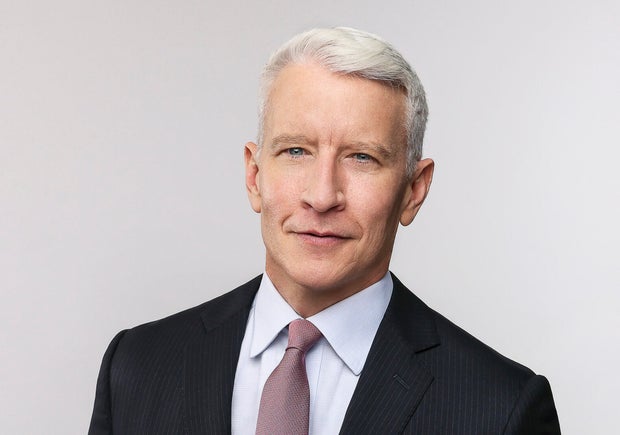
Anderson Cooper is leaving CBS News’ “60 Minutes” at the end of this season after 20 years with the celebrated newsmagazine. He’ll still report multiple stories in production for “60 Minutes” before the season ends in May, according to the show.
Cooper, who is also a primetime anchor on CNN, said in a statement that he decided to leave his role at CBS to spend more time with his children.
“Being a correspondent at ’60 Minutes’ has been one of the highlights of my career. I got to tell amazing stories, and work with some of the best producers, editors and camera crews in the business,” Cooper said. “For nearly twenty years, I’ve been able to balance my jobs at CNN and CBS, but I have little kids now and I want to spend as much time with them as possible, while they want to spend time with me.”
CBS News expressed gratitude for his work on the long-running program.
Anderson Cooper
Michele Crowe/CBS Broadcasting Inc.
“For more than two decades, Anderson Cooper has taken ’60 Minutes’ viewers on journeys to faraway places, told us unforgettable stories, reported consequential investigations and interviewed many prominent figures,” CBS News said in a statement. “We’re grateful to him for dedicating so much of his life to this broadcast, and understand the importance of spending more time with family. ’60 Minutes’ will be here if he ever wants to return.”
Cooper appeared on Sunday’s broadcast of “60 Minutes,” introducing a short video essay from documentary filmmaker Ken Burns about what he thinks would surprise America’s Founding Fathers about the U.S. ahead of its 250th anniversary.
Cooper started working as a correspondent for “60 Minutes” in the 2006-2007 television season through an agreement between CBS News and CNN. He previously contributed stories to “60 Minutes II,” a onetime spinoff of the broadcast.
His departure follows a tumultuous time for “60 Minutes,” which premiered in 1968. Last spring, the show’s third executive producer in its history, Bill Owens, left the network, saying it has “become clear that I would not be allowed to run the show as I have always run it.”
Owens’ exit came while “60 Minutes” was at the center of a lawsuit that President Trump filed against Paramount, the parent company of CBS News, during the 2024 presidential campaign over the broadcast’s interview with Vice President Kamala Harris, the Democratic nominee.
Paramount ultimately settled with Mr. Trump last summer for $16 million. The settlement didn’t include an apology. The chair of Paramount’s board at the time, Shari Redstone, had recused herself from talks about the settlement as the Federal Communications Commission was reviewing a merger between Paramount and David Ellison’s Skydance Media.
A few weeks after the settlement, the FCC cleared the way for the merger to move forward.
During my practical work as a mental health specialist, I’ve realized that one of the most significant factors of wellbeing is a holistic life vision. What do I mean by…
CHICAGO (AP) — From the moment the Rev. Jesse Jackson stepped forward as torchbearer to what was then a largely Southern civil rights struggle — a movement with much unfinished business — he created a bridge.
From the South’s fight with Jim Crow to the North’s battle with systemic racial inequality, from the buttoned-up, conservative generation of King’s circle to the dashiki-wearing Black Power leaders and the activists of the hip-hop generation, Jackson forged a link between improbable dreams and political power.
“From Martin Luther King to Barack Obama, there’s a bridge called Jesse Jackson,” the Rev. Al Sharpton said.
Jackson, a protégé of the Rev. Martin Luther King Jr. who led the Civil Rights Movement for decades after the revered leader’s assassination, died on Tuesday, his family said. He was 84.
Jackson kept up his public advocacy for racial justice, economic and political inclusion, and civil and human rights for more than a half-century, even after a neurological disorder in his later years affected his ability to move and speak.
Weighing in on political events, supporting the families of Black Americans killed by police and participating in COVID-19 vaccination drives to battle hesitancy in Black communities, Jackson built on a career that included running for president, international diplomacy and influencing the lexicon of racial identity in America.
Jackson clearly wasn’t the lion he had been toward the end, but his presence at racial justice protests and COVID-19 advocacy events, and his arrest outside the U.S. Capitol while calling on Congress to end the filibuster to protect voting rights displayed the bite left in his bark.
“We’ve always had a place for him,” said the Rev. William Barber II, co-chair of the Poor People’s Campaign and one of many activists who have followed in his footsteps. Jackson urged them to “live life so that it’s not your alarm clock that awakes you in the morning, but a purpose. … A purpose will get you up when you want to stay down.”
FILE – Democratic presidential hopeful Jesse Jackson with his wife, Jacqueline, salutes the cheering crowd at Operation Push in Chicago, March 10, 1988. (AP Photo/Fred Jewell, File)
FILE – Civil rights leader Dr. Martin Luther King, Jr., right, and his aide Rev. Jesse Jackson are seen in Chicago, Aug. 19, 1966. (AP Photo/Larry Stoddard, File)
FILE – Rev. Martin Luther King Jr., second from right, stands with Hosea Williams, left, Jesse Jackson, second from left, and Ralph Abernathy, right, on the balcony of the Lorraine Motel in Memphis, Tenn., a day before he was assassinated at approximately the same place, April 3, 1968. (AP Photo/Charles Kelly, File)
FILE – Rev. Jesse Jackson speaks to reporters at the Operation PUSH Soul Picnic in New York on March 26, 1972. With him are Tom Todd, vice president of PUSH, from second left, Aretha Franklin and Louis Stokes. (AP Photo/Jim Wells, File)
FILE – Rev. Jesse Jackson waves as he steps to the podium during the third day of the Democratic National Convention in Philadelphia, July 27, 2016. (AP Photo/J. Scott Applewhite)
1 of 5
FILE – Democratic presidential hopeful Jesse Jackson with his wife, Jacqueline, salutes the cheering crowd at Operation Push in Chicago, March 10, 1988. (AP Photo/Fred Jewell, File)
At George Floyd’s memorial service, Jackson’s plaintive call, “I can’t breathe!” pierced the collective silence in a Minneapolis cathedral. He cried out twice more as the minutes ticked by to symbolize how long Floyd had a police officer’s knee pressed on his neck.
It was not only Jackson’s powerful expression of his own grief over Floyd’s death, which sparked global protests against racial injustice. It was a reminder that his voice still carried the singular resonance that for decades made him an international figure for civil and human rights.
Jackson returned to rally demonstrators marching through downtown Minneapolis, and stood with Floyd’s family when a jury convicted former Minneapolis police officer Derek Chauvin of murder in Floyd’s death. “Even if we win,” he told the marchers, “it’s relief, not victory. They’re still killing our people. Stop the violence, save the children. Keep hope alive.”
“I think the fact that he came and then came back for the judge’s verdict, suffering with Parkinson’s, shows the determination that Jesse Jackson had all the way to the end,” Sharpton said about his longtime mentor. “He once said to me, years before he was diagnosed with Parkinson’s, ‘I’m not going to stop until I drop. I’m going to die on the battlefield.’”
Early in the COVID-19 pandemic, Jackson got vaccinated and urged others to get the shot. He pointed out racial disparities in heath care and partnered with the National Medical Association, which represents Black physicians and patients, on a public health campaign to improve testing and treatment data and to recruit more African Americans to the medical field.
“It’s America’s unfinished business — we’re free, but not equal,” Jackson told The Associated Press in a 2020 interview. “There’s a reality check that has been brought by the coronavirus, that exposes the weakness and the opportunity.”
Seeking the spotlight and redefining what was possible
Jackson had his share of critics both within and outside the Black community. Some considered him a grandstander, too eager to seek out the spotlight.
Jackson was widely known for his appearance in photographs taken moments after King was assassinated on the balcony of a Memphis hotel on April 4, 1968. For two days afterward, Jackson wore a turtleneck he said was soaked with the venerated civil rights leader’s blood, including at a King memorial service where he told the Chicago City Council: “I come here with a heavy heart because on my chest is the stain of blood from Dr. King’s head.”
Two decades later, Jackson made history with his runs for the White House. Until Barack Obama’s election in 2008, Jackson was the most successful Black candidate for the U.S. presidency, winning 13 primaries and caucuses for the Democratic nomination in 1988, four years after his first failed attempt.
“I was able to run for the presidency twice and redefine what was possible; it raised the lid for women and other people of color,” he told the AP in 2011. “Part of my job was to sow seeds of the possibilities.”
Jackson’s cultural impact extended to the American lexicon on race and identity. In 1988, he was among a group of leaders to assert that Black people wanted to be called “African Americans,” establishing an identity that honored the population’s origins as well as their citizenship.
As the founder and leader of Operation PUSH, which later evolved into the Rainbow/PUSH Coalition, Jackson channeled cries for Black pride and self-determination into corporate boardrooms, pressuring executives to make America a more open and equitable society. His high-profile diplomatic victories included the release of American civilians abroad during conflicts.
Pushing for change at an early age
Jesse Louis Jackson Sr. was born Oct. 8, 1941, in Greenville, South Carolina, to Helen Burns, an unmarried high school student, and Noah Louis Robinson, a married man who lived next door. Jackson was later adopted by Charles Henry Jackson, who married his mother.
Jackson played quarterback at Sterling High School in Greenville and accepted a football scholarship from the University of Illinois, but said he was told Black people couldn’t play quarterback. So he transferred to North Carolina A&T in Greensboro, arriving just months after students there launched the sit-in movement to desegregate restaurants across the South. He became first-string quarterback, student body president, and an honor student in sociology and economics.
Jackson was soon leading demonstrations, and traveled to Alabama to meet King during the march for voting rights from Selma to Montgomery in 1965. He was moving to Chicago to study theology, so King’s Southern Christian Leadership Conference assigned him the task of launching Operation Breadbasket, a campaign to pressure companies to hire more Black workers.
He later called his time with King “a phenomenal four years of work,” learning how to agitate within the law for social change.
The constant campaigns often left the college sweetheart he married in 1963, Jacqueline Lavinia Brown, taking the lead in raising their five children: Santita Jackson, Yusef DuBois Jackson, Jacqueline Lavinia Jackson Jr., and two future congressmen, former Rep. Jesse L. Jackson Jr., and Rep. Jonathan Luther Jackson. A frequent houseguest was Santita’s friend Michelle Robinson, the future first lady.
Jackson, who was ordained as a Baptist minister in 1968 and earned his Master of Divinity in 2000, also acknowledged fathering a child, Ashley Jackson, with one of his employees at Rainbow/PUSH, Karen L. Stanford. He said he understood what it means to be born out of wedlock and was supporting her emotionally and financially.
When the Southern Christian Leadership Conference and Jackson parted company in 1971, Jackson formed his own sweeping civil rights organization based in Chicago’s South Side, with a mission ranging from social services in communities of color to persuading corporate executives to hire more minorities. He formed the Rainbow Coalition after his first presidential run, then merged the political and social justice organizations into the Rainbow PUSH Coalition in 1996.
While Jackson was known for his powerful voice, his words sometimes got him in trouble. In 1984, he apologized for calling New York City “Hymietown,” a derogatory reference to the city’s large Jewish population, in what he said he believed were private comments to a reporter.
And in July 2008, he made headlines when a hot mike caught him complaining that Obama was “talking down to Black people.” Still, tears streamed down his face when he joined the immense crowd in Chicago’s Grant Park to celebrate Obama’s 2008 election victory.
“I wish for a moment that Dr. King or (assassinated civil rights leader) Medgar Evers … could’ve just been there for 30 seconds to see the fruits of their labor,” he told the AP years later. “I became overwhelmed. It was the joy and the journey.”
For Mónica Ramírez, being named one of this year’s 10 Elevate Prize winners means so much more than the monetary and structural support that comes with it.
It means the work she does with her Fremont, Ohio-based nonprofit Justice for Migrant Women, which advocates for the rights and needs of migrant women and other marginalized communities, is still valued despite the Trump administration’s immigration crackdown.
“As immigrant and migrant community members are being threatened and attacked around our country, it’s really important to have shows of support like the Elevate Prize is providing because we’ve seen a retraction — a big retraction — in support,” said Ramirez, who burst into tears when she learned she had won. “The award means we are able to do the work that we know is so urgently needed.”
Like all Elevate Prize winners announced Tuesday, Justice for Migrant Women will receive $300,000 in unrestricted funding and Ramirez, its founder and president, will receive support and training on organizational growth and increasing the group’s visibility.
Elevate Prize Foundation CEO Carolina Garcia Jayaram told The Associated Press that a group’s public profile has become more important these days. Not only does it help with fundraising and informing the public, but visibility “is also a form of protection,” she said.
“It’s more important than ever to double down on leaders like Monica,” said Jayaram, adding that one of last year’s Elevate Prize winners, Imran Ahmed, CEO of the Center for Countering Digital Hate, had been barred from the United States by the State Department last year for what Secretary of State Marco Rubio called “organized efforts to coerce American platforms to censor, demonetize and suppress American viewpoints they oppose.” A federal judge in December blocked the Trump administration from detaining Ahmed, a British citizen who lives in Washington.
To help Elevate Prize winners get more attention for their work, Jayaram said the foundation is launching “Good Is Trending,” an initiative that will include taking over NASDAQ’s Times Square billboards on Tuesday to shine a spotlight on the winners.
That bigger spotlight is something prize winner Mara Fleishman, CEO of Chef Ann Foundation, which brings made-from-scratch meals to schools, hopes will bring her nonprofit to the next level. The Boulder, Colorado-based organization has already attracted support from the U.S. Department of Agriculture and Waverley Street Foundation for its work, which supports elementary and secondary schools in developing menus that are less dependent on processed foods and utilize more fresh local produce.
“We’ve worked with over 17,000 schools and reached more than five million kids,” Fleishman said. “But how do we take the work we’ve done and turn it into something digestible for legislators and advocates to understand what is possible?”
CEO of the Chef Ann Foundation, Mara Fleishman, a winner of this year’s Elevate Prize, makes granola for her family at her home, Monday, Feb. 16, 2026, in Boulder, Colo. (AP Photo/Rebecca Slezak)
CEO of the Chef Ann Foundation, Mara Fleishman, a winner of this year’s Elevate Prize, works alongside her executive assistant Kim Rosenbarger at her home, Monday, Feb. 16, 2026, in Boulder, Colo. (AP Photo/Rebecca Slezak)
CEO of the Chef Ann Foundation, Mara Fleishman, a winner of this year’s Elevate Prize; her son Jake Anderson, center; and daughter Lucy Anderson, left, take their family dog for a walk, Monday, Feb. 16, 2026, in Boulder, Colo. (AP Photo/Rebecca Slezak)
CEO of the Chef Ann Foundation, Mara Fleishman, a winner of this year’s Elevate Prize, poses for a portrait at her home, Monday, Feb. 16, 2026, in Boulder, Colo. (AP Photo/Rebecca Slezak)
1 of 4
CEO of the Chef Ann Foundation, Mara Fleishman, a winner of this year’s Elevate Prize, makes granola for her family at her home, Monday, Feb. 16, 2026, in Boulder, Colo. (AP Photo/Rebecca Slezak)
Fleishman said her foundation needs to find ways to get the public to become a “force multiplier” for its message and carry it into school board meetings and statehouses around the country.
A lot of that work can be done through storytelling, Jayaram said. And the Elevate Prize selection panel took the potential stories the nominees could tell into account when choosing the winners.
“People pay more attention to people than they do to issues,” Jayaram said. “So when you can ground an issue in the story of a person, of a community, of a neighborhood, suddenly the whole world can start to engage and relate to that because it’s not that different from a community and a neighborhood and a family somewhere else.”
The Elevate Prize Foundation has believed in the power of storytelling for years. Last year, it even launched its own production house Elevate Studios to tell the stories of its prize winners more effectively, on platforms ranging from YouTube videos to feature-length documentaries released in theaters.
Ramirez says she looks forward to telling the stories of the people she supports through Justice for Migrant Women.
“I really think that the Elevate Prize is going to help us give a microphone to the people that we serve,” she said. “That’s my hope.”
The 2026 class of Elevate Prize winners are: Shabana Basij-Rasikh, president and co-founder of SOLA (School of Leadership, Afghanistan) for Afghan girls; Hillary Blout, founder and executive director of For the People, which helps people get released from prison; Manu Chopra, CEO of Karya, which brings AI advancements to low-income communities; Mara Fleishman, CEO of Chef Ann Foundation, which brings made-from-scratch meals to schools; Aisha Nyandoro, CEO of Springboard to Opportunities, which supports residents living in federally subsidized affordable housing; Tom Osborn, founder and CEO of Shamiri Institute, which brings mental health care to underserved regions, starting with Africa; Ai-jen Poo, executive director of Caring Across Generations, which centers care as a national priority; Mónica Ramírez, founder and president of Justice for Migrant Women, which supports migrant and rural women’s rights; Krutika Ravishankar, co-founder and executive director of Farmers for Forests, which protects and restores forests across India; Utkarsh Saxena, executive director of Adalat AI, which develops AI tools for the court system.
Associated Press coverage of philanthropy and nonprofits receives support through the AP’s collaboration with The Conversation US, with funding from Lilly Endowment Inc. The AP is solely responsible for this content. For all of AP’s philanthropy coverage, visit https://apnews.com/hub/philanthropy.
The Rev. Jesse Jackson, a child of Southern segregation who rose to national prominence as a powerful voice for Black economic and racial equality, has died.
Jackson, who had battled the neurodegenerative condition progressive supranuclear palsy for more than a decade, died at home surrounded by family. His daughter, Santita Jackson, confirmed his death with the Associated Press. He was 84. Jackson was originally diagnosed with Parkinson’s disease in 2017 before the PSP diagnosis was confirmed in April.
“Our father was a servant leader — not only to our family, but to the oppressed, the voiceless, and the overlooked around the world,” the Jackson family said in a statement posted online. “We shared him with the world, and in return, the world became part of our extended family. His unwavering belief in justice, equality, and love uplifted millions, and we ask you to honor his memory by continuing the fight for the values he lived by.”
Handsome and dynamic, an orator with a flair for memorable rhyme, Jackson was the first Black candidate for president to attract a major following, declaring in 1984 that “our time has come” and drawing about 3.5 million votes in Democratic primaries — roughly 1 in 5 of those cast.
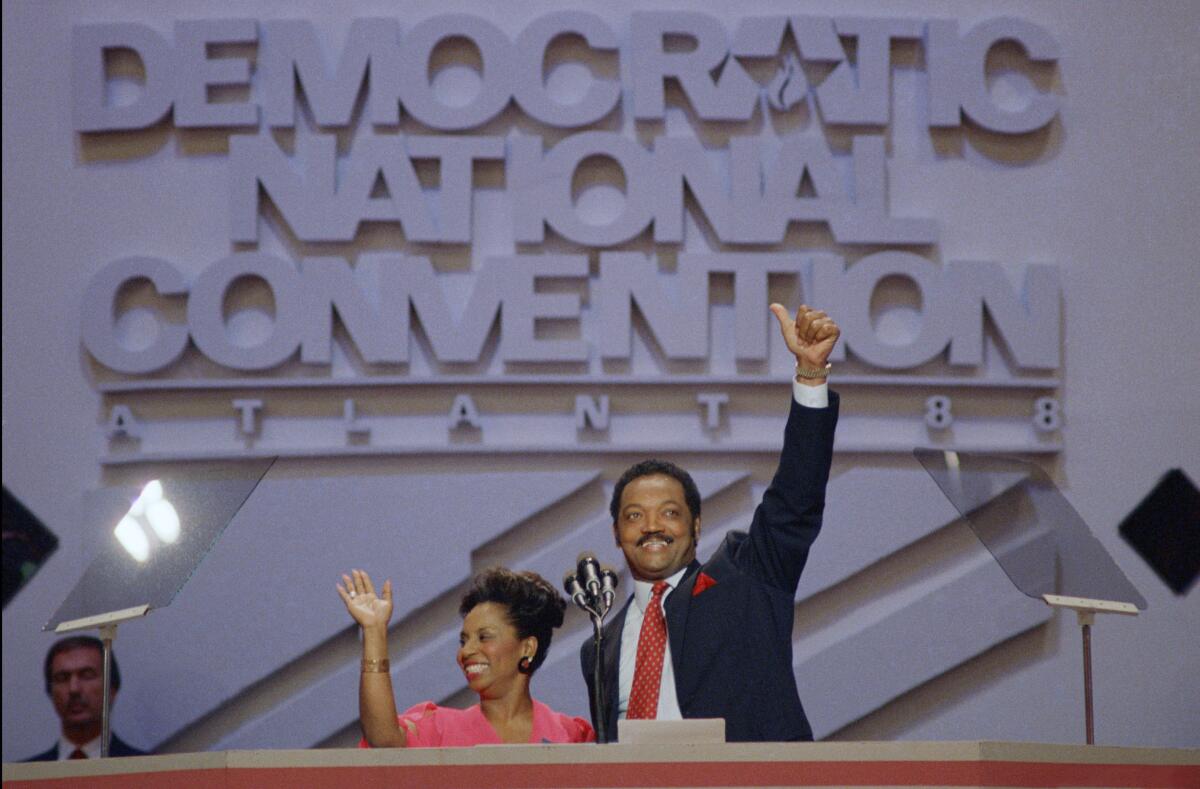
Four years later, using the slogan “Keep hope alive,” he ran again, winning 7 million votes, second only to the eventual nominee, Massachusetts Gov. Michael S. Dukakis. His hourlong speech at the 1988 Democratic National Convention brought many delegates to tears and provided the gathering’s emotional high point.
Rev. Jesse Jackson and his wife, Jacqueline, acknowledge the cheers of delegates and supporters before his emotional speech to the Democratic National Convention in Atlanta on July 20, 1988.
(John Duricka / Associated Press)
“Every one of these funny labels they put on you, those of you who are watching this broadcast tonight in the projects, on the corners — I understand,” he said. “Call you outcast, low down, you can’t make it, you’re nothing, you’re from nobody, subclass, underclass; when you see Jesse Jackson, when my name goes in nomination, your name goes in nomination.”
For nearly a generation, from the 1970s into the 1990s, that ability to absorb the insults and rejection suffered by Black Americans and transmute them into a defiant rhetoric of success made Jackson the most prominent Black figure in the country. Both beneficiary and victim of white America’s longstanding insistence on having one media-anointed leader serve as the spokesman for tens of millions of Black citizens, he drew adulation and jeers but consistently held the spotlight.
Supporters greeted his speeches with chants of “Run, Jesse, run.” Opponents tracked every misstep, from audits of his grants in the 1970s to his use of the anti-Jewish slur “Hymietown” to refer to New York City during the 1984 campaign, to the disclosure, in 2001, that he had fathered a daughter in an extramarital affair.
As he dominated center stage, the thundering chorus of his speeches — “I am … somebody” — inspired his followers even as it sometimes sounded like a painful plea.
Jackson’s thirst for attention began in childhood. Born out of wedlock on Oct. 8, 1941, he often stood at the gate of his father’s home in Greenville, S.C., watching with envy as his half-brothers played, before returning to the home he shared with his mother, Helen Burns, and grandmother, Mathilda.
During high school, his father, Noah Robinson, a former professional boxer, would sometimes go to the football field to watch Jesse play. If he played well, Noah would sometimes tell others, “That’s one of mine.” For the most part, however, until Jesse was famous, he shunned his son, who was later adopted by the man his mother married, Charles Jackson.
It was his grandmother, known as Tibby, who encouraged Jackson’s ambition. A domestic in stringently segregated Greenville, Tibby brought home books and magazines, such as National Geographic, that her white employers’ children had discarded.
“Couldn’t read a word herself but she’d bring them back for me, you know, these cultural things used by the wealthy and refined,” Jackson once said. “All she knew was, their sons read those books. So I ought to read them too. She never stopped dreaming for me.”
Her dreams propelled Jackson toward college — as did a need to avenge the childhood taunts that echoed in his head. An honors student, he turned down a contract to pitch for the Chicago White Sox to accept a football scholarship to the University of Illinois.
At Christmas break, he came home with a list of books. A librarian at the McBee Avenue Colored Branch referred him to the white library downtown and called ahead to clear the way. When he entered the main library, two police officers stood at the loan desk. A librarian told him it would take at least six days to get the books from the shelves. When he offered to get them himself, the officers told him to leave.
“I just stared up at that ‘Greenville Public Library’ and tears came to my eyes,” Jackson told a biographer, Marshall Frady.
That summer, 1960, Jackson came home and led a sit-in at the library, his arrest a first taste of civil disobedience. In the fall, he transferred to North Carolina A&T State University in Greensboro. There he became the star quarterback and participated in the beginnings of the sit-ins that became a signature part of the civil rights movement led by the Rev. Martin Luther King Jr.
“It wasn’t a matter of Gandhi or Dr. King then,” he said of the library sit-in, “it was just my own private pride and self-respect.”
With his height and his oratorical flourishes, Jackson was a charismatic figure who led protests in Greensboro. Once, during a demonstration outside a cafeteria, as police were about to arrest the demonstrators, Jackson suggested they kneel and recite the Lord’s Prayer.
“Police all took off their caps and bowed their heads,” he said. “Can’t arrest folks prayin’.”
Then he led the demonstrators in “The Star-Spangled Banner.”
“They stopped, put their hands over their heart,” Jackson said. “Can’t arrest folks singing the national anthem.”
After half an hour, he recalled, “we got tired and let ’em arrest us.”
Elected student body president, Jackson graduated in 1963. A grant from the Rockefeller Fund for Theological Education brought him to the Chicago Theological Seminary, where he hoped to find a venue for social activism.
That summer, Jackson traveled to Washington, where he heard King deliver his famous “I Have a Dream” speech. Two years later, he and a group of college buddies piled into vans to drive south for King’s Selma-to-Montgomery march. He met King there, and early the next year, King asked Jackson to head his Southern Christian Leadership Conference’s Operation Breadbasket in Chicago. The goal was to win economic gains for Black people with a combination of consumer boycotts and negotiated settlements.
At 24, Jackson was the youngest of King’s aides. Operating out of a hole-in-the-wall office at SCLC’s South Side headquarters, he began by organizing preachers, arranging for them to urge their congregations on Easter to boycott products made by a local dairy that employed no Black workers.
During the following week, Country Delight lost more than half a million dollars in revenue. Within days, the company offered a deal: 44 jobs for Black workers. Without waiting for a boycott, other dairy companies called with offers, too.
King soon asked Jackson to be the national director of Operation Breadbasket. Jackson hesitated — the job required him to leave the seminary six months short of graduation. Jackson recounted in his autobiography that King told him, “Come with me full time and you’ll learn more theology in six months than you would in six years at the seminary.” He earned his ordination several years later.
In 1968, Jesse Jackson stands to the left of the Rev. Martin Luther King Jr. on the balcony of the Lorraine Motel in Memphis, Tenn., where King was assassinated the next day.
(Charles Kelly / Associated Press )
In April 1968, Jackson joined King in Memphis, where the civil rights leader had decided to stand with striking Black sanitation workers. Few of King’s staff supported the effort, worrying that the strike — and the planned Poor People’s Campaign in Washington — distracted from the main goal of attaining voting and political rights for Black Americans.
During a planning meeting, King blew up at his aides, including Jackson. “If you’re so interested in doing your own thing, that you can’t do what this organization is structured to do, if you want to carve out your own niche in society, go ahead,” King yelled at Jackson, according to the latter’s account. “But for God’s sake, don’t bother me!”
The next day, standing below the balcony of the Lorraine Motel where the team was staying in Memphis, King yelled down at Jackson in joviality, as if to mitigate the outburst, inviting him to dinner.
Within moments, shots rang out. Jackson later said he ran upstairs and caught King’s head as he lay dying. Andrew Young, a King aide who later became U.S. ambassador to the United Nations, told Frady that he doubted Jackson had cradled King’s head, but that they all had rushed to the scene and all had gotten blood on their clothes.
But if all of them were touched by King’s blood, only Jackson wore his gore-stained olive turtleneck for days, sleeping and grieving in it, wearing it on NBC’s “Today Show” and before the Chicago City Council. In dramatizing the moment to his own benefit, Jackson provoked hostility from King’s widow and others in the movement’s leadership that lasted decades.
Richard Hatcher, the first Black mayor of Gary, Ind., and a Jackson supporter, recalled that once Jackson decided to run for president, the campaign thought it had the backing of the Black leadership.
“Big mistake. Big mistake,” Hatcher said. “Over the following months, every time things seemed to get going, here would come a statement from Atlanta, from Andy [Young] or Joe Lowery or Mrs. King, ‘We don’t think this is a good idea at all.’“
As Jackson’s media prominence grew — including a cover photo on Time magazine in 1970 — tensions erupted between Jackson and SCLC, in part because of the sloppy bookkeeping that became a Jackson characteristic. In late 1971, SCLC’s board suspended Jackson for “administrative impropriety” and “repeated violation of organization discipline.” Jackson resigned, saying, “I need air. I must have room to grow.”
Rev. Jesse Jackson raises a clenched fist from a police van after he and 11 others from Operation Breadbasket were arrested during a sit-in at the Atlantic and Pacific Tea Co., offices in New York City on Feb. 2, 1971. The organization, part of the Southern Christian Leadership Conference, has been protesting A&P’s alleged discrimination against blacks.
(MARTY LEDERHANDLER / Associated Press)
Calling a dozen Black celebrities to New York’s Commodore Hotel, Jackson formed his own organization. Originally called People United to Save Humanity — the presumptuous title was soon changed to People United to Serve Humanity — PUSH became his pulpit. Like Operation Breadbasket, its goal was to boost minority employment and ownership.
Jackson traveled the country preaching self-esteem and self-discipline. Thousands of youngsters took pledges to say no to drugs, turn off their television sets, study. They became the core of his voter registration drives, the inspiration for the “I am somebody” chant that would define his public ministry.
As with Operation Breadbasket, Jackson used PUSH to hold corporate America to account. In 1982, for example, he launched a boycott of Anheuser-Busch with the slogan “this Bud’s a dud.”
“We spend approximately $800 million with them [annually]. Yet, out of 950 wholesale distributorships, only one is Black-owned,” Jackson said.
Shortly thereafter, Anheuser-Busch contributed $10,000 to Jackson’s Citizenship Education Fund, contributed more than $500,000 to the Rainbow PUSH coalition, and established a $10-million fund to help minorities buy distributorships.
In 1998, 16 years later, the River North beer distributorship in Chicago was purchased by two of Jackson’s sons, Yusef and Jonathan. (Jackson’s eldest son, Jesse Jackson Jr., won election to Congress from Chicago in 1995, but resigned and was convicted of fraud in 2013 for misuse of campaign funds. Jackson and his wife, Jacqueline, also had two daughters, Jacqueline and Santita. A third daughter, Ashley Laverne Jackson, was the child of his relationship with a PUSH staff member, Karin Stanford.)
Critics called the PUSH campaigns elaborate shakedowns. Others, like Jeffrey Campbell, president of Burger King when Jackson opened negotiations in 1983, found the encounter with Jackson and his rhetoric of economic empowerment inspiring.
“Before they came in, my view was that we ought to fight them, that this guy Jackson was a monster, and I had the backing of my bosses to walk out if necessary,” Campbell told the Los Angeles Times in 1987. But Campbell said he quickly changed his mind.
“He got to me very quickly, without me realizing it, when he started talking about fairness. He would say: What is fair? Blacks give you 15% of your business — isn’t it fair that you give 15% of your business, your jobs, your purchases back to the Black community, the Black businesses?
“That little seed began to grow in the back of my mind,” Campbell said. “It was the right question to ask me.”
How Jackson handled money gave critics additional openings. Between 1972 and 1988, PUSH and its affiliates attracted more than $17 million in federal grants and private contributions. After many audits, the Justice Department sought $1.2 million in repayments, citing poor recordkeeping and a lack of documentation.
Jackson gave little thought to such issues. “I am a tree-shaker, not a jelly-maker,” he would often say.
Management held little interest for him. But politics was a different matter.
From the moment he began urging and registering Black Americans to vote, Jackson found his milieu. He used PUSH resources to staff get-out-the-vote drives that helped elect Hatcher in Gary, Kenneth Gibson in Newark, N.J., and Carl Stokes in Cleveland.
In those days, he also advocated participating in both parties, what he called “a balance of power.” In 1972, he claimed he had registered 40,000 Black voters to support Illinois’ white Republican senator, Charles Percy.
That same year, at the Democratic convention in Miami, Jackson unseated Chicago Mayor Richard Daley’s 58-member Illinois delegation and replaced it with a “rainbow” of his own, even though he had never voted in a Democratic primary. Liberal Democrats who despised Daley as a corrupt big-city boss hailed Jackson as a hero.
In the decade to come, Jackson basked in celebrity and international travel, including a controversial meeting with Yasser Arafat. Jackson met the then-leader of the Palestine Liberation Organization in 1979 when he traveled to Syria to free U.S. pilot Robert Goodman, who’d been shot down while on a bombing mission. By the time Jackson declared his 1984 presidential campaign, he had burnished his foreign policy credentials.
At the convention that year in San Francisco, he predicted that in an era of Reaganomics, a Rainbow Coalition of ethnic and religious identities could retake the White House.
“We must leave the racial battleground and come to economic common ground and moral higher ground,” he said in a memorable speech.
“America, our time has come. We come from disgrace to amazing grace. Our time has come,” he said. “Give me your tired, give me your poor, your huddled masses who yearn to breathe free and come November, there will be a change, because our time has come.” Delegates roared to their feet.
The Rev. Jesse Jackson, a candidate for the democratic nomination for President, works the crowd from onstage following a speech at the Cincinnati Convention center, Friday, April 13, 1984.
(Al Behrman / Associated Press)
But they did not nominate him. Nor did the convention of 1988. Addressing Black ministers in Los Angeles in 1995, the hurt still showed as Jackson railed at the injustice of beating Al Gore in the presidential primaries, only to watch as he was tapped by Bill Clinton to be his running mate in 1992.
“In 1988, I beat him in Iowa, a state 98% white; he said it was ’cause of liberals and farmers. So I beat him in New Hampshire; he said it was ’cause he was off campaigning in the South. So I beat him in the South on Super Tuesday; he said Dukakis had split his support. I beat him then in Illinois, in Michigan; he said he wasn’t really trying. I beat him then in New York; said he ran out of money. But now, here I am this afternoon, talking to y’all in this church in South Central L.A. — and he’s vice president of the United States.”
To many of his Democratic opponents, however, Jackson’s “rainbow coalition” symbolized not common ground, but the party’s devolution into a collection of identity caucuses whose narrow causes doomed them to defeat. In 1992, many of those critics gathered around Clinton as he formulated his “New Democrat” campaign. Clinton soon used Jackson as a foil.
The occasion came when Jackson invited rap singer and activist Sister Souljah to a political event featuring the Arkansas governor. In an interview, Souljah had wondered why after all the animus of white people toward Black people, it was unacceptable for Black people to kill whites. Clinton, instead of delivering the usual liberal-candidate-seeks-Black-votes hominy, lashed out at her words.
The moment bought Clinton a priceless image of willingness to speak truth to the party’s interest groups but came at the price of Jackson’s rage.
“I can maybe work with him, but I know now who he is, what he is. There’s nothin’ he won’t do,” Jackson said to Frady. “He’s immune to shame.”
By then, however, Jackson’s prominence had already begun to wane. Indeed, the role of race leader, itself, had started to disappear. The civil rights revolution in which Jackson had figured so prominently had allowed a new and more diverse generation of Black elected officials, corporate executives and public figures to flourish. Their success eroded his singular platform.
Democratic presidential hopeful Sen. Barack Obama, D-Ill., right, laughs after saying goodbye to Rev. Jesse Jackson, reflected left, after Obama addressed the Rainbow PUSH Coalition’s annual conference breakfast in Rosemont, Ill. on June 4, 2007
(harles Rex Arbogast / Associated Press)
Jackson continued to travel, agitate, protest, but the spotlight had moved on. He dreamed that Jesse Jr. might one day win the office he had pursued. When, instead, another Black Democrat from Chicago, Barack Obama, headed toward the Democratic nomination in 2008, Jackson’s frustration spilled into public with a vulgar criticism of Obama caught on microphone.
In Obama’s White House, he suffered what for him might have been the severest penalty — being ignored.
Yet to those who had seen him in his prime, his image remained indelible.
“When they write the history of this campaign,” then-New York Gov. Mario Cuomo said after the 1984 contest, “the longest chapter will be on Jackson. The man didn’t have two cents. He didn’t have one television or radio ad. And look what he did.”
Jackson is survived by his wife, Jacqueline, and six children, Jesse Jr., Yusef, Jonathan, Jacqueline, Santita and Ashley.
the Rev. Jesse Jackson speaks at the League of United Latin American Citizens convention Friday, June 30, 2006, in Milwaukee. (AP Photo/Morry Gash)
Warner Bros. Discovery is cracking open the door to allow spurned bidder, Paramount Skydance, to make its case — but Warner’s board still maintains its preference for Netflix’s competing proposal.
Warner’s move to reopen talks comes after weeks of pressure from Paramount, which submitted an enhanced offer to buy Warner last week. Paramount’s willingness to increase its offer late in the auction attracted the attention of some Warner investors.
On Tuesday, Warner Bros. Discovery responded with a letter to Paramount Chairman David Ellison and others on Paramount’s board, giving the group seven days to “clarify your proposal.”
“We seek your best and final proposal,” Warner board members wrote. Warner set a Feb. 23 deadline for Paramount to comply.
The closely watched sale of the century-old Warner Bros., known for “Batman,” “The Big Bang Theory,” “Casablanca,” and HBO, the home of “Game of Thrones” and “Succession,” is expected to reshape Hollywood.
The flurry of activity comes as Warner Bros. Discovery and Netflix are seeking to enter the home stretch of the auction. Warner separately issued its proxy and set a special March 20 meeting of its shareholders to decide the company’s fate.
Warner Bros. Discovery is recommending that its stockholders approve the $82.7-billion Netflix deal.
“We continue to believe the Netflix merger is in the best interests of WBD shareholders due to the tremendous value it provides, our clear path to achieve regulatory approval and the transaction’s protections for shareholders against downside risk,” Warner Chairman Samuel A. Di Piazza, Jr., said in a Tuesday statement.
Still, the maneuver essentially reopens the talks.
Warner Bros. is creating an opportunity for Paramount to sway Warner board members, which could perhaps prompt Netflix to raise its $27.75 a share offer for Warner’s Burbank-based studios, vast library of programming, HBO and streaming service HBO Max.
Netflix is not interested in buying Warner Bros. Discovery’s basic cable channels, including CNN, TBS, HGTV and Animal Planet, which are set to be spun off to a stand-alone company later this year.
In contrast, Paramount wants to buy the entire company and has offered more than $30 a share.
Last week, Paramount sweetened its bid for Warner, adding a $2.8-billion “break fee” that Warner would have to pay Netflix if the company pulled the plug on that deal. Paramount also said it would pay Warner investors a “ticking fee” of 25 cents a share for every quarter after Jan. 1 that the deal does not close.
“While we have tried to be as constructive as possible in formulating these solutions, several of these items would benefit from collaborative discussion to finalize,” Paramount said last week as it angled for a chance to make its case. “We will work with you to refine these solutions to ensure they address any and all of your concerns.”
Netflix agreed to give Warner Bros. Discovery a temporary waiver from its merger agreement to allow Warner Bros. Discovery to reengage with Paramount, which lost the bidding war on Dec. 4.
“We granted WBD a narrow seven-day waiver of certain obligations under our merger agreement to allow them to engage with PSKY to fully and finally resolve this matter,” Netflix said Tuesday in a statement. “This does not change the fact that we have the only signed, board-recommended agreement with WBD, and ours is the only certain path to delivering value to WBD’s stockholders.”
Netflix has matching rights for any improved Paramount offer. The company renewed its confidence in its deal and its prospect to win regulatory approval.
“PSKY has repeatedly mischaracterized the regulatory review process by suggesting its proposal will sail through, misleading WBD stockholders about the real risk of their regulatory challenges around the world,” Netflix said in its statement. “WBD stockholders should not be misled into thinking that PSKY has an easier or faster path to regulatory approval – it does not.”
Warner Bros. Discovery acknowledged that Paramount’s recent modification “addresses some of the concerns that WBD had identified several months ago,” according to the letter to Paramount.
But Warner Bros. Discovery added Paramount’s offer “still contains many of the unfavorable terms and conditions that were in the draft agreements … and twice unanimously rejected by our Board,” Warner Bros. Discovery said.
Warner’s board told Paramount it will “welcome the opportunity to engage” during the seven-day negotiation period.
Paramount has been pursuing the prized assets since last September.
“Every step of the way, we have provided PSKY with clear direction on the deficiencies in their offers and opportunities to address them,” Warner Chief Executive David Zaslav said in a statement. “We are engaging with PSKY now to determine whether they can deliver an actionable, binding proposal that provides superior value and certainty for WBD shareholders.”
PARIS (AP) — Gisèle Pelicot’s memoir was released Tuesday in 22 languages worldwide, sharing details of the horror she went through and sending a powerful message of hope and support to victims of sexual abuse.
“I wanted my story to help others,” Pelicot told French national channel France 5 last week ahead of the release of her book, “A Hymn to Life, Shame has to Change Sides.”
Pelicot recounted her story of survival in the book and in her first series of interviews since the landmark 2024 trial that turned her into a global icon against sexual violence and imprisoned her husband who knocked her out with drugs so other men could assault her inert body.
“Today I’m doing better, and this book allowed me to engage in self-reflection, to take stock of my life,” she said. “I had to try to rebuild myself on this field of ruins. Today I am a woman standing strong.”
Pelicot said her book is meant to deliver “a message of hope to all the women who are going through a very complicated period in their lives.”
The shocking case — and Pelicot’s decision to waive her anonymity and speak publicly — prompted a reckoning over rape culture in France and beyond, as her dignity and strength impressed many across the world.
Gymnastic superstar and Olympic gold medalist Simone Biles, herself a survivor of sexual abuse, paid tribute to Pelicot in a message broadcast by the BBC.
“Gisèle has demonstrated to the world that it’s not for victims of sexual abuse to feel shame — it’s the perpetrators,” Biles said. “By waiving her anonymity and refusing to feel shame, Gisèle paves the way for other victims to come forward.”
In December 2024, Pelicot’s ex-husband, Dominique Pelicot, and 50 other men were convicted of sexually assaulting her between 2011 and 2020 while she was under chemical submission. Dominique Pelicot was sentenced to 20 years in prison, while the other defendants received sentences ranging from three to 15 years. An appeals court later increased to 10 years the sentence of the only defendant who challenged his conviction.
Dominique Pelicot, whom Gisèle Pelicot had been married to for nearly 50 years, acknowledged that for years he mixed sedatives into her food and drink so he could rape her and invite other men to do the same.
The unprecedented trial exposed how online pornography, chat rooms and distorted notions of consent can fuel sexual violence.
In October, France passed a law defining rape and other sexual assault as any non-consensual sexual act in the wake of the Pelicot case, joining many other European nations that have similar consent-based laws, including neighboring Germany, Belgium and Spain. Until then, rape under French law was defined as penetration or oral sex using “violence, coercion, threat or surprise.”
CHICAGO (AP) — The Rev. Jesse L. Jackson, a protege of the Rev. Martin Luther King Jr. and two-time presidential candidate who led the Civil Rights Movement for decades after the revered leader’s assassination, has died. He was 84.
Jackson died Tuesday surrounded by family, according to a statement posted online from the family.
As a young organizer in Chicago, Jackson was called to meet with King at the Lorraine Motel in Memphis shortly before King was killed and he publicly positioned himself thereafter as King’s successor.
Jackson led a lifetime of crusades in the United States and abroad, advocating for the poor and underrepresented on issues from voting rights and job opportunities to education and health care. He scored diplomatic victories with world leaders, and through his Rainbow/PUSH Coalition, he channeled cries for Black pride and self-determination into corporate boardrooms, pressuring executives to make America a more open and equitable society.
And when he declared, “I am Somebody,” in a poem he often repeated, he sought to reach people of all colors. “I may be poor, but I am Somebody; I may be young; but I am Somebody; I may be on welfare, but I am Somebody,” Jackson intoned.
It was a message he took literally and personally, having risen from obscurity in the segregated South to become America’s best-known civil rights activist since King.
Despite profound health challenges in his final years including a rare brain disorder that affected his ability to move and speak, Jackson continued protesting against racial injustice into the era of Black Lives Matter. In 2024, he appeared at the Democratic National Convention in Chicago and at a City Council meeting to show support for a resolution backing a ceasefire in the Israel-Hamas war.
“Even if we win,” he told marchers in Minneapolis before the officer whose knee kept George Floyd from breathing was convicted of murder, “it’s relief, not victory. They’re still killing our people. Stop the violence, save the children. Keep hope alive.”
FILE – Democratic presidential hopeful Jesse Jackson with his wife, Jacqueline, salutes the cheering crowd at Operation Push in Chicago, March 10, 1988. (AP Photo/Fred Jewell, File)
FILE – Jesse Jackson speaks during a press conference regarding Little League International’s decision to strip Chicago’s Jackie Roberson West baseball team of it’s national championship, in Chicago, Feb. 12, 2015. (AP Photo/M. Spencer Green, File)
FILE – Jesse Jackson, of the Southern Christian Leadership Conference, speaks at a University of California rally on May 27, 1970, at The Greek Theater in Berkeley, Calif. (AP Photo/Sal Veder, File)
FILE – President George W. Bush speaks with Rev. Jesse Jackson, right, after signing a bill in the Eisenhower Executive Office Building, Dec. 1, 2005, authorizing a statue of civil rights leader Rosa Parks be placed in the U.S. Capitol’s Statuary Hall. (AP Photo/Ron Edmonds, File)
1 of 4
FILE – Democratic presidential hopeful Jesse Jackson with his wife, Jacqueline, salutes the cheering crowd at Operation Push in Chicago, March 10, 1988. (AP Photo/Fred Jewell, File)
Jackson’s voice, infused with the stirring cadences and powerful insistence of the Black church, demanded attention. On the campaign trail and elsewhere, he used rhyming and slogans such as: “Hope not dope” and “If my mind can conceive it and my heart can believe it then I can achieve it,″ to deliver his messages.
Jackson had his share of critics, both within and outside of the Black community. Some considered him a grandstander, too eager to seek out the spotlight. Looking back on his life and legacy, Jackson told The Associated Press in 2011 that he felt blessed to be able to continue the service of other leaders before him and to lay a foundation for those to come.
“A part of our life’s work was to tear down walls and build bridges, and in a half century of work, we’ve basically torn down walls,” Jackson said. “Sometimes when you tear down walls, you’re scarred by falling debris, but your mission is to open up holes so others behind you can run through.”
In his final months, as he received 24-hour care, he lost his ability to speak, communicating with family and visitors by holding their hands and squeezing.
“I get very emotional knowing that these speeches belong to the ages now,” his son, Jesse Jackson Jr., told the AP in October.
A student athlete drawn to the Civil Rights Movement
Jesse Louis Jackson was born on Oct. 8, 1941, in Greenville, South Carolina, the son of high school student Helen Burns and Noah Louis Robinson, a married man who lived next door. Jackson was later adopted by Charles Henry Jackson, who married his mother.
Jackson was a star quarterback on the football team at Sterling High School in Greenville, and accepted a football scholarship from the University of Illinois. But after he reportedly was told Black people couldn’t play quarterback, he transferred to North Carolina A&T in Greensboro, where he became the first-string quarterback, an honor student in sociology and economics, and student body president.
Arriving on the historically Black campus in 1960 just months after students there launched sit-ins at a whites-only diner, Jackson immersed himself in the blossoming Civil Rights Movement.
By 1965, he joined the voting rights march King led from Selma to Montgomery, Alabama. King dispatched him to Chicago to launch Operation Breadbasket, a Southern Christian Leadership Conference effort to pressure companies to hire Black workers.
Jackson called his time with King “a phenomenal four years of work.”
Jackson was with King on April 4, 1968, when the civil rights leader was slain at the Lorraine Motel in Memphis, Tennessee. Jackson’s account of the assassination was that King died in his arms.
With his flair for the dramatic, Jackson wore a turtleneck he said was soaked with King’s blood for two days, including at a King memorial service held by the Chicago City Council, where he said: “I come here with a heavy heart because on my chest is the stain of blood from Dr. King’s head.”
However, several King aides, including speechwriter Alfred Duckett, questioned whether Jackson could have gotten King’s blood on his clothing. There are no images of Jackson in pictures taken shortly after the assassination.
In 1971, Jackson broke with the Southern Christian Leadership Conference to form Operation PUSH, originally named People United to Save Humanity. The organization based on Chicago’s South Side declared a sweeping mission, from diversifying workforces to registering voters in communities of color nationwide. Using lawsuits and threats of boycotts, Jackson pressured top corporations to spend millions and publicly commit to diversifying their workforces.
The constant campaigns often left his wife, Jacqueline Lavinia Brown, the college sweetheart he married in 1963, taking the lead in raising their five children: Santita Jackson, Yusef DuBois Jackson, Jacqueline Lavinia Jackson Jr., and two future members of Congress, U.S. Rep. Jonathan Luther Jackson and Jesse L. Jackson Jr., who resigned in 2012 but is seeking reelection in the 2026 midterms.
The elder Jackson, who was ordained as a Baptist minister in 1968 and earned his Master of Divinity in 2000, also acknowledged fathering a child, Ashley Jackson, with one of his employees at Rainbow/PUSH, Karen L. Stanford. He said he understood what it means to be born out of wedlock and supported her emotionally and financially.
This is a breaking news report. More information will be added as it comes in.
Former Associated Press writer Karen Hawkins, who left The Associated Press in 2012, contributed to this report.
The closure at 552 N. Orange St. is expected by March 19 and will affect 70 employees, who were alerted in mid-January, according to a letter from Albertsons Cos., owner of Vons, to the state’s Employment Development Department.
The company said it is making every effort to transfer those employees to other stores in the area.
Vons has a long history in the region, founded by Charles Von der Ahe as a “groceteria” in Los Angeles in 1906. His “cash and carry” concept (instead of the usual delivery service, was so popular the chain would grow to 87 stores in just 22 years. His sons took over in 1932, and by 1948 had launched a new style of shopping in a supermarket format of prepackaged perishable food, a deli and various other aisles and departments of food and household products.
Vons was acquired by Albertsons in 2015 for $9.2 billion.
Free tax prep help for SB County residents
Community Action Partnership in San Bernardino is offering free tax preparation for eligible residents.
The VITA Program (Volunteer Income Tax Assistance) provides help to lower-income tax filers, helping them claim important tax credits and benefits in their annual federal and state returns.
Household income must be below $67,000 to qualify. Retirees over the age of 60 and people with disabilities also are eligible.
The VITA site is open 8 a.m. to 5 p.m. Monday through Friday at 696 S. Teppecanoe Ave. To schedule an appointment, go to oncehub.com/CAPSBC-VITA.
For questions contact Paolo Bilbao at 909-7823-1566 or email pbilbao@capsbc.org
CAPSBC is a nonprofit that provides programs and services for low-income individuals and families with the goal of lifting them out of poverty.
James Hardie fiber cement sheeting in a warehouse in Melbourne. (Carla Gottgens/Bloomberg)
Concrete board maker closing plant in Fontana
James Hardie Manufacturing in Fontana is closing in March, laying off 94 employees in the process.
In a company press release, James Hardie said the move was part of a plan to optimize its manufacturing footprint in order to save money.
A large part of the facility at 10901 Elm Ave. is expected to close March 16, according to a letter sent in January to the state’s Employment Development Department. James Hardie is also closing a plant in South Carolina, but keeping its research and development teams in Fontana.
“The decision to close our plants in Fontana and Summerville, South Carolina, was not taken lightly,” said Aaron Erter, the company’s chief executive officer. “I want to thank the teams at these sites for their years of dedication and hard work. We are grateful for their many contributions, which have been significant in shaping James Hardie.”
The list of affected employees at the fiber cement maker includes many engineers, electricians, mechanics, office staff and plant operators. James Hardie, an American-Irish company based in Dublin, makes cement siding used in homebuilding.
The closures will help the company save roughly $25 million annually beginning in the first quarter of fiscal year 2027, the statement reads.
RSVC laying off 127 people in April
The construction company RSVC Company is closing in Riverside in early April, affecting 127 people who will lose their jobs.
RSVC operates two facilities, one on Myers Street and the other on Chicago Avenue.
In a letter dated Feb. 4 to the state’s Employment Development Department, the company’s Chief Financial Officer Keith Gruber said the entire facility at 3051 Myers St. in Riverside would close by April 6. The letter did not mention the fate of the company’s offices at 1825 Chicago Ave.
Affected employees at the company’s two facilities include concrete technicians, demo specialists, technicians, warehouse managers, a warehouse driver, service account managers, foremen and supervisors.
The logistics company Legacy Supply Chain is laying off 129 workers in Southern California after losing a service contract with Walters Wholesale Electric. The company has facilities in Brea, Fontana, Indio, San Diego and Canoga Park. (Photo courtesy of Google street view in Brea)
Legacy to lay off staff in April
The logistics company Legacy Supply Chain is laying off 129 workers in Southern California after losing a service contract with Walters Wholesale Electric.
Legacy outlined the layoffs, or employee “separations,” in a letter to the state’s Employment Development Department, dated Jan. 31.
The company operates in Fontana, Brea, Indio, San Diego and Canoga Park.
The letter, written by James Darwin, Legacy’s director of Human Resources, said “the entirety of Legacy’s operations at these locations will cease” on April 1.
Nisha Morris was promoted at City of Hope to senior vice president and chief marketing and communications officer. She previously was the cancer hospital’s chief communications officer. (Photo courtesy of City of Hope)
1 of 1
Nisha Morris was promoted at City of Hope to senior vice president and chief marketing and communications officer. She previously was the cancer hospital’s chief communications officer. (Photo courtesy of City of Hope)
Longtime Ontario resident Nisha Morris recently joined City of Hope as its senior vice president and chief marketing and communications officer. At CoH, she leads enterprise and regional strategy for brand, marketing and external communications. Morris previously was the cancer hospital’s chief communications officer where she helped advance its national profile. She also was vice president of Marketing and Communications for CofHo Orange County from 2018 to 2023.
San Bernardino County Supervisor Curt Hagman was elected Feb. 9 as chairman of the Inland Empire Health Plan, which serving more than 1.6 million members in Riverside and San Bernardino Counties. Hagman has served on the IEHP board since January 2015, and was chairman from 2018-2020 and again in 2024. He’s been the Fourth District’s supervisor since 2014, representing Chino, Chino Hills, Montclair, Ontario, and Upland — below 14th St.
The business briefs are compiled and edited by Business Editor Samantha Gowen. Submit items to sgowen@scng.com. High-resolution images can also be submitted. Allow at least one week for publication. Items are edited for length and clarity.
A new artificial intelligence video generator from Beijing-based ByteDance, the creator of TikTok, is drawing the ire of Hollywood organizations
A new artificial intelligence video generator from Beijing-based ByteDance, the creator of TikTok, is drawing the ire of Hollywood organizations that say Seedance 2.0 “blatantly” violates copyright and uses the likeness of actors and others without permission.
Seedance 2.0, which is only available in China for now, lets users generate high-quality AI videos using simple text prompts. The tool quickly gained condemnation from the movie and TV industry.
The Motion Picture Association said Seedance 2.0 “has engaged in unauthorized use of U.S. copyrighted works on a massive scale.”
“By launching a service that operates without meaningful safeguards against infringement, ByteDance is disregarding well-established copyright law that protects the rights of creators and underpins millions of American jobs. ByteDance should immediately cease its infringing activity,” Charles Rivkin, chairman and CEO of the MPA, said in a statement Tuesday.
Screenwriter Rhett Rheese, who wrote the “Deadpool” movies, said on X last week that “I hate to say it. It’s likely over for us.” His post was in response to Irish director Ruairí Robinson’s post of a Seedance 2.0 video that shows AI versions Tom Cruise and Brad Pitt fighting in a post-apocalyptic wasteland.
Actors union SAG-AFTRA said Friday it “stands with the studios in condemning the blatant infringement” enabled by Seedance 2.0.
“The infringement includes the unauthorized use of our members’ voices and likenesses. This is unacceptable and undercuts the ability of human talent to earn a livelihood,” SAG-AFTRA said in a statement. “Seedance 2.0 disregards law, ethics, industry standards and basic principles of consent. Responsible AI development demands responsibility, and that is nonexistent here.”
ByteDance said in a statement Sunday that it respects intellectual property rights.
“(We) have heard the concerns regarding Seedance 2.0. We are taking steps to strengthen current safeguards as we work to prevent the unauthorized use of intellectual property and likeness by users,” the company said.
TOKYO — Japan’s benchmark Nikkei 225 index fell Tuesday following a U.S. national holiday, while most markets in Asia were closed for Lunar New Year holidays.
U.S. futures declined and oil prices were mixed. Prices for gold and silver also fell.
Weak economic data released Monday appeared to be clouding sentiment in Tokyo, and a 5.4% decline for tech giant SoftBank Group also pulled shares lower. The decline follows a big rally after a resounding win for Prime Minister Sanae Takaichi’s ruling party in a Feb. 8 general election.
The Nikkei 225 was down 0.8% in afternoon trading at 56,363.39.
Traders likely were locking in profits from the recent gains that took the Nikkei to record levels. Polls show Takaichi’s popularity is slowly slipping, as hopes for economic revival from her plans to increase government spending and cut taxes subside.
In Australia, the S&P/ASX 200 gained 0.2% to 8,958.90, while India’s Sensex edged 0.4% higher. In Thailand, the SET was up 0.5%.
European shares ended mixed on Monday and trading in the U.S. was closed for Presidents Day. U.S. markets are set to reopen Tuesday.
On Friday, the S&P 500 edged up less than 0.1% a day after one of its worst losses since Thanksgiving. The Dow Jones Industrial Average rose 0.1%, and the Nasdaq composite slipped 0.2%.
Share prices have been waxing and waning with fluctuations in confidence over massive investments in AI. Investors are also focused on inflation and how price pressures might affect interest rates. Also in the spotlight for later in the day are jobs data from Britain.
In other dealings early Tuesday, benchmark U.S. crude rose 48 cents to $63.37 a barrel. Brent crude, the international standard, lost 42 cents to $68.23 a barrel.
The U.S. dollar slipped to 152.88 Japanese yen from 153.51 yen. The euro cost $1.1844, down from $1.1852.
The price of gold fell 2.9% and silver was down 8.2%.
NEW ORLEANS, La. — As people head back to work Tuesday after the long holiday weekend, beads will be flying, crawfish boiling and parades rolling in New Orleans as the city celebrates Mardi Gras.
Mardi Gras, also known as Fat Tuesday, marks the climax and end of the weekslong Carnival season and a final chance for indulgence, feasting and revelry before the Christian Lent period of sacrifice and reflection. The joyous goodbye to Carnival always falls the day before Ash Wednesday.
Among the final parades in Louisiana’s most populous city, which is world-famous for its Mardi Gras bash, is one hosted by the Zulu Social Aide & Pleasure Club.
Marchers and float riders in the Zulu parade wear African-inspired garb and toss “throws” — trinkets that include plastic beads, candy, doubloons, stuffed animals, cups and toys. This parade’s signature “throw” is hand-decorated coconuts, coveted items that many revelers hope for.
Later in the day Rex, the King of Carnival parade will roll along St. Charles Avenue, lined by paradegoers and stately oak trees covered in Spanish moss and beads.
Carnival events are popular for their spectacular and enormous floats, and also the intricately crafted outfits worn, such as Black masking Indians, whose beaded and bejeweled costumes are topped with feathered headdresses, or paradegoers walking the French Quarter in homemade costumes that capture the unique spirit of the Big Easy.
The good times will roll not just in New Orleans but all across the state, from exclusive balls to the Cajun French tradition of the Courir de Mardi Gras, or Fat Tuesday Run — a rural event in Central Louisiana featuring costumed participants performing, begging for ingredients and chasing after live chickens to be cooked in a communal gumbo.
Parades are also held in other Gulf Coast cities such as Mobile, Alabama, and Pensacola, Florida, and there are other world-renowned celebrations in Brazil and Europe.
BEIJING — British and Canadian citizens can enter China without a visa starting Tuesday, bringing to 79 the number of countries granted visa-free access in a bid to boost tourism and business.
China has expanded eligibility for the program significantly in the last two years. Visitors can stay for up to 30 days for business, tourism, exchange programs and to visit family and friends.
Most Europeans qualify for visa-free entry, along with some from select countries in other regions including Latin America, Southeast Asia and the Middle East.
Citizens of a few other countries, including the United States and Indonesia, can enter for 10 days if they are in transit — meaning they have a ticket departing for a different country than they arrived from.
Business executives and tourists have welcomed the change, as the China visa application process can be a relatively cumbersome one.
The U.K. and Canada are being added following visits to China last month by their prime ministers, Keir Starmer and Mark Carney. Both are relatively new leaders who are trying to revamp ties with Beijing after a downturn in recent years.
For most countries, the visa-free access expires at the end of this year, but it has been extended in the past.
ALBUQUERQUE, N.M. — The federal agency that provides health care to Native Americans and Alaska Natives has announced it will phase out the use of dental fillings containing mercury.
The Indian Health Service has used fillings, known as dental amalgams, that contain elemental mercury to treat decayed and otherwise damaged teeth for decades. Native American rights and industry advocates have called for an end to the practice, arguing it exposes patients who may not have access to private dentistry to a harmful neurotoxin.
The use of mercury-containing amalgams, also known as “silver fillings” due to their appearance, has declined sharply since 2009 when the U.S. Food and Drug Administration reclassified the devices from low to moderate risk. The industry has largely abandoned them in favor of plastic resin alternatives, which are also preferred for aesthetic reasons.
The Indian Health Service says it will fully implement the move to mercury-free alternatives by 2027. Already, the percentage of the Indian Health Service’s roughly 2.8 million patient user population receiving them has declined from 12% in 2005 to 2% in 2023, the latest year of available data, agency documents show.
The U.S. Department of Health and Human Services, which oversees IHS, said growing environmental and health concerns about mercury exposure, and global efforts to reduce materials containing the hazardous heavy metal prompted the change announced this month.
“This is a commonsense step that protects patients and prevents harm before it starts,” Health Secretary Robert F. Kennedy Jr., said in a statement.
The agency’s switch to mercury-free alternatives also upholds legal responsibilities the U.S. government has to the 575 federally recognized tribes, he said.
According to the U.S. Food and Drug Administration, dental amalgam fillings can release small amounts of mercury vapor during placement, removal, teeth grinding and gum chewing. It recommends that certain people at high risk for adverse effects of mercury exposure, including pregnant women, children under 6, and those with existing neurological conditions avoid the fillings. But the administration, along with the American Dental Association, says available evidence does not link mercury-containing fillings to long-term negative health outcomes.
The World Health Organization has created a plan to encourage countries around the world to phase out the use of dental amalgams, citing potential for mercury exposure. In 2013 several countries, including the U.S., signed onto the Minamata Convention, a global agreement targeting the adverse health and the environment effects of mercury. In November, signatories to the convention agreed to phase out the use of mercury-containing dental amalgams by the year 2034.
While Kennedy’s decision to stop its use within the IHS by 2027 puts the U.S. ahead of the global schedule, the country is still behind many other developed nations that have already banned the practice.
“The rest of the world is light years ahead of us,” said Rochelle Diver, the U.N. environmental treaties coordinator for the International Indian Treaty Council, adding that IHS patients should not receive treatment that is considered antiquated by many dentists.
In a statement, the American Dental Association acknowledged declining use of mercury-containing fillings, but said they remain a “safe, durable and affordable material.”
The use of mercury in other medical devices, including thermometers and blood pressure devices, has also declined sharply in recent decades. While mercury-containing amalgams have fallen out of favor in the U.S. private dental sector, patients relying on government services may not have a say, according to Charles G. Brown, president of the World Alliance for Mercury-Free Dentistry.
Many state-administered Medicaid programs continue to cover mercury-containing fillings as a treatment for tooth decay, Brown said.
“If you’re on Medicaid, if you are stuck in the Indian Health Service, if you were stuck in a prison or other institution, you just don’t have any choice,” Brown said.