Home Blog Page 10

Secured Signing Reaches Major Milestone for New Year: Now SOC 2 Type 2 Compliant

0
Secured Signing Reaches Major Milestone for New Year: Now SOC 2 Type 2 Compliant

[ad_1]

MOUNTAIN VIEW, Calif. /California Newswire – NEWS/ — Secured Signing, a leader in Digital Signatures and Remote Online Notarization (RON) solutions, is proud to announce that it has officially achieved SOC 2® Type 2 compliance. This isn’t just another certificate on the wall. Following a grueling, comprehensive audit by the experts at Sensiba LLP, this achievement serves as a formal, third-party validation of our unwavering commitment to protecting your most sensitive information.

At Secured Signing, security is viewed not merely as a feature, but as the foundation of the entire platform. While many organizations seek Type 1 compliance, a “snapshot” of controls at a single point in time, the Type 2 audit is a more demanding, long-term evaluation. It confirms that Secured Signing’s security systems are not only well-designed but have operated effectively over an extended period.

Secured Signing Reaches a Major MilestoneSecured Signing Reaches a Major Milestone

“Attaining SOC 2 Type 2 compliance is our way of honoring the trust our customers place in us,” says Mike Eyal, CEO of Secured Signing. “It proves that we don’t just ‘talk the talk’ we live these security standards every single day to ensure the integrity of every document processed through our platform.”

WHAT THIS MEANS FOR OUR CUSTOMERS

At Secured Signing, we recognize that our customers entrust us with their most sensitive legal and professional assets. Achieving SOC 2® Type 2 compliance is a testament to that trust, providing independent assurance that every document, signature, and data point is handled with the highest level of integrity.

HERE IS HOW OUR “SECURITY-FIRST” PHILOSOPHY PROTECTS YOUR BOTTOM LINE:

* Trust That Scales: By choosing Secured Signing for your Digital Signature and Remote Online Notarization (RON) needs, you’re not just buying a tool; you’re gaining a partner. We provide independent assurance required by legal, financial, and government institutions to move fast without compromising safety.

* The Ultimate Defense for RON: Remote Online Notarizations involve “life event” data-the most sensitive information a person can share. Our SOC 2® Type 2 status provides a battle-tested layer of protection for video recordings, biometric ID verification, and confidential records.

* Long-Term Data Confidentiality: In an era of evolving cyber threats, our compliance proves that your data is shielded by effective, long-term security measures. We ensure your confidential business assets remain private, yesterday, today, and tomorrow.

* Hardened Audit Trails: Every signature comes with a story. We protect the metadata and digital audit trails that make your signatures legally binding, ensuring they are admissible and tamper-proof in any jurisdiction.

THE BEGINNING OF A NEW STANDARD

While we are incredibly proud of this achievement, we aren’t slowing down. The digital landscape is always changing, and we are committed to staying three steps ahead. We will continue to invest in the latest deepfake-resistant technology and identity verification to ensure we remain the most trusted name in digital transactions.

We want to thank the team at Sensiba LLP for their partnership and, most importantly, you, our customers, for trusting us to protect your most important assets.

ABOUT SECURED SIGNING

Secured Signing delivers a comprehensive and secure SaaS platform that unifies eSignatures, digital signatures, Remote Online Notarization (RON), IPEN, and advanced video-based signing solutions. With built-in real-time identity verification and deepfake resistant technology, the platform ensures that every signer is authenticated with confidence. Designed for organizations with strict security and legal compliance requirements, Secured Signing empowers businesses worldwide to sign, verify, and notarize documents through one trusted, all-in-one digital signing experience.-based signing solutions.

With built-in real-time identity verification and deepfake-resistant technology, the platform ensures every signer is authenticated with confidence. Designed for organizations with strict security and legal-compliance requirements, Secured Signing empowers businesses worldwide to sign, verify, and notarize documents through one trusted, all-in-one digital signing experience. https://www.securedsigning.com/

[ad_2]

Source link

Troy girls basketball falls to Valencia in the Division 1 quarterfinals – Orange County Register

0
Troy girls basketball falls to Valencia in the Division 1 quarterfinals – Orange County Register

[ad_1]

FULLERTON — In his first year back at the school where he guided the girls basketball team to five CIF Southern Section titles and three state championships, Troy coach Kevin Kiernan turned the Warriors back in the direction they hadn’t gone in several years.

Troy won more games this year than it had in the previous two seasons combined.

But the Warriors fell short in their CIF-SS Division 1 quarterfinal Wednesday night, losing to Valencia of Valencia, 52-48, at Troy High School.

Troy, ranked No. 8 in Orange County, led 47-45 with under 35 seconds remaining in the game. That’s when Valencia’s Keira McLaughlin knocked down a 3-pointer from the top of the key to put the Vikings (27-4) ahead by a point.

The Warriors (22-9) had possession of the ball and trailed by three with 16.2 seconds remaining. They turned the ball over and the Vikings put the game away with a pair of free throws with 4.2 seconds left.

Warriors starter Lexi Joko was injured early in the third quarter and never came back into the game. Rilynn Robinson, Aoki Perry and Princeton signee Mei-ling Perry were in foul trouble for much of the second half and had to be taken out for periods of time.

Mei-ling Perry scored 21 points before fouling out late in the fourth. Robinson also fouled out late in the fourth.

“It was a really physical game,” Kiernan said. “We knew they were going to be really physical and we wanted to match that physicality. We got in foul trouble and that really hurt us, you know, because we had to get both Perrys out of there for a while and had players foul out. And then Lexi got hurt, and not having your point guard at the end of the game hurt us.”

The Vikings led by six points late in the second quarter, the largest lead by either team.

Joko scored to get the Warriors within a basket. Aarna Nagakar made a steal and passed to Joke, who hit a three-pointer to get Troy within a point at the half.

The Warriors also had a tough time containing Kamilla Basyrova, who led the Vikings with 19 points.

Valencia also exploited its height advantage under the basket.

“Rebounding has been a big deal for us all season,” Valencia coach Jared Honig said. “We always talk about rebound margin as being one of our main stats that we look for, so just trying to dominate the boards on both sides.”

Kiernan said he plans to return next season and several seasons after that.

“I don’t think they really believed we could be in this position, in this game, in front of this crowd, with as many people caring,” Kiernan said. “I don’t think they believed that as little as four weeks ago. They’re young but I think they saw how exciting this is, win or lose.”

During Kiernan’s first 11 years Troy, before he went to Mater Dei, the Warriors were undefeated in the Freeway League every year.

Kiernan extended that streak to 12 undefeated seasons in league games in his first year back as the Warriors went 8-0 in the Freeway League.

[ad_2]

Source link

Jurupa Valley woman gets more than 12 years in prison for role in 1-year-old son’s fentanyl death – Press Enterprise

0
Jurupa Valley woman gets more than 12 years in prison for role in 1-year-old son’s fentanyl death – Press Enterprise

[ad_1]

RIVERSIDE — A Jurupa Valley woman partly responsible for her 1-year-old son’s ingestion of a deadly dose of fentanyl was bound for state prison Wednesday to serve a sentence of 12 years, four months behind bars after pleading guilty to voluntary manslaughter and another felony.

Sandy Alyssa Acuna, 25, admitted the manslaughter count, along with child cruelty, under a plea agreement Tuesday with the Riverside County District Attorney’s Office. In exchange for her admissions, prosecutors dropped second-degree murder and other charges against Acuna.

During a hearing at the Riverside Hall of Justice, Superior Court Judge Joshlyn Pulliam certified the terms of the plea deal and imposed the sentence stipulated by the prosecution and defense.

Acuna’s co-defendant and former live-in boyfriend, 26-year-old Adler Alan Metcalf of Jurupa Valley, is charged with second-degree murder and three counts of child cruelty. Metcalf’s case was pending trial Wednesday at the downtown courthouse, though no courtroom had been assigned yet for pretrial motions. He’s being held in lieu of $500,000 bail at the Robert Presley Jail.

The defendants were the parents of Adler Acuna Jr., who died in 2020.

According to a sheriff’s department arrest warrant declaration, in the early morning hours of Sept. 1, 2020, Acuna called 911 after discovering the toddler unconscious and barely breathing in their mobile home in the 5400 block of 34th Street.

Paramedics attempted resuscitative measures, and the child was taken to a Riverside hospital, where he was pronounced dead on arrival.

Acuna told first responders she believed Adler Jr. had somehow climbed out of his crib and gotten hold of “three Oxycontin” pills that she claimed had been prescribed to her, according to the affidavit. The case was immediately turned over to detectives for potential child abuse, and further investigation revealed Acuna had no prescription for the painkillers.

Investigators also turned their attention to the couple’s 4-month-old daughter, whose blood was tested for the presence of drugs, which confirmed the infant had marijuana in her system, according to court papers.

An autopsy ultimately verified that Adler Jr. had died from “acute fentanyl toxicity,” the declaration stated.

Detectives seized Acuna’s mobile phone after a search warrant was served at the defendants’ residence in early October 2020. The device revealed pictures of blue “M-30” pills, which are known to contain fentanyl, according to the affidavit.

“Sandy said she does not use the drug,” the document said. “She said she allows a number of people to use her phone. Adler Sr. said he vapes marijuana, using a wax pen.”

Investigators later uncovered the parents were intentionally “giving fentanyl and marijuana to Adler Jr.” and the 4-month-old for reasons unclear, the affidavit alleged.

The pair were arrested without incident during the second week of November 2020. Neither defendant had documented prior felony convictions.

[ad_2]

Source link

Rep. Kevin Kiley measure would block key element of proposed California wealth tax

0
Rep. Kevin Kiley measure would block key element of proposed California wealth tax

[ad_1]

As progressives seek to place a new tax on billionaires on California’s November ballot, a Republican congressman is moving in the opposite direction — proposing federal legislation that would block states from taxing the assets of former residents.

Rep. Kevin Kiley (R-Rocklin), who faces a tough re-election challenge under California’s redrawn congressional maps, says he will introduce the “Keep Jobs in California Act of 2026” on Friday. The measure would prohibit any state from levying taxes retroactively on individuals who no longer live there.

The proposed legislation adds another layer to what has already been a fiery debate over California’s approach to taxing the ultra-wealthy. It has created divisions among Democrats and has placed Los Angeles at the center of a broader political fight, with Bernie Sanders set to hold a rally on Wednesday night in support of the wealth tax.

Kiley said he drafted the bill in reaction to reports that several of California’s most prominent billionaires — including Meta Chief Executive Mark Zuckerberg and Google co-founders Larry Page and Sergey Brin — are planning to leave the state in anticipation of the wealth tax being enacted.

“California’s proposed wealth tax is an unprecedented attempt to chase down people who have already left as a result of the state’s poor policies,” Kiley said in a statement Wednesday. “Many of our state’s leading job creators are leaving preemptively.”

Kiley said it would be “fundamentally unfair” to retroactively impose taxes on former residents.

“California already has the highest income tax of any state in the country, the highest gas tax, the highest overall tax burden,” Kiley said in a House floor speech earlier this month. “But a wealth tax is something unique because a wealth tax is not merely the taxation of earned income, it is the confiscation of assets.”

The fate of Kiley’s proposal is just as uncertain as his future in Congress. His 5th Congressional District, which hugs the Nevada border, has been sliced up into six districts under California’s voter-approved Proposition 50, and he has not yet picked one to run in for re-election.

The Billionaire Tax Act, which backers are pushing to get on the November ballot, would charge California’s 200-plus billionaires a onetime 5% tax on their net worth in order to backfill billions of dollars in Republican-led cuts to federal healthcare funding for middle-class and low-income residents. It is being proposed by the Service Employees International Union-United Healthcare Workers West.

In his floor speech, Kiley worried that the tax, if approved, could cause the state’s economy to collapse.

“What’s especially threatening about this is that our state’s tax structure is essentially a house of cards,” Kiley said. “You have a system that is incredibly volatile, where top 1% of earners account for 50% of the tax revenue.”

But supporters of the wealth tax argue the measure is one of the few ways that can help the state seek new revenue as it faces economic uncertainty.

Sanders, an independent from Vermont who caucuses with the Democrats, is urging Californians to back the measure, which he says would “provide the necessary funding to prevent more than 3 million working-class Californians from losing the healthcare they currently have — and would help prevent the closures of California hospitals and emergency rooms.”

“It should be common sense that the billionaires pay just slightly more so that entire communities can preserve access to life-saving medical care,” Sanders said in a statement earlier this month. “Our country needs access to hospitals and emergency rooms, not more tax breaks for billionaires.”

Other Democrats are not so sure.

Gov. Gavin Newsom, who is eyeing a presidential bid in 2028, has opposed the measure. He has warned a state-by-state approach to taxing the wealthy could stifle innovation and entrepreneurship.

Some of he wealthiest people in the world are also taking steps to defeat the measure.

Brin is donating $20 million to a California political drive to prevent the wealth tax from becoming law, according to a disclosure reviewed by the New York Times. Peter Thiel, the co-founder of PayPal and the chairman of Palantir, has also donated millions to a committee working to defeat the proposed measure, the New York Times reported.

[ad_2]

Source link

L.A. County prosecutors probing whether Edison should be criminally prosecuted for Eaton fire

0
L.A. County prosecutors probing whether Edison should be criminally prosecuted for Eaton fire

[ad_1]

The Los Angeles County district attorney is investigating whether Southern California Edison should be criminally prosecuted for its actions in last year’s devastating Eaton wildfire, which killed 19 people and left thousands of families homeless, the company said Wednesday.

Pedro Pizarro, chief executive of Edison International, told Wall Street analysts during an afternoon conference call that the company was cooperating with the district attorney’s office. He said he didn’t know the magnitude of the investigation.

The company said in its annual 10-K report, which was released Wednesday, that it “could be subject to material fines, penalties, or restitution” if the investigation “determined that it failed to comply with applicable laws and regulations.”

“SCE is not aware of any basis for felony liability with regards to the Eaton Fire,” the report said. “Any fines and penalties incurred in connection with the Eaton Fire will not be recoverable from insurance, from the Wildfire Fund, or through electric rates.”

The district attorney’s office declined to comment.

The investigation into the fire, which destroyed a wide swath of Altadena, has not yet been released. Pizarro has said that a leading theory of the fire’s cause is that a century-old transmission line in Eaton Canyon, which had not carried power for 50 years, somehow reenergized and sparked the fire.

Edison executives have said they didn’t remove the line because they believed it would be used in the future.

Company executives knew idle transmission lines could spark wildfires. In 2019, investigators traced the Kincade fire in Sonoma County, which destroyed 374 homes and other structures, to a transmission line owned by Pacific Gas & Electric that was no longer in service.

The Times reported in December how Edison fell behind in maintenance of its transmission system before the fire.

Despite the dangerous Santa Ana wind conditions on Jan. 7, 2025, Edison decided not to shut down the transmission lines running through Eaton Canyon. Pizarro has said the winds that night didn’t meet the company’s threshold at the time for turning off the lines.

Pizarro told investors on the call Wednesday that he continued to believe that the company had acted as a “reasonable utility operator” before the deadly fire.

Under state law, if a utility is determined to have acted reasonably it can be reimbursed for all or most of the damages of the fire by a state wildfire fund.

Edison is now facing hundreds of lawsuits by victims of the Eaton fire. The lawsuits claim the company was negligent in failing to safely maintain its equipment and for not shutting down the Eaton Canyon transmission lines that night.

Edison denies that it acted negligently.

To reduce the burden of that litigation, the company is offering compensation to victims who give up their right to sue.

If the county district attorney’s office decided to pursue criminal charges, it would not be the first time a California utility was prosecuted for starting a deadly wildfire.

In 2020, PG&E pleaded guilty to 84 counts of involuntary manslaughter and one felony count of unlawfully starting a fire in a case stemming from the 2018 Camp fire. The inferno destroyed most of the town of Paradise in Northern California and killed 85 people.

State prosecutors investigated the possibility of filing criminal charges against Edison for the 2018 Woolsey fire, which killed three and destroyed more than 1,600 homes and other structures in L.A. and Ventura counties.

In 2021, the office of California Atty. Gen. Rob Bonta announced that prosecutors had not found enough evidence to charge Edison criminally for that 2018 fire.

[ad_2]

Source link

Why a dose of art may be the cure for a number of society’s ailments – Press Enterprise

0
Why a dose of art may be the cure for a number of society’s ailments – Press Enterprise

[ad_1]

While developing art programs at a London hospital, Dr. Daisy Fancourt began collecting observations that would ultimately change the course of her life’s work.

She watched as a child who’d been hospitalized for burns didn’t need morphine when he was watching a theater performance, and an adult patient with dementia who couldn’t remember her relatives began to sing along perfectly to a song the pianist was playing.

“Isn’t this a lovely entertainment program?” Dr. Fancourt recalls one of the patient’s visitors saying. “I was realizing that, no, this is so much more than entertainment,” she said during a recent interview. “I’m seeing the tangible benefits this is having on people’s health.”

For Dr. Fancourt, the exchange was a catalyst. She was pursuing a degree in music at Oxford at the time, but after completing it, she transitioned to studying science. “That was one of those moments that made me want to research this, to be able to help provide more evidence that would demonstrate tangibly what I was seeing.”

Immersing herself in psychology, immunology, and statistics, she ultimately earned a PhD from University College London in psychoneuroimmunology; her thesis examined the effects of music on stress hormones and inflammatory markers across different patient groups.

Since then, she’s worked in universities and hospitals conducting clinical trials on the medical impact of the arts, to quantify the impact of the arts on the health of societies as a whole.

What she discovered during more than 15 years of research astonished her: scientific evidence that art can improve health, stave off illness and disease, and help people live longer, more fulfilling lives.

In “Art Cure: The Science of How the Arts Save Lives,” Dr. Fancourt offers a comprehensive look at her findings and below, she talks more about “Art Cure.”

The following interview has been edited for length and clarity.

SEE MORE: Southern California romance bookstores do not want AI for Valentine’s Day

Q: You frame art as a prescription, a medicine with ingredients. Do you think using this analogy helps people understand both the gravity and the simplicity of art as a form of treatment?

I try to be clear that the arts are not a pill — I’m not proposing that we should be whittling down this sort of thing that we take and forget about, as you do with a medicine. I’m celebrating the arts for the really beautiful and inspiring activities that they are.

But I do think this analogy to medicine is relevant, because if the arts were a pill, we would all want to take it every day, and we’d be talking about it and paying a lot of money for it.

So I think it’s helpful to demonstrate when the arts are just as effective as a pill, and when they’re even more effective, like recorded music for surgery for anxiety prior to surgery, where music is more effective than benzodiazepines in reducing pre-surgical anxiety. So I think it is good to draw those parallels when they do exist, because that helps people to see quite starkly just how strong the evidence is.

Q: As I was reading, I kept thinking of that clichéd figure — the tortured artist. “Art Cure” highlights a different figure — the happy, healthy artist. Did the idea of the tortured artist drive any of your research?

The tortured artist thing is interesting because it is really a myth. It was developed largely in the 18th century, when there was a vogue for linking the arts to what, at the time, was called madness. There were even artists at the time who would pretend to be, in their words at the time, mad, because they felt it gave them this aura of genius and being on this elevated artistic plane.

What’s really interesting is when you look at the science of it, there have been some big population health studies, like in Sweden with over a million people, where they found that people with a severe mental illness are not more likely to become an artist.

We latch onto examples like Virginia Woolf, but it’s a scientific myth. Yes, there are people with severe mental illness who are artists, and there are people who are not. There’s not a causative link between them, and many people with severe mental illness say that when they’re experiencing a lot of those symptoms, it can actually be much harder to create art.

But I think it’s interesting that the myth is better known than the science behind the reality that the arts are generally good for our mental health.

Q: I read a quote from someone recently, “Art isn’t for liking; it’s for conversation.” I thought of the anecdote at the beginning of “Art Cure,” with the newspaper critic and young Daisy. The newspaper critic was unimpressed by the art, while young Daisy was captivated by the same piece. Does liking the art or disliking the art make any difference in the benefit of engaging with it, or is it the consideration and the conversation itself that’s so beneficial?

In general, it’s absolutely fine to engage with art you don’t really like. We all read books where we really hate that main character because they’re just so annoying, or they’re not behaving in the way we want them to. And that is normally quite a positive process, because it means we’re getting to respond emotionally to the art form, but if we force ourselves to engage with art we really hate, then that isn’t going to have a positive response for us.

I talk in the book about the myth that things like heavy metal music can be bad for you. Actually, the studies show that it’s not that they are bad for you, unless you actively don’t like that music, in which case, being made to listen to it can make you angrier and more frustrated. So it’s fine to have a little bit of friction in our response, and that can be a really good thing for our brains to contemplate it, but it doesn’t stand that we should be forcing ourselves into experiences we really don’t enjoy.

Stress reduction is largely going to be achieved when you do have a positive emotional response. For example, elevator music is calming, but if people don’t like it, they may find it irritating, and it doesn’t relax them. Equally, if you’re trying to increase your happiness in the moment, you want art forms you enjoy so you get your dopamine boosts. But if you are more interested in challenging your worldview, thinking differently about the world, seeking novelty, then books and other things can provide that, and that’s OK. So it’s OK to read books you don’t enjoy. I’ve just read a book in my book club that I really didn’t like, but it was so thought-provoking. I loved the discussions and the way they made me think.

Q: I was especially moved when you discussed singing to your newborn daughter when she was in the intensive care unit and seeing her subsequent improvement. Many readers might not think of a nonfiction, popular science book as rooted in the author’s personal experiences. Can you tell me about your decision to include that anecdote?

In popular science books, authors often create stories that combine elements of people’s real lives into a new fictional character because they’re worried about anonymity. I wanted to have real stories in this book because there are so many, and I feel it’s more authentic when you have those genuine voices. So I’m really lucky that all the people in the book are real people with real names, but I also acknowledge that there’s a vulnerability in putting out your story in that way, which is why I wanted to make sure that I contributed something of my own, so that it felt like an equal partnership with the other people who’d come forward and told their stories.

SEE ALSO: ‘Infinite Jest’ at 30: Why its editor says it’s ‘more valuable than ever’

Q: The current administration in the US has cut funding for so many arts programs. How do you think communities can overcome hurdles like these, and how crucial do you think it is to make that a priority?

I think there are two points here: One is that it is important that we talk about the impact that these funding cuts have, because there’s still a perception that cutting an arts budget is a kind of ideological thing that you can do based on whether or not you want to have arts in society.

But actually, the point I’m trying to make in the book is that cutting an arts budget has consequences for your health budgets and for your criminal justice budgets and for all of these other budgets. So I’m trying to make this less of an ideological position about whether you want arts in society, and more of an economic, pragmatic one about what is going to be the investment that’s going to achieve the outcomes that we want within society at the best cost. And that’s where actually investing in the arts has that economic benefit.

There’s another side, which is that, as well as hoping for top-down policy initiatives that support this, it’s really important that there are grassroots-up initiatives too. Something that’s so wonderful about the arts sector in so many countries is that it’s led by individual artists and communities, by local arts organizations, by the behaviors of individuals. And that doesn’t have to wait for policy. That’s something that people can be mobilizing and engaging with, to take part in and to share art themselves.

Q: In the age of AI and social media addiction, do you think human engagement with the arts will decline to dangerous levels?

I think it’s a risk, but I’ve got a little bit of optimism here, because I have been noticing this trend that seems to be appearing amongst young people for what they’re calling “Granny hobbies,” so things like crocheting and knitting and other things where it involves their hands, just like a screen. But I’ve seen things where they’re deliberately doing it to get off their phones, to get off their screens and into something that feels more meaningful and tactile and tangible. So there are things like that that make me feel the arts has been an enduring human behavior for hundreds of thousands of years, maybe we can have some hope that actually, people will return to this behavior more and perhaps less, for screens which have not been an enduring human behavior for hundreds of thousands of years.

But I think it’s also important that we consider the difference between art and AI that I’ve heard discussed: can you create AI-generated music that is the perfect kind of relaxation music and particularly beneficial to health? And I think that’s completely the wrong way of going about it, because our arts experiences are partly about the sensory input that we get, like the ingredients of the arts, but it’s also partly about our own modulation, our own processing of that, our own perception of that based on our personalities and our memories and our life experiences, and that’s not something that is easily generated in that way. And also, I don’t understand why we would want to have AI producing art, because surely the point of AI is to do the jobs we don’t want to do. So we get to do the really enjoyable things like art and creativity, right?

SEE ALSO: Exploring why we want our lives to matter with the author of ‘The Mattering Instinct’

Q: Do certain mediums of art engagement outweigh others in health benefits, like reading versus drawing? 

This really depends on what kind of health benefit you’re hoping for. So there are some health benefits like mental health, for example, where all kinds of arts engagement can support our mental health. But if you’re looking for something that’s going to support your mobility, then art forms like dance and music that have that rhythm, that pulse, that beat and that movement to them are particularly beneficial.

And equally, if you’re thinking about things that are going to challenge your way of thinking, your world views, help you to feel empathy with other people, then you’re going to need things that have got that narrative storyline. Or if you want things that are going to reduce loneliness, then you need art forms that are going to have that social component.

So I think it’s important for people to consider which aspect of their health they’re most interested in, and whether there’s a particular ingredient or component of arts that’s going to be important to helpto achieve that.

Q: What about digital art versus tactile?

Digital art — I call that, probably quite rudely in the book — the ultra processed food of arts engagement zones, because it does have benefits, like digital arts engagement does have a lot of benefits, but it’s interesting that in a number of the trials, the benefits are muted, or not as strong as we see from in-person, tactile engagement.

So we know that people who sing in choirs with other people in real life have stronger responses from people who sing in virtual choirs that they’re doing through their computers, and people who watch things in the cinema rather than watching plays in the theater don’t have the same cognitive benefits from the cinema that they get from the theater.

And partly, this is about the less real interactions that you get when it’s in person, and partly it’s about the screen-based nature, which is, you know, does have different effects on our brains, particularly making us into a particularly alert but quite passive brain states.

Q: Does the screen almost become a barrier to the full connection or full flow state? 

Yes, we do see a difference in how people get flow. We also see that with virtual arts engagement, such as virtual choirs or virtual book clubs, there’s greater variability in how present people feel in the moment and how genuinely connected they can feel with others.

And of course, we are losing some of those micro-interactions, like when you go to a real choir, as well as singing, you’re getting those extra things, like those little conversations that take place. You’re getting the atmosphere of the room you’re in. And those are auxiliary to the actual art itself, but they are things that are normally latched onto the vehicle of engaging in that art. So they bring extra benefits.


[ad_2]

Source link

Home Gardens Library gets $2.8 million facelift – Press Enterprise

0
Home Gardens Library gets $2.8 million facelift – Press Enterprise

[ad_1]

The Home Gardens Library has a fresh look.

1 of 16

Griselda Velazquez, rear, watches children Ariana Velazquez and Aldo Velazquez play Tuesday, Feb. 17, 2026, in the community game room at the Home Gardens Library, which was upgraded during a recent project. (Photo by Anjali Sharif-Paul, The Sun/SCNG)

Expand

An eight-month project has given those in the largely Latino neighborhood between Riverside and Corona more reasons to visit.

Its amenities now include:

  • A new children’s storytime room
  • Expanded study rooms
  • New furniture and shelving
  • New computers
  • An expanded children’s collection
  • A new community playground

The library opened in 2006 and was expanded in 2009. The $2.8 million renovation project ended in December.

The library, part of the Riverside County Library System, is at 3785 S. Neece St. It’s open seven days a week.

Information: 951-279-2148 or click here.

[ad_2]

Source link

Riverside Philharmonic to offer inside look at the orchestra’s future – Press Enterprise

0
Riverside Philharmonic to offer inside look at the orchestra’s future – Press Enterprise

[ad_1]

The Riverside Philharmonic invites orchestra patrons and community leaders to Jazz Meets Orchestra … An Exclusive Evening with the Conductor,” an event featuring live music and conversation about the orchestra’s upcoming performances and more, 4-6 p.m. Feb. 28 in downtown Riverside.

At the event, violinist Tomasz Golka, music director of the Riverside Philharmonic, and Ryan Whyman’s jazz trio will perform music including Claude Bolling’s “Suite for Violin and Jazz Piano Trio,” according to the Riverside Philharmonic’s website.

In addition, Jamie Azpeitia-Sachs, the orchestra’s new executive director, will speak about the orchestra’s evolving partnerships, upcoming performances and initiatives designed to strengthen the cultural life of Riverside and the Inland Empire, according to a news release from the Riverside Philharmonic.

“This evening offers a meaningful opportunity to hear directly from us about the direction of the philharmonic and the exciting ventures ahead,” Azpeitia-Sachs said in the news release. “It is both a celebration of artistry and a glimpse into the future.”

[ad_2]

Source link

A robotic dog made in China gets an Indian university kicked out of an AI summit

0
A robotic dog made in China gets an Indian university kicked out of an AI summit

[ad_1]

NEW DELHI — A private Indian university was booted from a top artificial intelligence summit in New Delhi on Wednesday after one of its staffers displayed a commercially available robotic dog made in China, claiming it was the university’s own innovation.

According to two government officials, Galgotias University was ordered to take down its stand at the summit a day after the university’s professor of communications, Neha Singh, told state-run broadcaster DD News that robotic dog Orion was developed by the Centre of Excellence at the university.

Internet users, however, quickly identified the robot as the Unitree Go2, sold by China’s Unitree Robotics with a starting price tag of $1,600 and used widely in research and education.

On Wednesday, Singh told reporters she never explicitly claimed the dog was university’s own creation, but only an exhibit.

The incident was an embarrassment for host country India, the two government officials said, speaking on condition of anonymity as they were not authorized to speak to the media.

A statement from Galgotias on Tuesday said the university was “deeply pained” and described the incident as a “propaganda campaign” that could spread negativity and harm the morale of students working to innovate, learn and build their skills using global technologies.

Then, in a new statement on Wednesday, the university apologized for the confusion and said Singh, its representative at the AI summit pavilion, was not authorized to talk to the media and was “ill-informed.”

“She was not aware of the technical origins of the product and in her enthusiasm at being on camera, gave factually incorrect information,” it said.

It wasn’t immediately clear if the university had removed its booth from the summit.

Still, the episode underscores the high stakes for India as it tries to cast itself as a global hub for AI and advanced manufacturing, drawing billions of dollars in investments while stressing credibility and local innovation.

The summit kicked off on Monday with some organizational hiccups as attendees and exhibitors reported long queues and delays at the venue. Several exhibitors took to social media to complain that their personal belonging and products on display were stolen. Organizers later said the items were recovered and returned.

The India AI Impact Summit, billed as a flagship event in the Global South, is attended by at least 20 heads of state and governments, including French President Emmanuel Macron and Brazilian President Luiz Inácio Lula da Silva.

Indian Prime Minister Narendra Modi will address a session Thursday.

Also expected to attend are Google’s Chief Executive Sundar Pichai, Qualcomm’s CEO Cristiano Amon, OpenAI’s CEO Sam Altman, Microsoft’s President Brad Smith and AMI Labs Executive Chairman Yann LeCun.

[ad_2]

Source link

Seahawks sale process begins less than 2 weeks after winning Super Bowl, Paul Allen’s estate says

0
Seahawks sale process begins less than 2 weeks after winning Super Bowl, Paul Allen’s estate says

[ad_1]

SEATTLE — The Seattle Seahawks are going up for sale in accordance with the wishes of late team owner Paul Allen.

Allen’s estate announced Wednesday that it has begun the process of selling the team, which is coming off its second Super Bowl victory in franchise history. The NFL did not immediately respond to a request for comment from The Associated Press, nor did Allen’s estate have anything further to add beyond its brief statement, it said.

Ahead of the Super Bowl, NFL Commissioner Roger Goodell commended Allen’s estate on its time owning the Seahawks.

“They’re in the Super Bowl, and I think from that standpoint they’ve done a really important job in the context of the trust and the execution of that,” Goodell said. “But eventually the team will need to be sold in accordance with that. That will be Jody’s decision for when she does that, and we will be supportive of that.”

Investment bank Allen & Company and law firm Latham & Watkins will lead the sales process, which is estimated to continue through the offseason. NFL owners must then ratify a final purchase agreement.

The estate said the sale is consistent with Allen’s directive to eventually sell his sports holdings and direct all estate proceeds to philanthropy.

The Seahawks have been in the Allen family since 1997, when Paul Allen bought the team for $194 million from then-owner Ken Behring. Allen was critical in keeping the Seahawks in Seattle, which is where the team is expected to remain after the sale is finalized. The Seahawks have a lease at Lumen Field that runs through 2032 with three 10-year options.

Since Allen, co-founder of Microsoft, died in 2018 from complications of non-Hodgkin lymphoma at 65, the Seahawks and the NBA’s Portland Trail Blazers have been owned by his sister, Jody. The estate agreed in September to sell the Trail Blazers to an investment group led by Carolina Hurricanes owner Tom Dundon. The Trail Blazers will remain in Portland as part of the deal, which could be completed this spring.

The last NFL team to be sold was the Washington Commanders in 2023. A group led by Josh Harris that includes Magic Johnson bought the team from longtime owner Dan Snyder and his family for a record $6.05 billion.

It already has been an offseason of change for the Seahawks less than two weeks removed from their Super Bowl victory over the New England Patriots.

The Las Vegas Raiders plucked away offensive coordinator Klint Kubiak and hired him as their head coach. The Seahawks are moving to hire San Francisco 49ers tight ends coach and run game coordinator Brian Fleury as their offensive coordinator, a person with knowledge of the hiring process said Sunday, speaking to The Associated Press on condition of anonymity because a deal was still being worked on.

The Seahawks’ roster could look quite different in 2026, too.

Defensive starters safety Coby Bryant, cornerbacks Josh Jobe and Riq Woolen and edge rusher Boye Mafe will become unrestricted free agents this offseason. Offensive standouts wide receiver/return specialist Rashid Shaheed and running back Kenneth Walker III will be unrestricted free agents in March, too.

Both Shaheed and Walker, who was the Super Bowl MVP, have said publicly they would like to return to Seattle next season.

Should the Seahawks’ sale wrap up by this offseason, though, the team will not be owned by the Allen family for the first time in nearly three decades.

___

AP NFL: https://apnews.com/hub/nfl

[ad_2]

Source link

Fed minutes: Lower inflation needed before many officials will support rate cuts

0
Fed minutes: Lower inflation needed before many officials will support rate cuts

[ad_1]

WASHINGTON — Many Federal Reserve officials want to see inflation fall further before they would support additional interest rate cuts this year, particularly if the job market continues to stabilize, minutes of last month’s meeting show.

The “vast majority” of the 19 participants on the Fed’s rate-setting committee said that there were signs the job market has stabilized, after the unemployment rate rose in late 2025, the minutes said. And most of the officials agreed that the Fed’s key rate is close to a level that neither stimulates nor restrains the economy. The minutes were released Wednesday, three weeks after the central bank’s Jan. 27-28 meeting.

Fed officials at that meeting agreed to keep its key rate steady at about 3.6%, after cutting it three times late last year. Two officials — Fed governors Stephen Miran and Christopher Waller — voted instead to cut another quarter-point.

The minutes underscored the deeply divided nature of the committee, with several camps emerging: “Several” officials said additional cuts will “likely be appropriate” if inflation continues to decline. But “some” officials favored keeping rates unchanged “for some time,” suggesting a longer pause. And several other officials said they could have supported language in the statement issued after the meeting that would signal the next move by the Fed could be either a cut or a rate hike, if inflation remains above their 2% target.

The support for signaling an openness to a potential rate hike appears to be a significant shift from previous meetings. Chair Jerome Powell said after meetings last year that the idea of a rate hike wasn’t on the table.

Powell signaled after January’s meeting that the Fed could wait for a few months before cutting rates again. He said at a news conference that the economy and hiring had improved since the central bank had previously met in December, and added that the Fed was “well positioned” to evaluate how the economy evolves in the coming months before making any further moves.

The decision to keep rates unchanged defied a stream of demands from President Donald Trump for the Fed to reduce its key rate to as low as 1%, a level few economists endorse. When the Fed cuts its key rate, it can over time lower borrowing costs for mortgages, auto loans, and business loans, though those rates are also influenced by financial markets.

The minutes said that the “vast majority” of the 19-person committee agreed that the risks of job losses and a worsening labor market had diminished, likely a key reason that they voted to keep rates unchanged. The Fed typically cuts rates to boost spending, growth, and hiring.

Figures released last week suggest the Fed will be unlikely to cut anytime soon. Inflation remains elevated, according to the Fed’s preferred measure, and January’s jobs report showed that hiring picked up last month. Those trends support those Fed officials who argue that the economy doesn’t need further rate cuts.

Consumer prices grew 2.4% in January compared with a year earlier, the government said last week, not too far from the Fed’s 2% target.

But the Fed focuses on a different measure of inflation, which is running higher. When the latest figure is released Friday, it is expected to have increased roughly 3% from a year earlier. The Fed’s preferred measure puts much less weight on housing and apartment rental costs, which have cooled considerably, and as a result it is running above the better-known consumer price index.

Also last week, the government said that hiring improved in January, with employers adding 130,000 jobs, the biggest gain in just over a year, while the unemployment rate slipped to a low 4.3%, down from 4.4%.

Fed Governor Michael Barr on Tuesday pointed to the jobs report as evidence that the labor market is “stabilizing,” while inflation remains above 2%.

“Based on current conditions and the data in hand, it will likely be appropriate to hold rates steady for some time,” Barr said.

Separately, Austan Goolsbee, the president of the Federal Reserve Bank of Chicago, told CNBC Tuesday that the Fed could reduce rates “several more” times this year, if there is evidence that inflation was moving closer to 2%.

[ad_2]

Source link

Moderna says the FDA will consider its new flu shot after resolving a public dispute

0
Moderna says the FDA will consider its new flu shot after resolving a public dispute

[ad_1]

WASHINGTON — The Food and Drug Administration will consider whether to approve Moderna’s new flu vaccine after all, resolving a dispute that had blocked the company’s application for the first-of-its-kind shot.

Moderna announced the change Wednesday, about a week after revealing that the FDA’s vaccine chief was refusing to review the new vaccine, made with Nobel Prize-winning mRNA technology.

The dispute centered over a 40,000-person clinical trial that concluded Moderna’s new vaccine was more effective in adults age 50 and older than one of the standard flu shots used today. In the FDA’s rare “refusal to file” letter, vaccine director Dr. Vinay Prasad faulted the trial for not including another brand specifically recommended for people 65 and older.

Moderna publicly objected. It said that while the FDA had recommended that approach, the agency ultimately agreed to the study’s design — and that the company shared additional comparison data from a separate trial that used a high-dose shot for older people. Nor did the FDA identify any safety concerns.

Still, Moderna said Wednesday that in a compromise, it is seeking full approval for the vaccine’s use in adults 50 to 64 and accelerated approval for those 65 and older, with an additional study once the shot is on the market. Shares of Moderna Inc. rose more than 5% after the announcement in morning trading.

The FDA is targeting a decision on the application by Aug. 5, and Moderna said it hoped to make the vaccine available later this year. It also has applied for the vaccine’s approval in Europe, Canada and Australia.

The highly unusual public dispute was the latest sign of the FDA’s heightened scrutiny of vaccines under Health Secretary Robert F. Kennedy Jr., particularly those using mRNA technology, which he has criticized before and after becoming the nation’s top health official.

In the past year, FDA officials working under Kennedy have rolled back recommendations around COVID-19 shots, added extra warnings to the two leading COVID vaccines — which are made with mRNA technology — and removed critics of the administration’s approach from an FDA advisory panel.

___

The Associated Press Health and Science Department receives support from the Howard Hughes Medical Institute’s Department of Science Education and the Robert Wood Johnson Foundation. The AP is solely responsible for all content.

[ad_2]

Source link

Desperate search continues for 9 missing skiers following California backcountry avalanche

0
Desperate search continues for 9 missing skiers following California backcountry avalanche

[ad_1]

Nine backcountry skiers remain missing on Wednesday following an avalanche in California’s Sierra Nevada Mountains, in which search crews braved “highly dangerous” conditions on Tuesday to rescue six skiers who were part of the same guided group, authorities said.

Perilous conditions near Donner Pass, where the avalanche occurred, continued on Wednesday morning. Rescuers faced a winter storm dumping more than 2 inches of snow an hour in the area, grounding rescue helicopters and hampering ground crews trying to reach the missing skiers, according to the Sierra Avalanche Center.

Tuesday’s avalanche was reported around 11:30 a.m. PT in the Castle Peak area at an elevation of 8,200 feet in the Sierra Nevada northwest of Lake Tahoe, according to the Nevada County Sheriff’s Office.

A rescue ski team makes their way to the area of an avalanche in the Castle Peak area of Truckee, Calif., February 17, 2026.

Nevada County Sheriff’s Office

A group of 15 skiers, including four guides from the company Blackbird Mountain Guides, encountered the avalanche, according to the sheriff’s office.

“The group was in the process of returning to the trailhead at the conclusion of a three-day trip when the incident occurred,” Blackbird Mountain Guides said in a statement.

Preliminarily, the slide measured a D2.5 on the Destructive Force Scale, the avalanche version of the Enhanced Fujita Scale for rating tornadoes, meaning it was strong enough to injure, bury, or kill a person, according to the Sierra Avalanche Center. A D3 on the scale is strong enough to destroy a house.

Location of California avalanche

Map Tiles by Google Earth

Rescuers are hopeful that lost skiers are wearing emergency beacons, which will make locating them quicker. Most guided trips are required to carry emergency beacons.

Six people were successfully rescued Tuesday evening by search-and-rescue teams with varying injuries, authorities said. The survivors had been taking cover under a tarp when they were found alive, a source who communicated with the group told ABC News.

The survivors made a 911 call using an iPhone satellite SOS message, the sheriff’s officer said. Emergency beacons also helped rescuers find the stranded skiers, the sheriff’s office said.

“Due to extreme weather conditions, it took several hours for rescue personnel to safely reach the skiers and transport them to safety where they were medically evaluated by Truckee Fire,” the Nevada County Sheriff’s Office said in a statement. “Two of the six skiers have been transported to a hospital for treatment.”

PHOTO: California Avalanche

Motorists drive on a snow-covered road during a storm on Tuesday, Feb. 17, 2026 in Truckee Calif. (AP Photos/Brooke Hess-Homeier)

Brooke Hess-homeier/AP

Authorities initially said 16 skiers were in the group, and 10 were missing.

Nevada County Sheriff Shannon Moon said the priority Tuesday night was taking care of the six survivors. Moon said once that was completed, they will work to locate those who remain missing.

Rescuers faced very difficult conditions, including avalanche danger themselves, according to Brandon Schwartz, director of the Sierra Avalanche Center, which forecasts avalanche conditions in the area around Lake Tahoe. The area saw 2 to 3 feet of new snow in the last 36 hours and more was still falling at 2 to 4 inches per hour, Schwartz told ABC News.

Snow falls, Feb. 17, 2026 in Truckee Calif.

Brooke Hess-Homeier/AP

The Blackbird Mountain Guides said the avalanche happened near the Frog Lake Backcountry Huts in the Castle Peak area, northwest of Truckee.

The group of skiers had been staying at the huts — which the company describes in online advertisements as “luxury-dormitories” — since Sunday. A 3-to-4-day stay at the huts normally costs $1,795, according to the company’s website.

The company lists prerequisites for customers, including requiring skiers to be “adept with their backcountry touring skills and have a solid foundation of touring before the trip.” Customers are also required to be in good physical shape, according to the company, “able to hike 4-6 miles and climb 1,500-2,500 vertical feet throughout the course of a day.”

The Sierra Avalanche Center said there was “high” avalanche danger in the backcountry on Tuesday, raising questions of why the group was in the rugged area.

Nevada County Sheriff’s Office officials monitor an avalanche in the Castle Peak area of Truckee, Calif., February 17, 2026.

Nevada County Sheriff’s Office

On Monday, Blackbird Mountain Guides posted a video on Instagram showing what it described as “atypical layering from our normal mid season snowpack.”

“The result is a particularly weak layer in many northerly aspects, across various elevation bands,” a company employee said in the video. “As we move into a large storm cycle this week, pay close attention to places where faceting has been particularly strong — avalanches could behave abnormally and hazards could last longer than normal.”

The Sierra Avalanche Center said rapidly accumulating snowfall, weak layers of existing snowpack and gale-force winds that blow and drift snow “have created dangerous avalanche conditions in the mountains.”

“Natural avalanches are likely, and human-triggered avalanches large enough to bury or injure people are very likely,” the center said.

PHOTO: California Avalanche

A road is covered in snow during a storm on Tuesday, Feb. 17, 2026 in Truckee Calif. (AP Photos/Brooke Hess-Homeier)

Brooke Hess-homeier/AP

The center has issued an avalanche warning for the Central Sierra Nevada Mountains between Yuba Pass on the north and Ebbetts Pass on the south, including the greater Lake Tahoe area, through Wednesday morning.

In an updated statement on Wednesday morning, the center said, “HIGH avalanche danger continues,” and added, “travel in, near, or below avalanche terrain not recommended.”

“Increased uncertainty exists with ongoing reactivity of these buried weak layers under this large storm snow load.  The potential continues for large to very large avalanches occurring in the backcountry today.”

Whiteout conditions have been reported in the region where the avalanche occurred.

The California Highway Patrol’s Truckee office warned that high winds are “creating full whiteout conditions” across the Donner Summit.

Interstate 80 over Donner Summit was closed in both directions on Tuesday and remained closed on Wednesday morning due to whiteout conditions and poor visibility.


[ad_2]

Source link

Moderna says FDA will now review its new flu vaccine, reversing earlier decision

0
Moderna says FDA will now review its new flu vaccine, reversing earlier decision

[ad_1]

The U.S. Food and Drug Administration has reversed an earlier decision and said it will review drugmaker Moderna’s application for approval of a seasonal flu vaccine, the company said in a statement Wednesday. 

The FDA’s Center for Biologics Evaluation and Research notified Moderna that the agency will allow the application for the vaccine candidate, mRNA-100, to proceed to review, the drugmaker said. 

This marks a reversal for the FDA, which last week sent Moderna a so-called “refusal to file” letter rejecting the application. The dispute centered on a 40,000-person clinical trial that found Moderna’s new vaccine was more effective in adults aged 50 and older than one of the standard flu shots used today.

The FDA, part of the U.S. Department of Health and Human Services (HHS), on Wednesday told CBS News that subsequent discussions with Moderna “led to a revised regulatory approach and an amended application, which FDA accepted.” 

“FDA will maintain its high standards during review and potential licensure stages as it does with all products,” HHS spokesperson Andrew Nixon told CBS News. 

In the FDA’s initial, rare, “refusal to file” letter, vaccine director Dr. Vinay Prasad faulted the trial for not including another brand specifically recommended for people 65 and older.

In a high-priority, or “Type A,” meeting with the FDA, Moderna revised its application to seek full vaccine approval for adults aged 50 to 64 and accelerated approval for adults aged 65 and older. The drugmaker also agreed to conduct an additional study of the drug’s use by older adults.

The FDA is expected to make a decision by August, and Moderna said it aims to make the approved vaccine available to adults 50 and up for the 2026-27 flu season.

“We appreciate the FDA’s engagement in a constructive Type A meeting and its agreement to advance our application for review,” Moderna chief executive Stéphane Bancel said in a statement Wednesday. “Pending FDA approval, we look forward to making our flu vaccine available later this year so that America’s seniors have access to a new option to protect themselves against flu.”

The vaccine candidate is also under review in Europe, Canada and Australia.  

Shares of Moderna rose $2.57, or 5.9%, to $46.50 in late morning trading.

[ad_2]

Source link

Uber looks to cash in on self-driving cars — but not by driving them

0
Uber looks to cash in on self-driving cars — but not by driving them

[ad_1]

Uber wants to capitalize on the emergence of self-driving cars — not by handing the wheel to AI-powered drivers, but rather by tapping the mountain of potentially valuable data the rideshare company could collect in the billions of trips it handles every year.

Uber this week announced a new initiative to collect and analyze data from vehicle cameras and sensors for its robotaxi partners. The goal: to generate real-world driving data valuable to autonomous vehicle (AV) companies.

Uber told CBS News it will start the effort by working with its 50,000 global fleet partners — third-party individuals or companies that own multiple vehicles and manage drivers that register their vehicles with Uber. Fleet partners will begin outfitting these vehicles with customized sensor kits that track weather and road obstructions, according to an Uber spokesperson. 

Uber said the sensor kits will be exterior-facing, not inside the car, and will focus on the public road environment.

“We have this platform strategy, and this is about helping our partners and accelerating equitable access to safe [autonomous vehicles] around the world,” the spokesperson said. 

Uber declined to disclose which of its more than 20 partners, including Waymo, are involved in the effort. Canadian robotaxi company Waabi on Wednesday announced it is partnering with Uber to deploy 25,000 robotaxis on the platform in a deal valued at $1 billion.

Uber previously collected real-world data with its autonomous vehicle partner, Nvidia, and already has vehicles on the road today that are collecting data through cameras, the rideshare company has said said previously. 

In 2020, Uber stopped developing its own autonomous vehicles and sold the company’s unit to self-driving car startup Aurora. That deal followed the death of a pedestrian hit by an autonomous Uber in 2018.

Real-world training

Autonomous driving companies and researchers have largely relied on simulations and algorithms to predict real-world traffic and driving problems to develop their products. For example, researchers from the University of Michigan developed AI to simulate terrible drivers, reducing the costs and complexity of testing the technology.

Uber told CBS News that one of its goals is to track unpredictable events, like trash cans blowing into a roadway or a pedestrian suddenly appearing in the dark, that synthetic models are worse at predicting. 

“The biggest bottleneck to autonomy is no longer software or hardware — it’s access to superior, real-world training data and models,” Uber Chief Technology Officer Praveen Neppalli Naga told CBS News in a statement. 

Such “long-tail data,” as Uber calls it, is potentially lucrative for self-driving players, given that the sector’s commercial potential depends on consumers feeling safe in an AV.  It could also provide a new revenue stream for Uber, which eventually plans to charge its partners a fee for the rideshare company’s data. 

“This is really something that we can offer to supercharge the advent of this technology… we’re very bullish and excited about it because the data can be very valuable right now,” the Uber spokesperson said. “AVs at scale are a huge, trillion-dollar opportunity for Uber.”

Rough road ahead?

Zachary Greenberger, formerly the chief business officer at Uber rival Lyft, also sees opportunity in the convergence of AI and traffic. He is now the CEO of Nexar, which develops tools for capturing and analyzing autonomous driving data. But getting up to speed quickly is likely to prove challenging for Uber, Greenberger told CBS News. 

Greenberger also pointed out that fleet drivers — that is, Uber’s initial target for the new technology — are professionals and less likely than an inexperienced driver to get into the “crazy situations” that produce data that simulations cannot, like a child unexpectedly rolling a ball into the street.

“[T]he reality is that the math is pretty brutal. They would need to deploy hundreds of thousands of sensors onto vehicles, and they would need to do it very quickly to be able to provide data to these companies in a way that would be useful.”

[ad_2]

Source link

U.S. star Mikaela Shiffrin wins gold in women’s slalom, breaking Olympic medal drought

0
U.S. star Mikaela Shiffrin wins gold in women’s slalom, breaking Olympic medal drought

[ad_1]

Mikaela Shiffrin, the U.S. skiing star who’s also her sport’s most decorated athlete of all time, broke her medals drought at the 2026 Olympics on Wednesday, taking home the gold in the women’s slalom.

The 30-year-old appeared stunned and visibly emotional over her triumph after completing a smooth second run in the slalom, which is her best event. She finished with a combined time of 1:39.10, beating Switzerland’s Camille Rast, who held the second place position after two runs, by a substantial 1.5 seconds. Anna Swenn Larsson of Sweden positioned herself in third place. 

Shiffrin had sped to an early lead in the event, finishing her first slalom run with a time of 47.13 seconds and gaining an advantage over Rast, Larsson, Germany’s Lena Duerr and other competitors.

Before this latest competition, Shiffrin, the biggest winner in the history of the World Cup circuit and a multi-time Olympian, had failed to make the podium in eight straight Olympic events. The last time she took home a medal was during the 2018 Winter Games in PyeongChang, when she won gold and silver. 

SKI ALPINE-OLY-2026-MILANO CORTINA-PODIUM

Gold medallist USA’s Mikaela Shiffrin poses during the podium ceremony of the women’s slalom event during the Milano Cortina 2026 Winter Olympic Games at the Tofane Alpine Skiing Centre in Cortina d’Ampezzo on February 18, 2026.

Marco BERTORELLO /AFP via Getty Images


Shiffrin secured her first gold medal in the slalom event during the 2014 Games in Sochi. At just 18, it was also her Olympic debut. 

Shiffrin’s medals drought had persisted this year even as she competed in the women’s giant slalom event on Sunday. Despite being a favorite to win, she finished the race in 11th place, with a series of clean runs that weren’t quite fast enough to make her a serious challenger for top spots. 

Italy’s Frederica Brigone earned the gold in that event, marking fifth overall medal and her second gold since the Milan Cortina Games began. Shiffrin praised her performance after Brigone crossed the finish line.

“That was, like, the greatest show of GS skiing that we’ve had in a really long time,” Shiffin said. “And to do it, you know, at the Olympics where people actually have eyes on the sport. Frederica skied incredible. That was so cool to watch.”

Milan Cortina Olympics Alpine Skiing

USA’s Mikaela Shiffrin, center, winner of an alpine ski, women’s slalom race, celebrates with second-placed Switzerland’s Camille Rast, left, and third-placed Sweden’s Anna Swenn Larsson, at the 2026 Winter Olympics, in Cortina d’Ampezzo, Italy, Feb. 18, 2026.

Andy Wong / AP


Last week, Shiffrin finished in 15th place in the slalom portion of the women’s skiing team combined race. She and fellow U.S. skiing champion Breezy Johnson earned fourth place in the event overall.

In 2024, Shiffrin crashed after losing control while on the course for the 2026 Milano Cortina Olympics. Then last year, she said she was dealing with post-traumatic stress disorder from another crash, during which she suffered a puncture wound and severe trauma to her oblique muscles.

[ad_2]

Source link

Judge says lawsuit over Buffalo Wild Wings boneless wings has “no meat on its bones”

0
Judge says lawsuit over Buffalo Wild Wings boneless wings has “no meat on its bones”

[ad_1]

An Illinois judge ruled that a Buffalo Wild Wings customer’s lawsuit over the restaurant chain’s boneless chicken has “no meat on its bones.”

Aimen Halim sued Buffalo Wild Wings in 2023, alleging that its use of the term “boneless wings” is deceptive because it contains chicken breast meat. According to court documents, Halim ordered the “boneless wings” at an Illinois location in January 2023, expecting to receive “wings that were deboned.” 

Had he known he was eating breast meat, Halim would have refused to buy the product or paid less, the documents say. Halim sought monetary damages.

On Tuesday, Judge John Tharp Jr. of the U.S. District Court for the Northern District of Illinois rejected Halim’s claims, riffing in his opinion that the plaintiff did not “drum” up enough facts to support his claim. 

Tharp said the term “boneless wings” is not deceptive but rather a “fanciful name.” He wrote that words can have multiple meanings, using the example of “buffalo wing,” which he said “refers to the type of sauce on the wing, rather than indicating it is made of buffalo meat.”

“A reasonable consumer would not think that BWW’s boneless wings were truly deboned chicken wings, reconstituted into some sort of Franken-wing,” Tharp said. 

Tharp also compared the item to cauliflower wings, another product sold at Buffalo Wild Wings, noting that a reasonable customer would not believe the dish is made from wing meat.

Later, in his opinion, Tharp stated that “boneless wings” is a common term that has been in use for over two decades and is familiar to customers.

Buffalo Wild Wings likewise said that a reasonable consumer would not be misled by the term “boneless wings” and that “context clues make it clear that the product cannot be made of wing meat,” the opinion says.

The restaurant chain and the plaintiff’s lawyers did not immediately respond to a request for comment.

Tharp said Tuesday that Halim has until March 20 to file an amended complaint.

[ad_2]

Source link

Weather alert issued for thunderstorms and gusty showers in Santa Ana Mountains early Wednesday morning – Orange County Register

0
Weather alert issued for thunderstorms and gusty showers in Santa Ana Mountains early Wednesday morning – Orange County Register

[ad_1]

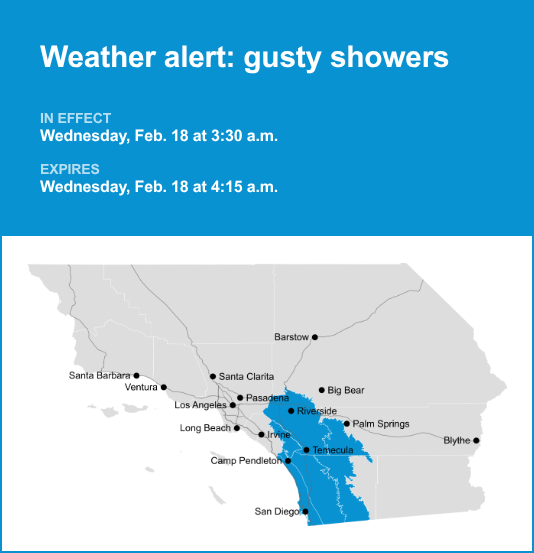
Santa Ana Mountains is the focus of a weather alert for thunderstorms and gusty showers issued at 3:30 a.m. on Wednesday by the National Weather Service. The alert is in effect until 4:15 a.m.

Residents should be prepared for wind gusts of up to 55 mph.

“At 3:24 a.m., Doppler radar showed bands of showers and isolated thunderstorms moving inland into the coast and valleys in San Diego County and into southwestern Riverside County. Movement was northeast at 40 mph,” according to the NWS San Diego CA. “Gusty winds could knock down tree limbs and blow around unsecured objects.”

Locations impacted by the alert include Chula Vista, Moreno Valley, Oceanside, Carlsbad, Temecula, El Cajon, Vista, Encinitas, National City, La Mesa, Lake Elsinore, Poway, Imperial Beach, Ramona, Del Mar, Alpine, Mission Valley, Linda Vista, North Park and Valley Center.

According to the NWS, “If outdoors, consider seeking shelter inside a building.”

The full list of affected locations includes:

  • Santa Ana Mountains/Foothills
  • San Diego County Coastal Areas
  • San Bernardino and Riverside County Valleys
  • San Diego County Inland Valleys
  • Riverside County Mountains
  • San Diego County Mountains

When lightning looms: Expert safety tips for thunderstorms

Lightning strikes the United States approximately 25 million times each year, mostly during the summer. Lightning claims the lives of about 20 people annually, according to the NWS. The risk of lightning-related incidents escalates as thunderstorms draw near, reaching its peak when the storm directly looms overhead. However, it gradually recedes as the tempest moves

To ensure your safety during a thunderstorm, consider the following recommendations:

Lightning safety plan:

  • When venturing outdoors, it’s vital to establish a clear plan for seeking shelter in case of lightning.
  • Monitor the sky for threatening signs and listen for the sound of thunder. If thunder is audible, it’s an indication that lightning is nearby.
  • Seek shelter promptly in a safe location, preferably indoors.

Indoors safety measures:

  • Once you’re indoors, avoid using corded phones, electrical devices, plumbing fixtures, and stay away from windows and doors.
  • Lightning can follow conductive pathways, and these precautions reduce the risk of electrical surges.

Wait for the all-clear:

  • After the last lightning strike or thunderclap, wait at least 30 minutes before resuming outdoor activities.
  • Lightning can strike even when a storm has seemingly passed, so exercise caution.

When indoor shelter isn’t available:

If you find yourself outdoors without access to indoor shelter during a thunderstorm, take these steps to maximize your safety:

  • Avoid open fields, hilltops, or ridge crests, which expose you to greater lightning risk.
  • Steer clear of tall, isolated trees and other prominent objects. In wooded areas, stay close to lower stands of trees.
  • If you’re with a group, ensure individuals are spread out to prevent lightning current from transferring between people.
  • Camping in an open setting during a thunderstorm is strongly discouraged. If you have no alternative, set up camp in a valley, ravine, or other low-lying areas. It’s crucial to note that a tent provides no protection against lightning.
  • Do not approach water bodies, wet objects, or metal items. Although water and metal do not attract lightning, they conduct electricity effectively and can pose significant risks.

In summary, when facing the threat of lightning, preparedness and vigilance are your best allies. By following these guidelines, you can significantly reduce the likelihood of lightning-related incidents and prioritize your safety.

Mastering wet roads: Safety tips for heavy rainfall

Rain can turn roads into hazards. Stay informed and follow these tips from the NWS to ensure safety during heavy rainfall:

Beware of rapid water flow:

In heavy rain, refrain from parking or walking near culverts or drainage ditches, where swift-moving water can pose a grave danger.

Maintain safe driving distances:

Adhere to the two-second rule for maintaining a safe following distance behind the vehicle in front of you. In heavy rain, allow an additional two seconds of distance to compensate for reduced traction and braking effectiveness.

Slow down and drive with care:

On wet roads, slowing down is paramount. Gradually ease off the accelerator and avoid abrupt braking to prevent skidding.

Choose your lane wisely:

Stick to the middle lanes to minimize the risk of hydroplaning. Outer lanes are more prone to accumulating water.

Prioritize visibility

Enhance your visibility in heavy rain by turning on your headlights. Watch out for vehicles in blind spots, as rain-smeared windows can obscure them.

Watch out for slippery roads:

The first half-hour of rain is when roads are slickest due to a mix of rain, grime, and oil. Exercise heightened caution during this period.

Keep a safe distance from large vehicles:

Large trucks and buses can reduce your visibility with tire spray. Avoid tailgating and pass with caution.

Mind your windshield wipers:

Heavy rain can overload the wiper blades. When visibility is so limited that the edges of the road or other vehicles cannot be seen at a safe distance, it is time to pull over and wait for the rain to ease up. It is best to stop at rest areas or other protected areas.

When stopping by the roadside is your only option, position your vehicle as far off the road as possible, ideally beyond guardrails. Keep your headlights on and activate emergency flashers to alert other drivers of your position.

In the face of heavy rain, these precautions can make a significant difference in ensuring your safety on the road. Remember to stay informed about weather conditions and heed guidance from local authorities for a secure journey.

Rainy day rules: How to stay safe in heavy precipitation

When heavy rain sets in, the risk of flooding and hazardous driving conditions rises. Whether it’s prolonged rainfall or rapid runoff, being prepared is essential. Here are some valuable safety tips from the NWS to ensure you stay safe in heavy rain:

Beware of rapid water flow:

  • During heavy rain, avoid playing near culverts or drainage ditches, where swift-moving water can pose a serious risk.

Maintain safe driving distances:

  • The two-second rule for following distance is your ally in heavy rain. Extend it to four seconds to ensure safe spacing in adverse conditions.

Slow down and drive with care:

  • On wet roads, reducing your speed is crucial. Ease off the accelerator gradually and avoid abrupt braking to prevent skidding.

Choose your lane wisely:

  • Stick to the middle lanes to minimize the risk of hydroplaning. Outer lanes are more prone to accumulating water.

Visibility matters:

  • Enhance your visibility in heavy rain by turning on your headlights. Watch out for vehicles in blind spots, as rain-smeared windows can obscure them.

Watch out for slippery roads:

  • The first half-hour of rain is when roads are slickest due to a mix of rain, grime, and oil. Exercise heightened caution during this period.

Keep a safe distance from large vehicles:

  • Large trucks and buses can reduce your visibility with tire spray. Avoid tailgating and pass with caution.

Mind your windshield wipers:

Overloaded wiper blades can hinder visibility. If rain severely limits your sight, pull over and wait for conditions to improve. Seek refuge at rest areas or protected spots. When stopping roadside, position your vehicle as far off the road as possible, ideally beyond guardrails. Keep your headlights on and activate emergency flashers to alert other drivers.

By following these safety measures, you can significantly reduce risks and ensure your well-being when heavy rain pours down. Stay informed about weather conditions and heed advice from local authorities to make your journey safe and sound.

For more local weather alerts, visit our Weather Advisory page

[ad_2]

Source link

Flood watch for 5 Freeway north of LA until Wednesday morning caused by prolonged rainfall – Press Enterprise

0
Flood watch for 5 Freeway north of LA until Wednesday morning caused by prolonged rainfall – Press Enterprise

[ad_1]

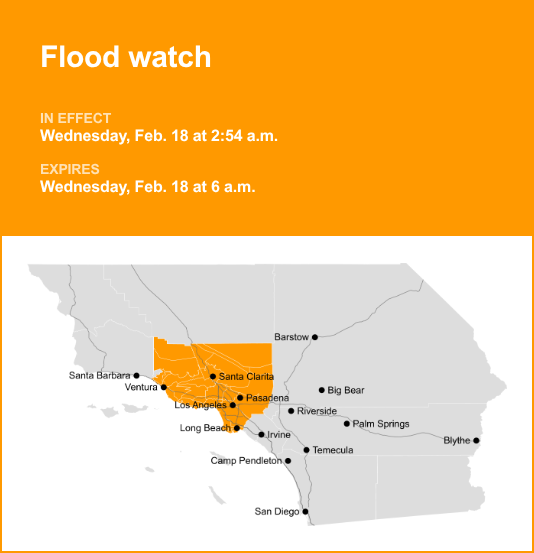
5 Freeway north of LA is the focus of a flood watch issued at 2:54 a.m. on Wednesday by the National Weather Service. The watch is in effect until 6 a.m.

The NWS Los Angeles/Oxnard CA said, “Flooding caused by excessive rainfall is possible. Rock and mud slides are possible near steep terrain and along canyon roads. Debris flows are possible on recent burn scars.”

“Flash flooding is possible. Excessive runoff may result in flooding of low-lying and flood-prone locations, including creeks and streams. Flooding may occur in poor drainage and urban areas. Low-water crossings may be flooded. Extensive street flooding is possible,” according to the NWS. “You should monitor later forecasts and be alert for possible Flood Warnings. Those living in areas prone to flooding and recent burn scars should be prepared to take action should flooding develop. Travel through passes and canyons could become dangerous, and be alert for rock slides and mud slides. Follow the direction of Emergency Management and Law Enforcement officials.”

The full list of affected locations includes:

  • 5 Freeway corridor near Santa Clarita
  • Santa Clarita Valley
  • Ventura County Beaches
  • Ventura County Inland Coast
  • Lake Casitas
  • Ojai Valley
  • Central Ventura County Valleys
  • Malibu
  • Los Angeles County Beaches
  • Palos Verdes Peninsula
  • Los Angeles County Inland Coast including Downtown Los Angeles
  • Western Santa Monica Mountains Recreational area
  • Eastern Santa Monica Mountains Recreational area
  • Calabasas/Agoura Hills
  • San Fernando Valley
  • Southeastern Ventura County Valleys
  • Santa Susana Mountains
  • Southern Ventura County Mountains
  • Northern Ventura County Mountains
  • Western San Gabriel Mountains/Highway 14 Corridor
  • Eastern San Gabriel Mountains
  • Western Antelope Valley Foothills
  • Eastern Antelope Valley Foothills
  • Antelope Valley
  • San Gabriel Valley

Understanding the differences between advisories, watches, and warnings

  • Flash flood warning: Take action!

A flash flood warning is issued when a flash flood is imminent or occurring. If you are in a flood-prone area, move immediately to high ground. A flash flood is a sudden violent flood that can take from minutes to hours to develop. It is even possible to experience a flash flood in areas not immediately receiving rain.

  • Flood warning: Take action!

A flood warning is issued when flooding is imminent or occurring.

  • Flood advisory: Be aware:

A flood advisory is released when flooding is not expected to reach a severity level necessitating a warning. Nonetheless, it can still cause considerable inconvenience and, without exercising caution, potentially lead to situations that threaten life and/or property.

  • Flood watch: Be prepared:

A flood watch is issued when conditions are favorable for flooding. It doesn’t guarantee that flooding will occur, but it signifies that the possibility exists.

Weathering the storm: Flood safety guidelines from the NWS

Floods can pose a significant threat, especially if you live in a flood-prone area or find yourself camping in a low-lying region. To ensure your safety, the NWS offers essential flood safety guidelines:

Move to higher ground:

If you reside in a flood-prone region or are camping in low-lying terrain, the first step to safety is relocating to higher ground.

Follow evacuation orders:

When local authorities issue an evacuation order, promptly comply. Before leaving, secure your home by locking it.

Disconnect utilities and appliances:

If time allows, disconnect your utilities and appliances. This reduces the risk of electrical hazards during flooding.

Avoid basements and submerged areas:

Avoid basements or rooms submerged in water with electrical outlets or cords. Preventing electrical accidents is crucial.

Evacuate promptly for safety:

If you notice sparks or hear buzzing, crackling, snapping, or popping noises, evacuate immediately. Avoid any water that may be charged with electricity.

Refrain from walking in floodwaters:

Never attempt to walk through floodwaters. Even just 6 inches of swiftly moving water can forcefully knock you off your feet.

Seek high ground if trapped:

In the event you become trapped by moving water, make your way to the highest point available and contact emergency services by calling 911.

When heavy rain occurs, there is a potential for flooding, particularly in areas that are low-lying or prone to floods. It is crucial to never drive through water on the road, even if it appears shallow. According to the NWS, as little as 12 inches of fast-flowing water can carry away most vehicles. Prioritize your safety by staying informed and prepared.

Navigating rainy roads: Safety tips for wet weather

Heavy rainfall may lead to flooding if prolonged or if there is excessive runoff. Excessive runoff can be a result of saturated ground and/or rainfall intensity. Follow these recommendations from the NWS to stay safe in heavy rain:

Beware of swollen waterways:

During heavy rain, avoid parking or walking near culverts or drainage ditches, where swift-moving water can pose a serious risk.

Maintain safe driving distances:

Adhere to the two-second rule for maintaining a safe following distance behind the vehicle in front of you. In heavy rain, allow an additional two seconds of distance to compensate for reduced traction and braking effectiveness.

Slow down and stay cautious:

On wet roads, reducing your speed is crucial. Ease off the accelerator gradually and avoid abrupt braking to prevent skidding.

Choose your lane wisely:

Stick to the middle lanes on multi-lane roads to minimize the risk of hydroplaning, as water tends to accumulate in outer lanes.

Visibility matters:

Turn on your headlights and be careful of other vehicles to the rear and in blind spot areas as they are especially difficult to see through rain-spattered windows.

Watch out for slippery roads:

The first half-hour of rain is when roads are slickest due to a mix of rain, grime, and oil. Exercise heightened caution during this period.

Keep a safe distance from large vehicles:

Large trucks and buses can reduce your visibility with tire spray. Avoid tailgating and pass with caution.

Mind your windshield wipers:

  • Overloaded wiper blades can hinder visibility. If rain severely impairs your vision, pull over and wait for conditions to improve. Seek refuge at rest areas or sheltered spots.
  • If the roadside is your only option, pull off as far as possible, preferably past the end of a guard rail, and wait until the storm passes. Keep your headlights on and turn on emergency flashers to alert other drivers of your position.

In the face of heavy rain, these precautions can make a significant difference in ensuring your safety on the road. Remember to stay informed about weather conditions and heed guidance from local authorities for a secure journey.

For more local weather alerts, visit our Weather Advisory page

[ad_2]

Source link

Rep. Jim McGovern introduces bill to end “counterproductive” U.S. embargo against Cuba

0
Rep. Jim McGovern introduces bill to end “counterproductive” U.S. embargo against Cuba

[ad_1]

On Thursday, Rep. Jim McGovern of Massachusetts introduced a bill to the House of Representatives that calls for the end of the United States’ 64-year-old embargo against Cuba.

The proposed measure comes as the Trump administration has moved toward placing a total oil blockade on the island nation, following the abduction of Venezuelan President Nicolás Maduro.

Since Maduro’s capture, the U.S. has cut off all shipments of Venezuelan oil to Cuba. President Trump has also threatened to impose tariffs on countries that send oil to the island.

The oil deprivation in Cuba has sparked concern from international bodies, including the United Nations, which warned that the holdout would strain an already-fragile fuel situation and create a humanitarian crisis in the country.

“For 60 years, we have been waiting for [the] embargo to do what politicians in Washington claim it will do — deliver freedom or democracy to the people of Cuba. It has failed,” McGovern wrote in his newly introduced bill.

“It’s time to throw away the old, obsolete, failed policies of the past and try something different. Let’s focus on the people of Cuba — and let’s treat them like human beings who want to live their lives in dignity and freedom. The Cuban people — not politicians in Washington — ought to decide their own leaders and their own future.”

The Massachusetts representative’s proposal mirrors a similar bill that was put forth to the U.S. Senate by Oregon Senators Ron Wyden (D-Ore.) and Jeff Merkley (D-Ore.) in 2025.

Additionally, McGovern criticized the seemingly hypocritical nature that the blockade has on Trump’s desire to curb immigration in the U.S.

“The Trump administration says they want to curtail migration, but their own hard line approach only incentivizes migration to the United States by making living conditions worse in Cuba,” he wrote.

“Not only is the embargo absurdly ineffective — it is counterproductive, hurting the very people it purports to help. It’s not Cuban elites who are harmed by our policies — it’s regular people and families who are denied food, medicine, and basic goods. We ought to use diplomacy and engagement to achieve our goals.”

McGovern isn’t new to looking for an end of the embargo, his advocacy on the topic dates back to at least 2000.

At the turn of the century, he penned an Op-Ed in The Times calling for former President Bill Clinton to put an end to the Cold War politics looming over the two countries’ strain.

“The president should … declare to the Cuban people that the Cold War is finally over,” McGovern wrote in his 2000 article. “He should announce that he will use his executive power to normalize diplomatic relations, lift the travel restrictions imposed on U.S. citizens who want to travel to Cuba and waive as much of the outdated economic embargo as current law allows.”

Other Democratic congresspeople have criticized the devastating nature of the oil embargo in recent days. Rep. Alexandria Ocasio-Cortez compared the Cuban crisis to that of Gaza, Rep. Ilhan Omar of Minnesota called for the “cruel” and “despotic” blockade to be lifted and Rep. Chuy García of Illinois said the blockade is “deliberately starving civilians” in Cuba.

To help curb the humanitarian crisis that is unfolding in Cuba, Mexican President Claudia Sheinbaum sent two of her country’s naval ships filled with humanitarian aid to the island last week, despite Trump’s tariff threats.

In another effort to send aid to Cuba, an international coalition is preparing to send a flotilla with resources in March to the Caribbean archipelago. Named after “Nuestra América,” the 1891 essay by Cuban independence leader José Marti, the “Nuestra América Flotilla” mission is inspired by the Global Sumud Flotilla, which attempted to get aid to Gaza last year amid Israel’s blockade of the Palestine coastline.

The coalition includes the political and grassroots organizations Progressive International, the People’s Forum and Code Pink, among others.

“We are sailing to Cuba, bringing critical humanitarian aid for its people,” the organizers wrote on the official flotilla website. “The Trump administration is strangling the island, cutting off fuel, flights, and critical supplies for survival. The consequences are lethal, for newborns and parents, for the elderly and the sick.”

[ad_2]

Source link

Why actor Chris Pine turned to this nonprofit film fund

0
Why actor Chris Pine turned to this nonprofit film fund

[ad_1]

Actor Chris Pine was just 13 when his family’s finances took a turn and his parents lost their home.

So when the “Star Trek” actor read the Pulitzer Prize-winning book “Evicted: Poverty and Profit in the American City” from author Matthew Desmond, about eight families who fight to stay housed in Milwaukee, he knew he had to make a film out of it.

For the record:

10:40 a.m. Feb. 17, 2026A previous version of this article stated that investor Shauna Ockey was from West Point, Utah. She is from Calgary. Also investor Lloyd Roberts was listed as being from Calgary; he is from West Point, Utah.

“The power of what we do as filmmakers … is really to remind people that we are not alone, that our experiences are transcendent,” Pine recently told an audience at the Sundance Film Festival. “This is one of those stories.”

Pine is producing a documentary based on the book and it’s among several projects backed by Harbor Fund, an emerging Utah-based nonprofit investment group that leverages the donations of high-net-worth individuals and other investors to support films, television shows and documentaries that have a positive social message.

“Good stories can change how people feel,” Lindsay Hadley, Harbor Fund’s co-founder and chief executive, said in an interview. “We just really believe in the power of film and the entertainment world to harness a society of compassion.”

Since it began about a year and a half ago, the fund has raised $15 million from 82 donors with an average contribution of $250,000. Already, Hadley said, $10 million has been deployed across 22 projects, including “Evicted.”

“It’s rooted in housing policy and economics, but at its core, it’s about people — and stories like this aren’t always easy to back in an industry built to minimize risk,” Pine said in a statement.

“Harbor Fund immediately understood the moral center of the film and why it needed to be told honestly. Their mission goes beyond financing films. They care about what happens after a premiere — about bringing films into communities that initiate civic conversation and making sure the conversation continues beyond the screen.”

Finding a consensus on what constitutes a social good can be tricky, especially in the current fraught and deeply partisan political climate.

Hadley said she gets extensive advice on pitches from the fund’s advisory board, which includes filmmakers like Patty Jenkins, David Oyelowo, Amy Redford and Mark Burnett. The projects seek to home in on shared values and avoid works that dehumanize other people, she said.

Harbor Fund wants to reach $100 million in the next two years, said Hadley, who previously served as chief development officer for advocacy organization Global Citizen and has produced its annual festival in New York’s Central Park that supports social issues.

Efforts to finance socially conscious films aren’t new. Culver City-based production company Participant built its reputation around projects that prioritized social commentary, including Al Gore’s 2006 environmental documentary “An Inconvenient Truth” as well as Oscar-winning feature films such as 2015’s “Spotlight” and 2018’s “Green Book.” But the company closed in 2024 as the market for independent films changed drastically.

The traditional business model for indie films has broken down as audiences still have not shown up to theaters with the same enthusiasm as before the pandemic. Add to that a shrinking number of distributors — though some new ones recently emerged — and the inherent risk of funding a movie, and it’s no surprise investors have shied away.

“Theatrical windows used to be the lifeblood of independent film, and now it’s basically gone,” said David Offenberg, an associate professor of finance at Loyola Marymount University and author of the book “Independent Film Finance.”

Harbor Fund’s model for financing is rare, he said, though it taps into one of the big motivations for investors to fund movies and TV — social impact.

“A lot of investors are putting money into film because they want to make a change in the world and they want the movie to help make that change,” Offenberg said.

With a nonprofit venture capital-type structure, no costly production arm and a diversified portfolio, Harbor Fund aims to be sustainable, Hadley said. The fund also has invite-only forums, such as last year’s in Montana that featured actor Kevin Costner, where investors can hear about potential projects directly from those involved, which can include A-list stars.

Donors engage with the fund knowing they will not see a return on their investment. They choose projects they want to support, Harbor Fund takes an equity position in it, and any money it makes is invested back into the fund for future films and TV series.

“If it’s successful, it’s a gift that keeps giving,” Hadley said.

Investor Shauna Ockey of Calgary chose to contribute to the documentary “Orphan Myth,” which details the plight of children separated from family members in poverty, because she sees it as a social return rather than a financial one.

“Reuniting children with families so they don’t grow up in institutions is an important part of me and my husband’s value systems,” said Ockey, who has contributed $350,000 to Harbor Fund with her husband. “When you invest philanthropically in a film, of course you want to have the best outcome, but … not all films are going to be box office hits. But if it just impacts a few people, that’s a good enough return.”

The fund’s projects span a wide range of subjects, from “Hershey,” a film set for release this year about the philanthropic legacy of eponymous chocolate-maker Milton Hershey and his wife, Catherine, to “Flash Before the Bang,” a movie about a deaf track team.

The investments help pay the overhead costs for these films in part because of the belief that big-name stars will attract a larger audience and, hopefully, create more change, Hadley said.

For West Point, Utah-based investor Lloyd Roberts, the 2006 Will Smith drama “The Pursuit of Happyness,” about a father and son who struggle to find housing, changed his thinking about the role of perspective in feelings of fulfillment.

“You can have someone stand onstage and tell you these ideas, but you put it in a feature film like ‘The Pursuit of Happyness,’ and you feel like you have a firsthand view of how putting it into practice can help you,” said Roberts, who has invested a little more than $1 million in the fund and believes audiences will reap the benefits.

“One of the best mechanisms for an idea is not just documentaries but motion pictures that have an underlying message that pulls on their heartstrings,” he said.

[ad_2]

Source link

Rancho Christian boys basketball team takes down Millikan in Division 1 quarterfinal – Press Enterprise

0
Rancho Christian boys basketball team takes down Millikan in Division 1 quarterfinal – Press Enterprise

[ad_1]

TEMECULA — Rancho Christian embodied the phrase “go big or go home” and leaned on 6-foot-9 forward Daniel Bol late in Tuesday’s CIF-Southern Section Division 1 quarterfinal to defeat Millikan 71-62 and advance to the semifinals for the second time in three seasons.

Bol, a junior power forward, emphasized the “power” portion of his position and after the Rams built their biggest lead of the game, 56-52, with 6:23 to play. He scored eight of his 16 points in the final frame, including a nifty turnaround jumper that knotted the game at 56-all, and then a dunk with 3:54 to play to break another tie and launch the Eagles’ 12-3 run that closed out the hard-fought contest.

Rancho Christian won its sixth consecutive game to improve to 22-9 and earn a berth in the CIF State playoffs.

But more important to the Eagles is Friday’s semifinal matchup at home against top-seeded Crean Lutheran, which raced past Village Christian 83-53 Tuesday. Tipoff is 7 p.m.

“It’s taken us a long time to get to where we want to be, and we want to be playing our best basketball here in February, not in November,” Rancho Christian coach Jalen Lake said.

Millikan’s sharpshooters never let the Eagles build more than a seven-point lead, repeatedly clawing back by firing from long range. The Rams, led by freshman guard Quali Giral’s 21 points, drained seven three-pointers. Senior guard Jeremiah Hunt had 17 points and senior Joseph Wicker tossed in 10 points. And junior forward Christian Parker fought for offensive rebounds on four successive possessions in the third period that the Rams converted into points that kept the game close.

“He’s been battling all year,” coach Stephon Price said. “We put him against guys, 7-foot, 6-foot-10, and he’s only 6-4. He’s been battling, and that’s his DNA.”

Price was emotional after the contest. The Rams (24-7), who marched through the rugged Moore League without a loss and were seeking their first semifinal berth since 2022, had their 13-game win streak snapped.

“It hurts because you know the work they put in, all the three-a-day workouts we do, all the off-the-court stuff,” Page said. “They fight, and you have to give it up to them. We have to keep on working to get better.”

Millikan’s peskiness concerned Lake.

“They’re a tough program. We watched lots of film, and we knew it was going to be a dogfight,” Lake said.

“It starts with the second chances. No. 21 (Perron) was a dog on the rebounds, He works hard, and they have a great group of guards that we knew were going to be a handful.

“There were a few mishaps, We made a few mistakes and it cost us, but the main thing is we stuck to it, bounced back and stacked some stops together when it really mattered.

“We have to be tougher down the stretch,” Lake said. “We’re the bigger team. We can’t allow guys to come in here and get second chance after second chance. We have to be mentally and physically tougher.”

Jeremiah Profit, a transfer from Temecula Valley, where he was coached by his father, scored 11 of his 21 points in the second half to lead Rancho Christian.

“He’s a one-of-a-kind player, one of the top players in the country for a reason,” Lake said. “His ability to make everyone around him better is something that people don’t seem to look at. Everybody can score the ball, we know that. But his ability to get others involved, to elevate other people’s games, in my opinion, makes him a top-30 player in the country.”

Tony Rutledge had 14 points and 6-foot-9 center Dave Mapey chipped in 10 for Rancho Christian, which has won 15 of its last 16 contests.

[ad_2]

Source link

Brayan De La Torre’s hat trick lifts Citrus Hill boys soccer team past Patriot – Press Enterprise

0
Brayan De La Torre’s hat trick lifts Citrus Hill boys soccer team past Patriot – Press Enterprise

[ad_1]

PERRIS — Brayan De La Torre is finally picking up where his older brother left off.

1 of 29

Citrus Hill’s Giancarlo Collazo and Patriot’s Mauricio Perez go for a header in a CIF Southern Section Division 2 boys soccer quarterfinal match on Tuesday, Feb. 17, 2026. (Photo by Milka Soko, Contributing Photographer)

Expand

De La Torre was clinical in front of goal, scoring two of his three goals in the first half, as Citrus Hill defeated Patriot 4-1 on Tuesday night in a CIF Southern Section Division 2 quarterfinal match.

“Got to give it up to Brayan. That’s quite a performance from him,” Citrus Hill coach Aram Najar said. “His teammates saw that he was feeling himself and they were giving him balls in good spots and he just took advantage of it.”

The younger brother of Jose De La Torre, the 2024 IE Varsity Boys Player of the Year, Brayan De La Torre has nine goals and eight assists this season for resurgent Citrus Hill (16-2-4 overall), the Sunbelt League champion.

Unbeaten over their last 17 matches, the Hawks next play at Bishop Amat in the semifinals Saturday.

“We know it’s going to be a dog fight playing Bishop Amat,” Najar said. “I want the energy level to stay high because that’s a really good school, and I want them to enjoy the process and enjoy this moment because it’s something that they’re going to take with them forever.”

Following two 1-0 victories over Alta Loma and Fullerton in the first two rounds of the playoffs, De La Torre’s attacking masterclass gives Citrus Hill confidence moving forward.

“I just want them to feel excited for this next game,” Najar said. “At the end of the day they’re high school athletes and they don’t often get to play a semifinal game.”

De La Torre’s first goal was barely more than a tap in after a cross from the wing dropped between defenders and he poked it past Patriot’s goalkeeper for a 1-0 lead in the 13th minute.

He added his second on a free kick in the 27th minute, dipping his shot over the three-man defensive wall and into the lower left corner away from the outstretched hands of Patriot’s goalkeeper.

“Their No. 10 (De La Torre) is a legit player and good players find and know how to make space,” Patriot coach Johnny Mosher said. “We weren’t aware of him at times and that’s all. We didn’t cover him.”

Patriot (15-6-6) increased its tempo and produced two shots on goal in the final 5 minutes of the first half before Fernando Guerrero earned a foul inside the edge of the penalty area and stepped up to blast the spot kick under the bar as the Warriors got on the scoreboard just before halftime.

Mosher’s side was aggressive to start the second half but a turnover deep in Patriot’s defense third led to De La Torre pouncing for his third goal and a 3-1 lead.

Sophomore forward Benjamin Castellanos added to Citrus Hill’s advantage 5 minutes later, running past the defense and onto a pass from junior Byron Chavez before scoring his seventh of the season.

Freshman goalkeeper Richard Baltazar made four saves in each half to preserve the win, Citrus Hill’s fifth straight overall.

The loss snapped a six-game unbeaten streak for Patriot, which advanced to the quarterfinals for the first time and finished with the most wins in the school’s 19-year history.

[ad_2]

Source link