Daily News

Home Daily News Page 100
Daily News

Takeaways from RFK Jr.’s vaccine panel meeting on COVID-19 and childhood vaccines

0

[ad_1]

NEW YORK — A vaccine advisory committee handpicked by U.S. Health and Human Services Secretary Robert F. Kennedy Jr. met in Atlanta this week to consider whether to revise recommendations on shots against COVID-19, hepatitis B, and a combination shot that protects children against measles, mumps, rubella and chickenpox.

The panel, which is charged with making vaccine recommendations, declined to recommend COVID-19 vaccines, saying instead that people could make individual decisions — a move that adds confusion as people weigh whether to get a dose this fall.

During the sometimes chaotic two-day meeting, the panel also recommended new restrictions for a vaccine that protects against chickenpox as well as measles, mumps and rubella. In a surprise move, the group indefinitely postponed an expected vote on hepatitis B shots given to infants on the day they are born.

With Kennedy, a vaccine skeptic, leading the country’s health agencies, the meeting of the Advisory Committee on Immunization Practices, or ACIP, struck a different tone from past gatherings. Among the 12 members, all chosen this year by Kennedy after he fired the previous 17-member panel, are people who have criticized and spread misinformation about vaccines. Critics say the panel’s makeup and agenda could sow distrust in the shots.

The panel’s recommendations will be sent to the director of the Centers for Disease Control and Prevention, an agency that has been rocked by disagreements over Kennedy’s vaccine policies. The panel’s recommendations are usually adopted by the CDC, and then widely followed by doctors and insurers.

Here are some takeaways from the meeting.

The panel on Friday debated COVID-19 vaccinations as the virus has remained a public health threat, resulting in 32,000 to 51,000 U.S. deaths last fall and winter, according to CDC data.

Until now, the vaccinations had been routinely provided to nearly all Americans who wanted them. The Food and Drug Administration recently put new restrictions on this year’s shots from Pfizer, Moderna and Novavax, reserving them for people over 65 or younger ones who are deemed at higher risk from the virus.

Panelists declined to recommend the shots for anyone, including seniors and high-risk populations. They said individuals could make their own decisions. Removing the recommendations that were previously in place may confuse Americans trying to decide whether and how to get their fall boosters.

The panel also urged the CDC to adopt stronger language around claims of vaccine risks, despite pushback from outside medical groups who said the shots had a proven safety record from the billions of doses administered worldwide.

The divided panel narrowly avoided urging states to require a prescription for the shot.

Several states have announced policies to try to ensure people’s access to COVID-19 vaccines, worried about Friday’s ACIP decision. And a group representing most health insurers, America’s Health Insurance Plans, said earlier this week that its members will continue covering the shots through 2026.

The committee recommended that a combined vaccine known as MMRV should not be given to children under 4. Instead, they said in an 8-3 vote with one abstention, children in this age group should get separate vaccines — one for MMR and another for varicella, or chickenpox.

Their discussions centered on rare feverish seizures that can occur in kids who receive the first dose, between the ages of 1 and 2. Medical experts agree these seizures, while potentially frightening for families, are not linked to brain function or school problems.

In 2009, the ACIP changed a previous recommendation to advise that either the combination shot or separate shots were acceptable for the first dose.

Some doctors and public health experts say they are not aware of any new safety data that would explain the revisiting of those vaccination recommendations.

About 85% of children already receive separate doses for the first round, according to information presented at the meeting.

But experts have raised concerns that other kids could have a hard time getting the combination vaccine as a result of the panel’s recommendation. Government insurance programs like Medicaid, for example, would have to stop paying for the early combo dose if the acting CDC director accepts the panel’s guidance.

Ever since the ACIP panel in 2005 recommended a dose of the hepatitis B vaccine for newborns, cases of the liver virus among infants have dropped by more than half.

Nonetheless, the committee opted to revisit the guidance in this week’s meeting, with members questioning whether babies born to moms who test negative for hepatitis B really need a vaccine at birth.

The panelists considered whether to recommend delaying that initial vaccination — something doctors and parents already can choose to do.

One committee member asked if the vaccination right after birth was “asking our babies to solve an adult problem.” Hepatitis B can spread through sex, sharing needles, or from an infected mother to a newborn baby.

But several outside medical experts criticized that the committee was debating the issue at all and said the vaccine is safe and successful at reducing infant infections.

After discussing it on Thursday, the panel decided Friday morning to indefinitely postpone a vote on the issue.

Chairman Martin Kulldorff opened the meeting by challenging former CDC directors to a public debate. Several doctors representing outside medical groups accused the panel of not following the CDC’s long-established guidelines in weighing evidence for making recommendations.

CDC staff, as usual, presented numerous studies on the topics being debated, explaining how they chose which research to discuss. But a few times, panel members cited different papers they had found, including ones done in mice, which are not generally considered applicable.

The committee also took a vote on Thursday that they had to redo on Friday morning concerning the government’s Vaccines for Children program, which covers vaccine costs for about half of U.S. kids. On Friday, they voted to align coverage under the program with their guidance on MMRV shots. A day earlier, they had voted no on the idea.

“We are rookies. … There are many technical issues that we might not grasp as of yet,” Kulldorff said. He said a committee member had told him that “maybe we didn’t quite understand what was going on” with the vote.

At one point Thursday, one of the panelists appeared to be napping, with his eyes closed and his chin resting on his chest.

Doctors and public health experts watching the meeting unfold said they are concerned that the committee is creating fear and mistrust around vaccines at a time when U.S. vaccination rates are already falling.

They suggested the new panel was selectively using its recommendations to justify specific conclusions, rather than considering all the evidence.

“It’s troubling to see the erosion of the committee’s integrity,” said Dr. Sandra Fryhofer of the American Medical Association.

___

Associated Press writer Jonathan Poet in Philadelphia contributed to this report.

[ad_2]
Source link

US attorney resigns amid pressure from Trump after sources say he refused to charge NY AG Letitia James

0

[ad_1]

U.S. Attorney Erik Siebert resigned his position Friday amid pressure from Trump administration officials to bring a criminal case against New York Attorney General Letitia James.

Siebert, the U.S. attorney for the eastern district of Virginia, informed employees at his office in Alexandria of his decision to resign in an email that was obtained by ABC News.

“For the last eight months, I have had the pleasure of leading the finest and most exceptional of DOJ employees, who care deeply about our nation and our EDVA community,” Siebert wrote. “Thank you for the lessons you have taught me, the sacrifices you have made, and the pursuit of justice you strive for every day.” 

“He didn’t quit, I fired him!” Trump wrote in an early Saturday morning post on his social media platform.

Siebert was notified of the president’s intention to fire him Thursday, sources said, and Trump said Friday afternoon in the Oval Office that he wanted Siebert “out” of his position.

ABC News has reported that Trump was expected to fire Siebert after investigators were unable to find incriminating evidence of mortgage fraud against James, according to sources. Trump officials had pushed Siebert to bring charges against James, despite investigators failing to find clear evidence that she committed a crime, sources said. 

“It looks to me like she is very guilty of something, but I really don’t know,” Trump told reporters in the Oval Office on Friday. 

PHOTO: Erik Siebert, interim U.S. Attorney for the eastern district of Virginia, speaks during a news conference, March 27, 2025, in Manassas, Va.

Erik Siebert, interim U.S. Attorney for the eastern district of Virginia, speaks during a news conference about an MS-13 gang leader who was arrested in an operation by the Virginia Homeland Security Task Force, at the Manassas FBI Field Office, March 27, 2025, in Manassas, Va.

Rod Lamkey/AP

When asked about Siebert, Trump said he wanted him “out” of the position because Virginia’s two Democratic senators supported his nomination. Trump nominated Siebert for the position in May, and he has served as the interim U.S. attorney since Trump’s inauguration. 

“When I saw that he got approved by those two men, I said, pull it, because he can’t be any good,” Trump said. “When I learned that they voted for him, I said, I don’t really want him.” 

In his subsequent social media post, Trump wrote, “Today I withdrew the Nomination of Erik Siebert as U.S. Attorney for the Eastern District of Virginia, when I was informed that he received the UNUSUALLY STRONG support of the two absolutely terrible, sleazebag Democrat Senators, from the Great State of Virginia. Next time let him go in as a Democrat, not a Republican.”

While Siebert resigned from his position as interim U.S. attorney, he told his colleagues that he intends to continue working as a line prosecutor in the office, sources familiar with the matter said.

It is unclear if he will be permitted to return to his previous role as an assistant U.S. attorney. 

Siebert’s removal leaves one of the nation’s most important U.S. attorney’s offices without a leader, according to sources, as Siebert’s deputy has already left her position and intends to continue work in the office as a line prosecutor. With her position vacant, there is currently no answer to who specifically will take over the office and whether any of its attorneys have any authority to continue regular prosecutorial activity. 

The investigation into James began in April when Bill Pulte, the director of the Federal Housing Finance Agency, sent the Department of Justice a criminal referral alleging that James falsified records related to her 2023 purchase of a home in Virginia.

After investigating the allegations for five months and interviewing 15 witnesses, investigators were unable to find clear evidence that James knowingly falsified records to obtain better loan terms, ABC News first reported earlier this week. 

James has denied wrongdoing, and her lawyer, in a statement on Friday, called the reported firing of Siebert a “brazen attack on the rule of law.”

“Firing people until he finds someone who will bend the law to carry out his revenge has been the President’s pattern — and it’s illegal,” Abbe Lowell said Friday morning in a statement to ABC News. “Punishing this prosecutor, a Trump appointee, for doing his job sends a clear and chilling message that anyone who dares uphold the law over politics will face the same fate.”  

The forcing out of Siebert because he refused to charge one of Trump’s political rivals marks an escalation in what the president’s critics have called a retribution campaign, with ongoing investigations also targeting Sen. Adam Schiff and Federal Reserve Governor Lisa Cook. 

Attorney General Letitia James sits in the courtroom during the civil fraud trial of former President Donald Trump at New York Supreme Court, Jan. 11, 2024, in New York.

Seth Wenig/Pool/Getty Images

Trump has repeatedly accused James — who successfully brought a civil fraud case against him last year and leads multiple lawsuits challenging his administration’s policies — of targeting him for political reasons, calling her “biased and corrupt.” 

James is “a horror show who ran on the basis that she was going to get Trump before she even knew anything about me,” Trump said during his civil fraud trial in 2023. “This has to do with election interference, plain and simple. We have a corrupt attorney general in this state.”

Following a three-month trial, a New York judge concluded that Trump and his family had committed a decade of business fraud by overstating the value of their properties to get favorable loan terms, fining Trump and his sons nearly half a billion dollars. An appeals court subsequently tossed the financial penalty but upheld the finding that Trump committed fraud. 

A former police officer with Washington, D.C.’s Metropolitan Police Department, Siebert graduated from law school in 2009 and has worked as an assistant United States attorney in the Eastern District of Virginia since 2010. In addition to serving as a line prosecutor, Siebert headed the office’s organized drug crime task force and supervised the office’s Richmond division from 2019 to 2024. 

Siebert began serving as the interim U.S. attorney on Jan. 21 after the late Jessica Aber, who ran the office from 2021-25, resigned following President Trump’s inauguration. Both of Virginia’s Democratic senators, Mark Warner and Tim Kaine, recommended Siebert to Trump in April, and Trump nominated him for the position in May.

“Mr. Siebert has dedicated his career to protecting public safety, from his work with the Washington, D.C., Metropolitan Police Department to his handling of violent crimes and firearms trafficking as a line Assistant U.S. Attorney in the Eastern District of Virginia. With his experience and dedication to service, Mr. Siebert is equipped to handle the challenges and important obligations associated with this position,” Warner and Kaine said in a statement in May, pledging to support his nomination.

[ad_2]
Source link

Trump unveils “Gold Card” fast-track visas for $1 million

0

[ad_1]

President Trump signed an executive order Friday to offer up fast-track “Gold Card” visas to people willing to pay $1 million or more.

“The Trump Gold Card is Here,” reads a government website, which features a mock-up of a bright, gilded card embossed with a photo of Mr. Trump, his signature and images of a bald eagle and the Statue of Liberty: “Unlock life in America.”

Under the Gold Card program, which Mr. Trump first floated in February, non-Americans who give a gift of at least $1 million to the Commerce Department will be eligible for an “expedited process” to gain an immigrant visa, the executive order states. Corporations can sponsor people for Gold Cards if they give the government at least $2 million.

Some 80,000 Gold Cards will be made available, according to Commerce Secretary Howard Lutnick, who said the program is still in the “implementation phase.”

People who are approved for a Gold Card after vetting by the State Department and Department of Homeland Security — and who pay a $15,000 “vetting fee” — will be considered lawful permanent residents, more commonly known as green-card holders, Lutnick told reporters Friday. He said Gold Cards will take the place of the existing EB-1 and EB-2 visa programs, which offer green cards to people with “exceptional ability” in business or other fields.

“You can prove exceptional value for the United States of America by contributing $1 million to the United States of America. That’s a pretty good expectation that they’re highly valuable,” he said.

Lutnick said: “In less than a month, the other visa Green Card categories are likely to be suspended, and this will be the model that people can come into the country.”

The administration is also considering offering a $5 million “Platinum Card” that will allow people to spend up to 270 days in the country without paying taxes on their non-U.S. income. That program, which Lutnick said would not offer a pathway to citizenship, will need approval from Congress before it launches. The federal government has set up an online waiting list.

Separately, Mr. Trump signed an executive order Friday that imposes an extra $100,000 fee for people who wish to enter the U.S. on an H-1B visa, a non-immigrant visa that allows tens of thousands of people to live and work in the U.S. for up to six years. 

The change could mark a substantial crackdown on the H-1B program. Critics argue that the visas allow employers to undercut U.S. workers by sponsoring foreign job applicants willing to work for lower salaries. But supporters of the program argue it is essential to industries like tech that often struggle to find qualified U.S.-based workers — with firms like Amazon applying for thousands of H-1Bs per year — and employers are already required to pay H-1B recipients no less than the wages earned by similarly qualified workers.

Asked Friday how he believes tech companies will react to the new H-1B fee, Mr. Trump told reporters: “I think they’re going to be very happy.”

“And we’re going to be able to keep people in our country that are going to be very productive people, and in many cases, these companies are going to pay a lot of money for that, and they’re very happy about it,” the president said.

[ad_2]
Source link

AI glasses foster independence for visually-impaired people

0

[ad_1]
Visually-impaired people are finding new independence with AI glasses. “CBS Saturday Morning” meets Emeline Lakrout, an active, visually-impaired New Yorker who has found new ways to use AI glasses to her advantage.

[ad_2]
Source link

3 reasons your grocery bill is getting more expensive

0

[ad_1]

Americans’ grocery bills are growing, causing some shoppers to cut back on discretionary spending as they find themselves struggling to afford the basics. 

Food prices grew by half a percent from July to August, marking the fastest monthly rate of change since the fall of 2022. Behind the rising cost of food items on store shelves are three main culprits, according to experts.

The Trump administration’s wide-ranging tariffs, climate change and a shortage of agricultural workers in the U.S. are the leading causes of grocery inflation, Phil Lempert, a food industry analyst also known as the “Supermarket Guru,” told CBS News correspondent Jo Ling Kent. 

Price hikes, he added, have been steepest on goods that the U.S. imports from nations facing higher levies. For example, the U.S. imports about 35% of its coffee from Brazil, whose exports are taxed at a rate of 50%.

The latest Consumer Price Index data shows that coffee prices rose 21% in August compared with a year ago.

As companies see their costs rise, they pass along those burdens to consumers. In the case of tariffs, some businesses began raising prices on products even before the levies were in full force.

“There’s no question that what we’ve seen is, we’re seeing companies increased prices because of the impending tariffs,” said Lempert. 

“What they want to do is they want to protect themselves. A lot of these big food companies are public companies. So what they’ve gotta do is they’ve gotta report back to their shareholders on profit margins. So they’ve been hedging their bets,” Lempert said.

Sometimes, packaged-goods companies disguise price hikes by offering consumers less product for the same amount of money. The covert inflation strategy has been dubbed “shrinkflation,” Lempert explained. 

“What they’re doing is they’re trying to put less in the package, hoping that you and I are not gonna observe that and keep that price either stable or just slightly increased,” he said

Climate change

Increasing temperatures and shifts in weather patterns have made conditions for growing some fruits and vegetables in the U.S. inhospitable. As a result, a lot of domestic production has been moved to Central and Latin America, according to Lempert.

“We can’t grow our food where we used to grow it,” he said.

Labor shortage

Additionally, Mr. Trump’s immigration policies, including raids on workplaces that employ large numbers of immigrants, plus waning interest in agricultural work, have led to an industrywide labor shortage, Lempert explained. 

Consumers are reacting to higher prices by looking for deals, purchasing store brand goods instead of name-brands and buying shelf-stable groceries in bulk at shopping clubs like Costco. 

Lempert said a little planning can go a long way to ensure that consumers can buy what they need. 

“The number one thing that people want to do if they want to save money — stop wasting food,” Lempert said.

“Forty percent of all of our food in this country is wasted. A lot of that’s in our homes. So, take doggy bags from restaurants, use leftovers, freeze leftovers, don’t waste food and you’ll save a substantial amount of money,” he said. 

[ad_2]
Source link

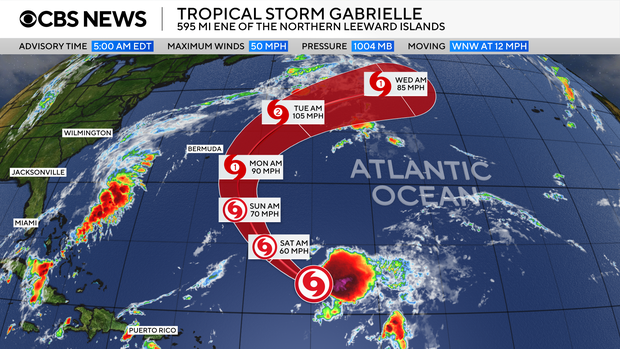
Maps show the forecast track of Tropical Storm Gabrielle, the 7th named storm of the 2025 Atlantic hurricane season

0

[ad_1]

Tropical Storm Gabrielle formed Wednesday morning over the central Atlantic Ocean, becoming the seventh named storm of the 2025 Atlantic hurricane season. Forecasters expect the weather system to remain over open waters for the next several days and haven’t yet warned of any hazards that could potentially affect land. 

Gabrielle is forecast to become a hurricane by Sunday, according to the Miami-based National Hurricane Center. 

The storm’s current forecast predicts that Gabrielle’s track will carry it north of the Caribbean and away from land, but the system could pass to the east of Bermuda next week as it continues to strengthen over the open waters of the central Atlantic Ocean, CBS News meteorologist Nikki Nolan said.

A map produced by Nolan shows Gabrielle’s anticipated path through Tuesday, at which point it may be packing hurricane-force winds. 

b9e70e7a-99ae-4154-9745-df85fe79ab98.png

A map shows the potential path of Tropical Storm Gabrielle over the next several days.

Nikki Nolan for CBS News


On Saturday morning, Gabrielle was situated roughly 530 miles northeast of the northern Leeward Islands and nearly 685 miles southeast of Bermuda. It was tracking northwest at 13 mph, the National Hurricane Center said, after making a “gradual turn” on Friday night. 

Its maximum sustained winds were 50 mph, just over the threshold that differentiates a tropical depression from a tropical storm. Gabrielle grew from a tropical depression in the Atlantic that meteorologists initially flagged earlier on Wednesday.

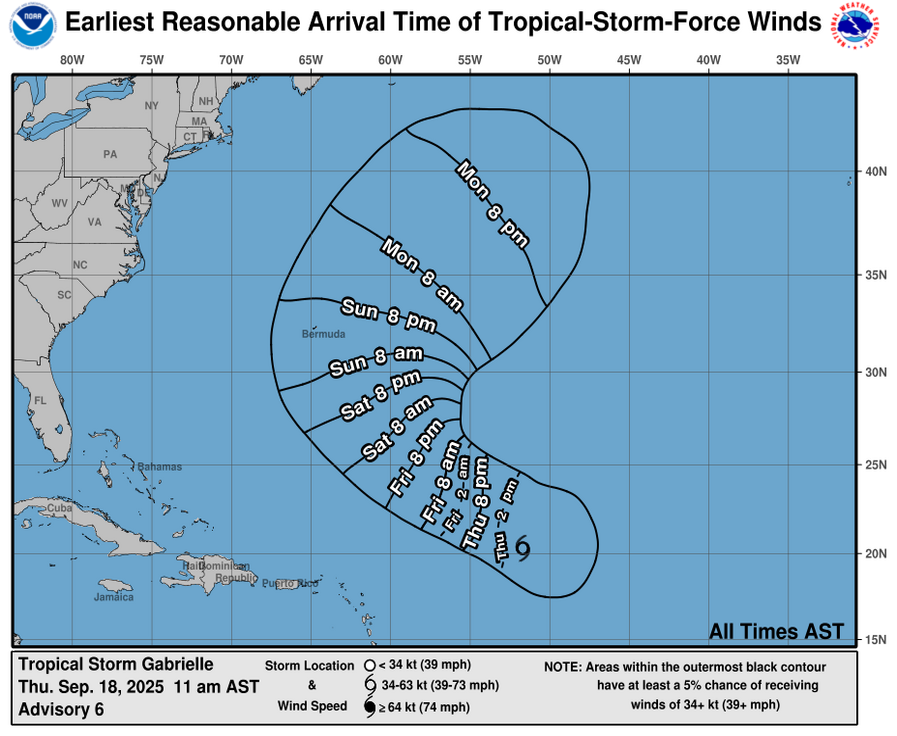
Tropical-storm-force winds extended outward some 140 miles from Gabrielle’s center, the hurricane center said. The storm will likely continue to move west-northwest or northwest through Sunday, the agency said, then make a turn to the north-northeast on Monday. 

There is “little change in strength” expected over the next 48 hours, but the center forecast “some gradual intensification” late in the weekend.

The storm may have some impacts to Bermuda early next week, Nolan said.

A map shows the earliest expected arrival times of tropical-storm-force winds for Tropical Storm Gabrielle.

A map shows the earliest expected arrival times of tropical-storm-force winds for Tropical Storm Gabrielle.

National Hurricane Center


Gabrielle took shape about one week after what was historically considered the peak of the Atlantic hurricane season, which runs annually from June 1 to Nov. 30 and has in the past become most active around Sept. 10. 

Officials at the National Oceanic and Atmospheric Administration initially predicted the 2025 season would be busier than usual and produce more named storms than an average year, but hurricane activity has so far been quieter than anticipated. 

At the start of the season, NOAA’s outlook suggested that between 13 and 19 named storms would form in the Atlantic, with as many as nine strengthening into hurricanes and as many as five becoming Category 5 storms, which are the most powerful. The agency revised the outlook slightly in August, predicting that the season would see 13 to 18 named storms, including five to nine hurricanes, two of which could be major.

Of the six named tropical storms that have developed this year before Gabrielle, only one, Chantal, made landfall in the U.S.

contributed to this report.

[ad_2]
Source link

Northwood football’s strong all-around effort too much for Portola – Orange County Register

0

[ad_1]

IRVINE — He spends the week alone at practice. The kicker. But Dillan Low of Northwood won’t be so lonely this week.

Not after kicking three field goals and providing the difference in the Timberwolves’ 22-14 victory over rival Portola on Friday night.

Low kicked field goals of 42, 36 and 31 yards to lift Northwood (3-2) to its second consecutive nonleague victory going into its bye week.

Portola dropped to 2-3.Dil

“Kicking game was huge for us,” Northwood coach Erik Terry said. “Dillan was dynamite. Those two he kicked in the first half were big. We knew we were going to give him a shot within 40, but when he hit the one from 42, we knew we were going to give him a shot all night.”

The kicks of 42 and 36 yards – the latter with 58 seconds on the clock – helped Northwood to a 13-7 lead at halftime.

“Nights like this make me realize why I’m here,” said Low, whose previous long this season was 28 yards. “I don’t think I’d be able to do this without holder Caden Jacobs and snapper Noah Green.”

Northwood's Dillan Low kicked field goals of 42, 36 and 31 yards to help the Timberwolves defeat Portola 22-14 on Friday, Sept. 19, 2025. (Photo by Martin Henderson)
Northwood’s Dillan Low kicked field goals of 42, 36 and 31 yards to help the Timberwolves defeat Portola 22-14 on Friday, Sept. 19, 2025. (Photo by Martin Henderson)

Northwood’s lead disappeared quickly in the third quarter. Portola’s Michael Hood returned the opening kickoff 92 yards to give the Bulldogs a 14-13 advantage.

But Low put Northwood back on top with his 31-yard field goal with 52 seconds left in the third quarter.

It stayed that way through most of the fourth quarter. Isaac Kwon’s 32-yard interception return set up Northwood at the 4-yard line, and Xayn Ali scored from the 1 with 5:35 remaining. The two-point conversion failed, but the defense shut down Portola on the ensuing drive to secure the victory.

“I think we finally played three-phase football for the first time this season,” Terry said. “Defense gave us a chance with that late interception to put it away. Special teams took care of business on the field goals. We did give up a kickoff return for a touchdown but we didn’t get down. We bounced back. We trusted our offense. We’ve got some big play-makers, we’ve just got to get the ball in their hands and let them do it.”

Kwon had five receptions for 72 yards with a TD and interception, and Bert Chubb had four catches for 53 yards. L.J. Ulmer carried 20 times for 77 yards for Northwood. Sophomore Dylan D’Epifanio completed 13 of 29 passes for 174 yards, a TD, and two interceptions.

Portola was without one of its primary offensive weapons. Lead running back Timothy Grettenberg was kept out of the game after a knee injury last week. Mayan Kim carried 14 times for 50 yards in a starting role.

Portola scored first, on its first drive, as Malachi Moore grabbed a 19-yard pass from Orion Suttle on the sidelines. That score, at 8:01 of the first quarter, was triggered by Blaise Williams’ interception at the Northwood 48 that he returned to the 36.

Northwood answered on the first play of the second quarter. Capping a seven-play, 54-yard drive, D’Epifanio connected with Kwon for a 38-yard score and a 7-7 tie.

Then it became the Dillan Low show.

[ad_2]
Source link

Roosevelt football hands Santiago its first loss of season – Press Enterprise

0

[ad_1]

CORONA — The angry boos of Roosevelt fans echoed throughout Santiago’s football field as the referee called four penalties in a row on the Mustangs, but despite the adversity, Roosevelt handed Santiago its first loss with a 35-26 victory Friday night.

Roosevelt quarterback Blake Nadler completed 21 of 37 passes for 364 yards with four touchdowns and one interception.

Wide receiver Jorge Islas had 89 receiving yards and a touchdown, freshman Darion Rubin had 78 receiving yards and two touchdowns and Shawn Leon had 77 receiving yards and two touchdowns. Nathan Ramirez also finished with 72 receiving yards.

Santiago’s quarterback Clayton Plewe completed 20 of 44 passes for 254 yards, two touchdowns and an interception.

The game was balanced in the first quarter with both teams finding the end zone. Roosevelt’s Islas scored a 19-yard touchdown and Santiago’s Carter Ward scored a 23-yard touchdown, tying the game at 7 going into the second quarter.

Roosevelt’s defense suddenly turned it up a notch, stopping Santiago (3-1) multiple times.

“They (the defense) weren’t listening to what their job responsibility was, they weren’t doing their job that first quarter,” Roosevelt head coach Aaron Crone said. “They were trying to figure out whatever it was, but once we made some adjustments and we hammered home the details of doing their job, it seemed like it was clicking and they started getting some big fourth down stops.”

After Roosevelt (3-2) fumbled a punt return, Santiago recovered it on the 9-yard line. Christian Horton scored a 9-yard rushing touchdown to put the Sharks up 14-7.

Which would ultimately be their first and last lead of the game.

“It wasn’t our best game,” Santiago head coach Scott Morrison said. “Our guys don’t lack for effort. We played our tails off … we just didn’t execute. We didn’t tackle very well in the first half, had a couple blown coverages (that) kind of put us behind the sticks and they did a good job on defense. And we had plenty of opportunities to make plays and didn’t.

Roosevelt put in Matthew Ochoa at quarterback for a few plays, mostly for his mobility and versatility, according to Crone.

Ochoa’s one passing attempt was a completion for a 10-yard touchdown to Rubin, tying the game up once again.

Leon scored back-to-back touchdowns for the Mustangs, his first being a 20-yarder and his second for 17 yards, giving his team the 28-14 lead.

When asked how Leon felt about contributing to his team’s win, all he could do was smile and say:

“Joy, joy – that’s it.”

Santiago’s offense was able to get a field goal in before halftime, resulting in a 28-17 score and the defense forced a safety.

Ben Tapley scored a 5-yard touchdown to put the Sharks within two points, with an entire quarter left to play. But on the next drive, Roosevelt’s Rubin scored his second touchdown of the night.

“We’ve been on a steady incline,” Morrison said. “We’ve played better every week. This is the first real hiccup, so I think the real question isn’t what we have to do better, the real question is how are we going to respond to this, and if we respond appropriately, this will turn out to be a good thing for us.”

[ad_2]
Source link

If he ever gets his job back, I have just the hat for Jimmy Kimmel, thanks to Trump

0

[ad_1]

These are dark times, the average cynic might argue.

But do not despair.

If you focus on the positive, rather than the negative, you’ll have to agree that the United States of America is on top and still climbing.

Yes, protesters gathered Thursday outside “Jimmy Kimmel Live” in Hollywood to denounce ABC’s suspension of the host and President Trump’s threat to revoke licenses from networks that criticize him, despite repeated vows by Trump and top deputies to defend free speech.

You can call it hypocrisy.

I call it moxie.

And by the way, demonstrators were not arrested or deported, and the National Guard was not summoned (as far as I know).

Do you see what I mean? Just tilt your head back a bit, and you can see sunshine breaking through the clouds.

Let’s take the president’s complaint that he read “someplace” that the networks “were 97% against me.” Some might see weakness in that, or thin skin. Others might wonder where the “someplace” was that the president discovered his TV news favorability rating stands at 3%, given that he could get caught drowning puppies and cheating at golf and still get fawning coverage from at least one major network.

But Trump had good reason to be grumpy. He was returning from a news conference in London, where he confused Albania and Armenia and fumbled the pronunciation of Azerbaijan, which sounded a bit more like Abracadabra.

It’s not his fault all those countries all start with an A. And isn’t there a geography lesson in it for all of us, if not a history lesson?

We move on now to American healthcare, and the many promising developments underway in the nation’s capital, thanks to Trump’s inspired choice of Robert F. Kennedy Jr. as chief of the Department of Health and Human Services.

Those who see the glass half empty would argue that Kennedy has turned the department into a morgue, attempting to kill COVID-19 vaccine research, espousing backwater views about measles, firing public health experts, demoralizing the remaining staff and rejecting decades worth of biomedical advances despite having no medical training or expertise.

But on the plus side, Kennedy is going after food dyes.

It’s about time, and thank you very much.

I’m not sure what else will be left in a box of Trix or Lucky Charms when food coloring is removed, but I am opposed to fake food coloring, unless it’s in a cocktail, and I’d like to think most Americans are with me on this.

Also on the bright side: Kennedy is encouraging Americans to do chin-ups and pushups for better health.

Are you going to sit on the radical left side of your sofa and gripe about what’s happened to your country, or get with the program and try to do a few pushups?

OK, so Trump’s efforts to shut down the war on cancer is a little scary. As the New York Times reported, on the chopping block is development of a new technique for colorectal cancer prevention, research into immunotherapy cancer prevention, a study on improving childhood cancer survival rates, and better analysis of pre-malignant breast tissue in high-risk women.

But that could all be fake news, or 97% of it, at least. And if it’s not?

All that research and all those doctors and scientists can apply for jobs in other countries, just like all the climate scientists whose work is no longer a national priority. The more who leave, the better, because the brain drain is going to free up a lot of real estate and help solve the housing crisis.

Thank you, President Trump.

Is it any wonder that Trump has been seen recently wearing a MAGA-red hat that says “TRUMP WAS RIGHT ABOUT EVERYTHING!”

Well, mostly everything.

Climate change appears to be real.

The war in Ukraine didn’t end as promised.

The war in the Middle East is still raging.

Grocery prices did not go down on Day 1, and some goods cost more because of tariffs.

As for the promise of a new age of American prosperity, there’s no rainbow in sight yet, although there is a pot of gold in the White House, with estimates of billions in profits for Trump family businesses since he took office.

But for all of that, along with an approval rating that has dropped since he took office in January, Trump exudes confidence. So much so that he proudly wears that bright red hat, which he was giving out in the Oval office, and which retails for $25.

It’s another ingenious economic stimulation plan.

And there’s an important lesson here for all of us.

Never admit defeat, and when things don’t go your way, stand tall, adjust your hat, and find someone to blame.

We should all have our own hats made.

Doctors could wear hats saying they’ve never gotten a diagnosis wrong.

Dentists could wear hats saying they’ve never pulled the wrong tooth.

TV meteorologists could wear hats saying — well, maybe not — that they’ve gotten every forecast right.

I’m having hats made as you read this.

LOPEZ IS RIGHT ABOUT EVERYTHING!

Please don’t have me fired, Mr. President, if you disagree.

As for Jimmy Kimmel, I’m offering this idea free of charge:

If you ever get your job back, you, your sidekick Guillermo and the entire studio audience should be wearing hats.

KIMMEL WAS RIGHT ABOUT EVERYTHING!

Steve.lopez@latimes.com

[ad_2]
Source link

Trump says China’s Xi has approved a deal to save TikTok in the U.S.

0

[ad_1]

President Trump said Friday that he has reached a deal with China to keep the popular social video app TikTok running in the U.S.

Trump said on his social media platform that he had a “very productive call” Friday morning with China’s President Xi Jinping. TikTok is owned by Chinese tech company ByteDance, a fact that prompted U.S. national security concerns over data protection.

He suggested that Xi had approved the planned takeover of TikTok in the U.S., but did not provide details on what the leader’s sign-off entailed.

“We made progress on many very important issues including Trade, Fentanyl, the need to bring the War between Russia and Ukraine to an end, and the approval of the TikTok Deal,” Trump wrote Friday.

He added: “The call was a very good one, we will be speaking again by phone, appreciate the TikTok approval, and both look forward to meeting at APEC!”

Trump had signaled earlier this week that an agreement was coming. For months, TikTok’s future had been uncertain in the U.S., due to the national security worries. Trump in his social media post did not reveal much detail about the deal, but said this week that TikTok’s U.S. operations would be owned by American investors.

“TikTok has tremendous value,” Trump said at a news conference Thursday, adding that the U.S. will be getting a “fee-plus” for making the deal. “I’d rather reap the benefits. The kind of money we are talking about is very substantial. It will be owned by all American investors.”

The Wall Street Journal reported Tuesday that under terms of the deal, TikTok’s U.S. users would migrate to a new version of the app with technology licensed from ByteDance. U.S. user data would be managed in Texas by cloud computing company Oracle, the Journal reported, adding that details of the deal could change, as it was still being discussed.

About 80% of a new company running TikTok’s U.S. operations would be owned by American investors, with the remaining amount owned by Chinese shareholders, according to the Journal.

Oracle’s Chairman and Chief Technology Officer Larry Ellison is a Trump ally and the world’s second richest person with an estimated net worth of more than $360 billion, according to Forbes. Ellison is also preparing a bid for Warner Bros. Discovery, the media company that owns HBO, TNT and CNN, after already completing a takeover of Paramount, one of Hollywood’s original studios.

The White House did not immediately return a request for comment on the terms of the agreement.

Reports cited Xinhua, China’s state-run news agency, which quoted Xi as saying the Chinese government “respects the wishes of companies and welcomes them to conduct commercial negotiations based on market rules and reach solutions that comply with Chinese laws and regulations and balance interests.”

The deal paves a path for TikTok to continue operating in the U.S. after President Biden signed a law that would require ByteDance to divest ownership in the U.S. operations of the app or have TikTok banned in the nation due to security concerns. TikTok denies sharing user data with the Chinese government and says it has not been asked by Beijing to provide such sensitive information.

ByteDance on Friday thanked Xi and Trump “for their efforts to preserve TikTok in the United States.”

“ByteDance will work in accordance with applicable laws to ensure TikTok remains available to American users through TikTok U.S.,” the company said.

The law had initially given ByteDance a deadline of Jan. 19, but Trump has extended that deadline several times, most recently to Dec. 16.

TikTok has more than 170 million users in the U.S. and is a home for video content creators and businesses. Fans of the app enjoy scrolling through feeds of entertaining short videos.

Some industry observers were skeptical over whether the deal will adequately address Congress’ security concerns.

“There’s just too many loose ends and too many things that could go awry,” said Carl Tobias, a law professor at the University of Richmond School of Law.

The TikTok agreement comes as the U.S. and China have been dealing with trade talks amid a tariff war.

On Thursday, Trump credited TikTok with helping him win the 2024 presidential election. He had campaigned to try to keep TikTok operational in an appeal to younger voters. He reversed his stance from his first term, in which the Trump administration made moves toward banning the app.

Daniel Keum, an associate professor of management at Columbia Business School, said he doesn’t think much will change after a deal is made. Many creators have already posted their content in other places such as Instagram and YouTube in light of TikTok’s uncertain future, Keum said.

“Even before, as there was so much uncertainty around the fate of TikTok, a lot of other platforms like YouTube and Facebook were co-opting the short-reel format, so creators were distributing their content across other platforms,” he said.

[ad_2]
Source link

Early look at the scores from Friday’s games – Press Enterprise

0

[ad_1]

An early look at the scores from the high school football games Friday, Sept. 19.

We will publish a complete list of the final scores at the end of the night.

FRIDAY’S RESULTS

Mater Dei 27, Bishop Gorman (Las Vegas) 24

McCallie (Tenn.) 25, Mission Viejo 14

Tustin 21, Yorba Linda 7

JSerra 39, Leuzinger 35

Laguna Beach 28, El Dorado 14

Dana Hills 47, Tesoro 15

Crean Lutheran 38, La Serna 14

Los Alamitos 49, Granite Hills 42

Northwood 22, Portola 14

Sunny Hills 34, Sonora 20

Trabuco Hills 43, Brea Olinda 36

Capistrano Valley 42, Foothill 7

Troy 21, Segerstrom 13

Huntington Beach 48, Mayfair 12

West Torrance 33, Cypress 28

La Habra 35, La Mirada 10

Monrovia 35, Baldwin Park 14

Bishop Amat 32, Upland 3

Northview 56, Covina 21

Bonita 14, Schurr 7

Rowland 42, Nogales 6

El Monte 41, Arroyo 7

Western 55, San Dimas 6

Glendora 45, Ayala 7

Simi Valley 48, Thousand Oaks 28

Hart 46, Saugus 35

Valencia 48, West Ranch 0

Calabasas 49, Birmingham 28

Kennedy 40, Van Nuys 10

Long Beach Poly 56, Long Beach Jordan 7

Lakewood 31, Compton 0

Millikan 63, Long Beach Cabrillo 0

Rio Hondo Prep 36, Bellflower 7

Downey 21, Inglewood 20

Norwalk 21, Paramount 14

San Juan Hills 38, Mira Costa 28

Serra 19, Oaks Christian 10

Palos Verdes 52, Banning 0

Torrance 35, El Segundo 24

South Torrance 48, Hawthorne 0

Corona Centennial 42, Rancho Cucamonga 14

Damien 40, Salesian 18

[ad_2]
Source link

Check out Friday night’s Week 4 high school football action – Press Enterprise

0

[ad_1]

Take a look at some of the Southern California News Group’s top photos from the Week 4 games Friday, Sept. 19.

1 of 43

Jordan Johnson (5) of Thousand Oaks brings down Simi Valley’s Quentin McGahan (17) during their game at Simi Valley High School Sep. 19, 2025.(Photo by Andy Holzman, Contributing Photographer)

Expand

xxx

[ad_2]
Source link

Riverside enacts 45-day ban on new smoke shops – Press Enterprise

0

[ad_1]

New smoke shops are temporarily prohibited from opening in Riverside, city leaders decided this week.

The Riverside City Council unanimously approved a 45-day moratorium on smoke shop permits Tuesday, Sept. 16, a move that will give officials time to study and recommend measures to prevent illegal activity at such shops.

“I think this is a great opportunity to really take a step back to look at this and see what’s best moving forward,” Councilmember Philip Falcone said Tuesday. Tobacco shops feel like Riverside’s own “war on drugs,” he added.

According to a report presented to the council Tuesday, tobacco shops are a drain on public safety resources.

Currently, there are 226 stores selling tobacco in Riverside, according to the city.

From the start of the year through August, the Riverside Police Department conducted 18 criminal investigations at 13 smoke shops in the city. Police seized 4,870 units of cannabis products, 535 nitrous oxide gas tanks, 182 units of psilocybin mushroom products — all currently prohibited in smoke shops — and 76,298 units of illegal tobacco products, according to the report.

Cannabis retail regulations were approved by the council in recent months — and are separate from the regulations enforced at smoke shops.

According to the city, there are 20 tobacco shops operating without permits, and over the past three years, the Police Department has received hundreds of calls reporting criminal activity around smoke shops.

Councilmember Sean Mill said the moratorium gives the city a chance to pause more shops popping up. During the 45-day period, city staff will consider more tobacco shop regulations and possible changes for city codes.

“We applaud this effort today … and are here to support these next steps,” Paloma Montes, the public policy lead at Blue Zones Project Riverside said at the meeting.

One of the Blue Zone initiative’s priorities is creating policy that promotes health and curbs activities that could put the community’s health at risk, such as tobacco use.

[ad_2]
Source link

Day and night get equal billing Monday as fall equinox arrives. Here’s what to know

0

[ad_1]

Day and night will get equal time for a brief moment Monday as much of the world heads into fall.

The autumnal equinox arrives Monday, marking the start of the fall season for the Northern Hemisphere and the spring in the Southern Hemisphere. On the equator, the sun will be directly overhead at noon. Equinoxes are the only times when both the north and south poles are lit by sunshine at the same time.

In the Northern Hemisphere, sunlight will gradually diminish each day until the winter solstice on Dec. 21.

Equinoxes have been marked and celebrated worldwide for centuries. The fall equinox is often connected with harvest festivals in the Northern Hemisphere. For example, Dozynki, the harvest festival celebrated in Poland and other Eastern European countries, was thought to have been originally tied to the equinox. At the Mayan site Chichen Itza in Mexico, people gather during the equinox to watch the sun create a shadow pattern that resembles a serpent descending a building called El Castillo.

This year, there’s a bonus for some: Antarctica, New Zealand and a sliver of Australia may be able to see a partial lunar eclipse during their Monday.

But what is happening in the heavens? Here’s what to know about how we split up the year using the Earth’s orbit.

As the Earth travels around the sun, it does so at an angle.

For most of the year, the Earth’s axis is tilted either toward or away from the sun. That means the sun’s warmth and light fall unequally on the northern and southern halves of the planet.

During the equinox, the Earth’s axis and its orbit align so that both hemispheres get an equal amount of sunlight.

The word equinox comes from two Latin words, meaning equal and night. That’s because on the equinox, day and night last almost the same amount of time — though one may get a few extra minutes, depending on where you are on the planet.

The Northern Hemisphere’s fall — or autumnal — equinox can land between Sept. 21 and 24, depending on the year. Its spring — or vernal — equinox can land between March 19 and 21.

The solstices mark the times during the year when the Earth is at its most extreme tilt toward or away from the sun. This means the hemispheres are getting very different amounts of sunlight — and days and nights are at their most unequal.

During the Northern Hemisphere’s summer solstice, the upper half of the Earth is tilted in toward the sun, creating the longest day and shortest night of the year. This solstice falls between June 20 and 22.

Meanwhile, at the winter solstice, the Northern Hemisphere is leaning away from the sun — leading to the shortest day and longest night of the year. The winter solstice falls between Dec. 20 and 23.

These are just two different ways to carve up the year.

While astronomical seasons depend on how the Earth moves around the sun, meteorological seasons are defined by the weather. Meteorologists break down the year into three-month seasons based on annual temperature cycles. By that calendar, spring starts on March 1, summer on June 1, fall on Sept. 1 and winter on Dec. 1.

___

The Associated Press Health and Science Department receives support from the Howard Hughes Medical Institute’s Department of Science Education and the Robert Wood Johnson Foundation. The AP is solely responsible for all content.

[ad_2]
Source link

North Carolina judge orders $50M payment for helicopter crash death

0

[ad_1]

CHARLOTTE, N.C. — A North Carolina judge has ordered $50 million be paid to the family of a Charlotte TV station meteorologist who was killed in a helicopter crash three years ago after finding the companies that owned and operated the aircraft liable in his widow’s wrongful death lawsuit.

Following an evidentiary hearing earlier in the week, state Superior Court Judge Forrest Bridges issued a judgment order Thursday directing insurers for the Total Traffic & Weather Network, iHeartCommunications, and iHeartMedia to make the payment within the next two months.

WBTV meteorologist Jason Myers and pilot Chip Tayag died in November 2022 after the Robinson R44 helicopter crashed along a Charlotte-area interstate. The flight’s purpose was to provide Myers video training over a simulated news scene, according to the National Transportation Safety Board.

Jillian Myers initially sued the companies and a maintenance facility in March 2023 for the death of her 41-year-old husband, with whom they had four children. The maintenance facility was later removed as a defendant.

A National Transportation Safety Board report last year determined the probable cause of the crash was inadequate inspections, resulting in an eventual loosening of hardware and subsequent loss of helicopter control. A post-crash examination of the flight controls showed hardware that should have been connected to a part on the main rotor was disconnected and the connecting hardware was missing, the final NTSB report says.

Thursday’s order from Bridges said the plaintiffs’ experts confirmed and expanded upon the NTSB finding that the crash was “was due to operational and maintenance errors committed by” the remaining defendants.

The judgment entered for Jillian Myers was actually $126.3 million against the defendants — a $105 million total agreed upon by attorneys on both sides of the case and that Bridges found was a fair and reasonable settlement valuation — along with accrued interest.

But by agreement the defendants’ primary insurers will pay $50 million. Jillian Myers now will be able to seek the rest of the amount against the companies’ excess or umbrella insurance carriers, her attorney Gary C. Robb said on Friday. Those carriers recently told the defendants they were declining their additional layers of coverage for the wrongful death claims, Thursday order says.

Total Traffic & Weather Network and iHeartCommunications are subsidiaries of iHeartMedia. Wendy Goldberg, an iHeartMedia spokesperson, declined to comment on Friday.

Myers was raised in North Carolina and worked in the city of Raleigh, and in Texas and Virginia before returning to the Charlotte area where he grew up, WBTV said at the time of his death.

“This settlement does not bring back the man we lost, but it does represent a formal acknowledgment of the profound impact his death has had on our family,” Jillian Myers said in a news release.

Tayag, a pilot for more than 20 years, worked for the Total Traffic & Weather Network. Police praised him for avoiding a crash on Interstate 77, thus saving the lives of drivers.

Robb said Friday that Myers’ family had hoped the lawsuit would prompt improved operations and maintenance of helicopters used by television and weather operations, and ultimately save lives. That is already happening, he said.

“We believe the industry got the message,” he said in an interview.

[ad_2]
Source link

160-mile march for democracy arrives in Washington from Philadelphia

0

[ad_1]

WASHINGTON — Over the span of 14 days, nearly 200 people marched from Philadelphia to Washington, D.C., in defense of democracy.

From children to the elderly, members of the We Are America march arrived in the nation’s capital on a warm and sunny Friday afternoon, tired but joyous, where they were greeted with hugs and cheers from supporters and members of Congress.

The mission of their sprawling walk was to unite a movement strong enough to hold America’s leaders accountable in the face of mass firings at government agencies, the federal takeover of the District of Columbia’s law enforcement and myriad disagreements with actions made by the Trump administration and the president himself.

Marchers from across the country gathered in Philadelphia, then trekked through Newark, New Jersey; Wilmington, Delaware; Baltimore and beyond. Along the way they were housed in churches, where they slept in pews, or at people’s homes. One night the group camped outdoors.

Founding member Maggie Bohara said the marchers were warmly greeted in every community they entered, given food, water and shelter.

“It really showed that there are people who believe in what we believe in and that we’re not alone in this,” Bohara said.

80-year-old Dianne Shaw-Cummins and her son Ted Regnaud were members of the march. Shaw-Cummins, who lives in Arizona but spends the summer in Minnesota with Regnaud, said one morning her son asked how she felt about walking from Philadelphia to Washington, to which she replied, “I can do that.”

“I want better for my grandchildren. I want better for my children. I want better for all people that live and breathe in the United States of America,” she said.

Speaking to the marchers shortly after their arrival, Rep. Al Green, D-Texas, likened the march to Bloody Sunday, the day in 1965 when civil rights activists marched from Selma to Montgomery, Alabama, and were attacked by law enforcement on the Edmund Pettus Bridge.

“You marched on 160 miles, and today you are now bringing the Edmund Pettus Bridge moment to Washington, D.C. You’re bringing it to fruition,” Green said.

The marchers carried a version of the U.S. Constitution with them that was created by children from across the country. They gifted it to Sen. Chris Van Hollen, D-Md., after they arrived in Washington. Van Hollen sprang into the national spotlight in April when he flew to El Salvador to meet with his constituent, Kilmar Abrego Garcia, who was wrongly deported by the Trump administration in March.

Founding We Are America member MJ Tune said they carried the Constitution to remind elected officials of their oath to defend it against enemies, both foreign and domestic.

“We also wanted to build a sense of community on this March. Right now we feel like so many people in America have lost a sense of community, and community is essential to creating a movement that can sustain long-term nonviolent action, which is our ultimate goal,” Tune said.

[ad_2]
Source link

‘Children are bound to die’: Corruption, aid cuts and violence fuel a hunger crisis in South Sudan

0

[ad_1]

JUBA, South Sudan — At 14 months, Adut Duor should be walking. Instead, his spine juts through his skin and his legs dangle like sticks from his mother’s lap in a South Sudan hospital. At half the size of a healthy baby his age, he is unable to walk.

Adut’s mother, Ayan, couldn’t breastfeed her fifth child, a struggle shared by the 1.1 million pregnant and lactating women who are malnourished in the east African country.

“If I had a blessed life and money to feed him, he would get better,” Ayan said at a state hospital in Bor, 200 kilometers (124 miles) from the capital, Juba.

A recent U.N.-backed report projects that about 2.3 million children under 5 in South Sudan now require treatment for acute malnutrition, with over 700,000 of those in severe condition. The report attributes the rising numbers to renewed conflict in the northern counties and reduced humanitarian assistance.

Independent since 2011, South Sudan has been crippled by violence and poor governance. United Nations investigators recently accused authorities of looting billions of dollars in public funds, as 9 million of South Sudan’s almost 12 million people rely on humanitarian assistance. Now, funding cuts, renewed violence, climate change and entrenched corruption are converging to deepen the unfolding hunger crisis.

In the basic ward at the hospital in Bor, dozens of mothers cradle frail children. Malnutrition cases have more than doubled this year, a crisis worsened by recent staff cuts. Funding cuts this spring forced Save the Children to lay off 180 aid staff, including 15 nutrition workers who were withdrawn from Bor in May.

Funding cuts have also hit supplies of ready-to-use therapeutic food, RUTF, the peanut paste that has been a lifeline for millions of children around the world. USAID once covered half global production, but Action Against Hunger’s Country Director Clement Papy Nkubizi warns stocks are now running dangerously low.

“Twenty-two percent of children admitted for malnutrition at Juba’s largest children’s hospital have died of hunger,” Nkubizi said. “Triangulating this to the field… there are many children who are bound to die.”

He explains that families now walk for hours to reach support after the organization closed 28 malnutrition centers. UNICEF says more than 800 (66%) of malnutrition sites nationwide report reduced staffing.

Violence in South Sudan’s northern states has compounded the crisis, blocking humanitarian access and driving hundreds of thousands from their farmland.

Although a 2018 peace deal ended the country’s five-year civil war, renewed clashes between the national army and militia groups raise fears of a return to large-scale conflict. In Upper Nile State, where the violence has resurged, malnutrition levels are the highest.

The U.N. said intensified fighting along the white Nile River meant no supplies reached the area for over a month in May, plunging more than 60,000 already malnourished children into deeper hunger.

In June, the South Sudanese government told The Associated Press it turned to U.S. company Fogbow for airdrops to respond to needs in areas hit by violence. Although the company claims to be a humanitarian force, U.N workers question the departure from the established system.

Global humanitarian group Action Against Hunger had to abandon warehouses and operations in Fangak, Jonglei State, after an aerial bombing of a Doctors Without Borders hospital left seven dead in May.

“Our sites in these locations are now also flooded, submerged as we speak,” said Nkubizi.

Around 1.6 million people are at risk of displacement from flooding, as submerged farmland and failed harvests compound hunger in the climate-vulnerable country.

“Malnutrition is not just about food insecurity — cholera outbreaks, malaria and poor sanitation compound the problem,” says Shaun Hughes, the World Food Program’s regional emergency coordinator.

With more than 60% of the population defecating in the open, flooding turns contaminated water into a major health threat.

At Maban County Hospital near the northern border with Sudan, 8-month-old Moussa Adil cries with hunger in his mother’s arms.

Moussa’s nutritionist, Butros Khalil, says there’s no supplementary milk for the frail child that evening. The hospital received its last major consignment in March.

U.S. funding cuts forced international aid groups to reduce support to this hospital. Khalil and dozens of colleagues have not been paid for six months. “Now we are just eating leaves from the bush,” he says, describing how the exorbitant cost of living makes it impossible to feed his 20-person family.

The neighboring war in Sudan has disrupted trade and driven up the cost of basic goods. Combined with soaring inflation, the economic pressure means 92% of South Sudanese live below the poverty line — a 12% increase from last year, according to the African Development Bank.

“People pull their kids out of school, they sell their cattle just to make ends meet, then they become the hungry people,” says Hughes.

Action Against Hunger says it had to halt school feeding after U.S. funding was withdrawn, raising fears of children slipping from moderate to dangerous hunger levels.

In Maban’s camps near the Sudan border, refugees say WFP cash and dry food handouts no longer cover basic needs. With rations halved and over half the area’s population removed from the eligibility list, many face hunger — some even consider returning to war-torn Sudan.

Critics say years of aid dependence have exposed South Sudan. The government allocates just 1.3% of its budget to health — far below the 15% target set by the World Health Organization, according to a recent UNICEF report. Meanwhile, 80% of the health care system is funded by foreign donors.

The U.N. Commission on Human Rights in South Sudan recently said billions of dollars had been lost to corruption, as public officials diverted revenue. The government called the allegations “absurd.”

Committee member Barney Afako said leaders were “breaching international laws which oblige governments to apply maximum available resources to realize the rights to food, health and education.”

The Commission Chairperson, Yasmin Sooka, said the funds siphoned off by elites could have built schools, staffed hospitals and secured food for the South Sudanese people.

“Corruption is killing South Sudanese. It’s not incidental — it’s the engine of South Sudan’s collapse, hollowing out its economy, gutting institutions, fueling conflict, and condemning its people to hunger and preventable death,” she said.

As the international community warns of a worsening crisis, it has already reached the hospital floors of South Sudan and the frail frames of children like Moussa and Adut.

____

For more on Africa and development: https://apnews.com/hub/africa-pulse

The Associated Press receives financial support for global health and development coverage in Africa from the Gates Foundation. The AP is solely responsible for all content. Find AP’s standards for working with philanthropies, a list of supporters and funded coverage areas at AP.org.

[ad_2]
Source link

WATCH: Mother of hostage being held in Gaza speaks out

0

[ad_1]
The mother of one of the 20 hostages still believed to be alive in Gaza is speaking out with a clear message: “Save my son.”

[ad_2]
Source link

Trump says he and Xi “made progress” on TikTok deal, and he’ll go to China early next year

0

[ad_1]

Why Trump has high hopes for a TikTok deal


Why Trump has high hopes for a TikTok deal with China

02:38

Washington — President Trump said he “made progress” on the approval of a deal to resolve ownership of TikTok during a “very productive” conversation with Chinese President Xi Jinping on Friday morning. But the president told reporters later Friday that a deal “hasn’t been fully negotiated” yet.  

During the call, which was set up to finalize an agreement over the popular social media platform, Mr. Trump wrote on Truth Social that he agreed to visit China “in the early part of next year.” Xi and Mr. Trump also agreed that the Chinese president will visit the U.S. “at an appropriate time,” and will meet at the APEC Summit in South Korea in November, the president said. 

“The call was a very good one, we will be speaking again by phone, appreciate the TikTok approval, and both look forward to meeting at APEC!” Mr. Trump wrote. 

Treasury Secretary Scott Bessent announced Monday that U.S. and Chinese negotiators had arrived at a framework for an agreement to resolve the matter of TikTok’s ownership. And Friday’s call between Mr. Trump and Xi was meant to “complete the deal,” in Bessent’s words. 

A statement by the Chinese Ministry of Foreign Affairs summary of the call said Beijing will “support their teams in reaching a proper deal on TikTok through consultation.”

Mr. Trump has allowed TikTok to operate in the U.S., even establishing a White House TikTok account, despite a federal law forcing TikTok’s China-based parent company ByteDance to divest from TikTok or face a ban in the U.S. That law was upheld by the Supreme Court in a 9-0 decision in June. But the president has repeatedly delayed enforcement of the law through executive action.

The two leaders have had ups and downs in their relationship. The U.S. president has said he holds “great respect” for Xi, while often voicing frustration with China’s trade practices. Xi also raised eyebrows this summer with a show of unity with Russian President Vladimir Putin, who walked alongside Xi as he showcased missiles, drones and advanced weapons systems in China’s largest-ever military parade.

and

contributed to this report.

[ad_2]
Source link

TikTok’s fate in the U.S. could hinge on who controls its algorithm

0

[ad_1]

A deal in the works between the U.S. and China over the ownership of TikTok could include a licensing agreement for the closely guarded secret of the social media company’s algorithm, to which access has proved a major sticking point in negotiations between the countries. 

The Chinese government once vowed to block the sale of TikTok’s algorithm, the technology that seems to intuit user preferences almost instantaneously and that has been a driving force for the video-sharing app’s explosive growth in recent years. 

Previously, TikTok had also seemed unwilling to budge. In May, when the platform was challenging a 2024 law banning TikTok in the U.S., the company said in a legal filing that “divesting TikTok Inc.’s U.S. business and completely severing it from the globally integrated platform of which it is a part is not commercially, technologically, or legally feasible.”

President Trump this week again pushed back enforcement of the TikTok law, which would require its parent company, Beijing-based ByteDance, to sell its stake in the app or be cut off from the U.S. market. In the meantime, an agreement between the U.S. and China appears to be moving forward. Mr. Trump on Friday said he and Chinese President Xi Jinping have “made progress” in talks over a potential deal to resolve the dispute over TikTok’s ownership.

Although key elements of the framework deal remain unclear, when some details were released earlier this week, Wang Jingtao, deputy director of China’s Central Cyberspace Affairs Commission, told reporters in Madrid that the arrangement included agreement over “the use of intellectual property rights,” according the Associated Press.

William Akoto, an assistant professor at American University, thinks ByteDance executives may be urging the Chinese government to strike a deal so the company can continue earning revenue from the algorithm, while maintaining a foothold in the U.S. 

ByteDance and TikTok did not respond to requests for comment.

How would a TikTok licensing deal work?

Mr. Trump, asked Thursday about what will happen with TikTok’s algorithm, said, “TikTok has tremendous value. The United States has that value in its hand since we’re the ones that have to approve it.”

Chinese law prohibits the export of TikTok’s proprietary algorithm, including to the U.S., without government approval, according to experts. So exactly how a licensing deal would work remains unclear, including whether ByteDance could maintain any sort of outside control over TikTok’s algorithm once ownership transfers to U.S. owners. 

“What I understand is they would give a U.S. entity legal permission to use it under certain terms,” said Sarah Kreps, a nonresident senior fellow at the Brookings Institute, a nonpartisan policy research organization. “So it would be like they’re renting the algorithm rather than selling it.” 

Kreps added that in retaining a measure of ownership over the algorithm, ByteDance could have the right to access internal TikTok metrics and influence how content is ranked in the U.S., akin to how a software vendor can patch or upgrade licensed software.

The Wall Street Journal, citing people familiar with the matter, said this week that TikTok would create a new U.S. app and that the company’s engineers would re-create content-recommendation algorithms using technology licensed from ByteDance. 

A White House spokesperson declined to comment on the contours of the U.S.-China framework deal over TikTok. “Any details of the TikTok framework are pure speculation unless they are announced by this administration,” the spokesperson said. 

What makes TikTok’s algorithm special?

Algorithms are complex data systems that act as recommendation engines, ranking the content users ultimately see in their feeds. They also help companies gather information about their customers in order to serve them targeted advertisements, a key source of revenue. 

Like other social media players, TikTok’s algorithm delivers content to users based on their interests and interactions on the platform. Lauryn Williams, a deputy director and senior fellow focused on technology at the Center for Strategic and International Studies, described the algorithm as TikTok’s “secret sauce.”

Kreps highlights the algorithm’s ability to quickly pick up on user behavior, interests and preferences. “There’s something about it that is so well-tailored to what they understand people to want that it gets them on the platform and keeps them there in ways that don’t seem to be the case with other platforms,” she said.

In its own explanation of how it recommends videos, TikTok says it considers a range of factors, such as how long someone stays on a video and personal user information, such as someone’s language preference or country of origin. The algorithm then “selects from a large collection of eligible content and ranks them based on the system’s prediction of how likely you’ll be interested in each one.”

A Supreme Court ruling from January upholding the TikTok ban notes that each interaction a user has on TikTok — whether watching a video, following an account or leaving a comment — enables the recommendation system to “further tailor a personalized content feed.” 

National security concerns  

In Madrid, U.S. Trade Representative Jamieson Greer said on Monday that “we want to ensure that the Chinese have a fair, invested environment in the United States, but always that U.S. national security comes first,” according to CNN.

But while a deal between the U.S. and China could address the ownership dispute, it might not resolve all of the national security concerns that led Congress to pass the TikTok ban with bipartisan support in April of 2024, experts told CBS MoneyWatch.

The Justice Department last year accused TikTok of collecting sensitive data about U.S. users, warning that the Chinese government could use the information to manipulate the content that people see. It also said TikTok employees were able to communicate directly with ByteDance engineers in China via an internal messaging system called Lark.

In 2022, TikTok acknowledged in a letter to U.S. senators that China-based employees could have access to American users’ data in certain circumstances and said it was taking steps to strengthen data security. 

In its decision to uphold the TikTok ban in January, the Supreme Court also noted that China can require TikTok’s parent company “to cooperate with [its] efforts to obtain personal data,” and that “there is little to stop all that information from ending up in the hands of a designated foreign adversary.”

To minimize any national security concerns, Akoto, the American University assistant professor, said the new arrangement would have to ensure that the app’s China-based engineers are unable to access the U.S. version of Tiktok. If the algorithm sends user data back to China or if the algorithm can be updated outside of the U.S, that could leave American users’ data vulnerable, he said.

When Jingtao, the deputy director of China’s Central Cyberspace Affairs Commission, spoke to the press earlier this week, he indicated the U.S. and China have agreed on entrusting a partner with handling U.S. user data and content security, although its unclear how exactly that would work. 


[ad_2]
Source link

CDC advisory panel votes against recommending prescription for COVID-19 vaccine

0

[ad_1]

After the tabled hep B vote, some liaison members from top medical organizations shared their agreement for holding off on making changes to the current recommendations. Some also urged more transparency in how decisions will be made on future potential recommendation changes.

“I would urge the committee to use the methodical scientific method to weigh the risks and benefits appropriately,” said Dr. Amy Middleman, a liaison for the Society for Adolescent Health and Medicine. She added, “This is important for all vaccine decisions, and this is what I think some of us are really concerned about in terms of the absence of it.”

ACIP member Retsef Levi said he appreciated the desire to keep scientific methods but took issue with the liaison member’s comments.

“I have to say that one thing that puzzles me is that many of the speakers that push for the scientific approach are speaking very confidently in the absence of the gold standard evidence of robust long-term clinical trials against placebo,” Levi added, who has been pushing for more research beyond what the CDC has presented during the meetings. 

When ACIP chair Kulldorff began to move on from the hep B discussion, Dr. Jason Goldman, president of the American College of Physicians, chimed in asking for more explanation and to call out the committee for muting him.

“That is disrespectful. You want debate and discussion, but you’re muting people and silencing them,” Goldman said. “Please provide to the public so they can have trust, faith and confidence in vaccination as to what process we are going to be using to properly vet and discuss all future vaccines. … Tell the public how you are going to be analyzing all of these vaccine decisions so we can have confidence in this committee.”

Kulldorff responded that he previously responded to that comment already before moving on to the next agenda matter.

[ad_2]
Source link

This week on "Sunday Morning" (Sept. 21)

0

[ad_1]
A look at the features for this week’s broadcast of the Emmy-winning program, hosted by Jane Pauley.

[ad_2]
Source link

Bragg Celebrates National ACV Day 2025 with ‘Trendy Trade-In’ at Santa Monica Pier

0

[ad_1]

New campaign, ‘A Dose of What Works,’ launches alongside a national survey revealing Americans are weary of wellness fads and turning to time-tested staples like ACV

SANTA BARBARA, Calif. /California Newswire/ — Bragg Live Food Products, Inc. (“Bragg”), the pioneer of apple cider vinegar (ACV), has launched its new campaign, “A Dose of What Works,” to remind Americans that not every wellness craze delivers, but ACV has stood the test of time. To bring this message to life, Bragg will host its first-ever Trendy Trade-In Pop-Up on September 23, National ACV Day (a holiday created by the brand), at Santa Monica Pier.

Bragg Celebrates National ACV Day 2025
Running from 11 a.m. to 4 p.m. PDT, the activation invites people to trade in abandoned wellness products for Bragg ACV staples, learn how to build lasting routines, and create social-ready content to mark their fresh start with Bragg.

The launch coincides with results from the new Bragg Survey, which found that one in four Americans waste $500 or more annually on short-lived health products. Gen Z and Millennials emerged as the biggest wellness spenders, and the biggest regretters, while Boomers stick with tried-and-true fundamentals like sleeping and walking. These insights underscore Bragg’s mission: helping people move past fleeting trends and embrace what truly works.

“National Apple Cider Vinegar Day is about more than celebrating a product. It’s about recognizing Bragg’s century-long commitment to supporting wellness,” said Linda Boardman, CEO of Bragg Live Food Products. “We’re proud to be the original, time-tested and trusted Apple Cider Vinegar that endures while so many wellness product fads fade away. With our new campaign ‘A Dose of What Works,’ we’re helping people cut through the noise and focus on wellness that’s simple, accessible to all, and backed by science.”

For more information, please visit https://www.bragg.com/ and follow Bragg on social media @Bragg for more about the activation.

ABOUT BRAGG:

Founded in 1912 by renowned health advocate and pioneer Paul Bragg, Bragg Live Food Products, Inc. is one of the oldest independent natural food companies in the United States. With a mission to encourage a vibrant, healthy lifestyle, Bragg products provide a dose of wellness wisdom that customers have come to depend on for over a century. Beyond their famous Apple Cider Vinegar, Bragg’s product family consists of a wide range of offerings, including apple cider vinegar shots, olive oil, seasonings, salad dressings, beverages, supplements and more. Bragg products are available for purchase at natural food stores, grocery and mass market locations, major online retailers and https://www.bragg.com/.

Learn More: https://www.bragg.com/

This version of news story was published on and is Copr. © 2025 California Newswire® (CaliforniaNewswire.com) – part of the Neotrope® News Network, USA – all rights reserved.

Information is believed accurate but is not guaranteed. For questions about the above news, contact the company/org/person noted in the text and NOT this website.

[ad_2]
Source link

America’s love-hate relationship with California echoes in this poll – Orange County Register

0

[ad_1]

How divided are America’s feelings about California?

Ponder a curious poll of 1,000 American adults conducted for Clever Real Estate, which asked about various traits of the 50 states. My trusty spreadsheet’s review of this popularity contest dug into the nation’s love-hate relationship with the Golden State.

For example, the survey took a curious route to gain insight into “desirability” – asking folks to rank states as both “most” and “least” desirable.

Most desirable? California ranked No. 2, behind Florida. Then came Hawaii, Texas, and New York. Each have big economies and/or great vacation spots.

The lowest scores were in Mississippi, Kansas and Nebraska. Need I say more?

However, look what popped up when the question of “least desirable” was asked: conflicted feelings for California.

The Golden State got the No. 1 ranking followed by Alabama, New York, Alaska and Florida. Lowest scores were for North Carolina, New Hampshire, and Montana.

Price points

A somewhat more logical split was found in the rankings on twin questions about affordability.

California ranked No. 3 as a place for a relocation with “an unlimited budget” – trailing Hawaii and Florida. The lowest scores were in Iowa, Nebraska and Kansas.

But if you’re financially struggling, a move to California ranked 42nd best. Can’t argue with that, considering the Golden State’s lofty cost of living.

Top bargains were Alabama, Arkansas and West Virginia. Worst? Massachusetts, Hawaii and New Jersey.

Other grades

California was also poorly graded as a “most underrated” state with a No. 43 ranking.

To score well, size mattered, as in small populations. Tops were Vermont, Wyoming and Maine. Worst rankings had less of a theme: Mississippi, New York and Louisiana.

Two other poll questions were harder to define if they were tracking good or bad traits.

“Most boring” could mean dull or peaceful. California ranked a mid-range No. 29.

Iowa, Idaho and Wyoming were the most boring. The least were Hawaii, North Carolina and Massachusetts.

And, finally, there’s the “quirkiest residents” grades. Quirky could be a positive or a negative, depending on one’s tolerance for the out-of-the-ordinary.

California ranked No. 1, ahead of Alaska, New York, Utah and Oregon. Least quirky? North Carolina, South Carolina and Maryland.

Final score

California got very divergent grades.

Six of its rankings fell within the top or bottom 10 among the seven questions. That tied North Carolina for the most extreme grades.

Six states had five extreme rankings: Florida, New York, Kansas, Louisiana, Mississippi and North Dakota.

Or ponder a geeky “standard deviation” stat that tracks volatility. Only three states had wilder deviations in their poll rankings than California: New York, North Carolina and Mississippi.

Jonathan Lansner is the business columnist for the Southern California News Group. He can be reached at jlansner@scng.com

[ad_2]
Source link

Home Privacy Policy Terms Of Use Anti Spam Policy Contact Us Affiliate Disclosure DMCA Earnings Disclaimer