

Daily News

Home Daily News Page 111
Daily News

California GOP energized by opposition to Newsom’s redistricting plan

0
California GOP energized by opposition to Newsom’s redistricting plan

Generally speaking, it’s a grand time to be a Republican in the nation’s capital.

President Trump is redecorating the White House in his gold-plated image. The GOP controls both houses of Congress. Two-thirds of the Supreme Court was appointed by Republican presidents.

In California, the outlook for the GOP is far bleaker. The party hasn’t elected a statewide candidate in almost two decades; Democrats hold a nearly 2-to-1 voter registration edge and have supermajorities in both houses of the Legislature.

That’s long been the story for a state party stuck in the shadows in a deep-blue coastal state.

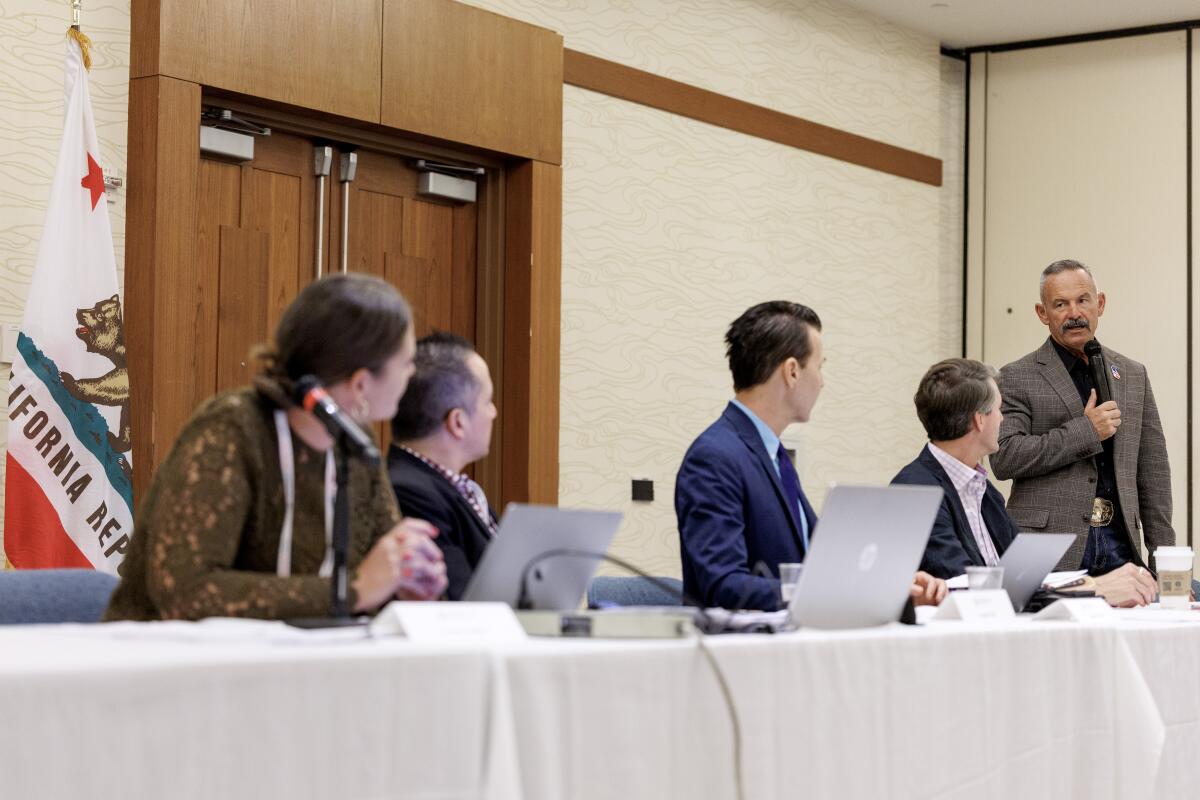
Will O’Neill, chairman, Republican Party of Orange County, Mark Mueser, Dhillon Law Group, Shawn Steel, RNC National Committeeman, Garrett Fahy, chair, Republican National Lawyers Association, and California State Assembly member David Tangipa during the Redistricting Lawfare in 2025 session at the California GOP Convention in Garden Grove on Saturday.

(Eric Thayer / For The Times)

However, amid a sea of “Trump 2028” T-shirts, red MAGA hats and sequined Americana-themed accessories, California Republicans had a brief reprieve from minority status this weekend at their fall convention in Orange County.

Members of the California GOP — often a fractious horde — were energized and united by their opposition to Proposition 50, the ballot measure crafted by Gov. Gavin Newsom and other Democratic leaders to redraw the state’s congressional districts to counter gerrymandering efforts in GOP-led states. Newsom accused Republicans of trying to “rig” the 2026 election at Trump’s behest to keep control of Congress.

Voters will decide its fate in a Nov. 4 special election and receive mail ballots roughly four weeks prior.

“Only one thing really matters. We’ve gotten people in the same room on this issue that hated each other for 20 years, probably for good reasons, based on ego,” said Shawn Steel, one of California’s three members of the Republican National Committee and the chairman of the party’s anti-Proposition 50 campaign, on Saturday. “But those days are over, at least for the next 58 days. … This is more than just unity. It’s survival.”

If approved, Proposition 50 could cost Republicans five seats in the closely divided U.S. House of Representatives and determine control of Congress during Trump’s final two years in office.

More than $40 million has already poured into campaigns supporting and opposing the effort, according to reports of large donations filed with the secretary of state’s office through Saturday.

Spending has been evident as glossy pamphlets opposing the effort landed in voters’ mailboxes even before lawmakers voted to put Proposition 50 on the ballot. This weekend, ads supporting the measure aired during the football game between the University of Michigan and the University of Oklahoma.

At the state GOP convention, which drew 1,143 registered delegates, alternates and guests to the Hyatt Regency in Garden Grove, this priority was evident.

Republican candidates running for governor next year would normally be focused on building support among donors and activists less than a year before the primary. But they foregrounded their opposition to Proposition 50 during the convention.

“I’m supposed to say every time I start talking, the No. 1 most important thing that we can talk about right now is ‘No on 50,’” Riverside County Sheriff Chad Bianco, a GOP gubernatorial candidate, said Saturday as he addressed the Log Cabin Republicans meeting. “So every conversation that you have with people has to begin with ‘No on 50.’ So you say, ‘No on 50. Oh, how are you doing?’”

Bianco and conservative commentator Steve Hilton are the two most prominent Republican candidates in the crowded race to succeed Newsom, who will be termed out in 2026.

The walls of the convention hotel were lined with posters opposing the redistricting ballot measure, alongside typical campaign fliers, rhinestone MAGA broaches and pro-Trump merchandise such as T-shirts bearing his visage that read “Daddy’s Back!” and calling for his election to an unconstitutional third term in 2028.

Though California Republicans last elected statewide candidates in 2006, they have had greater success on ballot measures. Since 2010, the party has been victorious in more than 60% of the propositions it took a position on, according to data compiled by the state GOP.

“We need you to be involved. This is a dire situation,” state Assemblyman David Tangipa (R-Fresno) told a packed ballroom of party activists.

The California GOP Convention in Garden Grove, CA on Saturday, September 6, 2025. (Eric Thayer / For The Times)

Attendees of the Redistricting Lawfare in 2025 session at the California GOP Convention in Garden Grove. (Eric Thayer / For The Times)

Tangipa urged the crowd to reach out to their friends and neighbors with a simple message that is not centered on redistricting, the esoteric process of redrawing congressional districts that typically occurs once every decade following the U.S. census to account for population shifts.

“It’s too hard to talk about redistricting. You know, most people want to get a beer, hang out with their family, go to work, spend time,” he said. “You need to talk to the Republicans [and ask] one question: Does Gov. Newsom and the legislative body in Sacramento deserve more power?”

“No!” the crowd roared.

Should the measure pass, lawyers would challenge the new lines in federal court the next day, attorney and former GOP candidate Mark Meuser said during a separate redistricting panel.

But rather than rely on the courts, panelists hoped to defeat the measure at the ballot box, outlining various messaging strategies for attendees to adopt. Voter outreach trainings took place during the convention, and similar virtual classes were scheduled to begin Monday.

Even with the heavy focus on the redistricting ballot measure, gubernatorial candidates were also skittering around the convention, speaking to various caucuses, greeting delegates in the hallways and holding private meetings.

More than 80 people have signaled their intent to run for governor next year, according to the secretary of state’s office, though some have since dropped out.

Despite being rivals who both hope to win one of the top two spots in the June primary and move on to the November 2026 general election, Bianco and Hilton amicably chatted, a two-man show throughout some of the convention.

Hilton, after posing alongside Bianco at the California MAGA gathering on Friday, argued that the number of Californians who supported Trump in the 2024 election shows that there is a pathway for a Republican to be elected governor next year.

Pointing to glittery gold block letters that spelled MAGA, he said he wanted to swap the first A for a U, so that the acronym stood for “the most useless governor in America, Gavin Newsom.”

“The worst record of any state, the highest unemployment, the highest poverty, the highest taxes, the highest gas prices,” Hilton said. “If we can’t rip these people apart, then we don’t deserve to be here. They’re going to be asking for another four years. They don’t deserve another four minutes.”
California gubernatorial candidate Riverside County Sheriff Chad Bianco speaks at the California GOP Convention in Garden Grove.

(Eric Thayer / For The Times)

At a Saturday gathering of roughly 60 delegates from the conservative northern swath of California, Bianco said he would never say a bad word about his Republican opponents. But, he argued, he was the only candidate who could win the election because of his ability to siphon off Democratic votes because of his law enforcement bona fides.

“Democrats want their kids safe. They want their businesses safe. They want their neighborhoods safe. And they can say, ‘I’ll vote for public safety.’ They’re not even going to say I’m voting for a Republican,” Bianco promised.

As he raised his hands to the crowd with a grin, Bianco’s closely cropped high-and-tight haircut and handlebar mustache instantly telegraphed his law enforcement background, even though his badge and holstered pistol were hidden beneath a gray blazer.

Later, after Bianco addressed a crowd of Central Coast delegates sporting more cowboy hats and fewer button-down shirts, Hilton walked to the front of the room and spoke in his clipped British accent about how another attendee had promised to take him pig hunting.

California gubernatorial candidate Steve Hilton speaks at the California GOP Convention in Garden Grove.

(Eric Thayer / For The Times)

“We weren’t talking about police officers, I want to make that clear!” a man yelled from the crowd.

“Exactly,” Hilton continued, explaining how his family had a salami business in Hungary and he had gotten his hands plenty dirty in the past, “doing every aspect of making sausage, including killing the pigs.”


Source link

South Korea expresses ire at U.S. raid at Hyundai plant, announces deal for detainees’ release

0
South Korea expresses ire at U.S. raid at Hyundai plant, announces deal for detainees’ release

South Korea says the Trump administration has agreed to release the hundreds of Koreans caught last week in the largest U.S. immigration raid.

South Korean presidential chief of staff, Kang Hoon-sik, said Sunday that negotiators were finalizing talks with U.S. officials to secure the release of the workers arrested in a federal immigration crackdown at a factory that South Korean battery maker LG Energy Solution and auto company Hyundai are building in Georgia.

The workers could return home on a chartered flight as early as this week, he said.

“The South Korean government will remain on guard and stay on the situation with responsibility until our citizens have safely returned home,” Kang said at a meeting with senior legislators and Cabinet officials.

On Thursday, federal agents arrested 475 people at the factory site in Ellabell, Ga. More than 300 of those detained were South Korean citizens employed by LG and its subcontractors.

The crackdown came as South Korea’s biggest companies have pledged billions of dollars in new investment to boost their manufacturing operations in the U.S. as part of a trade deal reached by President Trump and his South Korean counterpart Lee Jae Myung this year.

Trump announced in late July that tariffs on most imports from South Korea would be only 15% after South Korea agreed to invest $350 billion in key U.S. industries and purchase $100 billion worth of its liquefied natural gas.

The fact that the raid targeted one of Korea’s most ambitious investments in the U.S. at a time when the country is trying to rapidly ramp up its commitments prompted disbelief and indignation for some in Seoul.

In a news conference Sunday, ruling party lawmaker Oh Gi-hyoung stated that South Koreans should be treated with a level of respect commensurate with their country’s status as a major U.S. ally and investor.

The U.S. currently accounts for the greatest share of South Korea’s overseas investments, receiving $26 billion last year, according to South Korea’s Finance Ministry. South Korea is the U.S.’ 8th largest trading partner, with the two countries exchanging $242.5 billion in goods and services last year.

“If the U.S. genuinely wants to attract investment from South Korean companies, things like this cannot happen,” Oh said.

In a statement released Friday, the U.S. attorney’s office in the Southern District of Georgia said the operation — which was the largest single-site raid in the Department of Homeland Security’s history — was part of a nationwide initiative, known as Operation Take Back America, to “repel the invasion of illegal immigration.”

ICE has said that those arrested were found to be working illegally, many on “short-term or recreational visas,” which do not allow visitors to work.

As of 2022, around 110,000 unauthorized South Korean immigrants were living in the U.S., representing 1% of the total, according to data compiled by the Pew Research Center.

Even if there is a swift release of the workers, experts in South Korea said this heavy-handed action could impact how the Asian nation sees its trade relationship with the U.S.

Industry experts say that the crackdown could lead to logistical challenges for both ongoing and future efforts by South Korean companies in the U.S.

South Korea recently announced a $150-billion project to help revive a declining American shipbuilding industry. In addition, nearly 10 other battery plant projects are underway across the U.S.

For years, companies here have dispatched their own technical specialists to oversee the construction of U.S. factories using nonwork travel permits such as ESTA (Electronic System for Travel Authorization), a visa waiver that allows tourists to stay in the country for up to 90 days.

Though technically the visas do not allow holders to work, “it was tolerated for a long time by U.S. authorities,” said Hwang In-song, an industrial policy expert at the Korea Electronics Technology Institute, a government think tank.

South Korean companies have long complained that the visas legally required for their dispatched workers are too time-consuming and challenging to obtain.

For example, the H-1B visa, which allows people to work, is awarded through a lottery held once a year. And getting one has gotten increasingly difficult under Trump, who has limited its eligibility under the banner of “Buy American, Hire American.”

“South Korean companies are reluctant to go that route because it takes at least 8 months of lead time before you can begin working on an H-1B, and there is no guarantee you will get it,” said Chun Jong-joon, a Korean American immigration lawyer based in Washington.

Hwang said it is nearly impossible to find enough Americans with the skills needed to staff South Korea’s U.S. factories, including for lithium-ion battery manufacturing or shipbuilding.

“As of now, there’s no way other than sending experienced South Korean specialists to help,” Hwang said.

After the release of the detained workers, South Korean officials said that they would pursue improvements to U.S. work permits for South Korean citizens.

Chile, Australia and Singapore have special work visa programs that allow their citizens to work in specialized roles in the U.S.

Until then, the arrests at the Georgia battery plant will probably mean months of costly delays, as the joint venture struggles to redeploy workers.

“In the case of LG Energy Solutions, they will have to think twice before sending their workers to the Georgia plant,” Hwang said.


Source link

San Bernardino Valley College ends losing skid – Press Enterprise

0
San Bernardino Valley College ends losing skid – Press Enterprise


Kane Richardson passed for 148 yards and a touchdown and added 48 yards and another score on the ground as San Bernardino Valley College thumped LA Valley College 33-0 on Saturday in a nonconference game in Valley Glen.

The result was the program’s first win since Sept. 9, 2023. The Wolverines had lost 11 straight games on the field and also forfeited the final eight games of the 2024 season.

Jonathan Coar ran for 75 yards and a touchdown on 13 carries for SBVC (1-1).

The Wolverines host Compton College in a nonconference game Saturday at 1 p.m.

RCC FALLS TO GOLDEN WEST

Noa Banua passed for 229 yards and three touchdowns and added 59 yards and a score on the ground to lead Golden West College to a 42-35 win over Riverside City College in a nonconference game in Huntington Beach.

RCC (1-1) entered the contest ranked No. 2 in the 3C2A state rankings. Golden West (2-0) was No. 7 in those same rankings.

Jared Doolittle completed 23 of 40 passes for 385 yards and three touchdowns to lead the way for RCC.

RCC led 21-7 midway through the second quarter, but Golden West rattled off 28 consecutive points to take command.

Aaron Mitchell and Kendric Thompson combined to rush for 141 yards and two touchdowns for Golden West. Tanner Schmidt caught five passes for 84 yards and a touchdown, and Will McKissick had seven receptions for 83 yards and a touchdown for the Rustlers.

Ross Nickson III had six receptions for 103 yards and touchdowns for RCC.

The Tigers look to bounce back when they travel to Canyons for a nonconference game Saturday at noon.

REDLANDS WINS DEFENSIVE BATTLE

Taylor Bowie ran for 134 yards on 16 carries and scored a touchdown as University of Redlands opened its season with a 10-7 victory over George Fox University in a nonconference game Saturday in Redlands.

Kaleb Gibbs had two interceptions for the Bulldogs, and Skye Tait picked off another pass with 4:08 left in the game to help preserve the victory.

Jakai Torres caught eight passes for 72 yards for Redlands.

The Bulldogs return to action Sept. 20, when they travel to Spokane, Wash., for a nonconference game against Whitworth University.

RUSSO LEADS POMONA-PITZER TO VICTORY

Grady Russo passed for 325 yards and three touchdowns and added another 109 yards and two touchdowns on the ground as Pomona-Pitzer won its season opener, a 41-17 victory over Willamette University in a nonconference game Saturday in Salem, Ore.

The Sagehens will take a bye week then host Lewis & Clark College in a nonconference game Saturday, Sept. 20.

CMS OUTLASTS LAKE FOREST

Robert Litscher tossed two touchdown passes in the fourth quarter to lead Claremont-Mudd-Scripps to a 14-7 season-opening victory over Lake Forest College in a nonconference game Saturday in Chandler, Ariz.

The game was scoreless after three quarters. Litscher connected with Ben Kim for a 21-yard touchdown on the first play of the fourth quarter. Litscher found James Ryan for a 17-yard touchdown with 8:03 left in the game.

Michael Houk and Evan Gerber had two sacks apiece for the Stags.

CMS returns to action Sept, 20, when it travels to Newberg, Ore., for a nonconference game against George Fox.

CHAFFEY ROLLS PAST SANTA ANA

Frankie Villalbazo tossed three touchdowns passes as Chaffey College cruised to a 38-9 victory over Santa Ana College in a nonconference game Saturday in Rancho Cucamonga,

Chaffey’s defense intercepted four passes, including two by William Harper. Donovan Brown returned another pick 68 yards for a touchdown.

The Panthers (1-1)  host Moorpark in a nonconference game Saturday at 6 p.m.

MSJC SOARS PAST LONG BEACH

Julian Silva threw three touchdowns passes as Mt. San Jacinto College routed Long Beach City College 52-20 in a nonconference game Saturday in Long Beach.

Cole Vasquez ran for one touchdown and also threw a touchdown pass for the Eagles (1-1). William Ford led the ground attack with 66 yards and a touchdown, and Ifeanyi Onye recovered a fumble in the end zone for a score.

MSJC hosts Orange Coast College in a nonconference game Saturday at 6 p.m. at HCN Stadium in Menifee.


Source link

Angel City FC falls to Gotham FC – Press Enterprise

0
Angel City FC falls to Gotham FC – Press Enterprise


HARRISON, N.J. — Kennedy Fuller scored in the 2nd minute, but Angel City FC fell 3-1 to Gotham FC on Sunday at Sports Illustrated Stadium.

Fuller opened the scoring with a right-footed shot from outside the box. Gabi Portilho equalized in the 47th minute from close range off a pass from Midge Purce.

Rose Lavelle put Gotham ahead four minutes later, and Jaelin Howell added insurance in the 68th minute with a strike from outside the box off a pass from Geyse.

With the result, Gotham improved to 7-6-6 while Angel City moved to 6-5-8.


Source link

AI shakes up the call center industry, but some tasks are still better left to the humans

0
AI shakes up the call center industry, but some tasks are still better left to the humans

NEW YORK — Armen Kirakosian remembers the frustrations of his first job as a call center agent nearly 10 years ago: the aggravated customers, the constant searching through menus for information and the notes he had to physically write for each call he handled.

Thanks to artificial intelligence, the 29-year-old from Athens, Greece, is no longer writing notes or clicking on countless menus. He often has full customer profiles in front of him when a person calls in and may already know what problem the customer has before even saying “hello.” He can spend more time actually serving the customer.

“A.I. has taken (the) robot out of us,” Kirakosian said.

Roughly 3 million Americans work in call center jobs, and millions more work in call centers around the world, answering billions of inquiries a year about everything from broken iPhones to orders for shoes. Kirakosian works for TTEC, a company that provides third party customer service lines in 22 countries to companies in industries such as autos and banking that need extra capacity or have outsourced their call center operations.

Answering these calls can be thankless work. Roughly half of all customer service agents leave the job after a year, according to McKinsey, with stress and monotonous work being among the reasons employees quit.

Much of what these agents deal with is referred to in the industry as “break/fix,” which means something is broken — or wrong or confusing — and the customer expects the person on the phone to fix the problem. Now, it’s a question of who will be tasked with the fix: a human, a computer, or a human augmented by a computer.

Already, AI agents have taken over more routine call center tasks. Some jobs have been lost and there have been dire forecasts about the future job market for these individuals, ranging from modest single-percentage point losses, to as many as half of all call center jobs going away in the next decade. The drop likely won’t match the more dire predictions, however, because it’s become evident that the industry will still need humans, perhaps with even higher levels of learning and training, as some customer service issues become increasingly harder to solve.

Some finance companies have already experimented with going in heavily with AI for their customer service issues.

Klarna, the Swedish buy now, pay later company, replaced 700 of their roughly 3,000 customer service agents with chatbots and AI in 2024. The results were mixed. While the company did save money, Klarna found there was still a need for higher skilled human agents in certain circumstances, such as complicated issues related to identity theft. Earlier this year, Klarna hired seven internal freelancers to handle these issues.

Earlier this year, Klarna hired a handful of customer service employees back to the firm, acknowledging there were certain issues that AI couldn’t handle as well as a real person, like identity theft.

“Our vision of an AI-first contact center, where AI agents handle the majority of conversations and fewer, better trained and better paid human agents support only the most complex tasks, is quickly becoming a reality,” said Gadi Shamia of Replicant, an AI-software company that trains chatbots to sound more human, in an interview with consultants at McKinsey.

The call center customer’s experience, while improved, is still far from perfect.

The initial customer service call has long been handled through interactive voice response systems, known in the industry as IVR. Customers interact with IVR when they’re told “press one for sales, press two for support, press five for billing.” These crude systems got an update in the 2010s, when customers could prompt the system by saying “sales” or “support” or simple phrases like “I’d like to pay a bill” instead of navigating through a labyrinthian set of menu options.

But customers have little patience for these menus, leading them to “zero out,” which is call center slang for when a customer hits the zero button on their their keypad in hopes of reaching a human. It’s also not uncommon that after a customer “zeros out” they will be put on hold and transferred because they did not end up in the right place for their request.

Aware of Americans’ collective impatience with IVR, Democratic Sen. Ruben Gallego of Arizona and Republican Jim Justice of West Virginia have introduced the “Keep Call Centers in America Act,” which would require clear ways to reach a human agent, and provide incentives to companies that keep call center jobs in the U.S.

Companies are trying to roll out telephone systems that broadly understand customer service requests and predict where to send a customer without navigating a menu. OpenAI, the maker of ChatGPT, is coming out with its “ChatGPT Agent” service for users that’s able to understand phrases like “I need to find a hotel for a wedding next year, please give me options for clothing and gifts.”

Bank of America says it has had increasing success in integrating such features into “Erica,” its chatbot that debuted in 2018. When Erica cannot handle a request, the agent transfers the customer directly to the right department. Erica is now also predictive and analytical, and knows for instance that a customer may repeatedly have a low balance and may need better help budgeting or may have multiple subscriptions to the same service.

Bank of America said this month that Erica has been used 3 billion times since its creation and is increasingly taking on a higher case load of customer service requests. The chatbot’s moniker comes from the last five letters of the company’s name.

James Bednar, vice president of product and innovation at TTEC, has spent much of his career trying to make customer service calls less painful for the caller as well as the company. He said these tools could eventually kill off IVR for good, ending the need for anyone to “zero out.”

“We’re getting to the point where AI will get you to the right person for your problem without you having to route through those menus,” Bednar said.


Source link

AI shakes up the call center industry, but some tasks are still better left to the humans

0
AI shakes up the call center industry, but some tasks are still better left to the humans

NEW YORK — Armen Kirakosian remembers the frustrations of his first job as a call center agent nearly 10 years ago: the aggravated customers, the constant searching through menus for information and the notes he had to physically write for each call he handled.

Thanks to artificial intelligence, the 29-year-old from Athens, Greece, is no longer writing notes or clicking on countless menus. He often has full customer profiles in front of him when a person calls in and may already know what problem the customer has before even saying “hello.” He can spend more time actually serving the customer.

“A.I. has taken (the) robot out of us,” Kirakosian said.

Roughly 3 million Americans work in call center jobs, and millions more work in call centers around the world, answering billions of inquiries a year about everything from broken iPhones to orders for shoes. Kirakosian works for TTEC, a company that provides third party customer service lines in 22 countries to companies in industries such as autos and banking that need extra capacity or have outsourced their call center operations.

Answering these calls can be thankless work. Roughly half of all customer service agents leave the job after a year, according to McKinsey, with stress and monotonous work being among the reasons employees quit.

Much of what these agents deal with is referred to in the industry as “break/fix,” which means something is broken — or wrong or confusing — and the customer expects the person on the phone to fix the problem. Now, it’s a question of who will be tasked with the fix: a human, a computer, or a human augmented by a computer.

Already, AI agents have taken over more routine call center tasks. Some jobs have been lost and there have been dire forecasts about the future job market for these individuals, ranging from modest single-percentage point losses, to as many as half of all call center jobs going away in the next decade. The drop likely won’t match the more dire predictions, however, because it’s become evident that the industry will still need humans, perhaps with even higher levels of learning and training, as some customer service issues become increasingly harder to solve.

Some finance companies have already experimented with going in heavily with AI for their customer service issues.

Klarna, the Swedish buy now, pay later company, replaced 700 of their roughly 3,000 customer service agents with chatbots and AI in 2024. The results were mixed. While the company did save money, Klarna found there was still a need for higher skilled human agents in certain circumstances, such as complicated issues related to identity theft. Earlier this year, Klarna hired seven internal freelancers to handle these issues.

Earlier this year, Klarna hired a handful of customer service employees back to the firm, acknowledging there were certain issues that AI couldn’t handle as well as a real person, like identity theft.

“Our vision of an AI-first contact center, where AI agents handle the majority of conversations and fewer, better trained and better paid human agents support only the most complex tasks, is quickly becoming a reality,” said Gadi Shamia of Replicant, an AI-software company that trains chatbots to sound more human, in an interview with consultants at McKinsey.

The call center customer’s experience, while improved, is still far from perfect.

The initial customer service call has long been handled through interactive voice response systems, known in the industry as IVR. Customers interact with IVR when they’re told “press one for sales, press two for support, press five for billing.” These crude systems got an update in the 2010s, when customers could prompt the system by saying “sales” or “support” or simple phrases like “I’d like to pay a bill” instead of navigating through a labyrinthian set of menu options.

But customers have little patience for these menus, leading them to “zero out,” which is call center slang for when a customer hits the zero button on their their keypad in hopes of reaching a human. It’s also not uncommon that after a customer “zeros out” they will be put on hold and transferred because they did not end up in the right place for their request.

Aware of Americans’ collective impatience with IVR, Democratic Sen. Ruben Gallego of Arizona and Republican Jim Justice of West Virginia have introduced the “Keep Call Centers in America Act,” which would require clear ways to reach a human agent, and provide incentives to companies that keep call center jobs in the U.S.

Companies are trying to roll out telephone systems that broadly understand customer service requests and predict where to send a customer without navigating a menu. OpenAI, the maker of ChatGPT, is coming out with its “ChatGPT Agent” service for users that’s able to understand phrases like “I need to find a hotel for a wedding next year, please give me options for clothing and gifts.”

Bank of America says it has had increasing success in integrating such features into “Erica,” its chatbot that debuted in 2018. When Erica cannot handle a request, the agent transfers the customer directly to the right department. Erica is now also predictive and analytical, and knows for instance that a customer may repeatedly have a low balance and may need better help budgeting or may have multiple subscriptions to the same service.

Bank of America said this month that Erica has been used 3 billion times since its creation and is increasingly taking on a higher case load of customer service requests. The chatbot’s moniker comes from the last five letters of the company’s name.

James Bednar, vice president of product and innovation at TTEC, has spent much of his career trying to make customer service calls less painful for the caller as well as the company. He said these tools could eventually kill off IVR for good, ending the need for anyone to “zero out.”

“We’re getting to the point where AI will get you to the right person for your problem without you having to route through those menus,” Bednar said.


Source link

Florida’s plan to drop school vaccine rule won’t start for 90 days, won’t cover all diseases

0
Florida’s plan to drop school vaccine rule won’t start for 90 days, won’t cover all diseases

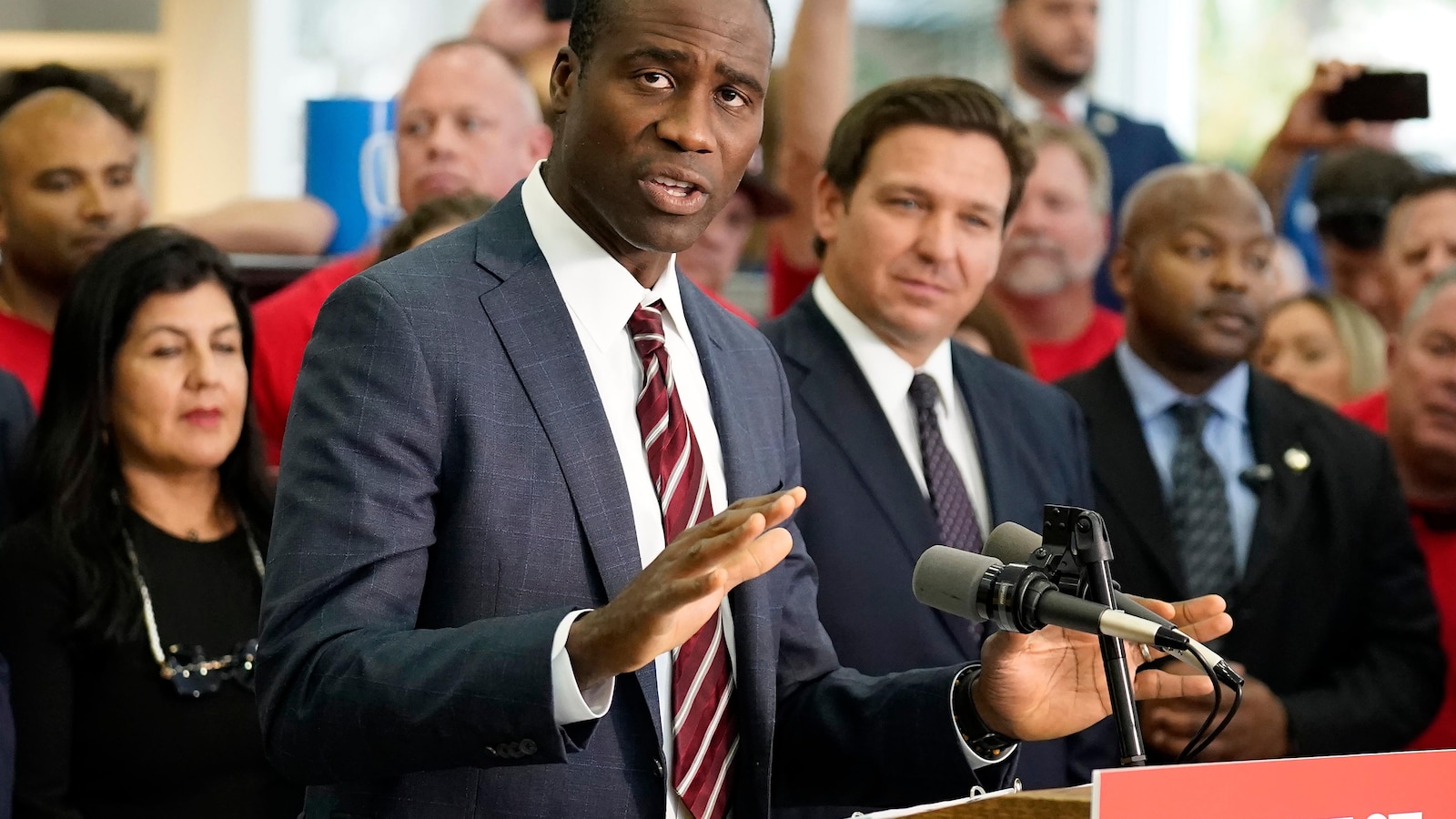
Florida’s plan to drop school vaccine mandates likely won’t take effect for 90 days and would include only chickenpox and a few other illnesses unless lawmakers decide to extend it to other diseases, like polio and measles, the health department said Sunday.

The department responded to a request for details, four days after Florida’s surgeon general, Dr. Joseph Ladapo, said the state would become the first to make vaccinations voluntary and let families decide whether to inoculate their children.

It’s a retreat from decades of public policy and research that has shown vaccines to be safe and the most effective way to stop the spread of communicable diseases, especially among children. Despite that evidence, U.S. Health Secretary Robert F. Kennedy Jr. has expressed deep skepticism about vaccines.

Florida’s plan would lift mandates on school vaccines for hepatitis B, chickenpox, Hib influenza and pneumococcal diseases, such as meningitis, the health department said.

“The Department initiated the rule change on September 3, 2025, and anticipates the rule change will not be effective for approximately 90 days,” the state told The Associated Press in an email. The public school year in Florida started in August.

All other vaccinations required under Florida law to attend school “remain in place, unless updated through legislation,” including vaccines for measles, polio, diphtheria, pertussis, mumps and tetanus, the department said.

Lawmakers don’t meet again until January 2026, although committee meetings begin in October.

Ladapo, appearing Sunday on CNN, repeated his message of free choice for childhood vaccines.

“If you want them, God bless, you can have as many as you want,” he said. “And if you don’t want them, parents should have the ability and the power to decide what goes into their children’s bodies. It’s that simple.”

Florida currently has a religious exemption for vaccine requirements. Vaccines have saved at least 154 million lives globally over the past 50 years, the World Health Organization reported in 2024. The majority of those were infants and children.

Dr. Rana Alissa, chair of the Florida Chapter of the American Academy of Pediatrics, said making vaccines voluntary puts students and school staff at risk.

This is the worst year for measles in the U.S. in more than three decades, with more than 1,400 cases confirmed nationwide, most of them in Texas, and three deaths.

Whooping cough has killed at least two babies in Louisiana and a 5-year-old in Washington state since winter, as it too spreads rapidly. There have been more than 19,000 cases as of Aug. 23, nearly 2,000 more than this time last year, according to preliminary CDC data.


Source link

Florida’s plan to drop school vaccine rule won’t start for 90 days, won’t cover all diseases

0
Florida’s plan to drop school vaccine rule won’t start for 90 days, won’t cover all diseases

Florida’s plan to drop school vaccine mandates likely won’t take effect for 90 days and would include only chickenpox and a few other illnesses unless lawmakers decide to extend it to other diseases, like polio and measles, the health department said Sunday.

The department responded to a request for details, four days after Florida’s surgeon general, Dr. Joseph Ladapo, said the state would become the first to make vaccinations voluntary and let families decide whether to inoculate their children.

It’s a retreat from decades of public policy and research that has shown vaccines to be safe and the most effective way to stop the spread of communicable diseases, especially among children. Despite that evidence, U.S. Health Secretary Robert F. Kennedy Jr. has expressed deep skepticism about vaccines.

Florida’s plan would lift mandates on school vaccines for hepatitis B, chickenpox, Hib influenza and pneumococcal diseases, such as meningitis, the health department said.

“The Department initiated the rule change on September 3, 2025, and anticipates the rule change will not be effective for approximately 90 days,” the state told The Associated Press in an email. The public school year in Florida started in August.

All other vaccinations required under Florida law to attend school “remain in place, unless updated through legislation,” including vaccines for measles, polio, diphtheria, pertussis, mumps and tetanus, the department said.

Lawmakers don’t meet again until January 2026, although committee meetings begin in October.

Ladapo, appearing Sunday on CNN, repeated his message of free choice for childhood vaccines.

“If you want them, God bless, you can have as many as you want,” he said. “And if you don’t want them, parents should have the ability and the power to decide what goes into their children’s bodies. It’s that simple.”

Florida currently has a religious exemption for vaccine requirements. Vaccines have saved at least 154 million lives globally over the past 50 years, the World Health Organization reported in 2024. The majority of those were infants and children.

Dr. Rana Alissa, chair of the Florida Chapter of the American Academy of Pediatrics, said making vaccines voluntary puts students and school staff at risk.

This is the worst year for measles in the U.S. in more than three decades, with more than 1,400 cases confirmed nationwide, most of them in Texas, and three deaths.

Whooping cough has killed at least two babies in Louisiana and a 5-year-old in Washington state since winter, as it too spreads rapidly. There have been more than 19,000 cases as of Aug. 23, nearly 2,000 more than this time last year, according to preliminary CDC data.


Source link

Chicago churches urge calm resistance to expected federal intervention

0
Chicago churches urge calm resistance to expected federal intervention

CHICAGO — The Rev. Marshall Hatch urged congregants of a prominent Black church on Chicago’s West Side to carry identification, stay connected to family and protest as the city readied for an expected federal intervention.

“You need to start telling people about your whereabouts, so you don’t disappear,” Hatch said during Sunday services at New Mount Pilgrim Missionary Baptist Church. “We’re not going to despair. We’re not going to feel threatened. We’re not going to give up and give in to fascism and authoritarianism.”

As Chicago braced for an immigration enforcement crackdown and a possible National Guard deployment, churches across the city turned up their response from the pulpit. Some worked to quell fears about detention and deportation while others addressed the looming possibility of more law enforcement on the streets of the nation’s third-largest city.

President Donald Trump has threatened federal intervention in Democratic strongholds, most recently warning apocalyptic force could be used in Chicago to fight crime and step up deportations. He’s repeatedly cited the expected plans over fierce objections from local leaders and many residents who call it unnecessary and unwanted.

While fears have been high in immigrant circles since Trump took office the second time, the threat of more federal agencies and troops has also inflamed tensions, particularly in Black and Latino communities where trust in police is fragile.

Among the church attendees was Lester Burks, a 74-year-old U.S. Army veteran who said a military presence in Chicago would be threatening.

“I don’t want soldiers here,” he said. “They are trained to fight.”

Details on the expected intervention have been sparse, including its focus and when it’s expected to begin. Trump’s border czar Tom Homan said Sunday on CNN’s “State of the Union” that federal law enforcement action will come to Chicago this week. He also promised more worksite enforcement operations like the massive one at a Hyundai plant in Georgia.

“You can expect action in most sanctuary cities across the country,” he said.

The Trump administration has repeatedly targeted, and unsuccessfully sued, over Chicago’s sanctuary laws, which are among the strongest in the nation. His administration launched a nationwide immigration enforcement operation in the city in January.

There is no official definition for sanctuary policies or sanctuary cities. The terms generally describe limits on local cooperation with Immigration and Customs Enforcement. ICE enforces U.S. immigration laws nationwide but sometimes seeks state and local help.

This time, the Department of Homeland Security plans to use a military base north of the city and has alerted leaders of another suburb that they’ll use a federal immigration processing center there for an operation that’ll potentially last 45 days. Meanwhile, Trump has said he might send National Guard troops to New Orleans before Chicago.

Trump has already deployed the National Guard into Los Angeles and Washington, D.C., where he’s also federalized the police force. A federal judge has ruled the Los Angeles deployment is illegal.

“We don’t need another level of law enforcement and their presence to pretend they’re going to solve problems related to violence,” U.S. Rep. Danny Davis, a Democrat, said at a Sunday news conference with other Black elected leaders on the city’s West Side.

Most of Chicago’s nearly 3 million people are Black or Latino. New Mount Pilgrim is located in the city’s West Garfield Park neighborhood, a largely Black neighborhood which has faced persistent crime and years of disinvestment, including five schools near the church that closed in 2013 as part of the largest mass public closure in U.S. history.

The church has often called for action against street violence even as Chicago’s rates of violent crime have dropped substantially in recent years as part of a national trend. Its large stained glass art installations depict the lives of slaves and memorialize Black people killed by violence. On Sunday, the church celebrated the groundbreaking of a nearby arts and activism center it said was part of the solution.

“We’re not calling for military, we’re calling for resources,” Hatch told congregants. “We know that there is a correlation between resources and violence.”

Elsewhere in the city, other churches worked to remind people of their rights when it comes to interactions with immigration agents, urging them to carry necessary documents.

The feeling of being on edge was familiar to many in Chicago, and the expected operation put a damper on the city’s usually festive Mexican Independence Day celebrations. Church leaders said the January immigration operation in Chicago had a chilling effect on attendance at immigrant-heavy and Latino churches as people stayed home.

Clergy said they were preparing for the same in the weeks ahead.

“It feels like anything can happen at any moment,” said the Rev. Paco Amador of New Life Community Church in the predominantly Mexican Little Village neighborhood. “It would be irresponsible not to talk about this.”

__

Associated Press writer Calvin Woodward contributed to this report from Washington.


Source link

Lottery spending is growing. Residents shell out the most in these states.

0
Lottery spending is growing. Residents shell out the most in these states.

The Powerball jackpot swelled to nearly $1.8 billion before two lucky tickets hit the winning numbers on Saturday night, Sept. 6. Powerball says the bit winners bought their tickets in Texas and Missouri, but some states have a larger share of participants than others.

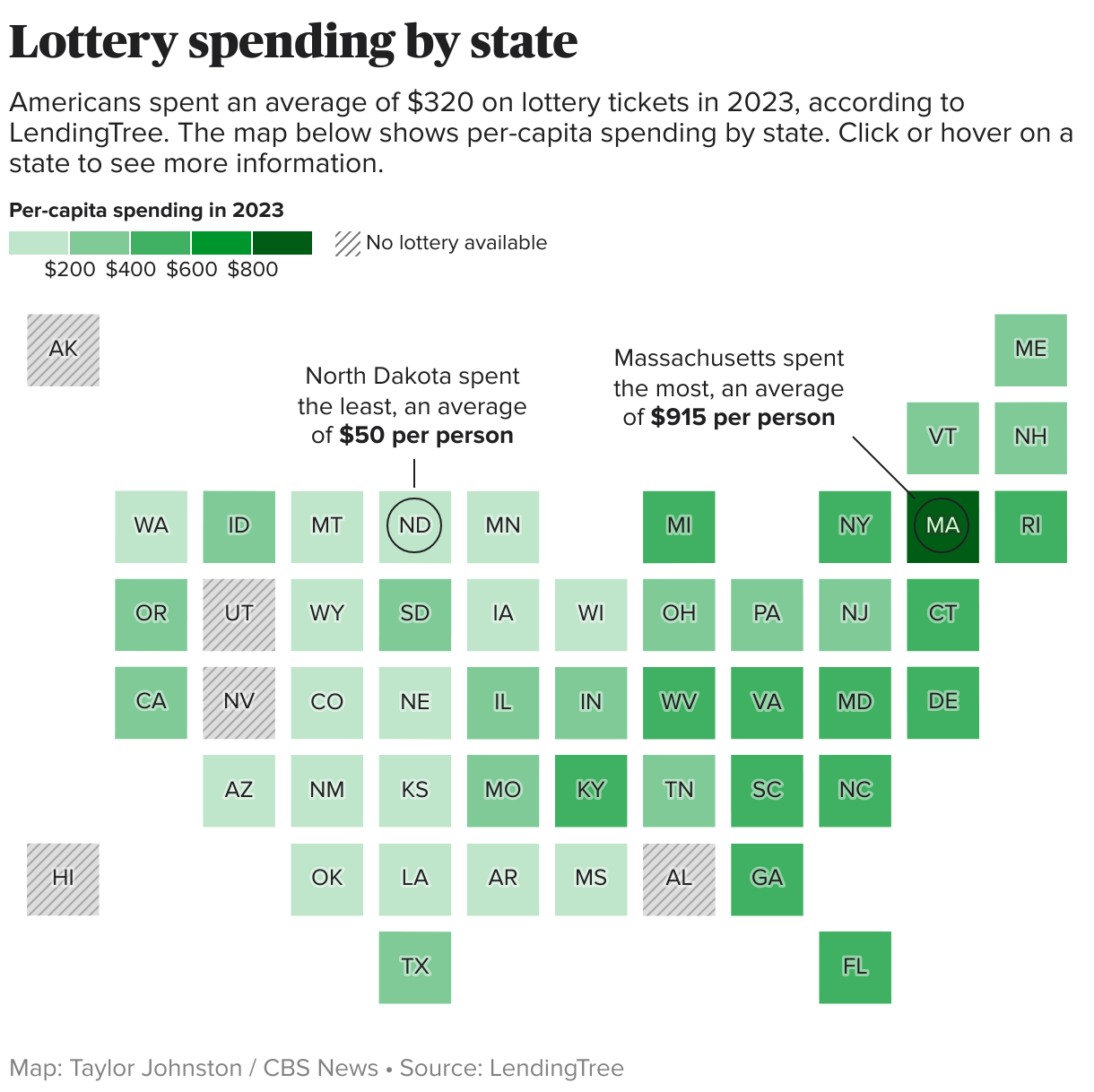
Massachusetts leads the way in lottery spending, according to a LendingTree analysis of government data. Residents there shell out an average of $915 a year on tickets they hope will earn them big bucks. Rhode Island residents come in second, spending $573 annually.

North Dakotans are perhaps the most realistic about their chances of winning. They spent just $50 on lottery tickets in 2023, the lowest of any other state.

But that may be because lottery tickets are harder to access there, according to LendingTree’s chief consumer finance analyst Matt Schulz, who noted that people in urban areas have more opportunities to purchase lottery tickets than those in rural areas. 

“It’s easier to go to a convenience store and pick up a lotto ticket in Massachusetts or New York than it is in North Dakota,” he told CBS MoneyWatch. “Some of it might just be about opportunity.”

Lottery spending by state (Choropleth map)


Source of revenue

Lottery spending can generate a substantial amount of revenue in participating states. On average it accounts for about 1% of a state’s general revenue. That figure rises to 3% in Rhode Island, South Dakota and West Virginia, according to the LendingTree’s analysis. In Florida, lottery sales make up 2% of the state’s revenue. 

“That shows how significant these programs are for these states,” Schulz said. “Imagine if something were to happen and suddenly 3% of a state’s revenue just disappeared.”

While the odds of winning are next-to-none, a prize-winning ticket can be life-changing. In 2023, Americans spent an average of $320 on lottery tickets, up about 4% from 2022, according to LendingTree. 

Saturday’s jackpot — worth a total of $1.787 billion, or $820.6 million if taken in a lump-sum cash payout — is the second-largest prize in U.S. lottery history, according to Powerball. The record jackpot of $2.04 billion was won on Nov. 7, 2022.


Source link

Data center demand is booming. Can the supply of trade workers keep up?

0
Data center demand is booming. Can the supply of trade workers keep up?

Brandyn Frye feels squeezed by two businesses trending in opposite directions — data centers such as one he manages outside Chicago hum along with soaring demand for workers to keep them running.

“Everything in here needs service — tech support, HVAC support, electricians,” Frye said.

But the supply of technical support he needs available 24/7 keeps shrinking, threatening his ability to retain customers.

Data centers now compete with factories and manufacturing plants for electricians and plumbers. As older blue collar workers retire, younger people look at college and white collar jobs.

Roughly 400,000 skilled trade jobs are unfilled in America, according to the Bureau of Labor Statistics. By 2033, it’s estimated that number could hit close to 2 million, according to Deloitte and the Manufacturing Institute.

Matt Breslin, an executive for the software company IFS, says new technology is one solution. His company sells a program that helps companies route and re-route their fleet of technicians.

“You can take things like weather, traffic, different priorities and add that on top. When you think about the labor shortages out there and you want to create more efficiencies and do more with less, this is how that’s going to happen,” Breslin said.

Back at the data center, HVAC technician Dan Brown knows there’s a labor crisis, but doesn’t understand it. In Chicago, Brown said, experienced HVAC technicians can make more than $150,000 without student debt.

“The trades kind of got neglected, so now there’s a void that needs to be filled,” Brown said.

Across the floor, electrician Kevin Fishback sees hope. His local union is aggressively recruiting young electricians in its apprenticeship program.

“They come into the trades and they got insurance, they got health care, they got a pension,” Fishback said.

That’s an update with power for Brandyn Frye.

“This career path is out there, and it is a valuable career path to take,” Fyre said.


Source link

Woman lost in Michigan woods during YouTube challenge found with help from police helicopter camera

0
Woman lost in Michigan woods during YouTube challenge found with help from police helicopter camera

Escapee from Inkster police has been found; Powerball jackpot grows; weather and other top stories


Escapee from Inkster police has been found; Powerball jackpot grows; weather and other top stories

04:00

A Michigan State Police helicopter crew found a woman who got lost in a state forest during a YouTube challenge on Saturday morning, officials said.

Troopers with the state agency were at the Pigeon River State Forest in northern Michigan to help the Otsego County Sheriff’s Office find a missing 36-year-old California woman. Police said she was a contestant in a YouTube survival challenge, had become lost on Friday evening and was reported missing at 5 a.m. Saturday.

State police canines searched the dense forest before the helicopter, coined Trooper 6, was called to the area.

The crew operating Trooper 6 spotted the woman using the aircraft’s camera around 10:40 a.m., officials said.

screenshot-20250907-124738.png

Footage from Trooper 6, a Michigan State Police helicopter, shows a 36-year-old California woman who was lost in the Pigeon River State Forest on Sept. 6, 2025.

Michigan State Police


Law enforcement and firefighters were able to walk the woman out of the woods.  

In April, drone cameras found another missing woman who was lost in the woods of West Michigan for three days.


Source link

Sen. Tammy Duckworth says Trump “essentially just declared war” on Chicago, but there’s no “indications” of deployment

0
Sen. Tammy Duckworth says Trump “essentially just declared war” on Chicago, but there’s no “indications” of deployment

Sen. Tammy Duckworth, an Illinois Democrat, said Sunday that President Trump “essentially just declared war on a major city in his own nation” referring to his recent remarks about Chicago. But she outlined that “we don’t have any indications” that the administration is getting ready to send troops into the nation’s third-largest city, despite signals in recent weeks that he is preparing to do so. 

“This is not normal,” Duckworth said of Mr. Trump’s statements on “Face the Nation with Margaret Brennan.” “This is not acceptable behavior.”

In a Truth Social post on Saturday, Mr. Trump shared a screenshot that read “Chicago about to find out why it’s called the Department of WAR,” alongside an AI-generated image that appeared to be inspired by the movie “Apocalypse Now.” On Friday, Mr. Trump signed an executive order to rename the Department of Defense the Department of War, though a formal name change would have to go through Congress. He is expected to seek congressional approval. 

Mr. Trump told reporters Sunday that “we’re not going to war.”

“We’re going to clean up our cities. We’re going to clean them up so they don’t kill five people every weekend,” the president said. “That’s not war, that’s common sense.”

The post marked the latest in a series of threats Mr. Trump has made to send troops to Chicago as part of a nationwide crackdown on illegal immigration and crime, following his decision to deploy the National Guard to Los Angeles in June. California Gov. Gavin Newsom challenged the legality of that deployment, and a judge ruled last week that it violated federal law, although the ruling appeared to only apply to California. 

Despite Mr. Trump’s rhetoric, Vice President JD Vance said in recent days that the administration has “no immediate plans” to send National Guard forces to Chicago. The comments came one day after Mr. Trump again suggested he would send federal forces to Chicago, saying “we’re going in.”

Still, Duckworth said she takes what the president says seriously.

“I take what the president of the United States says very seriously, because that is the respect you have to give to the office,” Duckworth said. “And if that’s what he’s declaring, then let me make it clear: it would be an illegal order to declare war on a major city, any city within the United States, by the President of the United States.”

Duckworth was among a group of Illinois leaders who visited the Naval Station Great Lakes Saturday, following news that some federal immigration enforcement agents will be based there. She said military leadership confirmed that the only assistance they’ve been requested to provide to the federal government is for office space for ICE.

“No barracks, no detention facilities, none of that is being requested or prepared in order to support troops into Chicago,” Duckworth said. 

The Illinois Democrat said “we certainly have sent the administration multiple inquiries about what they are planning on doing,” adding that the administration hasn’t reached out to local law enforcement to try to coordinate.

“If they were truly, truly interested in fighting crime, then they would work with local law enforcement and ask them, ‘What do you need? What help do you need?'” Duckworth said. “And we’ve not gotten any, any communications or feedback from the administration whatsoever.”

The developments come after Mr. Trump deployed the National Guard in Washington, D.C. last month as part of an anti-crime initiative, while vowing to intervene in cities like Chicago and Baltimore next. 

Local leaders have pushed back on the federal government’s threats to intervene on crime in Chicago, which could draw legal challenges.

A CBS News poll released Sunday found that a majority of Americans, 58%, are opposed to the president deploying National Guard troops to other cities beyond Washington, D.C. But a large majority, 85%, of his Republican base support these deployments. 


Source link

Prop. 50 is a cynical attack on free and fair elections  – Orange County Register

0
Prop. 50 is a cynical attack on free and fair elections  – Orange County Register


In 2001, then-Rep. Loretta Sanchez explained to the Orange County Register how gerrymandering worked after the 2000 U.S. Census.

“If my colleagues are smart, they’ll pay their $20,000, and Michael [Berman] will draw the district they can win in. Those who have refused to pay? God help them.”

As columnist Dan Walters explained, Berman was a top Democratic Party honcho who pioneered “microtargeting voters” through computer algorithms to gerrymander legislative and congressional districts, which then were drawn by the Democrat-dominated Legislature.

As a result of that and other outrages, in 2008 voters passed Proposition 11, the Voters FIRST Act. It gave redistricting of Assembly and state Senate districts to a new, independent Citizens Redistricting Commission, consisting of 14 members: five from each of the two largest parties, plus four independents. In 2010, 61% of voters passed Proposition 20, the Voters FIRST Act for Congress, giving the commission redistricting authority over districts for U.S. representatives.

That gerrymandered redistricting system of two decades ago is what Gov. Gavin Newsom wants to return to with Proposition 50, which voters will decide on Nov. 4. The official title voters will read itself shows why it ought to be rejected: “AUTHORIZES TEMPORARY CHANGES TO CONGRESSIONAL DISTRICT MAPS IN RESPONSE TO TEXAS’ PARTISAN REDISTRICTING.”

Texas’ redistricting scheme, signed into law on Aug. 29 by Gov. Gregg Abbott and supported by President Trump, indeed is partisan. It changes maps mid-term, before the 2030 Census. And it’s expected to gerrymander several new victories for Republicans. We denounced it in an Aug. 19 editorial.

This is California, not Texas. To fight an attack on democracy in Texas, we shouldn’t attack democracy here with a Rube Goldberg scheme designed to advance Newsom’s presidential profile and pad his fundraising lists. As Mom taught: Two wrongs don’t make a right.

As a practical matter, California making this move will only further inflame the gerrymandering problem, encouraging a further spiral of gerrymandering offsetting Democratic gains in other states. Bad actions often yield more bad actions.

There’s also a fair question: Will this really be temporary? If California Democrats are successful at getting voters to let them gerrymander the state, do you think the state’s dominant party will simply give up power and let more Republicans get elected in the future?

One of the best things Props. 11 and 20 did was instruct the commission to draw district lines close to the physical boundaries of cities and counties, which each have different needs best not divided, when possible. The gerrymandered Prop. 50 districts passed by the Legislature would end that and stick them with polities often of disparate conditions and needs.

Norco Mayor Greg Newton told the newspaper his city “will not receive the same level of advocacy or support in a (new) district that crosses county lines, with much larger cities who have different needs than Norco.” This is the sort of problem communities across California will see if Newsom gets his way and California is gerrymandered.

The California Redistricting Commission has worked fine. It’s protecting our democracy. It’s ensuring a reasonable degree of representation for more conservative Californians. Proposition 50 undermines all of this just to spit in the face of California Republicans.


Source link

Prop. 50 is a cynical attack on free and fair elections  – Press Enterprise

0
Prop. 50 is a cynical attack on free and fair elections  – Press Enterprise


In 2001, then-Rep. Loretta Sanchez explained to the Orange County Register how gerrymandering worked after the 2000 U.S. Census.

“If my colleagues are smart, they’ll pay their $20,000, and Michael [Berman] will draw the district they can win in. Those who have refused to pay? God help them.”

As columnist Dan Walters explained, Berman was a top Democratic Party honcho who pioneered “microtargeting voters” through computer algorithms to gerrymander legislative and congressional districts, which then were drawn by the Democrat-dominated Legislature.

As a result of that and other outrages, in 2008 voters passed Proposition 11, the Voters FIRST Act. It gave redistricting of Assembly and state Senate districts to a new, independent Citizens Redistricting Commission, consisting of 14 members: five from each of the two largest parties, plus four independents. In 2010, 61% of voters passed Proposition 20, the Voters FIRST Act for Congress, giving the commission redistricting authority over districts for U.S. representatives.

That gerrymandered redistricting system of two decades ago is what Gov. Gavin Newsom wants to return to with Proposition 50, which voters will decide on Nov. 4. The official title voters will read itself shows why it ought to be rejected: “AUTHORIZES TEMPORARY CHANGES TO CONGRESSIONAL DISTRICT MAPS IN RESPONSE TO TEXAS’ PARTISAN REDISTRICTING.”

Texas’ redistricting scheme, signed into law on Aug. 29 by Gov. Gregg Abbott and supported by President Trump, indeed is partisan. It changes maps mid-term, before the 2030 Census. And it’s expected to gerrymander several new victories for Republicans. We denounced it in an Aug. 19 editorial.

This is California, not Texas. To fight an attack on democracy in Texas, we shouldn’t attack democracy here with a Rube Goldberg scheme designed to advance Newsom’s presidential profile and pad his fundraising lists. As Mom taught: Two wrongs don’t make a right.

As a practical matter, California making this move will only further inflame the gerrymandering problem, encouraging a further spiral of gerrymandering offsetting Democratic gains in other states. Bad actions often yield more bad actions.

There’s also a fair question: Will this really be temporary? If California Democrats are successful at getting voters to let them gerrymander the state, do you think the state’s dominant party will simply give up power and let more Republicans get elected in the future?

One of the best things Props. 11 and 20 did was instruct the commission to draw district lines close to the physical boundaries of cities and counties, which each have different needs best not divided, when possible. The gerrymandered Prop. 50 districts passed by the Legislature would end that and stick them with polities often of disparate conditions and needs.

Norco Mayor Greg Newton told the newspaper his city “will not receive the same level of advocacy or support in a (new) district that crosses county lines, with much larger cities who have different needs than Norco.” This is the sort of problem communities across California will see if Newsom gets his way and California is gerrymandered.

The California Redistricting Commission has worked fine. It’s protecting our democracy. It’s ensuring a reasonable degree of representation for more conservative Californians. Proposition 50 undermines all of this just to spit in the face of California Republicans.


Source link

Utah gerrymander struck down by judge in a win for voters

0
Utah gerrymander struck down by judge in a win for voters

It’s been more than 60 years since Utah backed a Democrat for president. The state’s last Democratic U.S. senator left office nearly half a century ago and the last Utah Democrat to serve in the House lost his seat in 2020.

But, improbably enough, Utah has suddenly emerged as a rare Democratic bright spot in the red-vs.-blue redistricting wars.

Late last month, a judge tossed out the state’s slanted congressional lines and ordered Utah’s GOP-run Legislature to draw a new political map, ruling that lawmakers improperly thumbed their noses and overrode voters who created an independent redistricting commission to end gerrymandering.

It’s a welcome pushback against the growing pattern of lawmakers arrogantly ignoring voters and pursuing their preferred agenda. You don’t have to be a partisan to think that elections should matter and when voters express their will it should be honored.

Otherwise, what’s the point of holding elections?

Anyhow, redistricting. Did you ever dream you’d spend this much time thinking about the subject? Typically, it’s an arcane and extremely nerdy process that occurs once a decade, after the census, and mainly draws attention from a small priesthood of line-drawing experts and political obsessives.

Suddenly, everyone is fixated on congressional boundaries, for which we can thank our voraciously self-absorbed president.

Trump started the whole sorry gerrymandering business — voters and democracy be damned — by browbeating Texas into redrawing its congressional map to try to nab Republicans as many as five additional House seats in 2026. The paranoid president is looking to bolster his party ahead of a tough midterm election, when Democrats need to gain just three seats to win a House majority and attain some measure of control over Trump’s rogue regime.

California Gov. Gavin Newsom responded to Texas with a proposed Democratic gerrymander and perhaps you’re thinking, well, what about his attempted power grab? While your friendly columnist has deplored efforts to end-run the state’s voter-established redistricting commission, at least the matter is going on the ballot in a Nov. 4 special election, allowing the people to decide.

Meantime, the political race to the bottom continues.

Lawmakers in Republican-run Florida, Indiana, Missouri and Ohio may tear up their congressional maps in favor of partisan gerrymanders, and Democrats in Illinois and New York are being urged to do the same.

When all is said and done, 10 or so additional seats could be locked up by one party or the other, even before a single ballot is cast; this when the competitive congressional map nationwide has already shrunk to a postage stamp-sized historic low.

If you think that sort of pre-baked election and voter obsolescence is a good thing, you might consider switching your registration to Russia or China.

Utah, at least, offers a small ray of positivity.

In 2018, voters there narrowly approved Proposition 4, taking the map-drawing process away from self-interested lawmakers and creating an independent commission to handle redistricting. In 2021, the Republican-run Legislature chose to ignore voters, gutting the commission and passing a congressional map that allowed the GOP to easily win all four of Utah’s House seats.

The trick was slicing and dicing Democratic-leaning Salt Lake County, the state’s most populous and densely packed, and scattering its voters among four predominantly Republican districts.

“There’s always going to be someone who disagrees,” Carson Jorgensen, the chairman of the Utah Republican Party, said airily as lawmakers prepared to give voters their middle finger.

In July 2024, Utah’s five Supreme Court justices — all Republican appointees — found that the Legislature’s repeal and replacement of Proposition 4 was unconstitutional. The ruling kicked the case over to Salt Lake County District Judge Dianna Gibson, who on Aug. 25 rejected the partisan maps drawn by GOP lawmakers.

Cue the predictable outrage.

“Monday’s Court Order in Utah is absolutely Unconstitutional,” Trump bleated on social media. “How did such a wonderful Republican State like Utah, which I won in every Election, end up with so many Radical Left Judges?”

In Gibson’s case, the answer is her appointment by Gov. Gary R. Herbert, a Republican who would be considered a radical leftist in the same way a hot fudge sundae could be described as diet food.

Others offered the usual condemnation of “judicial activism,” which is political-speak for whenever a court decision doesn’t go your way.

“It’s a terrible day … for the rule of law,” lamented Utah’s Republican Sen. Mike Lee, who is apparently concerned with legal proprieties only insofar as they serve his party’s president and the GOP, having schemed with Trump allies in their failed attempt to overturn the 2020 election.

In a ruling last week rejecting lawmakers’ request to pause her decision, Gibson wrote that “Utah has an opportunity to be different.”

“While other states are currently redrawing their congressional maps to intentionally render some citizen votes meaningless, Utah could redesign its congressional plan with the intention to protect its citizens’ right to vote and to ensure that each citizen’s vote is meaningful.”

That’s true. Utah can not only be different from other states, as Gibson suggested.

It can be better.


Source link

A pachuca wanted to help her community. Now, she’s a trustee at Fullerton’s school district

0
A pachuca wanted to help her community. Now, she’s a trustee at Fullerton’s school district

“Pachucos stand tall in who they are, even when society tries to push them to the margins,” said Fullerton School District trustee Vanesa Estrella.

With pompadoured hair accented by a sparkly rose, a floral short-sleeved blouse and high-waisted and wide-legged burgundy slacks held up by black suspenders, Vanesa Estrella looked like a model for her family’s store, El Pachuco Zoot Suits in Fullerton.

She’s been working there for 23 years, ever since she married into the Estrella family, which owns the iconic shop. Business has been bustling lately, as pachuca and pachuco fashion has enjoyed some shine beyond SoCal this year — whether in the costuming at Rauw Alejandro’s “Cosa Nuestra” concerts, or on the runways of Willy Chavarria’s fashion shows.

Yet to Fullerton residents, Estrella is more than just a local business owner. She lives and works in District Five of the Fullerton School District, where its five elementary schools lag behind the city’s other campuses because of historical neglect by school administrators and the legacy of redlining in the southern part of the city.

“There’s always an area in any city that gets the short end of the stick,” said the 43-year-old Estrella, who sat at a table filled with podcast equipment.

She had spent years volunteering at schools and raising funds through her family’s nonprofit to help confront these challenges. But after finding herself frustrated by what she felt was a lack of change at the district, last year Estrella decided to channel the bold spirit of pachucas and run for a position on the board of trustees.

“Pachucos stand tall in who they are, even when society tries to push them to the margins,” she said, firmly. “That same spirit guided me in my campaign. Staying grounded in my roots, unapologetically representing my culture, and making sure my community knew they had a voice.”

Her genesis was both unlikely and a long time coming.

Born in Cocula, Jalisco, Estrella settled in Anaheim with her family as an 8-year-old without legal status. She paid her way through Fullerton College and Cal State Fullerton, graduating in 2007 with honors and a dual bachelor’s degree in business administration and criminal justice.

Estrella planned to attend Chapman University’s law school to become an immigration or family attorney. But after looking at the six-figure tuition, and interning at a law firm that left her disappointed with a judicial system she described as “red tape and bureaucracy [getting] in the way of actually helping people,” she decided not to enroll.

By then, Estrella was five years into her marriage and working full-time at El Pachuco: a shop founded in 1978 by her mother-in-law, Phyllis Estrella. The store takes its name and inspiration from the main character in Luis Valdez’s 1978 play “Zoot Suit,” which Phyllis saw at the Mark Taper Forum during its original run.

Before marrying into the family, Vanesa didn’t know anything about pachuco history; but she wasn’t shocked when she researched it. “It didn’t surprise me to learn that it was another group of people who have gone through the same racism, given the historical context of American history,” she said.

Although her business administration degree prepared her to help run El Pachuco, it was her mother-in-law who taught her how to truly connect with their customers. It would inadvertently help forge the path for her future political career.

“Once I was full-time, I fell in love with our customers, the culture, and hearing their stories,” said Vanesa. “I told my husband, I don’t know if I want to do law school. Maybe my sense of wanting to do more for my community will come later.”

Over time, Vanesa and her husband officially took over the store’s daily operations, with her mother-in-law now semi-retired.

The couple also connected with locals through the Estrella Family Foundation, a nonprofit founded in 2021 by Phyllis that raises funds to provide entrepreneur mentorship, school supplies and creative classes to underserved Fullerton residents and surrounding cities. That led Vanesa to become president of the English Learner Advisory Committee at Raymond Elementary, and at the district level.

“There were parents complaining about how they don’t feel heard and have somebody representing them and that’s hurtful,” she said. “I always said I wanted to serve my community in a [meaningful way], so that’s when I decided to run.”

But the task would be tough.

Her District 5 opponent, incumbent Leonel Talavera, had the endorsement of the Fullerton teachers’ union; Estrella had to fortify her connections from the community to earn key endorsements, like Rep. Lou Correa (D-Santa Ana) and former Fullerton mayor and current Assemblymember Sharon Quirk-Silva (D-Fullerton).

She also connected with volunteers like Jody Agius Vallejo, a USC sociology professor, whose child attends a Fullerton school.

“We would go canvassing with her and she would listen and understand people’s concerns about what was happening at the schools,” said Vallejo. “What really struck me about Vanesa was her leadership. When she was the president of DELAC, I would see her advocating for parents and families there.”

(William Liang/For De Los)

Estrella won by just a 2% margin. But she described her win as bittersweet because Donald Trump was also elected president of the United States. “It was a strange feeling: personal joy mixed with deep concern about the direction our nation was heading,” she said.

When the new trustee was sworn in in December, she immediately wanted to prioritize undocumented parents and their children in Fullerton schools, something supporters like Vallejo fully supported.

“She is in a unique position because she can serve as a bridge between immigrant families and children of immigrants within the district,” Vallejo said.

In February, the Fullerton School District passed a Safe Schools resolution dedicated to fostering a welcoming and supportive environment for all of its students after the Trump administration announced it would allow federal immigration agencies to make arrests at schools.

The following month, the district partnered with the nonprofit Camino Immigration Services to host free weekly forums to provide legal counsel at Nicolas Community Center.

It has also paid notaries to prepare for undocumented parents a California Caregiver Affidavit, which allows undocumented families to authorize another person to take care of their child, in case they are detained.

“We’re not just saying, ‘We’re gonna do this because we want to,’” Estrella said in a serious tone. “No, we are creating [resolutions] that say our schools are safe and you do not have to worry about having ICE coming into our schools because under California law, you are protected.”

Estrella still attends ELAC and PTA meetings to hear parents’ concerns about the schools she represents. While protecting immigrant families in the district has been a priority, Estrella also plans to close achievement gaps, get more parents involved, and address children’s mental health needs.

But throughout our conversation, she emphasized her passion for both the school board and El Pachuco.

“My business is a part of the community that I represent,” she said with her fingers interlaced. “I’ve never said this is my business and this is when I’m working, because I don’t separate my time with both.”


Source link

Chargers vs. Chiefs in Brazil a blueprint for NFL’s global strategy

0
Chargers vs. Chiefs in Brazil a blueprint for NFL’s global strategy

The Chargers played host to the Kansas City Chiefs on Friday in the first of the NFL’s record seven international games, with upcoming matchups between different teams in London, Madrid, Dublin and Berlin. Next season, the Rams will plant a flag in Australia with a regular-season game in Melbourne, the league’s first foray Down Under.

The NFL is focused on a long-range international strategy, not a series of one-off curiosities.

“It’s the opposite of the circus comes to town,” said Peter O’Reilly, NFL executive vice president of club business, international and league events. “It’s not one-and-done. It’s play the game and be engaged year-round. All clubs now have the rights in at least one market and that’s a long-term commitment. We’re investing in the long term to become a true global sport property.”

That will take some doing, especially in countries such as Brazil, where American football barely registers a blip on the sports radar with interest dwarfed by the passion for soccer.

Still, Corinthians Arena was filled to the brim Friday night with nearly 50,000 people, and fans — overwhelmingly adorned in red Chiefs jerseys — who stood the majority of the game.

O’Reilly calls it the pebble-in-the-pond effect. Stage a game and watch as ripples spread throughout the region. Last month, the NFL signed a multi-year deal with Globo, Brazil’s largest media company.

  • Share via

NFL Commissioner Roger Goodell, front, and Chiefs owner Clark Hunt pour beers for fans during a Chiefs event in São Paulo, Brazil, on Thursday night.

“Ultimately, it’s about building fans and providing as much reach as possible,” he said. “Yes, the financials are important at the end of the day, but it’s really about reach. How do we bring the NFL to more fans? This game was streamed free on YouTube around the world. We’re just opening up to a much wider audience.”

Said NFL commissioner Roger Goodell: “We know we have 36 million fans in Brazil. … Our players, and even our coaches, enjoy being on the global stage.”

The individual teams are getting more involved as well, rather than leaving the heavy lifting up to the NFL. For the latest Brazil game — the second in São Paulo and only the second regular-season NFL game in the Southern Hemisphere — both the Chargers and Chiefs hosted ticketed parties for their fans and various influencers from around the world.

At Chiefs House on Thursday night, Goodell and Chiefs owner Clark Hunt participated in a panel interview then got behind the bar and poured beer for the attendees.

“This is my favorite job, being a bartender,” said Goodell, standing beside an ice chest of Budweisers and filling plastic cups. “You make people happy… They don’t boo you here.”

Recording artist Karol G performs at halftime during the Chargers’ win over the Chiefs in São Paulo, Brazil, on Friday night.

(Buda Mendes / Getty Images)

In the panel discussion, Hunt said: “We’ve been very transparent about our desire to become the world’s team. Now we get to come to the most important country in South America and introduce them to Chiefs-style football.”

After a couple hours, the man often voted the most powerful executive in sports hopped in a sprinter van and made his way to the Chargers party, where club owner Dean Spanos did some mingling with party-goers, posing for photos with a large team flag a fan handed him.

By game’s end Friday, it was Spanos who left happy, with the Chargers upsetting the defending AFC champions, 27-21, beating Kansas City for the first time in eight tries.

Chargers owner Dean Spanos attends a team party in São Paulo, Brazil, on Thursday ahead of the team’s win over the Kansas City Chiefs on Friday.

(Sam Farmer / Los Angeles Times)

Unlike last year, when the Philadelphia Eagles and Green Bay Packers had trouble finding their footing on a playing surface designed for soccer, the grass held up this time. It was a newly installed hybrid field of rye and synthetic grass that could endure the wear and tear of 300-pound combatants.

“No complaints at all,” Chargers coach Jim Harbaugh said after the victory. “The atmosphere was great. The field was great. Everything was a plus-plus. Brazil has a real good place in my heart from now on.”

The NFL feels the same way.

“We’re still a challenger; we know that soccer is clearly No. 1,” O’Reilly said. “But we believe we’ve got the runway to really grow. There are not that many barriers for us. It’s really just about our commitment to getting after it and building the fan base. We’re seeing results.”


Source link

Centennial football team prevails in Matt Logan’s return to the sidelines – Press Enterprise

0
Centennial football team prevails in Matt Logan’s return to the sidelines – Press Enterprise

CORONA — Centennial football coach Matt Logan watched last week’s game against Santa Margarita from a hospital bed.

1 of 14

Centennial’s Keawe Browne, (#2), clothes the football for a touchdown in a game against Bingham at Centennial High School, Saturday in Corona, Sept. 6, 2025. (Photo by John Valenzuela/Contributing Photographer)

Expand

Logan went in for a check-up early in the week and tests revealed a rapid heart rate. He could not get it under control, so he was admitted to the hospital. Logan missed two practices and Thursday’s game, which the Huskies lost 33-27 in overtime. Logan said, prior to last week, he had missed one practice his entire coaching career — when his first wife, Donna, was battling breast cancer.

“Those feeds are delayed and it went out for about a quarter and a half,” Logan said about trying to watch the game on a laptop. “That was probably more stressful than any game I’ve ever coached. It was just really frustrating not being able to be with them.”

Logan was released over the weekend and quickly went into preparation mode Sunday for Centennial’s nonleague game against Bingham (South Jordan, Utah). And Logan’s return was triumphant, as the Huskies cruised to a 42-6 win Saturday evening.

“It was great to get back to work Sunday and have back that routine of doing what we love doing as coaches,” said Logan, who earned his 297th career victory. “You can take things for granted at times, and you really do appreciate everything you have something like this happens.”

Logan agreed Saturday night’s performance by his Huskies was uneven. The defense shined with five turnovers, including pick-six touchdowns by Miles Schirmer and Jaden Walk-Green. But Logan lamented some of the mishaps on offense and penalties.

“Unfortunately we carried over some of the mistakes we made last week,” Logan said. “We’re a young group and still learning.”

Centennial (2-1) has its toughest challenge ahead this Friday, when it hosts two-time defending CIF State champ Mater Dei (2-0). The Huskies once owned a 5-3 edge in that series, but Mater Dei has won seven consecutive meetings dating back to 2018.

“We prepare the same way no matter who we play,” Logan said. “With (Mater Dei), it comes down to performing better than we have.”

Centennial’s offense got off to a slow start Saturday evening, turning the ball over on downs on its first two possessions. There were no such problems for the defense, however, as that unit forced a turnover on downs and a quick three-and-out.

Centennial took the lead midway through the first quarter when Dominick Catalano lofted a pass to Keawe Browne, who made a spectacular diving and juggling catch for a 35-yard touchdown.

The Huskies needed only two plays to move the ball 70 yards on their next drive and double the lead. Catalano and Gavin Lorge connected on a 29-yard completion, and Zander Lewis burst through Bingham’s defense for a 41-yard touchdown run.

Centennial’s defense continued to shine during the second quarter. Schirmer tipped a pass at the line, corralled the ball and broke a couple of tackles en route to a 48-yard touchdown. Walk-Green went 68 yards for his touchdown 2 minutes later.

The lead was 35-0 after Malaki Davis ran the Statue of Liberty play for a 25-yard touchdown in the closing seconds of the half.

Bingham ended its scoring drought when Kash Dawson scored on a 2-yard keeper with 8:35 left in the third quarter. The Miners recovered an onside kick, but Centennial’s defense recovered a fumble four plays later. Centennial took advantage with another lightning-quick score, as Catalano found Jaden Bynum over the middle for a 65-yard touchdown to make it 42-6.

Logan said he will be monitoring his health throughout the season.

“I need to get a game plan for this,” Logan said. “We’ll deal with it and figure out how to treat this moving forward.”


Source link

Thousands of newborn stars dazzle in the latest snapshot by NASA’s telescope

0
Thousands of newborn stars dazzle in the latest snapshot by NASA’s telescope

This image provided by NASA on Friday, Sept. 5, 2025, shows a scene of star birth in Pismis 24, a young star cluster about 5,500 light-years from Earth in the constellation Scorpius taken by NASA’s Webb Space Telescope. (NASA via AP)

The Associated Press


Source link

Postal traffic to US sank 80% after Trump ended low-value parcels exemption

0
Postal traffic to US sank 80% after Trump ended low-value parcels exemption

Postal traffic into the United States plunged by more than 80% after the Trump administration ended a tariff exemption for low-cost imports, the United Nations postal agency said Saturday.

The Universal Postal Union says it has started rolling out new measures that can help postal operators around the world calculate and collect duties, or taxes, after the U.S. eliminated the so-called “de minimis exemption” for lower-value parcels.

Eighty-eight postal operators have told the UPU that they have suspended some or all postal services to the United States until a solution is implemented with regard to U.S.-bound parcels valued at $800 or less, which had been the cutoff for imported goods to escape customs charges.

“The global network saw postal traffic to the U.S. come to a near-halt after the implementation of the new rules on Aug. 29, 2025, which for the first time placed the burden of customs duty collection and remittance on transportation carriers or U.S. Customs and Border Protection agency-approved qualified parties,” the UPU said in a statement.

The UPU said information exchanged between postal operators through its electronic network showed traffic from its 192 member countries — nearly all the world countries — had fallen 81% on Aug. 29, compared to a week earlier.

The Bern, Switzerland-based agency said the “major operational disruptions” have occurred because airlines and other carriers indicated they weren’t willing or able to collect such duties, and foreign postal operators had not established a link to CBP-qualified companies.

Before the measure took effect, the postal union sent a letter to U.S. Secretary of State Marco Rubio to express concerns about its impact.

The de minimis exemption has existed in some form since 1938, and the administration says the exemption has become a loophole that foreign businesses exploit to evade tariffs and criminals use to get drugs into the U.S.

Purchases that previously entered the U.S. without needing to clear customs now require vetting and are subject to their origin country’s applicable tariff rate, which can range from 10% to 50%.

While the change applies to the products of every country, U.S. residents will not have to pay duties on incoming gifts valued at up to $100, or on up to $200 worth of personal souvenirs from trips abroad, according to the White House.

The UPU said its members had not been given enough time or guidance to comply with the procedures outlined in the executive order U.S. President Donald Trump signed on July 30 to eliminate the duty-free eligibility of low-value goods.


Source link

Sanders and Mamdani energize supporters at town hall as NYC mayor’s race enters final stretch

0
Sanders and Mamdani energize supporters at town hall as NYC mayor’s race enters final stretch

NEW YORK — U.S. Sen. Bernie Sanders and Zohran Mamdani rallied supporters at a town hall in Brooklyn on Saturday, slamming President Donald Trump and boosting their shared progressive message as Mamdani works to energize his base in the final weeks of the New York City mayor’s race.

The crowd was friendly, and the reception was almost entirely warm.

The idea of health care as a human right? Cheers. The mere mention of Trump? Heavy boos. The notion of an oligarchy? Even more boos. At one point, the crowd chanted the campaign slogans that helped Mamdani win the Democratic nomination in the race.

“We will freeze the?” Mamdani asked. The booming response: “Rent!”

“Make buses fast and?,” he continued.

“Free!,” the audience yelled.

The town hall — part of Sanders’ “Fighting Oligarchy” tour, which has drawn massive crowds in red and blue states alike — packed an auditorium in Brooklyn as Mamdani’s campaign barrels toward the November election.

He is facing off against former Gov. Andrew Cuomo and incumbent Mayor Eric Adams, who are both running as independents, along with Republican Curtis Sliwa, the founder of the Guardian Angels crime patrol group.

Sanders, an independent who represents Vermont, dubbed Mamdani “the future of the Democratic Party,” while criticizing the state’s top Democratic leaders for not endorsing him.

“I find it hard to understand how the major Democratic leaders in New York state are not supporting the Democratic candidate,” Sanders said.

The event, which felt more rah-rah lovefest than the usual caustic questioning of most political town halls, came near the end of a chaotic week in the race.

Adams has spent the last few days fending off reports that Trump intermediaries have been assessing his willingness to drop out of the contest to take a job with the federal government.

At the same time, Trump has told reporters he doesn’t want Mamdani, a democratic socialist, to be the city’s next mayor but believes he will win unless two of the three other major candidates exit the race. Trump has also said he thinks Cuomo might be able to win in a one-on-one race, adding, “If you have more than one candidate running against (Mamdani), it can’t be won.”

Edward Donlon, a 75-year-old Mamdani supporter who trekked from Staten Island to Brooklyn on a rainy day for the town hall, said it would be “outrageous” for the president to get involved in the race.

“I want to have an honest politician,” said Donlon, a retired attorney. “I’d like to have someone who you can believe what they’re saying.”

Through the town hall, Mamdani and Sanders, an independent who represents Vermont, fielded mostly friendly questions, though there was one raucous moment where a man was removed by security.

Just a few minutes into Mamdani’s opening remarks, a man with a shirt that read Cuba and had a Cuban flag approached the stage and began to yell, saying you are a Communist.

“You know that something has changed when it’s not enough to call us democratic socialists anymore,” Mamdani said as the man was removed by security.


Source link

RFK. Jr’s family members say he is a ‘threat’ to Americans’ health and call for his resignation

0
RFK. Jr’s family members say he is a ‘threat’ to Americans’ health and call for his resignation

WASHINGTON — Members of Robert F. Kennedy Jr.’s family are calling for him to step down as health secretary following a contentious congressional hearing this past week, during which the Trump Cabinet official faced bipartisan questioning about his tumultuous leadership of federal health agencies.

Kennedy’s sister, Kerry Kennedy, and his nephew, Joseph P. Kennedy III, issued scathing statements Friday, calling for him to resign as head of the Health and Human Services Department.

The calls from the prominent Democratic family came a day after Kennedy had to defend his recent efforts to pull back COVID-19 vaccine recommendations and fire high-level officials at the Centers for Disease Control at a three-hour Senate hearing.

“Robert F. Kennedy Jr. is a threat to the health and wellbeing of every American,” Joseph P. Kennedy III said in a post on X. The former congressman added: “None of us will be spared the pain he is inflicting.” His aunt echoed those claims, saying “medical decisions belong in the hands of trained and licensed professionals, not incompetent and misguided leadership.”

This is not the first time Kennedy has been the subject of his family’s ire. Several of his relatives had objected to his presidential run in the last campaign, while others wrote to senators earlier this year, calling for them to reject his nomination to be Trump’s health secretary due to views they considered disqualifying on life-saving vaccines.

Kennedy, a longtime leader in the anti-vaccine movement, has spent the last seven months implementing his once-niche, grassroots movement to the highest level of America’s public health system. The sweeping changes to the agencies tasked with public health policy and scientific research have resulted in thousands of layoffs and the remaking of vaccine guidelines.

The moves — some of which contradict assurances he made during his confirmation hearings — have rattled medical groups and officials in several Democratic-led states, which have responded with their own vaccine advice.


Source link

2 tickets — sold in Missouri, Texas — win massive $1.8B Powerball jackpot

0
2 tickets — sold in Missouri, Texas — win massive .8B Powerball jackpot

Players in Missouri and Texas won the nearly $1.8 billion Powerball jackpot Saturday night, the second largest prize in U.S. lottery history, after more than three months without a big winner. 

Two lucky tickets — one sold in Missouri, the other in Texas — matched all six numbers in Saturday’s drawing, according to Powerball.

The winning numbers in Saturday night’s drawing were: 11, 23, 44, 61 and 62 with Powerball 17.

The winning ticketholders, who will share the jackpot, can choose between a lump sum cash payment of $410.3 million or $893.5 million spread out over 30 annual payments that increase by 5% each year.

PHOTO: Powerball Jackpot

An electronic sign reads $1.8 billion as crowds wait in line to buy lottery tickets at the Bluebird Liquor store in Hawthorne, Calif., on Friday, Sept. 5, 2025.

Damian Dovarganes/AP

Saturday’s drawing was the 42nd since the Powerball jackpot was last won on May 31 in California. The current streak has tied the game’s record for the most consecutive drawings without a jackpot winner.

With final ticket sales, the Powerball jackpot came in at $1.787 billion, the organization said, which is the second largest in the game’s history.

The odds of winning the jackpot were 1 in 292.2 million, while the overall odds of winning any prize are 1 in 24.9.

Top 10 US lottery jackpots

  • $2.04 billion – Powerball, November 2022 (California)
  • $1.79 billion (current Powerball jackpot)
  • $1.76 billion – Powerball, October 2023 (California)
  • $1.60 billion – Mega Millions, August 2023 (Florida)
  • $1.59 billion – Powerball, January 2016 (California, Florida, Tennessee)
  • $1.54 billion – Mega Millions, October 2018 (South Carolina)
  • $1.35 billion – Mega Millions, January 2023 (Maine)
  • $1.34 billion – Mega Millions, July 2022 (Illinois)
  • $1.33 billion – Powerball, April 2024 (Oregon)
  • $1.27 billion – Mega Millions, December 2024 (California)

Source link

Home Privacy Policy Terms Of Use Anti Spam Policy Contact Us Affiliate Disclosure DMCA Earnings Disclaimer