BOSTON — Massachusetts insurance carriers will be required to cover vaccinations recommended by the state’s department of public health, whether or not those vaccines continue to be recommended by the federal government, Gov. Maura Healey announced Thursday.
The Democratic governor issued a bulletin saying the move was to ensure Massachusetts residents can afford the vaccines they need and want, “even if the federal government issues narrower recommendations,” according to a press release.
The announcement comes after Health Secretary Robert F. Kennedy Jr.’s extensive restructuring and downsizing of the Atlanta-based Centers for Disease Control and Prevention, including the firing of former CDC Director Susan Monarez last month.
“Massachusetts has the best health care in the world,” Healey said in a statement. “We won’t let Donald Trump and Robert Kennedy get between patients and their doctors.”
For decades, the CDC has set the nation’s standards on vaccines — which ones are recommended and who should get them. The recommendations were guidance, not law. But they were automatically adopted by doctors, school systems, health insurers and others.
Vaccinations that Massachusetts insurers would be required to cover under Healey’s guidance include respiratory virus vaccines, like COVID, flu and RSV, and routine vaccines for children, like measles, chickenpox, and Hepatitis B.
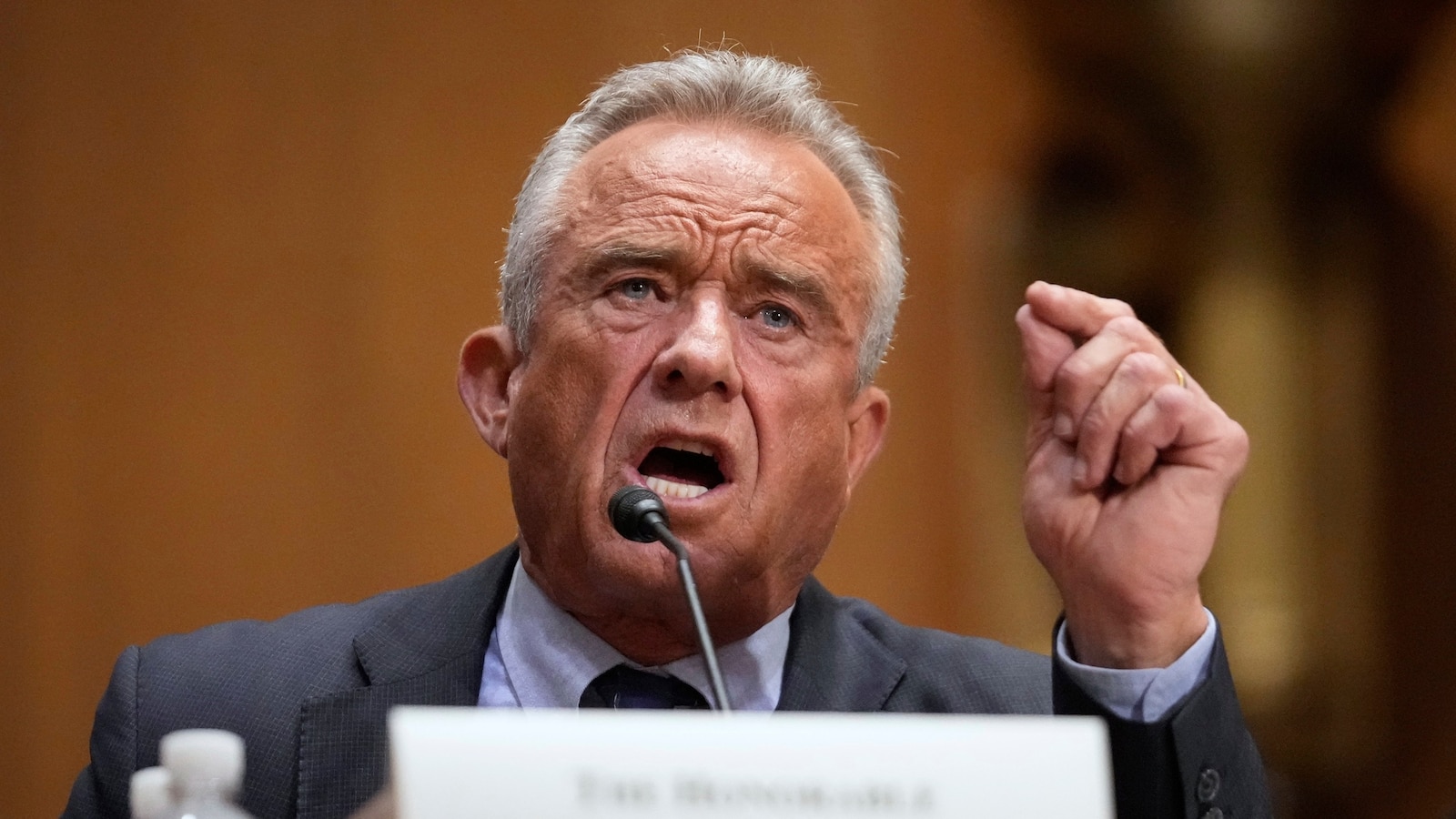
In Washington, Kennedy facing pointed bipartisan questioning at a rancorous three-hour Senate committee hearing on Thursday, tried to defend his efforts to pull back COVID-19 vaccine recommendations and explain the turmoil he has created at federal health agencies.
Kennedy testified that the fired CDC director was untrustworthy. He also stood by his past anti-vaccine rhetoric and disputed reports of people saying they have had difficulty getting COVID-19 shots.
Health and Human Services Secretary Robert F. Kennedy Jr. faced a grilling before the Senate Finance Committee on Thursday amid turmoil at the Centers for Disease Control and Prevention (CDC) and his controversial views on vaccines.
Kennedy clashed repeatedly with Democrat and Republican senators alike, many of whom questioned Kennedy’s handling of vaccine policy.
He spent about three hours defending himself and his actions a week after the ousting of Susan Monarez as CDC director and major vaccine changes, including limiting access to the COVID-19 vaccine.
During the hearing, Kennedy was far more combative than in previous appearances on Capitol Hill, notably getting into heated arguments with GOP senators and accusing some Democrats of “making things up” and speaking “gibberish.”
Here are four key takeaways:
Secretary of Health and Human Services Robert F. Kennedy Jr., appears before the Senate Finance Committee, on Capitol Hill in Washington, Sept. 4, 2025.
Monarez, who was in the job for only a month, was pushed out after she declined to fire top officials and pledge to support Kennedy’s vaccine policy changes in a meeting with the secretary early last week, a source familiar with her conversations with the secretary previously told ABC News.
In an op-ed published in The Wall Street Journal on Thursday morning, Monarez repeated the claim, stating she was fired partly because she wouldn’t prematurely sign off on vaccine recommendations from the CDC’s vaccine advisory committee.
Early on, Senate Finance Committee ranking member Sen. Ron Wyden, a Democrat from Oregon, asked if Monarez’s claims were true, which Kennedy denied.
“Did you, in fact, do what Director Monarez has said you did, which is tell her, ‘Just go along with vaccine recommendations, even if you didn’t think such recommendations aligned with scientific evidence?'” Wyden asked.
“No, I did not,” Kennedy replied.
“So, she’s lying today to the American people in The Wall Street Journal,” Wyden said.
“Yes, sir.”
Democratic Senator from Massachusetts Elizabeth Warren reacts during a Senate Banking, Housing, and Urban Affairs Committee confirmation hearing at the US Capitol, in Washington, September 4, 2025.
Graeme Sloan/EPA/Shutterstock
In a fiery exchange later on with Sen. Elizabeth Warren, a Democrat from Massachusetts, she noted that Kennedy had described Monarez an “unimpeachable” after she was confirmed but was currently saying she is lying.
“I told her that she had to resign because I asked her, ‘Are you a trustworthy person?’ And she said, ‘No,'” Kennedy replied. “If you had an employee who told you they weren’t trustworthy, would you ask them to resign, Senator?”
Kennedy reiterated the statement when asked by Sen. Bernie Sanders, an independent from Vermont, about the exchange with Monarez.
“Are you telling us that the former head of CDC, you asked her, ‘Are you a trustworthy person?’ And she said, ‘No, I am not a trustworthy person,'” Sanders asked.
‘”She didn’t say, ‘No, I’m not a trustworthy person.’ She said, ‘No,'” Kennedy replied.
Senator Bernie Sanders speaks as Health and Human Services Secretary Robert F. Kennedy Jr., testifies before a Senate Finance Committee hearing on President Donald Trump’s 2026 health care agenda, on Capitol Hill in Washington, Sept. 4, 2025.
Evelyn Hockstein/Reuters
In a statement from her attorneys, Monarez pushed back on Kennedy’s narrative of the events last week that led to her firing. Her lawyers call it “false” and “patently ridiculous.”
“Dr. Monarez stands by what she said in her op-ed in The Wall Street Journal, would repeat it all under oath and continues to support the vision she outlined at her confirmation hearing that science will control her decisions,” her lawyers, Mark Zaid and Abbe Lowell, said in a statement.
Later, Sanders said he would bring Monarez to Capitol Hill to testify.
“I look forward to her coming before the HELP Committee, maybe this committee as well,” Sanders said, referencing the Senate Committee on Health, Education, Labor and Pensions.
Kennedy also defended the recent shake-ups at CDC saying they were “absolutely necessary adjustments to restore the agency to its role as the world’s gold standard public health agency with a central mission of protecting Americans from infectious disease.”
He claimed,”new blood” is needed at CDC and that it is “imperative that we remove officials with conflicts of interest and catastrophically bad judgment and political agendas.”
Doctors and other public health experts have pointed out that Kennedy has filled open CDC positions with people who hold vaccine skeptical views and have earned income testifying against vaccine makers.
Cassidy, some other Republicans join Democrats in challenging Kennedy on vaccines
Tough questioning from Democrats has been a constant in Kennedy’s previous public hearings with senators, but Thursday saw several Republicans challenge the secretary over vaccines, as well.
Sen. Bill Cassidy, the Louisiana Republican and physician who struggled with his support for Kennedy but ultimately helped seal his confirmation to lead America’s public health agencies, questioned Kennedy’s support for Operation Warp Speed, the major Trump-era effort that led to the rapid launch of mRNA COVID vaccines.
Kennedy said the president deserves a Nobel Prize for Operation Warp Speed, but Cassidy pointed out several ways Kennedy has worked to undermine mRNA vaccines, including Kennedy’s cancelling $500 million in federally-funded mRNA vaccine funding and changing vaccine policy to apply to a narrower group of Americans.
On the Food and Drug Administration’s (FDA) recent changes to COVID vaccine access, Cassidy said, “I would say, effectively, we’re denying people vaccines.”
Sen. Bill Cassidy questions Health and Human Services Secretary Robert Kennedy Jr. during a Senate Finance Committee, September 4, 2025 in Washington.
Andrew Harnik/Getty Images
Two other Republicans on the committee, Sens. John Barrasso of Wyoming and Thom Tillis of North Carolina, expressed concern over Kennedy’s handling of vaccines and the CDC.
Barrasso, also a physician, said he had “grown deeply concerned” since Kennedy took over HHS.
“Over the last 50 years, vaccines are estimated to have saved 154 million lives worldwide,” he said, citing data from the World Health Organization. “I support vaccines. I’m a doctor. Vaccines work.”
Tillis suggested that Kennedy had backtracked on promises he had made to the committee.
“You said you’re going to empower the scientists at HHS to do their job. I’d just like to see evidence where you’ve done that,” Tillis said.
He also questioned the firing of CDC director Monarez after just a few weeks on the job.
“I don’t see how you go over four weeks from, ‘public health expert with unimpeachable scientific credentials, a long-time champion of MAHA values, caring and compassionate and a brilliant microbiologist,’ and four weeks later, fire her,” said Tillis, quoting things Kennedy previously said about Monarez.
Cassidy has tasked the committee he chairs, the Senate HELP Committee, to perform “oversight” of Monarez’s ousting, he wrote on X last week, and he indicated after Thursday’s hearing that he was still pursuing that.”
Kennedy has also faced scrutiny from other Republicans, including at the highest level. Senate Majority Leader John Thune said Kennedy had to “take responsibility” for firing Monarez just four weeks after the Senate confirmed her, while Republican Sen. Susan Collins of Maine said she didn’t see any “justification” for the termination.
Republican Sen. John Kennedy, Cassidy’s counterpart in Louisiana, called the CDC a “multiple vehicle pileup.”
Senators press for clarity on COVID vaccine access
Since the FDA changed COVID vaccine approvals last week to apply to older, higher risk Americans, there has been increasing confusion over who can get a vaccine, driven by differing rules depending on which state people live in or even which pharmacy they frequent.
Despite the reality playing out on the ground, Kennedy maintained on Thursday that “everybody can get access” to the shots — but in a tense back-and-forth with Warren, eventually acknowledged some of the caveats that have interrupted peoples’ attempts to get their shots.
“Most Americans” would be able to get the shot, and it depends on the state, Kennedy said.
“It depends on the state, but they can still get it,” Kennedy said. He argued that there was not enough data to show that COVID vaccines were necessary for healthy, young people.
Sen. Maria Cantwell questions Health and Human Services Secretary Robert F. Kennedy Jr., as he testifies before a Senate Finance Committee hearing on President Donald Trump’s 2026 health care agenda, on Capitol Hill in Washington, Sept. 4, 2025.
Evelyn Hockstein/Reuters
Warren threw Kennedy’s own words at him: “You promised that you would not take away vaccines from anyone who wanted them,” she said, quoting Kennedy from November.
“It takes it away if you can’t get it from your pharmacy, it takes it away if you have to pay $200,” Warren added.
According to pharmacists, insurance groups and trade organizations, the FDA approval change will make it more difficult for younger, otherwise healthy people to get a COVID-19 vaccine ahead of the winter respiratory virus season, as it will involve a trip to the doctor instead of walking into a pharmacy, and insurance coverage is, for now, unclear.
For at least the next few weeks until a CDC committee weighs in with more detail, and as the policy shifts are absorbed, the confusion may also impact access for older, higher-risk people.
This reality is playing out at CVS pharmacies nationwide, which is the largest pharmacy chain in the country.
In 34 states, CVS will continue to offer COVID vaccines for those who fall under the new FDA authorizations.
But in another 13 states, people will need a prescription to get a COVID shot, even if they are older or high risk. Additionally, in three states, New Mexico, Nevada and Massachusetts, CVS is holding off on giving COVID shots, company spokesperson Amy Thibault said, citing “the current regulatory environment.”
Walgreens, another large pharmacy chain, said it would give shots where it was legally able to do so, but didn’t specify which states would have which rules.
Kennedy also refused to say during the hearing that over one million Americans died from COVID-19 — as recorded by the CDC — and that COVID-19 vaccines saved millions of lives, as determined by analyses.
Kennedy appears combative during testimony
The three-hour hearing quickly became combative as Kennedy defended his time as HHS secretary amid a flurry of questions on his staffing shakeups, vaccine changes and other issues.
A particularly tense exchange with Democratic Sen. Michael Bennet from Colorado began with Bennet having to repeatedly call to get Kennedy’s attention, as the secretary appeared to be looking at something else. The two went on to yell over one another over vaccines, with Kennedy accusing Bennet of evading a question and the senator retorting, “I’m asking the questions!”
Sen. Michael Bennet questions Health and Human Services Secretary Robert Kennedy Jr. during a Senate Finance Committee, September 4, 2025 in Washington.
Andrew Harnik/Getty Images
He later accused Democratic Sen. Maggie Hassan of New Hampshire of “making stuff up to scare people” when she pressed him on why the change in vaccine recommendations were done “behind closed doors.”
Kennedy said Democratic Sen. Ben Ray Lujan from New Mexico was speaking “gibberish” and said he was “not understanding how the world works” when Lujan asked if he would share the protocols used for a study investigating autism.
Kennedy also took aim at Warren and appeared to suggest she was in the pocket of the pharmaceutical industry. Warren has received money from pharmaceutical companies in the past.
As the hearing came to a close, Kennedy was asked if he would like to make any other statements. “I think I’ll have mercy on everyone here and let us adjourn,” he responded.
A federal jury has ordered Google to pay $425.7 million for improperly snooping on people’s smartphones during a nearly decade-long period of intrusions.
The verdict reached Wednesday in San Francisco federal court followed a more than two-week trial in a class-action case covering about 98 million smartphones operating in the United States between July 1, 2016, through Sept. 23, 2024. That means the total damages awarded in the five-year-old case works out to about $4 per device.
Google had denied that it was improperly tracking the online activity of people who thought they had shielded themselves with privacy controls. The company maintained its stance even though the eight-person jury concluded Google had been spying in violation of California privacy laws.
“This decision misunderstands how our products work, and we will appeal it,” Google spokesman Jose Castaneda said Thursday. “Our privacy tools give people control over their data, and when they turn off personalization, we honor that choice.”
The lawyers who filed the case had argued Google had used the data they collected off smartphones without users’ permission to help sell ads tailored to users’ individual interests — a strategy that resulted in the company reaping billions in additional revenue. The lawyers framed those ad sales as illegal profiteering that merited damages of more than $30 billion.
Even though the jury came up with a far lower calculation for the damages, one of the lawyers who brought the case against Google hailed the outcome as a victory for privacy protection.
“We hope this result sends a message to the tech industry that Americans will not sit idly by as their information is collected and monetized against their will,” said attorney John Yanchunis of law firm Morgan & Morgan.
The San Francisco jury verdict came a day after Google avoided the U.S. Department of Justice’s attempt to break up the company in a landmark antitrust case in Washington, D.C., targeting its dominant search engine. A federal judge who had declared Google’s search engine to be an illegal monopoly ordered less radical changes, including requiring the company to share some of its search data with rivals.
A federal judge excoriated the Justice Department over its handling of criminal cases during the Trump administration’s ongoing federal takeover of Washington, D.C., saying at a hearing Thursday that the department has brought “embarrassment and shame” on the government during its “rush” to charge individuals.
U.S. District Judge Zia Faruqui apologized to Edward Dana, a man who was charged for what the Justice Department and U.S. Secret Service said was a threat to kill President Trump last month. Dana spent a week in jail, only to have the charges against him dropped Thursday.
Faruqui said the U.S. is “past the point of constitutional crisis,” as the Trump administration “is playing cops and robbers, like children” during the federal takeover of Washington’s police department.
The judge also criticized the Justice Department over the D.C. U.S. attorney’s multiple failed indictments in recent weeks, saying he had a “grave concern” that in a “rush to get stats on Twitter or Truth Social” touting the takeover, the Justice Department has not given time to those who have been “illegally detained.”
Faruqui said there have been “too many misfires” by the Justice Department in attempting to prosecute people in D.C., and that the federal government is operating under the concept of “we’ll arrest people… then see what happens.”
Dana did not comment on the dismissal of charges when asked by CBS News for a reaction after the hearing.
Dana was arrested in August for allegedly destroying a light fixture and other property at a D.C. restaurant, but he was charged for threatening comments he made about Mr. Trump while he was being taken to a D.C. police station.
While he was seated in the back of a police car, charging documents allege Dana said he was “not going to tolerate fascism” and would “protect the Constitution by any means necessary,” before, the document alleges, he threatened to kill Mr. Trump and the officer driving him to the station.
“And that means killing you, officer, killing the President, killing anyone who stands in the way of our Constitution,” Dana said, according to a Secret Service affidavit. “You want to stand in the way of our Constitution, I will f****** kill you.”
Faruqui ordered the Justice Department to make a filing by Thursday night explaining its handling of Dana’s case, saying, “It’s Sept. 4. As of now we still have a constitutional democracy.”
At the end of Thursday’s hearing, Faruqui looked at Dana, who is a person of color, and said that “the government’s message to people who look like Mr. Dana is ‘be very afraid,'” before adding, “I’m afraid right now.”
In a post on X, U.S. Attorney in D.C. Jeanine Pirro said that Faruqui “took an oath to follow the law, yet he has allowed his politics to consistently cloud his judgment and his requirement to follow the law. America voted for safe communities, law and order, and this judge is the antithesis of that.”
Jake Rosen is a reporter covering the Department of Justice. He was previously a campaign digital reporter covering President Trump’s 2024 campaign and also served as an associate producer for “Face the Nation with Margaret Brennan,” where he worked with Brennan for two years on the broadcast. Rosen has been a producer for several CBS News podcasts, including “The Takeout,” “The Debrief” and “Agent of Betrayal: The Double Life of Robert Hanssen.”
American businesses could be owed tens of billions of dollars in refunds for tariffs they paid on foreign goods.
U.S. Customs and Border Protection has collected more than $200 billion in tariff revenue from American businesses of all sizes from October through August 24, according to agency data. Of that, more than $70 billion comes from payments of country-based tariffs that a federal appeals court recently ruled President Trump lacked the authority to impose.
Industry-specific tariffs, such as steel and aluminum levies, are unaffected by Friday’s ruling.
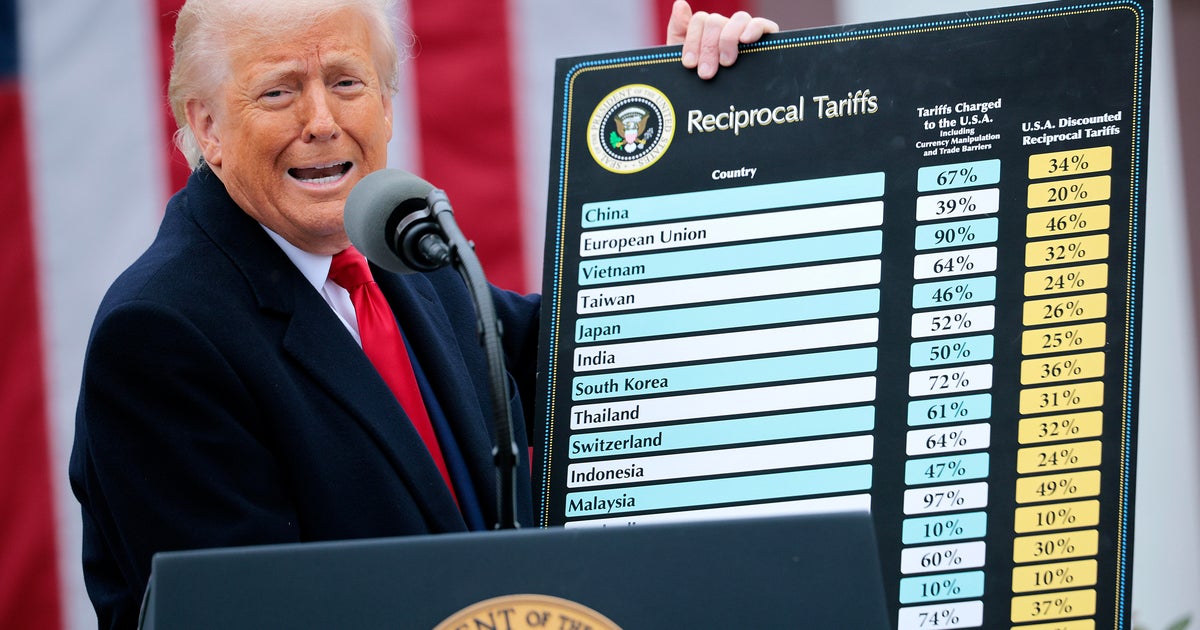
The court on Friday ruled that President Trump unlawfully invoked the International Emergency Economic Powers Act, or IEEPA, to impose sweeping tariffs of up to 145% on dozens of U.S. trade partners. Mr. Trump on Wednesday asked the Supreme Court to review the federal appeals court’s decision before it takes effect on Oct. 14.
Mr. Trump’s appeal means that, for now, there’s no guarantee businesses will receive refunds. That spells more uncertainty for enterprises struggling to balance raising prices to cover the cost of levies against potentially turning away customers, according to supply chain experts.
“From the supply chain perspective, we are seeing a lot of uncertainty, which has been the case since April 2,” Scott Pruneau, CEO of ITS Logistics, told CBS MoneyWatch. “No one knows how to price their goods, because you can’t whipsaw your customers on pricing.”
If the court’s decision stands, the U.S. government could have to return billions in tariff revenue it has collected from businesses.
“It’d be very challenging”
But even if the Supreme Court strikes down the tariffs, businesses could still face hurdles in collecting refunds for the levies they’ve already paid the U.S. government, experts told CBS MoneyWatch. For one, there is no guarantee that whatever kind of refund system the government sets up would be automatic or that the process will be simple.
“There’s been speculation that if ultimately, the Supreme Court overturns the tariffs, then Customs could just issue refunds, but I don’t know that it’s going to happen that way,” Felicia Pullam, former executive director of the Office of Trade Relations at U.S. Customs and Border Protection, and the current senior director for geo-commerce at APCO, a global advisory firm, told CBS MoneyWatch.
“The easiest way would be for Customs to put a process in place and issue refunds, rather than make companies go and apply,” she added.
Ultimately, however, if refunds are owed, it would be up to the Trump administration to decide how to administer them. “It’d be very challenging, but I am confident CBP could handle it.”
U.S. Customs and Border Protection didn’t immediately reply to a request for comment.
Requests for refunds
Ted Murphy, co-leader of Sidley Austin’s global arbitration, trade and advocacy practice, told CBS MoneyWatch that if the Supreme Court affirms the federal circuit court’s ruling that Trump’s reliance on IEEPA to impose country-based tariffs was illegal, the government would have to cease collecting tariffs from companies.
When it comes to recouping levies that have already been paid, there are three ways refunds could be administered, Murphy said.
Most simply, the government could provide automatic refunds to businesses for levy amounts paid. “The government has that information, so it could happen automatically,” Murphy told CBS MoneyWatch. “I don’t think that’s particularly likely, but it is an option.”
The government could instead decide that only the plaintiffs who filed suit against the tariffs are entitled to refunds, and require additional parties seeking refunds to bring similar legal actions. “In that case, you’d see tens and tens of thousands of people filing complaints at the Court of International Trade,” he said.
But the most likely repayment option in Murphy’s view would be that the government agrees to refund duties paid by parties who submit requests for reimbursement.
Historical precedent for refunds
There’s precedent for the government reimbursing businesses for tariff payments that were later deemed unlawful. In 1998, the Supreme Court struck down a harbor maintenance tax assessed on exports, which had been imposed by the Reagan administration. The government then owed companies more than a billion dollars in refunds, which it required companies to apply for in order to receive.
Dan Anthony, president of Trade Partnership Worldwide, a trade consultancy, echoed Murphy, saying that it is hard to predict how the government might choose to process refunds, should the Supreme Court determine they are owed.
“It’s up to the administration to decide, and that’s where it gets very complicated and speculative,” he told CBS MoneyWatch.
Technically speaking, issuing refunds wouldn’t be hard. “Theoretically, the government could quite quickly figure out who paid what, and refund it to the payer,” he said. “But the government could also make it very difficult and force people to make requests.”
That would create work for companies, but also for the government, which would then have to review requests for refunds from thousands of companies. “That’s infinitely more work for the government, but it’s pretty clear the government does not want to give money back, so if you make it a difficult process, then a number of importers are probably not going to pursue it,” Anthony said.
Large refunds to businesses could weigh on the Treasury’s finances, TD Securities analysts noted in a report Thursday. “Treasury would likely step up bill supply even further to obtain the extra funds, creating little disruption in longer-dated yields, but potentially pressuring funding spreads,” TD Securities analysts said.
The Trump administration could also turn to other emergency powers to replace the IEEPA tariffs in order to maintain the U.S.’ effective tariff rate, the analysts noted.
Neither the White House nor the Treasury immediately responded to a request for comment.
Megan Cerullo is a New York-based reporter for CBS MoneyWatch covering small business, workplace, health care, consumer spending and personal finance topics. She regularly appears on CBS News 24/7 to discuss her reporting.
TORRANCE, Calif. /California Newswire/ — DocMagic, Inc. today announced that CEO and Co-Founder Pat Theodora has been named a recipient of the 2025 HousingWire Vanguard Award. This recognition honors C-level professionals and business leaders who are making a significant impact on the housing economy through bold vision, enduring leadership and forward-thinking innovation.
Theodora has played a pivotal role in shaping DocMagic’s evolution from its inception in 1987 to its current standing as an industry leader in digital mortgage transformation. Over the past year, he has been a driving force behind breakthrough innovations such as DocMagic’s new all-in-one AI-powered platform and spearheading the mortgage industry’s first-ever electronic home equity line of credit (eHELOC) registration with the MERS® eRegistry.
“Pat’s influence on DocMagic and the broader mortgage ecosystem is undeniable,” said Lori Johnson, COO of DocMagic. “He leads with integrity, experience and vision, consistently challenging us to deliver better outcomes for our clients and the industry at large.”
Theodora’s leadership is informed by more than four decades of experience in the mortgage space. He began his career as a loan officer in 1980 and went on to successfully run multiple mortgage companies before co-founding DocMagic. His firsthand understanding of lender pain points has been instrumental in designing technologies that streamline processes, ensure compliance and create more seamless borrower experiences.
Under his direction, DocMagic has continued to expand its lender base, introduced enhanced AI-powered solutions and launched new capabilities to support digital asset management at scale. By Q1 2026, enterprise adoption of DocMagic’s technology will support 90% of loan volume for a top-tier national lender, representing billions in annual originations.
Theodora is also an active presence in industry circles and his local community. He frequently attends industry conferences nationwide and supports various philanthropic causes, including board service with Torrance Memorial Medical Center and ongoing volunteer work with the YMCA and the Boy Scouts of America.
“This recognition is a reflection of our team’s commitment to driving the industry forward,” said Theodora. “I’m proud of what we’ve all accomplished together and even more excited about the innovations we’re building to support lenders, borrowers and partners in the years ahead.”
The HousingWire Vanguard Awards recognize executives whose leadership is moving markets forward. Honorees span diverse sectors of the housing economy-lending, servicing, investments, and real estate-and are selected for their measurable contributions to business growth, innovation, and industry advancement.
“The 2025 HousingWire Vanguards exemplify what it means to lead with vision and resilience,” said Sarah Wheeler, Editor-in-Chief of HousingWire. “These leaders aren’t just driving growth within their organizations, they’re shaping the future of housing itself. Their achievements reflect the innovation, adaptability, and commitment required to thrive in today’s rapidly evolving market.”
The full list of 2025 HousingWire Vanguard Award honorees is available now at www.housingwire.com/vanguard.
About DocMagic:
Founded in 1987 and headquartered in Torrance, California, DocMagic, Inc. is a leading provider of compliant document generation, automated compliance, eSignature, and comprehensive eMortgage solutions for the mortgage industry. The company’s solutions-including multiple patented innovations-facilitate precision-based digital lending transactions, connecting industry participants and ensuring data integrity. DocMagic’s compliance experts continuously monitor legal and regulatory changes at both federal and state levels. For more information, visit https://www.docmagic.com/.
Information is believed accurate but is not guaranteed. For questions about the above news, contact the company/org/person noted in the text and NOT this website.
There were no tickets sold with all six numbers in the latest drawing of the multi-state Powerball lottery, pushing the estimated jackpot for Saturday’s drawing to $1.7 billion, the third-largest lottery jackpot in U.S. history.
There hasn’t been a drawing with a grand prize winner since May 31, 41 drawings ago, when a ticket worth $207 million was sold at a convenience store in Arleta.
The only larger Powerball jackpots in U.S. history were the $2.04 billion jackpot for the Nov. 7, 2022, drawing and the $1.765 billion jackpot for the Oct. 11, 2023, drawing.
The numbers drawn Wednesday were 3, 16, 29, 61, 69, and the Powerball number was 22. The estimated jackpot was $1.4 billion, the sixth-largest lottery jackpot in U.S. history and fourth-largest in the history of the Powerball game, which began in 1992.
There have been two larger jackpots for the Mega Millions game, which began in 1996 as The Big Game and was given the new name Mega Millions in 2002.
There were 15 tickets sold with five numbers, but missing the Powerball number, including two in California, both at supermarkets, one in Riverside and the other in Bakersfield. They are both worth $984,594, according to the California Lottery.
The California tickets matching five numbers were sold at Stater Bros. market, 7200 Arlington Ave. in Riverside, and at Albertsons, 13045 Highway 58 in Bakersfield.
Powerball tickets matching five numbers, but missing the Powerball number, sold in other states are worth $1 million or $2 million, but payout amounts in California are on a pari-mutuel basis under state law and determined by sales and the number of winners.
The odds of matching all five numbers and the Powerball number is 1 in 292.2 million, according to the Multi-State Lottery Association. The overall chance of winning a prize is 1 in 24.9.
The Powerball game is played in 45 states, the District of Columbia, Puerto Rico and U.S. Virgin Islands.
WASHINGTON (AP) — The District of Columbia on Thursday sued to stop President Donald Trump’s deployment of National Guard during law enforcement intervention in Washington.
The city’s attorney general, Brian Schwalb, said the hundreds of troops are essentially an “involuntary military occupation.” He argued in the federal lawsuit that the deployment is an illegal use of the military for domestic law enforcement.
A federal judge in California recently ruled that Trump’s deployment of National Guard troops to Los Angeles after days of protests over immigration raids in June was illegal. The Republican administration is appealing that decision and Trump has said he is ready to order federal intervention in Chicago and Baltimore, despite staunch opposition in those Democrat-led cities.
That ruling, however, does not directly apply to Washington, where the president has more control over the Guard than in states.
WASHINGTON — President Trump has asked the Supreme Court for a fast-track ruling that he has broad power acting on his own to impose tariffs on products coming from countries around the world.
Despite losing in the lower courts, Trump and his lawyers have reason to believe they can win in the Supreme Court. The six conservative justices believe in strong presidential power, particularly in the area of foreign policy and national security.
In a three-page appeal filed Wednesday evening, they proposed the court decide by next Wednesday to grant review and to hear arguments in early November.
They said the lower court setbacks, unless quickly reversed, “gravely undermine the President’s ability to conduct real-world diplomacy and his ability to protect the national security and economy of the United States.”
They cited Treasury Secretary Scott Bessent’s warning about the potential for economic disruption if the court does not act soon.
“Delaying a ruling until June 26 could result in a scenario in which $750 billion-$1 trillion have already been collected and unwinding them could cause significant disruption,” he wrote.
Trump and his tariffs ran into three strong arguments in the lower courts.
First, the Constitution says Congress, not the president, has the power “to lay and collect Taxes, Duties, Imposts and Excises,” and a tariff is an import tax.
Second, the 1977 emergency powers law that Trump relies on does not mention tariffs, taxes or duties, and no previous president has used it to impose tariffs.
And third, the Supreme Court has frowned on recent presidents who relied on old laws to justify bold, new, costly regulations.
So far, however, the so-called “major questions” doctrine has been used to restrict Democratic presidents, not Republicans.
Three years ago, the court’s conservative majority struck down a major climate change regulation proposed by Presidents Obama and Biden that could have transformed the electric power industry on the grounds it was not clearly based on the Clean Air Act of the 1970s.
Two years ago, the court in the same 6-3 vote struck down Biden’s plan to forgive hundreds of millions of dollars in student loans. Congress had said the Education Department may “waive or modify” monthly loan payments during a national emergency like the COVID-19 pandemic, but it did not say the loans may be forgiven, the court said. Its opinion noted the “staggering” cost could be more than $500 billion.
The impact of Trump’s tariffs figures to be at least five times greater, a federal appeals court said last week in ruling them illegal.
In a 7-4 vote, the federal circuit court cited all three arguments in ruling Trump had exceeded his legal authority.
“We conclude Congress, in enacting the International Emergency Economic Powers Act, did not give the president wide-ranging authority to impose tariffs,” they said.
But the outcome was not a total loss for Trump. The appellate judges put their decision on hold until the Supreme Court rules. That means Trump’s tariffs are likely to remain in effect for many months.
Trump’s lawyers were heartened by the dissent written by Judge Richard Taranto and joined by three others.
He argued that presidents are understood to have extra power when confronted with foreign threats to the nation’s security.
Taranto called the 1977 law “an eyes-open congressional grant of broad emergency authority in this foreign-affairs realm” that said the president may “regulate” the “importation” of dangerous products including drugs coming into this country.
Citing other laws from that era, he said Congress understood that tariffs and duties are a “common tool of import regulation.”
An Alabama man who claimed to be Michael the Angel of Death has been charged with multiple felonies after he threatened to “do the Lord’s reaping” at a Catholic monastery in Orange County and then traveled to the church with a sizable cache of weapons, authorities said.
On Wednesday, Joshua Michael Richardson, 38, was charged with felony criminal threats and possession of six high-capacity gun magazines, brass knuckles and a sword, according to the Orange County district attorney’s office. Investigators also found knives, a stun gun, body armor, duct tape and rope in his truck.
On Aug. 19, St. Michael’s Abbey in Silverado Canyon received an email from Richardson in which he claimed to be the “rider of the pale horse,” the last of the four horsemen in the Book of Revelation, who personifies death. He also said he was Michael the Angel of Death, referencing the Archangel Michael, who is tasked with escorting souls to the afterlife, prosecutors said.
Richardson wrote that he would soon be traveling to the church from Alabama and that he had selected St. Michael’s Abbey because it is one of the few places of worship that still celebrates Michaelmas. The church is scheduled to recognize the Feast of St. Michael on Sept. 29, which celebrates the archangel’s role as a defender of the faithful.
Richardson showed up at St. Michael’s Abbey on Aug. 26 and attended afternoon services. He then allegedly followed the priest into a private area of the church and informed him that “he came to do the Lord’s work, to separate the weak from the weeds, and that he rode his white pale horse from Alabama,” prosecutors said.
Two days later, the Orange County Sheriff’s Department received a report about the threatening emails and arrested Richardson.
“While incidents like this can feel unsettling, they also highlight the power of community,” said the Sheriff’s Department in a statement. “If something seems off, say something. Trust your instincts and report suspicious activity, whether it is a strange message, unusual behavior, or something that does not sit right.”
Richardson’s arrest took place just one day after a shooting at a Catholic school in Minneapolis killed two children and injured 21 others.
Prosecutors successfully argued that Richardson should be held without bail due to the serious danger he poses to the public. He is scheduled to be arraigned Thursday.
“No one should have to worship in fear that a stranger would walk through the door with the intent to carry out their own day of judgment and determine who lives and who dies,” said O.C. Dist. Atty. Todd Spitzer in a statement. “A threat on one house of worship is an attack on every place of worship, and we refuse to allow threats and terror to dissuade any person from practicing their faith without fear.”
St. Michael’s Abbey describes itself as a community of Canons Regular of Prémontré, under the guardianship of St. Michael the Archangel, with more than 60 years of daily prayer, teaching and service. It is home to dozens of parishioners who live on the monastery’s compound.
Job cuts so far this year have already surpassed the total for 2024, as government cost-cutting, economic uncertainty and AI have prompted employers to reduce staff.
California and the tech industry have been particularly hard hit, according to a Thursday report from Challenger, Gray & Christmas, a company that helps people pivot to new careers and monitors job cut announcements by U.S. companies.
In the eight months through August, companies announced about 892,000 cuts. That’s 66% more than a year earlier and already above the total for 2024. The last time the cut tally was higher was in the middle of COVID-19 lockdowns in 2020.
The Trump administration’s initiative to slash government spending — through what it calls the Department of Government Efficiency, also known as DOGE — was the biggest culprit for the slashing of government jobs, while economic concerns and technological change weighed on sectors including tech, finance and retail.
“After the impact of DOGE on the Federal Government, employers are citing economic and market factors as the driver of layoffs,” said Andrew Challenger, senior vice president and labor expert for Challenger, Gray & Christmas, in a statement.
California was the state with the most cuts, surpassed only by Washington, D.C.
California’s cuts this year increased by 24% to 135,241. Washington saw a tripling of cuts to 294,696. Job cuts rose 33% in New York but fell in some states, including Texas and Nevada.
Challenger, Gray & Christmas, which offers outplacement services and executive coaching, gathers data from news reports, company filings, annual reports, news releases and layoff notices. It tracks job cuts by company headquarters unless the announcement includes the location of the layoffs.
The report is the latest glimpse into the brutal job market facing workers as layoffs continue in various industries, including healthcare and tech. In August, pharmaceutical companies, financial firms, nonprofits and retailers saw huge bumps in job cuts.
“Retailers are being hard hit by tariffs, inflation, and ongoing economic uncertainty, causing bankruptcies and closures,” said Challenger. “If tariffs and consumer spending constraints play out, the approaching holiday shopping season may see fewer seasonal hires and, in fact, high layoffs.”
Last month, retailers such as Kroger announced massive job cuts and Claire’s, which sells accessories in shopping malls, filed for bankruptcy.
Meanwhile, the rise of artificial intelligence chatbots that can generate text and code has heightened anxiety among workers that their jobs could eventually be automated.
This year, artificial intelligence was cited as the reason for 10,375 job cuts, the report said. Technological updates, which possibly include AI, contributed to 20,219 job cuts.
Tech companies announced 102,239 job cuts this year, down 3% from last year, according to the report.
Intel, Microsoft, Meta and Salesforce are among tech companies that have slashed their workforce this year while also investing heavily in AI.
Angels starting pitcher Caden Dana throws to the plate during the first inning of a game against the Kansas City Royals on Wednesday, Sept. 3, 2025, in Kansas City, Mo. (AP Photo/Charlie Riedel)
The Kansas City Royals’ Bobby Witt Jr. slides to second in an unsuccessful attempt to steal the base during the first inning of a baseball game against the Los Angeles Angels, Wednesday, Sept. 3, 2025, in Kansas City, Mo. (AP Photo/Charlie Riedel)
The Kansas City Royals’ Bobby Witt Jr. (7) is caught stealing second by Angels shortstop Zach Neto during the first inning of a baseball game Wednesday, Sept. 3, 2025, in Kansas City, Mo. (AP Photo/Charlie Riedel)
Angels starting pitcher Caden Dana throws to the plate during the first inning of a game against the Kansas City Royals on Wednesday, Sept. 3, 2025, in Kansas City, Mo. (AP Photo/Charlie Riedel)
Angels starting pitcher Caden Dana throws to the plate during the first inning of a game against the Kansas City Royals on Wednesday, Sept. 3, 2025, in Kansas City, Mo. (AP Photo/Charlie Riedel)
Kansas City Royals third baseman Maikel Garcia trips over the Angels’ Oswald Peraza after Peraza stole third during the third inning of a baseball game Wednesday, Sept. 3, 2025, in Kansas City, Mo. (AP Photo/Charlie Riedel)
Angels catcher Logan O’Hoppe chases a bunt hit by the Kansas City Royals’ Kyle Isbel during the third inning of a baseball game Wednesday, Sept. 3, 2025, in Kansas City, Mo. (AP Photo/Charlie Riedel)
Angels catcher Logan O’Hoppe chases a bunt hit by the Kansas City Royals’ Kyle Isbel during the third inning of a baseball game Wednesday, Sept. 3, 2025, in Kansas City, Mo. (AP Photo/Charlie Riedel)
The Kansas City Royals’ Michael Massey runs home to score on a sacrifice bunt hit by Kyle Isbel during the third inning of a baseball game against the Angels, Wednesday, Sept. 3, 2025, in Kansas City, Mo. (AP Photo/Charlie Riedel)
The Kansas City Royals’ Michael Massey celebrates in the dugout after scoring on a sacrifice bunt hit by Kyle Isbel during the third inning of a baseball game against the Angels, Wednesday, Sept. 3, 2025, in Kansas City, Mo. (AP Photo/Charlie Riedel)
The Kansas City Royals’ Mike Yastrzemski hits a sacrifice fly to score a run during the third inning of a baseball game against the Angels, Wednesday, Sept. 3, 2025, in Kansas City, Mo. (AP Photo/Charlie Riedel)
Angels right fielder Jo Adell catches a sacrifice fly hit by the Kansas City Royals’ Mike Yastrzemski to score on a run during the third inning of a baseball game Wednesday, Sept. 3, 2025, in Kansas City, Mo. (AP Photo/Charlie Riedel)
The Kansas City Royals’ Jac Caglianone celebrates in the dugout after scoring on a sacrifice fly hit by Mike Yastrzemski during the third inning of a baseball game against the Angels, Wednesday, Sept. 3, 2025, in Kansas City, Mo. (AP Photo/Charlie Riedel)
Angels center fielder Bryce Teodosio, left, catches a fly ball hit by the Kansas City Royals’ Salvador Perez for an out during the fourth inning of a baseball game Wednesday, Sept. 3, 2025, in Kansas City, Mo. (AP Photo/Charlie Riedel)
Kansas City Royals left fielder Michael Massey runs onto the field during the fourth inning of a baseball game against the Angels, Wednesday, Sept. 3, 2025, in Kansas City, Mo. (AP Photo/Charlie Riedel)
The Angels’ Jo Adell hits a go-ahead three-run home run during the sixth inning of a game against the Kansas City Royals on Wednesday, Sept. 3, 2025, in Kansas City, Mo. (AP Photo/Charlie Riedel)
Kansas City Royals center fielder Kyle Isbel watches a ball hit by the Angels’ Jo Adell go over the fence for a go-ahead thrwe-run homer during the sixth inning on Wednesday, Sept. 3, 2025, in Kansas City, Mo. (AP Photo/Charlie Riedel)
The Angels’ Jo Adell, left, celebrates with third base coach Bo Porter as he runs the bases after hitting a go-ahead three-run home run during the sixth inning of their game against the Kansas City Royals on Wednesday night in Kansas City, Mo. (AP Photo/Charlie Riedel)
The Angels’ Jo Adell celebrates as he crosses the plate after hitting a go-ahead three-run home run during the sixth inning of a baseball game against the Kansas City Royals, Wednesday, Sept. 3, 2025, in Kansas City, Mo. (AP Photo/Charlie Riedel)
The Angels’ Jo Adell (7) celebrates with teammate Chris Taylor as he returns to the dugout after hitting a go-ahead three-run home run during the sixth inning of a baseball game against the Kansas City Royals, Wednesday, Sept. 3, 2025, in Kansas City, Mo. (AP Photo/Charlie Riedel)
The Angels’ Jo Adell celebrates for a television camera after hitting a go-ahead three-run home run during the sixth inning of a baseball game against the Kansas City Royals, Wednesday, Sept. 3, 2025, in Kansas City, Mo. (AP Photo/Charlie Riedel)
The Kansas City Royals’ Adam Frazier celebrates on second after hitting an RBI double during the seventh inning of a game against the Angels, Wednesday, Sept. 3, 2025, in Kansas City, Mo. (AP Photo/Charlie Riedel)
The Kansas City Royals’ Salvador Perez (13) beats the tag at second by Angels second baseman Luis Rengifo (2) after hitting a double during the seventh inning of a baseball game Wednesday, Sept. 3, 2025, in Kansas City, Mo. (AP Photo/Charlie Riedel)
The Angels’ Yoan Moncada (5) beats the tag at second by Kansas City Royals shortstop Bobby Witt Jr. (7) after hitting a double during the eighth inning of a baseball game Wednesday, Sept. 3, 2025, in Kansas City, Mo. (AP Photo/Charlie Riedel)
The Angels’ Jo Adell watches his RBI single during the eighth inning of a baseball game against the Kansas City Royals, Wednesday, Sept. 3, 2025, in Kansas City, Mo. (AP Photo/Charlie Riedel)
The Angels’ Yoan Moncada celebrates in the dugout after scoring on a single by Jo Adell during the eighth inning of a baseball game against the Kansas City Royals, Wednesday, Sept. 3, 2025, in Kansas City, Mo. (AP Photo/Charlie Riedel)
Angels relief pitcher Andrew Chafin throws to the plate during the eighth inning of a baseball game against the Kansas City Royals, Wednesday, Sept. 3, 2025, in Kansas City, Mo. (AP Photo/Charlie Riedel)
Angels relief pitcher Andrew Chafin throws to the plate during the eighth inning of a baseball game against the Kansas City Royals, Wednesday, Sept. 3, 2025, in Kansas City, Mo. (AP Photo/Charlie Riedel)
Angels relief pitcher Reid Detmers throws during the ninth inning of a baseball game against the Kansas City Royals, Wednesday, Sept. 3, 2025, in Kansas City, Mo. (AP Photo/Charlie Riedel)
Angels center fielder Bryce Teodosio catches a line drive hit by the Kansas City Royals’ Maikel Garcia for an out during the ninth inning of a baseball game Wednesday, Sept. 3, 2025, in Kansas City, Mo. (AP Photo/Charlie Riedel)
Angels catcher Logan O’Hoppe and relief pitcher Reid Detmers (48) celebrate after their 4-3 victory over the Kansas City Royals on Wednesday, Sept. 3, 2025, in Kansas City, Mo. (AP Photo/Charlie Riedel)
Angels outfielders Chris Taylor, left, Bryce Teodosio, center, and Jo Adell celebrate after their 4-3 victory over the Kansas City Royals on Wednesday, Sept. 3, 2025, in Kansas City, Mo. (AP Photo/Charlie Riedel)
Angels right fielder Jo Adell runs off the field at the end of the seventh inning of a game against the Kansas City Royals, Wednesday, Sept. 3, 2025, in Kansas City, Mo. (AP Photo/Charlie Riedel)
1 of 33
Angels starting pitcher Caden Dana throws to the plate during the first inning of a game against the Kansas City Royals on Wednesday, Sept. 3, 2025, in Kansas City, Mo. (AP Photo/Charlie Riedel)
KANSAS CITY, Mo. — Jo Adell has been swinging a hot bat for a few weeks. On Wednesday night, he was a one-man gang.
Adell homered and drove in every run for the Angels in their 4-3 victory over the Kansas City Royals. He hit a go-ahead homer in the sixth inning for the second consecutive game, his three-run shot to center field on the first pitch he saw from reliever John Schreiber giving the Angels a 3-2 lead in this one.
Yoán Moncada, aboard on a single when Adell went deep, doubled off Lucas Erceg (6-4) in the eighth before scoring when Adell hit a soft dribbler to the left side of the infield for a 4-3 advantage.
“I was just up there grinding,” Adell told MLB.com. “Erceg has a really good sinker. Just trying to put the ball in play and see what would happen. That one and the homer were both cool moments. But putting the team ahead [for good] with the grounder and having them have to make a play was probably more important tonight for me.”
Adell, whose 33 home runs and 90 RBIs are career highs, clubbed a go-ahead two-run home run in the sixth inning of a 5-1 victory on Tuesday. He has eight homers in his past 16 games.
Interim manager Ray Montgomery is impressed with the 26-year-old outfielder.
“The homer was incredible because the wind was pushing the ball down a little bit,” Montgomery told reporters. “I was equally impressed by the contact he made on the infield single. Jo just keeps putting up those types of at-bats. We should not be surprised anymore.”
Kyle Isbel was on second base in the eighth on Wednesday when Angels reliever Andrew Chafin struck out Bobby Witt Jr. for the second out. Chafin then fanned Vinnie Pasquantino in a 12-pitch duel to maintain the one-run lead.
Reid Detmers struck out two in the ninth for his third save.
Angels star Mike Trout sat out again after getting scratched from the lineup Tuesday night because of a skin infection on his left arm.
Caden Dana, recalled from Triple-A Salt Lake to start for the Angels, allowed two runs (one earned) on two hits and a walk while striking out four over five innings.
Dana, making his first start this season and the fourth of his career, retired the first six batters he faced. In the third, he allowed a bloop single to Michael Massey and walked Jac Caglianone. Isbel then laid down a bunt that Angels first baseman Oswald Peraza fielded, but he threw wildly to Luis Rengifo covering the bag, allowing the game’s first run. Caglianone scored on Mike Yastrzemski’s sacrifice fly for a 2-0 Royals lead.
“Errors are going to happen,” Dana told MLB.com. “That’s when the game tries to speed you up. You just think about how you planned to execute. Slow the game down as much as possible in those moments.”
Royals rookie Ryan Bergert allowed just one run on one hit and three walks while striking out six over five innings. He left with a 2-0 lead after issuing a leadoff walk to Zach Neto in the sixth. Schreiber came on and allowed an infield hit to Moncada but struck out Taylor Ward. However, Adell followed with his go-ahead blast.
The Royals answered in the bottom of the seventh, as Salvador Perez and Adam Frazier hit back-to-back doubles off Angels relieved Robert Stephenson (1-0) to tie the score at 3-all.
With the back-to-back wins, the Angels (66-73) secured their first winning road series since July 18-20 and improved to 5-4 on their 10-game trip.
The Angels, playing spoilers during the final month, go for a series sweep on Thursday.
“This is the group that will take us where we’re going,” Montgomery told reporters. “Every bit of experience we can get in these games, with stuff on the line, is going to make us better. When we come back in these situations, maybe a year from now, they’ve already done it and it’s a big help.”
Kansas City (70-69) has lost three in a row and seven of 11.
LOS ANGELES — USC’s Bishop Fitzgerald had been a quarterback most of his life. But when he received no Division I scholarship offers coming out of high school, he had to make a change. Defensive back was calling.
“That was one of the best decisions I made,” Fitzgerald told reporters after practice on Wednesday.
The safeties were in a friendly competition throughout fall training camp to see who would get the first interception of the season, and no one expected it to be Fitzgerald.
“I dropped every (potential) pick in fall camp,” he said. “So nobody thought it was going to be me. I showed them I got the jitters out of me.”
USC safety Bishop Fitzgerald returns an interception for a touchdown during the first half of their season opener against Missouri State on Saturday at the Coliseum. (Photo by Keith Birmingham, Pasadena Star-News/SCNG)
Fitzgerald switched to defense when he got to Coffeyville (Kansas) Community College, where he also rose to become the No. 10 JUCO prospect and No. 1 overall JUCO safety by recruiting website 247sports.com.
“Both my years in JUCO, it was just a whole switch of mentality and culture and footwork,” he said. “JUCO is a whole different mentality and kind of like a dog-eat-dog world, so I think that kind of heightened everything and the sense of urgency to learn it. I think that helped me, too.”
The Trojans’ secondary locked down the defensive backfield against Missouri State. Safety Christian Pierce had three tackles, a tackle for loss and a pass breakup and cornerback Marcelles Williams recorded three tackles.
Redshirt freshman safety Marquis Gallegos had even gotten into the game and had three tackles in addition to two tackles for loss.
“Marquis is my dog,” Fitzgerald said. “When you come in, you have to drop all your pride. So I’m asking some of the young guys who have been here for stuff and where’s stuff at and how do you adjust and he was one of the main guys who I bonded with.”
USC rotated in multiple cornerbacks, including Braylon Conley, DJ Harvey, Kevin Longstreet and Decarlos Nicholson. Defensive coordinator D’Anton Lynn mentioned Nicholson as someone who particularly stood out.
“I thought all of them did good things,” Lynn told reporters on Wednesday. “It’s still a very tight competition. I think the more reps we can get all those guys in actual games, the better.”
Ryon Sayeri thrives in spotlight
USC never punted in Saturday’s game, but redshirt freshman punter/kicker Ryon Sayeri put in plenty of work on kickoffs and PATs.
The Chaminade College Preparatory product completed 11 kickoffs for 698 yards and nine touchbacks with an average of 63.5 yards per kick. He also made a 32-yard field goal with 10:51 left in the game.
“Eleven kickoffs was a good amount, but I’ll do it every game if I have to if we’re winning like that,” Sayeri told reporters after practice on Wednesday.
Sayeri took over kicking duties after sophomore kicker and UNLV transfer Caden Chittenden was ruled out due to an undisclosed injury. The only game he played in last season was the Las Vegas Bowl against Texas A&M, when he punted just once for 57 yards.
Head coach Lincoln Riley has attended nearly every special teams meeting this season, which is appreciated by Sayeri and others.
“Anytime someone needs coaching, he’s the first one to go up to them and coach them on it,” Sayeri said. “Having the head coach in meetings like that, he’s taking so much account for special teams this year. As he did last year, too, but this year he’s in there every meeting coaching people up. It’s really great to see.”
RIVERSIDE – The UC Riverside athletics department experienced some extreme highs and lows under former director Wes Mallette.
From avoiding the entire program’s demise to playing in its first men’s basketball National Invitational Tournament (NIT) and having to replace its highest-profile coach, the Highlanders are seemingly acclimated to the ebbs and flows of life in NCAA Division I.
Now, new interim athletic director Michelle Almazan wants to chart a calmer course forward.
“As much as (Mallette) was out there and he was the face of UC Riverside athletics,” Almazan said. “I’ll be cheering just as loud, but sometimes I’ll be in the background. I bring a different level of energy.”
With more than a decade of experience in UC Riverside’s athletics department, Almazan is uniquely suited to the new role.
“I’ve spent the past 10 years focused on the internal side of our operations, working with the student-athlete experience and student-athlete development,” Almazan said. “The last 5 years I’ve had the opportunity to serve with Wes as his (senior women’s administrator) and really learn more about the external side and our full operations.”
With one of the smallest athletics departments in the UC system, Almazan will now lean into what UCR does well.
“We have a small staff but I don’t focus on that,” she said. “We’re lean but that allows and gives us the opportunity to really experience all the facets of collegiate athletics.”
The university recently announced a partnership with GameFund, which allows coaches to connect with external donors who can give back directly to student-athletes.
“NIL is reshaping collegiate athletics in general. We’re trying to approach it with a realistic yet student-centered mindset,” Almazan said. “We’re not going to have the same scale of funding that some of these major programs might have, but we are going to do our part and do our best to give our student-athletes meaningful opportunities.”
Almazan said that UCR’s ‘RaiseTheRiv’ collective, started with external partners two years ago, and the new GameFund will enlarge the revenue share for student-athletes and provide opportunities to help keep Riverside competitive locally, within the Big West and on the national landscape.
“Externally, (California Baptist University) may look like it’s better resourced but we’re scrappy and we have connections, and we continue to build and we continue to be competitive,” Almazan said. “We may not have the financial investment but I say, ‘We don’t have that, yet.’ We were one of the first in the Big West to start a collective, so we’re growing (and) we’re out there and we’re not just keeping up. We’re going to keep winning.”
But will she ever try to pump up the crowd like her predecessor?
“I’ve been known to put on a sideline jersey and shag balls at soccer, if necessary,” Almazan said. “I’m going to be out there supporting our student-athletes and this is an opportunity to show who I am.”
ROSAS LEADS CBU
CBU junior distance runner Victor Rosas the season-opening Aztec Coastal Classic hosted by San Diego State on Friday, Aug. 29, crossing the finish line first in the 5-kilometer race in 21 minutes, 50 seconds .
The Western Athletic Conference’s athlete of the week, Rosas led a group of seven across the line at SDSU’s Mission Valley River Park course, located next to Snapdragon Stadium. The preseason No. 15-ranked Lancers totaled 11 of the race’s top 16 finishers.
A transfer from San Diego Mesa College, Rosas finished 225th at last year’s NCAA Division I Nationals and collected a pair of All-WAC honors during the outdoor season.
NEW YEAR FOR COYOTES
The Cal State San Bernardino women’s volleyball team opens its season Thursday at the Seaside Invitational at Point Loma Nazarene University.
After 27 consecutive seasons of 20-or-more wins including the 2019 NCAA Division II national championship and seven West Region titles — the Coyotes fell short of their standard with a 15-11 record in 2024.
Coach Kim Cherniss begins her 33rd season when CSUSB plays Northwest Nazarene on Thursday, followed by matches against Emporia State on Friday and Point Loma on Saturday.
SWEEP FOR REDLANDS
The University of Redlands women’s volleyball team wrapped up a perfect trip to Northern California after a three-set win to finish off the SlugFest Invitational at UC Santa Cruz.
The Bulldogs (3-0 overall) beat Lewis & Clark and UC Santa Cruz on Friday, and Occidental College 25-21, 25-12, 25-20 on Saturday behind nine kills and six blocks from freshman Lily Kautai, and 12 assists and 10 digs from sophomore Makenna Vanhofwegen.
Unbeaten after its first three matches for the first time since 2018, Redlands plays Pomona-Pitzer in a non-conference match on Friday.
ODDS & ENDS
CBU senior Mikayla O’Brien (Summit High) was named WAC women’s goalkeeper of the week after making seven saves in a 1-0 loss to South Dakota State on Thursday, Aug. 28. … Cal Poly Pomona’s men’s soccer team, last year’s CCAA regular season champions, received four first place votes to claim the top spot in the conference’s preseason coaches’ poll. … Claremont-Mudd-Scripps senior outside hitter Brooke McKee (Upland High) was selected the SCIAC volleyball player of the week honor after leading the Athenas to a 3-0 record with wins over NCAA Division III No. 25 Case Western, St. Olaf and Lake Forest at the Pacific Coast Classic. … Sophomore center Luke Bills (Redlands East Valley High) totaled 13 goals as the Riverside City College men’s water polo team (2-2 overall) beat Merced and Los Positas to conclude the Merced North vs. South Tournament.
Artificial intelligence, apparently, is the new “fake news.”
Blaming AI is an increasingly popular strategy for politicians seeking to dodge responsibility for something embarrassing — among others. AI isn’t a person, after all. It can’t leak or file suit. It does make mistakes, a credibility problem that makes it hard to determine fact from fiction in the age of mis- and disinformation.
And when truth is hard to discern, the untruthful benefit, analysts say. The phenomenon is widely known as “the liar’s dividend.”
On Tuesday, President Donald Trump endorsed the practice. Asked about viral footage showing someone tossing something out an upper-story White House window, the president replied, “No, that’s probably AI” — after his press team had indicated to reporters that the video was real.
But Trump, known for insisting the truth is what he says it is, declared himself all in on the AI-blaming phenomenon.
“If something happens that’s really bad,” he told reporters, “maybe I’ll have to just blame AI.”
He’s not alone.
On the same day in Caracas, Venezuelan Communications Minister Freddy Ñáñez questioned the veracity of a Trump administration video it said showed a U.S. strike on a vessel in Caribbean that targeted Venezuela’s Tren de Aragua gang and killed 11. A video of the strike posted to Truth Social shows a long, multi-engine speedboat at sea when a bright flash of light bursts over it. The boat is then briefly seen covered in flames.
“Based on the video provided, it is very likely that it was created using Artificial Intelligence,” Ñáñez said on his Telegram account, describing “almost cartoonish animation.”
Blaming AI can at times be a compliment. (“He’s like an AI-generated player,” tennis player Alexander Bublik said of his U.S. Open opponent Jannik Sinner’s talent on ESPN ). But when used by the powerful, the practice, experts say, can be dangerous.
Digital forensics expert Hany Farid warned for years about the growing capabilities of AI “deepfake” images, voices and video to aid in fraud or political disinformation campaigns, but there was always a deeper problem.
“I’ve always contended that the larger issue is that when you enter this world where anything can be fake, then nothing has to be real,” said Farid, a professor at the University of California, Berkeley. “You get to deny any reality because all you have to say is, ‘It’s a deepfake.’”
That wasn’t so a decade or two ago, he noted. Trump issued a rare apology (“if anyone was offended”) in 2016 for his comments about touching women without their consent on the notorious “Access Hollywood” tape. His opponent, Democrat Hillary Clinton, said she was wrong to call some of his supporters “a basket of deplorables.”
Toby Walsh, chief scientist and professor of AI at the University of New South Wales in Sydney, said blaming AI leads to problems not just in the digital world but the real world as well.
“It leads to a dark future where we no longer hold politicians (or anyone else) accountable,” Walsh said in an email. “”It used to be that if you were caught on tape saying something, you had to own it. This is no longer the case.”
Danielle K. Citron of the Boston University School of Law and Robert Chesney of the University of Texas foresaw the issue in research published in 2019. In it, they describe what they called “the liar’s dividend.”
“If the public loses faith in what they hear and see and truth becomes a matter of opinion, then power flows to those whose opinions are most prominent—empowering authorities along the way,” they wrote in the California Law Review. “A skeptical public will be primed to doubt the authenticity of real audio and video evidence.”
Polling suggests many Americans are wary about AI. About half of U.S. adults said the increased use of AI in daily life made them feel “more concerned than excited,” according to a Pew Research Center poll from August 2024. Pew’s polling indicates that people have become more concerned about the increased use of AI in recent years.
Most U.S. adults appear to distrust AI-generated information when they know that’s the source, according to a Quinnipiac poll from April. About three-quarters said they could only trust the information generated by AI “some of the time” or “hardly ever.” In that poll, about 6 in 10 U.S. adults said they were “very concerned” about political leaders using AI to distribute fake or misleading information.
Trump’s history of misinformation and even lies to suit his narrative predates AI. He’s famous for the use of “fake news,” a buzz term now widely known to denote skepticism about media reports. Leslie Stahl of CBS’ “60 Minutes” has said that Trump told her off camera in 2016 that he tries to “discredit” journalists so that when they report negative stories, they won’t be believed.
Trump’s claim on Tuesday that AI was behind the White House window video wasn’t his first attempt to blame AI. In 2023, he insisted that the anti-Trump Lincoln Project used AI in a video to make him “look bad.”
In the spot titled ” Feeble,” a female narrator taunts Trump. “Hey Donald … you’re weak. You seem unsteady. You need help getting around.” She questions his ”manhood,” accompanied by an image of two blue pills. The video continues with footage of Trump stumbling over words.
“The perverts and losers at the failed and once-disbanded Lincoln Project, and others, are using A.I. (Artificial Intelligence) in their Fake television commercials in order to make me look as bad and pathetic as Crooked Joe Biden,” Trump posted on Truth Social.
The Lincoln Project told The Associated Press at the time that AI was not used in the spot.
___
Associated Press writers Ali Swenson in New York, Matt O’Brien in Providence, Rhode Island, Linley Sanders in Washington and Jorge Rueda in Caracas, Venezuela, contributed to this report.
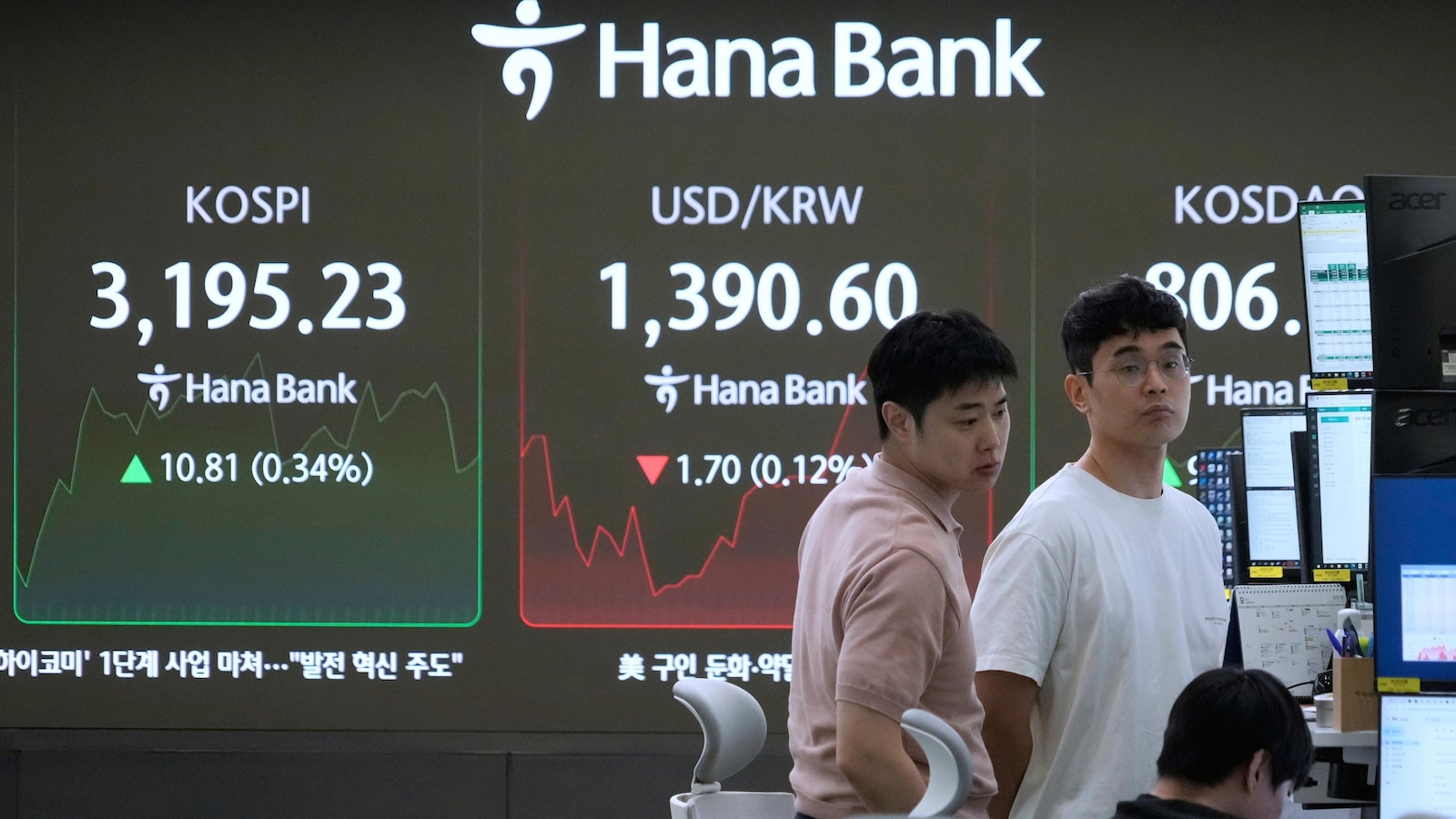
MANILA, Philippines — Shares in Asia mostly traded higher Thursday after a rally of technology stocks steadied Wall Street and a slide in the dollar made Asian assets more attractive.
U.S. futures were mixed while oil prices were lower.
Japan’s Nikkei 225 jumped 1.2% to 42,437.37 while Australia’s S&P/ASX 200 added 0.6% to 8,791.50. South Korea’s Kospi rose 0.2% to 3,192.22. Taiwan climbed 0.7% while India’s BSE Sensex added 0.6%.
The Chinese markets bucked the trend, with Hong Kong’s Hang Seng index down 1.1% to 25,006.22. The Shanghai Composite index fell nearly 2% to 3,738.32 on fears regulators will intervene amid excessive stock gains and liquidity.
On Wednesday, Wall Street steadied after Alphabet and other technology stocks rallied. It also got some relief from easing pressure from the bond market, where the latest discouraging report on the U.S. job market bolstered expectations that the Federal Reserve will cut interest rates soon to support the economy.
The S&P 500 climbed 0.5% to break the two-day losing slide it had been on since setting its latest all-time high. The Dow Jones Industrial Average dipped 24 points, or 0.1%, and the Nasdaq composite climbed 1%.
Also helping to steady Wall Street was a calming bond market. A day earlier, yields climbed worldwide on worries about governments’ abilities to repay their growing mountains of debt, as well as concerns that President Donald Trump’s pressure on the Federal Reserve to cut short-term interest rates could lead to higher inflation in the long term.
Such worries have pushed investors to demand higher yields before lending money to governments. And when bonds are paying more in interest, investors feel less need to pay high prices for stocks, which are riskier investments.
The report showed that U.S. employers were advertising 7.2 million job openings at the end of July, fewer than economists had forecast.
A weakened job market could push the Federal Reserve to cut its main interest rate for the first time this year at its meeting later this month. That’s the widespread expectation among traders, with the next big data point coming on Friday via an update on U.S. hiring during August.
Lower interest rates could give the job market and overall economy a boost. The downside is that they can also push inflation higher when Trump’s tariffs may be set to raise prices for all kinds of imports.
“The dollar, naturally, buckled under the weight of weaker jobs and lower rates, and increased Fed cut bets, handing Asia an early boost. When the U.S. dollar slides, Asian assets instantly look more attractive in currency-adjusted terms, and regional equities should snap to life after a sluggish start to September,” Stephen Innes of SPI Asset Management said in a commentary.
But he said Chinese equities slid as regulators fret over excessive stock gains and too much liquidity in the system, with Beijing signaling it may tighten the screws.
In other dealings on Thursday, U.S. benchmark crude lost 42 cents to $63.55 per barrel. Brent crude, the international standard, shed 35 cents to $67.25 per barrel.
The U.S. dollar rose to 148.24 Japanese yen, from 148.05 yen. The euro fell to $1.1653 from $1.1667.
MADISON, Wis. — A judge sentenced four former Milwaukee hotel workers accused of killing a man in a suffocating dogpile to a mix of probation and time served Wednesday, sparing them any more time behind bars.
Milwaukee County Circuit Judge David Swanson handed down the sentences in D’Vontaye Mitchell’s June 2024 death during a series of hearings that lasted all day. The orders bring an end to a case that drew comparisons to the 2020 police killing of George Floyd.
The judge ordered former Hyatt security guard Todd Erickson to serve two years in prison but stayed the sentence and placed him probation for two years. Another former security guard, Brandon Turner, got a year in prison but Swanson stayed that sentence, too, and placed him on probation for a year.
Former bellhop Herbert Williamson was sentenced to 10 days in jail with credit for 10 days already served. Former front desk worker Devin Johnson-Carson was ordered to serve four days in jail with credit for four days already served.
Attorneys for Erickson, Turner and Williamson didn’t immediately return messages. Johnson-Carson’s attorney, Craig Robert Johnson, said in an email to The Associated Press that the sentence was appropriate given that Johnson-Carson was trying to protect hotel guests and staff and never intended to seriously injure Mitchell.
According to investigators, Mitchell ran into the Hyatt’s lobby and went into the women’s bathroom. Two women later told detectives that Mitchell tried to lock them in the bathroom.
Turner pulled Mitchell out of the bathroom and together with a guest dragged him out of the lobby onto a hotel driveway. Turner, Erickson, Williamson and Johnson-Carson struggled with Mitchell before taking him to the ground and piling on top of him.
Hotel surveillance video shows Johnson-Carson holding Mitchell’s legs while Erickson, Turner and Williamson held down his upper body. They kept him pinned for eight to nine minutes. By the time emergency responders arrived, Mitchell had stopped breathing.
A medical examiner ruled his death a homicide, finding that Mitchell’s immediate cause of death was suffocation and toxic effects of cocaine and methamphetamine.
Attorneys for Mitchell’s family likened his death to the murder of Floyd, a Black man who died after a white Minneapolis police officer knelt on his neck for about nine minutes. Floyd’s death sparked a national reckoning on racial relations.
Mitchell was Black. Court records identify Erickson as white and Turner, Williamson and Johnson-Carson as Black.
The workers told investigators that Mitchell was strong and tried to bite Erickson, but they didn’t mean to hurt him. Ambridge Hospitality, the company that manages the Hyatt, fired all four of them.
SEATTLE — The Democratic governors of Washington, Oregon and California announced Wednesday that they created an alliance to safeguard health policies, believing the Trump administration is putting Americans’ health and safety at risk by politicizing the U.S. Centers for Disease Control and Prevention.
The move comes with COVID-19 cases rising and as Health Secretary Robert F. Kennedy Jr. has restructured and downsized the CDC and attempted to advance anti-vaccine policies that are contradicted by decades of scientific research. Concerns about staffing and budget cuts were heightened after the White House sought to oust the agency’s director and some top CDC leaders resigned in protest.
“The CDC has become a political tool that increasingly peddles ideology instead of science, ideology that will lead to severe health consequences,” the governors said in a joint statement.
“The dismantling of public health and dismissal of experienced and respected health leaders and advisors, along with the lack of using science, data, and evidence to improve our nation’s health are placing lives at risk,” California State Health Officer Erica Pan said in the news release.
Washington state Health Secretary Dennis Worsham said public health is about prevention — “preventing illness, preventing the spread of disease, and preventing early, avoidable deaths.”
The partnership plans to coordinate health guidelines by aligning immunization plans based on recommendations from respected national medical organizations, said a joint statement from Gov. Bob Ferguson of Washington, Gov. Tina Kotek of Oregon and Gov. Gavin Newsom of California.
This isn’t the first time Democratic-led states have banded together to coordinate policies related to public health.
In the first months of the coronavirus pandemic, states formed regional alliances to gain buying power for respirators, gloves and other personal protective equipment for front-line workers and to coordinate reopening their largely shuttered economies.
U.S. Department of Health and Human Services spokesman Andrew G. Nixon shot back in a statement Wednesday that “Democrat-run states that pushed unscientific school lockdowns, toddler mask mandates, and draconian vaccine passports during the COVID era completely eroded the American people’s trust in public health agencies.”
He said the administration’s Advisory Committee on Immunization Practices “remains the scientific body guiding immunization recommendations in this country, and HHS will ensure policy is based on rigorous evidence and Gold Standard Science, not the failed politics of the pandemic.”
Governors in the Northeast and West Coast — all but one of them Democrats — announced separate regional groups in 2020 hours after Trump said on social media that it would be his decision when to “open up the states.”
___
Associated Press reporter Geoff Mulvihill in Cherry Hill, New Jersey, contributed to this report.
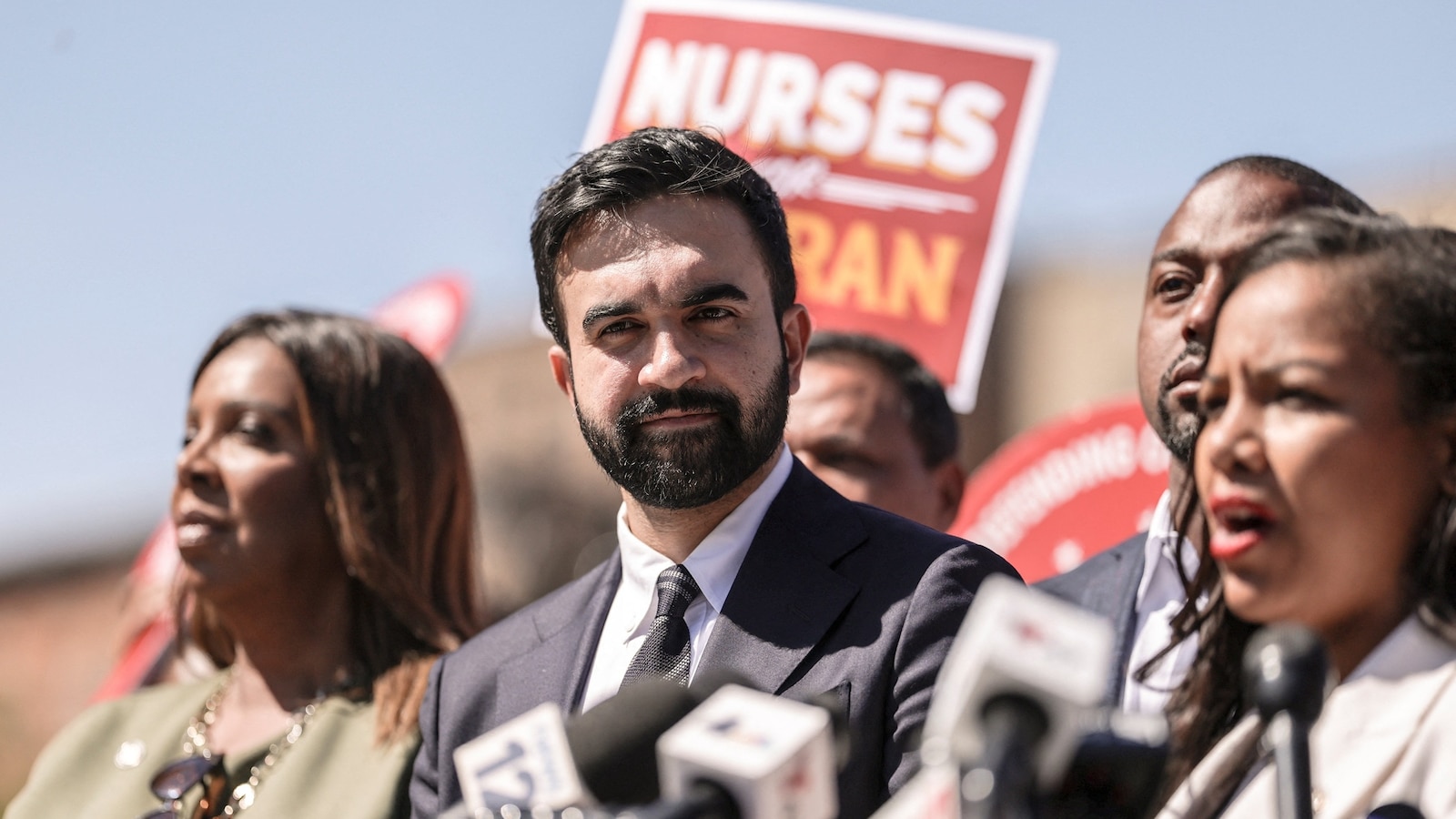
New York City mayoral candidate Zohran Mamdani called reporting Wednesday that the White House is considering administration jobs for Mayor Eric Adams and Republican candidate Curtis Sliwa an “affront to our democracy.”
The New York Times reported Wednesday that advisers to President Donald Trump have discussed giving incumbent Mayor Eric Adams, who is running as an independent, a position in the administration to clear the field and set up a head-to-head race between Mamdani and former New York Gov. Andrew Cuomo, who lost the Democratic primary to Mamdani and is now running as an independent. The talks have also involved Republican candidate Curtis Sliwa, the Times reported.
In mid-July after the Democratic primary, Trump told reporters that Cuomo should remain in the race.
“I think he should stay. I think he has a shot,” he said. “He’s going to run a tough campaign.”
New York City mayoral candidate Zohran Mamdani attends a press conference in New York City, Sept. 2, 2025.
Jeenah Moon/Reuters
In August, asked if he had spoke to Cuomo about his New York city mayoral run, Trump said, “I haven’t, no, I haven’t.”
Mamdani said Wednesday of the Times report, “Today, we have learned what New Yorkers have long suspected — that Andrew Cuomo is Donald Trump’s choice to be the next mayor of this city.”
He continued: “Today’s news that the White House is considering job offers for Eric Adams and Curtis Sliwa, it is not news that carries meaning because of any impact it will have on this race. We feel just as confident as we did yesterday that we will win this race in November.”
This is, however, about an affront to our democracy, an affront to what makes so many of us proud to be Americans, that we choose our own leaders, not that they get to pick themselves, not that they get to be picked by the president of the United States, the same president who detained a 6-year-old girl from a New York City public school system and took her hundreds of miles away, the same president that cut SNAP benefits from the hungry across these five boroughs … the same president who will throw millions of New Yorkers off their health insurance, is now seeking to undermine the very fabric of this city.”
An emotional Mamdani then stressed that New York “is not for sale.”
“That is what this news has revealed to us today, and that is what this campaign is fighting — not simply any other candidate that will be on the ballot, but the notion that New York City is for sale. We know that this city will decide its own future, and we know that it is New Yorkers that we will turn to make that decision in November, not the White House in Washington, D.C.”
New York City Mayor Eric Adams arrives to attend a ribbon-cutting ceremony at his Queens campaign office in Queens, New York, Aug. 14, 2025.
Eduardo Munoz/Reuters
Adams’ campaign denied that he has spoken with Trump and said he was not offered or asked for a role in Trump’s administration.
“Mayor Adams has made it clear he will not respond to every rumor that comes up,” campaign spokesperson Todd Shapiro said in a statement to ABC News. “Mayor Adams has not met with Donald Trump — don’t believe the noise,” campaign spokesperson Todd Shapiro said in a statement to ABC News. “He is not dropping out of the race. The Mayor is fully committed to winning this election, with millions of New Yorkers preparing to cast their votes. His record is clear: crime is down, jobs are up, and he has consistently stood up for working families. Mayor Adams is focused on building on that progress and earning four more years to continue delivering for the people of New York.”
Sliwa said in a statement to ABC News that the White House had not contacted him, adding that he is focused on New York.
“I’m the only candidate on a major party line who can defeat Mamdani, and I’m committed to carrying this fight through to Election Day,” he said.
ABC News has reached out to Cuomo’s campaign for its reaction.
The White House has not responded to ABC News’ request for comment.
New York City mayoral candidate Curtis Sliwa campaigns in the New York City subway system, Aug. 18, 2025.
Richard Drew/AP
Mamdani was asked Wednesday by a reporter if he was angry. He said he was, pointing to “backroom deals” that alienate New Yorkers, and his winning margins over Cuomo could have encouraged Trump to get involved.
“I am angry. I’m angry because so often we think of this solely in terms of the dynamics of politics. But the reason that so many New Yorkers are fed up with politics as they know it is because of news like this, backroom deals, corrupt agreements, all of which serve to increase the sense of disaffection and despair as it pertains to how people feel about politics across this country, and to know that having defeated Andrew Cuomo by 13 points, having won the votes of close to 600,000 New Yorkers, has only been understood by that former government as an invitation to collaborate with Donald Trump,” Mamdani added.
Asked what his message is directly for Eric Adams, Mamdani said he doesn’t think any mayoral candidate should be considering taking deals with the administration.
“I don’t think anyone seeking to represent the people of this city should be taking a job with the administration that is making it harder for the people of the city to afford the place that they call home…my issue is the work that is taking place right now in these kinds of conversations, in these kinds of meetings, to subvert the will of Democrats across the city, all in the interest of Donald Trump.”
Mamdani said he also sees “many ethical issues with this news” and has a hard time believing what he says is “Mayor Adams’ ever-changing story.”
Americans are expected to rein in spending this holiday season by the most amount since the pandemic, as they continue to face pressure from high prices and tariffs.
That’s according to a new survey released by accounting firm PwC on Wednesday, which predicts Americans this year will reduce holiday spending to $1,552 a person on average, which is 5% less than in 2024. That includes spending on gifts, travel, food and entertainment.
If the predictions come to pass, it would represent the most significant drop in holiday spending since 2020. While consumers are not cutting purchases entirely, they are getting smarter about how they stretch their dollars, according to Alison Furman, PwC’s consumer markets industry leader.
“Inflation is kind of creeping in, and they’re seeing it affect their wallets,” Furman told CBS MoneyWatch.
For its report, PwC surveyed 4,000 Americans from Gen Zs to baby boomers over a two-week period from June to July, when tariff-related uncertainty was more pronounced. But any perceived changes in the economy over the next couple of months could alter consumers’ attitude toward spending.
“Economic signals continue to shift and, between now and December, purchasing behavior could evolve in response,” the report states.
The generation expected to tighten their spending the most is Gen Z. Respondents from this cohort, ages 17 to 28, said they expect to reduce their holiday budgets by 23% — more than any other generation in the study. That’s due in part to the tough job market facing young Americans, along with rising costs.
Overall, 84% of consumers expect to cut back spending in general over the next six months, according to the report.
A slowdown in spending could spell trouble for retailers who depend on holiday sales to shore up revenue toward the end of the year. Since 2019, holiday sales during the months of November and December have accounted for 19% of total retail revenue for the year, according to a National Retail Federation report.
Tariffs, high prices top of mind
The projected pullback in consumer holiday spending underscores Americans’ shaky confidence in the state of the economy. Worries over inflation and tariffs have already led shoppers to be more judicious with their spending.
Discretionary spending on categories like indoor and outdoor dining were down in August, according to the U.S. Conference Board’s latest consumer confidence index each month. Meanwhile, average 12-month inflation expectations among consumers increased to 6.2%, from 5.7% in July.
Tighter spending
PwC expects consumers to approach holiday shopping “more deliberately,” with an eye toward saving money, amid ongoing concerns over tariffs and high prices.
Furman said the potential for tariff-related price increases has already made the consumers “very conscious of trying to buy things at a discount.”Case in point: Internet searches for “discount” and “coupon code” have climbed by 11% over the past year, according to the survey.
With deals in mind, consumers are expected to do a large portion, or 39%, of their total planned holiday gift spending, during the time between Thanksgiving and Cyber Monday, according to the PwC report. With heightened traffic expected during that five-day stretch, Furman advises shoppers to start looking early for popular items.
“If you’re interested in very hot items, knowing that they’re going to likely be on shelves sooner, to guarantee that you’ll get them, you may want to shop for them in those early promotional cycles, versus wait until the five-day frenzy,” she said.
Mary Cunningham is a reporter for CBS MoneyWatch. Before joining the business and finance vertical, she worked at “60 Minutes,” CBSNews.com and CBS News 24/7 as part of the CBS News Associate Program.
Hosted by Jane Pauley. Featured: David Pogue on how AI is affecting job searches; Jane Pauley talks with Dr. Sanjay Gupta about treatments for chronic pain; Robert Costa interviews singer-songwriter John Fogerty; Steve Hartman explores the bedrooms left behind by children killed by gun violence; Elaine Quijano visits the studio of painter Alex Katz; and Luke Burbank checks out the world’s largest truck stop.
Heading toward fall, Americans are continuing to rate the U.S. economy negatively, as most pick “uncertain” and “struggling” to describe its current state. Ratings dipped again slightly over the last month.
A third of Americans pick the descriptors “rebounding” or “expanding.” (Respondents could pick multiple words.) And more than twice as many said “unfair” as “fair.”
Positive views of the economy have been hovering in a range in the 30s all year. They had ticked up slightly toward the end of July, though today it’s above the low hit back in the winter.
Behind those views is much the same story as it has been for a while: Prices. Two-thirds say prices are still going up and, perhaps more importantly for outlook, two-thirds expect them to keep going up, at least a little.
Americans’ ratings of their personal financial situations are somewhat connected to perceptions of price changes. People who say prices are going up are more likely to describe their own situation as bad, more so than people who say prices are holding steady.
Otherwise, personal finance ratings are much the same story as it has been: those with higher incomes say it’s better for them personally.
There is some partisanship perception mixed in here, as often is the case in economic evaluations. Republicans are less likely than Democrats and independents to report that prices around them are going up. That said, none of the partisan stripes say prices are going down.
On the outlook overall, a majority continue to say the economy is getting worse, as opposed to better. Around a quarter continue to think there will be a recession.
This CBS News/YouGov survey was conducted with a nationally representative sample of 2,344 U.S. adults interviewed between August 29 – September 2, 2025. The sample was weighted to be representative of adults nationwide according to gender, age, race, and education, based on the U.S. Census American Community Survey and Current Population Survey, as well as 2024 presidential vote. The margin of error is ±2.3 points.
Anthony Salvanto, Ph.D., is CBS News’ executive director of elections and surveys. He oversees the CBS News Poll and all surveys across topics and heads the CBS News Decision Desk that estimates outcomes on election nights
According to Everytown, an advocacy group fighting gun violence in the U.S.,125 people are killed by guns every day. Anna Schecter has the story of a gunshot survivor from overseas and the American trauma surgeons who gave him a second chance.
GARDEN GROVE, Calif. /California Newswire/ — Informative Research (IR), a leading technology provider of data-driven credit and verification solutions for the lending industry, today announced that Chief Experience Officer Matt Orlando has been named a 2025 HousingWire Vanguard. The award recognizes C-suite professionals and business leaders whose vision and leadership are driving the housing industry forward across lending, servicing, investments and real estate.
As Chief Experience Officer, Orlando has redefined how technology and client strategy intersect to support lenders. By championing borrower-centric innovation and architecting scalable platforms, he has advanced operational efficiency and transformed both lender workflows and borrower experiences. His leadership has positioned Informative Research at the forefront of mortgage technology modernization.
Over the past year, Orlando has spearheaded initiatives that strengthened IR’s strategic role in the mortgage ecosystem. His efforts to expand and evolve the company’s Verification Platform, while fostering greater adoption of consumer-permissioned data tools, have helped lenders streamline processes, maintain compliance, and enhance borrower empowerment. Beyond product innovation, Orlando continues to champion a client-first culture that emphasizes collaboration, agility and responsiveness to industry needs.
“Matt’s leadership reflects the very essence of what it means to be a HousingWire Vanguard,” said Beth Fowler, President and EVP of Stewart Lender Services. “He combines strategic vision with an unwavering commitment to clients and the industry, ensuring that innovation is always practical, ethical and impactful.”
Orlando is also an active participant in the Housing Policy Council, where he contributes to shaping industry-wide discourse on responsible data use, verification technology and borrower empowerment. His forward-looking approach reflects not only operational expertise but also a deep commitment to advancing the mortgage ecosystem as a whole.
“The 2025 HousingWire Vanguards exemplify what it means to lead with vision and resilience,” said Sarah Wheeler, Editor-in-Chief of HousingWire. “These leaders aren’t just driving growth within their organizations, they’re shaping the future of housing itself. Their achievements reflect the innovation, adaptability, and commitment required to thrive in today’s rapidly evolving market.”
HousingWire is an information services company that provides unique data and research, respected business journalism and must-attend events for housing leaders to use to advance their understanding and business outcomes. Our vision is a world in which housing leaders have a complete view of the housing market, and a broad community of peers with whom they can connect. We are committed to delivering the data, analytics, media, and events that advance this vision.
Because housing is too important for narrow perspectives and missed connections. Informed housing leaders are better housing leaders. A connected housing industry is a better housing industry. And the full picture always reveals new opportunities.
Explore more at www.housingwire.com.
About Informative Research
Informative Research, a Stewart company, is a premier technology provider delivering data-driven credit and verification solutions to the lending community. The solutions provider currently serves mortgage companies, banks and lenders throughout the United States. The company is recognized for streamlining the loan process with its straightforward service model, progressive solutions and cutting-edge technology. To learn more, visit https://www.informativeresearch.com/.
Information is believed accurate but is not guaranteed. For questions about the above news, contact the company/org/person noted in the text and NOT this website.