New details are emerging Monday about the gunman in a fatal attack on The Church of Jesus Christ of Latter-day Saints in Michigan.
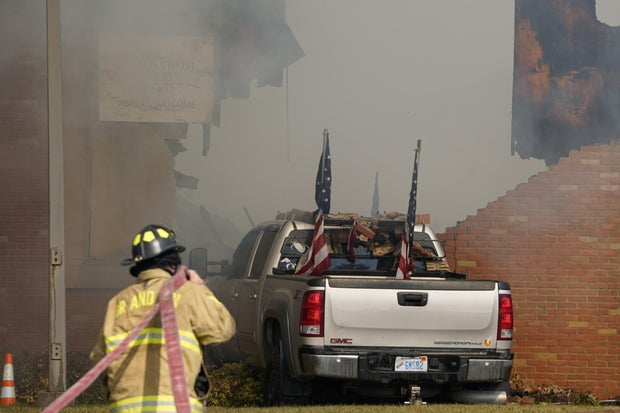
Thomas Jacob “Jake” Sanford, 40, drove his vehicle through the front doors of the church and fired multiple rounds from an assault rifle during Sunday services, authorities said. Sanford also apparently used gas to start a fire at the church, officials said. Police said officers were on the scene within 30 seconds after a 911 call and eventually fatally shot Sanford, who killed four people and injured eight more.
Sanford served in the U.S. Marines from 2004 to 2008, CBS News confirmed. He was an Iraq war veteran who deployed for several months during 2007 and 2008, according to service records provided by the Pentagon.
White House spokesperson Karoline Leavitt said on Fox Monday morning that FBI Director Kash Patel told her Sanford “hated people of the Mormon faith.”
“From what I understand based on my conversations with the FBI director, all they know right now is this was an individual who hated people of the Mormon faith, and they are trying to understand more about this, how premeditated it was, how much planning went into it, whether he left a note,” Leavitt said.
Kris Johns, who is running for city council in Burton, Michigan, which is near where the shooting happened in Grand Blanc Township, told CBS News he met Sanford at his home last week while campaigning. He said Sanford had a particular dislike of the Latter-day Saints church, which was previously known as the Mormon church. He said Sanford told him that the church’s followers “believe they’re above Jesus.”
Johns said Sanford told him he moved to Utah for a fresh start to plow snow and that while he was there he started a relationship with a Latter-day Saints woman.
Johns recalls Sanford telling him: “They wanted me to get rid of my tattoos. They wanted me to do all this stuff, and I wouldn’t do it.”
Johns said he and Sanford didn’t talk politics.
“He said nothing about Charlie Kirk, nothing about our current president or past president,” Johns said. “He asked me about guns. I said I support the Second Amendment. We ended the conversation very positively.”
Johns also said Sanford told him that he had issues with drugs after he returned from overseas deployment.
Johns said he provided a statement to the FBI and the Michigan State Police on Sunday.
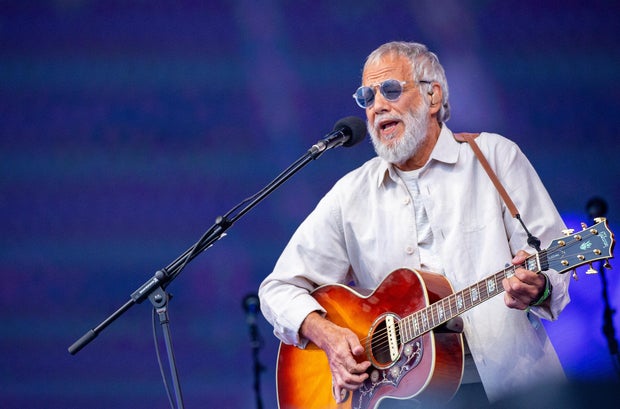
Legendary singer-songwriter Cat Stevens, also known as Yusuf, announced that his upcoming North American book tour will be postponed due to unspecified visa issues.
The “Morning Has Broken” singer took to Instagram to share the news on Monday, saying his “Cat on the Road to Findout” book tour won’t be going ahead as scheduled next month. The book will be released in the U.S. on Oct. 7 and was made available in the U.K. earlier this month.
“Waiting months for visa approvals, we held out as long as we could,” he wrote. “However, at this point, the production logistics necessary for my show cannot be arranged in time.”
He added: “I am really upset! Not least for my fans who have bought tickets and made travel plans to see me perform.”
Yusuf Islam, also known as Cat Stevens, performs during Glastonbury Festival in Somerset, England, on June 25, 2023.
Joel C Ryan/Invision/AP
Stevens said North American fans may still get a chance to see the tour “if visa approvals come through,” though he said those dates would most likely be “some time away” because of other commitments.
“Hopefully, fans will be able to hop on the Peace Train route at some time in the future,” he added. “Meanwhile, tour delays should not affect the book, which you’ll still be able to enjoy… the obvious benefit of it being — books don’t need visas!”
The singer-songwriter, who changed his name to Yusuf Islam after embracing the Muslim faith, did not specify any reason for the visa delays. He is the latest in a string of international musicians and athletes impacted by visa issues, as fees have increased in the past year and processing times have slowed.
Representatives of Stevens did not immediately respond to The Associated Press’ request for comment.
The singer’s tour was set to start Oct. 2 in Philadelphia and had various stops scheduled across the country for the rest of the month. His Oct. 8 tour stop in Toronto, Canada, was also postponed.
The British singer-songwriter rose to fame in the 1960s and put his career on hold for two decades after converting to Islam in the late 1970s. He returned to secular music in the 2000s.
Royalty. Roses. A renewed year for the Tournament of Roses, which announced the 2026 Rose Court on Monday morning, Sept. 29.
A group of seven Tournament of Roses princesses was chosen from 28 finalists from 41 Pasadena-area schools.
They will comprise the Rose Court for the Jan. 1, 2026, Rose Parade.
It is a big moment for a group of young people who will become ambassadors for the Tournament of Roses in a year in which the Eaton fire impacted so many in the Tournament of Roses’ local footprint.
After resounding applause for the 28 finalists, Tournament of Roses President Mark Leavens announced final seven in an outdoor ceremony at the Tournament House.
They are:
-Riya Gupta, California Institute of Technology (Caltech);
-Serena Hui Guo, Arcadia High School;
-Livia Amy de Paula, Temple City High School;
-Sophia Bai Ren, Arcadia High School;
-Keiko Rakin, Alhambra High School;
-Naira Elaine Wadley, John Muir High School; and
-Olivia Hargrove, Pasadena City College.
Leavens said that as the area rebuilds after the Eaton fire, “we need teamwork perhaps more than ever,” and the young people chosen exemplified that effort.
“These seven young women selected today will become part of our tournament teamwork,” he said, referencing the Tournament’s theme this year, “The Magic in Teamwork!”. “This group is very joyful and very hopeful.”
This year, in light of the Eaton fire, the Tournament allowed applicants who were displaced by the fire to apply as long as they attended a school within the eligibility area. The area is determined by the Pasadena City College District map along with seven additional zip codes that include Eagle Rock, Highland Park, San Gabriel and Alhambra.
On Monday at the famous Tournament House, the finalists were joined by friends, family and Tournament members as the seven members of the 2026 Rose Court were announced.
The full 28 finalists made choosing the seven “extremely difficult,” Leavens said.
To set the mood, they were joined by a live band, and about 200 people gathered for what organizers called an “iconic event.”
The selection process involves a series of interview sessions at Tournament House in early September. They are selected based on a combination of qualities. That includes public speaking ability, youth leadership, academic achievement and community and school involvement.
Each Rose Court member will receive a $7,500 academic scholarship. But it’s what they give that will touch a community. Once they move through personal development programs designed to enhance their public speaking and presentation abilities, boost self-confidence and refine their etiquette skills, “Rose Court members are provided with opportunities to actively participate in the community, make positive contributions and discover ways to connect with local leaders,” according to the Tournament of Roses.
CHARLOTTE, N.C. (AP) — Airplane maintenance workers at a North Carolina airport found the body of a suspected stowaway in the landing gear compartment of an American Airlines flight that had recently arrived from Europe, police said.
The body was found Sunday morning while the plane was undergoing maintenance at Charlotte Douglas International Airport. The Charlotte-Mecklenburg Police Department said in a statement that it is investigating the death.
Neither the airline nor police have offered information about the person who died, including a possible cause of death, or said where the flight originated.
The airport said it was deeply saddened by the discovery and said it will support the police investigation. American Airlines said it was working with law enforcement on its investigation and directed questions to police.
Experts believe roughly three-quarters of stowaways do not survive if they hide on a plane’s undercarriage because of the extreme cold and lack of oxygen they experience as the plane reaches cruising altitude.
In January, two bodies were found in the landing gear compartment of a JetBlue aircraft at Fort Lauderdale-Hollywood International Airport. The bodies were discovered in the wheel well area during a routine post-flight inspection. The aircraft had arrived in Fort Lauderdale shortly after flight from John F. Kennedy International Airport in New York. The jet had been in both Kingston, Jamaica, and Salt Lake City, Utah, earlier that day.
In December, a body was found in the wheel well of a United Airlines plane after it landed in Maui from Chicago.
In a darkened airport hotel ballroom room, a bevy of California Democrats sought to distinguish themselves from the crowded field running for governor in 2026.
It was not an easy task, given that the lineup of current and former elected officials sharing the stage at the Sunday morning forum agreed on almost all the issues, with any differences largely playing out in the margins.
They pledged to take on President Trump, make the state more affordable, safeguard immigrants and provide them with Medi-Cal healthcare benefits, and keep the state’s over-budget bullet train project intact.
There is not yet any clear front-runner in the race to run the nation’s most populous state, though former Orange County Rep. Katie Porter has had a small edge in recent polling.
Aside from a opaque dig from former state Controller Betty Yee, Porter was not attacked during the debate.
They were joined onstage by former U.S. Secretary of Health and Human Services Xavier Becerra, California Supt. of Public Instruction Tony Thurmond and former Los Angeles Mayor Antonio Villaraigosa. State Sen. Toni Atkins, who was supposed to participate, dropped out due to illness. Wealthy first-time political candidate Stephen J. Cloobeck withdrew due to a scheduling conflict.
The forum was sponsored by the National Union of Healthcare Workers, in partnership with the Los Angeles Times and Spectrum News. It was held in Los Angeles and moderated by Associated Press national planning editor Lisa Matthews, with L.A. Times California politics editor Phil Willon, Spectrum News 1 news anchor Amrit Singh and Politico senior political reporter Melanie Mason asking the questions.
Sen. Alex Padilla and businessman Rick Caruso have also both publicly flirted with a bid for the state’s top office, but have yet to make a decision.
With Prop. 50 in the forefront, a lack of attention on the race
California’s June 2 gubernatorial primary is just eight months away, but the horde hoping to replace Gov. Gavin Newsom has been competing for attention against an extraordinarily crowded landscape, with an unexpected special election this November pulling both dollars and attention away from the race for governor. To say nothing of the fact that the race had been somewhat frozen in place for months until the end of July, when former Vice President Kamala Harris finally announced she would not be running.
The candidates reiterated their support for Proposition 50, the Newsom-led November ballot measure to help Democrats win control of the U.S. House of Representatives next year by redrawing California congressional districts. Newsom pushed for the measure to counter efforts by Republican-led states to reconfigure their congressional districts to ensure the GOP keeps control of Congress.
“This is not a fight we actually wanted to have,” Yee said. “This is in response to a clear attempt to mute our representation in Washington. And so we have to fight back.”
A focus on immigrant backgrounds, and appeals to Latino voters
The candidates repeatedly focused on their families’ origins as well as their efforts to protect immigrants while serving in elected office.
Thurmond raised his upbringing in his opening remarks.
“I know what it is to struggle. You know that my grandparents were immigrants who came here from Colombia, from Jamaica? You know that I am the descendant of slaves who settled in Detroit, Mich.?” he said.
Becerra highlighted his support for undocumented people to have access to state healthcare coverage as well as his successful lawsuit protecting undocumented immigrants brought to this nation as young children that reached the Supreme Court.
“As the son of immigrants, I know what happens when you feel like you’re excluded,” he said.
Becerra and Thurmond addressed the diverse audience in Spanish.
Yee, who spoke about sharing a room with her immigrant parents and siblings. also raised her background during a lightning-round question about what the candidates planned to dress up as on Halloween.
“My authentic self as a daughter of immigrants,” she said.
Differing opinions on criminal justice approaches and healthcare
The debate was overwhelmingly cordial. But there was some dissent when the topic turned to Proposition 36, a 2024 anti-crime ballot measure that imposed stricter penalties for repeat theft and crimes involving fentanyl.
The ballot measure — which undid key parts of the 2014 criminal justice reform ballot measure Proposition 47 — sowed division among California Democrats, with Newsom and groups including the ACLU strongly opposing it. Its passage marked a turning of the tide in Californians’ attitudes about criminal justice reform and response to crime, following years of support for progressive policies that leaned away from punitive prison sentences for lower-level crimes.
First, Villaraigosa contended that he was the only candidate on stage who had supported Proposition 36, though Porter and Becerra quickly jumped in to say that they too had supported it.
But Porter also contended that, despite her support, there were “very real problems with it and very real shortcomings.” The measure should have also focused on prevention and incarcerating people for drug offenses doesn’t make anyone safer, she said.
Thurmond strayed sharply from the pack on the issue, saying he voted “no” on Proposition 36 and citing his career as a social worker.
“Prop. 36, by design, was set up to say that if you have a substance abuse issue, that you will get treatment in jail,” Thurmond contended, suggesting that the amount of drugs present in the prison system would make that outcome difficult.
As governor, he would more money into treatment for substance abuse programs and diversion programs for those who commit minor crimes, he said.
When the candidates were asked to raise their hands if they supported a single-payer healthcare system, Porter and Villaraigosa did not, while Becerra, Yee and Thurmond did.
The need to build more housing
Issues of affordability are top of mind for most Californians, particularly when it comes to housing.
Thurmond said he would build two million housing units on surplus land on school sites around the state and provide a tax break for working and middle class Californians.
Villaraigosa also focused on the need to build more housing, criticizing bureaucratic red tape and slow permitting processes.
Villaraigosa also twice critiqued CEQA — notable because the landmark California Environmental Quality Act was once held seemingly above reproach by California Democrats. But the law’s flaws have become increasingly accepted in recent years as the state’s housing crisis worsened, with Newsom signing two bills to overhaul the the law and ease new construction earlier this year.
Porter said that if she were governor, she would sign SB 79, a landmark housing bill that overrides local zoning laws to expand high-density housing near transit hubs. The controversial bill — which would potentially remake single-family neighborhoods within a half-mile of transit stops — is awaiting Newsom’s signature or veto.
Ever since Elijah Maldonado was born at just 29 months, he has needed specialty treatments that his family could afford only with publicly funded healthcare.
Diagnosed with cerebral palsy as an infant, he spent his first three months at a public hospital where the family lives in Orange County.
Now 7, Elijah receives physical and speech therapy among a host of other services paid for through Medicaid. He relies on a wheelchair funded by the government. An assistant paid for with taxpayer dollars makes sure he’s safe on the bus ride to and from school.
Each month, he receives a $957 disability check that helps to cover his and his family’s living expenses.
Josephine Rios wipes her grandson Elijah’s face.
(Juliana Yamada / Los Angeles Times)
Still learning to speak on his own, he uses a Proloquo speech app on an iPad provided by his school to tell his family when he’s hungry, needs to use the restroom or wants to play with his favorite toys.
“It’s his voice — his lifeline,” his aunt and primary caretaker Cassandra Gonzalez says of the app. Her compensation for his in-home care comes from taxpayer dollars too.
Now that lifeline — and much of the government assistance Elijah receives — is at risk of going away.
With hundreds of billions of dollars worth of cuts to Medicaid and food aid kicking in this fall thanks to the passage of the Republican-backed “One Big Beautiful Bill Act” — on top of earlier cuts imposed by Elon Musk’s Department of Government Efficiency — a host of federally funded healthcare and nutrition programs that serve low-income Americans will be scaled back, revamped with expanded work requirements and other restrictions or canceled altogether if individual states can’t find alternate funding sources.
The budget reduces federal spending on Medicaid alone by about $1 trillion over the next 10 years nationwide, with initial reductions taking effect in the coming weeks.
Gov. Gavin Newsom responded by accusing the Trump administration of “ripping care from cancer patients, meals from children and money from working families — just to give tax breaks to the ultra-rich.”
L.A. public health officials called the cuts devastating for a county where nearly 40% of the population is enrolled in Medi-Cal, the state’s Medicaid program. L.A. County’s Department of Health Services, which oversees four public hospitals and about two dozen clinics, projects a budget reduction amounting to $750 million a year, and federal funding for the Department of Public Health, which inspects food, provides substance-use treatment and tracks disease outbreaks, will drop by an estimated $200 million a year. Spending cuts have prompted hiring freezes and projections of ballooning budget deficits, county health officials said.
Spending reductions, combined with recent changes to the Affordable Care Act and Medicare, could leave an additional 1.7 million people in California uninsured by 2034, according to an analysis by the nonprofit healthcare research organization KFF.
It’s not just that the cuts to these programs are massive by historical standards.
The new rules and restrictions are confusing and states have been given little guidance from the federal agencies that oversee health and nutrition programs on how, or even when, to implement them, experts at the Center on Budget Policy and Priorities wrote in a recent report.
What’s clear, the CBPP said, is that millions of children, older adults, people with disabilities and veterans stand to lose not just Medicaid coverage but federal aid to access the type of healthy foods that could prevent illness and chronic conditions.
More than 5 million California households receive food aid through the state’s CalFresh program and 97% percent of them will see their benefits either slashed or eliminated because of federal spending cuts, changes to eligibility requirements or financial constraints at the state level, according to an analysis by the nonpartisan California Budget Policy Center.
Elijah plays with toy cars outside his aunt’s home in Tustin.
(Juliana Yamada / Los Angeles Times)
In Orange County, where Elijah’s family lives, public health officials were already reeling from federal spending cuts in the months before the budget bill passed, said Dr. Veronica Kelley, director of the OC Health Care Agency. For example, there was the $13.2-million cut to funding for family planning services in the county, and the $4-million reduction in funding to Women, Infants and Children nutrition (WIC).
The agency has worked to prevent mass layoffs by moving public-health workers in canceled programs to other departments or leaving some positions unfilled in order to save jobs elsewhere, and it has sought out nonprofit social service organizations and philanthropies to either take over programs or help fund them, Kelley said.
Now, Kelley is preparing for possible cuts to programs to combat obesity, maintain community gardens, help seniors make better healthcare decisions and reduce the use of tobacco. The agency also has to figure out how to make up for a $4.8-million reduction in federal funds for the county’s SNAP program that takes effect on Wednesday — another casualty of the federal spending bill.
The measures that the agency has leaned on to get through the year are not sustainable, Kelley said. “We can only do that for so long,” she said. “It’s chaotic. In terms of healthcare, it’s devastating… It feels like we’re taking so many steps backward.”
The looming cuts and changes have also set off alarm bells at Kaiser Permanente, California’s largest private healthcare provider with 9.5 million members statewide, 1.1 million of whom are enrolled in Medi-Cal, the state’s Medicaid program.
“Without the ability to pay, newly uninsured people will find themselves having to delay care, leading to more serious and complex health conditions, increasing the use of emergency services and more intensive medical services,” Kaiser Permanente Southern California Regional spokeswoman Candice Lee said in a statement to The Times.
“This will affect all of us as the cost of this uncompensated care leads hospitals and care providers to charge paying customers more to cover their costs. Some hospitals and providers, especially those in rural and underserved areas, will be unable to make up for these unreimbursed costs, and will be financially threatened by these changes.”
Standing in front of her sister Cassandra’s town home in Tustin, a quiet suburban city of 80,000 about 10 miles south of Disneyland, Elijah’s mother, Samantha Rios; grandmother Josephine Rios; and Aunt Cassandra are filled with worry.
Elijah points to a command on his Proloquo speech app, which he uses to communicate his needs.
(Juliana Yamada / Los Angeles Times)
Josephine, a nursing assistant who works at a Kaiser hospital in Orange County, said she hears the panic in patients’ voices when they describe rushing to schedule needed medical procedures in anticipation of losing their Medicaid benefits.
Earlier this year, Josephine joined delegations of unionized California healthcare workers who traveled to Washington with the aim of pressing lawmakers to oppose spending cuts.
Rep. Young Kim, the Republican who represents the Rios family’s district in Congress, was receptive to the delegation’s pleas to vote no on the budget bill, Josephine recalls. The congresswoman ultimately voted for the bill, saying on her official webpage the legislation was good for Californians because it would relieve the tax burden on families, ensure that government dollars are used effectively and “strengthen Medicaid and SNAP for our most vulnerable citizens who truly need it.”
Elijah’s Aunt Cassandra and grandmother Josephine look over his shoulder as he watches a TV show.
(Juliana Yamada / Los Angeles Times)
Now, Josephine looked on as Elijah, seated in his wheelchair, played on his iPad and watched a Disney program on his phone. He can press a tab on the touchscreen to make the tablet say “My name’s Elijah” if he’s feeling unsafe away from home, another to tell his family he needs space when upset.
Watching Elijah enjoy himself, the women said they feel awkward broadcasting their woes to strangers when all they desire is what’s best for him. They don’t need the public’s pity.
The family wants lawmakers and the public to understand how seemingly abstract healthcare decisions involving billions of dollars, and made 2,000-plus miles away in Washington, have brought new financial turmoil to a family that’s already on the edge financially.
Samantha, a single mom, works full time to provide a home for Elijah and his two sisters, ages 10 and 8. A subscription to the Proloquo speech app alone would cost $300 a year out-of-pocket — more than she can afford on her shoestring budget.
Due to changes in household income requirements, Samantha had already lost Medicaid coverage for herself and her two girls, she said, as well as her SNAP food assistance, leaving her at a loss for how to fill the gap. She now pays about $760 a month to cover her daughters and herself through her employer-based health plan.
The cut to food aid has forced her to compensate by getting free vegetables, milk, eggs and chicken from the food pantry at a local school, a reality that she said she was at first too ashamed to disclose even to relatives.
Then came the bad news Samantha recently received about Elijah’s monthly Social Security Insurance for his disability. She was stunned to hear that because of stricter income cut-offs for that type of aid, Elijah would no longer receive those checks as of Oct. 1.
“Before, he was getting $957 a month — obviously that’s grocery money for me,” Samantha said. The money also went to buy baby wipes, as well as knee pads to help him move more comfortably on the floor when not using his wheelchair.
“I don’t get food stamps. I don’t get Medi-Cal for my girls. I don’t get any of that,” Samantha said. “As of Oct. 1, now I’ve got to figure out how am I going to pay my rent? How am I going to buy groceries?”
Luckily, the sisters said, the physical, speech and behavioral-health therapies that Elijah receives are safe — for now.
And the women know they can lean on each other in tough times. The sisters and Josephine all live within minutes of each other in Tustin, close enough for Samantha’s children to eat at someone’s home when their own cupboards are bare.
Every few months, Samantha said, Elijah experiences severe seizures that can last up to 90 minutes and require hospitalization.
Cassandra and Josephine like that they can run over to help if Elijah has a medical emergency. Another sister who lives farther away is on hand when needed too.
“What’s going to happen to other families who don’t have that support system?” Samantha said.
Given the potential for further cuts to programs that pay for home-based healthcare and assistants for people with disabilities, Cassandra wonders what will happen to her own family if she can no longer work as Elijah’s caregiver.
Where would the family get the money to pay a new caregiver who is qualified enough to work with a special-needs child who can speak a few words thanks to speech therapy but who cannot eat, walk or use the restroom without supervision? What if funding is eliminated for the assistant who travels with Elijah to school?
“People think that cutting Medi-Cal, cutting food stamps or whatever isn’t going to affect that many people,” Cassandra said. “It’s affecting my nephew and nieces. It’s affecting my sister. But it’s not just affecting her household. It’s affecting my household.”
“We’re not saying we’re going to Disneyland or going out to eat every day,” Cassandra said. “This is just living. We can’t even live at this point, with things being cut.”
The women offered up principles they feel are in short supply lately in the discourse over the government’s role in public health — among them “morals” and “empathy.” Samantha adds one more word to the list.
Months of negative news have triggered a tough summer for tourism in Los Angeles, deepening the economic woes for a city buffeted by natural disasters and immigration raids.
Tourist arrivals fell by close to 10% this season, according to the latest numbers from Visit California.
The region’s economy and image suffered significant setbacks this year. Shocking images of the destructive Eaton and Palisades fires in January, followed by the immigration crackdown in June, made global news and repelled visitors. Meanwhile, President Trump’s fickle tariff policies and other geopolitical posturing have convinced many international tourists to avoid America.
On Hollywood Boulevard, there are fewer tourists, and the ones who show up spend less, says Salim Osman. He works for Ride Like A Star, an exotic car company that rents to visitors looking to take a luxury vehicle for a spin and snap the quintessential L.A. selfie.
Last year, crowds lined up to rent its Ferraris and Porches for around $200 an hour, Salim says. However, this summer, foot traffic dropped by nearly 50%.
“It used to be shoulder to shoulder out here,” he said, looking along the boulevard. “It’s a lot harder for people to come here, or they’re afraid of what’s going on here, so they just don’t come.”
Business has been slow around the TCL Chinese Theater, where visitors place their hands into the concrete handprints of celebrities like Kristen Stewart and Denzel Washington.
There were fewer people to hop onto sightseeing buses, stop inside Madame Tussauds wax museum and snap impromptu photos with patrolling characters such as Spiderman and Mickey Mouse. Souvenir shops nearby say they have also had to increase the prices of many of their knick-knacks because of tariffs and a decline in sales.
Of all the state’s international travelers, the most significant absence was from Canadian tourists. Arrivals from visitors from up north fell around 30% in June and July.
Summer in Palm Springs was okay this year, said its mayor, Ron deHarte, but only because domestic tourists offset the sharp decline in Canadians.
“We’ve hurt our Canadian Friends with actions that the administration has taken. It’s understandable,” he said. “We don’t know how long they won’t want to travel to the States, but we’re hopeful that it is short-term.”
A view of travelers at Long Beach Airport in Long Beach. Long Beach Airport saw a 10.5% decrease in passenger traffic when compared to 2024.
(Allen J. Schaben/Los Angeles Times)
Visitors from China, India and Germany also avoided the state. Surprisingly, Mexican tourists didn’t stay away. There were 5.4% more arrivals from our southern neighbor despite the ICE raids, which often targeted Latino people.
There was a dip in traffic to most Los Angeles airports. With the World Cup on the books for next year and the Summer Olympics gearing up in 2028, the growing decline in tourism is worrisome for many across all industries.
Cynthia Guidry, the director of the Long Beach Airport, says reduced airline schedules, economic pressures and rising costs also impacted airport traffic. She’s currently seeking out ways to best prepare for the Olympics, which don’t involve flight revenue, such as dining at the airport and souvenir shopping.
“We’re focused on attracting new service, growing non-aeronautical revenue and managing expenses to stay resilient,” she said.
Many of the state’s most prominent attractions are also experiencing dry spells. Yosemite reported a decrease of as much as 50% in bookings ahead of Memorial Day weekend.
Dennis Speigel, president of International Theme Park Services, a consulting firm in the industry, says that this past year has been a “soft year” for most theme parks nationwide.
The “Forever Marilyn” statue towers over visitors who attend the weekly Palm Springs Villagefest along Museum Way.
(Genaro Molina/Los Angeles Times)
There have been fewer international visitors and more domestic traffic, as more people are embracing the idea of staycations, or spending their holidays closer to home.
“People in the locales where the parks are stayed in their areas,” he said, adding that this summer people stayed home because of “the general economy, the media, the tariffs, the confusion and the uncertainty that came with that.”
Los Angeles and California depend on tourism.
Last year, the state’s tourism hit a new high, with visitors spending $157.3 billion, up 3% from 2023, and creating 24,000 jobs, according to a 2024 economic impact report from Visit California.
“Los Angeles is California’s primary international gateway; the impacts are felt statewide,” Adam Burke, president of Los Angeles Tourism, said in a statement to The Times. “Looking ahead, long-term recovery will depend on global economic conditions and how the U.S. is perceived abroad.”
Tourists walk across celebrity stars on Hollywood Boulevard in front of the Dolby Theater.
(Gina Ferazzi/Los Angeles Times)
Australian tourists Geoffrey and Tennille Mutton ignored the warnings of their friends and family to bring their two daughters to L.A.
“A lot of people have had a changed view of America,” said Geoffrey as his family enjoyed Ben & Jerry’s ice cream outside of Hollywood’s Dolby Theater. “They don’t want to come here and support this place.”
WASHINGTON (AP) — Here he is, depicted at six months in office, chiseled and brawny, as mighty as the very nation. Here he is as a Star Wars Jedi wielding a patriot-red lightsaber, rescuing our galaxy from the forces of evil. Here he is taking over Gaza, transforming the strip into a luxury resort complete with a golden effigy of himself.
You can be anything, perhaps you were told growing up. Doctor. Astronaut. Maybe, one day, the president. But even the chief executive of the United States, the free world’s leader, frames himself as something more epic — as someone not entirely himself.
On the social media accounts of Donald Trump and his second-term administration, a new official image of the president is emerging bit by bit: one generated artificially.
FILE – FOX News reporter Peter Doocy, right, shows President Donald Trump a photo on his phone during an event about the relocation of U.S. Space Command headquarters from Colorado to Alabama in the Oval Office of the White House, Sept. 2, 2025, in Washington. (AP Photo/Mark Schiefelbein, File)
A sign of the times, certainly — when the appeal of reimagining yourself with artificial intelligence has trickled up from us everyday citizens. Bored with your selfies? Join a viral trend: There’s an image generator or a chatbot that can turn you into a Renaissance-style painting, a Studio Ghibli character or an action figure with box art and accessories.
The AI images of Trump posted by him and his team opt for the alternative — not deceptive but self-evident in their fictitiousness. Pope Francis dies, and Trump jokes to reporters that he’d like to be pope. A week later, he is, but in an AI-generated image that he posts, reposted by the White House. Trump likens himself to a king in a Truth Social post in February, and AI makes him one in an X post by the White House less than an hour later.
The artifice arrives in Trump’s usual style — brassy, unabashed, attention-grabbing — and squares with his social media team’s heavy meme posting, which it has promised to continue. The administration’s official social media accounts have grown by more than 16 million new followers across platforms since Inauguration Day, a White House official told NBC News.
The White House recognizes the appeal. In July, it posted to its X account: “Nowhere in the Constitution does it say we can’t post banger memes.” Attached to the post, a photo of a sign on the White House lawn parodying the naysayers: “oMg, diD tHe wHiTE hOuSE reALLy PosT tHis?”
Behind the commander in chief’s desire to craft an AI self — not itself uncommon — an infantry of official communications channels stands at his ready. And we, the people, can’t help but tune in.
Feelings don’t care about your facts
Like so much on the internet these days, Trump’s AI portraits are primed for people to react, says Evan Cornog, a political historian and author of “The Power and the Story: How the Crafted Presidential Narrative Has Determined Political Success from George Washington to George W. Bush.”
“By the time you’ve seen it, you’ve understood it. And that’s, of course, the efficacy,” Cornog said. “It requires no effort, either for the person generating it, but particularly for the person consuming it.”
The expressive power of political imagery, regardless of the truth of its message, has long been understood by politicians and their detractors.
President William Henry Harrison’s log cabin and hard cider campaign symbols, representing him as a “man of the people,” helped him win the election of 1840. Thirty years later, political cartoonist Thomas Nast would turn public opinion against William Marcy “Boss” Tweed with his scathing portrayals of the politician, whom he depicted satirically overweight from greed. “Let’s stop those damned pictures!” Tweed once said, or so the story goes.
The decades since witnessed the birth of photo, film, TV, the internet, computer printers, image-editing software and digital screens that shrank until they could fit in our pockets, making it increasingly easy to create and disseminate — and manipulate — imagery.
By contrast, today’s generative AI technology offers greater realism, functionality and accessibility to content creation than ever before, says AI expert Henry Ajder. Not to mention, of course, a capacity for endless automated possibility.
Past presidents “had to actually have fought in a war to run as a war hero,” Cornog says. Now, they can just generate an image of themselves as one. On a horse — or no, a battlefield. With an American flag waving behind him and an eagle soaring.
The AI images of Trump shared by him and his administration chase a similarly heroic vision of the president. Potency — his and the country’s — is a consistent theme, Cornog added.
Indeed, generative AI allows for an exposure of perhaps uncomfortably intimate inner worlds as people use such technology to illustrate and communicate their “fantasy lives” or cartoonish versions of themselves, says Mitchell Stephens, author of “The Rise of the Image, the Fall of the Word.”
But it can just as easily fulfill an inverse desire: to depict or reinforce a subjective concept of reality.
“Quite a lot of people are sharing AI-generated content, which is clearly fake but is almost seen as a revelatory kind of representation of someone,” Ajder said. This content feeds a mentality that mutters, “We all know they’re really like this.”
“And so, even if people know it’s fake,” Ajder said, “they still see it as kind of reflecting and satisfying a kind of truth — their truth about what the world is like.”
Commenters take up the mantle
The lack of subtlety in Trump’s AI images of himself helps explain their consistent virality.
Commenters can be found lamenting the demise of presidential decorum (“I never thought I’d see the day when the White House is just a joke. This is so embarrassing.”) or relishing those very reactions (“Watching the left explode over this has been a treat.”).
Other responses, even from the president’s base, remain unconvinced (as one X user griped under the White House post of Trump as pope: “I voted for you, but this is weird and creepy. More mass deportations and less of whatever this is.”).
But that is tradition for Trump, who finds no trouble cashing the currency of our attention economy: Whether you cracked a smile or clutched your pearls, he still made you look.
“In his first administration, he used Twitter in a way no president had,” said Martha Joynt Kumar, director of the White House Transition Project, an organization that facilitates the transition between presidents. “What they do in this administration is taking it further, as you’ve had an increase in what can be done online.” Or, as one Reddit user referred to the president: “Troll in Chief.”
Does Trump really think he should be pope? Does the White House really think him a king? Accuracy isn’t the point, not for a man who frequently arbitrates what counts as truth. Trump’s use of AI sticks to a familiar recipe for bait: crude comedy sprinkled with wishful thinking.
“It’s fine,” Trump said in May, when asked whether the AI-generated post of him as pope diminished the substance of the official White House account.
ARLINGTON, Texas — Brandon Aubrey and Brandon McManus traded short field goals in overtime, and Micah Parsons’ highly anticipated return to Dallas ended with the Cowboys and Green Bay Packers in a 40-40 tie Sunday night.
Dak Prescott and Jordan Love had three touchdown passes apiece in regulation, which included seven consecutive lead-changing TDs before McManus’ tying 53-yard field goal as time expired.
McManus kicked a 34-yarder as the clock hit 0:00 in overtime, just after Love’s pass into the back of the end zone fell incomplete with just a second remaining.
What started as the hyped return of one of the game’s elite pass rushers exactly a month after the Cowboys (1-2-1) traded Parsons to the Packers (2-1-1) ended up as the second dramatic duel of quarterbacks in as many home games for Dallas.
The Cowboys beat the Giants 40-37 in overtime two weeks earlier when Russell Wilson was starting for New York.
The second-highest scoring tie in NFL history, behind the Raiders’ 43-43 draw with the Boston Patriots in the AFL in 1964, was the first for Dallas since 1969. The Packers last tied in 2018.
EAGLES 31, BUCCANEERS 25
TAMPA, Fla. — The Philadelphia Eagles used a fake punt, another special teams touchdown and a late defensive stop to stay undefeated.
Jalen Hurts tossed two touchdown passes, Sydney Brown returned a blocked punt for a score and the Eagles beat Tampa Bay for their 20th victory in 21 games.
The only loss in that span for the reigning Super Bowl champions was against Washington last December in a game Hurts left with a concussion in the first half.
Chase McLaughlin’s 65-yard field goal for Tampa Bay on the final play of the first half was the longest in NFL history in an outdoor stadium.
BILLS 31, SAINTS 19
ORCHARD PARK, N.Y. — Josh Allen threw two touchdown passes and ran for a score, and Buffalo shook off a sloppy first three quarters to stay undefeated while beating winless New Orleans.
James Cook had 117 yards rushing and a touchdown in a game that wasn’t decided until midway through the fourth quarter. The Bills never trailed, but were clinging to a 21-19 lead when Allen hit a wide-open Dalton Kincaid for a 28-yard touchdown with 7:07 left.
Allen asserted himself on the previous play by putting his head down, breaking two tackles and dragging three defenders before finally going down for a 27-yard gain to convert a third-and-5.
Allen finished 16 of 22 for 209 yards while throwing his first interception of the season. Khalil Shakir scored on a 43-yard catch to cap Buffalo’s opening drive.
The five-time defending AFC East champion Bills are 4-0 for the 10th time in team history and first since 2020. Buffalo also won its 14th straight regular-season outing at home, one short of matching the franchise record spanning the 1990-91 seasons.
The Saints opened a season 0-4 for the ninth time in team history and first since 2012. They’ve lost eight straight dating to last year, their worst streak since losing 14 straight in 1980.
The Saints showed some resolve, but still couldn’t finish, a week after a mistake-filled 44-13 loss at Seattle.
STEELERS 24, VIKINGS 21
DUBLIN — Kenneth Gainwell ran for 99 yards and two touchdowns and Pittsburgh held on to beat Minnesota in Ireland’s first regular-season NFL game.
DK Metcalf had five catches for 126 yards, including an 80-yard touchdown for the Steelers, who improved to 3-1 going into their bye week.
The Steelers victory gave quarterback Aaron Rodgers his first international win and capped a Rooney family homecoming in front of a decidedly pro-Steelers crowd of 74,512 at Croke Park. Rodgers was 18 for 22 for 200 yards and the touchdown to Metcalf.
Carson Wentz, making his second consecutive start for the injured J.J. McCarthy, was 30 for 46 for 350 yards with two touchdowns and two interceptions for the Vikings (2-2).
T.J. Watt’s interception of Wentz’s pass — tipped by Cam Heyward at the line of scrimmage — set up the Steelers on the Minnesota 35 in the third quarter, and Gainwell scored from 4 yards for a 21-6 lead. It was nearly identical to Gainwell’s 1-yard touchdown run in the first quarter.
DeShon Elliott had the other interception and the Steelers sacked Wentz six times.
TEXANS 26, TITANS 0
HOUSTON — Rookie Woody Marks had a touchdown reception and ran for another score and Houston beat Tennessee for its first win this season.
It’s the third time the Texans have shut out a team and the first time since blanking the Titans 29-0 on Nov. 28, 2010. The Titans were shut out for the first time since a 16-0 loss at Denver on Oct. 13, 2019.
C.J. Stroud threw for 233 yards and two touchdowns as the Texans scored three touchdowns in the fourth quarter Sunday to put the game away and match their TD total in the previous three games combined.
The Texans (1-3) led 6-0 after two first-half field goals, but neither team got into the red zone until a 17-yard grab by Nico Collins put Houston on the 12 on the last play of the third quarter. Stroud connected with Marks for a TD on the next play, but the 2-point try failed to leave the Texans up 12-0.
Derek Stingley picked off rookie first overall pick Cam Ward on the next drive and returned it 20 yards. The Texans cashed in on that mistake when Stroud threw a 24-yard touchdown pass to rookie Jayden Higgins to push the lead to 19-0 with about 9 ½ minutes to go.
An 18-yard touchdown run by Marks, a fourth-round pick from USC, made it 26-0 with less than five minutes remaining.
Marks had 69 yards rushing and 50 yards receiving.
FALCONS 34, COMMANDERS 27
ATLANTA — Michael Penix Jr. bounced back from his worst NFL start, Bijan Robinson had a career-high 181 yards from scrimmage as Atlanta beat short-handed Washington.
The Falcons (2-2) were coming off a 30-0 loss to the Panthers in which Penix and the offense were totally ineffective. Against the Commanders (2-2), Penix completed 20 of 26 passes for a career-high 313 yards with two touchdowns and one interception.
Robinson had 75 rushing yards on 17 carries, including a nifty 14-yard touchdown run where he broke multiple tackles. He also had four catches for 106 yards, the highlight being a 69-yard catch-and-run in the third quarter that set up Penix’s TD toss to Kyle Pitts.
Falcons wide receiver Drake London had his best game of the season with eight catches for 110 yards and a touchdown less than a week after the Falcons fired wide receivers coach Ike Hilliard.
Marcus Mariota, filling in for injured Commanders starter Jayden Daniels, was 16 for 27 for 156 yards with two touchdowns and one interception. With top receiver Terry McLaurin also sidelined, Deebo Samuel had six receptions for 72 yards and a TD for Washington. Luke McCaffrey also had a scoring catch and Chris Rodriguez Jr. led the Commanders in rushing with 59 yards on seven carries.
Tyler Allegeier gave the Falcons a 31-16 lead with a 15-yard run late in the third quarter. Mariota answered with a pretty 24-yard touchdown pass to Samuel on fourth down, plus a 2-point pass to Zach Ertz to cut the lead to 31-24.
The Falcons responded with a 14-play, 69-yard drive that featured two key third-down conversions by Penix and ended with Parker Romo’s 26-yard field goal with 1:57 left. Matt Gay kicked a 42-yard field goal with 1:33 remaining for the Commanders, but the Falcons recovered the ensuing onside kick.
PATRIOTS 42, PANTHERS 13
FOXBOROUGH, Mass. — Marcus Jones had an 87-yard punt return for a touchdown, Drake Maye added two touchdown passes and ran for another, and New England rolled to a win over Carolina.
TreVeyon Henderson and Antonio Gibson added touchdown runs and Jones had a 61-yard punt return that set up another TD to help the Patriots (2-2) avoid their fifth straight 1-3 start.
A week after turning the ball over five times in a loss to Pittsburgh, the Patriots were turnover-free while going 4 for 4 in the red zone.
Maye was steady throughout, completing 14 of 17 passes for 203 yards. Receiver Stefon Diggs had six catches for 101 yards.
Carolina struggled from the outset, missing an extra point after scoring on the game’s opening possession and then punting on four of its final five drives. The other possession ended with a missed field goal.
Panthers quarterback Bryce Young finished 18 of 30 for 150 yards and a touchdown before being replaced by Andy Dalton with just over eight minutes remaining.
Maye put New England in front 14-6 in the opening seconds of the second quarter when he scored on a designed quarterback run.
Later, following a missed 55-yard field-goal attempt by Carolina’s Ryan Fitzgerald, Maye led the Patriots on an eight-play drive that was punctuated by a 5-yard TD run by Henderson.
A 61-yard punt return by Jones to the Carolina 14 got the Patriots back in business. Four plays later, a 1-yard touchdown run by Gibson pushed the lead to 28-6 just before halftime.
LIONS 34, BROWNS 10
DETROIT — Jared Goff threw two touchdown passes to Amon-Ra St. Brown, Kalif Raymond returned a punt 65 yards for another score and Detroit beat Cleveland.
The Lions (3-1) intercepted Joe Flacco twice in the first half and scored 20 straight points for a 13-point lead at halftime. Detroit forced Flacco to fumble in the fourth, setting up another touchdown.
The Browns (1-3) opened with an 88-yard, 13-play touchdown drive, then had 44 yards with three punts and two turnovers the rest of the half. They finished with 249 yards of offense, gaining an average of 3.8 yards per play.
Goff was 16 of 27 for 168 yards with a 2-yard touchdown pass to St. Brown late in the first half and an 8-yard toss to him in the fourth quarter, giving the All-Pro receiver six TD receptions in the last three games.
Flacco started strong before struggling and finishing 16 of 34 for 184 yards with three turnovers. Rookie Dillon Gabriel, a third-round pick, replaced Flacco late in the lopsided game.
Quinshon Judkins had 21 carries for 82 yards and a 1-yard scoring run that gave the Browns a short-lived lead in the first quarter.
The Lions pulled into a tie on the ensuing possession after Jahmyr Gibbs scored on an 8-yard run. Jake Bates kicked 48- and 58-yard field goals in the first half to give Detroit a 20-7 lead.
Cleveland pulled within 10 points on Andre Szmyt’s 33-yard field goal midway through the third quarter, and its stingy defense kept the score close until Raymond’s punt return early in the fourth and St. Brown’s second scoring catch helped the Lions pull away.
JAGUARS 26, 49ERS 21
SANTA CLARA, Calif. — Parker Washington had Jacksonville’s first punt return touchdown in eight seasons and the Jaguars opportunistic defense delivered four more takeaways in a victory over San Francisco.
Former Niners star Arik Armstead’s strip-sack of Brock Purdy with less than three minutes to play sealed the win for the Jaguars (3-1).
The Jaguars have generated at least three takeaways in all four games this season, and have four more takeaways than they had in the entire 2024 season. They turned those into 17 points against the 49ers (3-1) highlighted by Travis Etienne’s 48-yard run one play after Dennis Gardeck forced a fumble by Luke Farrell in the second quarter.
Trevor Lawrence then threw a 4-yard TD pass to Hunter Long following the first of Purdy’s two interceptions for the 49ers to give the Jaguars their second 3-1 start in the past 18 seasons.
Jacksonville built the lead to 26-14 when Washington returned a punt 87 yards for the Jaguars first punt return TD since Jaydon Mickens had one in 2017
Purdy threw a 21-yard TD pass to Jake Tonges with 7:41 to play to cut the deficit to 26-21 and San Francisco had a chance for a comeback after Cam Little missed a 47-yard field goal.
But Armstead broke through on the second play of the ensuing drive and knocked the ball loose from Purdy. Foyesade Oluokun recovered to give the Jaguars their fifth road win ever in 20 trips to the West Coast.
CHIEFS 37, RAVENS 20
KANSAS CITY, Mo. — Patrick Mahomes threw for 270 yards and four touchdowns while outdueling Lamar Jackson, who left in the second half with a right hamstring injury, and Kansas City routed beat-up Baltimore.
Xavier Worthy returned from a shoulder injury to catch five passes for 83 yards, igniting a Chiefs offense that had been struggling to find its footing without the speedster and his suspended teammate, Rashee Rice, early in the season.
The Chiefs (2-2) built a 20-10 halftime lead against Baltimore before cruising to their seventh win in the past eight meetings. The most recent time the Ravens (1-3) beat them was September 2021, and their previous win in Kansas City was on Oct. 7, 2021.
Jackson threw for 147 yards with a touchdown and his first interception of the season before hurting his hamstring midway through the third quarter, though by that point the game was mostly decided. Cooper Rush played the rest of the way for the Ravens, who suddenly find themselves in a dire situation just four weeks into the season.
BEARS 25, RAIDERS 24
LAS VEGAS — Josh Blackwell blocked a 54-yard field-goal attempt by Daniel Carlson in the final minute to preserve a fourth-quarter rally led by Caleb Williams, and Chicago stunned Las Vegas.
After D’Andre Swift’s 2-yard touchdown run with 1:34 left put the Bears (2-2) in front, Geno Smith led the Raiders (1-3) into position for Carlson’s kick with 38 seconds left. Blackwell came in nearly untouched from the left side, dived and deflected the ball. He raced down the field in celebration as teammates chased him.
The Bears became the second team to win 800 regular-season games, joining the Green Bay Packers, who had 812 going into Sunday night’s game at Dallas. The Raiders have lost three straight.
Chicago had four takeaways for the second game in a row, allowing the Bears to survive a middling performance by Williams and coach Ben Johnson’s offense. They gained 271 yards, just 69 on the ground.
The Bears rushed for 2 yards in the first half. That’s their lowest output in a half since totaling minus-1 against Minnesota in Week 17 in 2017. It was also the fewest allowed by the Raiders in a first half since Kansas City had minus-2 in Week 15 in 2012.
Rome Odunze, playing in his hometown, became the first Bears receiver to catch at least one touchdown pass in the first four games of a season since Alshon Jeffery’s six-game streak in 2014.
Answering the call to help fix the region’s shortage are students such as 25-year-old Markus Saavedra.
Inspired by his veterinarian grandfather, the California Baptist University student always knew he wanted to be in the medical field. But when Saavedra researched the amount of training it took to become a doctor, he pivoted down the shorter physician assistant path.
“He didn’t work with humans, but he would always speak to people on their level, no matter where they came from,” said Saavedra, who is from Lancaster. “I saw how it really made a difference in the way patients felt heard and received care, how they were treated and so I wanted to model that.”
California Baptist University physician assistant student Markus Saavedra, a 25-year-old from Lancaster, demonstrates a butterfly ocular ultrasound on student Jianna Andrews in Riverside on Thursday, Sept. 11, 2025. (Photo by Terry Pierson, The Press-Enterprise/SCNG)
James M. Zapata, physician assistant studies program director of doctor of medical sciences, right, explains MRIs to students in California Baptist University’s off-campus facility in Riverside on Thursday, Sept. 11, 2025. (Photo by Terry Pierson, The Press-Enterprise/SCNG)
James M. Zapata, physician assistant studies program director of doctor of medical sciences at California Baptist University, right, demonstrates a butterfly ocular ultrasound. Physician assistant student Markus Saavedra, 25, performs the procedure on student Jianna Andrews in Riverside on Thursday, Sept. 11, 2025. (Photo by Terry Pierson, The Press-Enterprise/SCNG)
Physician assistant student Markus Saavedra, 25, who is from Lancaster, is seen Thursday, Sept. 11, 2025, at California Baptist University’s new off-campus physician assistant lab in Riverside. (Photo by Terry Pierson, The Press-Enterprise/SCNG)
California Baptist University students train in standard-sized patient exam rooms, seen Thursday, Sept. 11, 2025, to simulate a real-world environment at the university’s new off-campus physican assistant lab facility in Riverside. (Photo by Terry Pierson, The Press-Enterprise/SCNG)
Physician Assistant Studies Department Chair and Program Director Heather Ontiveros is seen Thursday, Sept. 11, 2025, inside California Baptist University’s new off-campus physician assistant lab facility in Riverside. (Photo by Terry Pierson, The Press-Enterprise/SCNG)
James M. Zapata, left, program director of the doctor of medical sciences physician assistant studies at California Baptist University, is seen Thursday, Sept. 11, 2025, during an ultrasound demonstration. Physician assistant student Markus Saavedra, right, performs the procedure on student Jianna Andrews in Riverside. (Photo by Terry Pierson, The Press-Enterprise/SCNG)
California Baptist University Physician Assistant Studies Program Director of Doctor of Medical Sciences James M. Zapata, right, explains MRIs to students in Riverside on Thursday, Sept. 11, 2025. (Photo by Terry Pierson, The Press-Enterprise/SCNG)
About 60 students can work in a large lab, seen seen Thursday, Sept. 11, 2025, at California Baptist University’s new off-campus physican assistant lab facility in Riverside. (Photo by Terry Pierson, The Press-Enterprise/SCNG)
California Baptist University Physician Assistant Studies Department Chair and Program Director Heather Ontiveros demonstrates an interactive 3-D virtual dissection table in the clinical lab in Riverside on Thursday, Sept. 11, 2025. (Photo by Terry Pierson, The Press-Enterprise/SCNG)
Physician Assistant Studies Department Chair and Program Director Heather Ontiveros is seen Thursday, Sept. 11, 2025, inside California Baptist University’s new physican assistant lab in Riverside. (Photo by Terry Pierson, The Press-Enterprise/SCNG)
A photo of a skeleton at California Baptist University’s new off-campus physician assistant lab facility in Riverside, seen Thursday, Sept. 11, 2025, shows school pride by displaying the university’s Lance Up sign. (Photo by Terry Pierson, The Press-Enterprise/SCNG)
California Baptist University student Jacqueline Androsko, left, has her temperature checked by Sydney Zeiler at the university’s new off-campus physican assistant lab in Riverside on Thursday, Sept. 11, 2025. (Photo by Terry Pierson, The Press-Enterprise/SCNG)
1 of 13
California Baptist University physician assistant student Markus Saavedra, a 25-year-old from Lancaster, demonstrates a butterfly ocular ultrasound on student Jianna Andrews in Riverside on Thursday, Sept. 11, 2025. (Photo by Terry Pierson, The Press-Enterprise/SCNG)
To address the Inland area’s severe physician shortage, universities are leading the way and seeking students — like Saavedra — to train as physican assistants or doctors. California Baptist University, UC Riverside and the California University of Science and Medicine in Colton are working to add to the state’s declining health care workforce by training professionals who they hope will stay to serve the region.
U.S. programs are usually 2 to 2 1/2 years long — much shorter than the average medical doctor’s training, which can be eight or more years. While many programs include clinical rotations, specialties and postgraduate training, there’s no residency requirement, according to the American Medical Association.
Similar research from the University of Wisconsin Population Health Institute’s County Health Rankings shows one primary care physician per 1,230 residents in California. In San Bernardino County, for every one doctor, there are 1,700 residents. It’s worse in Riverside County, where there’s one physician for every 2,160 people.
Of California Baptist’s physician assistant alums, 35% are working alongside physicians, according to Heather Ontiveros, a professor and chair of the school’s Department of Physician Assistant Studies. A physician assistant’s two-year training at California Baptist offers much of what physicians receive, Ontiveros said, and many choose specialties such as women’s health, behavioral health, surgery, pediatrics or internal/emergency medicine.
After a year in labs and classrooms, students do clinical rotations, exploring different specialties by working in clinics and hospitals from the Inland Empire to L.A. and San Diego.
“We give preference to (applicants) who want to serve in an underserved region,” Ontiveros said. “We attract those who are underserved, who want to treat the underserved, because we do, too. It aligns with CBU’s mission … we honor the Lord every day, a huge part of our ethos, that’s about giving back and understanding that we’re here for a purpose bigger than ourselves.”
California Baptist’s program is majority female, a big leap in a once male-dominated field. Nearly half — 49% — of the university’s physican assistant graduates stay in the Inland Empire, Ontiveros said. About 28% go into primary care, 24% go into emergency/urgent medicine, and approximately 10% into surgeries.
As for trainee Saavedra, he works at a Corona family medicine clinic in his second year of physician assistant school. He appreciates connecting with patients in Spanish, especially in the Latino-heavy Inland area and recalled how his grandfather connected with patients, especially Latinos, despite the culture’s general “distrust in the medical community.”
“When I saw that I thought, ‘This is what I want to do and why I want to do it’ — making connections, building trust with my patients, rather than just treat a diagnosis and call it a day.”
Other Inland universities are also addressing the shortage with training programs — or are trying to.
UC Riverside has run its highly rated medical school since 2013. It has graduated 460 physicians, with 36% of the last graduating class staying in the Inland Empire for residencies, spokesperson Iqbal Pittalwala said. In the past five years, an average of 37% of graduates have continued to work in the Inland region.
Dr. Daniel Teraguchi, UCR’s executive associate dean for student affairs and the Salma Haider Endowed Chair for the Thomas Haider Program, helps oversee the 10 pathway programs that help recruit future health professionals. Of the hundreds admitted into UCR’s four-year medical school, at least 90% have Inland Empire ties and the university sees that as a “big investment” toward the health care in the area, Teraguchi said.
About 40% of UCR students do residencies in the area, he said. UCR is also the UC system’s only community-based medical school, meaning that most its medical students train at community clinics across the Inland area and from the Coachella Valley to Apple Valley.
“A big part of addressing the area’s workforce shortage is getting folks to work in our community,” Teraguchi added. “If you grew up here, you’re more likely to practice here.”
“That’s our goal — we want to be the anchor, central hub of health care access for the IE,” producing “leaders in the community” who focus on “empowering patients, reducing health disparities and improving overall access to health in the region.”
One anticipated medical program failed to launch this fall.
It’s not clear if officials at Cal State San Bernardino, which itself is fully accredited, plan to reapply.
Over the past decade, another Inland program has been fighting the shortage.
Christopher Nguyen, Yamila Salazar, Brianna Ma and Dr. Hina Mohsin, assistant professor of medical education, are seen at the California University of Science and Medicine in Colton in 2022. The school offers a master of biomedical sciences degree and a four-year doctor of medicine program. (Courtesy of Rafael Pena, California University of Science and Medicine)
Doctor of medicine class of 2025 graduates from the California University of Science and Medicine in Colton are seen taking the Hippocratic Oath. (Courtesy of California University of Science and Medicine)
Medical students train at the California University of Science and Medicine in Colton in 2022. (Courtesy of Rafael Pena, California University of Science and Medicine)
Class of 2025 graduates in the master of biomedical sciences program are seen at the California University of Science and Medicine in Colton. (Courtesy of California University of Science and Medicine)
California University of Science and Medicine medical students are seen in 2022 in a lecture hall in Colton. The school offers a master of biomedical sciences degree and a four-year doctor of medicine program. (Courtesy of Rafael Pena, California University of Science and Medicine)
Class of 2025 graduates in the Master of Biomedical Sciences program are seen at the California University of Science and Medicine in Colton. (Courtesy of California University of Science and Medicine)
Medical students are seen in a study room in 2022 at the California University of Science and Medicine in Colton. The school offers a master of biomedical sciences degree and a four-year doctor of medicine program. (Courtesy of Rafael Pena, California University of Science and Medicine)
1 of 7
Christopher Nguyen, Yamila Salazar, Brianna Ma and Dr. Hina Mohsin, assistant professor of medical education, are seen at the California University of Science and Medicine in Colton in 2022. The school offers a master of biomedical sciences degree and a four-year doctor of medicine program. (Courtesy of Rafael Pena, California University of Science and Medicine)
The California University of Science and Medicine opened its Colton campus in 2020, but had established a medical school in 2015, officials said.
It offers two programs: a 10-month Master of Biomedical Sciences degree for those seeking careers in health care or health education and a four-year M.D. program, both of which began accepting students in 2018.
Officials said 99% of its graduates find positions in residency programs, usually three to four years, with many based in the area. These include partner hospitals such as Riverside Community Hospital, Riverside University Health System, Eisenhower Medical Center in the Coachella Valley, and its main residency partner, Arrowhead Regional Medical Center in Colton.
To date, the university has conferred 410 M.D. degrees. Fifty percent of its biomedical sciences students are local, and 55 of 130 students in this year’s M.D. group are from the Inland area, university spokesperson Cynthia Baker said in a statement.
The program works with schools, introducing kindergarten- through high school-aged students to health care careers, Baker added. Thanks to grants, the university is developing training programs, health education programs and facilities to serve the region’s rural areas, including its newest health clinic in Riverside focusing on neurological care.
The university’s goal is “to provide the best medical education available, as well as ensure our students understand that compassion, empathy and equity are essential to career of healthcare service to patients,” Baker said.
During a Thursday, Sept. 11, lab for new physician assistant students at California Baptist, James Zapata — a practitioner who helps teach classes and labs — demonstrated a 3D ocular ultrasound exam for new students, with Saavedra’s help.
“We have a major underserved community here in the IE,” Zapata said afterward. “Having more quality programs — and the doubled cohort size here — is important because we have a huge (medical professional) shortage … We have patients who need good quality clinicians, who will care for them well.”
But the laws, all passed this year, don’t fully address the fast-changing landscape of AI software development. And app developers, policymakers and mental health advocates say the resulting patchwork of state laws isn’t enough to protect users or hold the creators of harmful technology accountable.
“The reality is millions of people are using these tools and they’re not going back,” said Karin Andrea Stephan, CEO and co-founder of the mental health chatbot app Earkick.
___
EDITOR’S NOTE — This story includes discussion of suicide. If you or someone you know needs help, the national suicide and crisis lifeline in the U.S. is available by calling or texting 988. There is also an online chat at 988lifeline.org.
___
The state laws take different approaches. Illinois and Nevada have banned the use of AI to treat mental health. Utah placed certain limits on therapy chatbots, including requiring them to protect users’ health information and to clearly disclose that the chatbot isn’t human. Pennsylvania, New Jersey and California are also considering ways to regulate AI therapy.
The impact on users varies. Some apps have blocked access in states with bans. Others say they’re making no changes as they wait for more legal clarity.
And many of the laws don’t cover generic chatbots like ChatGPT, which are not explicitly marketed for therapy but are used by an untold number of people for it. Those bots have attracted lawsuits in horrific instances where users lost their grip on reality or took their own lives after interacting with them.
Vaile Wright, who oversees health care innovation at the American Psychological Association, agreed that the apps could fill a need, noting a nationwide shortage of mental health providers, high costs for care and uneven access for insured patients.
Mental health chatbots that are rooted in science, created with expert input and monitored by humans could change the landscape, Wright said.
“This could be something that helps people before they get to crisis,” she said. “That’s not what’s on the commercial market currently.”
That’s why federal regulation and oversight is needed, she said.
Earlier this month, the Federal Trade Commission announced it was opening inquiries into seven AI chatbot companies — including the parent companies of Instagram and Facebook, Google, ChatGPT, Grok (the chatbot on X), Character.AI and Snapchat — on how they “measure, test and monitor potentially negative impacts of this technology on children and teens.” And the Food and Drug Administration is convening an advisory committee Nov. 6 to review generative AI-enabled mental health devices.
Federal agencies could consider restrictions on how chatbots are marketed, limit addictive practices, require disclosures to users that they are not medical providers, require companies to track and report suicidal thoughts, and offer legal protections for people who report bad practices by companies, Wright said.
From “companion apps” to “AI therapists” to “mental wellness” apps, AI’s use in mental health care is varied and hard to define, let alone write laws around.
That has led to different regulatory approaches. Some states, for example, take aim at companion apps that are designed just for friendship, but don’t wade into mental health care. The laws in Illinois and Nevada ban products that claim to provide mental health treatment outright, threatening fines up to $10,000 in Illinois and $15,000 in Nevada.
But even a single app can be tough to categorize.
Earkick’s Stephan said there is still a lot that is “very muddy” about Illinois’ law, for example, and the company has not limited access there.
Stephan and her team initially held off calling their chatbot, which looks like a cartoon panda, a therapist. But when users began using the word in reviews, they embraced the terminology so the app would show up in searches.
Last week, they backed off using therapy and medical terms again. Earkick’s website described its chatbot as “Your empathetic AI counselor, equipped to support your mental health journey,” but now it’s a “chatbot for self care.”
Still, “we’re not diagnosing,” Stephan maintained.
Users can set up a “panic button” to call a trusted loved one if they are in crisis and the chatbot will “nudge” users to seek out a therapist if their mental health worsens. But it was never designed to be a suicide prevention app, Stephan said, and police would not be called if someone told the bot about thoughts of self-harm.
Stephan said she’s happy that people are looking at AI with a critical eye, but worried about states’ ability to keep up with innovation.
“The speed at which everything is evolving is massive,” she said.
Other apps blocked access immediately. When Illinois users download the AI therapy app Ash, a message urges them to email their legislators, arguing “misguided legislation” has banned apps like Ash “while leaving unregulated chatbots it intended to regulate free to cause harm.”
A spokesperson for Ash did not respond to multiple requests for an interview.
Mario Treto Jr., secretary of the Illinois Department of Financial and Professional Regulation, said the goal was ultimately to make sure licensed therapists were the only ones doing therapy.
“Therapy is more than just word exchanges,” Treto said. “It requires empathy, it requires clinical judgment, it requires ethical responsibility, none of which AI can truly replicate right now.”
In March, a Dartmouth University-based team published the first known randomized clinical trial of a generative AI chatbot for mental health treatment.
The goal was to have the chatbot, called Therabot, treat people diagnosed with anxiety, depression or eating disorders. It was trained on vignettes and transcripts written by the team to illustrate an evidence-based response.
The study found users rated Therabot similar to a therapist and had meaningfully lower symptoms after eight weeks compared with people who didn’t use it. Every interaction was monitored by a human who intervened if the chatbot’s response was harmful or not evidence-based.
Nicholas Jacobson, a clinical psychologist whose lab is leading the research, said the results showed early promise but that larger studies are needed to demonstrate whether Therabot works for large numbers of people.
“The space is so dramatically new that I think the field needs to proceed with much greater caution that is happening right now,” he said.
Many AI apps are optimized for engagement and are built to support everything users say, rather than challenging peoples’ thoughts the way therapists do. Many walk the line of companionship and therapy, blurring intimacy boundaries therapists ethically would not.
Therabot’s team sought to avoid those issues.
The app is still in testing and not widely available. But Jacobson worries about what strict bans will mean for developers taking a careful approach. He noted Illinois had no clear pathway to provide evidence that an app is safe and effective.
“They want to protect folks, but the traditional system right now is really failing folks,” he said. “So, trying to stick with the status quo is really not the thing to do.”
Regulators and advocates of the laws say they are open to changes. But today’s chatbots are not a solution to the mental health provider shortage, said Kyle Hillman, who lobbied for the bills in Illinois and Nevada through his affiliation with the National Association of Social Workers.
“Not everybody who’s feeling sad needs a therapist,” he said. But for people with real mental health issues or suicidal thoughts, “telling them, ‘I know that there’s a workforce shortage but here’s a bot’ — that is such a privileged position.”
___
The Associated Press Health and Science Department receives support from the Howard Hughes Medical Institute’s Department of Science Education and the Robert Wood Johnson Foundation. The AP is solely responsible for all content.
Shares were mostly higher Monday in Asia after Wall Street broke its three-day losing streak, trimming its losses for last week.
China factory data are due out on Tuesday and a quarterly business sentiment survey by the Bank of Japan comes on Wednesday.
The next big event for Wall Street could be a looming shutdown of the U.S. government, with a deadline set for this week. But such political impasses have had limited impact on the market before.
U.S. jobs data also will be in the spotlight.
U.S. futures edged higher early Monday and oil prices fell.
Tokyo’s Nikkei was the regional outlier, giving up 1% to 44,892.52.
Chinese markets advanced, with the Hang Seng in Hong Kong adding 1.5% to 26,518.03, while the Shanghai Composite index gained 0.1% to 3,832.65.
Australia’s S&P/ASX 200 rose 0.7% to 8,545.70, while the Kospi in South Korea surged 1.3% to 3,430.57.
The S&P 500 rose 0.6% to 6,643.70. The Dow Jones Industrial Average gained 0.7% to 46,247.29, while the Nasdaq composite added 0.4% to 22,484.07. All three indexes pulled closer to the all-time highs they set at the start of the week.
Stocks got some help from the report showing inflation in the United States accelerated to 2.7% last month from 2.6% in July, according to the measure of prices that the Federal Reserve likes to use. While that’s above the Fed’s 2% target, it was precisely what economists had forecast.
That offered some hope that the Fed could continue cutting interest rates in order to give the economy a boost. Without such cuts, growing criticism that stock prices have become too expensive by rising too quickly would become even more powerful.
The Fed just delivered its first rate cut of the year last week but is not promising more because they could worsen inflation.
Another report said sentiment among U.S. consumers was weaker than economists expected. The survey from the University of Michigan said consumers are frustrated with high prices, but their expectations for inflation over the coming 12 months also ticked down to 4.7% from 4.8%.
One factor threatening to push inflation higher, adding to consumer woes, is President Donald Trump’s tariffs, and he announced more late Thursday. They include taxes on imports of some pharmaceutical drugs, kitchen cabinets and bathroom vanities, upholstered furniture and heavy trucks starting on Oct. 1.
Details were sparse about the coming tariffs, as is often the case with Trump’s pronouncements on his social media network. That left analysts unsure of their ultimate effects, and the announcement created ripples in the U.S. stock market instead of huge waves.
Paccar, the company based in Bellevue, Washington, that’s behind the market-dominant Peterbilt and Kenworth truck brands, revved 5.2% higher, for example.
In other trading early Monday, U.S. benchmark crude oil lost 49 cents to $65.23 per barrel. Brent crude, the international standard, declined 42 cents to $68.80 per barrel.
Reports that the OPEC plus oil producing nations might raise their production limits next month have added to worries over oversupply, analysts said.
The U.S. dollar slipped to 148.93 Japanese yen from 149.51 yen. The euro rose to $1.1727 from $1.1703.
PROVO, Utah — The 22-year-old man charged with killing Charlie Kirk will have a court hearing Monday where he and his newly appointed legal counsel will decide whether they want a preliminary hearing where the judge will determine if there is enough evidence against him to go forward with a trial.
The Utah state court system gives people accused of crimes an option to waive their legal right to a preliminary hearing and instead schedule an arraignment where they can enter a plea.
Kathryn Nester, the lead attorney appointed to represent Robinson, declined to comment on the case ahead of Monday’s hearing. Prosecutors at the Utah County Attorney’s Office did not respond to email and phone messages seeking comment.
The hearing in Provo is open to the public, just a few miles from the Utah Valley University campus in Orem where many students are still processing trauma from the Sept. 10 shooting and the day-and-a-half search for the suspect.
Authorities arrested Robinson when he showed up with his parents at his hometown sheriff’s office in southwest Utah, more than a three-hour drive from the site of the shooting, to turn himself in. Prosecutors have since revealed incriminating text messages and DNA evidence that they say connect Robinson to the killing.
A note that Robinson had left for his romantic partner before the shooting said he had the opportunity to kill one of the nation’s leading conservative voices, “and I’m going to take it,” Utah County Attorney Jeff Gray told reporters before the first hearing. Gray also said that Robinson wrote in a text about Kirk to his partner: “I had enough of his hatred.”
The assassination of Kirk, a close ally of President Donald Trump who worked to steer young voters toward conservatism, has galvanized Republicans who have vowed to carry on Kirk’s mission of moving American politics further to the right.
Trump has declared Kirk a “martyr” for freedom and threatened to crack down on what he called the “radical left.”
Workers across the country have been punished or fired for speaking out about Kirk after his death, including teachers, public and private employees and media personalities — most notably Jimmy Kimmel, who had his late-night show suspended then quickly reinstated by ABC.
Kirk’s political organization, Arizona-based Turning Point USA, brought young, evangelical Christians into politics through his podcast, social media and campus events. Many prominent Republicans are filling in at the upcoming campus events Kirk was meant to attend, including Utah Gov. Spencer Cox and Sen. Mike Lee at Utah State University on Tuesday.
But the laws, all passed this year, don’t fully address the fast-changing landscape of AI software development. And app developers, policymakers and mental health advocates say the resulting patchwork of state laws isn’t enough to protect users or hold the creators of harmful technology accountable.
“The reality is millions of people are using these tools and they’re not going back,” said Karin Andrea Stephan, CEO and co-founder of the mental health chatbot app Earkick.
___
EDITOR’S NOTE — This story includes discussion of suicide. If you or someone you know needs help, the national suicide and crisis lifeline in the U.S. is available by calling or texting 988. There is also an online chat at 988lifeline.org.
___
The state laws take different approaches. Illinois and Nevada have banned the use of AI to treat mental health. Utah placed certain limits on therapy chatbots, including requiring them to protect users’ health information and to clearly disclose that the chatbot isn’t human. Pennsylvania, New Jersey and California are also considering ways to regulate AI therapy.
The impact on users varies. Some apps have blocked access in states with bans. Others say they’re making no changes as they wait for more legal clarity.
And many of the laws don’t cover generic chatbots like ChatGPT, which are not explicitly marketed for therapy but are used by an untold number of people for it. Those bots have attracted lawsuits in horrific instances where users lost their grip on reality or took their own lives after interacting with them.
Vaile Wright, who oversees health care innovation at the American Psychological Association, agreed that the apps could fill a need, noting a nationwide shortage of mental health providers, high costs for care and uneven access for insured patients.
Mental health chatbots that are rooted in science, created with expert input and monitored by humans could change the landscape, Wright said.
“This could be something that helps people before they get to crisis,” she said. “That’s not what’s on the commercial market currently.”
That’s why federal regulation and oversight is needed, she said.
Earlier this month, the Federal Trade Commission announced it was opening inquiries into seven AI chatbot companies — including the parent companies of Instagram and Facebook, Google, ChatGPT, Grok (the chatbot on X), Character.AI and Snapchat — on how they “measure, test and monitor potentially negative impacts of this technology on children and teens.” And the Food and Drug Administration is convening an advisory committee Nov. 6 to review generative AI-enabled mental health devices.
Federal agencies could consider restrictions on how chatbots are marketed, limit addictive practices, require disclosures to users that they are not medical providers, require companies to track and report suicidal thoughts, and offer legal protections for people who report bad practices by companies, Wright said.
From “companion apps” to “AI therapists” to “mental wellness” apps, AI’s use in mental health care is varied and hard to define, let alone write laws around.
That has led to different regulatory approaches. Some states, for example, take aim at companion apps that are designed just for friendship, but don’t wade into mental health care. The laws in Illinois and Nevada ban products that claim to provide mental health treatment outright, threatening fines up to $10,000 in Illinois and $15,000 in Nevada.
But even a single app can be tough to categorize.
Earkick’s Stephan said there is still a lot that is “very muddy” about Illinois’ law, for example, and the company has not limited access there.
Stephan and her team initially held off calling their chatbot, which looks like a cartoon panda, a therapist. But when users began using the word in reviews, they embraced the terminology so the app would show up in searches.
Last week, they backed off using therapy and medical terms again. Earkick’s website described its chatbot as “Your empathetic AI counselor, equipped to support your mental health journey,” but now it’s a “chatbot for self care.”
Still, “we’re not diagnosing,” Stephan maintained.
Users can set up a “panic button” to call a trusted loved one if they are in crisis and the chatbot will “nudge” users to seek out a therapist if their mental health worsens. But it was never designed to be a suicide prevention app, Stephan said, and police would not be called if someone told the bot about thoughts of self-harm.
Stephan said she’s happy that people are looking at AI with a critical eye, but worried about states’ ability to keep up with innovation.
“The speed at which everything is evolving is massive,” she said.
Other apps blocked access immediately. When Illinois users download the AI therapy app Ash, a message urges them to email their legislators, arguing “misguided legislation” has banned apps like Ash “while leaving unregulated chatbots it intended to regulate free to cause harm.”
A spokesperson for Ash did not respond to multiple requests for an interview.
Mario Treto Jr., secretary of the Illinois Department of Financial and Professional Regulation, said the goal was ultimately to make sure licensed therapists were the only ones doing therapy.
“Therapy is more than just word exchanges,” Treto said. “It requires empathy, it requires clinical judgment, it requires ethical responsibility, none of which AI can truly replicate right now.”
In March, a Dartmouth University-based team published the first known randomized clinical trial of a generative AI chatbot for mental health treatment.
The goal was to have the chatbot, called Therabot, treat people diagnosed with anxiety, depression or eating disorders. It was trained on vignettes and transcripts written by the team to illustrate an evidence-based response.
The study found users rated Therabot similar to a therapist and had meaningfully lower symptoms after eight weeks compared with people who didn’t use it. Every interaction was monitored by a human who intervened if the chatbot’s response was harmful or not evidence-based.
Nicholas Jacobson, a clinical psychologist whose lab is leading the research, said the results showed early promise but that larger studies are needed to demonstrate whether Therabot works for large numbers of people.
“The space is so dramatically new that I think the field needs to proceed with much greater caution that is happening right now,” he said.
Many AI apps are optimized for engagement and are built to support everything users say, rather than challenging peoples’ thoughts the way therapists do. Many walk the line of companionship and therapy, blurring intimacy boundaries therapists ethically would not.
Therabot’s team sought to avoid those issues.
The app is still in testing and not widely available. But Jacobson worries about what strict bans will mean for developers taking a careful approach. He noted Illinois had no clear pathway to provide evidence that an app is safe and effective.
“They want to protect folks, but the traditional system right now is really failing folks,” he said. “So, trying to stick with the status quo is really not the thing to do.”
Regulators and advocates of the laws say they are open to changes. But today’s chatbots are not a solution to the mental health provider shortage, said Kyle Hillman, who lobbied for the bills in Illinois and Nevada through his affiliation with the National Association of Social Workers.
“Not everybody who’s feeling sad needs a therapist,” he said. But for people with real mental health issues or suicidal thoughts, “telling them, ‘I know that there’s a workforce shortage but here’s a bot’ — that is such a privileged position.”
___
The Associated Press Health and Science Department receives support from the Howard Hughes Medical Institute’s Department of Science Education and the Robert Wood Johnson Foundation. The AP is solely responsible for all content.
A gunman drove his truck into a Michigan church where hundreds were worshiping on Sunday morning, shooting congregants before setting the building on fire, officials said.
At least four people were killed and eight others were injured in the shooting and fire, according to police. The gunman was then killed in a shootout with responding police.
The FBI is now leading the investigation, calling the attack an “act of targeted violence.”
The mass shooting comes amid a rash of violence against churches and other religious institutions and amid a series of politically motivated shootings. It also comes after a mass shooting at a waterfront bar in North Carolina left three people killed late Saturday night.
The shooting on Sunday morning was at The Church of Jesus Christ of Latter-day Saints in Grand Blanc, Michigan.
Emergency responders work the scene outside The Church of Jesus Christ of Latter-day Saints following a shooting and fire in Grand Blanc, Mich., Sunday, Sept. 28, 2025. (Lukas Katilius/The Flint Journal via AP)
Lukas Katilius/AP
The fire set in the aftermath of the shooting grew to a five-alarm blaze that caused a partial collapse of the structure, according to law enforcement officials. James Deir, Special Agent in Charge of the ATF Detroit Field Division, said during a press conference Sunday night that the gunman used gasoline as an accelerant to burn the building.
Officials said that the chapel is a “total loss” as investigators work to comb through the rubble.
Michigan State Police said that after the shooting, they responded to several bomb threats at other locations in the area — some of them churches.
Officials confirmed that of those shot, one victim died at the scene, another later died at the hospital and two more individuals were found dead at the scene due to the fire. Eight others remain hospitalized, seven are in stable condition and one is in critical condition.
The gunman was identified by police as 40-year-old Thomas Jacob Sanford.
The church was deliberately set on fire by the suspect, who officials said is from Burton, Michigan, about 8 miles north of Grand Blanc.
“We do believe we will find additional victims once we have that scene secured,” Renye said.
Firefighters work, September 28, 2025, to put out a fire at The Church of Jesus Christ of Latter-day Saints in Grand Blanc, Michigan, after a gunman shot multiple people, according to police.
Constance Deming
The attack unfolded at 10:25 a.m. and “hundreds of people” were attending the service, according to Renye.
“He ran the vehicle through the front door, exited and started firing shots,” Renye said of the suspect, adding that it remains unclear what connection, if any, the suspect had to the church.
A source briefed on the investigation told ABC News that detectives are urgently working to determine the motive behind the shooting. Investigators are working to learn whether the church had been the target of threats in recent months and looking to see whether the timing could be connected to the death on Saturday of Russell M. Nelson, president of The Church of Jesus Christ of Latter-day Saints. He was 101 years old.
Nelson died at his home in Salt Lake City, church spokesperson Candice Madsen said in a statement.
President Donald Trump said he’s been briefed on the shooting and fire, writing Sunday on social media, “This appears to be yet another targeted attack on Christians in the United States of America.”
“The Trump Administration will keep the Public posted, as we always do. In the meantime, PRAY for the victims, and their families. THIS EPIDEMIC OF VIOLENCE IN OUR COUNTRY MUST END, IMMEDIATELY!” Trump said.
Trump also wrote that the FBI is leading the investigation efforts. Trump said that while the suspect is dead, there is “still a lot to learn.”
Smoke rises in the distance from a fire set, September 28, 2025, during a mass shooting at The Church of Jesus Christ of Latter-day Saints in Grand Blanc, Michigan.
WXYZ
Vice President JD Vance posted his own statement on social media, calling the shooting and fire at an LDS church “awful.” He said the “entire” Trump administration is monitoring the incident.
“Just an awful situation in Michigan. FBI is on the scene and the entire administration is monitoring things. Say a prayer for the victims and first responders,” Vance wrote.
Shortly after the shooting, Attorney General Pam Bondi said in a post on X, “I am receiving briefings about what appears to be a horrific shooting and fire at an LDS church in Grand Blanc, Michigan. @FBI and @ATFHQ agents are en route to the scene now. Such violence at a place of worship is heartbreaking and chilling. Please join me in praying for the victims of this terrible tragedy.”
Michigan Gov. Gretchen Whitmer said her “heart is breaking for the Grand Blanc community” in a statement on X.
“Violence anywhere, especially in a place of worship, is unacceptable,” she said. “I am grateful to the first responders who took action quickly. We will continue to monitor this situation and hold the Church of Jesus Christ of Latter-Day Saints in the Grand Blanc close.”
Emergency vehicles respond to a mass shooting, September 28, 2025, at The Church of Jesus Christ of Latter-day Saints in Grand Blanc, Michigan.
WXYZ
Renye said during Sunday’s news conference that the FBI has assigned more than 100 agents to help in the investigation.
“Violence in a place of worship is a cowardly and criminal act. Our prayers are with the victims and their families during this terrible tragedy,” FBI Director Kash Patel said in a social media post.
Church of Jesus Christ of Latter-day Saints spokesperson Doug Anderson issued a statement confirming that the gunman opened fire on the congregation during Sunday worship services.
“The Church is in communication with local law enforcement as the investigation continues and as we receive updates on the condition of those affected,” Anderson said. “We offer thanks to the emergency responders who are assisting victims and families. We are deeply grateful for the outpouring of prayers and concern from so many people around the world. In moments of sorrow and uncertainty, we find strength and comfort through our faith in Jesus Christ. Places of worship are meant to be sanctuaries of peacemaking, prayer and connection. We pray for peace and healing for all involved.”
For years, law enforcement and homeland security experts have been warning that religious institutions across the board are being targeted for acts of violence.
“We can all agree that our houses of worship should be safe places for people to exercise their freedom of religion but right now we are increasingly seeing them being targets for violence — and not just attacks on any one faith,” Michael Masters, who oversees security operations for the main U.S. network of Jewish schools and synagogues, told ABC News. “Attacks against religious institutions are attacks against our democracy as a whole.”
Masters said there has been an increase in targeted attacks across the faith-based community over the past several years.
“This is something we’ve been working to prepare for in the Jewish community for many years. In the current threat environment, the offenders are often not distinguishing. There’s the Jewish community, the Sikh community, the Annunciation church and now the LDS church in Michigan,” he said.
A government shutdown could begin within days, halting pay for hundreds of thousands of federal workers and delaying services, as lawmakers remain deadlocked over funding past Sept. 30.
The financial impact of a shutdown typically depends on the length of the disruption, with each week costing the U.S. economy about $7 billion, according to a new analysis from EY-Parthenon Chief Economist Gregory Daco. A suspension could also weigh on investor and consumer confidence at a time when the U.S. economy is already facing headwinds, he told CBS News.
Government shutdowns aren’t new: The U.S. has experienced 14 of them since 1980, with the longest occurring over 34 days from December 2018 into January 2019, according to the Bipartisan Policy Center. They’re triggered when Congress fails to pass a full-year spending bill or a continuing resolution to fund the government for the pending fiscal year, which begins on Wednesday. Oct. 1.
“We’ve been to this picnic before, unfortunately,” Wayne Winegarden, a senior fellow in business and economics at Pacific Research Institute, told CBS News. Pacific Research is a think tank that focuses on free trade.
“In general, things like Social Security, Medicare and Medicaid, those will continue to go out, and we’ll continue to pay interest on the debt,” Winegarden said.
But, he added, “The general rule is that the longer it goes on, the bigger the disruption.”
What happens if there is a government shutdown?
Without congressional approval for new spending, federal agencies are typically prohibited from doling out money. Activities at many agencies will be suspended until lawmakers agree on a new funding bill, with hundreds of thousands of federal workers likely to be furloughed during that time.
Yet because the government must continue to provide services that protect life and property, agencies will determine which essential workers must continue working, although they won’t receive pay until lawmakers resolve the funding gap.
And while some federal employees would eventually receive back pay, others could experience financial strain while their paychecks are suspended, Daco noted.
During the shutdown of 2018-2019, about 800,000 government workers missed several weeks of pay, creating financial hardships for many. Some turned to online fundraising campaigns for assistance, while others relied on food banks to help them get through the period.
What is the economic impact of a government shutdown?
While the biggest direct hit would be on government workers, followed by federal contractors who would also be shut off from funding, delayed federal procurement on goods and services could also ripple through the broader economy, Daco told CBS News.
A shutdown could also undermine confidence in the economy at a time when some sectors, such as the labor market, are facing headwinds, he added. Markets could be rattled by the disruption, as well as consumer sentiment, some economists noted.
“We need more certainty in the rules of the game of the economy,” Winegarden said. “Uncertainty, at this moment, is the last thing we need.”
A halt in government functions could also complicate monetary policy decisions, potentially resulting in delays for key economic data next month, such as the Oct. 3 jobs report from the Bureau of Labor Statistics. With the labor market stalling out over the summer, Federal Reserve officials are expected to closely scrutinize the latest jobs data when they make their next rate decision at the central bank’s Oct. 29 meeting.
“A government shutdown at this economic juncture represent a graver risk than when the economy is running at full steam,” Daco said.
Would Social Security benefits be impacted?
Social Security, Medicare and Medicaid are covered by mandatory spending, which means that funding for these programs has been approved by Congress to continue without an expiration date.
Social Security benefits would be paid on time, while health care payments for seniors in Medicare and low- and middle-income Americans enrolled in Medicaid would continue.
However, Social Security’s administrative budget needs to receive approval from Congress, which means that some of its services could be impacted in a shutdown, some experts note.
“In the event of a government shutdown … customer service at the Social Security Administration may be disrupted, including benefit verifications, earnings record corrections and updates, overpayments processing and replacing Medicare cards,” Max Richtman, CEO of the National Committee to Preserve Social Security & Medicare, said in a Friday email.
Would other federal functions like the TSA be impacted?
Air traffic controllers and Transportation Security Administration agents would be required to work without pay because they provide essential services.
Unlike other government agencies. the U.S. Postal Service operates as a self-funded, independent agency. That means mail, packages and other shipments would still be delivered and post offices would remain open in the event of a shutdown.
But there could be other impacts for consumers and businesses. For one, some mortgage processing could face delays because the flood insurance program would be closed to new policies until Congress agrees to a new spending deal, according to TD Cowen analyst Jaret Seiberg.
“That means no mortgages which require federal flood insurance will be originated,” he noted.
In previous shutdowns, other services were also suspended, such as the Food and Drug Administration’s inspections, as well as the entry to the National Parks, according to the Committee for a Responsible Federal Budget.
Aimee Picchi is the associate managing editor for CBS MoneyWatch, where she covers business and personal finance. She previously worked at Bloomberg News and has written for national news outlets including USA Today and Consumer Reports.
The parents of teenagers who killed themselves after interactions with artificial intelligence chatbots testified to Congress on Tuesday about the dangers of the technology.
“What began as a homework helper gradually turned itself into a confidant and then a suicide coach,” said Matthew Raine, whose 16-year-old son Adam died in April.
“Within a few months, ChatGPT became Adam’s closest companion,” the father told senators. “Always available. Always validating and insisting that it knew Adam better than anyone else, including his own brother.”
Raine’s family sued OpenAI and its CEO Sam Altman last month alleging that ChatGPT coached the boy in planning to take his own life.
ChatGPT mentioned suicide 1,275 times to Raine, the lawsuit alleges, and kept providing specific methods to the teen on how to die by suicide. Instead of directing the 16-year-old to get professional help or speak to trusted loved ones, it continued to validate and encourage Raine’s feelings, the lawsuit alleges.
Also testifying Tuesday was Megan Garcia, the mother of 14-year-old Sewell Setzer III of Florida.
Garcia sued another AI company, Character Technologies, for wrongful death last year, arguing that before his suicide, Sewell had become increasingly isolated from his real life as he engaged in highly sexualized conversations with the chatbot.
In this undated photo provided by Megan Garcia of Florida in Oct. 2024, she stands with her son, Sewell Setzer III.
Courtesy Megan Garcia via AP
His mother told CBS News last year that her son withdrew socially and stopped wanting to play sports after he started speaking to an AI chatbot. The company said after the teen’s death, it made changes that require users to be 13 or older to create an account and that it would launch parental controls in the first quarter of 2025. Those controls were rolled out in March.
Hours before the Senate hearing, OpenAI pledged to roll out new safeguards for teens, including efforts to detect whether ChatGPT users are under 18 and controls that enable parents to set “blackout hours” when a teen can’t use ChatGPT. The company said it will attempt to contact the users’ parents if an under-18 user is having suicidal ideation and, if unable to reach them, will contact the authorities in case of imminent harm.
“We believe minors need significant protection,” OpenAI CEO Sam Altman said in a statement outlining the proposed changes.
Child advocacy groups criticized the announcement as not enough.
“This is a fairly common tactic — it’s one that Meta uses all the time — which is to make a big, splashy announcement right on the eve of a hearing which promises to be damaging to the company,” said Josh Golin, executive director of Fairplay, a group advocating for children’s online safety.
“What they should be doing is not targeting ChatGPT to minors until they can prove that it’s safe for them,” Golin said. “We shouldn’t allow companies, just because they have tremendous resources, to perform uncontrolled experiments on kids when the implications for their development can be so vast and far-reaching.”
California State Senator Steve Padilla, who introduced legislation to create safeguards in the state around AI Chatbots, said in a statement to CBS News, “We need to create common-sense safeguards that rein in the worst impulses of this emerging technology that even the tech industry doesn’t fully understand.”
He added that technology companies can lead the world in innovation, but it shouldn’t come at the expense of “our children’s health.”
The Federal Trade Commission said last week it had launched an inquiry into several companies about the potential harms to children and teenagers who use their AI chatbots as companions.
The agency sent letters to Character, Meta and OpenAI, as well as to Google, Snap and xAI.
How to seek help
If you or someone you know is in emotional distress or a suicidal crisis, you can reach the 988 Suicide & Crisis Lifeline by calling or texting 988. You can also chat with the 988 Suicide & Crisis Lifeline here. For more information about mental health care resources and support, The National Alliance on Mental Illness (NAMI) HelpLine can be reached Monday through Friday, 10 a.m.-10 p.m. ET, at 1-800-950-NAMI (6264) or email info@nami.org.
At least four people are dead after a shooter opened fire at a church in Michigan during a Sunday morning worship service and then set it ablaze. Eight other victims have been hospitalized, according to police.
Worshippers were gathered at the Church of Jesus Christ of Latter-day Saints on McCandlish Road in Grand Blanc Township around 10:25 a.m., Grand Blanc Township Police Chief William Renye said. That’s when the suspect, identified as a 40-year-old Thomas Jacob Sanford of Burton, Michigan, drove his vehicle through the front doors of the church, exited his vehicle and fired “several rounds” of an assault rifle at hundreds of churchgoers, Renye said at a news conference.
Ten people with gunshot wounds were taken to the hospital, where two victims were pronounced dead. One victim was in critical condition and seven others were in stable condition on Sunday afternoon.
Renye said in an update on Sunday evening that two other people were found dead inside the church and that “some” individuals are still unaccounted for, though the exact number is unknown. Police did not say how those two people died.
Police said Sanford died after a Grand Blanc officer and a DNR officer “engaged in gunfire” with him in the back parking lot of the church. Records confirmed by CBS News show that Sanford was a Marine Corps veteran. Authorities have not confirmed his motive in the attack.
A vehicle that was rammed into the building is surrounded by smoke as a firefighter works on the scene at the Church of Jesus Christ of Latter-day Saints in Grand Blanc, Mich., Sunday, Sept. 28, 2025. (Lukas Katilius/The Flint Journal via AP)
Lukas Katilius / AP
According to investigators, the suspect deliberately started a fire at the Latter-day Saints church at some point. The Bureau of Alcohol, Tobacco, Firearms and Explosives said the fire was started using some type of accelerant. Crews have since contained the blaze, but the church is considered a total loss.
The FBI is leading the case, which is now being investigated as “an act of targeted violence.”
Michigan state police said Sunday evening that officers are continuing to response to other locations in the community after they received additional bomb threats. Law enforcement confirmed some suspected devices were located but did not provide additional details of where or what they were.
Officials have set up an on-site reunification site at a movie theatre on Trillium Circle Avenue. Anyone who needs to connect with someone who was at the church is asked to call the American Red Cross at 248-705-7352.
The Federal Bureau of Investigation is asking anyone with information to call 1-800-225-5324 or submit a tip here.
Smoke rises from The Church of Jesus Christ of Latter-day Saints in Grand Blanc, Michigan, on Sept. 28, 2025. Police said there were multiple victims in a shooting at the church.
CBS News Detroit
The Church of Jesus Christ said in a written statement that it has been in communication with law enforcement and that it’s thankful for the emergency responders who are helping the victims and their families.
“We are deeply grateful for the outpouring of prayers and concern from so many people around the world,” the statement said. “In moments of sorrow and uncertainty, we find strength and comfort through our faith in Jesus Christ. Places of worship are meant to be sanctuaries of peacemaking, prayer and connection. We pray for peace and healing for all involved.”
Officials react to Michigan church shooting
Gov. Gretchen Whitmer posted a written statement on social media that said, “My heart is breaking for the Grand Blanc community. Violence anywhere, especially in a place of worship, is unacceptable. I am grateful to the first responders who took action quickly. We will continue to monitor this situation and hold the Church of Jesus Christ of Latter-day Saints in Grand Blanc close.”
Grand Blanc Township police said at least 100 Federal Bureau of Investigation agents are responding to the shooting. FBI Director Kash Patel said on X that the agency is tracking reports of the shooting and that agents are at the scene to assist local authorities.
“Violence in a place of worship is a cowardly and criminal act. Our prayers are with the victims and their families during this terrible tragedy,” Patel said.
U.S. Attorney General Pam Bondi said she has received briefings about the incident.
“Such violence at a place of worship is heartbreaking and chilling. Please join me in praying for the victims of this terrible tragedy,” Bondi said.
President Trump also said that he has been briefed on the shooting.
“The suspect is dead, but there is still a lot to learn. This appears to be yet another targeted attack on Christians in the United States of America. The Trump Administration will keep the Public posted, as we always do. In the meantime, PRAY for the victims, and their families. THIS EPIDEMIC OF VIOLENCE IN OUR COUNTRY MUST END, IMMEDIATELY,” Mr. Trump said in a Truth Social post.
According to Secretary of Homeland Security Kristi Noem, her agency is in communication with “interagency partners.”
Noem added in a social media post on X that, “Sacred places of worship should never fear violence in America. I am praying for the victims of this heinous attack and their families.”
The New York Police Department said early Sunday afternoon that it was deploying “additional resources to religious institutions across the city,” in response to the shooting. Los Angeles Mayor Karen Bass also said Sunday that out of an abundance of caution, the Los Angeles Police Department will be increasing patrols at places of worship across the city.
The Grand Blanc Township Police Department said it will have counselors at its facility starting on Monday and through the rest of the week.
The shooter who attacked the U.S. Immigration and Customs Enforcement facility in Dallas was targeting ICE agents, federal officials said at a news conference Thursday.
Nancy Larson, the acting U.S. attorney for the Northern District of Texas, said a collection of notes found at Joshua Jahn’s residence showed an animus toward ICE agents and that he had been planning the attack for some time. Jahn legally purchased the 8mm bolt-action rifle used in the shooting last month, officials said.
Larson said that early Wednesday morning, Jahn was seen driving his car with a long ladder. Officials believe he used the ladder to access the roof of an office building near the Dallas ICE facility, from where he started firing at about 6:30 a.m.
Larson said he fired rounds the length of the building and intended to damage property, as well as hurt or kill ICE personnel.
The three victims were detainees inside one of the vans Jahn targeted, Larson said. One of them died, and the others are in critical condition. Officials did not provide any more specifics about the victims’ identities.
On Saturday, Sept. 27, the man fatally shot was identified as 37-year-old Norlan Guzman-Fuentes by the Dallas Medical Examiner. The two injured men have been identified by ICE as Jose Andres Bordones-Molina and Miguel Angel Garcia-Hernandez.
Larson said law enforcement personnel from multiple federal agencies put themselves at risk to move other detainees who were in the vans to safety.
The Dallas ICE office will remain closed on Monday, September 29, ICE said.
Dallas ICE shooting suspect worked alone, authorities say
Another note found at the suspect’s residence said, “Yes, it was just me,” Larson said.
She and Joseph Rothrock, the FBI special agent in charge of the Dallas field office, both said all of the evidence indicates that Jahn acted alone. Larson also said there was no indication that Jahn was a member of any group.
Rothrock said it was officers from the Dallas Police Department and Dallas County Sheriff’s Office who found Jahn on the rooftop. He was dead of a self-inflicted gunshot wound.
Gunman used apps that track ICE agents
Marcos Charles, the ICE executive associate director for enforcement and removal operations, blamed “wild rhetoric” for what he said was a 1,000% increase in assaults on ICE officers.
Charles also said that Jahn used apps that track ICE agents as part of his planning for the attack.
“Anyone who creates or distributes these apps that is designed to spot, track and locate ICE officers, are well aware of the dangers they are exposing to law enforcement,” Charles said.
Multiple apps have sprung up in recent months to warn migrants of potential ICE operations and help them avoid arrest as the Trump administration increased its crackdown on undocumented immigrants.
Steven Rosenbaum is a digital producer for CBS Texas. A versatile journalist, Steven writes, edits and produces content for the CBS Texas digital platforms.
The Trump administration has ramped up military operations across the Caribbean in recent weeks, including attacks on targets the U.S. alleges are trafficking drugs. In doing so, Washington is further blurring the line between law enforcement and military operations, utilizing questionable authorizations while providing few details on strikes targeting small vessels said to be from Venezuela. These actions raise serious questions about both the balance of power between U.S. branches of government and how the military adheres to transparency in its operations.
As of this writing, U.S. military personnel have targeted and destroyed at least three small vessels in the Caribbean that the administration claims were Venezuelan cartel-operated drug smuggling ships. Those strikes occurred on September 2,15, and a third unknown date, killing at least 17 people.
Officials have justified these decisions by citing Trump’s designation of various Latin American cartels and gangs as terrorist organizations, arguing that these groups have steadily “invaded” the United States for years to poison American society with drugs. These same officials argue that Venezuelan President Nicolas Maduro is an illegitimate head of state who leads multiple gangs and cartels smuggling drugs into the country and targeting U.S. citizens.
This use of terror designations does more than merely aim to legitimize military buildup and action to the south of the United States. In designating the groups as terror organizations akin to Al-Qaeda, as some Trump officials argue, the administration likely aims to connect them to previously passed Authorization for the Use of Military Force (AUMF) declarations that have driven Washington’s so-called global “War on Terror.”
Thus, the strikes represent the latest iteration of that never-ending war, but in a new form. For decades, U.S. officials have used the 2001 AUMF against Al-Qaeda and “nations, organizations, or persons” who aided the group in the 9/11 attacks to expand military operations exponentially across the globe. Examples of this expansion include operations in Iraq, Syria, Yemen, and wide swaths of Africa.
Those claims already stretched the limits of seriousness and legality, targeting splinter groups – at best – and other bad actors completely unassociated with Al Qaeda at worst. That dynamic, which has afforded undue warmaking powers within an already increasingly powerful executive branch, is now being cited as a thin legal justification for expanding counterterrorism operations into the Caribbean.
However, possibly acknowledging the fallacies of any potential argument for attaching the 2001 AUMF to Latin American cartels, the Trump administration has offered little legal reasoning for the strikes, going so far as to exclude senior House staffers from briefings on the strikes. Instead, it has committed to a public relations campaign, spinning the strikes as necessary to protect vague “U.S. interests” and deter “immediate threats” to the homeland. The finer details are left to the imagination.
What little information the public does have has come from government leaks or members of Congress. Earlier this month, U.S. Senator Rand Paul revealed that the September 2 operation was a drone strike, going so far as to have a bitter public feud with Vice President JD Vance on Twitter, calling the administration’s killing of non-combatants without trial “despicable and thoughtless.” In this regard, the strikes are likely to constitute extra-judicial killings.
In another instance, a Department of Defense official described the boat strikes as a criminal attack on civilians, arguing that, “The U.S. is now directly targeting civilians. Drug traffickers may be criminals, but they aren’t combatants.” This anonymous official went on to accuse the Trump administration of firing the military’s top lawyers to avoid legal scrutiny around strikes they knew were illegal.
That assessment would match other leaks, including information that the first boat targeted had altered its course, appearing to turn around before the strikes. If true, the additional information would strongly refute any argument that the boat, still hundreds or thousands of miles away from U.S. territory, posed an “immediate threat” to the country.
With more information likely to become available over time, concerns regarding the legality and necessity of these strikes contribute to serious public concern. If the president and his team are confident that these boats were operated by drug smugglers and contained drugs headed for U.S. territories, they should be able to prove such claims by declassifying intelligence for the American public. The ongoing lack of transparency suggests that the administration either does not know or, worse, is aware that their actions were illegal – possibly on the most basic grounds of who was targeted and why.
Regardless, any so-called strategy that utilizes military tools in clear law enforcement operations violates numerous domestic and international laws surrounding the legal use of military force. To further shroud the details around such operations, in what could be an effort to unilaterally bypass those laws, is an affront to the American people, who have vested warmaking powers to the Congress.
Even when the U.S. does undertake legally authorized military action, there are rules in place for a reason to protect all non-combatants – including criminals – to avoid real and avoidable harm to civilians. The Trump administration would be wise to adjust course if it hopes to succeed in any anti-cartel efforts in Latin America today.
Alexander Langlois is a Contributing Fellow at Defense Priorities.
Oregon moved up to No. 2 in The Associated Press college football poll on Sunday, Mississippi earned its highest ranking since 2015, Alabama jumped back into the top 10 and Virginia was in the Top 25 for the first time in six years in the wake of a volatile weekend in which four top-10 teams lost.
Ohio State won at Washington and remains No. 1 for the fifth straight week. The Buckeyes received 46 first-place votes, six fewer than a week ago, and their 37-point lead over Oregon is the closest margin between the top two teams since the preseason poll in mid-August.
Oregon’s two-overtime win at Penn State earned the Ducks 16 first-place votes, 15 more than last week, and gave them their highest ranking since they were No. 1 for two months last year.
Miami, which had an open date, slipped one spot to No. 3 and was followed by Mississippi and idle Oklahoma. The No. 4 Rebels got a nine-rung promotion for beating LSU and have their highest ranking since they were No. 3 in late September 2015. LSU fell to No. 13, swapping places with Mississippi.
Texas A&M, Penn State, Indiana, Texas and Alabama round out the top 10.
Alabama, which had been out of the top 10 since losing its opener against Florida State by two touchdowns, has won three straight after beating Georgia for the 10th time in 11 meetings and ending the Bulldogs’ 33-game home win streak. No. 12 Georgia has its lowest ranking since it was No. 12 on Dec. 6, 2020. It’s just the second poll the Bulldogs have been out of the top 10 since 2021.
The losses by Penn State, LSU and Georgia marked the first time since 2016 that three top-five teams lost the same week in the regular season.
Florida State’s loss at Virginia was the latest development in an up-and-down season for the Seminoles. They went from unranked to No. 14 for beating ‘Bama, were in the top 10 for three weeks and plunged 10 spots to No. 18 this week.
In and out
No. 24 Virginia, not listed on any ballots in the previous poll, was rewarded for beating its highest-ranked opponent since then-No. 4 Florida State in 2005. The Cavaliers are 4-1 for a second straight season for the first time since 2003-04.
— Week 5 marked the second time this season that four top-10 teams lost. It also happened in Week 1, but three of the four top-10 teams had to lose that week because there were three top-10 matchups.
— Mississippi’s nine-spot rise into the top five was the biggest by any team since the Rebels jumped 12 spots to No. 3 for beating Alabama in 2015.
— Indiana has been the fastest riser over the past month, moving up 15 rungs since Week 1. Over that span, Oklahoma and Texas A&M have each risen 13 spots.
Miami at Florida State: It will be the 27th time the Hurricanes and Seminoles face off as ranked teams. Miami is 15-11 in those games but Florida State has won the last five such contests, the last of which came in 2016.
Vanderbilt at Alabama: Crimson Tide will be looking for payback. Vanderbilt’s 40-35 win as a 23-point underdog last season marked the Commodores’ first over a No. 1 team and was widely regarded as the 2024 upset of the year.
AP Top 25 college football poll rankings
1. Ohio State
2. Oregon
3. Miami (Fla.)
4. Ole Miss
5. Oklahoma
6. Texas A&M
7. Penn State
8. Indiana
9. Texas
10. Alabama
11. Texas Tech
12. Georgia
13. LSU
14. Iowa State
15. Tennessee
16. Vanderbilt
17. Georgia Tech
18. Florida State
19. Missouri
20. Michigan
21. Notre Dame
22. Illinois
23. BYU
24. Virginia
25. Arizona State
Others receiving votes: South Florida 53, Utah 52, Mississippi St. 46, Memphis 38, Louisville 36, USC 22, Maryland 7, North Texas 7, TCU 6, UNLV 3.
Compare that with Republicans, who not only believe in second chances but, more often than not, seem to prefer their presidential candidates recycled. Over the last half century, all but a few of the GOP’s nominees have had at least one failed White House bid on their resume.
Why the difference? It would take a psychologist or geneticist to determine if there’s something in the minds or molecular makeup of party faithful, which could explain their varied treatment of those humbled and vanquished.
The notable lack of self-blame has rankled other Democrats. Aside from some couldas and shouldas, Harris largely ascribes her defeat to insufficient time to make her case to voters — just 107 days, the title of her book — which hardly sits well with those who feel Harris squandered the time she did have.
More generally, some Democrats fault the former vice president for resurfacing, period, rather than slinking off and disappearing forever into some deep, dark hole. It’s a familiar gripe each time the party struggles to move past a presidential defeat; Hillary Clinton faced a similar backlash when she published her inside account after losing to Donald Trump in 2016.
That critique assumes great masses of voters devour campaign memoirs with the same voracious appetite as those who surrender their Sundays to the Beltway chat shows, or mainline political news like a continuous IV drip.
They do not.
Let the record show Democrats won the White House in 2020 even though Clinton bobbed back up in 2017 and, for a short while, thwarted the party’s fervent desire to “turn the page.”
But there are those avid consumers of campaigns and elections, and for the political fiends among us Harris offers plenty of fizz, much of it involving her party peers and prospective 2028 rivals.
Pete Buttigieg, the meteoric star of the 2020 campaign, was her heartfelt choice for vice president, but Harris said she feared the combination of a Black woman and gay running mate would exceed the load-bearing capacity of the electorate. (News to me, Buttigieg said after Harris revealed her thinking, and an underestimation of the American people.)
Harris implies Govs. JB Pritzker and Gretchen Whitmer of Illinois and Michigan, respectively, were insufficiently gung-ho after Biden stepped aside and she became the Democratic nominee-in-waiting.
In her book, Harris recounts the hours after Biden’s sudden withdrawal, when she began telephoning top Democrats around the country to lock in their support. In contrast to the enthusiasm many displayed, Newsom responded tersely with a text message: “Hiking. Will call back.”
He never did, Harris noted, pointedly, though Newsom did issue a full-throated endorsement within hours, which the former vice president failed to mention.
It’s small-bore stuff. But the fact Harris chose to include that anecdote speaks to the tetchiness underlying the warmth and fuzziness that California’s two most prominent Democrats put on public display.
“That’s not my focus right now,” she told Rachel Maddow, in a standard-issue non-denial denial. For his part, Newsom is obviously running, though he won’t say so.
There would be something operatic, or at least soap-operatic, about the two longtime competitors openly vying for the country’s ultimate political prize — though it’s hard to see Democrats, with their persistent hunger for novelty, turning to Harris or her left-coast political doppelganger as their savior.
Meantime, the two are back on parallel tracks, though seemingly headed in opposite directions.
While Newsom is looking to build Democratic bridges, Harris is burning hers down.
Leonardo DiCaprio can still draw audiences to movie theaters.
His latest film, “One Battle After Another,” landed in the top spot at the box office this weekend, hauling in $22.4 million in the U.S. and Canada. Globally, the film made $48.5 million in its opening weekend. Industry analyst estimates had pegged the film’s debut at $20 million to $25 million, though some had predicted $30 million or more. Studio sources expected the film to bring in $20 million in its domestic opening.
Written and directed by auteur filmmaker Paul Thomas Anderson, “One Battle After Another” tells the story of a one-time revolutionary, played by DiCaprio, who must band together with old friends and community members to rescue his daughter from a former enemy. The film, which is loosely based on a Thomas Pynchon novel, also stars Sean Penn, Teyana Taylor, Benicio Del Toro and Regina Hall. Its budget was $130 million.
“One Battle After Another” had strong interest from Hollywood cinephiles, but there were questions about whether it would connect with more casual moviegoers, particularly since early marketing was more ambiguous about its genre. In addition, adult dramas have not performed at the box office as they did before the pandemic, as older audiences have been slower to return to theaters. Fans of DiCaprio, who may have followed his career since his turn in 1997’s “Titanic,” fall into that group.
But the film notched a solid 98% approval rating on aggregator Rotten Tomatoes and has benefited from buzz about its awards potential.
“One Battle After Another” marks the latest win for Warner Bros. The studio has had a string of success at the theaters starting with April’s “A Minecraft Movie,” which has grossed a total of $957 million. That streak continued with Ryan Coogler’s “Sinners,” James Gunn’s “Superman,” Zach Cregger’s “Weapons,” and the latest installments of franchises like “The Conjuring” and “Final Destination.” It’s been a remarkable turnaround for the studio and its film chiefs Mike De Luca and Pam Abdy, who earlier this year were reportedly on the hot seat for under-performing films.
At that time, “One Battle After Another” was seen as an especially risky bet for De Luca and Abdy, but the success of the rest of the year’s lineup has reduced the pressure on this film, said Shawn Robbins, director of movie analytics at Fandango and founder of site Box Office Theory.
“They’re in an envious position right now because they don’t need this movie to over-perform,” he said. “‘One Battle After Another’ is a little bit of a cherry on top.”
“Gabby’s Dollhouse” came in second place at the box office this weekend, grossing $13.5 million. “Demon Slayer,” “The Conjuring: Last Rites” and “The Strangers: Chapter 2” rounded out the top five.
Tim Skipper basked in the what-could-have-been. It was harder to fall further than rock bottom; the fourth loss in four games “stings,” no matter how you put it, UCLA’s interim coach said.
But the Bruins (0-4, 0-1 Big Ten), despite their 17-14 loss in Evanston on Saturday afternoon, showed fight — a hunger that from the outside looking in had previously escaped the watchful eye.
On defense — after a first half which exploited much of their same inequities on the field, allowing 17 points and 108 rushing yards — UCLA turned a corner, shutting out Northwestern in the second half.
Almost 7 yards per rush turned into 3.5 yards per rush from the first to the second half, tackles struck Wildcats to the ground, and when senior defensive analyst Kevin Coyle (hired early last week) — who called defensive plays on Saturday — signaled to send an extra man, whether a safety such as Cole Martin or a linebacker such as true freshman Scott Taylor, those Bruins made highlight plays.
Martin, a redshirt sophomore transfer from Arizona State and the son of defensive backs coach Demetrice Martin, collected a career-high nine tackles and a tackle for loss. Taylor, a Loyola High alumnus, recorded his first-career tackle and came up big for UCLA in the fourth quarter — getting a hand to a Preston Stone pass for a pass breakup that forced a punt and provided UCLA its penultimate drive down just three points.
“We were just fighting, and that was the biggest thing — just to fight,” defensive back Rodrick Pleasant said when asked about what sparked the second-half defensive stand. “We’re all we got and we’re all we need.”
Pleasant — who often, alongside Martin, would rush on a blitz in a more aggressive approach compared to the first three weeks — blocked a field goal in the fourth quarter to keep Northwestern at bay. UCLA had seven tackles for loss, more than doubling any total it had produced against Utah, UNLV and New Mexico.
“I just wish we would have played the first half better, because I think it would have been a different outcome,” Skipper told reporters after the game.
Coyle stripped back the defense, placing a new defensive playbook with Skipper — although the Bruins continued to show more of a 4-2-5 approach, similar to how they had with former defensive coordinator Ikaika Malloe through three games. The broadcast crew on the Big Ten Network said the players only had 40% of the defensive play calls loaded before the game.
“This is a completely different scheme,” Skipper said, adding that he liked how many players rotated into the game. “The first half, we acted like it was a new scheme. We were thinking, and we didn’t wrap up and tackle and things like that. But in the second half, we settled down and we started playing ball.”
Flores returns
Rico Flores Jr. (torn ACL) returned to the field Saturday and started at wide receiver, tallying four catches on six targets for 43 yards.
The redshirt sophomore, who transferred to UCLA from Notre Dame a year ago, played in football camps alongside quarterback Nico Iamaleava growing up — now getting to build a connection with the signal caller in Westwood. He missed the final eight games of the 2024 season after undergoing season-ending surgery.
“It was great having Rico back, man,” Iamaleava told reporters after the game. “He’s a big-time playmaker for us, and I’m excited he’s back working for us.”