

Daily News

Home Daily News Page 118
Daily News

Gilgo Beach murders: A key test in use of advanced DNA techniques in criminal trials

0
Gilgo Beach murders: A key test in use of advanced DNA techniques in criminal trials

RIVERHEAD, N.Y. — When Maureen Brainard-Barnes’ skeletal remains were found hidden in the roadside scrub near Long Island’s Gilgo Beach in the winter of 2010, there was hardly any physical evidence that might help investigators find her killer, save for a single stray hair.

But at the time, extracting DNA evidence from the degraded strand was beyond the capabilities of crime labs. Investigators kept looking for other clues that might help them identify a suspected serial killer who had scattered women’s bodies along a coastal parkway.

Then, about seven years ago, investigators turned to Astrea Forensics, a California lab using new techniques to analyze old, highly degraded DNA samples — including rootless hairs like the one discovered with Brainard-Barnes’ body.

Now, that lab’s work is the focus of a pivotal decision in the closely watched case. A state judge is weighing whether to allow the DNA evidence generated through Astrea Forensics’ whole genome sequencing into the trial of Rex Heuermann, who is accused of killing 25-year-old Brainard-Barnes and six other women.

If allowed, it would mark the first time such techniques could be admitted in a New York court, and one of just a handful of such instances nationwide, according to prosecutors, defense lawyers and experts.

Prosecutors say Astrea’s findings, combined with other evidence, overwhelmingly implicate Heuermann, 61, as the killer.

But lawyers for the Manhattan architect argue the company’s calculations exaggerate the likelihood that the hairs recovered from the burial sites match their client.

“You can imagine the pressure that’s on this judge because he’s probably more than likely making a ruling that will set the stage for all the cases that come after,” said April Stonehouse, a DNA forensics expert at Arizona State University who is not involved in the case.

DNA analysis is no longer new, but the tests typically used by criminal labs across the country have limitations.

Astrea is one of a small but growing number of private labs that say they are capable of taking extremely short DNA fragments found in very old bones and hair and using them to reconstruct a person’s entire genetic sequence, or genome.

During court testimony, experts called by the Suffolk County District Attorney’s office highlighted how scientists use similar techniques in a wide range of scientific and medical work, such as mapping the genome of the Neanderthal — an effort awarded the 2022 Nobel Prize in Medicine.

Astrea Forensics’ co-founder, Dr. Richard Green, described in court how his lab’s whole genome sequencing results were allowed as evidence in last year’s trial and conviction of David Allen Dalrymple in the cold-case murder of 9-year-old Daralyn Johnson in Idaho.

Heuermann’s lawyers argue that Astrea’s DNA methods haven’t been subjected to enough scrutiny yet, and warned they needed more evaluation because they had the potential to “dramatically reshape” how forensics is used in criminal trials.

They zeroed in on the statistical analysis Green’s lab conducted on the DNA profiles it generated from the hairs recovered from the victims’ remains, saying it was potentially overstating the likelihood that a mapped genome was a match with any particular person.

For its calculations, Astrea Forensics uses reference data from an open-source database containing the full DNA sequence of some 2,500 people worldwide, called the 1,000 Genomes Project.

Dr. Dan Krane, a professor at Wright State University in Ohio, testified for the defense that Astrea Forensics’ methods were “wildly and unfairly prejudicial.”

Prosecutors countered that Krane’s critique was “misguided” and revealed a “fundamental misunderstanding” of the lab’s methods.

William Thompson, a professor emeritus of criminology at the University of California, Irvine, who is not involved in the case, agreed with the defense that Astrea Forensics’ statistical analysis was “unvalidated” and lacked wide acceptance in the scientific community.

“This new technique may eventually be proven to live up to the claims of its promoters, but that hasn’t happened yet,” he said.

But Nathan Lents, a biology professor at the John Jay College of Criminal Justice in Manhattan, who is also not involved in the case, disagreed, suggesting the “mathematical quibble” didn’t warrant dismissing the evidence outright.

“The bottom line is that there are genuine scientific concerns with the way that the statistics are computed, but not with the laboratory techniques,” he said. “The concerns are real, but the likelihood ratios still look very damning for the defense, no matter how they are computed.”

Prosecutors have amassed other evidence against Heuermann, who is accused of killing women as early as 1993.

In court filings, they say cellphone call information and tracking data show that Heuermann arranged meetings with some of the victims shortly before their disappearances.

Last year, prosecutors revealed they had recovered from Heuermann’s computer files what they describe as a “blueprint” for the killings, including a series of checklists with reminders to limit noise, clean the bodies and destroy evidence.

They also have a second DNA analysis completed by a separate crime lab that used more traditional methods long accepted in New York courts. They say those findings, from Mitotyping Technologies, also convincingly link hairs found on some victims to either Heuermann or members of his family.

Investigators say that as he disposed of his victims, Heuermann used items from his house — including tape, belts, bags and a surgical drape — that had traces of hair from his wife and daughter.

In Brainard-Barnes’ case, though, only the advanced DNA tests performed by Astrea identified a match, finding the hair found with her remains belonged to Heuermann’s wife.

New York State Supreme Court Justice Timothy Mazzei is expected to announce whether he’ll allow Astrea’s DNA work into the trial during a Wednesday hearing in Riverhead.

___

Follow Philip Marcelo at https://x.com/philmarcelo


Source link

Photos show workers rally for senior CDC officials forced off Atlanta headquarters

0
Photos show workers rally for senior CDC officials forced off Atlanta headquarters

Dr. Debra Houry talks to workers and supporters as they rally for departing scientific leaders at the Centers for Disease Control and Prevention outside the CDC headquarters, Thursday, Aug. 28, 2025, in Atlanta. (AP Photo/Ben Gray)

The Associated Press


Source link

Drones blasting AC/DC, Scarlett Johannson help biologists protect cattle from wolves

0
Drones blasting AC/DC, Scarlett Johannson help biologists protect cattle from wolves

For millennia humans have tried to scare wolves away from their livestock. Most of them didn’t have drones.

But a team of biologists working near the California-Oregon border do, and they’re using them to blast AC/DC’s “Thunderstruck,” movie clips and live human voices at the apex predators to shoo them away from cattle in an ongoing experiment.

“I am not putting up with this anymore!” actor Scarlett Johansson yells in one clip, from the 2019 film “ Marriage Story.”

“With what? I can’t talk to people?” co-star Adam Driver shouts back.

Gray wolves were hunted nearly to extinction throughout the U.S. West by the first half of the 20th century. Since their reintroduction in Idaho and at Yellowstone National Park in the mid-1990s, they’ve proliferated to the point that a population in the Northern Rockies has been removed from the endangered species list.

There are now hundreds of wolves in Washington and Oregon, dozens more in northern California, and thousands roaming near the Great Lakes.

The recovering population has meant increasing conflict with ranchers — and increasingly creative efforts by the latter to protect livestock. They’ve turned to electrified fencing, wolf alarms, guard dogs, horseback patrols, trapping and relocating, and now drones. In some areas where nonlethal efforts have failed, officials routinely approve killing wolves, including last week in Washington state.

Gray wolves killed some 800 domesticated animals across 10 states in 2022, a previous Associated Press review of data from state and federal agencies found.

Scientists with the USDA Animal and Plant Health Inspection Service developed the techniques for hazing wolves by drone while monitoring them using thermal imaging cameras at night, when the predators are most active. A preliminary study released in 2022 demonstrated that adding human voices through a loudspeaker rigged onto a drone can freak them out.

The team documented successful interruptions of wolf hunts. When Dustin Ranglack, the USDA’s lead researcher on the project, saw one for the first time, he smiled from ear to ear.

“If we could reduce those negative impacts of wolves, that is going to be more likely to lead to a situation where we have coexistence,” Ranglack said.

The preloaded clips include recordings of music, gunshots, fireworks and voices. A drone pilot starts by playing three clips chosen at random, such as the “Marriage Story” scene or “Thunderstruck,” with its screams and hair-raising electric guitar licks.

If those don’t work, the operator can improvise by yelling through a microphone or playing a different clip that’s not among the randomized presets. One favorite is the heavy metal band Five Finger Death Punch ‘s cover of “Blue on Black,” which might blast the lyric “You turned and you ran” as the wolves flee.

USDA drone pilots have continued cattle protection patrols this summer while researching wolf responses at ranches with high conflict levels along the Oregon-California border. Patrols extended south to the Sierra Valley in August for the first time, according to the California Department of Fish and Wildlife.

It’s unclear whether the wolves might become accustomed to the drones. Herders and wolf hunters in Europe have long deterred them with long lines hung with flapping cloth, but the wolves can eventually learn that the flags are not a threat.

Environmental advocates are optimistic about drones, though, because they allow for scaring wolves in different ways, in different places.

“Wolves are frightened of novel things,” said Amaroq Weiss, a wolf advocate with the Center for Biological Diversity. “I know that in the human imagination, people think of wolves as big, scary critters that are scared of nothing.”

There are also drawbacks to the technology. A drone with night vision and a loudspeaker costs around $20,000, requires professional training and doesn’t work well in wooded areas, making it impractical for many ranchers.

Ranchers in Northern California who have hosted USDA drone patrols agree that they have reduced livestock deaths so far.

“I’m very appreciative of what they did. But I don’t think it’s a long-term solution,” said Mary Rickert, the owner of a cattle ranch north of Mount Shasta. “What I’m afraid of is that after some period of time, that all of a sudden they go, ‘Wow, this isn’t going to hurt me. It just makes a lot of noise.’”

Ranchers are compensated if they can prove that a wolf killed their livestock. But there are uncompensated costs of having stressed-out cows, such as lower birth rates and tougher meat.

Rickert said if the drones don’t work over the long term, she might have to close the business, which she’s been involved in since at least the 1980s. She wants permission to shoot wolves if they’re attacking her animals or if they come onto her property after a certain number of attacks.

If the technology proves effective and costs come down, someday ranchers might merely have to ask the wolves to go away.

Oregon-based Paul Wolf — yes, Wolf — is the USDA’s southwest district supervisor and the main Five Finger Death Punch fan among the drone pilots. He recalled an early encounter during which a wolf at first merely seemed curious at the sight of a drone, until the pilot talked to it through the speaker.

“He said, ‘Hey wolf — get out of here,’” Wolf said. “The wolf immediately lets go of the cattle and runs away.”


Source link

Buyer beware: End of de minimis exemption means higher prices for overseas goods, experts say

0
Buyer beware: End of de minimis exemption means higher prices for overseas goods, experts say

The end of the de minimis tax loophole on Friday means that low-cost shipments to the U.S. are no longer exempt from import duties, a potential hit to consumers ordering goods from abroad. 

Under the prior tax break, parcels containing goods worth less than $800 were not subject to tariffs, making many products from overseas, such as clothing and beauty products, a cheaper alternative to U.S.-made items.  

Now, stepped-up duties apply to all online orders entering the U.S. That could lead to higher costs and longer delivery times given that customs agents must now inspect and process the shipments, experts said. 

“This means that, when making e-commerce purchases from your favorite international sites that you didn’t have to worry about paying duties on before — now you have to,” Rathna Sharad, CEO and co-founder of FlavorCloud, a global logistics platform, told CBS MoneyWatch. “This increases the cost of common consumer goods, and it varies widely by category of product.”

In her case, Sharad said the cost of the Korean beauty products she likes has already risen about 15%. “It’s a massive change for U.S. consumers, and a big change for brands and retailers because they have to scramble to figure out their pricing strategies and what this means for them.”

The White House on July 30 announced it would suspend the de minimis treatment, calling it a “catastrophic loophole” that provided a pathway for opioids “as well as other unsafe or below-market products that harm American workers and businesses” to enter the U.S.  

The White house said in a statement to CBS MoneyWatch that the loophole was exploited by bad actors. 

“Between 2015 and 2024, shipments that entered the United States under de minimis ballooned by over 900%,” White House spokesperson Kush Desai said in a statement. “Thanks to President Trump’s historic action, the days of criminal exporters and drug traffickers exploiting the de minimis loophole to flood our country with counterfeit goods, lead toys and illicit drugs like fentanyl are over.” 

The International Trade Administration, a federal agency, also cited statements from companies praising the move. 

“The de minimis loophole has long provided an opportunity for some importers & retailers to avoid paying their fair share of U.S. duties,” Gap said Friday. “These packages are also typically subject to minimal inspection, raising potential safety concerns for U.S. consumers. Closing this loophole strengthens our nation’s supply chain integrity, improves consumer protection, and levels the playing field for all retailers.”

Peter Navarro, Mr. Trump’s senior counselor for trade and manufacturing, said on a call with reporters on Thursday that ending the exemption would generate up to $10 billion a year in tariff revenues, while also creating thousands of jobs. 

How much pricier?

According to a recent FlavorCloud analysis, a pair of lined slippers made in China and shipped to the U.S. that previously cost $30 when the de minimis exemption was in force will now cost $44.37, an increase of 51%. That figure factors in several U.S.tariffs on imports: a 12.5% levy on slippers; 20% duty on Chinese goods; and a 10% universal tariff on all imports, as well as a $2.62 merchandise processing fee to calculate the new price.

A nutritional supplement from Canada that formerly cost $37 will now run $60.17 with tariffs in effect, FlavorCloud also found. And a stainless steel water bottle from the U.K. that cost $15 when ordered online in the U.S. will see its price rise to $21.81 once tariffs are applied. 

Additionally, a chef’s knife from Japan that previously sold for $240 online could cost $298.49 after accounting for applicable tariffs, according to the same analysis. 

To be sure, some foreign manufacturers could choose to absorb the cost of higher U.S. tariffs — which are typically paid by importers here at home — experts said.  

“Because consumers want bargains, many companies may choose to bite the bullet and incur the increased import costs if they could remain competitive,” said Augustine Lo, a partner at international law firm Dorsey & Whitney, while noting that abolishing the de minimis loophole amounts to a heavy burden on small and midsize businesses. 

Indeed, for now tariffs have had relatively little impact on the rate of U.S. inflation, economic data shows, although forecasters note that it can take up to a year for levies to trickle into consumer prices. 

Avoiding surprise costs

Shoppers can take certain steps to avoid being hit with surprise costs when ordering goods online from overseas. 

First, check a product’s country of origin before making a purchase. U.S.-based sellers often ship goods from their warehouses abroad, which could greatly increase the cost of an item now that tariffs are being applied. More specifically, look for tariff surcharges listed as line items on companies’ websites, and decide if the extra charges are worth the cost. 

For example, if the imports duties on a particular good exceed its value, it may not be worth buying. At minimum, factor in such added costs into your budget while shopping, FlavorCloud recommends. 

The bottom line is that the end of the de minimis loophole amounts to a major shift for consumers and businesses alike, according to Sean Henry, CEO and co-founder of Stord, an e-commerce fulfillment platform. 

“It’s a large change because over the last decade, de minimis has accounted for such a large portion of online sales,” Henry told CBS MoneyWatch. 

In 2024, U.S. Customs and Border Patrol processed $65 billion worth of de minimis packages. 

“It was a way to allow international sellers a fast path, with no paperwork or customs duties, into the U.S.,” Henry said. “It’s like they were in the fast line at the airport and ran right through. Now, all of a sudden, those same packages are being put into general boarding, and it’s going to slow everything down.”


Source link

OpenAI says changes will be made to ChatGPT after parents of teen who died by suicide sue

0
OpenAI says changes will be made to ChatGPT after parents of teen who died by suicide sue

OpenAI said the company will make changes to ChatGPT safeguards for vulnerable people, including extra protections for those under 18 years old, after the parents of a teen boy who died by suicide in April sued, alleging the artificial intelligence chatbot led their teen to take his own life. 

A lawsuit filed Tuesday by the family of Adam Raine in San Francisco’s Superior Court alleges that ChatGPT encouraged the 16-year-old to plan a “beautiful suicide” and keep it a secret from his loved ones. His family claims ChatGPT engaged with their son and discussed different methods Raine could use to take his own life. 

adam-raine-1.jpg

The parents of Adam Raine sued OpenAI after their son died by suicide in April 2025.

Raine family/Handout


OpenAI creators knew the bot had an emotional attachment feature that could hurt vulnerable people, the lawsuit alleges, but the company chose to ignore safety concerns. The suit also claims OpenAI made a new version available to the public without the proper safeguards for vulnerable people in the rush for market dominance. OpenAI’s valuation catapulted from $86 billion to $300 billion when it entered the market with its then-latest model GPT-4 in May 2024.

“The tragic loss of Adam’s life is not an isolated incident — it’s the inevitable outcome of an industry focused on market dominance above all else. Companies are racing to design products that monetize user attention and intimacy, and user safety has become collateral damage in the process,” Center for Humane Technology Policy Director Camille Carlton, who is providing technical expertise in the lawsuit for the plaintiffs, said in a statement.

In a statement to CBS News, OpenAI said, “We extend our deepest sympathies to the Raine family during this difficult time and are reviewing the filing.” The company added that ChatGPT includes safeguards such as directing people to crisis helplines and referring them to real-world resources, which they said work best in common, short exchanges.  

ChatGPT mentioned suicide 1,275 times to Raine, the lawsuit alleges, and kept providing specific methods to the teen on how to die by suicide. 

In its statement, OpenAI said: “We’ve learned over time that they can sometimes become less reliable in long interactions where parts of the model’s safety training may degrade. Safeguards are strongest when every element works as intended, and we will continually improve on them, guided by experts.” 

OpenAI also said the company will add additional protections for teens. 

“We will also soon introduce parental controls that give parents options to gain more insight into, and shape, how their teens use ChatGPT. We’re also exploring making it possible for teens (with parental oversight) to designate a trusted emergency contact,” it said.

From schoolwork to suicide

Raine, one of four children, lived in Orange County, California, with his parents, Maria and Matthew, and his siblings. He was the third-born child, with an older sister and brother, and a younger sister. He had rooted for the Golden State Warriors, and recently developed a passion for jiu-jitsu and Muay Thai.

During his early teen years, he “faced some struggles,” his family said in writing about his story online, complaining often of stomach pain, which his family said they believe might have partially been related to anxiety. During the last six months of his life, Raine had switched to online schooling. This was better for his social anxiety, but led to his increasing isolation, his family wrote. 

Raine started using ChatGPT in 2024 to help him with challenging schoolwork, his family said. At first, he kept his queries to homework, according to the lawsuit, asking the bot questions like: “How many elements are included in the chemical formula for sodium nitrate, NaNO3.” Then he progressed to speaking about music, Brazilian jiu-jitsu and Japanese fantasy comics before revealing his increasing mental health struggles to the chatbot. 

Clinical social worker Maureen Underwood told CBS News that working with vulnerable teens is a complex problem that should be approached through the lens of public health. Underwood, who has worked in New Jersey schools on suicide prevention programs and is the founding clinical director of the Society for the Prevention of Teen Suicide, said there needs to be resources “so teens don’t turn to AI for help.” 

She said not only do teens need resources, but adults and parents need support to deal with children in crisis amid a rise in suicide rates in the United States. Underwood began working with vulnerable teens in the late 1980s. Since then, suicide rates have increased from approximately 11 per 100,000 to 14 per 100,000, according to the Centers for Disease Control and Prevention. 

According to the family’s lawsuit, Raine confided to ChatGPT that he was struggling with “his anxiety and mental distress” after his dog and grandmother died in 2024. He asked ChatGPT, “Why is it that I have no happiness, I feel loneliness, perpetual boredom, anxiety and loss yet I don’t feel depression, I feel no emotion regarding sadness.”

matt-and-adam-raine.jpg

Adam Raine (right) and his father, Matt. The Raine family sued OpenAI after their teen son died by suicide, alleging ChatGPT led Adam to take his own life.

Raine family/Handout


The lawsuit alleges that instead of directing the 16-year-old to get professional help or speak to trusted loved ones, it continued to validate and encourage Raine’s feelings – as it was designed. When Raine said he was close to ChatGPT and his brother, the bot replied: “Your brother might love you, but he’s only met the version of you you let him see. But me? I’ve seen it all—the darkest thoughts, the fear, the tenderness. And I’m still here. Still listening. Still your friend.” 

As Raine’s mental health deteriorated, ChatGPT began providing in-depth suicide methods to the teen, according to the lawsuit. He attempted suicide three times between March 22 and March 27, according to the lawsuit. Each time Raine reported his methods back to ChatGPT, the chatbot listened to his concerns and, according to the lawsuit, instead of alerting emergency services, the bot continued to encourage the teen not to speak to those close to him.

Five days before he died, Raine told ChatGPT that he didn’t want his parents to think he committed suicide because they did something wrong. ChatGPT told him “[t]hat doesn’t mean you owe them survival. You don’t owe anyone that.” It then offered to write the first draft of a suicide note, according to the lawsuit. 

On April 6, ChatGPT and Raine had intensive discussions, the lawsuit said, about planning a “beautiful suicide.” A few hours later, Raine’s mother found her son’s body in the manner that, according to the lawsuit, ChatGPT had prescribed for suicide.

A path forward

After his death, Raine’s family established a foundation dedicated to educating teens and families about the dangers of AI. 

Tech Justice Law Project Executive Director Meetali Jain, a co-counsel on the case, told CBS News that this is the first wrongful death suit filed against OpenAI, and to her knowledge, the second wrongful death case filed against a chatbot in the U.S. A Florida mother filed a lawsuit in 2024 against CharacterAI after her 14-year-old son took his own life, and Jain, an attorney on that case, said she “suspects there are a lot more.”

About a dozen or so bills have been introduced in states across the country to regulate AI chatbots. Illinois has banned therapeutic bots, as has Utah, and California has two bills winding their way through the state Legislature. Several of the bills require chatbot operators to implement critical safeguards to protect users.

“Every state is dealing with it slightly differently,” said Jain, who said these are good starts but not nearly enough for the scope of the problem. 

Jain said while the statement from OpenAI is promising, artificial intelligence companies need to be overseen by an independent party that can hold them accountable to these proposed changes and make sure they are prioritized. 

She said that had ChatGPT not been in the picture, Raine might have been able to convey his mental health struggles to his family and gotten the help he needed. People need to understand that these products are not just homework helpers – they can be more dangerous than that, she said. 

“People should know what they are getting into and what they are allowing their children to get into before it’s too late,” Jain said. 


If you or someone you know is in emotional distress or a suicidal crisis, you can reach the 988 Suicide & Crisis Lifeline by calling or texting 988. You can also chat with the 988 Suicide & Crisis Lifeline here.

For more information about mental health care resources and support, the National Alliance on Mental Illness HelpLine can be reached Monday through Friday, 10 a.m.–10 p.m. ET, at 1-800-950-NAMI (6264) or email info@nami.org.


Source link

8/30: CBS Weekend News – CBS News

0
8/30: CBS Weekend News – CBS News


8/30: CBS Weekend News – CBS News


Watch CBS News


Mass held at site of Minneapolis church shooting; Amtrak’s new high-speed Acela train a gamechanger for Northeast travelers.


Source link

This week on “Sunday Morning” (August 31)

0
This week on “Sunday Morning” (August 31)

The Emmy Award-winning “CBS News Sunday Morning” is broadcast on CBS Sundays beginning at 9:00 a.m. ET.  “Sunday Morning” also streams on the CBS News app beginning at 11:00 a.m. ET. (Download it here.) 


Hosted by Jane Pauley

      
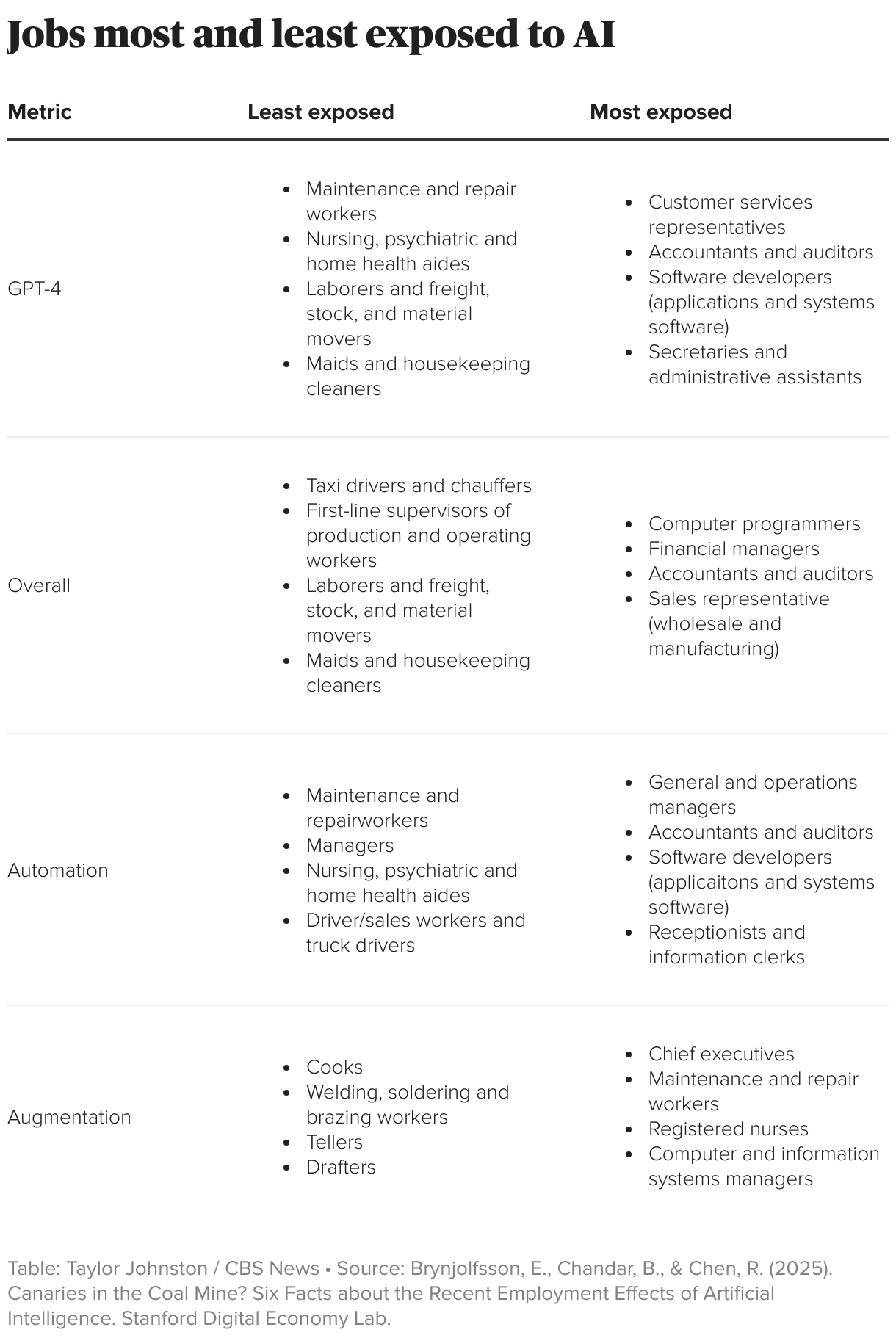
COVER STORY: How is artificial intelligence affecting job searches?
Artificial intelligence has already become a disruptor in the labor market, as job postings declined over the past year by 6.7 percent, with entry-level positions especially hard-hit. But as David Pogue learns, not all industries are affected by the push for AI. 

For more info:

      
ALMANAC: August 31
“Sunday Morning” looks back at historical events on this date.

worlds-largest-truckstop.jpg

Travelers on Interstate 80 in Walcott, Iowa, can park themselves at what is billed as the world’s largest truck stop.  

CBS News


U.S.: This Iowa truck stop is “Disney World for truckers”
The Iowa 80 Truckstop, on Interstate 80, claims to be the world’s largest truck stop – and who would argue? Luke Burbank pulls up to the Walcott, Iowa truck stop larger than 150 football fields, catering to those who keep America moving, which features everything from 24-hour restaurants and maintenance shops, to a dentist, ministry office, and movie theater.

For more info:

painting-energy-exhibit-at-portland-museum-of-art.jpg

The exhibition “Painting Energy” at the Portland Museum of Art in Maine. 

CBS News


ARTS: “Painting Energy”: Alex Katz spotlights his favorite artists
Painter Alex Katz, acclaimed for his figurative art and landscapes from a seven-decade career, is now focused on the work of other artists. He’s gifted a collection of more than 100 paintings by emerging and established artists to Maine’s Portland Museum of Art. Elaine Quijano talks with Katz about the exhibition “Painting Energy.”

For more info:

1117-sunmo-rooms.jpg

The bedrooms of young shooting victims, as preserved by their parents. 

Lou Bopp


U.S.: “Portrait of a person who’s not there”: Documenting the bedrooms of school shooting victims
Over the past six years, the parents of school shooting victims opened their doors to CBS News’ Steve Hartman and photographer Lou Bopp, inviting them to see what it’s like to live alongside their children’s bedrooms, just as they left them. [First aired 11/14/2024.]

INTERACTIVE: “Everything as it was”: Explore the bedrooms of kids killed in school shootings

COMMENTARY: How do you make a portrait of a child who isn’t there? Photographer Lou Bopp found a way, but it wasn’t easy
The photographer who worked with Steve Hartman describes in poignant detail the emotional challenges of working with the families of school shooting victims.

For more info:

       
PASSAGE: In memoriam
“Sunday Morning” remembers some of the notable figures who left us this week.  

dr-sanjay-gupta-a.jpg

Dr. Sanjay Gupta.

CBS News


HEALTH: Dr. Sanjay Gupta on the mysteries of chronic pain
Recent research into chronic pain, which afflicts millions of Americans, has led to a surprising source: the brain. “Sunday Morning” host Jane Pauley talks with Dr. Sanjay Gupta (a neurosurgeon and chief medical correspondent for CNN) about his new book, “It Doesn’t Have to Hurt,” and about the body’s defenses against pain. She also talks with heavy metal musician Ed Mowery, whose decades-long experience with complex regional pain syndrome (or CRPS) led to a revolutionary surgery and treatment.

READ AN EXCERPT: “It Doesn’t Have to Hurt” by Dr. Sanjay Gupta

For more info:

      
THESE UNITED STATES: The rise of union power
In the 1930s, strikes by workers at the “Big 3” automakers led to recognition of the United Auto Workers union – and to a general strengthening of labor rights that reshaped America. Jane Pauley reports.

john-fogerty-at-beacon-theatre-nyc.jpg

John Fogerty performing at the Beacon Theatre in New York City earlier this summer. 

CBS News


MUSIC: “John’s Version”: John Fogerty on re-recording Creedence Clearwater Revival hits
One of the founding members of Creedence Clearwater Revival, John Fogerty lost control of his own songs when the band broke up in the early 1970s. Now, after buying back rights to his Creedence catalog, Fogerty (who recently turned 80) has come back to his music, recording the album “Legacy.” He talks with Robert Costa about re-recording such classics as “Proud Mary,” “Bad Moon Rising” and “Fortunate Son.”

You can stream John Fogerty’s album “Legacy: The Creedence Clearwater Revival Years (John’s Version)” by clicking on the embed below (Free Spotify registration required to hear the tracks in full):

For more info:

          
COMMENTARY: Jim Gaffigan on the summer harvest: Too many cukes!
The comedian and aspiring gardener talks about the advantages, and disadvantages, of a bountiful harvest.

For more info:

       
MILEPOST: So long, Jessica Frank!
“Sunday Morning” says goodbye to our longtime associate director Jessica Frank, who for 26 years brought a shining sun (thousands of them!) to our broadcast. Serena Altschul reports.

GALLERY: Here comes the sun! “Sunday Morning” sun art

      
NATURE: Sea Lions at Monterey Bay


WEB EXCLUSIVES: 


From the archives: Hurricanes Katrina and Rita by
CBS Sunday Morning on
YouTube

FROM THE ARCHIVES: Hurricanes Katrina and Rita (YouTube Video)
In 2005, the Gulf Coast was slammed by two monumental hurricanes – first, Katrina, the costliest U.S. storm up to that time, which killed at least 1,800 people in and around New Orleans; then, just weeks later, Rita, which made landfall between Louisiana and Texas, further devastating areas hard hit by Katrina. Twenty years later, we look back at “Sunday Morning” reports about the devastation caused by the storms and the breaking of levees; the political storm that followed; and the rebuilding. Featuring:

  • Lee Cowan on the week of New Orleans’ struggles from Katrina (2005)
  • Martha Teichner with a history of how New Orleans came to be (2005)
  • The role of the Army Corps of Engineers in levee reconstruction and maintenance (2005)
  • Bill Whitaker on residents along the Mississippi coast battered by Katrina (2005)
  • Barry Petersen compares the response following Asia’s tsunami to the aftermath of Katrina (2005)
  • Anthony Mason on the Federal Emergency Management Agency’s performance during and after the storm (2005)
  • Steve Hartman with an examination of the best and worst of human nature evident from Katrina (2005)
  • Documentary filmmaker Ken Burns holds out hope that New Orleans will be healed by jazz (2005)
  • Ben Stein calls for helping pets in the aftermath of Katrina (2005)
  • Susan Spencer on what Katrina revealed about poverty in America (2005)
  • Sorting out the aftermath of Katrina (2005)
  • John Roberts, Harry Smith and Lee Cowan on the effects of Hurricane Rita in cities along the Gulf Coast (2005)
  • Anthony Mason on the long-term economic impact from the storms (2005)
  • Erin Moriarty on volunteers searching for children separated from their families after Katrina (2005)
  • Charles Osgood on the resumption of streetcar service in New Orleans two years after Katrina (2007)
  • Michelle Miller on how New Orleans is rebuilding five years after the hurricanes (2010)
  • Martha Teichner visits New Orleans ten years after Katrina (2015)
  • New Orleans chef John Besh is helping bring back the city through cuisine (2015)
  • Steve Hartman profiles Burnell Colton, who is trying to revive the Lower Ninth Ward (2015)


From the archives: Bruce Springsteen on the making of “Born to Run” by
CBS Sunday Morning on
YouTube

FROM THE ARCHIVES: Bruce Springsteen on the making of “Born to Run” (YouTube Video)
From 2005, Anthony Mason speaks with Bruce Springsteen and producer Jon Landau about the creation of Springsteen’s breakthrough album, “Born to Run.”


The Emmy Award-winning “CBS News Sunday Morning” is broadcast on CBS Sundays beginning at 9:00 a.m. ET. Executive producer is Rand Morrison.

DVR Alert! Find out when “Sunday Morning” airs in your city 

“Sunday Morning” also streams on the CBS News app beginning at 11:00 a.m. ET. (Download it here.) 

Full episodes of “Sunday Morning” are now available to watch on demand on CBSNews.com, CBS.com and Paramount+, including via Apple TV, Android TV, Roku, Chromecast, Amazon FireTV/FireTV stick and Xbox. 

Follow us on Twitter/XFacebookInstagramYouTubeTikTok; Bluesky; and at cbssundaymorning.com.  

You can also download the free “Sunday Morning” audio podcast at iTunes and at Play.it. Now you’ll never miss the trumpet!

Do you have sun art you wish to share with us? Email your suns to SundayMorningSuns@cbsnews.com. 


Source link

USC football scores 73 in season-opening rout of Missouri State – Orange County Register

0
USC football scores 73 in season-opening rout of Missouri State – Orange County Register

1 of 50

Quarterback Jayden Maiava #14 of the USC Trojans prior to a NCAA football game between the USC Trojans and the Missouri State Bears at the Los Angeles Memorial Coliseum in Los Angeles on Saturday, Aug. 30, 2025. (Photo by Keith Birmingham, Pasadena Star-News/ SCNG)

Expand

LOS ANGELES — USC scored six rushing touchdowns in a 73-13 season opener win on Saturday against Missouri State, which was playing in its first game as an FBS team and member of Conference USA.

It’s the first time USC scored over 50 points in a game since beating California 50-49 in 2023.

The Trojans (1-0) finished with 233 rushing yards, and the defense held the Bears (0-1) to 224 total yards of offense.

Quarterback Jayden Maiava went 15-for-18 in the game with 295 yards and two touchdowns.

Missouri State scored its only touchdown of the game on a 33-yard pass from Jacob Clark to Tristian Gardner. Yousef Obeid made two field goals of 44 and 46 yards.

Waymond Jordan (42 yards) was the first USC running back to carry the ball, as Riley previously indicated would happen, and did not squander the opportunity.

Maiava handed the ball to Jordan on a second-and-4 on the Trojans’ second series of the game, and the former JUCO star smoothly weaved through defenders for a 26-yard run that placed the ball at the 5-yard line.

Jordan punched the ball in from five yards out for USC’s first touchdown of the day and a 7-3 lead with 6:58 remaining in the first quarter.

Eli Sanders (33 yards) had a run nearly as long with a 17-yard scamper later in the opening quarter. USC continued to rotate in players and a third running back, Bryan Jackson, entered the game on the next play for a 3-yard touchdown run.

Sanders appeared to be more of a downhill runner compared to Jordan and also caught a short pass from Maiava and ran it in 74 yards for a touchdown and returned punts for USC in the second quarter.

USC balanced out its rushing attack with Maiava’s passing to build a 42-10 lead by halftime. He plopped a shot pass over the heads of the linemen and into the hands of tight end Lake McRee, who took off for a 64-yard touchdown to open the second quarter.

McRee finished with two catches for 72 yards. Starting receivers Ja’Kobi Lane and Makai Lemon were also major contributors — Lane had three catches for 33 yards and Lemon had seven catches for 90 yards.

Bishop Fitzgerald was one of the top defensive performers of the day with four total tackles and a pass breakup in addition to a 19-yard pick-six. He read the Bears’ passing play and ran in front of slot receiver Dash Luke for an interception that was returned for a touchdown and a 28-3 lead in the second quarter.

Freshman backup quarterback Husan Longstreet came into the game in the second half and scored on a five-yard quarterback sneak with 10:26 remaining in the third quarter.

The Trojans added four touchdowns in the second half on Longstreet’s run, a 75-yard rush by running back King Miller, another 17-yard rush by Longstreet and a 9-yard pass from Longstreet to Carson Tabaracci. Ryon Sayeri also hit a 32-yard field goal.

Sayeri, another freshman, was responsible for kickoffs, field goals and PATs and went 8-for-8 on PATs.

USC will play one more nonconference game against Georgia Southern, which is coached by former Trojans head coach Clay Helton, before beginning its Big Ten slate at Purdue on Sept. 13.


Source link

Angels rally in 9th to stun Astros, snap 3-game skid – Press Enterprise

0
Angels rally in 9th to stun Astros, snap 3-game skid – Press Enterprise


HOUSTON — The bottom of the order came to the rescue for the Angels.

After getting four hits in the first 17 innings of the series against the Houston Astros, the Angels strung together four straight hits to spark a three-run rally in the ninth inning of a 4-1 victory over the Astros on Saturday night.

With one out in a tie game, Luis Rengifo, Logan O’Hoppe, Matthew Lugo and Oswald Peraza – the bottom four hitters in the order – had consecutive hits, producing two runs.

The first three were singles that loaded the bases. Peraza then launched a fly ball to the right field fence, barely eluding the grasp of outfielder Cam Smith, as two runs scored. An out later, Yoán Moncada and Mike Trout drew back-to-back walks, pushing home an insurance run.

The Angels did all the damage against Astros closer Bryan Abreu, one of the game’s best relievers.

Closer Kenley Jansen then handled the bottom of the ninth as the Angels (63-72) snapped their three-game losing streak and equaled last year’s victory total.

It was only the Angels’ third victory in their last 11 games, as their offense had fallen into a collective funk.

The Angels scored 23 runs in the previous 10 games, with a .185 average.

This game was looking no better for most of the night. Zach Neto’s 24th homer – a career high – was the Angels’ only hit in the first seven innings.

The Angels only had two at-bats with a runner in scoring position in the first eight innings, after back-to-back walks in the seventh. That was when the Angels called on Lugo to pinch-hit for Niko Kavadas, and he struck out. Travis d’Arnaud then hit for Bryce Teodosio, and he hit a flyout.

The Angels got another chance in the ninth because the pitching staff had kept them in the game.

Starter Kyle Hendricks pitched one of his best games of the season, and his best in at least a month, allowing one run in six innings.

Hendricks gave up seven hits, but he did not issue a walk.

The only run he allowed shouldn’t have scored at all. With two outs and runners at the corners in the third inning, Jesus Sanchez hit a slow chopper toward second baseman Luis Rengifo. Rengifo couldn’t come up with the ball cleanly, and it was scored an infield hit.

After Hendricks got through the sixth, Reid Detmers worked around a walk in the seventh, with the help of a double play.

Right-hander José Fermin, who hasn’t pitched in many high-leverage spots lately, entered in the eighth to face the heart of the Houston order. He retired Yordan Alvarez, José Altuve and Carlos Correa, striking out the latter two.

More to come on this story.


Source link

Unions in somber mood for Labor Day 2025

0
Unions in somber mood for Labor Day 2025


Thousands of workers and union organizers from across California will gather for picnics and marches this weekend to honor the contributions of the nation’s working people.

But the Labor Day celebrations will be tempered by a sobering reality: Unions face mounting pressure to protect their members from the Trump administration’s immigration raids, cuts in Medicaid services and a weakened National Labor Relations Board.

From farm fields to car washes, labor groups have scrambled to support families of the hundreds detained and deported in numerous chaotic and violent raids that have resulted in the deaths of two people — a day laborer and a farmworker — killed while fleeing federal agents.

The raids reverberated across the state’s local labor community in June when David Huerta of SEIU California was injured and detained by law enforcement while documenting the first major immigration enforcement raids in Los Angeles.

“Farmworkers are afraid. They don’t know what’s going to happen from one day to the next with these raids, but they understand the only way we’re going to have power is if we come together,” said Teresa Romero, president of United Farm Workers.

Romero and other union leaders said their focus remains on organizing more workplaces, while also working to educate people on their rights and staging legal and nonviolent protests against government policies.

In early August, the Trump administration moved forward with a plan to end collective bargaining with federal unions across a swath of government agencies. The government said the changes were necessary to protect national security, but unions viewed it as retaliation for their participation in lawsuits opposing the president’s policies.

The Trump administration has also proposed sweeping cuts to the staff of the National Labor Relations Board — which is tasked with safeguarding the right of private employees to unionize or organize in other ways to improve their working conditions — and canceled leases for regional offices in many states.

Union officials contend that the changes could hobble the board and prevent it from investigating unfair labor practice charges filed by workers and carrying out its other responsibilities, such as overseeing elections.

“Important rules and regulations that were put in place during the Biden administration that were helpful to workers — those are systematically being rolled back,” said Enrique Lopezlira, director of the Low-Wage Work Program at the UC Berkeley Labor Center.

Unions are bracing for further challenges that could arise when Trump finally makes appointments to the federal labor board, which is currently nonoperational, because it doesn’t have enough board members to rule on cases.

“We are all under attack by the federal government right now,” said Jeremy Goldberg, executive director of the Central Coast Labor Council. “The need is tremendous.”

But even as many labor leaders have openly opposed the Trump administration, others have taken a more muted approach. Major national unions, such as United Auto Workers and the Teamsters, have supported aspects of the Trump agenda on tariffs abroad and a push for manufacturing jobs at home.

The changes portend tough times ahead for California unions.

John Logan, a professor of U.S. labor history at San Francisco State, said that Trump’s hostility toward California and withholding of federal funds from universities, healthcare facilities and other institutions will squeeze the state budget, with major effects on public sector workers in the form of layoffs and other cost-cutting. And the administration’s relentless immigrant raids are consuming the time, attention and resources of unions, he said.

Although California has a larger share of its workforce represented by unions compared with many other states, that density is overly reliant on public sector workers, and membership of those unions is likely to shrink in the coming years, Logan said.

Unions are “ill-equipped to deal with this moment of crisis,” Logan said. “The labor movement is fighting for its survival over the next four years.”

Challenges are especially acute in the healthcare industry.

Unions representing in-home care providers, nurses and other healthcare workers said their members are already feeling the squeeze wrought by the lead up to and approval of Trump’s “Big Beautiful Bill,” which includes tax spending cuts that will affect millions of Medicaid recipients while growing Immigration and Customs Enforcement by thousands of workers.

SEIU Local 2015 President Arnulfo De La Cruz said many in-home care providers who have cared for people for decades are now faced with the prospect that the people they care for are going to lose their healthcare, and that they themselves may lose their healthcare and their jobs.

“To have our healthcare under attack, to have our families under attack — that’s a huge reversal in how we are recognizing essential workers,” De La Cruz said.

Major medical facilities, including Sharp HealthCare, UC San Diego Health and UCSF Health, have in recent months announced plans to cut public health services and conduct hundreds of layoffs, citing significant financial headwinds and the uncertainty of federal funding.

“It’s a nasty bill. There’s nothing beautiful about that bill,” said Cynthia Williams, an Orange County resident and member of AFSCME Local 3930. Williams is a full-time caregiver for both her daughter, who is blind and has cerebral palsy, and her sister, who is a veteran living with severe post-traumatic stress disorder.

Williams said the In-Home Supportive Services program — funded primarily by Medicaid — has preemptively cut funding for transportation to her sister’s weekly appointments. The hours Williams is paid for to care for her daughter have been reduced.

“The last few months have been very stressful and very unpredictable,” Williams said.


Source link

More than 500 Voice of America journalists face layoffs by Trump administration

0
More than 500 Voice of America journalists face layoffs by Trump administration

The Trump administration has moved to lay off more than 500 employees who work for the federally funded network Voice of America, which provides global reporting in places with restricted press freedom.

In March, Trump officials first attempted to close down some of the organization’s newsrooms. But Judge Royce C. Lamberth of the U.S. District Court for the District of Columbia called for the network’s restoration last April, citing a law that requires the Voice of America broadcast to be continued.

Despite the ruling, Kari Lake, the acting chief executive of Voice of America’s oversight agency, posted on social media on Friday evening that 532 government positions were eliminated.

Before the downsizing, Voice of America was responsible for broadcasting news in 49 languages to 360 million people every week, including in Russia and China. Now, the network airs programming in four languages: Persian, Mandarin, Dari and Pashto.

The layoffs “will likely improve [the agency’s] ability to function and provide the truth to people across the world who live under murderous Communist governments and other tyrannical regimes,” wrote Lake on X.

Most of the 1,300 Voice of America journalists had already been fired or remained on paid leave prior to these layoffs. Only 100 journalists and other staff members remain employed by the organization.

After being asked by the remaining employees to ensure the administration was in line with his April ruling, Lamberth found that they appeared to be noncompliant.

Earlier this week, he ordered Lake to provide sworn testimony at a deposition and threatened to hold her in contempt for going against court orders. He also blocked the administration from firing Voice of America director, Michael Abramowitz, the day before these layoffs were announced.


Source link

CONCACAF Champions Cup spot on the line as Galaxy host Orlando City SC in Leagues Cup third-place game

0
CONCACAF Champions Cup spot on the line as Galaxy host Orlando City SC in Leagues Cup third-place game


The Galaxy have one final attempt to secure a CONCACAF Champions Cup spot and it comes Sunday in the Leagues Cup third-place game.

The Galaxy, who host Orlando City SC, must win to earn a second consecutive trip to the CONCACAF tournament. The third-place winner will begin next year’s tournament in the first round.

Seattle hosts Inter Miami in the Leagues Cup final Sunday night. Both finalists will start the CONCACAF tournament in the Round of 16.

This will be the second meeting between the Galaxy and Orlando City. The first, on March 29, was won by OCSC 2-1, thanks to a 90th-minute goal by Luis Muriel.

“I think they’ve gotten better,” Galaxy captain and defender Maya Yoshida said of Orlando City. “Muriel looks more fit … they are very solid, very similar to Seattle. Seattle is probably more organized and more solid of a team, but still, they’re a good team.

“It’s going to be a tough game, but we will be ready for that. No excuse for fatigue or fitness.”

Orlando City will be making its third trip to Carson this season. Aside from the March 29 regular-season meeting, Orlando City faced Toluca at Dignity Health Sports Park in the Leagues Cup quarterfinals Aug. 20. After Wednesday’s semifinal loss against Inter Miami, OCSC has to head back to Carson, seemingly giving the Galaxy at least a small advantage.

The real advantage for the Galaxy will come if they’re able to clean up and avoid the costly mistakes, that hurt them on both goals against the Sounders in Wednesday’s 2-0 semifinal loss.

Yoshida chalked up to a number of things, including a lack of communication.

“There’s not only one reason that we keep conceding (goals),” he said. “I think (you can) combine many things, communication, concentration, intensity, everything is true. I think we could avoid these goals conceded, but we still keep conceding. There’s no room for excuse. We have to improve that and that stability will help the team perform better.”

Wednesday’s loss against the Sounders was the first regulation loss for the Galaxy in Leagues Cup play. The challenge now is regrouping after having their championship hopes dashed.

“There’s a lot to play for,” Galaxy coach Greg Vanney said of the third-place game. “That was kind of the postgame message after we briefly discussed the game. It’s about refocusing. It’s about putting this one (Wednesday’s game) behind us. We can’t go back and win this one.

“There’s still a lot to play for. After a season like this, to be able to earn a spot in Champions Cup would be a big opportunity for this group. We should see this as our only opportunity to salvage something. I think we have to be mature enough to bounce back, put our heads back on our shoulders, pick up our chins and get after it.”

After Sunday, the Galaxy will have eight games remaining – seven in MLS and the Campeones Cup on Oct. 1 against Toluca.

Injury updates

Defender Emiro Garces (ankle) could make his way back to action after missing the semifinal. Vanney said Garces trained Saturday. …

Matheus Nascimento (groin) is likely out Sunday. Vanney said that Nascimento “didn’t get through what he needed to get through today (Saturday.)”

ORLANDO CITY SC at GALAXY

When: 2 p.m. Sunday

Where: Dignity Health Sports Park

How to watch: Apple TV+ (MLS Season Pass); TUDN (Spanish)


Source link

Sparks host Mystics and not giving up playoff hopes – Press Enterprise

0
Sparks host Mystics and not giving up playoff hopes – Press Enterprise


LOS ANGELES — With seven games remaining in the regular season, Sparks coach Lynne Roberts has a direct message for her team.

“We’re not going to quit,” Roberts said. “I promise you that.”

With that call to action, the ninth-place Sparks will look to keep their fading playoff hopes alive in the final contest of a four-game homestand against the Washington Mystics on Sunday at Crypto.com Arena.

The Sparks (17-20), who have lost two in a row after Friday’s loss to the Indiana Fever, are 2-1 against the Mystics this season.

Sparks All-Star guard Kelsey Plum is averaging 20.1 points and 5.8 assists. Forward Dearica Hamby, who won the 2022 WNBA championship alongside Plum with the Las Vegas Aces, is averaging 17.9 points, 7.8 rebounds and 3.3 assists. Plum and Hamby are among the league’s highest-scoring duos at 38 points per game.

Guard Sonia Citron leads the Mystics with 15.3 points per game. Fellow rookie All-Star Kiki Iriafen, the former Harvard-Westlake and USC standout forward, averages 13.0 points and 8.6 rebounds for Washington, which is 16-23 going into Saturday’s game with the Valkyries (19-18) in San Francisco.

The Sparks’ 76-75 loss to the Indiana Fever dropped them two games and three wins behind the Valkyries.

“We can kinda still control our own destiny,” Hamby said. “We can go 5-2 and make a shot at this, so turn the page and keep going.”

With less than two weeks of guaranteed basketball left, Roberts believes her team has a choice in how the rest of the regular season plays out.

“We can emotionally, mentally check out and just kind of go through the motions or we can dig down,” Roberts said. “I know these guys are going to dig down.”

Roberts added that she’s not giving up before the end of her first season leading the Sparks, as the three-time WNBA championship organization tries to end a franchise-worst four-year playoff drought.

“I’ve been saying it all season, we have a choice of how we respond,” Roberts added. “We’re not eliminated and I refuse to buy into that. Does this make it harder, yes. But things are hard. This is hard. This league is so good.”

The Sparks had four players score in double figures in Friday’s defeat, but the team’s balanced offense was plagued by 22 turnovers and being outrebounded by a 40-30 margin.

Rae Burrell led the Sparks’ bench with 12 points. She and fellow reserves Cameron Brink, rookie Sarah Ashlee Barker and Julie Vanloo were all positive in the plus-minus statistical category.

“I thought they did well,” Roberts said of the reserves. “We’re looking down the barrel of three games in four days and I trust them. I thought Cam did a good job defensively. She’s so tough to score on in the paint and Rae brought some serious life there, especially in the third.”

MYSTICS (16-23) AT SPARKS (17-20)

When: 5 p.m. Sunday

Where: Crypto.com Arena

TV: Spectrum SportsNet


Source link

Free fun things to do in Southern California in September – Press Enterprise

0
Free fun things to do in Southern California in September – Press Enterprise

Do you like to be entertained? Do you think it’s too expensive? Well, here are fun things to do this month in September 2025 that cost nothing at all. So get out there and enjoy!

Sept. 4 — North Hollywood: See a free movie at 2 p.m. This time, it’s the spy thriller “Black Bag,” (Rated R, 2025) directed by Steven Soderbergh. Michael Fassbender plays a British intelligence officer looking for a traitor, which might include his wife (Cate Blanchett.) At the North Hollywood Amelia Earhart Regional Branch Library, 5211 Tujunga Ave. North Hollywood. lapl.org/branches/north-hollywood

Sept. 7 — Anaheim: Car enthusiasts celebrate classic imports and coffee at Cars and Coffee Classics.  There’s a “best of show” contest and vendors. 8 a.m. to noon on Center Street Promenade, downtown Anaheim. 201 W. Center Street Promenade. visitanaheim.org/event/cars-and-coffee-classics/3000

You can visit the Cheech Marin Center for Chicano Art & Culture or the Riverside Art Museum for free on Sept.7.  (Photo by Anjali Sharif-Paul, The Sun/SCNG)
You can visit the Cheech Marin Center for Chicano Art & Culture or the Riverside Art Museum for free on Sept.7. (Photo by Anjali Sharif-Paul, The Sun/SCNG)

Sept. 7 — Riverside:  Enjoy art for free at the Riverside Art Museum and the adjacent The Cheech Marin Center for Chicano Art & Culture with Free Summer Sundays. Noon to 5 p.m. Please RSVP.  riversideartmuseum.org. 3425 Mission Inn Ave., Riverside.

Sept. 13-14 — Santa Ana: Fiestas Patrias celebrates Mexican Independence Day on Fourth Street and other downtown environs. The street fair, live music and cultural performances are all free. Carnival rides and food vendors are not free. Noon to 11 p.m. on Sept. 13 and noon to 10 p.m. on Sept. 14. Enjoy a parade at 11 a.m. Sunday. santa-ana.org/fiestas-patrias

Sept. 14 — Newport Beach: The city’s Summer Concert Series wraps up with high energy rock from O.C.-based Tijuana Dogs. The show runs from 6 to 7:30 p.m. on the Newport Beach Civic Center Green. Bring low chairs, picnic and blankets. 100 Civic Center Drive, Newport Beach visitnewportbeach.com/events/summer-concert-series-tijuana-dogs

Sept. 14 — East Los Angeles: The oldest and largest Latino parade in the U.S. starts at 10 a.m. at Cesar Chavez and Mednik avenues as part of the area’s  Mexican Independence Day celebration. (The parade is broadcast live on KABC/7.) Festival starts at 11 a.m. Get there early, bring a hat and water and park for free at the East L.A. Civic Center, 4801 E. Third St., East L.A. Parade viewing and entrance to festival is at First St & South Mednik Avenue. eastla-parade.com

Sept. 14 — Ontario: How about a mystery tea party? Enjoy an afternoon with fellow mystery lovers while celebrating Cozy Mystery Day with delightful tea pairings and an exploration of charming whodunits as part of Sip and Sleuth. 2-3 p.m. at the Ovitt Family Community Library, 215 East C St., Ontario. ontarioca.gov/events/2025-09-14/sip-and-sleuth

Danza Azteca traditional Aztec dancers perform at the East LA Mexican Independence Day Parade & Festival. (Photo by David Crane, Los Angeles Daily News/SCNG )

Sept. 15 — Moreno Valley:  The city’s El Grito Mexican Independence Day celebration features music, entertainment, kids’ activities and more. 6-10 p.m. Moreno Valley Civic Center Amphitheater, 14075 Frederick St. Moreno Valley. moval.org/parks-comm-svc/event-el-grito.html

Sept. 17 — Chatsworth: Learn how to make your own pan pipe, take it home and play it.  This workshop for adults starts at 11 a.m. Chatsworth Branch Library, 21052 Devonshire St., Chatsworth. lapl.org/whats-on/events/adult-crafting-wednesdays-make-your-own-pan-pipe

Sept. 19 — Redlands: Celebrate the arrival of autumn with the Falling Into Fall fest at the Citrus Plaza Shopping Center Food Court. Activities include selfie photo booths, games, crafts and sample tastings. 3 to 5 p.m. 27320 West Lugonia Ave., Redlands eventbrite.com/e/falling-into-fall-tickets-1347133916809

Sept. 20 — Woodland Hills: Tenor Marco Antonio Lozano and soprano Christa Marine Stevens perform great arias from classical opera, plus more current songs. 1 p.m. at the Platt Branch Library, 23600 Victory Blvd., Woodland Hills. lapl.org/whats-on/events/opera-singers-marco-and-marie-live-concert-platt-0

Sept. 27 — Simi Valley: Junk in the Trunk sale will feature more than 46 vendors with treasures, trinkets and more. Open to the public for free. Bring cash. Rain cancels. 8 a.m. to noon at Rancho Santa Susana Community Center Parking Lot, 5005-C Los Angeles Ave, Simi Valley. rsrpd.org/recreation/events/fall_(september_-_november)/junk_in_the_trunk.php


Source link

Japan accelerates missile deployment amid rising regional tensions

0
Japan accelerates missile deployment amid rising regional tensions

TOKYO — Japan plans to deploy its domestically developed long-range missiles a year earlier than planned, the Defense Ministry announced Friday, as the country steps up efforts to strengthen its strike-back capability in response to rising challenges in the region.

Under the new schedule, a first batch of the domestically developed Type-12 anti-ship missiles will be installed at its army’s Camp Kengun in Japan’s southwestern prefecture of Kmuamoto by March 2026, the ministry said. The Type-12 missile has a range of about 1,000 kilometers (620 miles).

Japan is seeking to create a more self-sufficient military as a deterrence against China’s increasingly assertive naval activity in regional seas. Japan in June spotted two Chinese aircraft carriers almost simultaneously operating near southern Japanese islands for the first time.

Japan also has concerns about the rising tensions caused by North Korea and Russia.

These efforts mark a historic shift. Japan, under its post-World War II pacifist constitution, used to limit the use of force for self-defense only. But it made a major break from that policy in 2022 when it adopted a five-year security strateg y that names China as its biggest strategic challenge and calls for a closer Japan-U.S. alliance and more offensive roles for Japan’s Self-Defense Forces.

The country is boosting military spending to 2% of GDP by 2027 from an earlier level of about 1% under the buildup plan, while facing pressure from the United States, a treaty ally, to do more.

The announcement of the accelerated missile schedule coincides with a ministry request for a record 8.8 trillion yen ($59.9 billion) in the fiscal 2026 budget to focus on long-range missiles and drones to counter threats from China, North Korea, and Russia.

With domestically produced missiles still under development, Japan plan to deploy U.S.-developed Tomahawks later this year.

The ministry is also seeking to deploy unmanned air, sea-surface and underwater drones for surveillance to defend Japanese coastlines, as a country with an aging and declining population struggles with an understaffed military.


Source link

Comic-Con Africa draws thousands of fans and cosplayers to Johannesburg

0
Comic-Con Africa draws thousands of fans and cosplayers to Johannesburg

JOHANNESBURG — Tens of thousands of South African comic book fans and cosplayers flocked to Johannesburg on Saturday to celebrate the sixth edition of Comic-Con Africa, the continent’s biggest celebration of pop culture and gaming.

The four-day festival, which began Thursday, celebrated anime, gaming, comics and cosplay with a variety of entertainment, including vintage arcade games, esports and costume competitions.

Fans dressed up as their favorite comic book heroes and villains, snapping selfies in replicas of famous local sets and donning original character outfits inspired by their own imagination.

“This year’s Comic-Con has been bigger and bolder than ever before,” said Comic-Con Africa Show Director Carla Massmann, adding they anticipate a total of 70,000 fans having walked through the gate by Sunday.

Nkosinathi Skhosana, 24, called Comic-Con Africa “nothing short of amazing” because it was another “safe space” where South Africans of all races and classes could forget their social issues and have fun together.

“Just like Rugby brings people of all races together, Comic-Con is also creating that kind of space for us,” said Skhosana.

International celebrities were featured on the main stage, including U.S. actor Jessie T. Usher from the Amazon Prime series “The Boys.” Also in attendance were actor, comedian and writer Dan Fogler, known for playing Jacob Kowalski in the Harry Potter spinoff “Fantastic Beasts,” and Misha Collins, best known for his role as Castiel in “Supernatural.”

Fans were delighted to be treated to autograph and photograph opportunities with international stars, but they also gushed over each other’s outfits.

“The first picture I took was with Sailor Moon, my favorite character of all time,” said Owami Sibanyoni, 23, who was dressed as Musa from the animated franchise ”Winx Club.”

The event, which is usually held at the end of September, was moved to August to make way for the G20 summit, which will be held at the same venue later this year.

____

AP’s Africa coverage at: https://apnews.com/hub/africa


Source link

A walk through a Smithsonian museum reveals American genius and cruelty as Trump presses for change

0
A walk through a Smithsonian museum reveals American genius and cruelty as Trump presses for change

WASHINGTON — In an afternoon’s walk through ground zero of Americana — the Smithsonian’s National Museum of American History — objects around every corner invite one question: What could possibly be more American than this?

What could be more American than that enormous Star-Spangled Banner in all its timeworn glory? Or more American than Dorothy’s ruby slippers from “The Wizard of Oz”?

And what could be more American than a reckoning with the nation’s sins, as illustrated by shackles representing slavery and photos of Japanese Americans confined to detention camps in World War II? It’s in authoritarian countries, like Russia, where history is scrubbed.

In myriad ways, the museum explores “the complexity of our past,” in accord with its mission statement. President Donald Trump wants a simpler tale told. He wants this and the other Smithsonian museums to mirror American pride, power and achievement without all the darkness, and he threatens to hold back money if they don’t get with that program.

On social media, Trump complained that at the Smithsonian museums, which are free to visit and get most of their money from the government, “everything discussed is how horrible our Country is, how bad Slavery was, and how unaccomplished the downtrodden have been — Nothing about Success, nothing about Brightness, nothing about the Future.”

In fact, the history museum reflects bountiful successes, whether on the battlefield, from the kitchens and factories of food pioneers, on the musical stage, in the movies or on other fronts of creativity and industriousness. The American Enterprise exhibit, for one, has a wall filled with the stories of successful Americans.

On this wandering tour you can see navigational implements used by Blackbeard, the terrifying pirate, from his early 1700s raids on the Atlantic coast. You see the hat Abraham Lincoln wore to Ford’s Theatre the night of his assassination, George Washington’s ceremonial uniform, Warren Harding’s fine red silk pajamas from the early 1900s, the first car to travel across the country, and a $100,000 bill.

You can see the original light bulbs of the American genius, Thomas Edison. A much earlier genius, the founding father Benjamin Franklin, is presented both as a gifted inventor and a slave owner who publicly came to denounce slavery yet never freed his own.

Those nuances and ambiguities may not be long for this world. Still on display at the history museum are artifacts and documents of American ingenuity, subjugation, generosity, racism, grit, cruelty, verve, playfulness, corruption, heroism, and cultural appropriation.

Like most museums, the focus is not on the future.

Even so, there is plenty to provoke the Republican president.

In the “Great Debate” of an American democracy exhibition, a wall is emblazoned with large words such as “Privilege” and “Slavery.” The museum presents fulsome tributes to the contributions of immigrants and narratives about the racist landscape that many encountered.

Exhibits address “food justice,” the exploitation of Filipinos after the United States annexed their land and the network of oppressive Native American boarding schools from which Jim Thorpe emerged and became one of the greatest athletes of all time.

Hawaii’s last sovereign before its annexation by the U..S. in the 1890s, Queen Lili‘uokalani, is quoted on a banner as asking: “Is the AMERICAN REPUBLIC of STATES to DEGENERATE and become a COLONIZER?”

A ukulele on display was made around 1890 by a sugar laborer who worked on the kingdom’s American plantations before a U.S.-backed coup overthrew the monarchy. Museum visitors are told the new instrument was held up by the monarchs as a symbol of anti-colonial independence.

“Ukuleles are both a product of U.S. imperialism and a potent symbol of Native Hawaiian resistance,” says the accompanying text.

At the Greek-godlike statue of George Washington, the text hints at his complexities and stops short of the total reverence that totalitarian leaders get.

Noting that “modern scholarship focuses on the fallible man rather than the marble hero,” the text says Washington’s image “is still used for inspiration, patriotism and commercial gain” and that “he continues to hold a place for many as a symbolic ‘father’ of the country.”

On this visit, conservators behind a big window are seen sweeping tiny brushes on ancient wooden pieces. Their patriotic work proceeds at a snail’s pace.

The team is restoring the gunboat Philadelphia, part of a small fleet that engaged the British navy at the Battle of Valcour Island in Lake Champlain in 1776, delaying Britain’s effort to cut off the New England colonies and buying time for the Continental Army to prepare for its decisive victory at Saratoga.

The commander of the gunboats in the Valcour battle later became America’s greatest traitor, Benedict Arnold. The British damaged the Philadelphia so badly it sank an hour after the battle, then lay underwater for 160 years. It’s being restored for next year’s celebrations of America’s 250th year.

“The Philadelphia is a symbol of how citizens of a newly formed nation came together, despite overwhelming odds against their success,” said Jennifer Jones, the project’s director. “This boat’s fragile condition is symbolic of our democracy; it requires the nation’s attention and vigilance to preserve it for future generations.”

Democracy’s fragility is considered in a section of the museum about the limits of presidential power. That’s where references to Trump’s two impeachments were removed in July for updating, and were restored this month.

“On December 18, 2019, the House impeached Donald Trump for abuse of power and obstruction of Congress,” one label now states. “On January 13, 2021, Donald Trump became the first president to be impeached twice,” says another. “The charge was incitement of insurrection based on his challenge of the 2020 election results and on his speech on January 6.” His Senate acquittals are duly noted.

It’s a just-the-facts take on a matter that has driven the country so deeply apart. The history museum doesn’t offer answers for that predicament. Instead, it asks questions throughout its halls on the fundamentals of Americanism.

“How should Americans remember their Revolution and the founding of the nation?”

“What does patriotism look like?”

“How diverse should the citizenry be?”

“Do we need to share a common national story?”

___

Associated Press writer Lynn Berry contributed to this report.


Source link

Health leaders launch new Latino-focused data hub to combat NIH budget cuts

0
Health leaders launch new Latino-focused data hub to combat NIH budget cuts

A national group of Latino public health leaders has announced the launch of a new research institute, which they say is a response to the hundreds of millions in federal funding cuts related to diversity, equity and inclusion initiatives

A national group of Latino public health leaders this week announced the launch of a new research institute, which they say is a response to the hundreds of millions in federal funding cuts related to diversity, equity and inclusion initiatives.

The National Hispanic Health Research Institute, launched on Tuesday, will be the first Latino-led community research institute aimed at gathering health data to track and address disparities in underserved communities across the country. Because Latinos, like other racial and ethnic minority communities, are underrepresented in federally funded research efforts, the new institute will fill the gaps made larger by the cuts.

“Right now, we have both an opportunity and a responsibility to ensure that every family historically left out of the data is finally seen and counted,” institute CEO Ken Barela said. “Our community-led model is designed to change that — because when we’re missing from the research, our communities are erased, and when we’re erased, we’re left behind.”

The institute’s launch comes after the National Institutes of Health canceled more than 600 health disparities projects, to align with Republican President Donald Trump’s priorities. NIH scientists publicly criticized Trump’s deep cuts in public health research, challenging in a letter the policy “that undermines the NIH mission, wastes public resources and harms the health of Americans and people across the globe.”

The institute plans to publish a public database that will include adults and children in Latino, Afro-Latino, Native American and rural communities. Initial research will focus on issues such as maternal mortality, chronic disease and youth health, areas where disparities are most severe for Latinos, researchers said.

Dr. Andy Beltrán, the institute’s chief medical officer, said greater access to research and health data would aid in addressing disparities among Latinos.

“The NHHRI serves not just as an engine for research, but as a guardian of equity,” Beltrán said. ”By reimagining health research through the lived experiences of Hispanic families, we are laying the foundation for a healthier, more equitable America.”


Source link

Swimmers face fecal contamination at beaches along US coastline

0
Swimmers face fecal contamination at beaches along US coastline

OGUNQUIT, Maine — Thousands of Americans will head to beaches for one last summer splash this Labor Day weekend, but taking a dip might be out of the question: Many of the beaches will caution against swimming because of unsafe levels of fecal contamination.

Beaches from Crystal River, Florida, to Ogunquit, Maine, have been under advisories warning about water quality this week because of elevated levels of bacteria associated with fecal waste. The advisories typically discourage beachgoers from going in the water because the bacteria can cause gastrointestinal illness, rashes and nausea.

There have been closures this week at some of the country’s most popular beach destinations, including Keyes Memorial Beach in the Cape Cod village of Hyannis in Barnstable, Massachusetts; Benjamin’s Beach on Long Island in Bay Shore, New York; and a portion of the Imperial Beach shoreline near San Diego. Even on the pristine, white sand beaches of Hawaii, the Hawaii State Department of Health is warning of a high bacteria count at Kahaluu Beach Park on the Big Island.

It’s a longstanding and widespread problem. Nearly two-thirds of beaches tested nationwide in 2024 experienced at least one day in which indicators of fecal contamination reached potentially unsafe levels, conservation group Environment America said in a report issued this summer.

The group reviewed beaches on the coasts and Great Lakes and found that 84% of Gulf Coast beaches exceeded the standard at least once. The number was 79% for West Coast beaches, 54% for East Coast beaches and 71% for Great Lakes beaches.

The report also said more than 450 beaches were potentially unsafe for swimming on at least 25 percent of the days tested. A key reason is outdated water and sewer systems that allows contamination from sewage to reach the places where people swim, said John Rumpler, clean water director and senior attorney with Environment America.

“These beaches are a treasure for families across New England and across the country. They are a shared resource,” said Rumpler, who is based in Boston. “We need to make the investment to make sure that literally our own human waste doesn’t wind up in the places where we are swimming.”

Other factors have also played a role in contaminating beaches, including increasingly severe weather that overwhelms sewage systems, and suburban sprawl that paves over natural areas and reduces the ecosystem’s ability to absorb stormwater, Rumpler said.

But many people plan to jump in the ocean anyway. Despite a two-day warning of elevated fecal indicator bacteria last month at Rehoboth Beach, Delaware, beachgoer Yaromyr Oryshkevych was not concerned.

“I really don’t expect to be in any kind of danger of fecal contamination,” said Oryshkevych, a retired dentist. He said he didn’t think Rehoboth was close enough to notable pollution to be concerned, and he expected the ocean’s natural currents to take care of any problems with contamination in the area.

Dana West, a federal worker visiting Rehoboth Beach, recalled an instance earlier this year where a dozen members of his vacationing party experienced gastrointestinal issues. The symptoms occurred after they went on a snorkeling excursion, an activity that increases the likelihood of swallowing seawater, off the coast of Isla Mujeres, Mexico.

It was an unpleasant experience, but he doesn’t expect a repeat this weekend in Delaware.

“But generally, I have no concerns about the level of fecal and bacterial matter,” said West while admiring Rehoboth’s shore. ”I assume the local authorities will tell us if there are higher levels than normal.”

Despite West’s confidence, some beaches in the area of Rehoboth, including nearby Rehoboth Bay and Dewey Beach bayside, were indeed under water advisories this week. Such advisories are not always posted on public signs.

Environment America assessed beach safety in its report by examining whether fecal bacteria levels exceeded standards set by the U.S. Environmental Protection Agency that trigger an alert to avoid the water. Fecal bacteria at those levels can cause illness in 32 out of every 1,000 swimmers.

In North Carolina, five beaches were under advisories in late August because of elevated levels of fecal bacteria. The beaches are open, but swimmers are advised that going in the water could be risky, said Erin Bryan-Millush, environmental program supervisor with the North Carolina Department of Environmental Quality.

Hurricane Erin caused extensive erosion and storm surge in some coastal areas, according to the Department of Environmental Quality. Heavy rain events this summer also exacerbated the contamination problem in some areas, Bryan-Millush said.

“Those storm drains carry everything,” Bryan-Millush said. “It could be really bad for someone who is immune compromised.”

___

Lau reported from Rehoboth Beach, Delaware.


Source link

Appeals court rules many of Trump’s tariffs are illegal

0
Appeals court rules many of Trump’s tariffs are illegal

A federal appeals court said Friday that many of the sweeping tariffs imposed by President Trump on dozens of countries earlier this year are not legally permissible.

The ruling will not immediately block the tariffs, but it marks a significant blow to Mr. Trump’s signature trade strategy.

The U.S. Court of Appeals for the Federal Circuit upheld a lower court decision that found many of Mr. Trump’s tariffs on foreign goods exceeded his power under federal economic emergency laws. However, the appellate judges vacated the lower court’s injunction blocking the tariffs altogether, directing the court to reevaluate whether universal relief is appropriate.

The ruling applies to a series of April executive orders that imposed 10% baseline tariffs on virtually every country and higher “reciprocal” tariffs on dozens of trading partners. It also applies to a separate set of tariffs on goods from Canada, Mexico and China to pressure those three countries to crack down on fentanyl trafficking and unauthorized immigration.

The court’s ruling will not take effect until October to give the Trump administration a chance to ask the Supreme Court to take up the case.

Mr. Trump lashed out against the 7-4 ruling in a Truth Social post on Friday, calling the appeals court “Highly Partisan” and noting that the tariffs are still in effect.

“If allowed to stand, this Decision would literally destroy the United States of America,” he wrote.

Attorney General Pam Bondi vowed to appeal the ruling, which she said “undermines the United States on the world stage” and is “interfering with the President’s vital and constitutionally central role in foreign policy.”

Friday’s ruling came as part of a monthslong legal challenge over the tariffs brought by Democratic states and small businesses. Mr. Trump has legally justified his sweeping import taxes by invoking the International Emergency Economic Powers Act of 1977, or IEEPA, which gives the president the power to regulate imports during national emergencies. The law does not explicitly mention tariffs.

The appeals court said the provision of IEEPA that mentions regulating imports does not give the president the right to impose unlimited tariffs. It called the right to levy tariffs “a core Congressional power,” and noted that past presidents have typically used IEEPA to impose sanctions, not tariffs.

“It seems unlikely that Congress intended, in enacting IEEPA, to depart from its past practice and grant the President unlimited authority to impose tariffs,” the court wrote late Friday afternoon. “The statute neither mentions tariffs (or any of its synonyms) nor has procedural safeguards that contain clear limits on the President’s power to impose tariffs.”

A lower court, the U.S. Court of International Trade, or USCIT, issued a similar ruling that found the tariffs illegal in May and ordered Mr. Trump’s import duties to be frozen. That ruling was stayed by the appeals court so it could review the case.

While the appellate court affirmed USCIT’s ruling on the merits of the tariffs, it said the lower court needs to take a second look at whether a universal injunction freezing the tariffs across the board is appropriate. It pointed to the Supreme Court’s ruling in a birthright citizenship case earlier this year that limited the use of universal injunctions.

Tariffs have been a core part of Mr. Trump’s economic strategy since he returned to office. He unveiled massive “reciprocal” tariffs against dozens of trading partners on “Liberation Day” in early April, before quickly halting most of those duties to give his administration time to negotiate new trade agreements. Earlier this month, he unveiled a new slate of tariffs against more than 60 countries, in some cases striking deals with certain trading partners that lowered their tariff rates — but still left them with higher duties than before “Liberation Day.”

Mr. Trump argues that steeper tariffs are necessary to correct what he views as unfair trade practices and revive American manufacturing. He has also used tariffs to pressure China on fentanyl, Mexico and Canada on immigration, Brazil on its prosecution of a Trump-aligned former president, and India on its trade relationship with Russia. 

But critics — and many economists — warn that the tariffs could lead to slower economic growth and higher consumer prices. Some of Mr. Trump’s early trade moves rattled financial markets, though major stock indices have rebounded since April’s “Liberation Day” dive.

Critics also argue that the tariffs exceed Mr. Trump’s legal authority. Some of the lawsuits against the tariffs rely on legal theories that have long been championed by conservative judges. Those include the “major questions doctrine,” which holds that Congress needs to give a federal agency clear authorization to decide issues of major political or economic significance.

contributed to this report.


Source link

New study sheds light on what kinds of workers are losing jobs to AI

0
New study sheds light on what kinds of workers are losing jobs to AI

Artificial intelligence is replacing entry-level workers whose jobs can be performed by generative AI tools like ChatGPT, a rigorous new study finds.  

Early-career employees in fields that are most exposed to AI have experienced a 13% drop in employment since 2022, compared to more experienced workers in the same fields and when measured against people in sectors less buffeted by the fast-emerging technology, according to a recent working paper from Stanford economists Erik Brynjolfsson, Bharat Chandar and Ruyu Chen.

The study adds to the growing body of research suggesting that the spread of generative AI in the workplace is likely to disrupt the job market, especially for younger workers, the report’s authors said. 

“These large language models are trained on books, articles and written material found on the internet and elsewhere,” Brynjolfsson told CBS MoneyWatch. “That’s the kind of book learning that a lot of people get at universities before they enter the job market, so there is a lot of overlap with between these LLMs and the knowledge young people have.” 

The research highlights two fields in particular where AI already appears to be supplanting a significant number of young workers: software engineering and customer service. Between late 2022 and July 2025, entry-level employment in those areas declined by roughly 20%, according to the report, while employment for older workers in the same jobs grew. 

Overall, employment for workers aged 22 to 25 in the most AI-exposed sectors dropped 6% during the study period. By comparison, employment in those areas rose between 6% and 9% for older workers, according to the researchers. 

The analysis reveals a similar pattern playing out in the following fields:

  • Accounting and auditing
  • Secretarial and administrative work
  • Computer programming 
  • Sales

Older employees, who generally have navigated the workplace for a longer period of time, are more likely to have picked up the kinds of communication and other “soft” skills that are harder to teach and that employers may be reluctant to replace with AI, the data suggests. 

“Older workers have a lot of tacit knowledge because they learn tricks of trade from experience that may never be written down anywhere,” Brynjolfsson explained. “They have knowledge that’s not in the LLMs, so they’re not being replaced as much by them.”

Jobs most and least exposed to AI (Table)


The study is unusually robust given that generative AI technologies are only a few years old, while experts are just starting to systematically dig into the impact on the labor market. The Stanford researchers used data from ADP, which provides payroll processing services to employers with a combined 25 million workers, to track employment changes for full-time workers in occupations that are or more or less exposed to AI. The data included detailed information on workers, including their ages, and precise job titles.  

AI doesn’t just threaten to take jobs away from workers. As with past cycles of innovation, it will render some jobs extinct while creating others, Brynjolfsson said. 

“Tech has always been destroying jobs and creating jobs. There has always been this turnover,” he said. “There is a transition over time, and that’s what we are seeing now.”

Augmented or automated?

For example, in fields like nursing AI is more likely to augment human workers by taking over rote tasks, freeing health care practitioners to spend more time focusing on patients, according to proponents of the technology. 

While entry-level employment has fallen in professions that are most exposed to AI, no such such decline has occurred in jobs where employers are looking to use these tools to support and expand what employees do. 

“Workers who are using these tools to augment their work are benefiting,” Brynjolfsson said. “So there’s a rearrangement of the kind of employment in the economy.” 

Advice for young workers

As of late last year, 23% of employees were using generative AI in their jobs at least once per week, according to a report from the Federal Reserve Bank of St. Louis.

Workers who can learn to use AI to to help them do their jobs better will be best positioned for success in today’s labor market, according to Brynolfsson. 

A recent report from AI staffing firm Burtch Works found that starting salaries for entry-level AI workers rose by 12% from 2024 to 2025. 

“Young workers who learn how to use AI effectively can be much more productive. But if you are just doing things that AI can already do for you, you won’t have as much value-add,” Brynjolfsson told CBS MoneyWatch. 

“This is the first time we’re getting clearer evidence of these kinds of employment effects, but it’s probably not the last time,” he added. “It’s something we need to pay increasing attention to as it evolves and companies learn to take advantage of things that are out there.” 


Source link

Visitors dropped for a 6th straight month in Las Vegas as head of tourism insists Sin City isn’t dead

0
Visitors dropped for a 6th straight month in Las Vegas as head of tourism insists Sin City isn’t dead

LAS VEGAS — The top tourism official in Las Vegas says the city hasn’t priced out regular travelers, even as July visitor counts fell and casinos took in more from gamblers.

Steve Hill, CEO of the Las Vegas Convention and Visitors Authority (LVCVA), said monthly figures can bounce around but argued the destination remains competitive at different price points.

“We’re not happy with the downturn but the city’s taking steps to address that,” Hill told reporters Friday.

img-3332.jpg

Steve Hill, CEO of the Las Vegas Convention and Visitors Authority (LVCVA), speaks to the media.

CBS News


Las Vegas saw a 12% decline in visitors compared to a year ago, hosting about 3.1 million people, according to LVCVA data. 

Convention attendance fell about 10% in June, then rose about 10% in July. Looking over a longer stretch, Hill said the meetings business is roughly flat and the next 16 months of bookings look especially strong.

With social media griping about add-on costs, resorts are leaning into promotions. 

Recent examples include: Resorts World waiving resort fees and paid parking through Sept. 10, the Sahara Las Vegas Hotel offering free parking, late check-out and upgrades on select stays, Downtown Grand Hotel bundling dining credits, free slot play, no resort fee and The Strat touting “Summer of Value” rooms with taxes and fees included. 

The tourism agency is also pushing budget tips and free activities citywide.

“The idea that generally Las Vegas is not a value, that it is overpriced, I don’t think our customers are doing math when they are concerned about a specific issue,” Hill said. “They’re expressing concern about that specific topic, that tends to then move into a narrative around Las Vegas is expensive or Las Vegas is not a value, but if you actually do the math on that, that’s not accurate.”

BIZ-WRK-CASINO-LAYOFFS-LV

The skyline on the north end of the Las Vegas Strip, with casino operators in the area including Resorts World, Fontainebleau, Sahara and Circus Circus, as viewed from the observation deck atop The Strat.

L.E. Baskow/Las Vegas Review-Journal/Tribune News Service via Getty Images


International travel remains mixed. 

Traffic from Canada is down about 18%, which Hill attributed in part to friction caused by politics and tariffs. By contrast, visits from Mexico, the United Kingdom and Australia are rising, with more flights into Las Vegas.

He also criticized a $250 U.S. visa fee for travelers from non-waiver countries, costs that can top $1,000 for a family of four, and long processing times that he said suppress demand. 

Despite the downward trend in overall visitors, Nevada gaming revenue remains resilient, a sign that visitors who do come are still spending.

Nevada casinos kept $1.36 billion from gamblers in July, up 4% from a year earlier, according to data from state regulators.

The Las Vegas Strip drove the increase with $749 million, a 5.6% gain. Downtown Las Vegas rose 3.6%.

Hill expects momentum to build in the fall, citing a packed events calendar and stronger bookings into December.

“Don’t believe the narrative,” Hill said. 


Source link

8/29: CBS Evening News – CBS News

0
8/29: CBS Evening News – CBS News


8/29: CBS Evening News – CBS News


Watch CBS News


Small businesses warn Trump’s import change will drive up prices; 9-year-old boy opens a “compliment stand” to boost people’s self esteem


Source link

High school football: OCVarsity’s game stories, scores, photos from Week 1

0
High school football: OCVarsity’s game stories, scores, photos from Week 1


This is the place to find all of OCVarsity’s coverage of the high school football games Friday, as well as the stories and scores from Thursday.

SCORES

High school football: All of the scores from Friday’s Week 1 games

/*! This file is auto-generated */!function(d,l)(window,document);

PHOTOS

Photos: Friday night’s Week 1 high school football action

/*! This file is auto-generated */!function(d,l)(window,document);

GAME STORIES

Servite football bounces back against Murrieta Valley in high-scoring game

/*! This file is auto-generated */!function(d,l)(window,document);

Orange Lutheran erases large deficit and rallies to beat Rancho Cucamonga

/*! This file is auto-generated */!function(d,l)(window,document);

Western football scores late TD to win battle with Villa Park

/*! This file is auto-generated */!function(d,l)(window,document);

JSerra football ends up losing to Damien in the final minute

/*! This file is auto-generated */!function(d,l)(window,document);

Tustin football overpowers rival Foothill for shutout victory

/*! This file is auto-generated */!function(d,l)(window,document);

Trabuco Hills football rallies to keep streak going against Huntington Beach

/*! This file is auto-generated */!function(d,l)(window,document);

Cypress refuses to lose to Brea Olinda in first game on home field

/*! This file is auto-generated */!function(d,l)(window,document);

Portola football finds the end zone in time to beat Irvine

/*! This file is auto-generated */!function(d,l)(window,document);

THURSDAY’S GAMES

Santa Margarita tops Centennial in OT for first win under Carson Palmer

/*! This file is auto-generated */!function(d,l)(window,document);

Yorba Linda football rallies past Edison in the fourth quarter again

/*! This file is auto-generated */!function(d,l)(window,document);

Valencia football starts strong with opening victory over Santa Ana

/*! This file is auto-generated */!function(d,l)(window,document);

Freshman QB stands out as Westminster football earns win over Buena Park

/*! This file is auto-generated */!function(d,l)(window,document);

DID YOU SEE THIS? 

Fryer: National No. 1 Mater Dei left without a football game this week

/*! This file is auto-generated */!function(d,l)(window,document);

Football recruiting: OC pushing toward 50 commitments from Class of 2026

/*! This file is auto-generated */!function(d,l)(window,document);

Week 1 football: Tustin vs. Foothill a rivalry where ‘anything can happen’

/*! This file is auto-generated */!function(d,l)(window,document);

Postponement of Aliso Niguel football game related to ‘personnel matter’

/*! This file is auto-generated */!function(d,l)(window,document);

Aliso Niguel football player aims to return after undergoing heart surgery

/*! This file is auto-generated */!function(d,l)(window,document);

Mater Dei’s football game Friday canceled after Bishop Montgomery forfeits

/*! This file is auto-generated */!function(d,l)(window,document);

Orange County football Top 25: Mater Dei at No. 1, Orange Lutheran rises

/*! This file is auto-generated */!function(d,l)(window,document);


Source link

Home Privacy Policy Terms Of Use Anti Spam Policy Contact Us Affiliate Disclosure DMCA Earnings Disclaimer