


Daily News

Home Daily News Page 126
Daily News

In Orange County, Black Catholic men have a club of their own

0
In Orange County, Black Catholic men have a club of their own

Jim Crow infested all parts of Prince Powe’s life when he was growing up in Mobile, Ala., in the 1950s — even the realm of God.

The city was a historic center for Black Catholics and the birthplace of the Knights of Peter Claver, founded in 1909 as one of the first Catholic fraternal orders in the country for Black men, at a time when other lay groups wouldn’t accept them.

Powe’s relatives belonged to the Knights, named for a 17th century Spanish Jesuit who ministered to enslaved people in Colombia and is the country’s patron saint. He attended Catholic school and remembers an active community in Mobile filled with baptisms, weddings and first communions.

He also remembers the reality of segregation. Black Catholics had their parishes, while white Catholics had nicer ones. When he asked about joining the local chapter of the Knights of Columbus, the largest Catholic men’s group in the U.S., he was told that Black members were not allowed.

Powe joined the Army, eventually serving two tours in Vietnam. In 1985, he found a job with Xerox and moved to a place not exactly known for its Black community: Orange County.

Of the nation’s 25 biggest metropolitan areas, O.C. is the only one with a Black population of less than 5%. At 2.6%, it’s a slight gain over the 2.1% recorded in the 1990, 2000 and 2010 U.S. censuses.

Yet Powe found the region welcoming and stayed. He became active in church life and was finally able to become a Knight of Columbus.

But Powe felt something was missing in his spiritual life. In the wake of George Floyd’s murder, he and other men in the Diocese of Orange formed their own Knights of Peter Claver chapter in 2021.

“I’m so happy we could do this,” said Powe, who looks far younger than his 85 years. “We’re able to show everyone in Orange County who we are.”

I met him in a busy coffee shop in Tustin on a weekday afternoon, along with three other officers of the O.C. chapter. The challenges before them — enlarging the group in an era of declining church attendance, promoting Catholic social teachings in an increasingly secular world, confronting anti-Blackness in American society and within church pews — are the same that other chapters face around the country.

A 2022 Pew Research Center survey found that just 6% of Black Americans are Catholic, and 4% of Catholics are Black, making the Knights of Peter Claver “brothers” minorities twice over.

About 45% of Black Catholics live in the South, according to the Pew report. Long-standing communities exist in Baltimore, Chicago, New York and also Los Angeles, where parishes like St. Brigid and Church of the Transfiguration in South L.A. date back to the Great Migration.

Orange County offers none of that. Its tiny Black population is spread out, meaning there’s no parish that Black Catholics can call theirs. The one church named after a Black saint, St. Martin de Porres, is in Yorba Linda, where Black residents make up just 1% of the population.

“You go into churches, and the angels are always white with blue eyes,” said Gee Padilla, the 46-year-old head of the Knights of Peter Claver O.C. “And the devil is always dark-skinned.”

Prince Powe, left, Gee Padilla, Gregory Herr and Ron Haynes pray before their meeting at Raised By Lions Coffee Roasters on May 22 in Tustin. The men are officers of the Knights of Peter Claver Council #406, Orange County’s local chapter of the oldest Black Catholic lay-led organization.

(Juliana Yamada / Los Angeles Times)

Members have heard stories from Black Catholics who were told that communion wasn’t meant for them, since they must be Protestant. They know local families who attend Mass in L.A. because they don’t feel comfortable in their own communities.

Although the Diocese of Orange doesn’t keep demographic figures on its congregants, the Knights of Peter Claver leaders shook their heads with wearied smiles about how few Black Catholics they’ve met at their own parishes.

“Just two in 11 years,” said Powe, who attends St. Vincent de Paul in Huntington Beach. “And I just met one this past Sunday.”

“Maybe three,” said Ron Haynes, 66. The Virginia native and lifelong Catholic works as an aerospace engineer and attends St. Anne’s in Seal Beach. He found out about the Knights of Peter Claver from a white priest.

When news got out about the formation of a local chapter, “people were saying, ‘Orange County, California — they want to do that there?’” said Gregory Herr, a retired inspector with the Irvine Ranch Water District. “I can count the Black parishioners at St. Angela Merici [in Brea] with one hand. Maybe two.”

He added, “It’s a daunting thing to figure out what role we can play in here with limited manpower.”

But in their own small way, the Knights of Peter Claver O.C. are succeeding.

The group cosponsored a 2023 gospel Mass at Christ Cathedral in Garden Grove and marched in a procession a few weeks ago that decried the immigration raids terrorizing large swaths of Catholic Southern California. When the Knights held a fundraiser with a goal of $3,000, Haynes said they were “shocked” to reach nearly $5,000.

“I don’t even get that type of support from my friends, let alone a stranger,” Padilla joked.

“Someone believed in us,” Haynes replied.

The group numbers only 20 — double the starting membership. It includes non-Black members, who are allowed in other chapters but aren’t a common sight. Padilla is Latino, and Herr recalls asking “if a white guy like me” could join.

“I could sense the agape right off the page,” said Herr, using the Greek term for the selfless love preached by Jesus, to explain why he wanted in.

Padilla’s road to the group seems the most preordained. Raised in South Gate, he listened to a podcast a few years ago hosted by a Black priest — “I didn’t even know there were Black American Catholics,” admitted Padilla, an ad executive.

Soon after, Padilla visited Colombia. Looking for a church to pray in after finding out his girlfriend was pregnant, he stumbled upon the Sanctuary of St. Peter Claver in Cartagena, which displays its namesake’s remains.

“I always kept a torch out for him after that,” said Padilla, who attends St. Bruno’s in Whittier and joined the Knights of Peter Claver in O.C. after reading about it in a Catholic publication. “I called Brother Greg, and my brothers welcomed me with open arms.”

Father Greg Walgenbach, a founding member, praised the Knights for piercing through the “bubbles” too many Orange County residents live in.

Black Catholics “hadn’t been included” as publicly in Orange County Catholic life before, “but they made their own way and created an inclusive community,” he said.

Walgenbach, who is white, brought up the Creole heritage of Pope Leo XIV, who made history this year as the first U.S.-born pope.

“There’s often a sense in religious studies that Christianity is a white man’s religion,” said the priest, the longtime director of the Diocese of Orange’s Office of Life, Justice and Peace. “But we need to recover ways of talking about our ways and history and saints that don’t just flatten all that richness but really accentuate the richness we have in our community, and that’s what the Knights of Peter Claver do.”

Gee Padilla takes notes during an officers meeting of the Orange County chapter of the Knights of Peter Claver.

(Juliana Yamada / Los Angeles Times)

The O.C. members hope that interest in Pope Leo’s background might inspire more Catholic men to find their group.

“When I looked at Pope Leo’s mom, she looked just like the people in Mobile,” a beaming Powe said.

“For me, I was more excited that he was an American,” Haynes replied. “What does that mean for Catholics like me?”

At the Tustin coffee shop, the Knights prayed for guidance from God on their goals for 2025 and beyond. Haynes suggested that the Knights weave themselves into the fabric of O.C. Catholic life with activities like volunteering for Eucharistic ministry or buying textbooks for seminarians.

“Just the visuals to be a Black Catholic doing these things that help all, it’ll show people who we are,” he said.

Haynes and Powe seemed wary when Herr suggested that the group take part in more anti-racism actions and invoked the phrase “Black Lives Matter.”

“All lives matter in the church,” Haynes replied.

“I think as soon as you say that, Brother Greg,” Powe said kindly, “ears are gonna perk up — and not in a good way.”

Padilla suggested volunteering as lectors in Masses across the Orange diocese. The men all nodded.

“Well,” Herr said, “we just hatched a plan.”


Source link

Edison’s actions in 2019 Sylmar wildfire draw scrutiny

0
Edison’s actions in 2019 Sylmar wildfire draw scrutiny

Roberto Delgado and his wife were praying the rosary on the night of Jan. 7 when they heard two loud booms that shook their Sylmar home. Then came a flash of light so bright that in the dead of night they could briefly see out their window the rocks and gullies of the San Gabriel foothills behind their house.

Seconds later, Delgado said in an interview, the couple saw flames under two electric transmission towers owned by Southern California Edison — even more shocking because they had seen a fire ignite under one of those towers just six years before.

“We were traumatized,” he said. “It was almost the exact same thing.” In both fires, the family was forced to race to their car and flee with few belongings as the flames rushed through the brush toward their home, which survived both blazes.

Edison’s maintenance of its power lines is now under scrutiny in the wake of January’s devastating Eaton fire, which destroyed a wide swath of Altadena and killed 19 people. Video captured by eyewitnesses shows the Eaton fire igniting under Edison transmission towers.

A lawsuit making its way through Los Angeles County Superior Court is raising new questions about Edison’s role in the 2019 Saddle Ridge fire in Sylmar and whether the company was transparent about the cause of the blaze. The fire killed at least one person and destroyed or damaged more than 100 homes and other structures. Firefighters were able to contain the more recent Sylmar fire, called Hurst, before any homes were destroyed.

The lawyers contend that both fires were caused by the same problem: an improperly grounded transmission line running through the foothills of Sylmar that Edison failed to fix, which the company denies.

In a court filing, the lawyers included a deposition they took of an L.A. Fire Department captain who said he believed that Edison was “deceptive” for not informing the department that its equipment failed just minutes before the 2019 blaze ignited, and for having an employee offer to buy key surveillance video from that night from a business next to one of its towers.

Edison has flatly disputed the lawyers’ assertions, calling their claims about the 2019 fire an “exotic ignition theory” based on “an unproven narrative.”

Kathleen Dunleavy, a spokeswoman for Edison, said that the utility had complied with the requests of investigators looking into the two fires and that “there is no connection” between the incidents.

Dunleavy said Edison did not tell the fire department about the failure of its equipment in 2019 because it happened at a tower miles away from where the fire ignited. And she said it is common for any investigator to seek to obtain video that could aid in an investigation. “SCE’s investigator did not offer to buy surveillance video,” she said.

“We follow the law. Period,” she said.

Dunleavy said the company has completed tests that show the transmission line is safe. She declined to share the results and pointed to testimony by Edison’s expert in the case — Don Russell, a Texas A&M professor of electrical engineering — who said the line was properly grounded.

As for the Jan. 7 Hurst fire, the utility told regulators in a February letter that it believes its equipment “may be associated with the ignition” of the blaze. The letter said the company found two conductors on the ground under a Sylmar tower. The repairs, the letter said, included replacing equipment at several towers and more than three miles of cable.

Delgado and Perez say that on the night of the fire they heard two loud booms and a flash of light so bright they could briefly see out their window the rocks and gullies of the San Gabriel foothills.

(Myung J. Chun/Los Angeles Times)

Undergrounding of towers questioned

In dispute is whether the failure of steel equipment at the top of an Edison transmission tower on the night of Oct. 10, 2019, caused a massive power surge across the system, resulting in multiple towers becoming electrified and intensely hot.

The tower, where the steel part known as a y-clevis broke, sits just off the 210 freeway in Sylmar on land shared with a nursery. The Edison tower behind Delgado’s home where investigators say the 2019 fire ignited is more than two miles away from the nursery.

The attorneys said in court filing that Edison made a “cost-saving choice” when building the transmission line in 1970 to not include “any purposeful grounding devices” that would enable power surges to dissipate down the tower and into the earth. Instead, the company used “only insufficient concrete footings,” the lawyers said in their filing.

Mark Felling, an electrical engineer and paid expert in the case, testified that he found that the size of the cement footings under the towers along the line varied by a factor of 10. The size of the footings, he said,affects whether the tower is properly grounded.

Felling said he believed that a sudden power surge could cause some towers to become “electrified and potentially very hazardous.”

Edison has disputed that theory and said in court that the electrical surge caused by the failure of equipment at the tower by the nursery safely dispersed. The utility said it was scientifically impossible that the electrical surge caused a fire 2½ miles away.

“The undisputed material facts cannot support plaintiff’s theory that SCE caused the Saddleridge fire,” the company wrote in a motion this month, which asked the judge to dismiss the case. A hearing on the motion is scheduled for Oct. 6.

Edison’s motion included a copy of the L.A. Fire Department’s investigation, which included new details of how the company responded to fire investigators days after the 2019 fire.

Delgado said his rosary and prayers were important to surviving the fires.

(Myung J. Chun/Los Angeles Times)

Failure to report power surge

L.A. Fire investigator Robert Price arrived at the dirt road leading up to the hillside transmission line where the fire had ignited the night before to see the yellow crime scene tape lying on the ground and an Edison truck driving out, Price said in his report.

Price also wrote that Edison’s equipment recorded a fault that resulted in a surge of electricity about three minutes before Delgado reported the fire to 911 at 9 p.m. But the company did not tell the Fire Department about the fault, Price wrote.

Instead, L.A. Fire Capt. Timothy Halloran learned from a news report that Sylmar resident Jack Carpenter had recorded a large flash of light on his dashboard camera at 8:57 that night as he was traveling west on the 210 freeway.

Halloran traced the flash to a transmission tower built on land used by Ornelas Wood Recovery Nursery. Halloran interviewed employees at the nursery, who told him that an Edison employee had offered to buy the surveillance footage from the nursery’s camera, according to a deposition Halloran later provided to lawyers representing the victims.

A nursery employee also had taken photos of the broken steel equipment he found at the foot of the tower, according to Price’s report. The employee told Halloran that an Edison crew came the day after the fire and cleaned up the shattered pieces.

Halloran said in the deposition, according to a June court filing, that the company’s failure to report the fault and its offer to buy the nursery’s surveillance video made him believe that the company’s actions were “deceptive.”

Price said in his report that he also saw Edison crews cleaning the towers along the line three days after the fire’s start. An Edison employee told him that the utility cleans the towers once a year but had decided to clean them that day “because they were dirty from the smoke and fire,” Price wrote.

The cleaning did not prevent fire investigators from finding burn marks at the bottom of a second tower not far from where Delgado and his wife live, which Price said may be related to the “catastrophic failure” of equipment at the tower by the nursery.

In his final conclusion on the fire, Price wrote that it was “outside my expertise” to determine whether the failure of equipment at the tower above the nursery “could cause high voltage to travel back through the conductors … and cause a fire, possibly through the tower’s grounding system” more than two miles away.

“Therefore the cause will be undetermined,” Price wrote.

Dunleavy said that Edison had notified the California Public Utilities Commission about the fire before it began cleaning up the broken pieces of equipment found under the tower at the nursery. That cleanup and the company’s repairs, Dunleavy said, were needed to “ensure safety and reliability” of the line.

She added that it was common practice for utilities to wash down equipment after a fire before the system was reenergized.

According to an L.A. Fire investigator, Edison’s equipment recorded a fault that resulted in a surge of electricity about three minutes before Delgado reported the fire to 911 at 9 p.m.

(Myung J. Chun/Los Angeles Times)

State utility investigators find violations

Also investigating the 2019 fire in the days after its start was Eric Ujiiye at the Public Utilities Commission.

The commission’s safety staff investigates fires that may have been caused by electric lines to determine whether the utility violated safety regulations.

Ujiiye said in his report that he found that Edison violated five regulations, including failing to safely maintain its equipment at the tower by the nursery.

Even though Price’s investigation for the L.A. Fire Department stated that the cause is undetermined, Ujiiye said in his report that he believed that the failure of equipment at the tower by the nursery “could have led to a fire ignition” at the pylon more than two miles away.

The commission’s staff asked Edison to perform tests to show that the towers on the line were properly grounded. According to a written response from Edison, the utility objected to the request as “vague and ambiguous.” But the company agreed to do the tests, which would be observed by the commission inspectors.

Terrie Prosper, a spokeswoman for the commission, said that the agency’s staff was planning to meet with Edison at the transmission line to witness the tests. However, COVID-19 pandemic restrictions delayed that meeting and the requested undergrounding tests. She said that commission staff later learned that Edison had performed similar tests soon after the fire. Those test results “sufficed,” Prosper said, and the company “was not made to re-do the tests.”

Prosper said the commission did not fine or otherwise penalize Edison for the five violations because the LAFD report said the cause was undetermined. She said company had corrected the violations.

April Maurath Sommer, executive director of the Wild Tree Foundation, which has challenged Edison’s requests to have utility customers pay for fire damages, questioned the commission’s handling of the 2019 fire.

“You would think that the Public Utilities Commission would use fines to address really egregious behavior in the hope it would deter future behavior that causes catastrophic fires,” she said.

Maurath Sommer noted that Edison has been repeatedly found to have failed to cooperate with investigators looking into the cause of devastating fires. For example, commission investigators said in a report that the utility refused to provide photos and other details of what its employees found at the site where the Woolsey fire ignited in 2018. The Edison crew was the first to arrive at the scene of the fire that destroyed hundreds of homes in Malibu. Edison argued that the evidence was protected by attorney-client privilege.

Edison’s Dunleavy said the allegation by commission investigators was later resolved. “We take our obligation to cooperate with the CPUC seriously,” she said.

Prosper of the commission said, “Public safety is, and will remain, our top priority,”

1

2

3

4

1. Fire fighters kept an eye on the wild fire burning behind Olive View Medical Center. (Irfan Khan/Los Angeles Times) 2. A firefighting plane drops red Phos-Chek, a fire retardant, to protect Olive View Medical Center from wind driven Saddle Ridge wild fire in October 2019. (Irfan Khan/Los Angeles Times) 3. Interstate 5 and California State Rute 14 were closed to traffic through Newhall Pass due to the Saddle Ridge fire. (Irfan Khan/Los Angeles Times) 4. Firefighters cleared brush and mopped up a hillside along California State Highway 14 due to fire in 2019. (Irfan Khan/Los Angeles Times)

Another fire in Sylmar

At about 10:30 on the night of Jan. 7, Katherine Twohy heard a loud crack and saw a bright flash. Edison’s transmission towers in Sylmar skirt around the edge of the Oakridge Mobile Home Park, where Twohy, a retired psychologist, lives.

“I was just coming in my back door and there was just this incredible flashing of white lights,” Twohy said. “Incredibly blue-white lights.”

She walked to her living room window where she can see two Edison towers, which are separated by more than a hundred yards. Twohy said she could see flames at the base of each one.

“The fires had made little circles around the base,” she said.

Twohy said she saw flames under the same towers the night the Saddle Ridge fire ignited in 2019.

“I thought, ‘Oh my god, it’s just like last time,’” Twohy said.

In court, lawyers representing victims of the 2019 fire have seized on Edison’s admission that its equipment may have sparked the Jan. 7 fire.

“The evidence will show that five separate fires ignited at five separate SCE transmission tower bases in the same exact manner” as the 2019 fire, they wrote in a June court filing.

Delgado’s home sits next to the dirt road leading up to the towers. The Jan. 7 fire melted his backyard fence but did little more damage. In the days after the fire, he found that some of the same Edison employees he spoke to in 2019 as a witness reappeared.

“I saw the exact same people from Edison show up,” he said. “I told them your towers almost killed my family again.”

Times staff writer Kevin Rector contributed to this report.


Source link

Angel City FC edges Orlando on Alyssa Thompson’s late goal

0
Angel City FC edges Orlando on Alyssa Thompson’s late goal

1 of 27

Angel City FC forward Riley Tiernan moves the ball up the field during the first half of their NWSL match against Orlando Pride SC on Thursday, Aug. 21, 2025, at BMO Stadium. (Photo by Raul Romero Jr., Contributing Photographer)

Expand

LOS ANGELES — Alex Straus is no longer winless as coach of Angel City Football Club.

He can thank a spirited effort, throughout the team on Thursday night and some late-game magic by Alyssa Thompson.

After a slow and sluggish start, Angel City found life in the second half. It all culminated with a Thompson strike in the 86th minute that Orlando Pride goalkeeper Anna Moorhouse failed to corral, giving the hosts a 1-0 victory at BMO Stadium.

“I felt like when I was in that position throughout the game, I didn’t really take all my 1-v-1 situations,” Thompson said. “We were towards the end of the game, so I just felt like I was going to go and do what I usually do and feint and then try to cut it and score and that’s what I did.

“I feel like I was more isolated in that time before we had runners and everyone, but in that time, I had a little bit of space to take my touch and shoot.”

The win vaults Angel City (5-7-5, 20 points) back near the playoff line in the 14-team NWSL. It was Angel City’s first win since May 9.

Angel City had four shots in the first half, but increased that to 19 in the second half, with their xG (Expected Goals) jumping from 0.29 to 1.02, while the Pride’s dipped from 0.67 to 0.05.

Since Straus took over on June 1, his challenge has been trying to get Angel City up to speed on his style of play, which was effective when he was at Bayern Munich.

The wins didn’t start coming until Thursday, but Angel City had showed the fight to pick up three draws.

Straus spoke about the process on Thursday.

“This is a process, but we need consistency,” he said. “We need to get our best players available week in and week out. That is not just for us, that is for every team. If you look at any team that is successful, they have consistency on the pitch.”

The game Angel City’s first on its home field since June 7. The club had played four consecutive road games, including three since the restart of the league after the month-long summer break.

Orlando (8-5-4, 28 points) nearly had a 2-0 lead inside the first 12 minutes, but Angel City goalkeeper Hannah Seabert came up with a pair of hockey-style kick saves to keep the game scoreless. Seabert finished with her second consecutive shutout.

The game went into halftime thanks to Orlando’s defensive effort. The Pride did a masterful job limiting Angel City’s attackers from getting into dangerous spots.

Angel City was the better team for stretches in the first half, even creating a pair of close chances, but both Madison Hammond and Miyabi were unable to get their chances on goal.

After the intermission, Angel City started to find space against the Pride’s defensive set.

“Today, the performance was really good,” Straus said. “It has not been an easy week. Today we dominated a really good team. What we are doing, the way we are playing, how we control the game, how we build, we wanted to create a lot of chances to get that balance right, and today we did. They played beautifully, and I am very impressed. We just need to be consistent and grow from this.”

Simone Jackson (Redondo Beach, USC) and Ally Lemos (Pasadena, UCLA) both played the first half for Orlando.

Angel City’s bench was limited with three players – Julie Dufour, Alanna Kennedy and Katie Zelem – out due to “excused absences.” Forward Jun Endo (lower leg) missed her second consecutive game.

Angel City did have defender Ali Riley, a fan favorite, back on the game day roster. Riley, who was the team’s first captain, had missed most the majority of the past two seasons recovering from various injuries.

Angel City will return to action Sept. 1 at home against Bay FC.


Source link

Redistricting raises Newsom’s profile, but risks remain – Press Enterprise

0
Redistricting raises Newsom’s profile, but risks remain – Press Enterprise


When former Vice President Kamala Harris announced that she would not enter California’s gubernatorial race, the assumption was that she did so in order to take another shot at the White House in 2028.

However, it increasingly appears that Democrats – at least those in California – have begun passing on the former VP in favor of Gov. Gavin Newsom.

Moreover, as Newsom continues leading the fight against Trump and GOP-led redistricting, there are signs that Democrats across the country may soon rally around the California Governor.

According to a new Politico-Citrin Center-Possibility Lab survey, which sampled California Democrats, Newsom leads Harris by 6-points (25% to 19%) in preferences for Democrats’ 2028 presidential nominee.

In that same vein, Emerson polling from early August found very similar results. In that poll – also conducted among California voters – Newsom (23%) led the Democratic field, with Buttigieg (17%) and Harris (11%) behind him.

Further, political betting site Polymarket shows Newsom (28%) with the best odds to be Democrats’ 2028 nominee, 14-points ahead of Rep. Alexandria Ocasio-Cortez and 23-points ahead of Harris.

To be sure, while 2028 is a considerable time away, these polls are not outliers.

Rather, they reinforce a point I made in these pages nearly two months ago: the political prospects for Newsom and Harris are sharply diverging.

Indeed, immediately after the 2024 election, Harris dominated 2028 polling.

At the time, polls, including this one from Puck News/Echelon Insights in November 2024 showed Harris holding a 33-point lead over the 2nd place Newsom (41% to 8%).

Similarly, an Emerson survey – also taken last November – reported that Harris led Newsom by a virtually identical 30-points (37% to 7%).

Behind Newsom’s improving political fortunes appears to be the increasingly front and center role he’s taken in fighting back against Trump and Republicans.

Nowhere is this more evident than in the ongoing saga over redistricting, an issue Newsom is using to raise his profile among Democratic voters, and which he is increasingly staking his 2028 hopes on.

To that end, as the redistricting issue garners more attention and with California lawmakers set to pass the measure to put it on the ballot, the risks for Newsom raise in tandem.

Should California voters pass the ballot referendum this fall, polls suggest that it will be a boom for Newsom’s chances in the Democratic primary.

One recent survey from UC Berkeley-Citrin Center shows that nearly two-thirds (63%) of national Democrats support California redistricting as a response to Texas’ efforts.

Further, former President Barack Obama has joined Newsom’s supporters, saying that California’s response to Texas is a “reasonable approach.”

Interestingly – and likely why Newsom is pushing so hard for redistricting – national Democrats are considerably more supportive of drawing new districts than those in California.

As I cited last week, more than 6-in-10 (61%) of California Democrats prefer the current system of an independent redistricting commission, versus just 39% who want politicians to redraw the maps.

In other words, with national Democrats overwhelmingly supportive of partisan redistricting, Newsom is hoping that he will garner their support if he successfully pushes the ballot measure through – and he very well may.

With all of this being said, there is a significant downside should California voters reject the Governor’s push, a very real possibility.

The aforementioned California poll revealed that 64% of all California voters opposed partisan redistricting, while 36% supported giving lawmakers the power to redraw maps.

Joining the nearly two-thirds of Californians in opposition to Newsom’s efforts is former Gov. Arnold Schwarzenegger. And while Schwarzenegger’s campaign is non-partisan – he even endorsed Harris in 2024 – California Republicans have joined in.

According to Politico reporting, former House Speaker Kevin McCarthy said he’s planning to raise more than $100 million to fund an opposition campaign, along with $30 million already promised by Charles Munger Jr. – the son of Warren Buffett’s late partner.

Whether or not the opposition is enough to overcome many Californian’s desire to push back against Trump and the GOP remains to be seen.

But it is clear that Newsom’s success is not a foregone conclusion.

With that in mind, should California voters reject the ballot measure, the defeat would be a tremendous blow for Newsom’s 2028 hopes.

Not only would the governor have failed to land an actual hit on Trump – something no Democrats or Republicans have truly been able to do thus far – but national Democrats may feel Newsom is ineffective.


Source link

Rebirth Homes helps human trafficking survivors in the Inland Empire – Press Enterprise

0
Rebirth Homes helps human trafficking survivors in the Inland Empire – Press Enterprise

By Greg Archer | Contributing Columnist

A recent Inland Empire Community Foundation grant will support a nonprofit group’s long-term residential program for survivors of human trafficking.

Rebirth Homes staff members attend a retreat in 2024. (Courtesy of Rebirth Homes)

Rebirth Homes received a grant via the Seraphim Fund, which aids women and children, to assist with its Victim to Survivor Program. Debbie Martis, CEO and founder of Rebirth Homes, said the program is comprehensive.

“We just acquired a large home in Corona, and we’re slowly building out capacity for that,” Martis said. “The grant funding will make a huge difference in supporting the healing and employment of these survivors of trafficking.”

Martis founded the nonprofit organization in 2012 to spread awareness about human trafficking.

“It’s really been a faith journey for me,” she said of the work.

Martis began hearing about human trafficking in 2008 when she was working in a different field in the for-profit sector. Something shifted when she attended a conference that year. Martis learned that 27 million people were being trafficked around the globe.

“I just felt like my bubble that I’ve been living in had been burst,” Martis said. “I felt like I needed to support those doing the work.”

After a series of serendipitous events and collaboration, a vision for the nonprofit organization emerged in 2012.

“When we opened our first home, it really was about education and involving the community, because it’s a large community,” Martis said. “And it’s the community that keeps Rebirth Homes fueled. That’s where the impact is.”

Rebirth Homes offers comprehensive wrap-around services that address physical, mental, emotional and spiritual “healing.”

The residential program has four phases and can be completed in two years, Martis said.

Women who enter the program set individual goals. Rebirth Homes accompanies women on their journeys, helping them through significant life transitions.


Source link

Another US military mini shuttle launches on a secret mission

0
Another US military mini shuttle launches on a secret mission

Another U.S. military mini shuttle blasted off Thursday night to conduct classified experiments in space.

Launched by SpaceX, the space plane with no one aboard took off from Cape Canaveral, Florida. It’s the eighth such flight for the test vehicles known as X-37B. This one will test laser communications and safe navigation without GPS, according to the U.S. Space Force.

It’s not yet clear how long the mini shuttle will remain aloft. The last X-37B circled the globe for a little over a year before returning to Earth in March. Previous missions have lasted months to years.

The Boeing-made reusable space planes were first launched in 2010 and are 29 feet (9 meters) long with a wingspan of almost 15 feet (4.5 meters).

___

AP science writer Adithi Ramakrishnan contributed.

___

The Associated Press Health and Science Department receives support from the Howard Hughes Medical Institute’s Department of Science Education and the Robert Wood Johnson Foundation. The AP is solely responsible for all content.


Source link

Matcha madness leaves Japan’s tea ceremony pros skeptical

0
Matcha madness leaves Japan’s tea ceremony pros skeptical

TOKYO — Clad in an elegant kimono of pale green, tea ceremony instructor Keiko Kaneko uses a tiny wooden spoon to place a speck of matcha into a porcelain bowl.

She froths up the special powdered Japanese green tea with a bamboo whisk after pouring hot water with a ladle from a pot simmering over hot coal.

Her solemn, dance-like movements celebrate a Zenlike transient moment, solitude broken up by the ritualistic sharing of a drink.

No wonder Kaneko and others serious about “sado,” or “the way of tea,” are a bit taken aback by how matcha is suddenly popping up in all sorts of things, from lattes and ice cream to cakes and chocolate.

No one knows for sure who started the global matcha boom, which has been going on for several years. But it’s clear that harvests, especially of fine-grade matcha, can’t keep up with demand.

Matcha is a type of tea that’s grown in shade, steamed and then ground into a very fine powder. It’s processed differently from regular green tea, with the best matcha ground using stone mills, and switching from one to the other takes time. No farmer wants to switch and then find that matcha fever has died.

The Japanese agricultural ministry has been working to boost tea growth, offering help for farmers with new machines, special soil, financial aid and counseling to try to coax tea growers to switch to matcha from regular green “sencha” tea.

“We don’t want this to end up just a fad, but instead make matcha a standard as a flavor and Japanese global brand,” said Tomoyuki Kawai, who works at the tea section of the agricultural ministry.

Production of “tencha,” the kind of tea used for matcha, nearly tripled from 1,452 tons in 2008, to 4,176 tons in 2023, according to government data.

Japan’s tea exports have more than doubled over the last decade, with the U.S. now accounting for about a third. Much of that growth is of matcha, according to Japanese government data. The concern is that with labor shortages as aging farmers leave their fields, the matcha crunch may worsen in coming years.

Other countries, including China and some Southeast Asian countries, also are producing matcha, so Japan is racing to establish its branding as the origin of the tea.

Tea ceremony practitioners aren’t angered by the craze, just perplexed. They hope it will lead to people taking an interest in sado, whose followers have been steadily declining. But they aren’t counting on it.

The tea ceremony is “reminding us to cherish every encounter as unique and unrepeatable,” said Kaneko, who is a licensed instructor.

She pointed to the special small entrance to her tea house. Noble samurai had to stoop to enter, leaving their swords behind them. The message: when partaking of tea, everyone is equal.

The purity and stillness of the ceremony are a world apart from the hectic and mundane, and from the craze for matcha that’s brewing outside the tea house.

The Matcha Crème Frappuccino is standard fare at the Starbucks coffee outlets everywhere. While matcha, a special ingredient traditionally used in the tea ceremony, isn’t meant to be drunk in great quantities at once like regular tea or juices, it’s suddenly being consumed like other fruit and flavors.

Matcha drinks have become popular at cafes from Melbourne to Los Angeles. Various cookbooks offer matcha recipes, and foreign tourists to Japan are taking home tins and bags of matcha as souvenirs.

It’s a modern take on traditions perfected by the 16th century Buddhist monk Sen no Rikyu in Kyoto, who helped shape the traditions of tea ceremony and of “wabi-sabi,” the rustic, imperfect but pure and nature-oriented aesthetic often seen as synonymous with high-class Japanese culture.

Minoru Handa, the third-generation chief of suburban tea store Tokyo Handa-en, which sells green and brown tea as well as matcha, says the appeal of matcha is in its versatility. Unlike tea leaves, the powder can be easily mixed into just about anything.

“The health boom and the interest in Japanese culture have added to the momentum,” he said, stirring a machine that was roasting brown tea, sending a pungent aroma through the streets.

“It’s safe and healthy so there’s practically no reason it won’t sell,” said Handa.

His business, which dates back to 1815, has a longtime relationship with growers in Kagoshima, southwestern Japan, and has a steady supply of matcha. To guard against hoarders he limits purchases at his store to one can per customer.

Handa, who has exhibited his prize-winning tea in the U.S. and Europe, expects that growers will increase the supply and shrugs off the hullabaloo over the matcha shortage.

But Anna Poian, co-director and founder of the Global Japanese Tea Association, thinks lower-grade matcha should be used for things like lattes, since one has to put in quite a lot of fine-grade matcha to be able to taste it.

“It’s a bit of a shame. It’s a bit of a waste,” she said.

The best matcha should be reserved for the real thing, she said in an interview from Madrid.

“It is a very delicate, complex tea that is produced with the idea to be drunk only with water,” she said.

___

Yuri Kageyama is on Threads: https://www.threads.com/@yurikageyama


Source link

Here’s what to know about Trump’s RNC chairman

0
Here’s what to know about Trump’s RNC chairman

ATLANTA — Florida conservative Joe Gruters, a Donald Trump cheerleader dating back to his days as a reality TV star, is the president’s handpicked choice to be the next Republican National Committee chairman.

Having no opposition, Gruters’ formal election is scheduled Friday at the Republicans’ summer meeting in Atlanta.

For Gruters, the vote will complete a steady climb from county party leader into the top ranks of Trump’s second presidency. For Trump, Gruters’ ratification reflects his penchant for loyal lieutenants and evolution from a new president disinterested in party machinery to an Oval Office veteran intent on gripping all levers of power.

Here is a look at Gruters’ history with Trump and Republicans and what that means as he becomes chairman.

Trump’s decade of domination over Republican politics is replete with rivals and critics who melted into the fold. Vice President JD Vance once compared Trump to Adolf Hitler, and Secretary of State Marco Rubio labeled Trump a “con artist” and mocked his manhood.

But Gruters was a true believer years before Trump launched his first campaign in 2015.

“Joe bet on the horse before the track was even built,” said Christian Ziegler, a former Florida Republican chair and friend of Gruters.

In 2012, Gruters led the Sarasota County GOP, and Republicans were nominating Mitt Romney for president at their convention in nearby Tampa, Florida.

Romney, then the kind of moderate Republican that is now almost extinct in public office, had embraced Trump even as the businessman falsely questioned then-President Barack Obama’s birthplace and citizenship. Still, Trump was widely considered a liability for Romney against Obama, and Romney’s team was circumspect about whether Trump would have a convention role. While Trump was eventually confirmed as a speaker, an approaching tropical storm shortened the convention schedule, and his slot was among the casualties.

Enter Gruters.

The eager Sarasotan had already picked Trump as his county party’s “Statesman of the Year,” slotting a dinner gala at Sarasota’s Ritz-Carlton hotel on convention eve with 1,000 guests. It cemented an enduring friendship.

Gruters’ support for Trump’s first presidential bid in 2015 stood out in Florida, given that Rubio and former Gov. Jeb Bush also were running.

In October, Gruters became co-chairman of Trump’s Florida campaign. His fellow chair was Susie Wiles, who is now Trump’s White House chief of staff. Bush didn’t make it to the Florida primary, and Trump trounced Rubio, ending the senator’s campaign.

Gruters was elected to the Florida House of Representatives in 2016 at the same time Trump won Florida’s electoral votes and the presidency. And Wiles, Gruters’ old Trump campaign partner, was the mastermind behind Florida Gov. DeSantis’ narrow 2018 victory.

So when it mattered, Gruters was well-positioned with a friend in the Oval Office and the governor’s office — buoyed by Wiles, who had distinguished herself as a Florida kingmaker.

All those powerful allies backed Gruters’ successful bid for Florida GOP chairman in 2019.

Gruters and the party increased GOP registration across the state and helped push battleground Florida to a clearer conservative advantage. In 2020, as Democratic presidential nominee Joe Biden flipped Sun Belt battlegrounds Arizona and Georgia, Trump won Florida comfortably.

That helped Gruters navigate Trump’s falsehoods that Biden’s national victory was rigged. Gruters chose his words carefully, stopping short of Trump’s election denialism yet ensuring he never drew the defeated president’s ire. Leaning on local results, Gruters called Florida the “gold standard.” He said there were “questions” about “shenanigans” in other states.

“Florida has been the center of everything,” said current state Chairman Evan Power. “Joe knows the successes and the lessons from Florida — he can bring that to the national level.”

Florida’s rightward shift continued dominating reelection victories for DeSantis and Rubio in 2022. The win made DeSantis a presumed front-runner for the Republican presidential nomination in 2024.

A certain Palm Beach resident, however, was not finished.

As Trump built his third campaign, Wiles stuck with him — not DeSantis. The governor ultimately broke with Wiles and Gruters. Then Trump buried DeSantis, just as he’d crushed Bush and Rubio. DeSantis made peace with Trump, but not with Gruters, describing him as recently as last month as having a “linguine spine.”

Trump has cycled through multiple national GOP chairs. Reince Priebus in 2016 was the reluctant Trump backer who became the president’s chief of staff in 2017, only to be fired via social media post. Trump then turned to Ronna Romney McDaniel, Mitt’s niece. He eventually pushed out McDaniel and tapped North Carolina’s Michael Whatley as chairman, with daughter-in-law Lara Trump as family stand-in at party headquarters.

As chairman, Gruters will be a fundraising partner with the White House. The RNC is a key cog in joint party fundraising efforts that the president headlines.

Trump has always been his own primary messenger, but Gruters will be another notable face as the president approaches the 2026 midterms. That doesn’t just mean policy and branding but also the mechanics of elections. Gruters sidestepped Trump’s election denialism, but he’ll now be partly responsible for building teams of lawyers and poll watchers for a president who openly questions the efficacy of U.S. elections.

Beyond the midterms, Gruters will be the chairman who helps set the presidential primary calendar, debate rules and other nuts and bolts of the 2028 campaign. While Trump is term-limited by the Constitution, he’s more than made clear that he will not stay in the shadows as voters choose his successor. With Gruters, he has a direct line into that process.

—-

Gomez Licon reported from Fort Lauderdale, Florida.


Source link

Georgia man may have tried to enter CDC campus two days before he attacked agency

0
Georgia man may have tried to enter CDC campus two days before he attacked agency

NEW YORK — The Georgia man who shot at Centers for Disease Control and Prevention buildings on Aug. 8 apparently tried to enter the campus two days earlier but was turned away by security, according to an internal CDC email.

Security video indicates “a very high likelihood” that the 30-year-old shooter — Patrick Joseph White — tried to enter the campus on the late afternoon of Aug. 6, the email said.

“The video evidence does not 100% confirm the person’s identity” but law enforcement thinks it was White, according to the email sent to CDC employees on Thursday.

“The probing of a site is a common practice for individuals planning to engage in violent acts,” Jeff Williams of the CDC’s security office wrote in the email. The Associated Press viewed a copy of the email, which was first reported on by Stat News.

White blamed the COVID-19 vaccine for making him depressed and suicidal. On Aug. 8, he opened fire from a spot at a pharmacy across the street from CDC’s main entrance. He killed a police officer and fired more than 180 shots into CDC buildings before killing himself. No one at CDC was injured.

Williams, in his email, said: “Due to our existing security protocols, the shooter did not attempt to enter campus on Friday, August 8, prior to the attack.”

A spokesperson for the Georgia Bureau of Investigation said the investigation is active and ongoing.

“We have no further information to release at this time,” said the spokesperson, Sara Lue.

___

AP reporter Jeff Amy in Atlanta contributed.

___

The Associated Press Health and Science Department receives support from the Howard Hughes Medical Institute’s Science and Educational Media Group and the Robert Wood Johnson Foundation. The AP is solely responsible for all content.


Source link

Erik Menendez denied parole, Lyle Menendez to learn his fate on Friday

0
Erik Menendez denied parole, Lyle Menendez to learn his fate on Friday

Erik Menendez was denied parole during his first-ever parole hearing on Thursday, 36 years and one day after he and his brother killed their parents, Jose and Kitty Menendez.

Erik Menendez, 54, attended the nearly 10-hour hearing via video from the Richard J. Donovan Correctional Facility in San Diego. The board said he can next be eligible for parole in three years.

The board based its decision on multiple factors, including: his behavior in prison; burglaries he participated in before the murders; and the killing of his mother.

PHOTO: Erik Menendez attends his Board of Parole hearing online from the Richard J. Donovan Correctional Facility in San Diego, CA.

Erik Menendez attends his Board of Parole hearing online from the Richard J. Donovan Correctional Facility in San Diego, Calif., on Aug. 21, 2025.

California Department Of Corrections via Reuters

“The killing of your mother especially showed a lack of empathy and reason,” Commissioner Robert Barton said.

Barton noted that Erik Menendez could’ve left his parents’ home, since he was 18, and could have gone to the police or stayed with relatives.

“We recognize and understand that many sexual assault victims find it hard to come forward, especially when the perpetrators are family members,” Barton added

Erik Menendez said he shot his mother because she had “betrayed him.”

“I saw my mother and my father as one person after I learned that she knew [about Jose Menendez allegedly sexually abusing him], so when I was running into the den, I was in a state of terror, of panic, of rage,” he said.

Barton noted that it is Erik Menendez’s behavior in prison, not the seriousness of the crime, that is the “primary reason for this denial.”

“Contrary to your supporters’ beliefs, you have not been a model prisoner, and frankly, we find that a little disturbing,” Barton said.

Barton noted Erik Menendez’s inappropriate behavior with visitors, drug smuggling, misuse of state computers and violence incidents. The board also took issue with Erik Menendez illegally using cellphones while leading rehabilitative groups.

“We find that you continue to pose an unreasonable risk to public safety,” Barton said.

After denying him parole, Barton said to Erik Menendez, “You have two options: one is to have a pity party … and then you become a self-fulfilling prophecy, probably not getting granted [parole] next time. Or you can take to heart what we discussed.”

“I hope that the people that are out there supporting you continue to motivate you,” Barton said.

Erik Menendez, Oct. 10, 2024.

CDCR

Erik Menendez’s aunt and Jose Menendez’s sister, Terry Baralt, said at the hearing, “Although I love my brother, I have fully forgiven Erik. … Erik carries himself with kindness, integrity and strength that comes from patience and grace.”

Baralt, 85, who is battling colon cancer, added, “More than anything, I hope I live long enough to welcome him into my home, to sit at the same table, to wrap my arms around him.”

Erik Menendez’s relatives, who have been pushing for his release, said in a statement after the hearing, “While we respect the decision, today’s outcome was of course disappointing and not what we hoped for. But our belief in Erik remains unwavering and we know he will take the Board’s recommendation in stride. His remorse, growth, and the positive impact he’s had on others speak for themselves. We will continue to stand by him and hold to the hope he is able to return home soon.”

Barton said he was amazed by the support from Erik Menendez’s relatives, but he added, “Two things can be true — they can love and forgive you, and you can still be found unsuitable for parole.”

The parole hearing for his brother, 57-year-old Lyle Menendez, will be on Friday.

“Tomorrow, we turn our attention to Lyle’s hearing,” the statement from the brothers’ relatives continued. “And while it is undoubtedly difficult, we remain cautiously optimistic and hopeful that the commissioner will see in Lyle what so many others have: a man who has taken responsibility, transformed his life, and is ready to come home.”

This combination of two booking photos provided by the California Department of Corrections shows Erik Menendez, left, and Lyle Menendez.

California Dept. of Corrections via AP

The board members’ decision focused on one question: would Erik Menendez pose an unreasonable risk to society if released?

Los Angeles County District Attorney Nathan Hochman opposed the Menendez brothers’ release, claiming they “have not demonstrated full insight into their crimes or shown that they have been fully rehabilitated, and therefore continue to pose a risk to society.”

A recently completed risk assessment said Erik and Lyle Menendez posed a moderate risk to the community if released.

The assessment revealed the brothers possessed illegal cellphones in prison, among numerous other violations, though many are not recent. However, Erik Menendez had a phone as recently as January of this year, which Hochman stressed was during the resentencing effort when he should have been on his best behavior.

Barton said he considered the risk assessment report to be neutral.

The brothers were initially sentenced to life without the possibility of parole for the 1989 murders. Lyle Menendez was 21 and Erik Menendez was 18 at the time, and the brothers said they committed the murders in self-defense after years of abuse by their father.

This May, Judge Michael Jesic resentenced Erik and Lyle Menendez to 50 years to life in prison, making them immediately eligible for parole under youth offender parole laws.

Jesic noted he was moved by the supportive letters from prison guards and was amazed by the work the brothers had accomplished to better the lives of their fellow inmates. The brothers, who watched the resentencing hearing from prison, gave their own statements to the judge, admitting their guilt.

Although his parole was denied, Erik Menendez can ask the parole board to review the case for errors, according to the California Department of Corrections and Rehabilitation. Separately, California Gov. Gavin Newsom can grant clemency to the Menendez brothers at any time.


Source link

TikTok employees raised concerns that app could be addictive, unsealed edited video shows

0
TikTok employees raised concerns that app could be addictive, unsealed edited video shows

Newly unsealed and edited video shows TikTok employees and consultants expressing concern that potentially addictive features of the app could harm users’ mental health.

The video compilation, which was shared with CBS News by the North Carolina Department of Justice, is part of the evidence in a 2024 lawsuit the state’s former attorney general filed against TikTok alleging the company misled the public about the safety of the social media platform. 

North Carolina Special Superior Court Judge Adam Conrad on Tuesday ordered that the video and complaint be unsealed. In a separate ruling, he also denied a motion by TikTok’s parent company, China-based ByteDance, to dismiss the North Carolina lawsuit.

“These clips clearly show that social media companies know they’re designing their apps to hook our children even at the expense of their health,” said North Carolina Attorney General Jeff Jackson in a statement to CBS News. “That’s why the company fought so hard to keep the video out of the public eye.”

In a statement to CBS MoneyWatch, a TikTok spokesperson called the video a “shameful attempt to distort an open internal conversation about making the platform safer when TikTok was just beginning five years ago.”

“This manipulation relies on conversations taken out of context with the sole purpose of misleading the public and grandstanding,” he added.

The spokesperson also said TikTok has over 70 features and settings designed to support the safety and well-being of teens and other app users. Those features include a 60-minute daily screen time limit and another that automatically triggers a guided meditation exercise after 10 p.m. for teen users scrolling on TikTok.

In a complaint issued in October 2024, former North Carolina Attorney General Joshua Stein alleged TikTok’s design fosters “excessive, compulsive and addictive use” and that the company knew about the harm it was causing. Stein also claimed TikTok ignored the addictive nature of the app “because their business model and desire for advertising revenue require keeping consumers on the app as much as possible.” 

The lawsuit is part of broader litigation brought by 14 state attorneys general last year over allegations that TikTok harms children’s mental health. Minnesota’s attorney general joined the fight this week with a separate lawsuit.

TikTok has denied the claims.

“We strongly disagree with these claims, many of which we believe to be inaccurate and misleading,”  a TikTok spokesperson said in a statement to CBS MoneyWatch at the time. “We’re proud of and remain deeply committed to the work we’ve done to protect teens and we will continue to update and improve our product.”

“Never want to leave”

The 3 1/2-minute video released this week features a series of clips of internal company meetings, with speakers describing what they viewed as harmful features of the TikTok app, including some that promote “compulsive use.” 

The meetings featured in the video took place a few years ago, according to a spokesperson for the North Carolina Department of Justice, who said they were unable to disclose the exact dates.

“We obviously wanted people to spend as much time as possible on TikTok, which can be in contrast to what is best for your mental health,” said Ally Mann, whose LinkedIn profile lists her as a creator marketing and events lead at TikTok.

In a separate clip, Ashlen Sepulveda, who is labeled in the video as working on trust and safety at the company, explains potential pitfalls of the TikTok algorithm which she says selects content based on users’ searches.

“Let’s say for eating disorders, for example,” Sepulveda said in the video. “The more the user looks up things about fitness or diet, it turns into losing weight and then soon enough the entire ‘for you’ feed for this user is really soft disordered eating behavior that is being discussed by their peers with no opportunity to remove themselves from that bubble.”

In another clip, Brett Peters, who is global head of creator advocacy and reputation at TikTok, according to his LinkedIn profile, said TikTok’s goal is to produce such a diversity of content that “you never want to leave” the app. 

Sixty-three percent of teens said they used TikTok in 2023, according to Pew Research Center poll. 

Meanwhile, TikTok continues to face an uncertain future as it stares down an approaching deadline, recently extended to Sept. 17 by President Trump, requiring the app to separate from its China-based parent company or be banned in the U.S. 


Source link

Newsom signs California redistricting plan that could tilt 5 House seats toward Democrats

0
Newsom signs California redistricting plan that could tilt 5 House seats toward Democrats

California Gov. Gavin Newsom on Thursday signed into law a contentious congressional redistricting plan, as state Democrats seek to counter a Trump-backed effort to add to the GOP’s House majority by redrawing Texas’ congressional maps

The new map — which still needs to be approved by voters — would shift five of California’s Republican U.S. House seats to be more favorable to Democrats in the 2026 midterm elections.  

The legislation easily passed the Democratic-led Assembly and Senate on Thursday. After Newsom’s signature, it will be added to the ballot on Nov. 4 for the voters’ final say. That election is likely to be expensive and unpredictable, given how quickly the effort has come together and how little time there is between the state Legislature’s actions and voters starting to have their say. 

California Democrats insisted they had no choice but to undertake the new maps after President Trump intervened in Texas and asked Republican lawmakers to redraw the districts to preserve the GOP’s razor-thin majority in the U.S. House. Following Newsom’s declaration that he would redraw California’s maps, several other states said they would undertake similar efforts. 

“They fired the first shot, Texas. We wouldn’t be here had Texas not done what they just did,” Newsom said during a signing ceremony Thursday. “We’re neutralizing what occurred [in Texas] and we’re giving the American people a fair chance.”

Although California Republicans have denounced the redistricting plan as a “tit-for-tat strategy,” the state’s Democrats on Thursday touted that the effort is different from Texas since it ultimately needs approval from the state’s voters. 

“In California, we will do whatever it takes to ensure that voters, not Donald Trump, will decide the direction of this country,” Assembly Speaker Robert Rivas said. “This is a proud moment in the history of this assembly. Californians, we believe in freedom. We will not let our political system be hijacked by authoritarianism, and today, we give every Californian the power to say no. To say no to Donald Trump’s power grab and yes to our people, to our state and to our democracy.”

California responds to Texas’ redistricting

The Republican-led Texas House on Wednesday approved the new congressional maps after a two-week delay when Democrats left the state to deny a quorum to bring the measure to the floor. The measure now goes to the Texas Senate, where it is likely to pass. 

Shortly after the Texas House passed the maps, Newsom posted to social media: “It’s on.” When Texas first launched its redistricting effort, Newsom had vowed to redraw the Golden State’s congressional districts to counter the Lone Star State’s plan and neutralize any potential GOP gains.  

Newsom — who is widely seen as a possible 2028 presidential contender — sarcastically congratulated Texas GOP Gov. Greg Abbott on X, saying, “You will now go down in history as one of Donald Trump’s most loyal lapdogs. Shredding our nation’s founding principles. What a legacy.”

Mr. Trump late Wednesday congratulated Texas Republicans for advancing the new maps, writing on social media that “Everything Passed, on our way to FIVE more Congressional seats and saving your Rights, your Freedoms, and your Country, itself.” He also encouraged GOP-led Indiana and Florida to take on redistricting. 

The relatively rare mid-decade redistricting gambit comes as both parties prepare to face off in 2026 and has major implications nationwide. Republicans have a narrow majority at the moment, and Democrats winning back three seats in the 2026 midterms could be enough to flip control of the chamber if the lines used in the 2024 election were still in place. Redistricting in red states could change that dynamic significantly, however, and with it the impact of the final two years on Mr. Trump’s second term in office. 

Texas and California are the two biggest redistricting battlegrounds, but Mr. Trump has pushed similar efforts in GOP-led Indiana and Florida, and New York Democrats have floated redrawing their House map. The Republican-led state of Missouri could also try and redraw a Democratic district in the coming weeks, and new maps are also expected in Ohio, where a redraw brought about by state law could impact some of the red state’s Democratic members of Congress. 

Earlier this week, former President Barack Obama acknowledged that he was not a fan of partisan gerrymandering, but he backed Newsom’s redistricting plan anyway at a fundraiser in Martha’s Vineyard and on social media, calling it a “smart, measured approach.”

Less than 24 hours before  California’s scheduled vote, Newsom joined a press call with Democratic party leaders, urging support for his state’s redistricting effort. 

“This is about taking back our country,” Newsom told reporters. “This is about the Democratic Party now punching back forcefully and very intentionally.”

A draft congressional map unveiled by California Democrats late last week would heavily impact five of the state’s nine Republican U.S. House members. It would redraw Reps. Doug LaMalfa and Kevin Kiley’s Northern California districts, tweak Rep. David Valadao’s district in the Central Valley and rearrange parts of densely populated Southern California, impacting Reps. Ken Calvert and Darrell Issa. And some more competitive Democrat-held districts could be tilted further from the GOP.

There’s no guarantee that Democrats will win in all five newly recast districts.

California Republicans push back against redistricting

Democrats hold large majorities in both chambers of California’s state legislature. But some legal hurdles still lie ahead, and Republicans in the state have pushed back against the redistricting plans.

Unlike Texas, California has an independent redistricting commission that was created by voters earlier this century. To overhaul the current congressional map, a constitutional amendment would need to be passed by a two-thirds vote in California’s Assembly and Senate and be approved by voters in the fast-moving fall election. 

On Wednesday, the California Supreme Court denied a GOP attempt to stop the mid-cycle redistricting. California Republicans had legally challenged Democrats’ efforts, claiming the state’s constitution gives Californians the right to review new legislation for 30 days. But Chief Justice Patricia Guerrero said they “failed to meet their burden of establishing a basis for relief at this time.”

The GOP legislators who filed the legal challenge told CBS News the ruling is “not the end of this fight,” vowing to keep fighting the redistricting plan in the courts.

In a phone interview with CBS News on Wednesday, California Senate Minority Leader Brian Jones, a Republican, condemned Newsom’s redistricting efforts. 

“This whole process is illegal from the beginning and violates the current California Constitution,” Jones said. “The voters spoke with a loud voice in 2008 and 2010 that they were taking this process out of the politicians’ hands and putting the responsibility into an independent commission.” 

Democrats faced a flurry of questions from Republican lawmakers during hearings this week on the alleged lack of transparency in the drafting of these maps and the financial implications of the Nov. 4 special election. 

“If we’re talking about the cost of a special election versus the cost of our democracy or the cost that Californians are already paying to subsidize this corrupt administration, those costs seem well worth paying at this moment,” said Democratic state Assemblyman Isaac G. Bryan. 

Democratic lawmakers and Newsom have repeatedly emphasized that these redistricting efforts would not get rid of the independent commission and that the new maps he’s hoping to put in place will be the lines used through the 2030 election. The commission would go back to drawing the state’s congressional maps after the 2030 census, according to Newsom, who says this is only being done as a response to Mr. Trump and Texas’ redistricting. 

That notion was rejected by Jones, who said: “Growing up, I was taught two wrongs don’t make a right, so no, it is not justified.” 

contributed to this report.


Source link

Longtime Texas House Dem says he won’t seek reelection if redistricting effort holds

0
Longtime Texas House Dem says he won’t seek reelection if redistricting effort holds

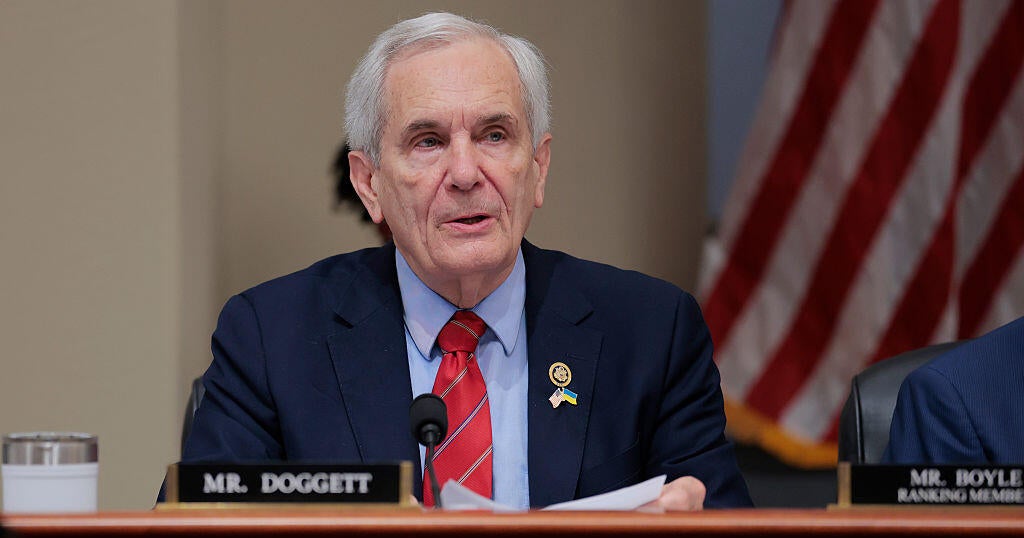
A longtime Democratic House lawmaker from Texas said Thursday he won’t run for another term if a Republican redistricting plan pushed by President Trump stands as law in the state.

The announcement from 78-year-old Rep. Lloyd Doggett, who has served in Congress since 1995, means Texas Democrats appear to have avoided a potentially messy congressional primary between Doggett and 36-year-old Rep. Greg Casar.

The new congressional lines that Republicans are attempting to pass in Texas created a situation where Doggett, who represents Texas’ 37th congressional district, and Casar, who represents the 35th congressional district, would likely have had to run against each other on the Democratic side in the 37th district due to new boundaries reshaping Casar’s current seat into one favorable to Republicans.

Democratic Rep. Lloyd Doggett of Texas

Democratic Rep. Lloyd Doggett of Texas speaks during a mark up meeting with the House Budget Committee on Capitol Hill on May 16, 2025 in Washington, D.C. 

Getty Images


Both Casar and Doggett currently represent parts of Austin, Texas. Casar’s current seat would be massively redrawn in the proposed changes.

Doggett said in a campaign statement Thursday that “if the courts give Trump a victory in his scheme to maintain control of a compliant House, I will not seek reelection in the reconfigured CD37, even though it contains over 2/3rd of my current constituents.”

Casar, who is in his second term, is chair of the Congressional Progressive Caucus. Doggett was the first Democrat in Congress to call on then-President Joe Biden to leave the 2024 presidential race after his disastrous presidential debate.

Before Doggett’s announcement Thursday, he had publicly attempted to encourage Casar to run in the redrawn 35th district rather than challenge him in a primary for the 37th district. 

“My only war is against Trump!” Doggett wrote on social media earlier this month. “2seats better than 1. Abandoning winnable majority Hispanic #TX35 to challenge me in #TX37 helps Trump, divides progressives.”

Doggett pointed to the political tensions in his statement Thursday, saying, “I had hoped that my commitment to reelection under any circumstances would encourage Congressman Casar to not surrender his winnable district to Trump. While his apparent decision is most unfortunate, I prefer to devote the coming months to fighting Trump tyranny and serving Austin rather than waging a struggle with fellow Democrats. If Trump extreme gerrymandering prevails, I wish Congressman Casar the best.”

“Lloyd Doggett is an Austin institution,” Casar said in a social media post following Doggett’s announcement. “I’ve learned so much from him. I’m grateful to him. The fight for democracy continues.”

The controversy surrounding the GOP-led Texas redistricting effort has dragged on for weeks after some Democratic Texas state legislators fled the state during a special session in order to prevent Republicans from having a quorum that would allow them to vote on overhauling the state’s congressional maps. 

Eventually they returned, assured that California Democrats are working to counter the congressional gains Texas Republicans are looking to make. On Wednesday, the Texas House passed the bill that will shift the state’s congressional maps to potentially give Republicans five more U.S. House seats.

The bill is expected to soon easily pass the Senate and then be signed into law by the Republican governor of Texas. A challenge in court to the new map appears likely. 


Source link

Passengers sue United and Delta for selling ‘window’ seats next to blank walls

0
Passengers sue United and Delta for selling ‘window’ seats next to blank walls


NEW YORK (AP) — A pair of federal lawsuits filed in San Francisco and New York this week accuse Delta Air Lines and United Airlines of misleading passengers by charging premium fees for window seats next to blank walls.


Source link

Lil Nas X hospitalized after bizarre 4 a.m. behavior in Studio City – Press Enterprise

0
Lil Nas X hospitalized after bizarre 4 a.m. behavior in Studio City – Press Enterprise


Rapper Lil Nas X was reportedly taken into custody early Thursday morning by police who found him walking in Studio City with neither shirt nor pants, and acting strangely.

Police were called around 4 a.m. Thursday because the 25-year-old “Old Town Road” singer was acting erratically on Ventura Boulevard, according to Fox11, which cited a TMZ report.

The tabloid news site reported it had viewed video of Lil Nas X barely dressed and acting weirdly, at one point putting an orange cone on his head like a jack-in-the-box. He reportedly was pointing at cars and repeating that he was headed to a party.

He was in the middle of the street when officers arrived, according to one report.

The rapper was taken to a hospital for possible treatment of a drug overdose, according to news reports.


Source link

Contributor: Armenians deserve more than a transactional peace deal with Azerbaijan

0
Contributor: Armenians deserve more than a transactional peace deal with Azerbaijan

On Aug. 8, as the White House hosted the trilateral signing of a peace agreement between Armenia, Azerbaijan and the United States, I spoke to a group of Armenian high school students from Los Angeles. We paused to watch the news conference on a laptop in the corner of our crowded room. Their faces — curious, cautious and skeptical — mirrored a sentiment across the Armenian diaspora: hope tempered by doubt, pride shadowed by mistrust.

This conflict’s roots run deep. After the Soviet Union collapsed, Armenia and Azerbaijan fought a brutal war over a region within Azerbaijan’s borders but claimed by both nations. Azerbaijanis call it Nagorno-Karabakh; Armenians call it Artsakh. A ceasefire held for years but left core disputes unresolved — over territory, governance and the right of self-determination for the region’s Armenian population.

War erupted again in 2020. Backed by Turkey and armed with advanced weapons, Azerbaijan gained control of much of the disputed territory. The Trump administration did nothing to meaningfully intervene. For Armenians, it was a devastating loss — of land, security, trust and cultural heritage. For Azerbaijan, it was a political and military victory that shifted the balance of power.

In December 2022, Azerbaijan launched a blockade of the Lachin corridor — the only road linking Nagorno-Karabakh/Artsakh to Armenia — tightening its grip on a region already reeling from war. For the next 10 months, gas, electricity, internet, food and medicine were cut off to 120,000 Armenians, many of them children and elderly. Families rationed bread. Surgeries were postponed. Schools closed.

I visited the region during this time and stood at the Armenian end of the corridor, where a silent convoy of trucks stretched out of sight up the road — each loaded with food, medicine and basic supplies, each driver knowing they might never be allowed to deliver them. The air was heavy with frustration and helplessness. In the limited coverage of the siege, the isolated Armenians spoke in hushed tones, their faces drawn from months of fear and deprivation. The International Court of Justice ordered Azerbaijan to reopen the corridor, but Baku ignored it.

I took pride when President Biden officially recognized the Armenian genocide — a moral milestone decades overdue. But his administration failed to punish Azerbaijan during the blockade, and it failed to prevent what came next: Azerbaijan’s full-scale military assault on Nagorno-Karabakh/Artsakh in September 2023. The attack lasted just 24 hours but forced more than 100,000 ethnic Armenians — virtually the entire population of the region — to flee their homes. Centuries-old communities were emptied almost overnight, and families left behind homes, businesses and places of worship, uncertain if they would ever return.

I’ve felt conflicted watching the Trump administration’s peace-making efforts between Armenia and Azerbaijan. On one hand, I love seeing my country, the United States, stand with Armenia and prioritize Armenian issues on the world stage. On the other, this moment feels hollow. And to me, this reflects a deeper problem: U.S. policy toward the South Caucasus has long lacked consistency, accountability and the will to confront aggressors, no matter which party is in power. And in Washington, Armenians have few friends and weak representation.

This agreement — like much of U.S. foreign policy in the current administration — is unmistakably transactional. Armenia gains U.S. security assurances and cooperation on artificial intelligence, including support for an emerging AI hub, which is meant to anchor its Western trajectory. Azerbaijan walks away with de facto immunity instead of being held accountable for its actions against the Armenians of Artsakh, as well as arms sales and a transit corridor to Turkey. The United States gets a geopolitical trophy: Trump’s name on the corridor to Turkey, leverage in the region and an apparent diplomatic “win” to market at home.

But this deal is far from complete. It omits the right of return for displaced Armenians to Artsakh, ignores the destruction of Armenians’ towns, homes and businesses, makes no commitment to preserve Artsakh’s cultural heritage and says nothing about prisoners of war. For many in the Armenian diaspora, these are glaring and unacceptable omissions.

On paper, the newly named Trump Route for International Peace and Prosperity, the link from Azerbaijan to Turkey, is billed as a neutral, cooperative route to be administered by the U.S. In reality, it raises serious questions about Armenia’s sovereignty. The corridor will run through Armenia’s southern Syunik province — its only direct land link to Iran — and could weaken Yerevan’s ability to fully control its own borders, regulate trade and ensure unimpeded access to a vital southern lifeline.

At best, the Aug. 8 agreement offers a slim hope for a real resolution of the region’s conflicts. If implemented fully, it could help build a more stable and prosperous Armenia for future generations. The challenge is in ensuring this deal yields a U.S. investment in reconstruction, accountability and lasting security, something more than a photo op.

And even incomplete, flawed agreements can create openings. Armenia’s pivot West, which the deal underlines, carries risk, but it also offers the possibility of stronger security partnerships, economic renewal and cultural preservation, if those benefits reach the people who have endured war and blockade, not just the leaders who signed the papers. In recent years, Armenia has seen a surprising economic boom, driven by tech investment, tourism and a wave of returning diaspora talent. This fragile momentum could be strengthened or squandered depending on what comes next.

I respect President Trump for pursuing peace agreements — leaders everywhere should make peace their highest priority. The Armenian American students I met on Aug. 8, who carry the inherited pain of their parents and grandparents, deserve more than symbolic gestures or transactional deals. They deserve justice and the freedom to envision a better future for their ancestors’ homeland. Ultimately, that is the hope we all share.

Jirair Ratevosian served as senior policy advisor for the State Department in the Biden administration.


Source link

Progress of Beacon fire stopped in residential area of Laguna Niguel

0
Progress of Beacon fire stopped in residential area of Laguna Niguel

Evacuation orders have been lifted for Laguna Niguel’s Beacon fire, as firefighters stopped the progress of the 4-acre burn less than a few hours after the blaze began in a residential area Wednesday afternoon.

The fire, which was reported at 3:26 p.m. near the intersection of Alcott Place and Ridgeway Avenue, caused some minor damage to fences behind some homes, according to the Orange County Fire Authority. Firefighters reported no structures had been lost nor injuries sustained.

The fire’s progress was officially stopped at 5:26 p.m., and firefighters began tamping down hot spots within an hour.

The fire authority lifted all evacuation orders as of 6:33 p.m. Wednesday. Approximately 20 homes on Copps Hill Street were affected by the evacuation, while residents along Middleton Place and Alcott Place were advised to shelter in place, according to the city of Laguna Niguel.

“The response from our public safety partners was extremely well-coordinated and aggressive,” Laguna Niguel Mayor Ray Gennawey said in a statement. “On behalf of the entire Laguna Niguel City Council, I extend my heartfelt appreciation to our firefighters from the Orange County Fire Authority and our deputies from the Orange County Sheriff’s Department.”


Source link

Hiltzik: The perils of government stock ownership

0
Hiltzik: The perils of government stock ownership

Back in 1935, the drafters of Social Security told Congress of their plans to build up a government pension reserve that would reach $47 billion.

The number shocked lawmakers. It was nearly three times the outstanding federal debt of the time.

“What in heaven’s name are you going to do with $47 billion?” Sen. Arthur Vandenberg, Republican of Michigan, asked Arthur Altmeyer, one of the drafters.

If we’re going to give you the money, we want a piece of the action.

— Trump’s rationale for taking stock in Intel (according to Commerce Secretary Lutnick)

“You could invest it in U.S. Steel and some of the large corporations,” Altmeyer suggested.

Vandenberg threw up his hands in horror. “That would be socialism!” he exclaimed.

Yet the idea of federal government investments in public corporation stock has never died. It walks among us like a zombie today, with the Trump administration talking about taking a 10% ownership stake in the chipmaker Intel and musing about creating a sovereign wealth fund akin to those established by Saudi Arabia, Singapore, Norway and other countries.

Here’s what history tells us about the virtues of this idea for the United States: There aren’t any.

Such funds “usually reflect the quality of governance of the states that sponsor them,” observed Steven Feldstein and Jodi Vittori of the Carnegie Endowment for International Peace in April. “Considering the Trump administration’s self-dealing and erosion of accountability, there is an acute risk that the U.S. SWF could become a source of graft to reward Trump’s friends, coerce political support for his priorities and bring personal enrichment.”

Leaving aside the quality of governance in Trump’s White House or legislators’ fears of “socialism,” the idea of federal investment in public companies has never found lasting favor on Capitol Hill, for it has been almost impossible for lawmakers to overcome the touchy economic, political and philosophical issues.

A federal fund with the authority to purchase corporate stock would be one of the largest and most potent investors in the market. As I wrote in 2005, when the idea of allowing Social Security to invest its trust fund in equities was under consideration again, the potential for conflicts of interest is inescapable.

The government might be a major shareholder in a corporation it was prosecuting for criminal activity. The government might end up on one side of an international issue as a member of a coalition of nations, and on the opposite side as a shareholder.

Its financial interests might stand in opposition to its social interests: In his 1999 State of the Union message, for example, President Clinton simultaneously threatened to sue the tobacco industry over its threat to public health, and advocated allowing Social Security to invest in all equities — tobacco included.

In 1935, Congress addressed the conundrum by mandating that the Social Security Administration invest its reserves only in U.S. Treasury securities, a rule that exists to this day.

Social Security’s would-be reformers periodically revive proposals to shift some of the program’s trust fund — which held more than $2.7 trillion in treasuries at the end of last year — into equities, pointing to their superior long-term returns compared with bonds. But those efforts have never come to fruition.

The federal government taking an equity stake in a public company wouldn’t be unprecedented. In 2009, the Obama administration acquired a 60.8% ownership of General Motors in return for almost $50 billion in bailout funds. The government also acquired a smaller stake in Chrysler, which was subsequently sold to Fiat.

The government sold the last of its GM holdings in 2013, booking a direct loss of about $10.5 billion. But its bailout has been deemed a success, given that it saved as many as 1.9 million jobs at GM, Chrysler and their suppliers.

The auto bailouts were emergency initiatives, taken to stave off what was shaping up as the auto industry’s imminent collapse. Obama made clear that these were temporary measures and that the government would sell off its stockholdings as soon as that was practicable. The government abjured any control over GM’s day-to-day operations, but it did orchestrate the exit of GM Chief Executive Rick Wagoner, oversaw the replacement of a majority of its board members and imposed compensation limits on its top executives.

The auto bailouts followed numerous examples of U.S. government takeovers, or attempted takeovers, of private businesses. In 1791, Congress authorized the government to take a 20% stake in the Bank of the United States, and in 1816, to take the same stake in the Second Bank of the United States. These are seen today as precursors to the creation of the Federal Reserve Bank as a central banking authority.

During the Great Depression, the Reconstruction Finance Corp., a Hoover creation that lived well into Franklin Roosevelt’s New Deal, took preferred shares in numerous impaired banks in return for capital infusions they needed to survive.

By the end of 1935, RFC-owned preferred stock amounted to nearly 40% of total bank common stock in the United States; the RFC’s hard-charging chairman, Texan Jesse Jones, was not shy about imposing “reasonable” compensation caps on its executives or replacing them when they faltered, or prodding their managements to make loans to private borrowers, a key element of FDR’s program of economic recovery.

The government also exercises effective control over Fannie Mae and Freddie Mac, two government-sponsored mortgage companies, via a conservatorship implemented in 2008, when the housing crash heralded the outset of the Great Recession. Stock in both companies remains in private hands, but warrants allow the government to acquire up to 79.9% of the common stock of each. Those warrants haven’t been exercised, but they equate to firm government authority over the firms’ activities.

Trump’s proposed Intel investment would occur in a very different economic environment and have very different features from any of those precursors. The terms of the plan have been murky.

Commerce Secretary Howard Lutnick confirmed during an appearance on CNBC Tuesday that the government would demand Intel shares in return for the roughly $10 billion in funds allocated to Intel via the Biden-era CHIPS Act, which aimed to shore up America’s position in high-tech hardware.

“We’ll deliver the money, which was already committed under the Biden administration,” Lutnick said. “We’ll get equity in return for it.” He quoted Trump as saying, “If we’re going to give you the money, we want a piece of the action.”

A $10-billion stake would be about 10% of Intel’s shares. That would make the government the company’s largest shareholder, outstripping the stakes held by institutional investors Vanguard and BlackRock. Lutnick said the government wouldn’t exercise voting rights or involve itself in governance. But he didn’t talk about a time-limited ownership, or specify what corporate policies the Trump administration would favor. As it happens, Trump has publicly demanded the resignation Intel CEO Lip-Bu Tan, a Malaysian, over Tan’s ostensible connections to China.

Despite its stumbles in recent years, Intel doesn’t appear to be facing extinction, as the automakers arguably did in 2008 and 2009. Nor would Intel’s demise have anywhere near the impact on the U.S. economy that a GM collapse might have had amid the Great Recession.

Once the linchpin of the high-tech boom of the 1990s, Intel has plainly lost its mojo. As my colleague Queenie Wong reported, its strategic blunders have included missing out on the artificial intelligence investment boom that has made Nvidia, the maker of chips for AI development, a darling of today’s stock market.

Intel hasn’t commented on the White House’s interest in taking an equity stake, but Intel investors don’t appear to know what to make of the idea. Shares in the company gained about 7% on Aug. 19, after Bloomberg first reported on the possibility, but have since fallen back, despite news that the Japanese investment firm SoftBank would take a $2-billion stake in the company.

Intel shares fell 7% Wednesday in Nasdaq trading, closing at $23.54, a hair below their price prior to the Bloomberg report.

Whether Trump could resist jawboning Intel, or any other companies in which the government holds shares, into instituting policies he favors is doubtful. He has frequently tried to exert pressure on CEOs of companies in which the government has no ownership, after all.

That concern would be heightened if the administration has control over a sovereign wealth fund. Trump aired that proposal via an executive order in February. The order called on Lutnick and Treasury Secretary Scott Bessent to submit a plan by the beginning of May, but none has yet surfaced.

A U.S. sovereign wealth fund wouldn’t be based on the same principles as those of many other such ventures. “SWFs have traditionally been set up by states rich in natural resources to manage their budgetary surplus, diversify their economies, and protect their wealth for future generations,” observed the Carnegie Endowment’s Feldstein and Vittori. That’s the case with the funds of both Saudi Arabia and Norway. The U.S., however, “doesn’t have excess funds to put into a SWF,” Feldstein and Vittori write.

In a fact sheet accompanying the executive order, Trump mentioned $5.7 trillion in government assets, including “natural resource reserves.” He has also talked about profits from crypto investments and the government take from tariffs — though the latter are essentially a tax on American consumers, who might have different ideas about how to spend the money.

The Carnegie researchers note that the most successful sovereign wealth funds such as Norway’s “maintain operational independence and make investments based on rigorous financial criteria.” Neither quality is a hallmark of the Trump administration.

Feldstein and Vittori point out that by building a U.S. fund via tariff income or income from Trump’s “gold card” proposal, which would give rich foreigners the right to live in the U.S. for a $5-million fee, might allow Trump to evade Congress’s constitutional monopoly on raising and spending money and even allow him to manage the fund behind closed doors.

Still, it would be up to Congress to establish the fund and oversee its operations. Will the lawmakers accept their responsibility? If not, Trump’s idea is a dangerous one. “Giving a president who aspires to be a king a potent financial weapon with ill-defined purposes and methods,” Feldstein and Vittori write, “presents a grave risk to American democracy.”


Source link

Wall Street lower in final moves ahead of a speech by Federal chair

0
Wall Street lower in final moves ahead of a speech by Federal chair


By STAN CHOE, Associated Press Business Writer

NEW YORK (AP) — U.S. stock indexes are edging lower on Thursday as Wall Street makes its final moves before the head of the Federal Reserve gives a highly anticipated speech on Friday that could hint at where interest rates are going.

The S&P 500 dipped 0.2% following four straight modest loss since it set an all-time high last week. The Dow Jones Industrial Average was down 101 points, or 0.2%, as of 10:35 a.m. Eastern time, and the Nasdaq composite was 0.1% lower.


Source link

Riverside Poly High students protest over forfeited girls volleyball game – Press Enterprise

0
Riverside Poly High students protest over forfeited girls volleyball game – Press Enterprise

Students at Riverside’s Poly High School rallied Wednesday, Aug. 20, to protest a Riverside school district social media post they say allowed the bullying of a transgender athlete who was criticized by President Donald Trump and others at a state track meet.

That same athlete — Jurupa Valley High School’s AB Hernandez — is alleged to be the reason that Poly forfeited a girls volleyball game last week, though the Riverside Unified School District will not say why the team made that decision. Hernandez, who appears to be on Jurupa Valley’s volleyball team, has been targeted online in response to the Riverside district’s post announcing the forfeit, protesters said.

RELATED: Riverside Poly forfeits girls volleyball match against Jurupa Valley

More than 20 Poly students stood after school under the shade of trees lining Victoria Avenue in front of the campus. They held handwritten signs with messages about respect and acceptance as they chanted “Kids are kids no matter what.”

“RUSD, through the post they’ve made has given a platform for people to bully a child whether or not they are transgender it is completely inexcusable,” said Nate Firetag, a 15-year-old Poly sophomore and a protest organizer.

1 of 9

Poly High School student Anaya Anderson takes part in a Wednesday, Aug. 20, 2025, rally outside the Riverside school to protest the Riverside Unified School District’s social media post announcing that the girls’ volleyball team would forfeit a game last week against Jurupa Valley High School. Students allege the post allowed for criticism of a Jurupa Valley transgender athlete. (Photo by Anjali Sharif-Paul, The Sun/SCNG)

Expand

Riverside Unified’s Friday, Aug. 15, Instagram post states that Poly’s girls volleyball team would forfeit its match that day against Jurupa Valley High. The post did not say why the team forfeited, but speculation on social media and parents of Poly players who spoke to Fox News allege the team did so in protest of Hernandez.

The post also said school officials understood that the decision was disappointing.

“We remain committed to providing a safe, positive environment for all student-athletes throughout the season,” the district’s Instagram post states.

Firetag said the district neglected to monitor comments on its post, which let people target Hernandez.

“We want to make sure that people know students are not for this,” Firetag said. “This is not what Poly students stand for. This is not what Poly students want and not what Poly students are going to let happen.”

“Trans kids are kids and no kid is deserving of being attacked,” Firetag said.

In a Wednesday, Aug. 20 statement, Riverside Unified spokesperson Liz Pinney-Muglia did not explain why Poly forfeited the game. She said later that she could not comment on individual students or athletes.

The statement said neither the high school nor district are places for hate but are places where students, staff and families have the right to be safe, included and accepted.

“We stand for a culture of mutual respect and inclusion, and for the safety and dignity of all students,” Pinney-Muglia wrote.

Hernandez is a senior who has competed on Jurupa Valley’s girls varsity volleyball and track and field teams since the 2022-23 school year. Hernandez was the subject of protests during last season’s track and field season. Hernandez placed first in the girls high jump and triple jump events at the California Interscholastic Federation State Championships in May and also finished second in the girls long jump.

Jacquie Paul, a spokesperson for the Jurupa Unified School District, said she could not comment on whether Hernandez is on the team. Paul said she could not discuss a student’s personal information. When asked if Jurupa Valley was given reason for the forfeit, she did not respond.

The CIF introduced a pilot entry program before the state meet that allowed an additional student to compete in the events in which Hernandez entered. The program allowed a cisgender female competitor who was displaced by Hernandez to share placings in those events.

Hernandez’s mother, Nereyda Hernandez, made an Instagram post the day after the forfeited match.

“”L🤍VE, Respect, Dignity, Fairness, Equality for ALL,” she wrote. “When we follow California law and school policies, especially those that protect the rights of ALL students, we are more than just rule-followers. We are respectful, inclusive, and principled citizens.” 

The Poly High rally aimed to raise awareness of transgender students and to acknowledge their role in the community, said Zander Hix, a junior and a protest organizer.

“We are standing for the most vulnerable in the community, even though they may not have a voice,” Hix said.

The state and national controversy surrounding transgender athletes has reached Poly, he said.

“I think the community at school is majority supportive of transgender students being on their sports teams,” Hix said.


Source link

At the US Open, tennis stars shine under dark sky-friendly outdoor lights

0
At the US Open, tennis stars shine under dark sky-friendly outdoor lights

NEW YORK — When the court lights flicker on at the U.S. Open, tennis stars shine under illumination designed to cut light pollution.

The wedge-shaped lamps around the USTA Billie Jean King National Tennis Center in Flushing Meadows direct light onto the players without spewing it into the surrounding skies.

The stadium complex is the only professional sports venue certified by a group that’s trying to preserve the night sky around the world. Across North America and Canada, schools and local parks have also swapped out their lights on baseball fields, running tracks and other recreation grounds to preserve their view of the stars and protect local wildlife.

Night lights can disrupt bird migration and confuse nocturnal critters like frogs and fireflies. Lights on sports fields are especially bright and cool, and often cast their glare into neighborhoods.

In renovations over the past decade, the U.S. Tennis Association swapped metal halide bulbs for shielded LED lights. The complex’s 17 tournament courts — including Arthur Ashe Stadium — and five practice courts were approved as dark sky-friendly last year.

USTA officials wanted the best lighting possible on their courts, which also happened to be friendly to dark skies. Their lighting company suggested striking a balance that would satisfy crowds and TV crews while cutting down spillover into the surrounding environment.

“This is an international event that has an impact on the community,” said the USTA’s managing director of capital projects and engineering Chuck Jettmar. “Let’s minimize that and make sure that everybody’s happy with it.”

U.S. Open qualifying matches this week were punctuated by players grunting, crickets chirping and audiences cheering. Rows of lights stood like sentries above, adorned with flat visors that guided the glow onto the action.

The lights at Flushing Meadows glow at a quarter of their brightness when the courts are rented for play during the year. They’re approved by DarkSky International, a nonprofit that gives similar designations to cities and national parks. The group widened its focus to include sports arenas in recent years and has certified over 30 venues since 2019 — including high school football fields and youth soccer fields.

“We live in a world where we need to engage with one another in the nighttime environment, and that’s OK,” said DarkSky spokesperson Drew Reagan. “That’s a beautiful thing and there’s a way to do that responsibly.”

The organization typically approves proposals at sports fields before any light fixtures are installed or replaced. Once construction is complete, a representative measures the glow and glare against a set of guidelines that benefit the night.

Renovating a field with dark skies in mind can cost about 5% to 10% more than traditional sports lighting, according to James Brigagliano, who runs DarkSky’s outdoor sports lighting program. Venues may require a few extra fixtures since the light shining from them is more targeted.

Most arenas make the change during scheduled maintenance and renovation, working with sports lighting company Musco. The company lights over 3,000 venues a year including college football stadiums, tennis courts and rail yards.

At Superstition Shadows Park in Apache Junction, Arizona, kids play T-ball and baseball in the evenings, when the darkness offers a brief respite from the summer heat. The city’s parks and recreation department replaced its already-aging lights with shielded, dark sky-friendly fixtures last year with federal and local government funding.

People venture to Apache Junction partly because “they can get out of the city and still see stars,” said the city’s parks and recreation director Liz Langenbach. The city is at the edge of the Phoenix metro area, bordered by rolling mountains and sweeping deserts.

“The choices we make on lighting, I think, affect all of that,” Langenbach said.

At Université Sainte-Anne in Canada, students run on a new track and soccer field outfitted with lights that DarkSky approved last year. Researchers at the university study native, nocturnal animals like the northern saw-whet owl.

The lights are “good for everyone,” said university spokesperson Rachelle LeBlanc. “For tourism, for our students, for our neighbors, for the animals that we share our campus with.”

Night lights harm the surrounding environment no matter how shielded they are. DarkSky-approved fields still allow a small fraction of their light to be pointed up since it’s necessary to keep track of flying balls.

“You can have the absolute best, most carefully designed stadium lighting in the world, and you’re still creating light pollution,” said Travis Longcore, an urban light pollution expert at the University of California, Los Angeles.

The U.S. Open courts are side-by-side with bright lights from Manhattan and Queens — so they can only darken a slice of the sky. But DarkSky says every light fixture makes a difference, and one professional arena can influence others.

“I’m not saying we as humans have to turn all the lights off,” said Longcore. “I think you have to make improvements from where you are.”

___

The Associated Press Health and Science Department receives support from the Howard Hughes Medical Institute’s Department of Science Education and the Robert Wood Johnson Foundation. The AP is solely responsible for all content.


Source link

US and EU frame the ongoing deal between the trading partners and solidify some commitments

0
US and EU frame the ongoing deal between the trading partners and solidify some commitments

WASHINGTON — The United States and the European Union on Thursday issued a joint statement that frames the ongoing deal between the trading partners and solidifies some trade commitments.

“This Framework Agreement will put our trade and investment relationship — one of the largest in the world — on a solid footing and will reinvigorate our economies’ reindustrialization,” the document reads.

Together, the U.S. and the EU have 44% of the global economy.

Key points in the letter include a 15% U.S. tariff rate on most European goods, with specifics on auto tariffs tied to EU legislative actions.

In addition, the EU agrees to eliminate tariffs on industrial goods and many agricultural products, while the U.S. will reduce tariffs accordingly. The agreement also covers $750 billion in energy purchases and $600 billion in EU investments by 2028. The agreement also addresses non-tariff barriers, digital trade and environmental regulations.

In July, President Donald Trump and European Commission President Ursula von der Leyen met briefly at Trump’s Turnberry golf course in Scotland and announced a sweeping trade deal that imposes 15% tariffs on most European goods, warding off Trump’s threat of a 30% rate if no deal had been reached by Aug. 1.

Before the Republican U.S. president returned to office for his second term, the U.S. and the EU maintained generally low tariff levels in what is the largest bilateral trading relationship in the world, with about $2 trillion, around 1.7 trillion euros, in annual trade.


Source link

Reporter says former aide to New York City Mayor Eric Adams gave her a chip bag filled with cash

0
Reporter says former aide to New York City Mayor Eric Adams gave her a chip bag filled with cash

A longtime adviser to New York City Mayor Eric Adams who resigned from his administration while under FBI scrutiny gave a reporter a potato chip bag filled with cash Wednesday following a campaign event, a gift her lawyer later insisted wasn’t an attempted bribe.

The local news site The City reported the episode hours after one of its reporters said Winnie Greco had pressed a bag of potato chips into her hands containing a red envelope with a $100 bill and several $20 bills.

The reporter, Katie Honan, had scrutinized Greco’s conduct in the past as a major fundraiser for Adams in the Chinese American community.

Greco’s attorney, Steven Brill, told The Associated Press that the situation was being “blown out of proportion.”

“This was not a bag of cash,” Brill wrote in an email. “In the Chinese culture, money is often given to others in a gesture of friendship and gratitude. And that’s all that was done here. Winnie‘s intention was born purely out of kindness.”

Asked why Greco wanted to make such a gesture to Honan, Brill said, “She knows the reporter and is fond of her.”

The City said it interviewed Greco later Wednesday and she apologized, saying she made “a mistake.”

“I’m so sorry. It’s a culture thing. I don’t know. I don’t understand. I’m so sorry. I feel so bad right now,” Greco said, according to The City.

In response to the report of the bag filled with cash, Adams’ reelection campaign said it had suspended Greco from further work as an unpaid volunteer and that Adams had no prior knowledge of Greco’s actions.

The City reported Greco had texted Honan to meet her inside a Whole Foods store after they both attended the opening of Adams’ campaign headquarters in Harlem.

When given the chip bag, Honan at first thought Greco was just giving her a snack and said she could not accept it but Greco insisted, according to the report.

Honan left and later discovered the money, then called Greco and told her she could not accept it and asked to give it back. Greco said they could meet later but then stopped responding, the report said.

Greco later called The City back and asked them not to do a story, saying “I try to be a good person,” the news outlet reported.

A City Hall spokesperson declined to comment Wednesday night. An Adams campaign aide, Todd Shapiro, said Greco holds no position in the campaign.

“We are shocked by these reports,” Shapiro said. “Mayor Adams had no prior knowledge of this matter. He has always demanded the highest ethical and legal standards, and his sole focus remains on serving the people of New York City with integrity.”

A text message sent to a phone number listed in public records for Greco was not immediately returned Wednesday night.

Since she resigned as Adams’ director of Asian affairs last fall, Greco has occasionally been seen at Adams campaign events. Before her resignation, Greco had served as Adams’ longtime liaison with the city’s Chinese American community. She was also a prolific fundraiser for Adams’ campaigns.

In February of 2024, federal agents searched two properties belonging to Greco. Authorities didn’t explain what the investigation was about, and Greco has not been charged with committing a crime, but she was a number of close aides to Adams who resigned or were fired amid the federal scrutiny.

The City has reported extensively on the investigation and Greco’s conduct, including a campaign volunteer’s allegations that Greco had promised to get him a city job if he helped renovate her home.

A separate federal investigation into Adams led to a 2024 indictment accusing the mayor of accepting illegal campaign contributions and travel discounts from a Turkish official and others — and returning the favors by, among other things, helping Turkey open a diplomatic building without passing fire inspections.

A federal judge dismissed the case in April after the Justice Department ordered prosecutors to drop the charges, arguing that the case was interfering with the mayor’s ability to aid President Donald Trump’s crackdown on illegal immigration.


Source link

Home Privacy Policy Terms Of Use Anti Spam Policy Contact Us Affiliate Disclosure DMCA Earnings Disclaimer