MELBOURNE, Australia — A trainee surgeon was released from custody on bail Friday after he was charged with secretly video recording hundreds of medical colleagues in the restrooms of Australian hospitals.
Ryan Cho, 28, will likely face around 500 charges relating to 4,500 intimate videos he secretly recorded with phones mainly in the staff restrooms of three Melbourne hospitals since 2021, police alleged in documents cited in the Victoria state Supreme Court.
Justice James Elliott ruled that the junior doctor be released on condition he live with his parents, who moved from Singapore to Melbourne in anticipation of their son’s release. His parents were required to post a 50,000 Australian dollar ($32,000) surety.
The prosecutor argued that the charges presented Cho with an inducement to flee and he had no meaningful ties to Australia after being suspended from his job. While Cho became an Australian permanent resident in April, he would face deportation if he was convicted and sentenced to 12 months or longer in prison, Hammill said.
The judge noted Cho had surrendered his Singapore passport and had no criminal connections to help him leave Australia.
Police allege Cho recorded intimate images of at least 460 women. The judge noted there was no allegation Cho had disseminated those images.
Cho was arrested in July after a phone was found recording from inside a mesh bag hanging in an Austin Hospital restroom. Police allege he also recorded in restrooms in the Peter MacCallum Cancer Center and the Royal Melbourne Hospital.
His lawyer Julian McMahon rejected prosecutors’ fears that if released, Cho could interfere with witnesses. There were likely to be hundreds of witnesses alleging similar offenses, McMahon said.
“There’s a sense here that if my client were to engage in the criminal offense of interfering with witnesses that it wouldn’t affect the outcome of the case,” McMahon said.
Cho was initially charged with six offenses but another 127 charges were added Thursday, including intentionally recording intimate images without permission.
McMahon said it was too early to tell if the allegations would go to trial. Cho hasn’t entered pleas.
Cho came to Australia as a student in 2017 and studied medicine at Melbourne’s Monash University.
The federal government is trying to force Kilmar Abrego Garcia to accept a guilty plea or face deportation to Uganda, his attorneys claimed in a filing on Saturday.
The Salvadoran man, who was wrongly deported in March before being brought back to the United States to face human smuggling charges, was released from criminal custody in Tennessee and sent back to Maryland on Friday.
After Abrego Garcia declined an offer to be deported to Costa Rica in exchange for remaining in jail and pleading guilty to the human smuggling charges, his attorneys say U.S. Immigration and Customs Enforcement informed them that he could be deported to Uganda and ordered him to report to their office in Baltimore on Monday.
The attorneys said the development came after the government on Thursday said that if Abrego Garcia agreed to extend the stay and plead guilty to both counts of the indictment, the government would promise to deport Abrego Garcia to Costa Rica.
Kilmar Abrego Garcia, leaves the Putnam County Jail, Aug. 22, 2025, in Cookeville, Tenn.
Brett Carlsen/AP
ABC News first reported that the government of Costa Rica informed the U.S. embassy on Thursday that the country would be willing to accept Abrego Garcia “upon the conclusion of any criminal sentence he may serve in the U.S.”
But after Abrego Garcia refused to extend the stay and was released on Friday, Abrego Garcia’s attorneys claim the government “responded to Mr. Abrego’s release with outrage.”
“Despite having requested and received assurances from the government of Costa Rica that Mr. Abrego would be accepted there, within minutes of his release from pretrial custody, an ICE representative informed Mr. Abrego’s counsel that the government intended to deport Mr. Abrego to Uganda and ordered him to report to ICE’s Baltimore Field Office Monday,” his attorneys said.
On Friday evening following Abrego Garcia’s release, his attorneys said DHS informed Abrego Garcia that he has until first thing Monday morning to accept a plea in exchange for deportation to Costa Rica, “or else that offer will be off the table forever.”
“There can be only one interpretation of these events: the DOJ, DHS, and ICE are using their collective powers to force Mr. Abrego to choose between a guilty plea followed by relative safety, or rendition to Uganda, where his safety and liberty would be under threat,” Abrego Garcia’s attorneys said.
Homeland Security Secretary Kristi Noem had criticized Abrego Garcia’s release on Friday saying, “Today, we reached a new low with this publicity hungry Maryland judge mandating this illegal alien who is a MS-13 gang member, human trafficker, serial domestic abuser, and child predator be allowed free.”
Abrego Garcia’s trial in his human smuggling case was set to begin on Jan. 27, 2027.
Multiple postal services around Europe announced Saturday that they are suspending the shipment of many packages to the United States amid a lack of clarity over new import duties.
Postal services in Germany, Denmark, Sweden and Italy said they will stop shipping most merchandise to the U.S. effective immediately. France and Austria will follow Monday, and the United Kingdom Tuesday.
India’s government also said the country will temporarily suspend postal deliveries to the United States starting Monday, except letters, documents and gift items of up to $100 in value, the AFP reported.
Under a decree signed by President Donald Trump last month, international goods that were previously exempt from U.S. tariffs — those valued under $800 — will be subject to import duties from Aug. 29. Letters, books, gifts and small parcels worth less than $100 will continue to be exempt.
A trade framework agreed by the U.S. and the European Union last month set a 15% tariff on the vast majority of products shipped from the EU.
Many European postal services say they are pausing deliveries now because they cannot guarantee the goods will enter the U.S. before Aug. 29. They cite ambiguity about what kind of goods are covered by the new rules, and the lack of time to process their implications.
Starting Saturday, Deutsche Post and DHL Parcel Germany said they “will no longer be able to accept and transport parcels and postal items containing goods from business customers destined for the US.”
Postnord, the Nordic logistics company, and Italy’s postal service announced similar suspensions effective Saturday.
“In the absence of different instructions from US authorities … Poste Italiane will be forced, like other European postal operators, to temporarily suspend acceptance of all shipments containing goods destined for the United States, starting August 23. Mail shipments not containing merchandise will continue to be accepted,” Poste Italiane said Friday.
Shipping by services such as DHL Express remains possible, it added.
Björn Bergman, head of PostNord’s Group Brand and Communication, said the pause was “unfortunate but necessary to ensure full compliance of the newly implemented rules.”
In the Netherlands, PostNL spokesperson Wout Witteveen said the Trump administration is pressing ahead with the new duties despite U.S. authorities lacking a system to collect them. He said that PostNL is working closely with its U.S. counterparts to find a solution.
“If you have something to send to America, you should do it today,” Witteveen told The Associated Press.
India’s communications ministry said in a statement that the executive order issued last month requires transport carriers or other “qualified parties” approved by US authorities to collect and remit the tariff duties, but “several critical processes relating to the designation of ‘qualified parties’ and mechanisms for duty collection and remittance remain undefined.”
“Consequently, US-bound air carriers have expressed their inability to accept postal consignments after 25th August, 2025, citing lack of operational and technical readiness,” the ministry said.
Austrian Post, Austria’s leading logistics and postal service provider, stated that the last acceptance of commercial shipments to the U.S., including Puerto Rico, will take place Tuesday.
France’s national postal service, La Poste, said the U.S. did not provide full details or allow enough time for the French postal service to prepare for new customs procedures.
“Despite discussions with U.S. customs services, no time was provided to postal operators to re-organize and assure the necessary computer updates to conform to the new rules,” it said in a statement.
The UK’s Royal Mail said it would halt U.S. shipments on Tuesday “to allow time for those packages to arrive before duties kick in.” Items originating in the U.K. will require a 10% duty for items over $100, it said.
PostEurop, an association of 51 European public postal operators, said that if no solution can be found by Aug. 29 all its members will likely follow suit.
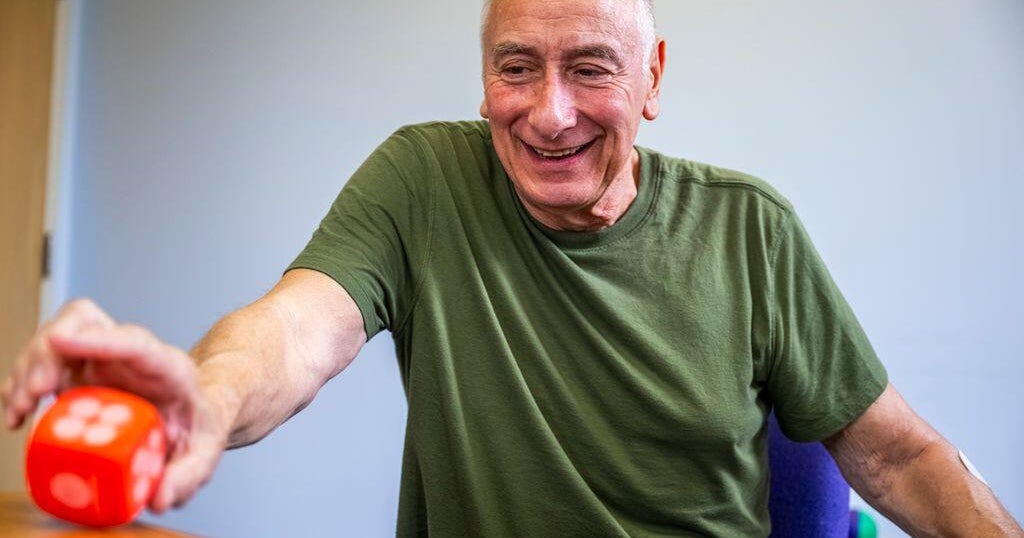
Restaurateur Tommy Fello was driving from his Ohio establishment to his house on Christmas Eve when he started veering off the road. Fello, then 71, had been awake since 4 a.m. local time preparing a holiday buffet for his family. He chalked the disturbance up to a flat tire. Driving slowly and relying on the vehicle’s autocorrect feature, he was able to complete his journey home safely.
But when Fello stepped out of the truck, he couldn’t get his balance.
“I finally realized it wasn’t the truck that was veering. It was me that was veering,” Fello said. He went indoors and talked to his wife and daughter, who said he looked unwell. About five minutes later, they called 911. Paramedics took him to an area hospital, where he lost all movement in his left arm and leg.
“They were literally just like appendages on me. I could not feel them and could not do anything,” Fello said.
A clot-busting drug reversed the stroke, but the numbness on the left side of his body, including his face, remained. He struggled to swallow, eat or drink. Physical and occupational therapy produced only minor improvements.
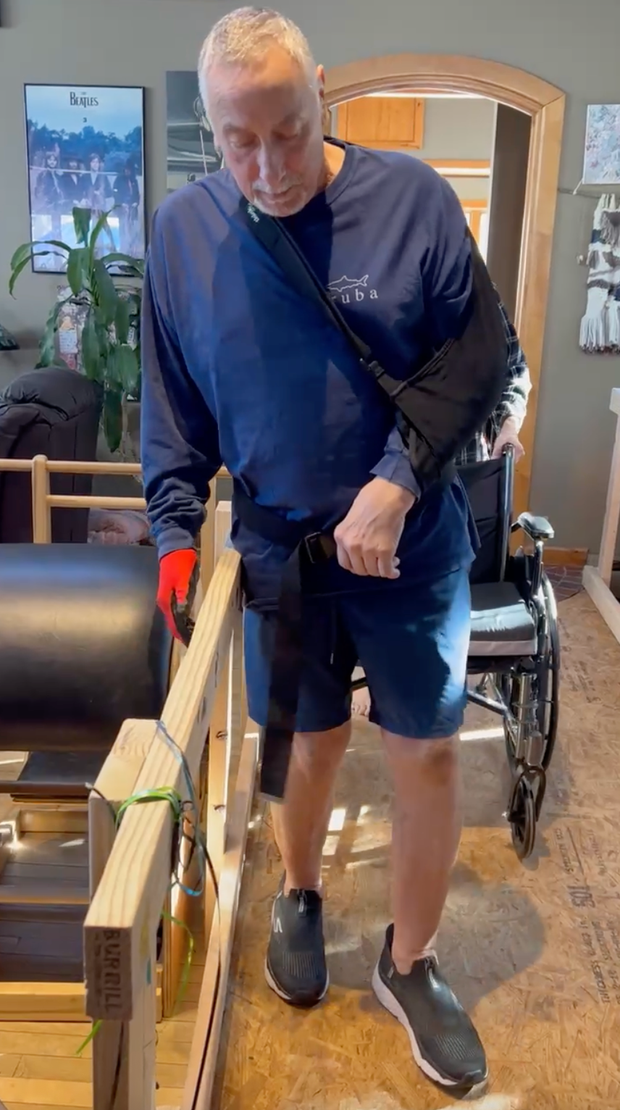
Tommy Fello walks during a rehabilitative therapy session before his surgery.
Thomas Fello
Dr. Sharon Covey, Fello’s occupational therapist and the founder of the Center for Stroke and Hand Recovery, Inc., told CBS News that his arm was essentially stuck in a bent position with his fingers curled when he met her in January 2024. The position and tension in the limb caused Fello constant pain. Working in his restaurant was out of the question.
“It was very scary. You take for granted so many of the things you do, and even the common, simplest things become like a chore,” Fello said. “We mark all these small victories … Being able to lift up your arm or pick up a cup is a gigantic accomplishment. Those little accomplishments are gigantic to a stroke victim. They encouraged me to keep going on. But there was always a thought in the back of my mind: ‘Is this as good as it’s going to get?'”
A “first-of-its-kind technology”
One day, another recovering stroke patient suggested Fello look into an implant called the Vivistim System. The FDA-approved implant, developed by the medical device company MicroTransponder Inc., uses vagus nerve stimulation during rehabilitation to improve hand and arm function for stroke victims. The vagus nerves are the body’s longest cranial nerve, with one on each side of the body, according to the Cleveland Clinic. They regulate the body’s involuntary functions.
The Vivistim Therapy system involves a physical or occupational therapist sending wireless signals to the device. That signal delivers a brief, gentle pulse to the vagus nerve while the stroke patient performs rehabilitative tasks. The stroke patient also does at-home exercises.
Dr. Erez Nossek, a neurosurgeon and director of the cranial bypass program at NYU Langone, told CBS News that the vagus nerve stimulation can enhance the brain’s ability to rewire itself, known as neuroplasticity. That increased neuroplasticity can result in “greater and faster improvements in motor function for stroke survivors,” Nossek said in emailed remarks.
An illustration from MicroTransponder, Inc. shows the positioning of the Vivistim System device.
MicroTransponder, Inc.
“There is no other FDA-approved technology proven to boost neuroplasticity for stroke survivors, creating new connections in the brain, which is theirs to keep, even after the device is no longer in use,” Nossek said. “This is (a) first-of-its-kind technology that is redefining what is possible for this patient population.”
A 108-person trial published in The Lancet in 2021 found that the device generated two to three times greater improvement in hand and arm function for stroke survivors when compared with just rehab. Stroke patients who have limited hand and arm function six months or more after their stroke and are considered to have “moderate to severe deficits” qualify for the device, the company said in a fact sheet.
Implant aids in recovery
Fello turned to the Cleveland Clinic, where he met cerebrovascular neurosurgeon Dr. Mark Bain. He studies stroke recovery, especially in the cases of patients like Fello, whose rehab progress has plateaued months after the stroke. Bain determined that Fello was a candidate for the Vivistim System. Fello became the first Cleveland Clinic patient to receive the implant on April 29, 2025.
“It didn’t really scare me to try and do it. I was anxious to see how it worked,” Fello said.
The device was placed during an hour-long procedure. The vagus nerve sits just below the carotid artery, so Bain and his surgical team made a small incision to place the leads of the implant and hid the scar in a fold of Fello’s neck. The key-fob sized implant was placed under Fello’s clavicle. Bain said the procedure itself is low-risk, with “less than 1% chance of any complications.” Two weeks after the surgery, the device was turned on and Fello returned to his rehabilitative work with Covey.
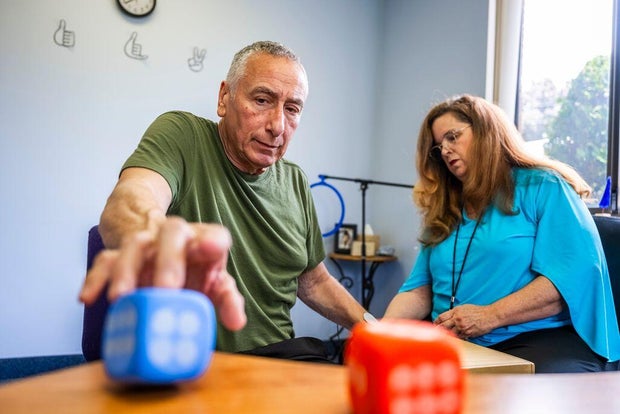
Tommy Fello and Dr. Sharon Covey during a therapy session.
Cleveland Clinic
Covey said Fello has made huge progress since the device was implanted four months ago. She said he has no pain or tension in the limb, and is beginning to practice using his left arm to carry items. The task is difficult, she said, but isn’t “something he could have done before.” Fello, now 72, said he’s been thrilled by the progress he’s made in a short time.
“I’m very, very happy to do it, very proud to do it, and I’m glad I did it,” he said.
“The sky’s the limit”
About 800,000 people in the United States experience an ischemic stroke each year, Bain said. Vivistim and other new technologies may offer hope to the patients like Fello who struggle to recover with just rehabilitation, Bain said.
“I think over the next probably five to 10 years, what you’re going to see is an explosion of procedures, devices and things in rehab that will help people, once they’ve had strokes, to get their lives back,” Bain said. “In the future, I think the sky’s the limit for what we can expect for stroke recovery.”
At the time of his conversation with CBS News, Bain had given seven other stroke patients a Vivistim implant. Covey said at her practice, there are eight patients with the implant receiving the paired therapy course. MicroTransponder Inc. declined to say how many patients have received the implant, but shared a map that shows dozens of surgeons and rehabilitation therapists that provide the therapy.
“I think this is the newest, most effective strategy for people getting their affected limbs back,” Covey said. “This is the first real technique that has been available, at least in the last 20 years, for stroke rehab. The theories that we use as practitioners to increase somebody’s use of their affected arm are 50 to 75 years old. So this is a new technology that’s really going to turn the stroke recovery world upside down.”
Kerry Breen is a news editor at CBSNews.com. A graduate of New York University’s Arthur L. Carter School of Journalism, she previously worked at NBC News’ TODAY Digital. She covers current events, breaking news and issues including substance use.
The Texas Senate has passed a controversial GOP redistricting bill that triggered a weekslong standoff in the House, sending it to Gov. Greg Abbott’s desk for approval.
Abbott said Saturday morning that he would “swiftly” sign the bill into law once it arrived on his desk.
“I promised we would get this done, and delivered on that promise,” Abbott said in a statement.
The Senate approved the measure early Saturday after a heated debate, marking a major step in a mid-decade redistricting effort backed by President Trump, who urged Texas lawmakers to secure more Republican seats ahead of the 2026 midterm elections.
Before the full Senate vote, the Texas Senate Committee on Redistricting advanced the bill on Thursday along party lines.
Democrats have vowed to challenge the legality of the new map in court, arguing it undermines fair representation and dilutes minority voting power.
California launches counter-redistricting plan
The Texas redistricting plan has sparked a nationwide fight over political boundaries.
Earlier this year, Mr. Trump asked Abbott to call a special session so lawmakers could create additional Republican districts, The New York Times reported. The unusual mid-decade redistricting was meant to help the GOP retain its narrow majority in the House of Representatives after the 2026 midterm elections.
The president’s party almost always loses seats in Congress in the midterms, according to historical data. Democrats gained 41 House seats and the majority in 2018, Mr. Trump’s first term, and Republicans picked up 9 seats to claim the majority in 2022, during President Biden’s term.
Texas House Democrats fled the state for two weeks to deny a mandatory quorum in the House, killing the first special session and visiting blue states to drum up support. They returned earlier this week, allowing the votes to proceed.
During that time, California Gov. Gavin Newsom joined the fight, introducing a new congressional map to flip five of California’s seats from Republican to Democratic. Voters will need to approve the plan in a special election called for the fall.
Newsom said the move was necessary to “fight fire with fire” and prevent what he called a Trump-backed attempt to rig the 2026 midterm elections.”
Steven Rosenbaum is a digital producer for CBS Texas. A versatile journalist, Steven writes, edits and produces content for the CBS Texas digital platforms.
Five people are dead after a tour bus with more than 50 passengers lost control and rolled over on a major highway in western New York on Friday, state police said.
The bus was traveling back to New York City from Niagara Falls, police said. It was going eastbound on the New York State Thruway near Pembroke, around 30 miles northeast of Buffalo and 40 miles southeast of Niagara Falls.
“For unknown reasons, the vehicle lost control, went into the median, over-corrected and ended up in the ditch” on the side of the road, state Trooper James O’Callaghan said. The bus was going full speed, but did not hit any other vehicle, he said.
Five passengers died as a result of the accident, and none of the passengers who died included children, police said. Passengers on the bus ranged in age from 1 to 74.
The bus was carrying 54 people, including two employees of the bus company, New York State Police said Friday. The bus company that was operating during the accident was M&Y Tour Inc.
The cause of the accident is still under investigation, but a mechanical failure and operator impairment have been ruled out, police said. The bus driver has been cooperative and no charges have been filed, according to officials.
First responders work to rescue victims at the scene of a tour bus that crashed and rolled over on the New York State Thruway near Pembroke, New York, on Friday, Aug. 22, 2025.
Libby March / AP
The Erie County Medical Center, a level 1 adult trauma center, said it had received 24 patients from the crash scene, including two in surgery and two who were in the intensive care unit. On Saturday morning, the ECMC said “as many as 10” of the patients it received were discharged Friday evening. Three of the four patients who had needed surgery or intensive care were listed as stable, the hospital said. The fourth is in critical condition.
United Memorial Medical Center in Batavia, New York, said it received two patients who were treated and released. The hospital said it didn’t expect to receive any additional patients.
Six patients from the crash were being treated at the University of Rochester Medical Center. Two are being treated for critical injuries and four are medically stable, including one pediatric patient, the hospital said.
Mercy Flight, a nonprofit emergency air medical transport provider, said it had taken multiple patients by air to hospitals.
The nationalities of most of the people on the bus were Indian, Chinese and Filipino, O’Callaghan said.
The New York State Thruway was closed in both directions between exits 48A and 49 due to the crash.
“Please avoid all local roads near the scene as traffic is being diverted off of the Thruway (Interstate 90) in both directions,” Erie County Executive Mark Poloncarz said on social media.
New York Gov. Kathy Hochul said she had been briefed on “the tragic tour bus accident” on the thruway.
“My team is coordinating closely with @nyspolice and local officials who are working to rescue and provide assistance to everyone involved,” she wrote on X.
IRVINE — Portola got pounded in its first game last season, then went on to win its first CIF Southern Section football title.
Well, so far, so good.
The Bulldogs took it on the chin again, falling for the second opener in a row to Long Beach Wilson, 35-0, in a game that featured teams that reached their respective Southern Section finals.
Portola went on to win a championship last season, while Wilson went on to lose. But the Bruins looked good on Friday at Portola High.
Kori Scott rushed 21 times for 109 yards and two touchdowns to lead the Bruins, but it was a 52-yard interception return by Jemel Grigsby that made it 14-0 at 10 minutes 5 seconds of the second quarter that was the game’s biggest play.
“The opportunity presented itself and I took it,” said Grigsby, who caught a ball after it was tipped in the air. “(The outcome) didn’t exceed our expectations, it was expected. We’ve been training for this all summer. Everybody came out and did their job like they should have.”
Grigsby said he’s very clear about the ceiling for the Bruins season. “When we play like this, we should be No. 1,” he said. “That’s all we’re aiming for. That’s the standard. One is the standard, nothing less.”
The long night for Portola began with a first quarter fumble at midfield. Wilson took advantage of the opportunity as Scott scored from two yards to make it 7-0 with 1:38 left in the first quarter.
After the interception return by Grigsby, a three-and-out set up the next Bruins’ scoring drive, which covered 47 yards. Seven plays in, Rick’quan Thompson scored from four yards for a 21-0 lead, though quarterback Mack Cooper completed passes of 13 and 29 yards to Thomas Jones during the drive.
With 30 seconds left in the half, Cooper’s 20-yard pass to tight end Jagger Kohagura made it 28-0 with the addition of Jayson Pimentel’s PAT.
When Scott scored from two yards with 33 seconds left in the third quarter, it created a running clock scenario in the fourth.
It was an extraordinary opening game performance for first-year coach Raudric Curtis.
“We started off sluggish, went back and forth, they held tight early,” said Curtis, who won a section title with Mayfair of Lakewood two seasons ago. “I knew they would play inspired on their home field. It took a big play from (Grigsby) on defense to spark us. We fed off of that, which was good. … Making those mistakes early is not something we can afford to do consistently. Not to harp on them, but there were a lot of mistakes.”
Wilson certainly appears to be in a good position, but titles aren’t won after one game, something that Portola knows very well. The Bulldogs lost all five of their nonleague games last season before winning nine of their next 11.
For Portola coach Peter Abe, the losses are opportunities to grow.
“I think, no matter who the opponent is, we expect to play Bulldog football … and do our job. If and when those things don’t happen, [this is] what happens,” Abe said of the one-sided outcome.
“We started off well, but once you compound mistakes – they weren’t mistakes that I think weren’t unfixable. The effort was fine but the execution and cleanliness of it needs to be crisper, cleaner. Hey, we’ve been here before. And we got it done. Let’s go.”
Timothy Grettenberg, a bruising running back for the Bulldogs, was ticked off by the performance, but also tried to maintain some perspective.
Portola running back Timothy Grettenberg was disappointed with the team’s play in a 35-0 loss to Long Beach Wilson on Friday, Aug. 22, 2025. (Photo by Martin Henderson)
“We got really complacent this week in practice, got too comfortable,” he said. “I think we’ll learn from these mistakes now that we’ve seen it. It’s a rough one. I like to say all cursings are blessings. It’s just about how we respond next week.”
SACRAMENTO — A day after his younger brother was denied release, Lyle Menendez also saw California parole officials reject his bid for freedom, ruling he will remain behind bars for now for the 1989 shotgun murders of his parents.
The parole board grilled Menendez, 57, over his efforts to get witnesses to lie during his trials, the lavish shopping sprees he and his brother Erik, 54, took after their parents’ killings, and whether he felt relief after the murders.
“I felt this shameful period of those six months of having to lie to relatives who were grieving,” Menendez told the board. “I felt the need to suffer. That it was no relief.”
As the elder brother, Menendez said he at times felt like the protector of Erik, but that he soon realized the murders were not the right way out of sexual abuse they were allegedly suffering at the hands of their parents.
“I sort of started to feel like I had not rescued my brother,” he said. “I destroyed his life. I’d rescued nobody.”
The closely watched hearing for Lyle Menendez, one of the most well-known inmates currently in the state’s prison system, was thrown into disarray Friday afternoon after audio of his brother’s parole hearing on Thursday was publicly released.
The audio, published by ABC 7, sparked anger and frustration from the brothers’ relatives and their attorney, who accused the California Department of Corrections and Rehabilitation of leaking the audio and tainting Lyle’s hearing.
A CDCR spokesperson confirmed the audio was “erroneously” issued in response to a record request, but did not elaborate or immediately respond to additional questions from The Times.
“I have protected myself, I have stayed out of this, I have not had a relationship with two human beings because I was afraid, and I came here today and I came here yesterday and I trusted that this would only be released in a transcript,” said Tiffani Lucero-Pastor, a relative of the brothers. “You’ve misled the family.”
Heidi Rummel, Lyle Menendez’s parole attorney, also criticized CDCR, accusing the agency of turning the hearing into a “spectacle.”
“I don’t think you can possibly understand the emotion of what this family is experiencing,” she said. “They have spent so much time trying to protect their privacy and dignity.”
After the audio was published, Rummel said family members who planned to testify decided not to speak after all, and said she would be looking to seal the transcripts of Friday’s hearing.
Parole Commissioner Julie Garland said regulations allowed for audio to be released under the California Public Records Act. Transcripts of parole hearings typically become public within 30 days of a grant or denial, under state law.
During his first-ever appeal to the state parole board, Lyle Menendez was questioned over his credibility.
Garland referred to Menendez’s appeal to get witnesses to lie, plans to escape, and lies to relatives about the killings as a “sophistication of the web of lies and manipulation you demonstrated.”
Menendez said he had no plan at the time, there was just “a lot of flailing in what was happening.”
“Even though you fooled your entire family about you being a murderer, and you recruited all these people to help you… you don’t think that’s being a good liar?” Garland asked.
Menendez said the remorse he felt after the crimes perhaps helped create a “strong belief” he didn’t have anything to do with the killings.
Like his brother, Lyle Menendez was denied parole for three years, but could be eligible to apply for an earlier hearing.
After the decision, which came at the end of a marathon 11-hour hearing, members of the parole board noted that Menendez had a strong support system of relatives for when he might be released in the future, and also commended the 57-year-old for having no incidents of violence despite being in prison for three decades.
But Garland said Menendez still struggled with antisocial personality traits, incidents of deception, and rule breaking.
“We find your remorse is genuine,” Garland said. “In many ways, you look like you’ve been a model inmate.”
Garland also highlighted what she said was a lack of self-control, impulsiveness and poor decision-making during the crimes — including the brothers’ “callous” decision to shoot their mother a final time.
Relatives of the siblings said they were disappointed in the decision, but not discouraged.
“The process for parole is exceptionally rigorous, but we are incredibly proud of how Erik and Lyle showed up — with honesty, accountability, and integrity,” relatives said in a joint statement. “This is not the end of the road. Both will go before the Board again, and their habeas petition remains under review. In the meantime, we know they will take time to reflect on the Board’s recommendation and will continue to lead, mentor, and build programs that support rehabilitation and hope for others.”
Dmitry Gorin, a former Los Angeles County prosecutor, said the board’s decision denying parole was consistent with past decisions involving violent crimes.
“Although this is a high-profile case, the parole board rejecting the release demonstrates that it seeks to keep violent offenders locked up because they still pose a risk to society,” Gorin said. “Historically, the parole board does not release people convicted of murder, and this case is no different.
He called the decision a win for Los Angeles Dist. Atty. Nathan Hochman, who has opposed the brothers’ release.
Gorin also characterized the issues with the audio release.
“They were promised privacy, they should expect that the state would honor it,” he said. “Everyone deserves a right to a fair hearing and a right to privacy consistent with the state rules.”
Neama Rahmani, a former federal prosecutor, said “there are no winners in the Menendez brothers case, when you have two dead parents and two murderers who were victims of sex abuse.”
“Many legal pundits like myself thought the parole board would be a mere formality and the brothers would be released in a matter of days or weeks,” Rahmani said. “But Hochman and his deputy Habib Balian saved their best argument for last and they’ll keep the Menendez brothers in prison, at least for now.”
The brothers were initially sentenced to life without the possibility of parole for the killings of their parents Jose and Kitty Menendez, but after qualifying for resentencing they gained a chance at freedom.
Many family members have supported their cause, but the gruesome crime and the brothers’ conduct behind bars led to pushback against their release.
The killings occurred after the brothers purchased shotguns in San Diego with a false identification and shot their parents in the family living room.
The bloody crime scene was compared by investigators to a gangland execution, where Jose Menendez was shot five times, including once in the back of the head. Evidence showed their mother had crawled, wounded, on the floor before the brothers reloaded and fired a final, fatal blast.
The brothers reported the killings to 911, according to court records. Soon afterward, prosecutors during the trial noted, the two siblings began to spend large sums of money, including buying a Porsche and a restaurant, which was purchased by Lyle. Erik bought a Jeep and hired a private tennis instructor.
Prosecutors argued it was access to their multimillion-dollar inheritance that prompted the killing after Jose Menendez shared that he planned to disinherit the brothers.
But during the trials, the Menendez brothers and relatives testified that the two siblings had undergone years of sexual and physical abuse at the hands of their father.
In contrast to their frenzy around their trial, Thursday and Friday’s parole hearings were quiet — yet occasionally contentious — affairs.
A Times journalist was the only member of the public allowed to view the hearing on a projector screen in a room inside the agency’s headquarters outside of Sacramento.
During the Friday hearing, the parole board quickly dove into the allegations that the brothers were sexually assaulted by their father, which Lyle Menendez said confused and “caused a lot of shame in me.”
“That pretty much characterized my relationship with my father,” he said, adding that the fear of being abused left him in a state of “hyper vigilance,” even after the abuse stopped and his father began to abuse Erik.
“It took me a while to realize that it stopped,” Menendez said. “I think I was still worried about it for a long time.”
Growing up, he said, taking care of his younger brother gave him purpose, and helped to protect him from “drowning in the spiral of my own life.”
Menendez alleged his mother also sexually abused him, but said he did not share it during his comprehensive risk assessment because he “didn’t see it as abuse really.”
“Today, I see it as sexual abuse,” he said. “When I was 13, I felt like I was consenting and my mother was dealing with a lot and I just felt like maybe it wasn’t.”
Board members also questioned Lyle Menendez on why he didn’t mention the possibility they were removed from their parent’s will in their submissions to the board, but Menendez contended their inheritance was not a motive in the killings.
Instead, he said, it became “a problem afterward” as they worried they would have no money after their parents’ deaths.
“I believe there was a will that disinherited us somewhere,” he said.
“How is my dad a threat to society,” Talia Menendez, his stepdaughter, wrote on Instagram shortly after the decision was made. “This has been torture to our family. How much longer???”
Friends, relatives and former cellmates have touted the brothers’ lives behind bars, pointing to programs they’ve spearheaded for inmates, including classes for anger management, meditation, and helping inmates in hospice care.
But members of the board questioned both siblings about their violation of rules, zeroing in at times about repeated use of contraband cellphones.
During the hearing Friday, Lyle said he sometimes used cellphones to keep in touch with family outside the prison. But Deputy Parole Commissioner Patrick Reardon questioned this explanation, and asked why Menendez needed a cellphone if he could make legitimate calls from a prison-issued tablet.
The rule violation, board members pointed out, had resulted in Menendez being barred from family visits for three years.
Reardon pointed out that Menendez pleaded guilty to two cellphone violations in November 2024 and in March 2025. Menendez was also linked to three other violations, although another cellmate of his took responsibility for those violations.
Menendez said the violations occurred when he lived in a dorm with five other inmates, and admitted the use of cellphones was a “gang-like activity.” The group, he said, probably went through at least five cellphones.
Rummel, Menendez’s parole attorney, argued in her closing that despite the cell phone issues, Menendez had no violent incidents on his prison record.
“This board is going to say you’re dangerous because you used your cell phones,” she said. “But there is zero evidence that he used it for criminality, that he used it for violence. He didn’t even lie about it.”
But members of the board repeatedly focused on what seemed to be issues of credibility. Reardon said at times it felt like Menendez was “two different incarcerated people.”
“You seem to be different things at different times,” Reardon said during the hearing. “I don’t think what I see is that you used a cellphone from time to time. There seems to be a mechanism in place that you always had a cellphone.”
Garland asked Menendez about whether he used his position on the Men’s Advisory Council — a group meant to be a liaison on issues between inmates and prison administrators — to manipulate others and gain unfair benefits.
Menendez said the position gave him access to wall phones, and used the position to help him barter or gain favors.
Garland also pointed to an assessment that found Menendez exhibited antisocial traits, entitlement, deception, manipulation and a resistance to accept consequences.
Menendez also said he didn’t agree with an assessment Garland brought up that said he showed narcissistic traits.
“They’re not the type of people like me self-referring to mental health,” he said, adding that he felt his father displayed narcissistic tendencies and lack of self-reflection. “I just felt like that wasn’t me.”
Menendez pointed to his work to help inmates in prison who are bullied or mocked.
“I would never call myself a model incarcerated person,” he said. “I would say that I’m a good person, that I spent my time helping people. That I’m very open and accepting.”
The parole board applauded Menendez’s work and educational history while in prison, noting he was working on a master’s degree.
Despite the violations, Menendez argued he felt he had done good work in prison.
“My life has been defined by extreme violence,” he said, tears visible on his face. “I wanted to be defined by something else.”
The Consulate General of India is carving out new space in Los Angeles with a lease for a full floor in a downtown skyscraper.
The Indian consulate is moving into the AON Center at 707 Wilshire Boulevard, once the tallest building in downtown. The 10-year lease covers 20,507 square feet and is a bright spot amid high office vacancy rates in the area.
The space will be the consulate’s second office in California. A consulate has been operating in San Francisco since the 1950s.
The move signals expanded cooperation between Los Angeles and India as Southern California prepares to host global events, including the 2028 Olympics and parts of the 2026 FIFA World Cup.
The chance for a stronger relationship between the two communities also comes as Indian business owners in Los Angeles brace for higher prices on imported goods. President Trump signed an executive order last month to impose a steep 25% tax on shipments from India.
“Los Angeles is the most important U.S. city in the western hemisphere,” said Gunjan Bagla, chief executive of the U.S. and India consultancy firm Amritt. “Having a local diplomatic presence here is crucial, and up until now, we have not had that.”
More than half a million Indian Americans reside in Southern California, and Los Angeles relies on Indian tourists and those seeking education in the U.S. to bolster its economy, Bagla said. With cricket—a hugely popular sport in India—coming to the Olympics, tourism from the country is expected to skyrocket, he said.
California is the only state to host two Indian consulates, according to Bagla. The Los Angeles consulate will also serve Arizona, New Mexico and Nevada.
The move into the AON Center comes as downsizing and tenant move-outs in downtown have sent the office vacancy rate to a record high of 22%, according to commercial real estate company Costar. The consulate chose downtown for its proximity to constituents and Los Angeles City Hall, and because the State Bank of India has a branch in the same building.
“Securing a home at AON Center not only provides a world-class office environment but also places the consulate at the heart of the city, making its essential services more accessible to the Indian-American community across Southern California,” said NAI Capital Executive Vice President Tina LaMonica, who represented the consulate in the transaction.
The AON Center opened in 1974 and underwent renovations after a fire in 1988. The building has lost some of its prestige since its prime, but remains a presence in the downtown skyline.
Bagla said the prominent location will heighten the impact for business leaders across industries.
“American business leaders in entertainment, aerospace, electric vehicles, telecommunications and biotech will now have direct access to Indian diplomats for trade, investment, and cultural connections,” he said.
The newly leased office space will be ready for occupancy in November. The Indian consulate will join a handful of other foreign missions downtown, including the Consulate General of the Arab Republic of Egypt and the Consulate General of the Republic of Indonesia.
ONTARIO — The Colony Titans are smiling from ear to ear.
The Titans went 0-10 on the gridiron last season, but Colony head coach Bran Zavala had a game plan on Friday night to end the losing streak that dates back to October 2023. Colony senior quarterback Jordan Juarez put the team on his back on the road against Ontario Christian, guiding the Titans to their first win of the season in a 34-0 finish.
Zavala wanted to make it known that the 2025-26 season marks a new chapter.
“Our seniors got cheated out of the whole season,” Zavala said. “And on paper, yeah, we were 0-10, but on the field I know what we were and that’s a family.”
Colony wasted no time getting on the scoreboard. On its first possession, Juarez finished the drive with a 15-yard rushing touchdown to put the Titans ahead 7-0 in the first quarter.
Ontario Christian had a tough time moving the ball in the second quarter. After forcing a three-and-out for a third straight drive, Colony took advantage of the opportunity.
Juarez completed several passes on a 14-yard touchdown drive to wide receiver Daylen Sumler to go ahead 14-0. With the defense clicking, the running game put on a clinic in the second half.
Senior running back Orlandes Green tacked on a rushing touchdown. After sophomore free safety Aiden Hill intercepted the ball, Juarez rushed for 20 yards to set up a 5-yard rushing touchdown from senior running back Justin Merren to go-ahead 27-0.
“They are all amazing,” Juarez said. “They are all productive and make sure to do their part, and I congratulate them every time.”
Colony put a cherry on top of a successful night with a 1-yard touchdown run from Aiden Castro to make it 34-0.
Ontario Christian entered Friday’s contest without its starting quarterback, who will be sidelined for four more games because of CIF transfer rules. Landon Fritz took the starting job on Friday.
Despite the loss, Ontario Christian sees this as a learning experience. Veteran head coach Lonyae Miller has been with the Knights for seven seasons and has seen the program through its challenges.
“The greatest motivation going into Week 1 and beyond is the effort that we displayed tonight,” Miller said. “ We found out Thursday that our starting quarterback has to sit for five games, so to be able to adjust on the fly with a whole different offense and putting a wide receiver at quarterback, I couldn’t be prouder of the group of guys that we have on offense.”
The Titans look to build on the momentum as they welcome Norco on Friday. Ontario Christian hosts South Hills on Friday.
Some are finding creative ways to cool down and escape the scorching heat, like those heading to LA Kings Riverside Ice Town.
“We are busy, busy, busy,” Monica Viola, the director of figure skating and ice hockey at the Riverside rink, said Friday morning. “People are just trying to escape the heat.”
The heat wave has been blanketing the Inland Empire and Southern California this week, and temperatures in the 100s are sticking around through Monday, Aug. 23. The National Weather Service has in place extreme heat warnings through Saturday evening, warning residents to take precautions. By Tuesday and into next week, temperatures will begin to drop into the 90s in many parts of the region.
An ice skater flies by as Paige Ondap, 17, and Stephanie De Ocera, 18, hold hands to keep their balance as their friend Kelly Hebenton, 17, all from Beaumont, looks on on Thursday, AUg. 21, 2025. The group was at LA Kings Riverside Ice Town for the open skate hours. (Photo by Will Lester, Inland Valley Daily Bulletin/SCNG)
LeAnn Phan, 12, from Riverside, spins on her rear as she practices her skating skills at LA Kings Riverside Ice Town in Riverside on Thursday, Aug. 21, 2025. (Photo by Will Lester, Inland Valley Daily Bulletin/SCNG)
First-time skater Nicholas Heldoorn, left, puts on his ice skates while his girlfriend Natalie Wilson, both from Riverside, looks on at the LA Kings Riverside Ice Town on Thursday, Aug. 21, 2025. (Photo by Will Lester, Inland Valley Daily Bulletin/SCNG)
Charlotte Hai, 5, and younger sister Serena, 4, both from Riverside, sit on the ice as they practice their skating skills at LA Kings Riverside Ice Town on Thursday, Aug. 21, 2025. (Photo by Will Lester, Inland Valley Daily Bulletin/SCNG)
Paige Ondap, left,, 17, Stephanie De Ocera, center, 18, and Kelly Hebenton, right, 17, all from Beaumont, take part in the open skate hours at the LA Kings Riverside Ice Town on Thursday, Aug. 21, 2025. (Photo by Will Lester, Inland Valley Daily Bulletin/SCNG)
Kathryn Valenzuela, 23, from Riverside, performs a lay back spin while she skates at the LA Kings Riverside Ice Town on Thursday, Aug. 21, 2025. (Photo by Will Lester, Inland Valley Daily Bulletin/SCNG)
First-time ice skater Nicholas Heldoorn, left, receives a steady hand from his girlfriend Natalie Wilson, both from Riverside, as he learns how to skate at the LA Kings Riverside Ice Town on Thursday, Aug. 21, 2025. (Photo by Will Lester, Inland Valley Daily Bulletin/SCNG)
1 of 7
An ice skater flies by as Paige Ondap, 17, and Stephanie De Ocera, 18, hold hands to keep their balance as their friend Kelly Hebenton, 17, all from Beaumont, looks on on Thursday, AUg. 21, 2025. The group was at LA Kings Riverside Ice Town for the open skate hours. (Photo by Will Lester, Inland Valley Daily Bulletin/SCNG)
Many of those at Riverside Ice Town, 10540 Magnolia Ave., in recent weeks have been “first timers and many high schoolers,” Viola said. Their largest classes right now, for adults ages 14 and up, is “completely full” despite it being offered four days a week.
The afternoons though — and often the hottest time of day — is when the ice is busiest. The open skate is drawing many who are in high school, Viola said.
It’s fun to see people getting out there for the first time too, she said.
It’s not just the weather that’s been bringing in more skaters, since the COVID-19 shutdown she said they have really seen an uptick in skaters coming in.
And don’t be deterred if you’ve never been on ice skates. The rink offers a time on weekends where they “cone off an area especially for beginners,” Viola said. There are buckets those first-time skaters use for balancing too, so they can “hold onto them and push them.”
The private space can help those trying out the sport for the first time feel more comfortable too, she said.
So while the scorching summer heat is here, the ice may be just what’s in order.
WASHINGTON — President Donald Trump said that Intel has agreed to give the U.S. government a 10% stake in its business.
Speaking with reporters on Friday, Trump said the deal came out of a meeting last week with Intel CEO Lip Bu Tan — which came days after the president called for Tan to resign over his past ties to China.
“I said, I think it would be good having the United States as your partner,” Trump said. “He agreed, and they’ve agreed to do it.”
Intel did not immediately respond to a request for comment on the agreement.
The struggling Silicon Valley chipmaker has a market cap of just over $100 billion. The agreement comes just after Japanese technology giant SoftBank Group disclosed Monday that it is accumulating its 2% stake in Intel.
The official announcement is expected to come later Friday, according to a White House official who was not authorized to speak publicly ahead of an announcement and spoke on condition of anonymity.
The Trump administration has been in talks to secure a 10% stake in Intel in exchange for converting government grants that were pledged to Intel under President Joe Biden. If the deal is completed, the U.S. government would become one of Intel’s largest shareholders and blur the traditional lines separating the public sector and private sector in a country that remains the world’s largest economy.
In his second term, Trump has been leveraging his power to reprogram the operations of major computer chip companies. The administration is requiring Nvidia and Advanced Micro Devices, two companies whose chips are helping to power the craze around artificial intelligence, to pay a 15% commission on their sales of chips in China in exchange for export licenses.
Trump’s interest in Intel is also being driven by his desire to boost chip production in the U.S., which has been a focal point of the trade war that he has been waging throughout the world. By lessening the country’s dependence on chips manufactured overseas, the president believes the U.S. will be better positioned to maintain its technological lead on China in the race to create artificial intelligence.
That’s what the president said August 7 in an unequivocal post calling for Intel CEO Lip-Bu Tan to resign less than five months after the Santa Clara, California, company hired him. The demand was triggered by reports raising national security concerns about Tan’s past investments in Chinese tech companies while he was a venture capitalist. But Trump backed off after Tan professed his allegiance to the U.S. in a public letter to Intel employees and went to the White House to meet with the president, who applauded the Intel CEO for having an “amazing story.”
The company isn’t commenting about the possibility of the U.S. government becoming a major shareholder, but Intel may have little choice because it is currently dealing from a position of weakness. After enjoying decades of growth while its processors powered the personal computer boom, the company fell into a slump after missing the shift to the mobile computing era unleashed by the iPhone’s 2007 debut.
Intel has fallen even farther behind in recent years during an artificial intelligence craze that has been a boon for Nvidia and AMD. The company lost nearly $19 billion last year and another $3.7 billion in the first six months of this year, prompting Tan to undertake a cost-cutting spree. By the end of this year, Tan expects Intel to have about 75,000 workers, a 25% reduction from the end of last year.
Although rare, it’s not unprecedented for the U.S. government to become a significant shareholder in a prominent company. One of the most notable instances occurred during the Great Recession in 2008 when the government injected nearly $50 billion into General Motors in return for a roughly 60% stake in the automaker at a time it was on the verge of bankruptcy. The government ended up with a roughly $10 billion loss after it sold its stock in GM.
U.S. Commerce Secretary Howard Lutnick told CNBC during a Tuesday interview that the government has no intention of meddling in Intel’s business, and will have its hands tied by holding non-voting shares in the company. But some analysts wonder if the Trump administration’s financial ties to Intel might prod more companies looking to curry favor with the president to increase their orders for the company’s chips.
Intel was among the biggest beneficiaries of the Biden administration’s CHIPS and Science Act, but it hasn’t been able to revive its fortunes while falling behind on construction projects spawned by the program.
The company has received about $2.2 billion of the $7.8 billion pledged under the incentives program — money that Lutnick derided as a “giveaway” that would better serve U.S. taxpayers if it’s turned into Intel stock. “We think America should get the benefit of the bar
SACRAMENTO, Calif. — California’s long-delayed high-speed rail project could be operating in the Central Valley by 2032, but it is far short of securing the funding it needs to connect up north toward the San Francisco Bay Area and south toward Los Angeles, according to a report by officials released Friday.
It will cost roughly $87 billion to build between Gilroy, about 80 miles southeast of San Francisco, and Palmdale, about 37 miles north of Los Angeles, the High Speed Rail Authority’s report says. That section is expected to start running in 2038.
“While challenges remain, so too does the potential to deliver a modern transportation system worthy of the state’s ambitions — one that reflects the scale, complexity, and promise of California itself,” Authority CEO Ian Choudri wrote in the report. “Let’s go build it.”
The project is designed to shuttle riders across nearly 500 miles between San Francisco and Los Angeles. When voters approved a proposition in 2008 to authorize a bond to fund a third of the project, the cost was estimated at $33 billion and was to have been up and running by 2020. It could now cost up to $128 billion to build, the authority estimated last year. Officials will release an updated estimate in a business report next year, authority spokesperson Micah Flores said in an email.
There is 119 miles of construction underway in the Central Valley. But the state needs to make progress to build toward larger population centers near the Bay Area and L.A. and secure stable sources of funding to attract potential private investors, the report says. The project desperately needs help from the private sector. The authority recently heard back from 31 potential private investors who expressed their interest and started meeting with them this month.
A 171-mile section in the Central Valley between Merced and Bakersfield is expected to cost nearly $37 billion. That’s up slightly from a previous estimate, but the authority said that figure would have ballooned to $51 billion had it not taken recent cost-saving measures.
The project has received nearly $24 billion in funding to date, most of which has come from the state through a voter-approved bond and money from the state’s cap-and-trade program. The rest has come from the federal government. But the Trump administration said in July it was pulling $4 billion in funding from the project, which the authority quickly sued to try to get restored.
The authority has spent about $14 billion on the project through May of this year, according to the new report. Dozens of structures have been built in the Central Valley, including viaducts, underpasses and overpasses, along with 70 miles of guideway, the report says.
President Donald Trump and Transportation Secretary Sean Duffy both have slammed the project as a “train to nowhere.”
“The Railroad we were promised still does not exist, and never will,” Trump wrote on Truth Social in July. “This project was Severely Overpriced, Overregulated, and NEVER DELIVERED.”
Democratic Gov. Gavin Newsom wants lawmakers to reauthorize the state’s cap-and-trade program through 2045 and ensure high-speed rail receives $1 billion a year from it. The program is set to expire at the end of 2030.
NEW YORK — The U.S. Department of Health and Human Services has moved to strip thousands of federal health agency employees of their collective bargaining rights, according to a union that called the effort illegal.
HHS officials confirmed Friday that the department is ending its recognition of unions for a number of employees, and are reclaiming office space and equipment that had been used for union activities.
It’s the latest move by the Trump administration to put an end to collective bargaining with unions that represent federal employees. Previously affected agencies include the Department of Veterans Affairs and the Environmental Protection Agency.
In May, an appeals court said the administration could move forward with President Donald Trump’s executive order aimed at ending collective bargaining rights for hundreds of thousands of federal employees while a lawsuit plays out.
“This action ensures that HHS resources and personnel are fully focused on safeguarding the health and security of the American people,” HHS spokesman Andrew Nixon said in a statement.
Officials with the American Federation of Government Employees said strong union contracts do not hinder strong responses to public health emergencies. Rather, they help make agencies like the Centers for Disease Control and Prevention have a stable, experienced and supported workforce, the union said.
Some CDC employees said the union has been a source of information and advocacy for the agency’s employees during layoffs this year and in the wake of the Aug. 8 attack at the CDC’s main campus in Atlanta.
Since then, the union has been trying to advocate for a better emergency alert system and better security.
Other affected agencies include the Food and Drug Administration, the National Institutes of Health, the Administration for Strategic Preparedness and Response, and at the Office of Refugee Resettlement within the Administration for Children and Families.
___
The Associated Press Health and Science Department receives support from the Howard Hughes Medical Institute’s Science and Educational Media Group and the Robert Wood Johnson Foundation. The AP is solely responsible for all content.
The woman thought to have the most direct knowledge of Jeffrey Epstein’s decades-long sex-trafficking operation claims there was no client list, no blackmail scheme and — to her knowledge — no high-profile Epstein associates who committed illicit acts in connection with the notorious sex-offender’s crimes.
That’s according to an account provided by Epstein’s convicted co-conspirator Ghislaine Maxwell to a top official of the U.S. Department of Justice during a highly unusual two-day interview session last month, according to a transcript and audio of the conversation released Friday by the DOJ.
“There is no list,” Maxwell told Deputy Attorney General Todd Blanche. “I’m not aware of any blackmail. I never heard that. I never saw it, and I never imagined it.”
Maxwell told Blanche that during her time with Epstein — which ranged from the early 1990s to the mid-2000s — she never witnessed nor heard of any inappropriate or criminal activity by President Donald Trump, former President Bill Clinton, nor any of the well-known men who associated with Epstein, according to the transcript.
Trump, Maxwell said, was cordial and a “gentleman in all respects” in all of her interactions with him. She described Clinton as a “truly extraordinary” man and a “fantastic ex-president,” according to the transcript of the meetings, which took place at the U.S. Attorney’s Office in Tallahassee, Florida.
The 63-year old Maxwell, who has been incarcerated since her arrest in 2020, also claimed she had been misidentified by a key witness at her criminal trial and insisted she was not involved in the sexual exploitation of minors.
“I did introduce him to women. I did, but not underage women,” she said. “And I did look for masseuses, I did. I went to spas and if I met somebody who said she was a masseuse, I did not check their credentials.”
Jeffrey Epstein and Ghislaine Maxwell attend de Grisogono Sponsors The 2005 Wall Street Concert Series Benefitting Wall Street Rising, with a Performance by Rod Stewart at Cipriani Wall Street on March 15, 2005 in New York City. (Photo by Joe Schildhorn/Patrick McMullan via Getty Images)
Patrick Mcmullan/Patrick McMullan via Getty Image
Blanche — who previously served as a personal defense attorney to President Donald Trump — announced his intention to speak with Maxwell in a social media post last month, as the Trump administration sought to quell the self-inflicted controversy surrounding its decision not to release the government’s investigative files on Epstein, after repeatedly promising to do so.
The Department of Justice — in an unsigned memo released last month explaining its decision — said that a “systematic review” revealed no incriminating client list and no evidence “that could predicate an investigation into uncharged third parties.”
Maxwell was granted limited immunity for the interview with Blanche — meaning nothing she said could be used against her, unless she lied. She and her attorneys signed the agreement at the outset of each day of the interview session, the transcript shows.
Maxwell is currently serving a 20-year prison sentence for aiding and participating in Epstein’s trafficking of underage girls, which involved a scheme to recruit young women and girls for massages of Epstein that turned sexual. Federal prosecutors in New York said Maxwell helped Epstein recruit, groom and ultimately abuse girls as young as 14.
Despite her conviction at trial in 2021 — where she declined to take the witness stand — Maxwell claimed in her interview with Blanche that she had been wrongly accused and did not receive a fair trial. She maintained, as she had done previously in a 2016 deposition in a civil case, that she never recruited anyone underage to massage Epstein and never witnessed or participated in any criminal acts, according to the transcript.
“I have no memory … of having seen anybody that resembles a young child, let’s call it what it is, at that house giving him a massage at all,” Maxwell said, in reference to Epstein’s Palm Beach home.
“I saw him with a lot of masseuses. I never saw a single masseuse ever look unhappy or not come back or whatever,” Maxwell said. “So any time I saw anybody with him, they were happy to be with him.”
Maxwell was indicted in July 2020, during the first Trump administration. Her trial occurred in late 2021, while President Joe Biden was in the White House.
Federal prosecutors charged Maxwell with perjury for alleged lies she told during the 2016 deposition. And the government repeatedly assailed her credibility during her criminal case, citing her “willingness to lie brazenly under oath about her conduct,” according to court records.
The perjury counts against her were eventually dropped after her conviction on the more serious charges.
Following the release of the interview transcript, Brittany Henderson, an attorney who has represented scores of Epstein victims, said Maxwell’s testimony should carry little weight.
“Ghislaine Maxwell was federally indicted on two perjury counts as a result of her testimony during her civil deposition. Having been convicted of sex trafficking, she is now in jail presumably hoping that she will receive a pardon from President Trump,” Henderson said in a statement. “I can’t imagine that her testimony will be given much weight by anyone with any knowledge whatsoever of her involvement with Jeffrey Epstein.”
Blanche’s meeting with Maxwell came just days after the Justice Department fired Maurene Comey, a federal prosecutor in New York with the most detailed knowledge of the case. Comey, the daughter of former FBI Director James Comey, led the criminal prosecution of Maxwell.
The tone of the conversation appeared cordial and non-confrontational, a review of the transcript shows, with Blanche frequently allowing space for Maxwell’s lengthy critiques of the accounts of her accusers.
“I don’t want you to be burdened,” Blanche told Maxwell a few hours into the interview. “I want you to just tell the truth the best you can. So I don’t want you to be burdened by what people said at trial or what, you know, the press says about you.”
Blanche — the top deputy to U.S. Attorney General Pamela Bondi –indicated that the goal of the Maxwell meeting was to determine if she had “information about anyone who has committed crimes against victims,” according to a July 22 statement posted to social media by the DOJ.
According to sources familiar with internal deliberations that preceded the meeting with Maxwell, Blanche was encouraged by some top administration officials to seek information that could lead to criminal investigations that might quiet the outrage from some of Trump’s most vocal supporters.
“The FBI and the DOJ will hear what she has to say,” Blanche wrote in the post. “Until now, no administration on behalf of the Department had inquired about her willingness to meet with the government. That changes now.”
The transcript confirms previous ABC News reporting that it was Maxwell’s legal team that initiated the request for the meeting.
“That’s true and I did speak to [my lawyer] … and did tell him that I would be very keen to talk to anyone because no one from the government at any time ever … since the inception of the case, so dating back to the early 2000s, has ever spoken to me, and I, indeed, I believe ever reached out to me at any time to even speak to me,” Maxwell said.
Maxwell appealed her conviction but her attempts have thus far been unsuccessful. She now has a pending application before the U.S. Supreme Court to review her conviction. Her lawyers have stated that they have not yet asked President Trump to commute her sentence or to pardon her, but that Maxwell “would welcome any relief.”
Blanche was accompanied by an FBI agent and another DOJ official and Maxwell was with three of her attorneys, according to the transcript.
The unusual meeting involving the nation’s second-ranking law enforcement official and a convicted sex-trafficker evoked a strong response from some victims of Epstein and Maxwell.
Annie Farmer, one of the witnesses who testified for the prosecution at Maxwell’s trial, told a federal court last week that she and other victims “unequivocally object to any potential leniency that the government may be considering for Maxwell.”
During nine hours of questioning over two days, Maxwell was quizzed by Blanche about dozens of famous people — politicians, business titans and Hollywood stars — who had previously been named as having associated with Epstein. The inquiries started broadly — with Blanche asking if Maxwell or Epstein knew the people — before asking if any of the high profile figures had done anything improper. And in each instance, Maxwell indicated that she had never witnessed nor heard about any alleged wrongdoing, the transcript shows
Maxwell’s attorney, David Markus, told reporters after the meetings concluded that his client had been asked by Blanche about “one hundred different people.”
“She didn’t hold anything back,” Markus said.
Among those Blanche inquired about, according to the transcript, were tech billionaires Bill Gates, Reid Hoffman and Elon Musk; political figures Ehud Barak, Robert Kennedy Jr. and former U.S. Sen. George Mitchell; and celebrities Kevin Spacey, Chris Tucker and Naomi Campbell.
The rumored existence of an apocryphal “Epstein client list” has long fueled speculation of a “deep state” cover-up to protect an elite cabal of alleged participants in Epstein’s crimes. Some of the most vocal purveyors of the theory — including FBI Director Kash Patel and his top deputy Dan Bongino — have since taken up prominent posts in the Trump administration.
But Maxwell said there was no such list and that she saw no indication that Epstein had obtained compromising information that he used to extort others.
“A man wants sexual favors, he will find that. They didn’t have to come to Epstein for that,” Maxwell said.
“[T]here’s no list. There never was a list,” she said. “None that I ever heard of, none that I ever witnessed.”
At one point in the interview, Maxwell likened the quest to find others complicit in Epstein’s crimes to a dark period in early American history.
“So that narrative that was created and then built upon, and it just mushroomed into what — basically this is like a Salem witch trial. People go and lost [sic] their minds for this thing,” she said. “I mean, it’s bananas.”
Significant portions of the interview were dedicated to inquiries about President Trump and ex-President Bill Clinton.
Before any allegations of sexual misconduct against Epstein surfaced in 2005, Trump and Clinton each spoke glowingly of Epstein, and court records have included documents and testimony indicating that — at separate times — both men flew with Epstein on his private jets.
Clinton’s association with Epstein was first noted publicly in 2002, after reporters learned of the former president’s journey that year on Epstein’s jet for a humanitarian mission to multiple African nations. Clinton told New York magazine through a spokesman at the time that “Jeffrey is both a highly successful financier and a committed philanthropist with a keen sense of global markets and an in-depth knowledge of twenty-first-century science.”
In that same article, Trump boasted of his friendship with Epstein, saying, “I’ve known Jeff for fifteen years. Terrific guy.”
“He’s a lot of fun to be with. It is even said that he likes beautiful women as much as I do, and many of them are on the younger side. No doubt about it — Jeffrey enjoys his social life,” Trump told the magazine.
Maxwell told Blanche she had a friendship with former President Clinton after being introduced by a mutual acquaintance, she said.
“President Clinton was my friend, not Epstein’s friend,” she said. “President Clinton liked me, and we got along terribly well. But I never saw that warmth with Mr. Epstein.”
Maxwell said she had suggested to Epstein that he allow Clinton to use his private jumbo-jet to fly to multiple international destinations in Africa, Asia and Europe in the early 2000’s, after the end of his presidency. Clinton, Maxwell said, had no particular interest in Epstein other than having the use of his plane.
“They met because of me and the plane was because of me,” she said. “I didn’t see President Clinton being interested in Epstein. He was just a rich guy with the plane.”
Despite President Trump’s oft-repeated claims that Clinton had traveled more than 20 times to Little St. James — Epstein’s private U.S. Virgin Islands estate where much of Epstein’s abuse is alleged to have occurred — Maxwell said the former president had never been there and wouldn’t have wanted to go, because he had no relationship with Epstein.
“He never, absolutely never went. And I can be sure of that because there’s no way he would have gone. I don’t believe there’s any way that he would’ve gone to the island had I not been there. Because I don’t believe he had an independent friendship, if you will, with Epstein,” Maxwell told Blanche.
Bill Clinton has previously said through a spokesperson that he “knew nothing” about Epstein’s crimes, had never visited the island, and that all the flights on Epstein’s aircraft in 2002 and 2003 were associated with work for the Clinton Foundation.
As for the current president, Maxwell said that she first knew of Trump through her late father, who purchased the New York Daily News in 1991. She said she only saw Trump and Epstein, both native New Yorkers, together in social settings and never saw or heard anything inappropriate about Trump while he was with Epstein.
“I may have met Donald Trump at that time because my father was very friendly with him and liked him very much,” Maxwell said. “And I think, [it] should be said that he also very much liked [Trump’s first wife] Ivana because she was also from Czechoslovakia where my dad was from.”
Maxwell said she only saw the two native New Yorkers, Trump and Epstein, together in social settings and never saw or heard anything inappropriate about Trump while he was with Epstein.
“I don’t know how they met, and I don’t know how they became friends. I certainly saw them together and I remember the few times I observed them together. But they were friendly. I mean, they seemed friendly,” Maxwell said.
And at a time when her legal team has publicly signaled her hopes for a reprieve from the president, Maxwell expressed admiration for Trump.
“And as far as I am concerned, President Trump was always very cordial and very kind to me. And I just want to say that I find — I admire his extraordinary achievement in becoming president now. And I like him. And I’ve always liked him,” she said.
“And did you ever hear Mr. Epstein or anybody say that President Trump had done anything inappropriate with masseuses or with anybody in your world? Blanche asked.
“Absolutely never, in any context,” Maxwell replied.
Published reports in the New York Times and the Wall Street Journal last month indicated that the decision not to release the Epstein files came after President Trump was informed in May that his name was among those that appeared multiple times in the documents. The president has denied that he was told his name appeared in the files.
The appearance of a name in the Epstein files is not evidence of illicit activity.
President Trump has said he ended his association with Epstein before any allegations of sexual abuse were raised in Florida in the mid 2000s.
Trump said in 2019, after Epstein’s arrest for child sex trafficking, that he hadn’t spoken to him in 15 years. More recently, the president has claimed he split with Epstein after discovering Epstein was allegedly poaching employees from the spa at Mar-a-Lago, the president’s private club in Palm Beach.
Maxwell was escorted from her prison cell in Tallahassee to the U.S. Attorney’s Office for the two days of meetings with Blanche. A week later, she was transferred to a minimum-security federal prison camp for women in Texas, with no official explanation for the move.
Maxwell is the Oxford-educated daughter of Robert Maxwell, the larger-than-life publishing baron whose rags-to-riches story captivated England. She lived an extravagant life among the British elite until her father’s business empire collapsed in the wake of his death in 1991. She relocated to New York looking for a fresh start and was soon seen in the company of the mysterious multimillionaire Epstein.
Epstein was arrested in July 2019 and charged in a federal indictment with conspiracy and child sex trafficking. He died in custody a month later, while awaiting trial. His death was ruled a suicide by hanging.
President Trump said that Intel has agreed to give the U.S. government a 10% stake in its business.
Speaking with reporters on Friday, Mr. Trump said the deal came out of a meeting last week with Intel CEO Lip Bu Tan — which came days after the president called for Tan to resign over his past ties to China.
“I said, I think it would be good having the United States as your partner,” Mr. Trump said. “He agreed, and they’ve agreed to do it.”
In a social media post Friday afternoon, Commerce Secretary Howard Lutnick indicated that the deal had been finalized, but did not elaborate.
“The United States of America now owns 10% of Intel, one of our great American technology companies,” Lutnick wrote. “This historic agreement strengthens U.S. leadership in semiconductors, which will both grow our economy and help secure America’s technological edge.”
Lutnick also thanked Tan “for striking a deal that’s fair to Intel and fair to the American People.”
The struggling Silicon Valley chipmaker has a market cap of just over $100 billion. The agreement comes just after Japanese technology giant SoftBank Group disclosed Monday that it is accumulating its 2% stake in Intel.
The Trump administration has been in talks to secure a 10% stake in Intel in exchange for converting government grants that were pledged to Intel under former President Joe Biden. With a 10% stake, the U.S. government would become one of Intel’s largest shareholders and blur the traditional lines separating the public sector and private sector in a country that remains the world’s largest economy.
Intel confirmed the deal in a news release Friday evening which stated that the U.S. government would “make an $8.9 billion investment in Intel common stock, reflecting the confidence the Administration has in Intel to advance key national priorities and the critically important role the company plays in expanding the domestic semiconductor industry.”
Intel said the government’s equity stake would be “funded by the remaining $5.7 billion in grants previously awarded, but not yet paid, to Intel under the U.S. CHIPS and Science Act and $3.2 billion awarded to the company as part of the Secure Enclave program.”
Intel said that under the terms of the deal, the government agreed to purchase 433.3 million primary shares of Intel stock, valued at $20.47 per share, or the equivalent of a 9.9% stake in the company.
In a Truth Social post early Friday evening, Mr. Trump wrote that it was his “Great Honor to report that the United States of America now fully owns and controls 10% of INTEL.”
Trump added that the U.S. “paid nothing for these Shares, and the Shares are now valued at approximately $11 Billion Dollars.”
Why did Trump want this deal?
In his second term, Mr. Trump has been leveraging his power to reprogram the operations of major computer chip companies. The administration is requiring Nvidia and Advanced Micro Devices, two companies whose chips are helping to power the craze around artificial intelligence, to pay a 15% commission on their sales of chips in China in exchange for export licenses.
Mr. Trump’s interest in Intel is also being driven by his desire to boost chip production in the U.S., which has been a focal point of the trade war that he has been waging throughout the world. By lessening the country’s dependence on chips manufactured overseas, the president believes the U.S. will be better positioned to maintain its technological lead on China in the race to create artificial intelligence.
Earlier this month, the president called on Tan to resign less than five months after the Santa Clara, California, company had hired him. The demand was triggered by reports raising national security concerns about Tan’s past investments in Chinese tech companies while he was a venture capitalist.
But Mr. Trump backed off after Tan professed his allegiance to the U.S. in a public letter to Intel employees and went to the White House to meet with the president, who applauded the Intel CEO for having an “amazing story.”
After enjoying decades of growth while its processors powered the personal computer boom, the company fell into a slump after missing the shift to the mobile computing era unleashed by the iPhone’s 2007 debut.
Intel has fallen even farther behind in recent years during an artificial intelligence craze that has been a boon for Nvidia and AMD. The company lost nearly $19 billion last year and another $3.7 billion in the first six months of this year, prompting Tan to undertake a cost-cutting spree. By the end of this year, Tan expects Intel to have about 75,000 workers, a 25% reduction from the end of last year.
Has the U.S. government done something like this before?
Although rare, it’s not unprecedented for the U.S. government to become a significant shareholder in a prominent company. One of the most notable instances occurred during the Great Recession in 2008 when the government injected nearly $50 billion into General Motors in return for a roughly 60% stake in the automaker at a time it was on the verge of bankruptcy. The government ended up with a roughly $10 billion loss after it sold its stock in GM.
Lutnick told CNBC during a Tuesday interview that the government has no intention of meddling in Intel’s business, and will have its hands tied by holding non-voting shares in the company. But some analysts wonder if the Trump administration’s financial ties to Intel might prod more companies looking to curry favor with the president to increase their orders for the company’s chips.
But some analysts wonder if the Trump administration’s financial ties to Intel might prod more companies looking to curry favor with the president to increase their orders for the company’s chips.
What federal grants does Intel receive?
Intel was among the biggest beneficiaries of the Biden administration’s CHIPS and Science Act, but it hasn’t been able to revive its fortunes while falling behind on construction projects spawned by the program.
The company has received about $2.2 billion of the $7.8 billion pledged under the incentives program.
Apple is raising the price of a subscription to its Apple TV+ streaming service for U.S. customers.
The technology giant said Thursday that an Apple TV+ subscription will now cost $12.99 a month, up from $9.99. The annual cost for Apple TV+ will remain $99.99.
The new pricing takes effect for new subscribers on Aug. 21, while existing customers will see the change 30 days after their next service renewal date.
Apple’s original content includes programs like “The Morning Show,” and “Severance.” The company last hiked Apple TV+ prices in October 2023, when a monthly subscription rose from $6.99 to $9.99 in the U.S.
The move comes after both Netflix and NBCUniversal’s Peacock streaming service also raised their prices earlier this year. In January, Netflix boosted the cost of a standard plan with ads from $6.99 to $7.99 a month. Peacock in July raised its subscription rates by $3, increasing the cost of a Premium Plus plan to $16.99 per month.
Megan Cerullo is a New York-based reporter for CBS MoneyWatch covering small business, workplace, health care, consumer spending and personal finance topics. She regularly appears on CBS News 24/7 to discuss her reporting.
Kilmar Abrego Garcia was released from Putnam County Jail in Tennessee on Friday and has been reunited with his family while he awaits trial, according to his attorney.
It’s the latest development in the case of a man who was mistakenly removed from the U.S. to an El Salvador prison where he alleges he was tortured. Initially detained by immigration officials in March before being sent to El Salvador, Abrego Garcia returned to the U.S. in June to face criminal charges that were filed in Tennessee. The Justice Department has accused him of smuggling and gang membership, allegations his family denies. He pleaded not guilty to two criminal counts of human smuggling last month.
“For the first time since March, our client Kilmar Abrego Garcia is reunited with his loving family,” attorney Simon Sandoval-Moshenberg said. “While his release brings some relief, we all know that he is far from safe. ICE detention or deportation to an unknown third country still threatens to tear his family apart. A measure of justice has been done, but the government must stop pursuing actions that would once again separate this family.”
Kilmar Abrego Garcia, center, leaves the Putnam County Jail, Friday, Aug. 22, 2025, in Cookeville, Tenn.
Brett Carlsen / AP
A federal magistrate had ordered Abrego Garcia to be released from jail while he awaits trial, currently scheduled for January. He is expected to have to wear an electronic monitoring device.
Abrego Garcia’s lawyers requested a delay of his release from jail in Tennessee earlier this summer, fearing that Immigration and Customs Enforcement could immediately detain him and try to deport him again. Last month, a federal judge in Maryland ruled that the government must return Abrego Garcia to supervised release under the U.S. Immigration and Customs Enforcement office in Baltimore, re-implementing a 2019 order.
Under that supervision order, issued in 2019, Abrego Garcia, who is Salvadoran, had permission to live in Maryland, as well as authorization to work. He was required to check in with an immigration officer at the ICE office in Baltimore. Court filings indicate Abrego Garcia was in compliance with the ICE supervision order when he was deported to El Salvador. The judge also ruled that Abrego Garcia must receive 72 hours’ notice if the Trump administration plans to deport him anywhere other than his country of origin, El Salvador.
Multiple people are dead after a tour bus with more than 50 passengers lost control and rolled over on a major highway in upstate New York Friday, state police said.
The bus was coming from Niagara Falls and believed to be traveling back to New York City, New York State Trooper James O’Callaghan said at the scene of the crash. The bus was traveling eastbound on New York State Thruway near Pembroke, around 30 miles northeast of Buffalo and 40 miles southeast of Niagara Falls.
“For unknown reasons, the vehicle lost control, went into the median, over-corrected and ended up in the ditch” on the side of the road, O’Callaghan.
There were “multiple fatalities, multiple entrapments and multiple injuries,” he said.
The Erie County Medical Center, a level 1 adult trauma center, said it had received seven patients as of about 2 p.m.
Mercy Flight, a non-profit emergency air medical transport provider, said it had taken four patients by air to hospitals and would be transporting at least two more.
Photos taken by a witness showed a large bus on its side in the grass next to the road, as well as a heavy emergency response.
A photo taken by a witness shows the emergency response to an overturned bus on Interstate 90 near Pembroke, New York, on Aug. 22, 2025.
Gail Potter
“Avoid the NYS Thruway eastbound at all costs as a tour bus has rolled over near the Erie and Genesee County lines,” Erie County executive Mark Poloncarz said on X. In a later update, Poloncarz called the crash a “serious mass casualty bus accident.”
New York Gov. Kathy Hochul said she had been briefed on “the tragic tour bus accident” on the thruway.
“My team is coordinating closely with @nyspolice and local officials who are working to rescue and provide assistance to everyone involved,” she wrote on X.
Amid the constantly shifting offensive line for UCLA across the fall, there’s been one Bruin whose place in the starting rotation appears certain.
Oluwafunto Akinshilo has split reps at center with Sam Yoon. Courtland Ford and Reuben Unije have been mixed in and out of the first-team walkthroughs. Garrett DiGiorgio appears at right tackle on some days and the opposite side of the line on others.
Julian Armella at right guard, however, has remained the same, seemingly certain.
The former four-star recruit, according to the 247Sports Composite, is searching for a college career refresh after seeing sporadic playing time across his first three seasons at Florida State. After being primarily a special teams player – blocking for field goals and punts for the Seminoles – the 6-foot-6, 320-pound redshirt junior appears primed for his first starting role in Westwood.
Guard is a switch for Armella, who trained as a tackle in the Southeastern Conference. He said recently that the adjustment had been fluid, and he is ready to jump back into his old position should depth issues arise.
Armella added that he’s also seen the cohesion of the offensive line grow over the fall with Nico Iamaleava behind center.
“It’s all just about locking in on the details, and I think this whole unit, from ones, twos and threes, has done a great job of being able to come out each day,” Armella said last week. “We’re gonna work, we’re gonna practice, we’re gonna meet – so embrace it.”
Between the uprights
Mateen Bhaghani wants more.
The junior has a chip on his shoulder, he said.
A year ago, Bhaghani nearly set a program record, notching the second-longest field-goal attempt with a 57-yarder against Iowa, and was one of the Bruins’ more efficient placekickers in recent history, converting 20 of 24 field-goal attempts and 20 of 20 extra-point attempts after transferring from Cal.
Yet, Bhaghani did not earn Big Ten honors. He remembers. And the San Diego native said he is ready to take his game to the next level.
“I’m always pushing myself just to get better, more consistent, get more range,” Bhaghani said last week. “I’m always shooting for, obviously, perfection, but just getting better every year, focusing on the day to day.”
Bhaghani said the plan is for punter Will Karoll, an Australian transfer from Tulane, to be his holder. Salem Abdul-Wahab will be the long snapper again this season.
“With a guy like Will, who’s been practicing it for a while, it’ll only take a couple of times going out there, and then we’ll be dialed in,” Bhaghani said when asked about building a comfort level with Karoll. “You know, to really just get that spot, like lean the ball how I want, but other than that it’s not super difficult.”
Open practice at the Rose Bowl
UCLA will host an open practice Saturday from 11 a.m. to 12:30 p.m. at the Rose Bowl
The event is open to attend at no cost, with free parking in Lot F. If fans want the full meet-and-greet experience – titled “Meet The Bruins” – the program is charging $100 for perks at the event.
Foster said that with the $100 package, fans can meet the team, get autographs from the players and get a look inside UCLA’s locker room.
The Bruins’ home opener against Utah is just one week away from Saturday’s practice and the sneak peek inside the Rose Bowl is also meant to ease the transition for the team’s new players – such as Iamaleava, who joined the team from Tennessee after spring practices – helping them get used to their home confines before the season gets underway.
“I’m looking forward to Saturday,” Foster said. “Have an opportunity to get in the Rose Bowl and show some of my new players the stadium, and just to have some of the fans come out and support us.”
Vegetables. This year, I let some radish plants grow instead of harvesting their roots, which is typically done three to six weeks after planting the seeds. A single radish plant may produce several hundred seeds or more so if you have an heirloom variety whose seeds will grow into predictable plants with predictable radishes, letting them go to seed will supply you with a vast supply of radishes for years to come. For the seeds to fully mature, allow the seed capsules, known as siliques, to turn brown. At this point, you can harvest and place them in small paper bags. The seeds will either fall out on their own or you can gently shake the pods for that to happen. Incidentally, when the seed pods first form, they may be eaten either raw or cooked. The flavor is spicy and will remind you of a radish, although their taste is not as sharp as that of the root. Radish flowers are white or pink and highly attractive to every type of bee as well as parasitic wasps that prey on aphids.
Fruits. Just as temperate zone trees such as apple, plum, peach, and cherry are best planted in the fall or winter so they can settle in before hot weather arrives, tropical trees are successfully planted at this time of year in order to settle in before winter cold comes. This means that August is appropriate for planting citrus, avocado, and guava. Heat-loving deciduous trees such as pomegranate and fig may also be planted now. You will, of course, want to pay special attention to the water needs of newly planted trees this time of year. Water every day for the first two weeks after planting. After that, watering frequency can be reduced. As always, a layer of mulch several inches thick will lengthen the interval between irrigations.
Herbs. Summer savory (Satureja hortensis) is an annual that grows rapidly to a height of 18 inches with a spread of 30 inches. The taste of its leaves combines the flavors of mint, marjoram, and thyme with a peppery twist. In the manner of basil, it grows well in moist soil with 6 hours of sun each day. Leaves are bronze-green, while stems are purple, and its tubular flowers are violet, thus making it an attractive garden selection in addition to its culinary value. While winter savory (Satureja montana) is perennial, the taste of its leaves is more bitter than that of its annual, summer-growing cousin.
Flowers. The perennial caper bush (Capparis spinosa) is famous for its edible flower buds, which we call capers when they are brined. Its flowers, however, are exceedingly unusual with their pyrotechnic, gold-tipped, purple stamens. They bloom at the hottest time of year on a plant that never needs to be watered. I have seen caper bushes growing out of cracks in the Western Wall at the base of the Temple Mount in Jerusalem and along the side of the road that runs along the Dead Sea, where summer temperatures may reach 120 degrees, as well as on the adjacent mountaintop Masada fortress. This is a plant that does well in a waterless garden and will even self-sow as long as a little rain falls during the winter.
Greg Fitze harvested 30 ears of popcorn from a 4 x 4 foot plot. After allowing the ears to dry while still attached to the stalks, he harvested them and allowed further drying indoors. He tested the kernels of one ear and found that half of them popped; it is only by testing that you know when your crop of kernels is completely poppable. In any case, Greg wants to know: “Is there an easier way to set the kernels free (from the cobs) other than by wearing out your thumbs?” The answer is yes, and you don’t have to spend a lot to “set the kernels free.” The most popular device to achieve this result is a Decker Hand-Operated Corn Sheller, available through online vendors for as little as $15. You simply rotate a cob of corn through the toothed metal sheller as the kernels fall away.
For the first time in more than half a century, immigrants leaving the U.S. outnumber those arriving, a phenomenon that may signal President Trump’s historic mass deportation efforts are having the intended effect.
An analysis of census data released by Pew Research Center on Thursday noted that between January and June, the United States’ foreign-born population had declined by more than a million people.
Millions of people arrived at the border between 2021 and 2023 seeking refuge in America after the COVID-19 pandemic emergency, which ravaged many of their home countries. In 2023, California was home to 11.3 million immigrants, roughly 28.4% of the national total, according to Pew.
In January, 53.3 million immigrants lived in the U.S., the highest number recorded, but in the months that followed, those who left or were deported surpassed those arriving — the first drop since the 1960s. As of June, the number living in the U.S. had dropped to 51.9 million. Pew did not calculate how many immigrants are undocumented.
Trump and his supporters have applauded the exodus, with the president declaring “Promises Made. Promises Kept,” in a social media post this month.
“Seven months into his second term, it’s clear that the president has done what he said he’d do by reestablishing law and order at our southern border and by removing violent illegal immigrants from our nation,” Homeland Security Secretary Kristi Noem wrote in a USA Today column on Thursday. “Both actions were necessary for Americans’ peace and prosperity.”
But some experts caution that such declines will have negative economic effects on the United States if they continue, resulting in labor shortages as America’s birth rate continues to drop.
“Looking ahead in the future, we’re going to have to rely on immigrant workers to fulfill a lot of the jobs in this country,” said Victor Narro, project director at UCLA Labor Center. “Like it or not, the demographics are going to be changing in this country. It’s already changing, but it’s going to be more pronounced in the future, especially with the decline in native-born workers.”
The Pew analysis highlights several policy changes that have affected the number of immigrants in the country, beginning during then-President Biden’s term.
In June 2024, Biden signed a proclamation that bars migrants from seeking asylum along the U.S. border with Mexico at times when crossings are high, a change that was designed to make it harder for those who enter the country without prior authorization.
Trump, who campaigned on hard-line immigration policies, signed an executive order on the first day of his second term, declaring an “invasion” at the southern border. The move severely restricted entry into the country by barring people who arrive between ports of entry from seeking asylum or invoking other protections that would allow them to temporarily remain in the U.S.
Widespread immigration enforcement operations across Southern California began in June, prompting pushback from advocates and local leaders. The federal government responded by deploying thousands of Marines and National Guard troops to L.A. after the raids sparked scattered protests.
Homeland Security agents have arrested 4,481 undocumented immigrants in the Los Angeles area since June 6, the agency said this month.
Narro said the decrease in immigrants outlined in the study may not be as severe as the numbers suggest because of a reduction in response rates amid heightened enforcement.
“When you have the climate that you have today with fear of deportation, being arrested or detained by ICE — all the stuff that’s coming out of the Trump administration — people are going to be less willing to participate in the survey and documentation that goes into these reports,” Narro said.
Michael Capuano, research director at Federation for American Immigration Reform, a nonprofit that advocates for a reduction in immigration, said the numbers are trending in the right direction.
“We see it as a positive start,” Capuano said. “Obviously enforcement at the border is now working. The population is beginning to decrease. We’d like to see that trend continue because, ultimately, we think the policy of the last four years has been proven to be unsustainable.”
Capuano disagrees that the decrease in immigrants will cause problems for the country’s workforce.
“We don’t believe that ultimately there’s going to be this huge disruption,” he said. “There is no field that Americans won’t work in. Pew notes in its own study that American-born workers are the majority in every job field.”
In 2023, the last year with complete data, 33 million immigrants were part of the country’s workforce, including about 10 million undocumented individuals. Roughly 19% of workers were immigrants in 2023, up from 15% two decades earlier, according to Pew.
“Immigrants are a huge part of American society,” said Toby Higbie, a professor of history and labor studies at UCLA. “Those who are running the federal government right now imagine that they can remove all immigrants from this society, but it’s just not going to happen. It’s not going to happen because the children of immigrants will fight against it and because our country needs immigrant workers to make the economy work.”
The United States experienced a negative net immigration in the 1930s during the Great Depression when at least 400,000 Mexicans and Mexican Americans left the country, often as a result of government pressure and repatriation programs. Not long after, the U.S. implemented the bracero program in 1942 in which the U.S. allowed millions of Mexican citizens to work in the country to address labor shortages during World War II.
Higbie predicts the decline in immigration won’t last long, particularly if prices on goods rise amid labor shortages.
“You could say that there’s a cycle here where we invite immigrants to work in our economy, and then there’s a political reaction by some in our country, and they kick them out, and then we invite them back,” he said. “I suspect that the Trump administration, after going through this process of brutally deporting people, will turn around and propose a guest worker program in order to maintain a docile immigrant workforce.”