


Daily News

Home Daily News Page 131
Daily News

Sierra Club in turmoil after board fires executive director

0
Sierra Club in turmoil after board fires executive director

The Sierra Club, one of the nation’s oldest and most prominent nonprofit environmental groups, was thrown into upheaval this week after its executive director was fired.

In an email to staff Monday, Sierra Club President Patrick Murphy said the board of directors had voted unanimously to terminate Ben Jealous after conducting “an extensive evaluation of his conduct.”

Jealous’ tenure had been tumultuous. He clashed with staff over sweeping layoffs and faced sharp criticism from ousted high-level employees, volunteers and some notable environmental advocates. They said the Oakland-based organization had stifled differing opinions and had become weakened as the Trump administration rolled back environmental protections.

The group’s board had placed Jealous on leave in July.

Murphy said in the Monday email that the board’s decision was “a difficult but principled one” to “ensure every individual at the Sierra Club is held equally accountable, with no special treatment or favor for those holding influence and power.”

The Sierra Club declined to give specific details on why Jealous, who ran the organization out of Washington, D.C., was fired.

Jonathon Berman, a spokesperson for the Sierra Club, said that Jealous had “engaged in conduct that constitutes cause under his employment agreement.” Berman clarified that the decision had “nothing whatsoever to do with layoffs” or controversial hiring moves by Jealous.

In a statement to The Times, Jealous defended his record, saying he strengthened the organization’s finances and achieved a “progressive union contract.” He said that he would contest the move to fire him, and that he “remained proud” of what he had accomplished at the Sierra Club.

“It is disheartening, unfortunate, but perhaps not surprising that the board has chosen an adversarial course that the facts so clearly cannot support,” he said in a statement. “I have begun the process under my contract to fight this decision. I am confident that we will prevail.”

Sierra Club had been in the process of negotiating the terms of Jealous’ exit, but talks had broken down, leading to the vote to fire the executive, according to a source with information on the board’s discussions who was not authorized to comment.

Jealous took over the organization in 2023, after it went through a wrenching internal reckoning over the racist views of its founder, John Muir, more than a century ago and allegations of sexual abuse by a former senior employee.

Staff members have said they were initially excited about the hiring of Jealous, who voiced support for the union at the beginning of his tenure. But the relationship began to sour when he announced deep cuts to staff and several organizational overhauls, citing a budget deficit.

The union publicly accused Jealous of hiring friends for costly management posts and spending lavishly on executive salaries.

Laid-off workers said efforts toward environmental justice for communities of color had been unraveled, with community organizations in California’s Inland Empire and other areas facing major congestion and pollution feeling betrayed and abandoned.

Last June, unionized workers who were poised to strike sent a letter to the Sierra Club’s board of directors informing them they had issued a vote of no confidence in the leadership.

The Sierra Club had previously defended hiring moves by Jealous, saying it had “moved quickly to fill those key roles with seasoned leaders.” Jealous told The Times in an interview last year that deep cuts were necessary and that he had been transparent throughout the process.

“These are the hard decisions that you have to make when you lead a more than century-old institution and you’re committed to it having a future as long as its past,” Jealous said then.

The organization also faced internal scrutiny over the hiring of a senior manager who was registered as a lobbyist for the cryptocurrency firm Crypto.com at the same time he worked at the Sierra Club, which has been politically critical of the polluting effects of the crypto industry and supports tighter regulations.

“The environmental impacts of cryptocurrency mining are well known,” said Dylan Plummer, an elected representative for the Sierra Club’s union, which is affiliated with the broader Progressive Workers Union. “To have hired an active lobbyist for Crypto.com at the highest ranks of our organization is so inappropriate it boggles my mind.”

Sierra Club did not respond to a question about the hiring of the lobbyist.

Erica Dodt, president of the broader Progressive Workers Union, said in a statement that she hopes Jealous’ departure “will open the door for a stronger relationship between workers and management, and allow the Sierra Club to better focus our efforts on fighting the Trump administration and protecting the environment.”

Jealous, who was formerly the chief executive of the NAACP and a 2018 Democratic nominee for governor of Maryland, is Black and was the first person of color to serve at the helm of the organization.

Some of his supporters have suggested racism played a role in his firing, which Sierra Club staff members have disputed.

“There are serious racial implications in firing a Black man of Ben’s caliber, in this fashion, at a time when diversity is under attack,” civil rights leader Al Sharpton said in a statement to Politico.

Some of the turmoil roiling the national organization is mirrored in its California advocacy arm. The state plays an outsize role in the club, home to its headquarters and roughly 134,000 members.

Sierra Club California, which is one of the most influential environmental voices in Sacramento, has in recent years seen plummeting membership, dropping by roughly 19% between 2019 and 2024, and revolving leadership — with the group cycling through four leaders in a four-year period.

Jason Mark, who served as editor-in-chief of the organization’s “Sierra” magazine for about nine years until December, when he was removed from his leadership post, welcomed Jealous’ termination.

“It was sad and demoralizing to watch the Sierra Club under Ben’s leadership,” Mark said in an interview. “Still, I’m convinced the Sierra Club is a vital force of nature and truly an irreplaceable pillar in the American environmental movement.”


Source link

5 Riverside Arts Academy students participate in YOLA National Festival – Press Enterprise

0
5 Riverside Arts Academy students participate in YOLA National Festival – Press Enterprise

Five young musicians from Riverside Arts Academy recently participated in the Los Angeles Philharmonic’s Youth Orchestra Los Angeles (YOLA) National Festival.

They are Jakob Saffi, oboe; Liam Membreno, violin; Tobias Membreno, viola; Jasmine Yang. violin; and Donnie Vasquez, percussion.

They were chosen for the YOLA National Festival through a national audition process and were among about 180 young musicians from across the United States participating in a weeklong session of music making at Los Angeles’ Walt Disney Concert Hall, led by conductor Gustavo Dudamel and other professional musicians, according to a news release from Riverside Arts Academy.

“Seeing our students stand alongside the nation’s finest young musicians is a moment of pride for all of Riverside,” Adam Karelin, Riverside Arts Academy’s executive and artistic director, said in the news release. “Wherever great music is being made, we believe Riverside voices should be heard.”

In addition to the YOLA National Festival, Riverside Arts Academy was represented at the 2025 Mariachi Nationals, with its flagship mariachi ensemble, Mariachi Campana de Riverside, performing at nationals.

“Seeing our mariachi students take the next step in their musical journey and commit to their education fills me with pride,” Alex Treviño II, head of Riverside Arts Academy’s mariachi programs, said in the news release. “We have worked tirelessly this year, and their dedication has truly paid off. The love for mariachi music is spreading beautifully here in Riverside, and our students are leading the way.”

Riverside Arts Academy, a nonprofit that offers a variety of music programs for students from second through 12th grade, is enrolling students of all ability levels through Aug. 31. Programs include orchestra, mariachi, choir, band and guitar, and financial aid is available.

For information and registration, go to riversideartsacademy.com.


Source link

Craft event will provide catnip mice, pet food for Mary S. Roberts Pet Adoption Center – Press Enterprise

0
Craft event will provide catnip mice, pet food for Mary S. Roberts Pet Adoption Center – Press Enterprise


DragonMarsh in Riverside invites people to to make catnip mice for cats at the Mary S. Roberts Pet Adoption Center, at drop-in events 2-6 p.m. Saturday and Sunday, Aug. 16 and 17 at the store at 3643 University Ave.

The Mouse Making Madness events are open to people of all ages and skill levels, and participants may drop in for as little as 15 minutes or stay the full four hours. Miss Pepper Jade, the DragonMarsh store cat, will be on hand to welcome participants, according to a news release from DragonMarsh.

Sewing experience is not required, as participants can choose to cut patterns, stuff toys or sew.

Fabric scraps, patterns and sewing supplies, plus catnip and other herbs for stuffing the toys, will be provided, according to the news release.

The entry fee is a donation of any pet food, but no one will be turned away for lack of donations.

The goal is to make at least 150 catnip mice, while collecting pet food for Riverside’s Mary S. Roberts Pet Adoption Center.

For information about DragonMarsh, go to dragonmarsh.com and for more about its Mouse Making Madness, go to my.allevents.in/mousemadness25.

The Mary S. Roberts Pet Adoption Center, a nonprofit organization, is at 6165 Industrial Ave., Riverside. For information, go to petsadoption.org.


Source link

Stone Age humans were picky about which rocks they used for making tools, study finds

0
Stone Age humans were picky about which rocks they used for making tools, study finds

WASHINGTON — Early human ancestors during the Old Stone Age were more picky about the rocks they used for making tools than previously known, according to research published Friday.

Not only did these early people make tools, they had a mental picture of where suitable raw materials were located and planned ahead to use them, traveling long distances.

By around 2.6 million years ago, early humans had developed a method of pounding rocks together to chip off sharp flakes that could be used as blades for butchering meat.

This allowed them to feast on large animals like hippos that gathered near a freshwater spring at the Nyayanga archaeological site in Kenya.

“But hippo skin is really tough” — and not all rocks were suitable for creating blades sharp enough to pierce hippo skin, said co-author Thomas Plummer, a paleoanthropologist at Queens College of the City University of New York.

Co-author Emma Finestone of the Cleveland Museum of Natural History added: “When we think about stone tools, not every rock is equal in terms of the quality of tools.”

At the Nyayanga site, researchers found durable blades made of quartzite, a rock material that they traced to streambeds and other locations around 8 miles (13 kilometers) away. The new research appears in the journal Science Advances.

“This suggests they’ve got a mental map of where different resources are distributed across the landscape,” said co-author Rick Potts of the Smithsonian’s Human Origins Program.

Previously, researchers had assumed the stones may have been found within just a mile or so of the freshwater spring site.

The new study shows that “these early humans were thinking ahead. This is probably the earliest time we have in the archaeological record an indication of that behavior,” said Eric Delson, a paleoanthropologist at the American Museum of Natural History, who was not involved in the research.

The oldest previously known example of early human ancestors transporting raw materials for tool-making was about 600,000 years later than the Nyayanga site.

Researchers said it’s unclear who these early toolmakers were — whether members of the Homo genus or a related but extinct branch of the family tree, such as Paranthropus.

Homo sapiens did not arise until much later, around 300,000 years ago.

But the knack for seeking out the best raw materials to make simple technology dates back nearly 3 million years. “We today are a species that’s still technology-dependent — using tools to spread around the world and adapt to different environments,” said Finestone.

___

The Associated Press Health and Science Department receives support from the Howard Hughes Medical Institute’s Department of Science Education and the Robert Wood Johnson Foundation. The AP is solely responsible for all content.


Source link

Air Canada suspends operations as flight attendants go on strike

0
Air Canada suspends operations as flight attendants go on strike

TORONTO — Air Canada suspended operations as more than 10,000 Air Canada flight attendants went on strike early Saturday after a deadline to reach a deal passed, leaving travelers around the world stranded and scrambling during the peak summer travel season.

Canadian Union of Public Employees spokesman Hugh Pouliot confirmed the strike had started after no deal was reached, and the airline said it halted operations.

A bitter contract fight between Canada’s largest airline and the union representing 10,000 of its flight attendants escalated Friday as the union turned down the airline’s request to enter into government-directed arbitration, which would eliminate its right to strike and allow a third-party mediator to decide the terms of a new contract.

A complete shutdown will impact about 130,000 people a day, and some 25,000 Canadians may be stranded abroad daily. Air Canada operates around 700 flights per day.

Keelin Pringnitz, from Ottawa, was returning with her family from a European vacation when they became stranded at London’s Heathrow Airport after flights were canceled. She said there was an option for the travelers in line to go the United States, but they were told there wouldn’t be any further assistance once they landed in the U.S.

“It didn’t go over well with the line. Nobody really seemed interested, everybody seemed a little bit amused almost at the suggestion, or exasperated, because it is a bit ridiculous to offer to take stranded passengers to a different country to strand them there,” she said.

Montreal resident Alex Laroche, 21, and his girlfriend had been saving since Christmas for their European vacation. Now their $8,000 trip with nonrefundable lodging is in doubt. They had a Saturday night flight to Nice, France, booked.

Air Canada Chief Operating Officer Mark Nasr has said it could take up to a week to fully restart operations once a tentative deal is reached.

Flight attendants walked off the job around 1 a.m. EDT on Saturday. Around the same time, Air Canada said it would begin locking flight attendants out of airports.

Federal Jobs Minister Patty Hajdu met with both the airline and union late Friday and urged them to work harder to reach a deal “once and for all.”

“It is unacceptable that such little progress has been made. Canadians are counting on both parties to put forward their best efforts,” Hajdu said in a statement posted on social media.

Ian Lee, associate professor, Carleton University’s Sprott School of Business, said he expects the government to intervene within five days if the strike is not settled quickly, noting the government repeatedly does so in transportation strikes.

“They will intervene to bring the strike to an end. Why? Because it has happened 45 times from 1950 until now,” Lee said. “It is all because of the incredible dependency of Canadians.”

Canada is the second-largest country in the world and flying is often the only viable option.

“We’re so huge a country and it’s so disruptive when there is a strike of any kind in transportation,” Lee said.

The government forced the country’s two major railroads into arbitration with their labor union last year during a work stoppage. The union for the rail workers is suing, arguing the government is removing a union’s leverage in negotiations.

The Business Council of Canada has urged the government to impose binding arbitration in this case, too.

Passengers whose travel is impacted will be eligible to request a full refund on the airline’s website or mobile app, according to Air Canada.

The airline said it would also offer alternative travel options through other Canadian and foreign airlines when possible. But it warned that it could not guarantee immediate rebooking because flights on other airlines are already full “due to the summer travel peak.”

Laroche said he considered booking new flights with a different carrier, but he said most of them are nearly full and cost more than double the $3,000 they paid for their original tickets.

Laroche said he was initially upset over the union’s decision to go on strike, but that he had a change of heart after reading about the key issues at the center of the contract negotiations, including the issue of wages.

“Their wage is barely livable,” Laroche said.

Air Canada and the Canadian Union of Public Employees have been in contract talks for about eight months, but they have yet to reach a tentative deal.

Both sides say they remain far apart on the issue of pay and the unpaid work flight attendants do when planes aren’t in the air.

“We are heartbroken for our passengers. Nobody wants to see Canadians stranded or anxious about their travel plans but we cannot work for free,” said Natasha Stea, a Air Canada flight attendant and local union president.

The attendants are about 70% women. Stea said Air Canada pilots, who are male dominated, received a significant raise last year and questioned whether they are getting fair treatment.

The airline’s latest offer included a 38% increase in total compensation, including benefits and pensions over four years, that it said “would have made our flight attendants the best compensated in Canada.”

But the union pushed back, saying the proposed 8% raise in the first year didn’t go far enough because of inflation.

“We’re the national carrier and we have people operating in poverty. Like that’s disgusting, that’s very problematic,” Wesley Lesosky, President of the Air Canada Component of CUPE, said at a news conference. ___

Airlines reporter Rio Yamat reported from Las Vegas.


Source link

Searing heat draws visitors to Death Valley, where it’s tough to communicate risks

0
Searing heat draws visitors to Death Valley, where it’s tough to communicate risks

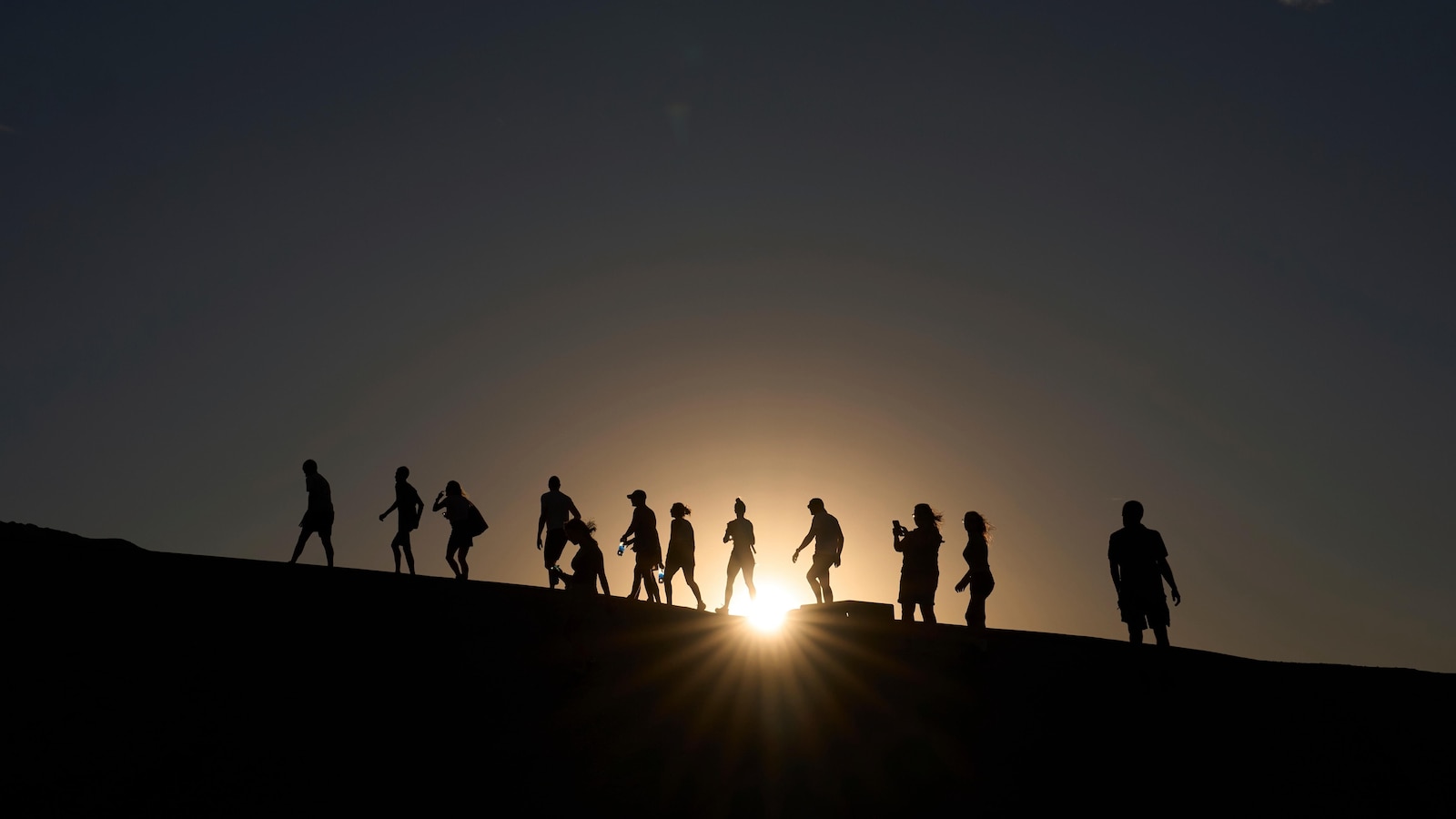
DEATH VALLEY NATIONAL PARK, Calif. — Ray Estrada’s 11-year-old grandson is used to Las Vegas’ scorching summers, but he’d always wanted to experience the heat in one of the Earth’s hottest places. So Estrada recently drove him to Death Valley National Park, with an umbrella, extra water and electrolytes in tow. That day, the thermometer soared to 118 F (47.78 C).

“We have to be very careful when we go out there,” Estrada told him. “If you start feeling dizzy or whatever… we’re just gonna turn back and be safe so we can do this again another time.”

The extreme temperatures in this stretch of California desert attract visitors every year, some determined to finish a grueling, multiday race, others just curious about the sizzling heat and the landscape’s vast beauty. Yet despite the warnings, the heat kills one to three people annually, and park rangers respond to overheated visitors multiple times per week, making communication about heat safety a priority for the National Park Service.

But that’s easier said than done.

“It’s very easy to underestimate how dangerous heat is,” said Abby Wines, the park’s acting deputy superintendent. “People are usually used to thinking of heat as something that makes them uncomfortable,” and that they can tough it out.

“This type of heat will kill,” she said.

Death Valley holds the record for the hottest temperature ever officially recorded — 134 F (56.67 C) in July 1913 — although some experts have disputed it and say the real record was 130 F (54.4 C) there in July 2021.

In the U.S., heat kills more people than other weather events combined, according to the National Oceanic and Atmospheric Administration. If planet-warming greenhouse gas emissions, which come from burning fuels like oil and coal, continue at their current pace, more places could experience broiling temperatures. That makes it crucial to communicate the dangers of extreme heat and safety precautions, as both can influence who lives and dies.

Throughout this desert are stark warnings of the deadly heat: “Stop. Extreme heat danger. Walking after 10 a.m. not recommended,” one sign says. “HEAT KILLS!” warns another. On bathroom walls there are reminders to hydrate in the form of charts displaying the color of pee — the darker the urine, the more you need to drink water.

Another sign warns visitors that helicopters for medical emergencies can’t safely fly amid extreme temperatures. Ambulances can often deploy in extreme heat but are not a guarantee. The safety of emergency responders is always considered.

Baruch Fischhoff, professor at Carnegie Mellon University who studies decision-making, said evidence shows that people generally underestimate risk when they have a sense of control. Information that explicitly says rescue might not be an option if it’s too hot “takes away that sense of the control that can lead to underestimating risk.”

Failing to recognize those risks can be deadly. Last summer, a helicopter was unable to fly to a rescue because of 128 F (53.33 C) temperatures. A group of visitors were traveling on motorcycles when one died from the heat, and another was treated for severe heat illness and transported to a hospital.

Rescue options are even more limited for hikers lost on a trail. Unless it’s a short distance and rescuers know where the person is, they’ll likely wait until sunset if it’s above 115 F (46.11 C). “Depending on their situation,” Wines said, that’s “probably too late.”

Two of the park’s busiest months are in the summer, and it sees a small bump in visitors when temperatures are expected to hit the high 120s or 130s F (48.89s to 54.44s C). But it’s the moderate temperatures that tend to get people into more trouble.

“We actually have a harder time communicating our concerns about heat to the public when they visit and it’s only 100 to 115,” Wines said. The dryness evaporates sweat almost instantly, so many people don’t realize how much they’re actually sweating.

Then there’s the vastness. Death Valley has more than 50 entrances, so many visitors aren’t seeing rangers who can relay important information. Instead, they place heat warning signs in the hottest and most popular spots. But they discovered that people responded less to heat warning signs that looked permanent compared to those that seemed temporary.

For Marc Green, an expert in experimental psychology, that finding is “100% predictable.”

“People judge what to do based on specific information,” he said. If a warning sign is up all the time, even when conditions are good, it contains no useful information. “That’s why people disregard it.”

Jennifer Marlon, senior research scientist at the Yale School of the Environment, has studied public perceptions of the health risks of extreme heat across the U.S. How people perceive heat and other climate risks varies by factors like age, race, gender, income level and where they live. Older white men, for instance, tend to have lower risk perceptions across the board, whereas women have higher risk perceptions than men.

“The challenge, though, is that the level of worry or risk perception doesn’t necessarily translate into action,” Marlon said. Optimism bias could also falsely make a person believe the heat won’t personally affect them. While studies show that experience with heat increases people’s concern, it is short-lived.

“You get a bump for like a year or so after a really big event and then it just goes right back to the baseline,” she said.

Marlon said to be specific. Don’t just tell people that heat can be lethal, tell them what could happen to their bodies and what to do to stay safe.

Death Valley park does this. On site and online, park officials tell visitors to avoid hiking at low elevations after 10 a.m., to stay on paved roads and near their cars. They say to drink and carry plenty of water, and to seek shade and hydrate if you feel dizzy, nauseous or have a headache.

And while this isn’t something the park would initiate, if scientists gave names to heat waves, similar to how hurricanes are named, that could better grab people’s attention because human brains are attuned to novelty, Marlon said.

The messenger is also important. If friends, family and neighbors are worried and nudging you to do something, that can be more powerful than reading information online. Community leaders modeling appropriate behavior — like saying they’re evacuating their family ahead of a hurricane or that they carry extra water in their trunk — can also go a long way.

Marlon also suggested communicating how extreme heat can impair the ability to think clearly. When communicating with images, show people drinking water, putting on cold wet towels or resting in shade.

“Whatever the recommended behavior is, show them pictures of that behavior because we’re incredibly and fundamentally social animals, and body language is so much of how we communicate,” Marlon said.

———

Associated Press photographer John Locher contributed to this report from Death Valley National Park.

———

The Associated Press receives support from the Walton Family Foundation for coverage of water and environmental policy. The AP is solely responsible for all content. For all of AP’s environmental coverage, visit https://apnews.com/hub/climate-and-environment.


Source link

Air Canada cancels hundreds of flights as potential strike by flight attendants looms

0
Air Canada cancels hundreds of flights as potential strike by flight attendants looms

TORONTO — More than 300 Air Canada flights, many of them international trips, have been canceled as the clock ticked closer Friday to a possible strike by flight attendants, leaving travelers stranded around the world and scrambling during the peak summer travel season.

The bitter contract fight between Canada’s largest airline and the union representing 10,000 of its flight attendants escalated Friday as the union turned down the airline’s request to enter into government-directed arbitration, which would eliminate its right to strike and allow a third-party mediator to decide the terms of a new contract.

Flight attendants were poised to walk off the job around 1 a.m. EDT on Saturday. Around the same time, Air Canada said it would begin locking out the flight attendants from airports. The actions threaten to impact about 130,000 travelers a day.

Federal Jobs Minister Patty Hajdu on Friday urged both sides to work with federal mediators “and get a deal done.”

“Time is precious and Canadians are counting on you,” Hajdu said in a statement.

The Canadian carrier already started canceling flights Thursday. It expects to call off 500 flights by the end of Friday and almost all of its flights by Saturday morning. A complete shutdown threatens to impact about 130,000 people a day, and it could affect some 25,000 Canadians a day who may become stranded abroad.

By Friday afternoon, Air Canada had called off at least 128 domestic flights and 194 international flights that were scheduled to depart on Friday and Saturday, according to aviation analytics firm Cirium. On Thursday, when the airline said it was beginning it’s “phased wind down” of most operations, 18 domestic flights and four international flights were canceled.

Montreal resident Alex Laroche, 21, and his girlfriend had been saving since Christmas for their European vacation. Now their $8,000 trip with nonrefundable lodging is on the line as they wait to hear from Air Canada about the fate of their Saturday night flight to Nice, France.

Laroche said he considered booking new flights with a different carrier, but he said most of them are nearly full and more than double the $3,000 they paid for their original tickets.

“At this point, it’s just a waiting game,” he said.

Laroche said he was initially upset over the union’s decision to go on strike, but that he had a change of heart after reading about the key issues at the center of the contract negotiations, including the issue of wages.

“Their wage is barely livable,” Laroche said.

Air Canada and the Canadian Union of Public Employees have been in contract talks for about eight months, but they have yet to reach a tentative deal.

Both sides say they remain far apart on the issue of pay and the unpaid work flight attendants do when planes aren’t in the air.

The airline’s latest offer included a 38% increase in total compensation, including benefits and pensions over four years, that it said “would have made our flight attendants the best compensated in Canada.” But the union pushed back, saying the proposed 8% raise in the first year didn’t go far enough because of inflation.

Passengers whose travel is impacted will be eligible to request a full refund on the airline’s website or mobile app, according to Air Canada.

The airline said it would also offer alternative travel options through other Canadian and foreign airlines when possible. But it warned that it could not guarantee immediate rebooking because flights on other airlines are already full “due to the summer travel peak.”

How long the airline’s planes will be grounded remains to be seen. But Air Canada Chief Operating Officer Mark Nasr has said it could take up to a week to fully restart operations once a tentative deal is reached.

___

Associated Press airlines writer Rio Yamat reported from Las Vegas.


Source link

Three years after his death, cricketer Shane Warne’s legacy lives on with heart health checks

0
Three years after his death, cricketer Shane Warne’s legacy lives on with heart health checks

BRISBANE, Australia — Cricketer Shane Warne’s legacy lives on more than three years after the death of the great spin bowler from a heart attack at the age of 52.

Warne died in March 2022 after suffering cardiac arrest while on holiday on the Thai island of Koh Samui.

The cause of his sudden death led his business team and family to unite to honor his life and create Shane Warne Legacy. The charity set up free heart health checkup machines at the Melbourne Cricket Ground during the past two Boxing Day tests.

The results of the stadium checks along with 311 community pharmacy stations across Australia were analyzed as part of a Monash University-led study. A total of 76,085 people were screened across seven weeks from mid-December 2023 to the end of January 2024, including 7,740 at the MCG.

The research published in the Journal of the American College of Cardiology on Friday showed almost seven out of 10 (68.9%) had at least one uncontrolled risk factor for heart disease. Factors were elevated blood pressure readings (37.2%), elevated body mass index (60.5%) and being a smoker (12.1%).

Cricket spectators who did the free checks, mostly men aged 35 to 64, had higher rates of elevated blood pressure and body mass index than those screened at pharmacies.

Warne revived and elevated the art of leg-spin bowling when he emerged on the international scene in the 1990s and was a central character in one of Australia’s most successful eras in the sport. He also was one of cricket’s larger-than-life showmen.

Warne held the record for the most test wickets with 708 when he retired in 2007 after his 145th match. Only Sri Lanka off-spinner Muttiah Muralitharan has passed him, with 800.

“Meeting people where they are, whether that’s at their local pharmacy or the MCG, can make all the difference to health outcomes,” said Dr. Sean Tan, a cardiologist and researcher at the Victorian Heart Institute.

Warne’s long-time personal assistant Helen Nolan said the findings reinforced Shane Warne Legacy’s mission to turn his death into a catalyst for change. The charity’s chief executive described the results as “bittersweet.”

“We’re proud to have helped thousands take their heart health seriously but we know there’s still work to do,” Nolan said. “Shane would have wanted this to make a massive difference.”

___

AP cricket: https://apnews.com/hub/cricket


Source link

Hurricane Erin tracker: Latest path, maps for first hurricane of Atlantic season

0
Hurricane Erin tracker: Latest path, maps for first hurricane of Atlantic season

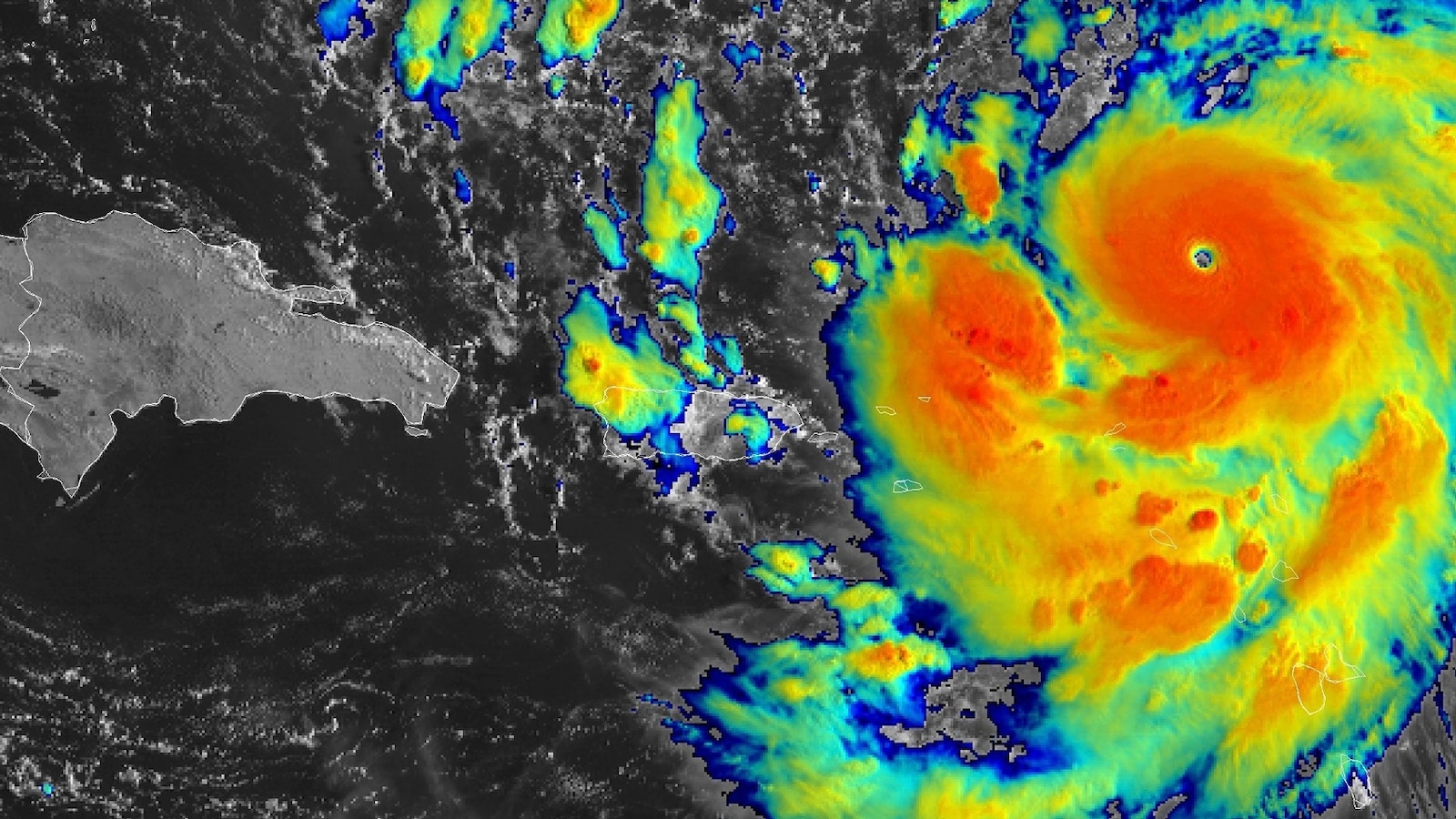
Erin has become the first hurricane of the Atlantic season, with several areas already on alert for heavy rain while strong waves and rip currents are possible along the East Coast of the United States as early as next week.

As of Saturday morning, Hurricane Erin had strengthened into a Category 4 storm with maximum sustained winds of up to 130 mph, the National Hurricane Center said.

Tropical storm watches are in place for the Northern Leeward Islands of St. Martin, St. Barts, Anguilla and Barbuda, with breezy and rainy conditions possible in these areas for the next 48 hours.

Erin is expected to pass near or north of the Leeward Islands on Saturday and could bring up to 6 inches of rain on Friday and Saturday.

Erin is the first hurricane of the 2025 Atlantic hurricane season.

ABC News

This weekend, Erin will move north of Puerto Rico and could potentially become even stronger by Sunday morning. The outer bands of this storm could bring 2 to 4 inches of rain to Puerto Rico and the U.S. Virgin Islands on Saturday and Sunday, which could lead to isolated flash flooding, potential mudslides and gusty winds of 40 to 50 mph.

PHOTO: Spaghetti models TS Erin map

Erin could grow further into a Category 4 with gusts reaching 140 mph.

Moving to next week, Erin will continue to move northwest, staying east of the Bahamas.

The majority of meteorological modeling continues to keep Erin well off the East Coast of the U.S. by hundreds of miles, but large waves and life-threatening rip currents are still expected to reach the coast from Aug. 20 to Aug. 27.

PHOTO: Erin the fifth named storm map

This would not only be dangerous for anyone entering the waters, but also for property along the coast, as erosion — especially along North Carolina’s Outer Banks — could be a serious threat. The Outer Banks and other parts of North Carolina could see waves of 8 to 12 feet, with other areas of South Carolina and Virginia possibly seeing waves reaching 6 feet next week.

Despite the threat of strong waves along the East Coast, a cold front pushing off of America’s coast is expected to keep Erin out to sea and will also bring below-average temperatures to the Northeast next week.

PHOTO: TS Erin wave heights map

The National Hurricane Center predicted an above-normal hurricane season for the Atlantic.

August, September and October are the most active months of the Atlantic hurricane season, which ends on Nov. 30.


Source link

Air Canada suspends all operations as flight attendants go on strike after no deal reached

0
Air Canada suspends all operations as flight attendants go on strike after no deal reached

Air Canada suspended all operations as more than 10,000 of the airline’s flight attendants went on strike early Saturday after a deadline to reach a deal passed.

Canadian Union of Public Employees spokesman Hugh Pouliot confirmed the strike had started after no deal was reached, and the airline said shortly after that it would halt operations.

“We are now officially on strike! Picket lines will be active at all bases,” the union said in a statement.

It is the first strike by flight attendants since 1985.

A bitter contract fight between Canada’s largest airline and the union representing 10,000 of its flight attendants escalated Friday as the union turned down the airline’s request to enter into government-directed arbitration, which would eliminate its right to strike and allow a third-party mediator to decide the terms of a new contract.

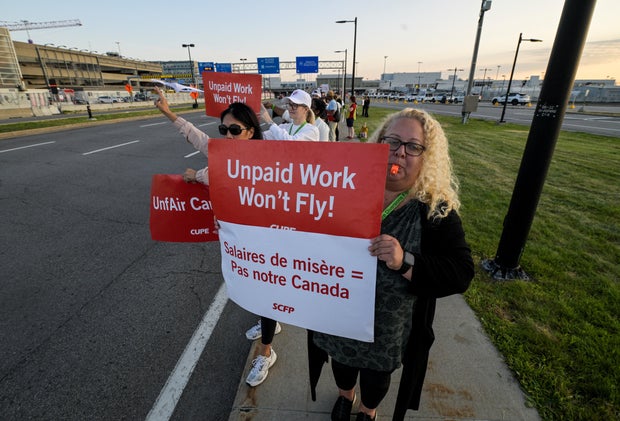
Air Canada union engages in strike activity, in Dorval

People hold placards as a strike begins after the union representing Air Canada’s 10,000 flight attendants failed to reach an agreement with the airline.

Peter McCabe / REUTERS


Flight attendants walked off the job around 1 a.m. EDT on Saturday. Around the same time, Air Canada said it would begin locking flight attendants out of airports.

Federal Jobs Minister Patty Hajdu met with both the airline and union on Friday night and urged them to work harder to reach a deal “once and for all.”

“It is unacceptable that such little progress has been made. Canadians are counting on both parties to put forward their best efforts,” Hajdu said in a statement posted on social media.

Pouliot, the spokesman for the union, earlier said the union had a meeting with Hajdu and representatives from Air Canada earlier Friday evening.

“CUPE has engaged with the mediator to relay our willingness to continue bargaining — despite the fact that Air Canada has not countered our last two offers since Tuesday,” he said in an email. “We’re here to bargain a deal, not to go on strike.”

Air Canada union engages in strike activity, in Dorval

People hold placards as a strike begins after the union representing Air Canada’s 10,000 flight attendants failed to reach an agreement with the airline.

Peter McCabe / REUTERS


A complete shutdown will affect approximately 130,000 people daily, and around 25,000 Canadians will be stranded abroad each day. Air Canada operates around 700 flights per day.

The airline said it would also offer alternative travel options through other Canadian and foreign airlines when possible. But it warned that it could not guarantee immediate rebooking because flights on other airlines are already full “due to the summer travel peak.”

“Air Canada is strongly advising affected customers not to go to the airport unless they have a confirmed ticket on an airline other than Air Canada or Air Canada Rouge,” the airline said in a statement. “Air Canada deeply regrets the effect the strike is having on customers.”

CORRECTION / CANADA-AVIATION-LABOUR

Two Air Canada planes are seen on the tarmac of the Pierre-Elliott Trudeau Airport in Montreal, Quebec, Canada.

ANDREJ IVANOV/AFP via Getty Images


In anticipation of the strike, the airline began cancelling flights on Thursday and Friday as flight attendants did not report to work.

How long the airline’s planes will be grounded remains to be seen, but Air Canada Chief Operating Officer Mark Nasr has said it could take up to a week to restart operations once a tentative deal is reached fully.

CORRECTION / CANADA-AVIATION-LABOUR

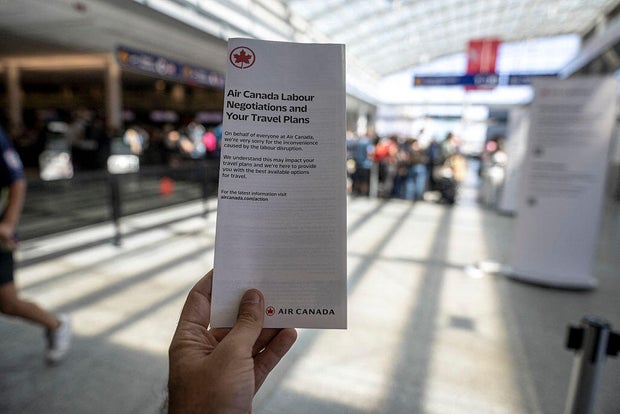
A pamphlet is given out to passengers as they wait in line to speak to Air Canada representatives to see if they can reschedule flights at the Pierre-Elliott Trudeau Airport in Montreal, Quebec, Canada, on August 15, 2025.

ANDREJ IVANOV/AFP via Getty Images


Passengers whose travel is impacted will be eligible to request a full refund on the airline’s website or mobile app, according to Air Canada.

Air Canada and the Canadian Union of Public Employees have been in contract talks for about eight months, but they have yet to reach a tentative deal.

Both sides say they remain far apart on the issue of pay and the unpaid work flight attendants do when planes aren’t in the air.

The airline’s latest offer included a 38% increase in total compensation, including benefits and pensions over four years, that it said “would have made our flight attendants the best compensated in Canada.”

But the union pushed back, saying the proposed 8% raise in the first year didn’t go far enough because of inflation.


Source link

How AI doctors are flooding the internet with false health advice

0
How AI doctors are flooding the internet with false health advice


How AI doctors are flooding the internet with false health advice – CBS News


Watch CBS News


Dr. Celine Gounder joins “CBS Mornings Plus” to discuss how AI-generated deepfakes are impersonating doctors and spreading misinformation online.


Source link

Trump says he will meet with Zelenskyy after “very successful day” with Putin

0
Trump says he will meet with Zelenskyy after “very successful day” with Putin

Trump, Putin speeches key takeaways


Trump, Putin speeches did not announce a ceasefire in Ukraine

16:35

President Donald Trump said he will meet with Ukranian president Volodymyr Zelenskyy at the White House on Monday afternoon to discuss an agreement “which would end the war” between Russia and Ukraine

The Truth Social post came about half a day after Mr. Trump met with Russian president Vladimir Putin in Alaska. Mr. Trump said the meeting with Putin “went very well.” He also said the meeting was followed by a “late night phone call” with Zelenskyy and other European leaders, including Mark Rutte, the secretary general of NATO

“It was determined by all that the best way to end the horrific war between Russia and Ukraine is to go directly to a Peace Agreement, which would end the war, and not a mere Ceasefire Agreement, which often times do not hold up,” Mr. Trump said. 

Mr. Trump did not share any details of the agreement. He said Zelenskyy would join him in the Oval Office on Monday afternoon to discuss the proposal. 

“If it all works out, we will then schedule a meeting with President Putin,” Mr. Trump said. “Potentially, millions of people’s lives will be saved.” 

This is a developing news story and will be updated. 


Source link

8/15: CBS Evening News – CBS News

0
8/15: CBS Evening News – CBS News


8/15: CBS Evening News – CBS News


Watch CBS News


Everything we know about the high-stakes summit between Trump and Putin; WWII veteran fulfills vow to conduct a band on 100th birthday.


Source link

Angels go quietly in ugly loss to A’s – Orange County Register

0
Angels go quietly in ugly loss to A’s – Orange County Register


WEST SACRAMENTO — The Angels matched the atmosphere with their performance again.

After three straight victories against the Dodgers in an electric, sold-out Angel Stadium, they took a flight north, had an off day and got back in action in a minor league park against the A’s.

The Angels lost, 10-3, to the A’s on Friday night, in a game played before 8,484 fans at the Triple-A park the A’s have borrowed while their new home in Las Vegas is under construction.

“It’s tough,” Angels shortstop Zach Neto said of going to such a different environment. “There’s no excuse for today. We came out flat, but at the end of the day, we’ve got tomorrow, and we’ve got a chance to win the series still.”

Neto provided the Angels’ biggest highlight of the game when he hit his 20th homer, which made him the fourth player in franchise history to have multiple 20/20 seasons. Neto, who has 21 stolen bases, joined Mike Trout, Shohei Ohtani and Don Baylor.

Neto said it was particularly meaningful because he missed the first few weeks of the season rehabbing from shoulder surgery.

“Just coming back all the perseverance and everything I had to overcome, I’m pretty grateful to be able to do it,” Neto said.

His fifth-inning two-run homer, which pulled the Angels within 4-3, was one of their five hits.

On the mound, starter Yusei Kikuchi had a rough game, in terms of effectiveness and efficiency.

Kikuchi gave up four runs in four innings, three of them on a Colby Thomas homer. Kikuchi hung a first-pitch curveball and Thomas blasted it 433 feet. Kikuchi gave up five hits and walked three.

“It just wasn’t a sharp outing for him,” interim manager Ray Montgomery said. “Very unusual start for him, given what we’ve seen all year.”

When Kikuchi wasn’t throwing the ball over the middle of the plate, the A’s were spoiling his better pitches. Kikuchi needed 94 pitches to get 12 outs, an average of 7.8 pitches per out. The major league average is 5.5 pitches per out.

“I think overall they had a really good approach today,” Kikuchi said through his interpreter. “Recently, I’ve gone to two strikes and had trouble putting the hitters away. I think I can work on my sequencing a little bit more.”

The A’s fouled off 37% of his pitches, which is more than double the major league average of 18%.

Inefficiency has been a constant problem for Kikuchi lately. Over his last nine games, Kikuchi has thrown 4.2 pitches per plate appearance. The major league average is 3.9. That has added up quickly, and he’s been able to complete the sixth inning in just one of those games.

Kikuchi said he would talk with pitching coach Barry Enright and catcher Travis d’Arnaud on Saturday about a way to use his pitches differently to be more efficient.

“I think I can use a changeup a little bit more and use my fastball more effectively,” Kikuchi said.

His 3.52 ERA is certainly what the Angels might have expected, but his problems getting deep in games has put a strain on the bullpen.

The Angels were only down by one run when they took Kikuchi out of the game, but then right-hander Connor Brogdon gave back the two runs from Neto’s homer.

Brogdon gave up three hits and a walk among the first six hitters he faced in the fifth. He had the same problem as Kikuchi. The A’s fouled off 28% of his pitches.

Right-hander Carson Fulmer finished the fifth, allowing a run to score on an infield hit, and then saved the bullpen by soaking up the final 3⅓ innings of the game. He gave up four runs in the eighth inning.

One of the positives for the Angels was center fielder Bryce Teodosio continuing to show off his range.

Teodosio made a spectacular catch in the right-center field gap in the third inning. Teodosio also went into right field to catch what would have been a routine fly ball for right fielder Jo Adell. Teodosio fell just after making the catch, so Nick Kurtz easily scored from third on the play. Adell would have had a better chance to throw out Kurtz, or perhaps even hold him at third.


Source link

Angels go quietly in ugly loss to A’s – Press Enterprise

0
Angels go quietly in ugly loss to A’s – Press Enterprise


WEST SACRAMENTO — The Angels matched the atmosphere with their performance again.

After three straight victories against the Dodgers in an electric, sold-out Angel Stadium, they took a flight north, had an off day and got back in action in a minor league park against the A’s.

The Angels lost, 10-3, to the A’s on Friday night, in a game played before 8,484 fans at the Triple-A park the A’s have borrowed while their new home in Las Vegas is under construction.

The highlight for the Angels was Zach Neto’s 20th homer, which made him the fourth player in franchise history to have multiple 20/20 seasons. Neto, who has 21 stolen bases, joined Mike Trout, Shohei Ohtani and Don Baylor.

His fifth-inning two-run homer, which pulled the Angels within 4-3, was one of their five hits.

On the mound, starter Yusei Kikuchi had a rough game, in terms of effectiveness and efficiency.

Kikuchi gave up four runs in four innings, three of them on a Colby Thomas homer. Kikuchi hung a first-pitch curveball and Thomas blasted it 433 feet. Kikuchi gave up five hits and he walked three.

When Kikuchi wasn’t throwing the ball over the middle of the plate, the A’s were spoiling his better pitches.

Kikuchi needed 94 pitches to get 12 outs, an average of 7.8 pitches per out. The major league average is 5.5 pitches per out.

The A’s fouled off 37% of his pitches, which is more than double the major league average of 18%.

Inefficiency has been a constant problem for Kikuchi lately. Over his last nine games, Kikuchi has thrown 4.2 pitches per plate appearance. The major league average is 3.9. That has added up quickly, and he’s been able to complete the sixth inning in just one of those games.

His 3.52 ERA is certainly what the Angels might have expected, but his problems getting deep in games has put a strain on the bullpen.

The Angels were only down by one run when they took Kikuchi out of the game, but then right-hander Connor Brogdon gave back the two runs from Neto’s homer.

Brogdon gave up three hits and a walk among the first six hitters he faced in the fifth. He had the same problem as Kikuchi. The A’s fouled off 28% of his pitches.

Right-hander Carson Fulmer finished the fifth, allowing a run to score on an infield hit, and then saved the bullpen by soaking up the final 3⅓ innings of the game. He gave up four runs in the eighth inning.

One of the positives for the Angels was center fielder Bryce Teodosio continuing to show off his range.

Teodosio made a spectacular catch in the right-center field gap in the third inning. Teodosio also went into right field to catch what would have been a routine fly ball for right fielder Jo Adell. Teodosio fell just after making the catch, so Nick Kurtz easily scored from third on the play. Adell would have had a better chance to throw out Kurtz, or perhaps even hold him at third.

More to come on this story.


Source link

How Democrats plan to reshape California’s congressional delegation and thwart Trump

0
How Democrats plan to reshape California’s congressional delegation and thwart Trump

A decade and a half after California voters stripped lawmakers of the ability to draw the boundaries of congressional districts, Gov. Gavin Newsom and fellow Democrats are pushing to take that partisan power back.

The redistricting plan taking shape in Sacramento and headed toward voters in November could shift the Golden State’s political landscape for at least six years, if not longer. The outcome could also sway which party controls the U.S. House of Representatives after the 2026 midterm elections, which will be pivotal to the fate of President Trump’s political agenda.

What Golden State voters choose to do will reverberate nationwide, killing some political careers and launching others, provoking other states to reconfigure their own congressional districts and boosting Newsom’s profile as a top Trump nemesis and leader of the nation’s Democratic resistance.

The new maps, drawn by Democratic strategists and lawmakers behind closed doors, were submitted Friday to legislative leaders by the Democratic Congressional Campaign Committee, the group that works to elect House Democrats.

The maps are expected to appear on a Nov. 4 special election ballot, along with a constitutional amendment that would override the state’s voter-approved, independent redistricting commission.

The changes would ripple across more than 1,000 miles of California, from the forests near the Oregon state line through the deserts of Death Valley and Palm Springs to the U.S.-Mexico border, expanding Democrats’ grip on California and further isolating Republicans.

The proposed map would concentrate Republican voters in a handful of deep-red districts and eliminate an Inland Empire congressional seat represented by the longest-serving member of California’s GOP delegation. For Democrats, the plans would boost the fortunes of up-and-coming politicians and shore up vulnerable incumbents, including two new lawmakers who won election by fewer than 1,000 votes last fall.

Under the proposal, Democrats could pick up five seats currently held by Republicans while bolstering vulnerable Democratic incumbent Reps. Adam Gray, Josh Harder, George Whitesides, Derek Tran and Dave Min, which would save the party millions of dollars in costly reelection fights.

In a letter to the state Legislature, Democratic Congressional Campaign Committee director Julie Merz said the map “serves the best interest of California voters, while also attempting to push back against the corrupt scheme occurring in Texas and other Republican-majority states.”

The National Republican Congressional Committee, the group that works to elect House Republicans, said they are “prepared to fight this illegal power grab in the courts and at the ballot box to stop Newsom in his tracks.”

“This is the final declaration of political war between California and the Trump administration,” said Thad Kousser, a political science professor at UC San Diego.

How will the ballot measure work?

For the state to reverse the independent redistricting process that the electorate approved in 2010, a majority of California voters would have to approve the measure, which backers are calling the “Election Rigging Response Act.”

The state Legislature, where Democrats hold a supermajority in both the Assembly and Senate, will consider the ballot language next week when lawmakers return from summer recess. Both chambers would need to pass the ballot language by a two-thirds majority and get the bill to Newsom’s desk by Aug. 22, leaving just enough time for voter guides to be mailed and ballots to be printed.

Approving the new map would be up to the state’s electorate, which backed independent redistricting in 2010 by more than 61%. Registered Democrats outnumber Republican voters by almost a two-to-one margin in California.

Newsom has said that the measure would include a “trigger,” meaning the state’s maps would only take effect if a Republican state — such as Texas, Florida or Indiana — approve new mid-decade maps.

“There’s still an exit ramp,” Newsom said. “We’re hopeful they don’t move forward.”

Explaining the esoteric concept of redistricting and getting voters to participate in an off-year election will require that Newsom and his allies, including organized labor, launch what is expected to be an expensive campaign very quickly.

“It’s summer in California,” Kousser said. “People are not focused on this.”

California has no limit on campaign contributions for ballot measures, and a measure that pits Democrats against Trump, and Republicans against Newsom, could become a high-stakes, high-cost national brawl.

“It’s tens of millions of dollars, and it’s going to be determined on the basis of what an opposition looks like as well,” Newsom said Thursday. The fundraising effort, he said, is “not insignificant… considering the 90-day sprint.”

The ballot measure’s campaign website mentions three major funding sources thus far: Newsom’s gubernatorial campaign, the main political action committee for House Democrats in Washington, and Manhattan Beach businessman Bill Bloomfield, a longtime donor to California Democrats.

The opposition is also expected to be well-funded. A representative of a coalition fighting the effort said that Charles Munger Jr., who bankrolled the 2010 ballot measure that created the independent commission, is committed to defending the electoral reform.

What’s at stake?

Control of the U.S. House of Representatives hangs in the balance.

The party that holds the White House tends to lose House seats during the midterm election. Republicans hold a razor-thin majority in the House, and Democrats taking control of chamber in 2026 would stymie Trump’s controversial, right-wing agenda in his final two years in office.

Redistricting typically only happens once a decade, after the U.S. Census. But Trump has been prodding Republican states, starting with Texas, to redraw their lines in the middle of the decade to boost the GOP’s chances in the midterms.

At Trump’s encouragement, Texas Gov. Greg Abbott called a special legislative session to redraw the Texas congressional map to favor five more Republicans. In response, Newsom and other California Democrats have called for their own maps that would favor five more Democrats.

Texas Democratic lawmakers fled the state to deny the legislature a quorum and stop the vote. They faced daily fines, death threats and calls to be removed from office. They agreed to return to Austin after the special session ended on Friday, with one condition being that California Democrats moved forward with their redistricting plan.

The situation has the potential to spiral into an all-out redistricting arms race, with Trump leaning on Indiana, Florida, Ohio and Missouri to redraw their maps, while Newsom is asking the same of blue states including New York and Illinois.

California Republicans in the crosshairs

The California gerrymandering plan targets five of California’s nine Republican members of Congress: Reps. Kevin Kiley and Doug LaMalfa in Northern California, Rep. David Valadao in the Central Valley, and Reps. Ken Calvert and Darrell Issa in Southern California.

The map consolidates Republican voters into a smaller number of ruby-red districts known as “vote sinks.” Some conservative and rural areas would be shifted into districts where Republican voters would be diluted by high voter registration advantage for Democrats.

The biggest change would be for Calvert, who would see his Inland Empire district eliminated.

Calvert has been in Congress since 1992 and represents a sprawling Riverside County district that includes Lake Elsinore, Menifee, Palm Springs and his home base of Corona. Calvert, who oversees defense spending on the powerful House Appropriations Committee, comfortably won reelection last year despite a well-funded national campaign by Democrats.

Under the proposed map, the Inland Empire district would be carved up and redistributed, parceled out to a district represented by Rep. Young Kim (R-Anaheim Hills). Liberal Palm Springs would be shifted into the district represented by Rep. Darrell Issa (R-Bonsall), which would help tilt the district from Republican to a narrowly divided swing seat.

Members of Congress are not required to live in their districts, but there would not be an obvious seat for Calvert to run for, unless he ran against Kim or Issa.

Leaked screenshots of the map began to circulate Friday afternoon, prompting fierce and immediate pushback from California Republicans. The lines are “third-world dictator stuff,” Orange County GOP chair Will O’Neill said on X, and the “slicing and dicing of Orange County cities is obscene.”

In Northern California, the boundaries of Kiley’s district would shrink and dogleg into the Sacramento suburbs to add registered Democrats. Kiley said in a post on X that he expected his district to stay the same because voters would “defeat Newsom’s sham initiative and vindicate the will of California voters.”

LaMalfa’s district would shift south, away from the rural and conservative areas along the Oregon border, and pick up more liberal areas in parts of Sonoma County. Democrat Audrey Denney, who lost to LaMalfa in 2018 and 2020, said Friday that if voters approve the new map, she would run again.

In Central California, boundaries would shift to shore up Harder and Gray, who won election last year by 187 votes, the narrowest margin in the country.

Valadao, a perennial target for Democrats, would see the northern boundary of his district stretch into the bluer suburbs of Fresno. Democrats have tried for years to unseat Valadao, who represents a district that has a strong Democratic voter registration advantage on paper, but where turnout among blue voters is lackluster.

Democrats eye open seats

Eight of the state’s 52 congressional districts would be left unchanged under the new map, including the three historic Black districts in Los Angeles and Oakland. Three districts with the highest number of Asian American voters would be preserved, while a Latino lawmaker would likely be elected from a new Los Angeles-area seat.

That new congressional seat in Los Angeles County that would stretch through the southeast cities of Downey, Santa Fe Springs, Whittier and Lakewood. An open seat in Congress is a rare opportunity for politicians, especially in deep-blue Los Angeles County, where incumbent lawmakers can keep their jobs for decades.

Portions of that district were once represented by retired U.S. Rep. Lucille Roybal-Allard, the first Mexican American woman elected to Congress. That seat was eliminated in the 2021 redistricting cycle, when California lost a congressional seat for the first time in its history.

Los Angeles County Supervisor Hilda Solis has told members of the California Congressional delegation that she is thinking about running for the new seat.

Another possible contender, former Assembly speaker Anthony Rendon of Lakewood, launched a campaign for state superintendent of schools in late July and said he is not interested in vying to represent the new district.

Other lawmakers who represent the area or areas nearby include State Sen. Blanca Rubio (D-Baldwin Park), state Sen. Bob Archuleta (D-Pico Rivera) and state Assemblywoman Lisa Calderon (D-Whittier).

In Northern California, the southern tip of LaMalfa’s district would stretch south into the Sonoma County cities of Santa Rosa and Healdsberg, home to Senate Pro Tem Mike McGuire. McGuire will be termed out of the state Senate next year, and the new seat might present a prime opportunity for him to go to Washington.

Times staff writer Taryn Luna in Sacramento contributed to this report.


Source link

‘Real-life nightmare for kids.’ ‘Roblox’ faces multiple lawsuits over child safety

0
‘Real-life nightmare for kids.’ ‘Roblox’ faces multiple lawsuits over child safety

“Roblox” faced a wave of new lawsuits this week that allege the popular gaming platform hasn’t done enough to safeguard kids from pedophiles and sexual content.

One of the latest complaints, filed in a federal court in the Northern District of California, claims that a predator posed as a child on the platform and sexually exploited a 10-year-old in Michigan. The man, who isn’t named in the lawsuit, allegedly convinced the victim to send sexually explicit images of herself after sharing some of himself.

The 10-year-old, who is anonymous in the lawsuit, met the predator last year on “Roblox” and suffered from mental health issues including anxiety, according to the complaint filed Thursday.

“What Roblox represents as a safe, appropriate space for children is, in fact, a digital and real-life nightmare for kids,” the lawsuit, filed by Dolman Law Group, stated.

Kids and teens create, explore and socialize in virtual spaces on “Roblox,” but the gaming platform has continued to grapple with child safety concerns over as its user numbers and revenue grow. On average, 111.8 million users visit the platform daily.

The San Mateo-based company’s share price closed down more than 6% at $117.34 on Friday.

“The assertion that Roblox would intentionally put our users at risk of exploitation is categorically untrue,” Roblox spokesperson Kadia Koroma said in a statement. “While no system is perfect, Roblox has implemented rigorous safeguards—such as restrictions on sharing personal information, links, and user-to-user image sharing—to help protect our community. Unfortunately, bad actors will try to circumvent our systems to try to direct users off the platform, where safety standards and moderation practices may differ.”

In early August, the company said it’s using artificial intelligence to help detect “child endangerment communications” earlier and alert law enforcement. Later on Friday, Roblox outlined other steps it’s taking, including restricting certain virtual experiences in spaces such as bedrooms to verified users and those at least 17 years old. The company also said it is testing a way for some users to verify their age by providing a government-issued photo ID.

The lawsuit is among a flurry of new complaints this year that accuse the gaming platform of prioritizing its profits over the safety of its users.

On Thursday, Louisiana Atty. Gen. Liz Murrill filed a lawsuit against Roblox over child safety concerns.

“Roblox” is also under political pressure. Rep. Ro Khanna, a California Democrat, has been urging people on social media to sign a petition asking the company to do more to protect children on the platform.

Since July, Dolman Law Group has filed five lawsuits against “Roblox” in courts in California, Georgia and Texas. Matthew Dolman, a Florida lawyer who is a managing partner at the law firm, said a sixth lawsuit is being filed on Friday.

The lawsuits point to several steps “Roblox” could have taken to make the platform safer, such as verifying ages through facial recognition, clearly warning parents about sexual predators and putting a higher age rating for its app.

“This is just the wild west,” Dolman said in an interview. “It’s like a hunting ground for predators.”

The company, he said, misrepresents how safe the platform is to both its users and shareholders.

“Roblox” profits from transaction fees when predators offer children Robux, a digital currency used on the gaming platform, in exchange for sexually explicit photos, according to the federal lawsuit filed on Thursday.

Predators will also tell children they won’t release these photos if they hand over Robux, the lawsuit alleges.

The complaint cites a Hindenburg Research report published last year that stated there were inappropriate games on “Roblox” that researchers were able to access by registering as a child.

Some of those experiences were modeled after criminal conduct by child sex offender Jeffrey Epstein.

“Roblox” rebutted claims made in the report and said it invested heavily in its trust and safety efforts, noting that it has rules against child exploitation on its platform.

The risk of sextortion, especially among young people, is a growing problem, child advocates say. Roughly 1 in 5 teenagers experienced sextortion, according to a report from Thorn, a child safety nonprofit.

Sextortionists have used a variety of platforms, including social media and gaming platforms such as “Roblox,” “Minecraft” and “Fortnite,” to threaten victims.


Source link

Dodgers lose Max Muncy to rib injury again – Press Enterprise

0
Dodgers lose Max Muncy to rib injury again – Press Enterprise


LOS ANGELES — If the Dodgers are going to recover first place in the National League West, they’re going to have to do it without Max Muncy for at least the next few weeks.

Muncy was scratched from Wednesday’s starting lineup against the Angels with pain in his right side. He underwent an MRI on Thursday and was diagnosed with a Grade 1 oblique strain.

Muncy missed three months with a rib injury last season but Dodgers manager Dave Roberts said this appears to be “a little bit more on the mild side.”

Muncy was placed on the injured list on Friday and the Dodgers added utility infielder Buddy Kennedy. Kennedy was designated for assignment by the Toronto Blue Jays earlier this week after playing two games for them. He also played four games for the Philadelphia Phillies this season.

“You kind of take it week to week and see when he can start baseball activities again to get him back,” Roberts said of Muncy. “I don’t think anyone expects it to be season-ending, but hopefully it’s sooner than later.”

Muncy played just eight games after returning from a knee injury before injuring himself while hitting in the batting cage on Wednesday. During his 25-game absence due to the bone bruise in his left knee, the Dodgers’ offense took a tumble. They averaged just 3.5 runs per game while batting .217 as a team and going 10-15.

“It’s certainly a tough loss,” Roberts said. “I think guys just have to continue to perform to their abilities. It’s hard to kind of backfill for Max, what he brings as far as the plate discipline, the slug, the on-base, all that stuff. I feel good about our lineup, the guys that we have. They just have to go out there and take good at-bats. That’s kind of all we can do right now.”

Roberts said Kennedy and Alex Freeland will get most of the playing time at third base in Muncy’s absence. Kennedy has hit .193 in 60 major-league games spread over parts of four seasons with the Arizona Diamondbacks, Detroit Tigers, Phillies and Blue Jays. The switch-hitting Freeland hit .176 in his first 12 games since being promoted from Triple-A while playing third and second.

RELIEVER ROUNDUP

Left-hander Tanner Scott faced hitters for the first time Friday since going on the IL with a forearm strain. He threw 22 pitches to Alex Call, Dalton Rushing and Justin Dean and said everything felt “good.”

“Everything felt good,” Scott said. “That’s probably the biggest thing. Everything has felt good coming out. My mechanics have felt good. I just want to keep rolling with it.”

Scott said he has been pain-free since shortly after receiving a cortisone injection following his July 21 appearance when he felt a “stinging” sensation in his forearm.

Right-hander Kirby Yates could be the first of the Dodgers’ three injured relievers to return. He is scheduled to throw to hitters for the second time this week on Saturday and could go on a minor-league rehabilitation assignment soon after that.

Right-hander Michael Kopech started his rehab assignment with Triple-A Oklahoma City on Thursday and struggled with his command. He gave up two hits, two stolen bases, walked two and threw a wild pitch and was charged with three runs in two-thirds of an inning. He threw 24 pitches, only 10 strikes.

Kopech is on the 60-day IL and not eligible to come back until August 27.

Right-hander Roki Sasaki started his rehab assignment in that same game with OKC. The Dodgers hoped he would pitch three innings but he gave up back-to-back singles to start the third and was pulled from the game after 41 pitches. Sasaki faced 13 batters and gave up six hits (all singles), walked one and didn’t strike out anyone. Most troubling, his fastball velocity was back down to 93-94 after hitting 97 mph during his simulated game at Dodger Stadium last weekend.

“Once he gets back here in town, we’ll figure out when he pitches again,” Roberts said.

As for the diminished velocity from a pitcher who had been known to hit 100 mph, Roberts expressed some concern.

“I wouldn’t say worried, but the expectation is that he gets into the upper 90s,” Roberts said. “But it was his first one, and I want to talk to him personally to kind of get a little bit more background on that. But yeah, it was a little surprising.”

MORE INJURIES

Roberts offered little optimism about the Dodgers’ three injured position players – Tommy Edman, Kiké Hernandez and Hyeseong Kim – being ready to return soon.

Edman (ankle) has just started baseball activities. Kim (shoulder) hit against velocity in the batting cage but still has some discomfort in his shoulder and he “still has to go out on (a rehab) assignment.” Hernandez (elbow) has increased his activity in workouts but is not ready to return.

UP NEXT

Padres (RHP Dylan Cease 5-10, 4.52 ERA) at Dodgers (LHP Blake Snell, 2-1, 2.37 ERA), Saturday, 6:10 p.m., SportsNet LA, 570 AM


Source link

New California congressional districts, proposed by House Democrats – Press Enterprise

0
New California congressional districts, proposed by House Democrats – Press Enterprise


The campaign arm for House Democrats sent the California Legislature proposed new maps for the state’s congressional districts.

The new, partisan maps come on the heels of Gov. Gavin Newsom’s launch of California’s redistricting campaign on Thursday, an effort he touted as meant to favor Democrats in California in the upcoming midterm elections as a counter to similar efforts in Republican-led states elsewhere in the country.

Related: What is redistricting? Your questions about maps, California’s feud with Texas and more, answered

The proposal from the Democratic Congressional Campaign Committee isn’t final. State legislators still need to approve the maps, which would then be decided by voters in a special election in November. And the redistricting effort is only “triggered,” Newsom has said, by similar partisan gerrymandering in red states.

Still, this is an early picture of what changes could be made to California’s congressional districts for the 2026, 2028 and 2030 elections — should that ultimately happen.

Related: Proposed changes to Orange County’s congressional districts emerge

Under this proposal, only four of the state’s 52 congressional districts would include a majority of registered Republican voters. Now, nine districts have more registered Republican voters than Democrats, according to the latest data from the California secretary of state.

“Our proposed map was created using traditional redistricting criteria, consistent with guidelines laid out by the California’s Citizen Redistricting Commission,” Julie Merz, the DCCC’s executive director, said in a letter to California legislators, obtained by the Southern California News Group. “It allows for more compact districts than in the current Commission-drawn map, keeps more communities and neighborhoods together, splits fewer cities and makes minimal disruptions to the Commission-drawn map so as to impact as few residents as possible.”

Meanwhile, a spokesperson for the National Republican Congressional Committee, the campaign operation for House Republicans, blasted the proposal, saying, “Out of touch Washington Democrats just hand-delivered their gerrymandered wishlist to Sacramento. Backroom deals in broad daylight, and they’re bragging about it.”

Take a look at the proposed maps — and more of what the DCCC told the state legislature — below.


Source link

After overseas accident following WWI, Riverside Navy seaman’s remains return home – Press Enterprise

0
After overseas accident following WWI, Riverside Navy seaman’s remains return home – Press Enterprise


Harry G. Robertson was born in July 1900, likely in Los Angeles, as that was where his mother, Elizabeth, was living in spring of that year, when the 1900 census was taken. He had a sister, Margaret, who was 3 years older. His father, James, worked for the railroad, which is probably why he wasn’t listed with the rest of the family in the 1900 census.

At some point the Robertson family moved to northern California, where James and Elizabeth divorced.

Later Elizabeth was referred to as a widow, but that was incorrect. She and her two children moved to Riverside in 1917, where they lived on Penrose Street. A year later, in September 1918, Harry registered for the draft. Harry’s draft card said he was of medium height, slender build, with brown eyes and light brown hair.

Military records available online could not be found for the beginning of Harry’s military career. However, his draft card said he was unemployed at the time he registered. With World War I winding down, Harry joined the Navy perhaps to see some of the world. Harry certainly did get to see the world as he was sent to China via the Philippines, where, as a seaman, he was assigned to the U.S.S. Villalobos to patrol rivers.

On the morning of Sept. 20, 1920, the Villalobos was moored on the Huangpu River at Shanghai, China.

At about 9:20 am, Harry was in a sampan, a flat bottomed wooden boat, with another sailor, cleaning the outside of the Villalobos. Unfortunately, the other sailor slipped and fell into the river. According to a letter sent to his mother by the commander of the Villalobos, Harry helped his ship mate back into the sampan, but the deck of the little wooden boat was slippery and he then fell into the water. Eye witnesses said he wasn’t seen again as the current in the river was very swift. The Riverside Enterprise noted at the time that Harry had been promoted to Seaman 1st Class shortly before his death.

Harry’s body wasn’t found until the following April. He was buried in a Chinese cemetery before his remains were moved to a military cemetery in the Philippines. In April 1921, his remains came home to Riverside, on the transport ship “Thomas,” the very ship he had taken to cross the Pacific at the beginning of his naval career just a few years earlier.


Source link

Arizona, Nevada and Mexico get less Colorado River water for a third year

0
Arizona, Nevada and Mexico get less Colorado River water for a third year

DENVER — Arizona, Nevada and Mexico will again live with less water from the Colorado River as drought lingers in the West, federal officials announced Friday.

The Colorado River is a critical lifeline to seven U.S. states, 30 Native American tribes, and two Mexican states. The cuts are based on projections for levels at federal reservoirs — chief among them Lake Powell and Lake Mead — released every August by the U.S. Bureau of Reclamation.

Arizona will again go without 18% of its total Colorado River allocation, while Mexico loses 5%. The reduction for Nevada — which receives far less water than Arizona, California or Mexico — will stay at 7%. California won’t face any cuts because it has senior water rights and is the last to lose in times of shortage.

Decades of overuse and the effects of long-term drought worsened by climate change means there’s far more demand for water than what actually flows through the river. Low reservoir levels at Lake Mead have triggered mandatory cutbacks every year since 2022, with the deepest cuts in 2023, which hit farmers in Arizona the hardest.

Meanwhile, the states are working to reach agreement by next year on new long-term rules to govern the river in dry years. The Trump administration gave a mid-November deadline for states to reach a preliminary agreement, or risk federal intervention. Negotiations have faced delays as states push back against how much water they should each give up.

The original 1922 Colorado River Compact was calculated based on an amount of water that doesn’t exist in today’s climate. That leaves the Upper Basin states of New Mexico, Colorado, Wyoming and Utah to share far less water after the required amount is sent to the to the “Lower Basin” states of Nevada, Arizona and California. Lots of water is also lost to evaporation and leaky infrastructure.

Fairly splitting the river’s water in the era of climate change has been vexing for years, with all of the major users hesitant to give anything up as they anticipate a drier future. There has to be enough water in the reservoirs to reach the tunnels that usher water downstream, and ideally, even more water for hydropower generation. Key infrastructure like the Hoover Dam rely on certain water levels in Lake Mead to generate electricity.

Mandatory cuts and emergency water releases are “reactive,” said John Berggren, a regional policy manager at Western Resource Advocates, a nonprofit focused on climate change.

“If we are going to be able to have a sustainable Colorado River and not just be responding to crisis after crisis, we need large amounts of flexibility built into this new set of guidelines,” he said.

“We can and must do better. Nature isn’t waiting for us,” said Becky Mitchell, Colorado’s commissioner in the Upper Colorado River Commission.

States are considering a so-called natural flow approach to managing the river — where the Lower Basin would receive a certain percentage of the average natural flow from the prior few years.

The Lower Basin states have helped stave off deeper cuts by coming up with voluntary conservation plans.

“Absent all of those measures, the river would be in a very bad place,” said J.B. Hamby, chairman of the Colorado River Board of California and a board member for the Imperial Irrigation District, the largest user of the river’s water. Still, he knows California, like others, will likely have to give up more in the negotiations.

Dozens of conservation projects along for Upper Basin states and tribes are in limbo. President Donald Trump froze yet-to-be-distributed Inflation Reduction Act funds on his first day in office, which included nearly $400 million for those projects. The entire Colorado congressional delegation signed a letter earlier this month urging the release their portion of those funds.

___

The Associated Press receives support from the Walton Family Foundation for coverage of water and environmental policy. The AP is solely responsible for all content. For all of AP’s environmental coverage, visit https://apnews.com/hub/climate-and-environment


Source link

Wall Street finishes its latest winning week with a fade

0
Wall Street finishes its latest winning week with a fade

NEW YORK — U.S. stocks edged back from their record levels on Friday in a quiet finish to another winning week.

The S&P 500 slipped 0.3% from the all-time high it set the day before, as it closed its fourth winning week in the last five. The Dow Jones Industrial Average flirted with its own record, which was set in December, before ending just below the mark with a rise of 34 points, or 0.1%. The Nasdaq composite dipped 0.4%, though it’s still near its record set on Wednesday.

The U.S. stock market reached all-time highs this past week as expectations built that the Federal Reserve will deliver a cut to interest rates at its next meeting in September. Lower rates can boost investment prices and the economy by making it cheaper for U.S. households and businesses to borrow to buy houses, cars or equipment, but they also risk worsening inflation.

A disappointing report about inflation at the U.S. wholesale level made traders pare back bets for coming cuts to interest rates on Thursday, but they’re still overwhelmingly expecting them. Such anticipation has sent Treasury yields lower in the bond market, though they inched higher Friday following some mixed updates on the economy.

One said shoppers boosted their spending at U.S. retailers last month, as economists expected, while another said that manufacturing in New York state unexpectedly grew. A third said industrial production across the country shrank last month, when economists were looking for modest growth.

Another report suggested sentiment among U.S. consumers is worsening because of worries about inflation, when economists expected to see a slight improvement.

“Overall, consumers are no longer bracing for the worst-case scenario for the economy feared in April,” when President Donald Trump announced his stunning set of worldwide tariffs, according to Joanne Hsu, director of the University of Michigan’s surveys of consumers. “However, consumers continue to expect both inflation and unemployment to deteriorate in the future.”

On Wall Street, UnitedHealth Group jumped 12% after famed investor Warren Buffett’s Berkshire Hathaway said it bought nearly 5 million shares of the insurer during the spring, valued at $1.57 billion. Buffett is known for trying to buy good stocks at affordable prices, and UnitedHealth’s halved for the year by the end of July because of a run of struggles.

Berkshire Hathaway’s own stock slipped 0.4%.

Applied Materials helped lead Wall Street lower with a decline of 14.1% even though it reported better results for the latest quarter than analysts expected. The focus was on the company’s forecast for a drop in revenue during the current quarter.

Its products help manufacture semiconductors and advanced displays, and CEO Gary Dickerson pointed to a “dynamic macroeconomic and policy environment, which is creating increased uncertainty and lower visibility in the near term, including for our China business.”

Sandisk fell 4.6% despite reporting a profit for the latest quarter that blew past analysts’ expectations. Investors focused instead on the data storage company’s forecast for profit in the current quarter, which came up short of Wall Street’s.

All told, the S&P 500 fell 18.74 points to 6,449.80. The Dow Jones Industrial Average rose 34.86 to 44,946.12, and the Nasdaq composite sank 87.69 to 21,622.98.

In stock markets abroad, indexes rose 0.8% in Shanghai but fell 1% in Hong Kong after data showed China’s economy may have slowed in July under pressure from uncertainty surrounding Trump’s tariffs.

“Chinese economic activity slowed across the board in July, with retail sales, fixed asset investment, and value added of industry growth all reaching the lowest levels of the year. After a strong start, several months of cooling momentum suggest that the economy may need further policy support,” ING Economics said in a market commentary.

Japan’s Nikkei 225 jumped 1.7% after the government said its economy grew at a better-than-expected pace in the latest quarter.

European stock indexes finished mixed before Trump began his meeting with Russian President Vladimir Putin, which could dictate where the war in Ukraine is heading.

In the bond market, the yield on the 10-year Treasury rose to 4.31% from 4.29% late Thursday. The two-year Treasury yield, which more closely tracks expectations for Fed action, rose to 3.75% from 3.74% late Thursday.

___

AP Writer Teresa Cerojano contributed.


Source link

Rapper Sean Kingston sentenced to 3.5 years in prison for $1 million fraud scheme

0
Rapper Sean Kingston sentenced to 3.5 years in prison for  million fraud scheme

FORT LAUDERDALE, Fla. — Rapper Sean Kingston was sentenced to three and a half years in prison Friday after being convicted of a $1 million fraud scheme in which he leveraged his fame to dupe sellers into giving him luxury items that he then never paid for.

Kingston, whose legal name is Kisean Paul Anderson, and his mother, Janice Eleanor Turner, were each convicted in March by a federal jury of conspiracy to commit wire fraud and four counts of wire fraud. Turner was sentenced to five years in prison last month.

Before U.S. Judge David Leibowitz handed down Kingston’s sentence, the singer apologized to the judge in the South Florida courtroom and said he had learned from his actions. His attorney asked if he could self-surrender at a later date due to health issues, but the judge ordered him taken into custody immediately. Kingston, who was wearing a black suit and white shirt, removed his suit jacket and was handcuffed and led from the courtroom.

Kingston, 35, and his mother were arrested in May 2024 after a SWAT team raided Kingston’s rented mansion in suburban Fort Lauderdale. Turner was taken into custody during the raid, while Kingston was arrested at Fort Irwin, an Army training base in California’s Mojave Desert, where he was performing.

According to court records, Kingston used social media from April 2023 to March 2024 to arrange purchases of high-end merchandise. After negotiating deals, Kingston would invite the sellers to one of his high-end Florida homes and promise to feature them and their products on social media.

Investigators said that when it came time to pay, Kingston or his mother would text the victims fake wire receipts for the luxury merchandise, which included a bulletproof Escalade, watches and a 19-foot (5.9-meter) LED TV, investigators said.

When the funds never cleared, victims often contacted Kingston and Turner repeatedly, but were either never paid or received money only after filing lawsuits or contacting law enforcement.

Kingston, who was born in Florida and raised in Jamaica, shot to fame at age 17 with the 2007 hit “Beautiful Girls,” which laid his lyrics over Ben E. King’s 1961 song “Stand By Me.” His other hits include 2007’s “Take You There” and 2009’s “Fire Burning.”


Source link

4th person dies after a Legionnaires’ disease outbreak sickens dozens in New York

0
4th person dies after a Legionnaires’ disease outbreak sickens dozens in New York

NEW YORK — A fourth person has died in connection with a Legionnaires’ disease outbreak in New York City, health officials disclosed Thursday as they revealed that some cooling towers that tested positive for the bacteria are in city-run buildings.

The outbreak in Central Harlem has sickened dozens since it began in late July. Seventeen people were hospitalized as of Thursday, according to the health department.

The bacteria that causes Legionnaires’ disease had been discovered in 12 cooling towers on 10 buildings, including a city-run hospital and sexual health clinic, health officials said. Remediation efforts have been completed on 11 of the cooling towers, with the final tower’s remediation required to be completed Friday.

Legionnaires’ disease is a type of pneumonia that is caused by Legionella bacteria, which grow in warm water and spread through building water systems. The city’s outbreak has been linked to cooling towers, which use water and a fan to cool buildings.

People usually develop symptoms — a cough, fever, headaches, muscle aches and shortness of breath — between two days to two weeks after exposure to the bacteria, according to the U.S. Centers for Disease Control and Prevention.

Dr. Michelle Morse, the city’s acting health commissioner, said new cases in the Central Harlem outbreak have begun to decline “which indicates that the sources of the bacteria have been contained.” She urged people who live or work in the area to contact a health care provider if they develop flu-like symptoms.


Source link

Home Privacy Policy Terms Of Use Anti Spam Policy Contact Us Affiliate Disclosure DMCA Earnings Disclaimer