




GOP lawmakers threaten to defund special counsel, impeach Biden over Trump charges

Watch CBS News
Be the first to know
Get browser notifications for breaking news, live events, and exclusive reporting.
Source link
Watch CBS News
Be the first to know
Get browser notifications for breaking news, live events, and exclusive reporting.

Watch CBS News
Be the first to know
Get browser notifications for breaking news, live events, and exclusive reporting.

I have obtained an audio recording of a secret meeting of the people who run California behind the scenes. The membership of the group has never been made public, but I can now confirm that it includes 10 environmentalists, 3 teachers, 2 bond underwriters, 8 plaintiffs’ attorneys, 6 professionally certified lunatics, the CEO of a candle company, 231 union leaders and one California business leader, calling in from his home in Toronto.
The group met after the latest flash-mob looting in the state, a highly publicized attack on the Nordstrom store at the Topanga mall in the west San Fernando Valley. In 1978, the Topanga mall was designated a protected habitat for Valley Girls.
“We have to do something about these smash-and-grab robberies,” said one of the professionally certified lunatics.
The union leaders threatened to walk out.
“May I share my screen?” the business leader asked.
No one answered.
“You’re on mute,” an environmentalist said.
“Oh, sorry,” the business leader said. “Here’s the video of the incident.”
He shared the recording of 30 or so masked thieves rushing through the sales floor of the department store, grabbing armloads of designer clothing from the racks. Some of the costly merchandise was secured to metal and glass display shelves with anti-theft cables. The video showed one thief carrying away a handbag still attached to the shelf unit, which dragged on the floor behind him like a reluctant dog on a leash.
“Our polling suggests,” said one of the bond underwriters, “that if we put a $20 billion prison-construction bond on the ballot, voters would go for it.”
Everybody threatened to walk out.
“No, really,” the bond underwriter continued. “There’s a perfect site right next to Nordstrom, the former Rocketdyne site. It’s where the Apollo moon mission engines were built. We could build a 35-story maximum security prison right there.”
“It’s contaminated from the Cold War,” said one of the lunatics. “It may not be suitable for human habitation.”
“It’s polling very well,” the bond underwriter said.
“Well, if we could put a man on the moon….” the lunatic said hopefully.
“We have to think about a more immediate solution,” an environmentalist growled. “Building things takes 20 years in California. We have to protect the endangered Valley Girls.”
“And the workers,” said a union leader.
“And the retailers,” said the business leader.
“You’re on mute,” said one of the teachers.
“All right,” said an environmentalist. “I’ve got it. Here it is. We’ll ban the cars.”
“In the Valley?” said a union leader. “Are you a lunatic?”
“How about just banning the getaway cars,” said one of the lunatics.
“That’s it!” said the environmentalist. “We’ll eliminate parking spaces near the stores! We’ll make it impossible for the getaway cars to park close to the exits! Then when the thieves run out of the store, they’ll have to wait for a clean electric shuttle!”
“And the shuttles won’t be working!” said another environmentalist. “So they’ll have to walk, and it’s 106 degrees on that pavement in the summer!”
Nearly everyone agreed this was an excellent plan.
“We’ll build low-income housing on the parking lot!” said a union leader.
“We’ll do a $30 billion bond for it!” said a bond underwriter.
“We’ll reserve 5% of the units for Valley Girls!” said an environmentalist.
The business leader carefully unmuted and spoke up. “It is not practical,” he said. “Retailers cannot survive without paying customers, and paying customers expect the convenience of parking and the security of safe surroundings. If there are no retail sales, there will be no sales tax revenue.”
That sent a shiver through the room.
“Here’s a better plan,” said one of the union leaders. “We’ll ban cars and build a new transit route right through the middle of the mall. The paying customers and the flash mobs will have to ride the train together.”
“That checks a lot of the boxes,” an environmentalist said. “I like it, too,” a plaintiff’s attorney chimed in. “The trains are filled with deranged and sometimes violent individuals. The city and county could face costly lawsuits.”
“We’ll support a tax increase,” the business leader said.
“Done!” said one of the teachers. “Who’s going to the Gascón fundraiser tonight?”
Write Susan@SusanShelley.com and follow her on Twitter @Susan_Shelley

If you think the world of a professional musician is all great tunes and glamour, you should have been at a downtown hotel on Dec. 13, 1983, when jazz bassist Bill Harrison and the more than dozen other members of a band set to play a corporate concert were instructed to don Conehead costumes, inspired by characters made famous by “Saturday Night Live,” because the party planners though it would amuse the crowd.
Harrison survived that night. He survived all the other nights in his 40-year career as a working member of the jazz world. He played bass in theaters, hotels and nightclubs. He played at weddings, private parties and bowling alleys.
He has played with such jazz giants as Clark Terry, Max Roach, Josie Falbo.
He also played, more times than he can count, “The Chicken Dance,” “Achy Breaky Heart,” “Margaritaville,” “Celebration” and so many others on a “list (that) makes me want to go take a shower.”
Like the majority of professional musicians, he was mostly anonymous. Or, as he writes, “The final essential quality for competence as a sideman is understanding and accepting your role in the jobbing juggernaut. You’re never the star of the show. … This is a bitter pill for some musicians to swallow but I savored the obscurity of jobbing with gratitude.”
He details his musical life in an intimate, honest and self-aware new book, “Making the Low Notes: A Life in Music” (Open Books Press).
It has received much praise, the jazz critic Neil Tesser calling it an “insightful journey.” It is funny. It is lively. It is poignant. It’s a great book.
There is a palpable immediacy to it. Harrison has kept a “written record of every gig, rehearsal, social occasion, lesson (taken and given), trip … and almost every other notable event” that occurred over his musical decades and this has allowed him to “verify dates and refresh my often-faulty memories of certain pivotal events.”
Born and raised on the East Coast, Harrison got hooked on music as a kid in middle school in 1968, giving a rendition of “Yankee Doodle Dandy.” He was not good, his playing sounding like “a nanny goat with an upset stomach” he writes, but “shocking applause erupts as I stumble offstage in a sweat-drenched daze” and “as I retreat to the bosom of backstage, a wave of pleasure pulses through my body. The moms and dads were applauding for me. Was that jolt of approval worth the jazzed-up breath, the jittery hands, the jumping-bean heart?”
The answer, unequivocally, was yes, and though he would aspire to a degree in film when he attended Northwestern University, he was drawn to other musicians on campus and together they started performing around the area. It was much fun, even though as he writes “part of me knew I was as green as moldy mozzarella, my increasingly busy schedule gave me the unwarranted impression that I was on a surefire path to a successful career as a professional musician.”
His arrogance compelled him to drop out of NU, get a music degree from DePaul University and start his career. He played all the best clubs, and enjoyed working in the pit for such musicals as “Wicked,” “The Lion King” and “Always … Patsy Cline.” He had long been a music teacher, and an admired one.
But in time “the pillars of my musical life came tumbling down.” He was beset by some physical ailments such as a bad back and arthritis. He had gotten a master’s degree in therapy and he was increasingly busy with a psychotherapy practice, saying, “Mental health counseling felt more and more like home. More than half of my clients being artists.” He wrote that practicing psychotherapy “connected me deeply with each of my clients, much as playing music connected me with my fellow musicians.”
His final performance came in December 2017, but he never intended to write this book. Still, he has always been writing and the imposed isolation of the pandemic only fueled his literary ambitions. He published a few stories in small magazines and eventually had enough for this fine book. He is working on his next, saying, “You’ll notice that there is not a great deal, very little actually, in this book about my family. The new one will be family stuff. I had, shall we say, a very colorful father.”
In person (and in print), Harrison is bright, fun and introspective, saying, “I had to face the scary stuff, the things that some might think should remain hidden. I believe the reader wants to be able to trust the writer and if I wasn’t making myself vulnerable, I wouldn’t be able to show who I really am.”
Here’s an example: “The bass might have a feminine shape, but the heft and sound suggest the masculine to me. I suppose it’s possible the instrument’s complex allusion to sexuality played a role in my choosing it over the brass instruments, but if so, that aspect was burning deep in my subconscious.”
He lives in the South Loop with his wife, Nina Corwin, also a therapist and a talented poet, to whom he has been married since 2013. They often go out to hear classical music. Every once in a while they will go out to hear jazz. They have a cat, whose name is Jazzy.
In their living room is his old companion, the upright bass that he toted around for so long. In his book, he writes that “It tethers me to my roots, reminds me to listen beyond the words and to respond with compassion and humility.”
He tells me, “Sometimes I’ll walk past it and stop and play, for a minute or two.”
rkogan@chicagotribune.com
©2023 Chicago Tribune. Visit chicagotribune.com. Distributed by Tribune Content Agency, LLC.
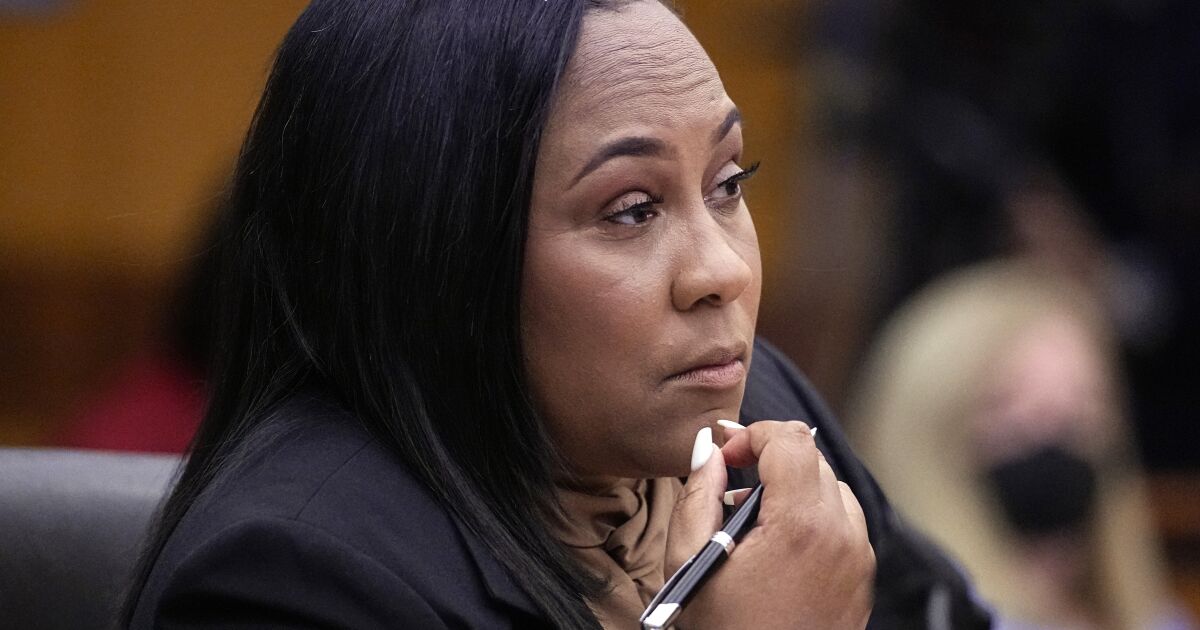
The indictment that Fulton County Dist. Atty. Fani Willis unveiled Monday night offers a panoramic recapitulation of the misdeeds that former President Trump and his confederates allegedly perpetrated to unlawfully retain power in the months after the 2020 election. Its core charge against Trump and 18 other defendants is a violation of Georgia’s version of the Racketeer Influenced and Corrupt Organizations Act, or RICO, traditionally used to prosecute organized crime.
About half the indictment consists of a recitation of 161 overt acts in furtherance of the RICO violation, 40 of which are crimes in themselves. It covers much of what we learned from the House Jan. 6 committee and Trump’s federal indictment on charges of attempting to overturn the 2020 election, adding details such as those concerning a plot to infiltrate voting systems in rural Coffee County.
Notwithstanding that it covers plenty of familiar ground, Trump’s fourth indictment in four months is something new in the effort to hold the former president accountable. It is in many ways the most aggressive prosecutorial response to this shameful chapter of our history.
The RICO law permitted Willis to pack a Georgia indictment with much of Trump and company’s nationwide scheme to steal the election, which extended to five other states. Under the capacious structure of the statue, it alleges that the 19 defendants participated in a criminal enterprise to keep Trump in power beyond his elected term.
If that sounds amorphous, it’s because it is, as RICO’s critics have long alleged. But prosecutors can satisfy the RICO charge by proving just two of the 40 other crimes alleged, something that isn’t likely to be a heavy lift.
One of the most important differences between the Fulton County indictment and the federal case is its inclusion of 18 defendants in addition to Trump. These alleged criminals run the gamut from what Mike Pence called the “gaggle of crackpot lawyers” who surrounded and abetted Trump — Rudy Giuliani, John Eastman and the others who special counsel Jack Smith listed as unnamed co-conspirators — to lesser-known Georgia players who took part in more provincial aspects of the plot. Whereas Smith’s Jan. 6 indictment was an arrow aimed straight at Trump, Willis’ is a blunderbuss.
The profusion of defendants has several implications. Perhaps most important, it pressures them to cooperate against the other defendants, especially Trump. That’s particularly true because it’s a state rather than a federal case, which means anyone convicted can’t hope for a pardon from Trump or another Republican president.
The crowd of alleged accomplices could constitute a giant step forward in the pursuit of accountability. Just as Watergate culminated with the imprisonment of several of “the president’s men,” justice for Trump’s outrages must extend to the brazen lawlessness of those who enabled and executed his schemes.
The crowd of defendants also presents colossal logistical problems for the Fulton County system. Willis said during her brief remarks Monday night that she wants to try all of them together. But the prospect of a 19–defendant trial that includes a former president is more than a challenge; it’s close to unfathomable. We have to expect that the number will narrow as defendants choose to cooperate and are divided into more manageable groups.
Another remarkable feature of the indictment is that most of the charged conduct was also in violation of federal law and perpetrated by a president and his allies during his term. That is in stark contrast with Manhattan Dist. Atty. Alvin Bragg’s case, which concerns violations of New York law mostly before Trump took office.
That poses one legal and one policy quandary. First, Trump can and surely will argue that the case should be transferred to federal court because it concerns official conduct he undertook as president. Willis will likely respond by arguing that Trump’s alleged crimes fell outside the parameters of his official duties.
Willis’ argument should probably prevail, as it has in other matters concerning Trump’s very unpresidential post-election conduct. But if it doesn’t, prosecutors from Willis’ office could be forced to try the case in an unfamiliar federal court, with a federal jury pool and according to federal procedures.
The policy point is that however righteous Willis’ case might be, and however overwhelming the evidence she has marshaled, it raises legitimate questions about local prosecution of a former president. That’s the line that Sen. Lindsey Graham (R-S.C.) immediately took, asking on Fox News, “Are we going to let county prosecutors start prosecuting the president of the United States, the former president of the United States? You open up Pandora’s box.”
Trump’s latest indictment is also distinct from the others by virtue of the government-friendly laws that will apply at trial. Those begin with RICO, the Georgia version of which is unusually expansive, encompassing predicate acts such as perjury that are not included in its federal counterpart.
Georgia also has stricter laws governing the conditions of release that lean toward pretrial detention, including a requirement that defendants show they pose no risk of intimidation to witnesses. Given Trump’s history, imagine the challenge that presents for his lawyers when he is arraigned, probably later this month.
Georgia also has strong speedy-trial provisions that could allow another defendant to demand to be tried within a few months, which could put Trump in a tight spot.
Even as it repackages much familiar evidence and treads some of the ground covered by another prosecution, Trump’s fourth indictment is a lot more than piling on. In some respects, it is the most far-reaching and portentous response to Trump’s assault on democracy.
Harry Litman is the host of the “Talking Feds” podcast. @harrylitman

Dave Currey, a former Division I college football coach who went on to spend 25 years as athletic director at Chapman University, died Saturday following an illness. He was 80.
In a message to the Chapman community earlier this week, university President Daniele Struppa described Currey as “kind, warmhearted, funny, honest to his core, and famously frugal.”
“That sums him up,” current Chapman athletic director Terry Boesel said. “He was all those things.”

Dave Currey helped bring football back to Chapman University during his 25 years as the school’s athletic director.
(Chapman University)
A former player at Samford University, Currey coached St. Bonaventure High School in Ventura to a state title in 1968 and was inducted into the school’s athletic hall of fame in 2010. After spending seven seasons as offensive coordinator at Stanford, Currey was the head coach at Long Beach State from 1977 to 1983 and at Cincinnati from 1984 to 1988, then spent one season as receivers coach at UCLA.
When Currey was hired as Chapman’s athletic director in 1990, the university had only nine varsity sports with 150 student-athletes and was struggling to compete as an NCAA Division II school. By the time Currey retired in 2015, Chapman featured 20 varsity sports with nearly 500 student-athletes and was thriving as a member of the Division III Southern California Intercollegiate Athletic Conference.
“Dave was a great fundraiser and friend builder,” said Jim Doti, who was Chapman’s president from 1991 to 2016. “Everybody liked him. He had a great sense of humor, real up spirit and that’s what makes a difference in fundraising. We raised a lot of money to build this program.”
Currey was inducted into the Chapman athletic program’s hall of fame in 2017 and received the SCIAC Distinguished Service Award in 2022.
Mary Cahill, who has been women’s volleyball coach at Chapman since 1989, credits “the atmosphere [Currey] created here in the athletic department” as one of the reasons why she and other coaches have hung around for multiple decades.
Currey was such a character that Cahill said he once showed up to a staff holiday party dressed as Santa Claus.
“We still laugh about that,” Cahill said. “You know, just little things like that made the department special.”

Chapman University President Daniele Struppa, right, honors Dave Currey upon the longtime athletic director’s retirement in 2015.
(Chapman University)
Football coach Bob Owens, who was hired by Currey in 2006, said he and the longtime AD would often take five-mile walks together before work.
“Fitness was certainly part of it. And fun was part of it,” Owens said of the outings. “Sometimes we were solving problems and sometimes we were just having fun and having a good time. We enjoyed the camaraderie.”
The mention of Currey’s frugality never fails to elicit a chuckle from members of the Chapman community. Carol Jue, who has coached the women’s basketball team for 21 years, remembered the time when Currey bought his wife, Elaine, one piece of jewelry to serve as a present for Valentine’s Day, Mother’s Day and her birthday.
“I said, ‘Coach! What are you saving your money for?’” Jue said with a laugh.
Then there was the time Doti suggested a group of staff members go out for an Italian dinner. Currey made the arrangements.
“And he came up with Olive Garden,” Doti said. “He said, ‘All those other places are way too expensive. And they’ve got great breadsticks — and they’re free!’”
But, Doti added, Currey’s thrifty nature is one of the many qualities that made him great at what he did.
“Why waste money on a dinner when you could be saving it for more important things like paying your coaches a decent salary, having great equipment, getting that extra piece of equipment in our fitness center?” Doti said.
“People knew he was frugal, so they were more inclined to give him the benefit of the doubt and provide that kind of philanthropy and financial support because they knew it would be well taken care of and wouldn’t be wasted.”
Currey is survived by his wife of 18 years, Elaine; son John-David, daughter-in-law Michelle and their children, Jenna and Ben; and daughter Tracey Riness, son-in-law Clayton and their children, Owen, Phoebe and Piper.


As usual, California was ahead of the game.
It’s been two decades since lawmakers passed the first law to begin requiring electric utilities to replace fossil fuels with renewable energy. Nearly as long since Gov. Arnold Schwarzenegger called for 1 million solar roofs. A decade since the state first mandated large numbers of electric cars on the road, and four years since Berkeley became the first U.S. city to ban gas appliances in new homes.
None of those initiatives have protected the Golden State from the ravages of the climate crisis.
The eight largest wildfires on record have all burned in the last six years, collectively torching more than 4 million acres — and none of them was nearly as deadly as the 2018 Camp fire, which killed 85 people and destroyed the town of Paradise.

The Camp fire in 2018 killed 85 people and burned more than 7,000 structures in Paradise, Calif.
(Marcus Yam / Los Angeles Times)
The three driest years ever recorded came to a dramatic end this past winter, when record rain and snow wreaked deadly havoc, flooding farmworker communities and burying mountain towns. The precipitation filled reservoirs but did nothing to change the reality that California faces a frighteningly water-scarce future as rivers dwindle and groundwater levels drop.
The coast has fared relatively better — but sea level rise grows ever more urgent. Cliffs are collapsing into the Pacific, rail lines are experiencing temporary shutdowns and waves are edging closer to toxic sites, threatening to poison nearby residents.

Erosion of the bluffs above the beach in Del Mar have repeatedly put nearby train tracks in jeopardy.
(John Gibbins / San Diego Union-Tribune)
And there may be no more harmful consequences of global warming than extreme heat. Hundreds of Californians already die in heat waves every year, roasting in their homes and baking on asphalt streets with little shade. The toll will only rise as we continue to burn coal, oil and fossil gas, spewing heat-trapping carbon dioxide and methane pollution into the atmosphere.
If the Golden State is going to lead the world toward a better, safer future, our political and business leaders — and the rest of us — will have to work harder to rewrite the California narrative. Here’s how we can push the state forward.
Lisa Patel, a Stanford University pediatrician, saw the dangers firsthand during last year’s Labor Day weekend heat wave, when temperatures reached 116 degrees outside her hospital in Pleasanton. She worked two 24-hour shifts, and she was called to several deliveries where laboring mothers had fevers or other complications. She sent multiple newborns to intensive care.
“In retrospect, I don’t know if those moms had a true infection or if they just got overheated,” Patel said.
It’s not too late to stop climate change from getting worse.

The blazing sun silhouettes visitors to Signal Hill.
(Luis Sinco / Los Angeles Times)
But for California to lead the world toward a safer future, the state’s politicians, business leaders and tens of millions of residents will need to work a lot harder — and be willing to accept a tomorrow that looks different than today.
Los Angeles offers a telling case study.
The city is dominated by freeways built to serve gas-guzzling cars and trucks, and for decades its biggest electricity source has been a coal-fired plant in Utah. Ships and trucks belch toxic fumes into low-income communities of color. Many neighborhoods have precious few trees to protect residents from heat soaked up by the urban hardscape. There are too many grassy lawns, not enough protected bus lanes and far too many well-to-do white homeowners willing to fight dense housing construction near job centers.
Elected officials are trying, at least, to make things better.
L.A.’s first-ever chief heat officer, Marta Segura, is working on efforts to plant trees, update building codes to keep residents cool and create an early-warning system for dangerous temperature extremes, with public outreach in English and Spanish. The port is aiming for a 100% zero-emissions truck fleet by 2035. City leaders have approved rebates for replacing grass with artificial turf or native plants, plus billions of dollars in spending to expand the Metro rail system ahead of the 2028 Summer Olympics.
And that Utah coal plant? It won’t be around much longer. The L.A. Department of Water and Power has an ambitious plan to fuel the city with 100% climate-friendly energy by 2035, largely by using solar farms, wind turbines and lithium-ion batteries.

The sun sets over windmills on a day where temperatures reach a high of a 110 in Desert Hot Springs on July 28, 2021.
(Genaro Molina / Los Angeles Times)
“This is a new direction — it’s kind of a new world order,” said Marty Adams, general manager of the Department of Water and Power. “We’re learning as quickly as we can, but there are a lot of things that are kind of like ground zero.”
None of it is enough. But at the same time, we’ve reached a point in history when almost nothing is enough.
Earth is likely headed beyond 1.5 degrees Celsius of warming — the goal urged by scientists and endorsed by nearly every nation at the 2015 Paris climate summit. Keeping average global temperature increases below that target would require slashing carbon pollution nearly in half by 2030 — not impossible, but nowhere close to current economic and political trends.
The 1.2 degrees of warming we’ve already felt have brought plenty of pain and suffering, especially for Black, Latino and Native American communities and nations in the Global South. Every additional tenth of a degree of warming will bring even more pain and suffering — and every tenth of a degree we avoid will mean better lives for billions of people.
So what more can California do to get its own house in order and possibly bring other states and countries along for the ride?
For one thing, California can prove it’s possible to phase out fossil fuels without badly disrupting daily life.
Hundreds of thousands of households and businesses got a taste of the difficulties in summer 2020, when state officials were forced to implement brief rolling blackouts during a brutal heat wave. There simply wasn’t enough power to supply tens of millions of air conditioners after sundown, when temperatures remained high but solar panels stopped producing electricity.

Residents look to cool off around the Southern California area.
Residents barely avoided more outages the next two summers — and only then because they heeded pleas to use less power.
“We all want to accelerate the elimination of the gas,” Gov. Gavin Newsom said during a September 2022 heat storm. But the fact that gas-fired power plants still provide much of the state’s on-demand power is “a sober reminder of reality.”
Newsom has made climate and clean energy top priorities, likely knowing any future presidential campaign could flourish or fail on his performance. Like many leaders in Washington, D.C., the governor has urged permitting reform to make it easier to build the massive number of renewable energy facilities the state will need to ditch fossil fuels. He has also led a push to keep California’s Diablo Canyon nuclear plant open past 2025, so that it can keep generating emissions-free electricity.
There are many actions regular Californians can take to push the state forward, too: installing rooftop solar panels, replacing gas furnaces with electric heat pumps and gasoline cars with electric models and hardening their homes against wildfire.
Golden State residents can also think more broadly about how their lifestyles line up with climate imperatives.
Do you have an opportunity to take public transit to work, or to work from home? Would you support devoting more space on your neighborhood’s streets to buses and bikes, even if it slows down your car-based commute? Do you really want to move from a city to a rural or suburban area surrounded by forests when there’s a decent chance flames will come for your home?
Of course, living more sustainably would be easier with support from politicians and business executives — cheaper housing within cities, better bus and rail options, corporate policies that don’t require employees to drive to faraway offices.
“There is no more important issue for the world,” said Mike Feuer, formerly L.A.’s city attorney, during an unsuccessful campaign for mayor last year. “If we were to look forward to a conversation that our kids or grandkids might have in 20 or 30 years, they’re going to look back on us and say, ‘What the heck were you thinking?’ ”
No matter how hard California’s 40 million residents might work to reduce their own emissions, there’s nothing more effective they can do to fight climate change than to put pressure on elected officials to take more sweeping action.

Are Californians willing to embrace, and pressure politicians for, less car-centric cities?
(Bloomberg via Getty Images)
That action should begin with aggressive measures to confront the fossil fuel industry, many activists say.
Under a bill pending in the state Legislature this year, California’s two big public employee pension funds — the nation’s largest — would be required to divest billions of dollars from oil and gas companies. Other proposals would require major corporations of all kinds to publicly report their heat-trapping emissions, as well as the risks that climate change poses to their operations.
But at least thus far, the deep-pocketed fossil fuel industry has largely been able to stave off transformative change.
Pumpjacks continue to suck oil and gas from the ground in and around Los Angeles, Kern County and elsewhere — polluting the air and contributing to asthma, preterm births and reduced lung function. Lawmakers voted last year to ban new drilling within 3,200 feet of homes, but the ban would do nothing to address existing wells — and it may never take effect. It’s paused through at least November 2024 after oil and gas producers secured enough signatures to send it to the ballot for voters to decide.

Chevron prepared for flooding at its giant Kern River Oil Field north of Bakersfield last month by isolating wells, draining pipelines, turning off electrical power, and armoring levees with rip rap.
(Robert Gauthier / Los Angeles Times)
Another bill that would have made fossil fuel companies financially liable for the health problems of people living near wells died a quiet death in the Legislature in May, when a powerful lawmaker blocked the legislation from even getting a full vote.
“Fossil fuel executives have known for decades that drilling in neighborhoods puts our communities at risk,” said Nicole Rivera, government affairs director at the Climate Center, a Santa Rosa-based nonprofit, after the bill was defeated. “Instead of acting to protect public health and our shared climate, they’ve lobbied and spent millions of dollars convincing elected officials to look the other way.”
The political sparring over gas furnaces, water heaters and stoves has been equally intense.
Berkeley’s 2019 ban on gas hookups in new homes and businesses spurred a nationwide trend, with dozens of cities across the U.S. following its lead — including Los Angeles. The fossil fuel industry pushed back hard, led by the nation’s largest natural gas utility, Southern California Gas Co. A recent court ruling called into question the legality of some of the bans.
Will Californians be willing to give up cooking with gas? Will they support cutting down on fossil fuel production, even if doing so means higher prices at the pump? Can they learn to embrace a future of more densely populated, less car-centric cities?
And equally important: Will they vote for politicians determined to stand up to one of the world’s most powerful industries?
Because at the end of the day, the main barriers to climate action are more political than anything. Studies have shown we have most of the technologies we need to stop burning fossil fuels. The costs of clean energy have fallen dramatically. We know how to redesign our cities — and reshape our patterns of development — to get carbon pollution mostly under control.
The climate crisis is here to stay. How bad it gets is still up to us.
Ask a Reporter: Inside the project
What: Times reporters Rosanna Xia and Sammy Roth will discuss “Our Climate Change Challenge” during a live streaming conversation. City Editor Maria L. LaGanga moderates.
When: Sept. 19 at 6 p.m. Pacific.
Where: This free event will be live streaming. Sign up on Eventbrite for watch links and to share your questions and comments.

By Shawna Mizelle| CNN
Washington — Fulton County District Attorney Fani Willis has reemerged in the spotlight after her office charged 19 co-defendants, including Donald Trump, regarding efforts by the former president and his allies to overturn the 2020 presidential election results.
The indictments are a culmination of an investigation that has lasted more than two years and has resulted in multiple charges including conspiracy and racketeering, which Willis has a history of successfully bringing against defendants.
The Atlanta-area prosecutor, who has not shied away from prosecuting high-profile cases, presented her case before a grand jury on Monday.
Willis, a Democrat who is Fulton County’s first female DA, had been in office for only a day when the former president phoned Georgia’s GOP secretary of state, Brad Raffensperger, on January 2, 2021, urging him to “find” votes to overturn the 2020 presidential election results.
For related news, see: Trump, 18 allies indicted in Georgia over 2020 election meddling, the 4th criminal case against him
She campaigned on the premise of restoring integrity to the Fulton County district attorney’s office, was elected after ousting six-term incumbent Paul Howard and inherited a stack of backlogged cases.
Within a month, her office was firing off letters to Georgia officials asking them to preserve documents related to attempts to influence the state’s 2020 election.
Trump has vehemently denied wrongdoing, as have his allies who are also under scrutiny in the probe. The former president has lashed out at Willis, who is Black, calling her “racist” and a “lunatic Marxist” and baselessly claiming she has ties to gang members.
Asked by CNN in February 2022 about the struggle to envision a former president under prosecution in her state, Willis said, “What I could envision is that we actually live in a society where Lady Justice is blind, and that it doesn’t matter if you’re rich poor, Black, White, Democrat or Republican. If you violated the law, you’re going to be charged.”
Besides leading the election subversion probe, Willis has also brought anti-corruption indictments against Grammy-winning rapper Young Thug and his associates. The district attorney has spoken fondly of RICO – the Racketeer Influenced and Corrupt Organizations Act – and has used it in unorthodox ways to bring charges against school officials and musicians, including Young Thug.
“The way she goes about any cases, she starts at the top and she really dives into it. She follows every lead that she can,” said Charlie Bailey, who previously worked with Willis in the Fulton County DA’s office and on the 2014 Atlanta Public Schools cheating scandal case, where she used racketeering statutes to secure guilty pleas from teachers and administrators.
“Ultimately she will make a decision based on the fact that they will uncover,” Bailey told CNN in 2021. “And she’ll make a decision based on applying that pertinent law.”
From California by way of Washington, DC, Willis obtained her undergraduate degree from Howard University in 1992 and graduated from Emory School of Law in 1996, according to her biography. Her name, Fani, is Swahili and means “prosperous,” and her father was a lawyer and Black Panther.
According to a South Atlanta Magazine profile, she worked in the private sector for five years before becoming assistant district attorney for Fulton County in 2001.
Willis drew attention as a leading prosecutor in the Atlanta Public Schools cheating scandal. Prosecuting the seven-month trial from 2014 to 2015, Willis secured convictions for 11 of the 12 defendants charged with racketeering and other crimes related to cheating that was believed to date to early 2001, when scores on statewide skills tests began to rise in the 50,000-student school district.
She opened a private practice focused on criminal defense and family law in 2018. “I was raised by a single father and so my heart is always with fathers – so in my family law practice I tend to represent men that are going through battles, you know, with children and child support and child custody,” Willis said in a July 2020 interview.
She ran against Howard, her former boss, as he faced allegations of misconduct, including financial mismanagement and sexual harassment. He previously questioned the timing of the sexual harassment lawsuits, which he said came “within weeks of the general election.”
CNN reached out to Howard for additional comment.
Willis, a mother of two, told South Atlanta Magazine shortly after being elected that she always knew she wanted to serve as district attorney, “but in my mind, I would never run against the sitting DA … but the cries got louder and louder and louder … and I just took the leap of faith and did what God called me to do.”
Pointing to the coronavirus pandemic and her predecessor, Willis has said she faced a backlog of thousands of cases when she took office in 2021.
Because of Georgia law that says suspects who’ve been charged with crimes in the state are entitled to bond if they’re not indicted within 90 days, Willis was tasked with handing down indictments or allowing violent offenders to return to the streets.
She pushed to secure additional funding from the Fulton County Commission to hire 55 staff members for the district attorney’s office, including 15 attorneys and 15 investigators. Willis said at the time that her office had worked “around the clock” to make sure murder cases were indicted before the deadline. Still, she said there would be “four- or five-hundred defendants that we don’t make the clock on and … a judge will be mandated to give them a bond.”
As district attorney, Willis created a pre-indictment diversion program that allows defendants to be enrolled in life-skills courses and participate in community service rather than be charged.

Willis’ working relationship with Bailey, a former senior assistant district attorney, was the source of scrutiny last year when Willis hosted a campaign fundraiser in support of his bid for lieutenant governor and donated to his primary campaign. Bailey’s opponent, Burt Jones, a Republican state senator, ultimately prevailed in the race.
Jones was one of 16 Republicans who served as “fake electors” in a plan to subvert the Electoral College from certifying Joe Biden’s 2020 victory.
A Georgia judge blocked Willis from pursuing an investigation against Jones after his attorneys argued her political actions should disqualify her.
In addition to blocking the investigation, Fulton County Superior Court Judge Robert McBurney criticized Willis for hosting a fundraiser for a candidate running against one of the investigation’s potential targets. “It’s a ‘What are you thinking?’ moment,” McBurney said. “The optics are horrific.”
Bailey declined to comment to CNN, including about the fundraiser.
A recent Trump campaign ad taking aim at multiple prosecutors noted that Willis was disqualified from investigating Jones but also included a baseless allegation that she hid a relationship with a gang member she was prosecuting.
Willis slammed the ad as “derogatory and false” and instructed her staff not to comment on it or other criticism directed toward her, her staff or her office in the coming months.
“We have no personal feelings against those we investigate or prosecute and we should not express any. This is business, it will never be personal,” she wrote last week in an email to her staff obtained by CNN. “We have a job to do. In this office, we prosecute based on the facts and the law. The law is non-partisan. You should feel no need to defend me.”
Willis added: “Your instruction from me is to ignore all the noise and keep doing your job with excellence.”
She has also urged local officials to stay vigilant about possible security threats spurred by the election subversion case. In an email last month to Fulton County officials, Willis shared a racist and sexualized message she received and said similar obscene messages had been left via voicemail.
“I am sending to you in case you are unclear on what I and my staff have come accustomed to over the last 2 ½ years,” Willis wrote.
Willis is one of five independently elected investigators across the US who have garnered high-profile attention due to investigations into the former president.
While investigating efforts by Trump and his allies to thwart Georgia’s election results, Willis and her team interviewed the 16 Republicans put forward in the state as alternate slates of electors. The district attorney’s office announced last year that those electors were targets of the probe.
“As our investigation has matured and new evidence has come to light, in a spirit of integrity we feel it only fitting to inform you that your clients’ status has changed to ‘Target,’” Willis’ office said at the time, according to a defense filing.
Willis’ office appeared to be trying to determine whether the pro-Trump electors in Georgia had any knowledge that their actions may have been part of a broader and potentially illegal plot to pressure election officials and overturn Biden’s victory, a source previously told CNN.
A number of notable figures received special grand jury subpoenas as a part of the DA’s investigation into efforts to overturn the 2020 election results in the state and still others have cooperated with the probe.
At least eight of the Republican “fake electors” have accepted immunity deals in the ongoing criminal investigation.
While Willis has subpoenaed Trump allies, such as Sen. Lindsey Graham of South Carolina and Rudy Giuliani, she has also handed down RICO indictments to chart-topping rappers including Young Thug and Gunna.
Willis previously announced indictments of Young Thug and Drug Rich Gang in cases that have cited song lyrics as evidence – an approach critics call an infringement on First Amendment rights.
When asked by a reporter during a news conference last August how she responds to criticism that she is specifically targeting Atlanta’s hip-hop community, Willis said, “I’m not targeting anyone, but however, you do not get to commit crimes in my county and then decide to brag on it, which you do that for a form of intimidation and to further the gang and not be held responsible.”
While her use of lyrics as evidence may anger some, Willis said, she will continue to use them.
“I have some legal advice. Don’t confess to crimes on rap lyrics if you do not want them used, or at least get out of my county,” she said.
The-CNN-Wire™ & © 2023 Cable News Network, Inc., a Warner Bros. Discovery Company. All rights reserved.

(CNN) — With only a quarter of the Maui wildfire burn area searched, the death toll of what’s already the deadliest US wildfire in more than a century still could rise significantly, Hawaii authorities said Monday.
At least 99 people have been confirmed dead from the wildfires, and the number could double over the next 10 days, Hawaii Gov. Josh Green told CNN Monday.
“It is a tragedy beyond tragedies,” the governor said about the fires that started sweeping parts of the island last week.
For related news, see: Interactive Maui wildfire map: Before and after images of Lahaina show scale of devastation
Authorities on Tuesday are expected to begin releasing the names of the dead whose families have been notified, Maui Police Chief John Pelletier said in a Monday news conference.
Most of the people found dead had been out in the open, in cars or in the water in western Maui’s hard-hit Lahaina area, Green told CNN. As more teams and cadaver dogs join the effort, the search is expanding through wiped-out neighborhoods.
It’s unclear how many people are unaccounted for, in part because of communication gaps, Green said. “A lot of people had to run and left all they had behind. They don’t have their phones – the phones are incinerated,” he said.
As of Monday, around 25% of the fire zone had been searched, Pelletier said, adding that he hopes 85% to 90% will have been covered by the weekend.
“We started with one dog. We are at 20,” Pelletier said. “We can only move as fast as we can, but we got the right amount of workers and teams doing it.”
Crews are going through what used to be homes, business and historic landmarks burned to the ground after wind-whipped wildfires began spreading erratically August 8, suddenly engulfing homes, forcing harrowing escapes and likely displacing thousands.
“Nothing can prepare you for what I saw during my time here, and nothing can prepare them for the emotional toll of the impact that this severe event has taken on them,” FEMA Administrator Deanne Criswell told reporters Monday.
The Maui wildfires are the deadliest in the US in more than 100 years, according to the National Fire Protection Association.
As firefighting and search efforts continue, here’s the latest on what’s happening on Maui:
• Burn victims treated: Nine people injured in the wildfires have been admitted to a specialized burn unit in Honolulu, the only burn unit in the state and the Pacific Region, according to Straub Medical Center.
• Calls to provide DNA: Those with missing family members have been urged to contact authorities to provide DNA samples, which would help in the identification process. Only three of those killed could be identified through fingerprints, Pelletier said, stressing the need for the DNA swabs.
• Homes lost: More than 2,200 structures have been destroyed or damaged by the fires – about 86% of them residential, Green said.
• ‘Shelters are starting to empty’: More than 400 hotel rooms are available for those displaced, and 1,400 Airbnb units will be ready for them Tuesday, Green said. And,160 people are offering to share their houses, he said. “We’ve already placed 220 families into housing. So you can see the shelters are starting to empty,” Green said.
• Power coming back: The fires wiped out both power and communications for thousands. Hawaiian Electric planned to have power restored to 80% of its 12,400 customers who lost power by end of Monday, Hawaiian Electric CEO Shelee Kimura said.
• Lawsuit over power lines: Hawaiian Electric is facing a lawsuit claiming power lines blown over by high winds helped to cause the destructive Lahaina wildfire, though an official cause has not yet been determined.
• Coast Guard shifts focus: The US Coast Guard in Maui is moving from search and rescue mode to containing potentially hazardous materials in the ocean left behind by the fires. Sonar technology was brought in and a 100-foot boom placed at the mouth of the Lahaina Harbor, the service said.
Families of two victims told CNN their loved ones died while trying to escape the Lahaina fire.
Maui resident Carole Hartley, 60, and her partner, Charles Paxton, were trying to evacuate when the smoke from the fire overwhelmed the couple and they got separated, her sister Donna Gardner Hartley told CNN.
Winds were vicious and they couldn’t see through dark smoke that “felt like a tornado,” Gardner Hartley recalled Charles telling her.
“They kept calling each other’s name,” Gardner Hartley said in a Facebook post. “He was screaming, ‘Run, run, run, Carole run.’ He eventually could not hear her anymore.”
Paxton, who was found by his friends, organized a search for Hartley after he was treated for his injuries, the sister said.
Hartley’s remains eventually were found on the couple’s property over the weekend, Gardner Hartley told CNN.
Hartley was described by her sister as a free spirit who “always looked for the good in people and always helped others.”
Franklin “Frankie” Trejos, 68, also died trying to escape the Lahaina fire, his niece Kika Perez Grant told CNN.
The family got a call from Trejos’ roommate letting them know that the island was on fire and that he wasn’t sure if Trejos had made it out alive, Perez Grant said.
“We kept hope alive, but then his roommate called us again a few hours later to tell us he had found Uncle Frankie’s remains,” Perez Grant said.
Trejos and his roommate tried to save their property at first, but then decided to leave in their own cars when they realized it was impossible, Perez Grant said.
The roommate later found Trejos’ car a few blocks from the house, with Trejos’ remains on top of the roommate’s dog, which also died, Perez Grant said.
Trejos, a native of Costa Rica who had moved to the United States at a young age, lived in Lahaina for the last 30 years, according to his niece.
“Uncle Frankie was a kind man, a nature lover, an animal lover and he loved his friends and his families with this whole heart,” Perez Grant said. “He loved adventure and was a free spirit.”
As the fires quickly advanced on the historic town of Lahaina last week, first responders encountered weak water pressure and fire hydrants running dry, several firefighters told the New York Times.
“There was just no water in the hydrants,” Keahi Ho, one of the firefighters working in Lahaina, told the paper.
Another firefighter, unnamed by the paper because he was not authorized to discuss the operation, said his truck connected to a hydrant but the water pressure was too weak to be of use, and the flames spread beyond firefighters’ ability to contain them.
CNN sought comment and information from the Maui County Department of Water Supply.
Asked about reports that firefighters didn’t have enough water to tackle the blazes on August 8, the governor told reporters in a news conference Monday: “One thing that people need to understand, especially from far away, is there’s been a great deal of water conflict on Maui for many years.”
“We have a difficult time on Maui. In other rural areas, getting enough water for houses, for our people, for any response,” Green said.
West Maui residents have described the fires jumping across highways and showing up in their yards or their engulfing homes without warning, forcing them to run for their lives.
Hawaii’s network of about 400 alarms, meant to alert residents to tsunamis and other natural disasters, did not activate as the fire spread August 8, Hawaii Emergency Management Agency spokesperson Adam Weintraub.
Although the emergency response is still being reviewed, authorities believe the sirens were “essentially immobilized” by the extreme heat, Green told CNN on Monday.
Hawaii Attorney General Anne Lopez is set to lead a review of officials’ response to the wildfires, her office announced Friday. The review will encompass “critical decision-making and standing policies leading up to, during, and after the wildfires,” the attorney general’s office said.
The-CNN-Wire™ & © 2023 Cable News Network, Inc., a Warner Bros. Discovery Company. All rights reserved.

There had been rumors swirling that the mostly female workforce at the mushroom farm in Sunnyside, Wash., was getting replaced with men, but Isela Cabrera tried to keep her head down, and hold on to her job.
Then hourly quotas for picking mushrooms increased. Women she worked alongside were getting written up, or let go. Co-workers were disciplined or fired for calling in sick or refusing to work 12-hour shifts because they had children at home.
It wasn’t long before new workers, mostly men, were bused into the farm in vans, taking the place of the fired women. Some of the new pickers looked like they were no more than 15 years old, several current and former workers at the farm told The Times.
“Little by little, they’re getting rid of the local workers,” said Cabrera, who worried the job she had for more than two years was at risk. “They fired people without saying anything, just gone.”
Ostrom Mushroom Farms agreed to pay a $3.4-million fine in May to settle a lawsuit filed by Washington’s Office of Attorney General, which accused the business of discriminating against its employees by replacing its mostly female workforce with male guest workers brought into the country through the federal H-2A Temporary Agriculture Program.
The program is meant to help companies find foreign labor when local workers are unable or unwilling to do the work. But prosecutors and workers say the company was trying to replace local employees with foreign workers who could be paid less and were willing to work longer hours.
The allegations of retaliation and worker discrimination surfaced only after workers tried to organize a labor union, just as hazardous working and living conditions were discovered at another mushroom farm in Half Moon Bay, Calif., only after a disgruntled worker killed seven people.
Advocates say the conditions in the mushroom farms in Sunnyside and Half Moon Bay highlight how discrimination and illegal working conditions in the industry can often go unreported because workers — who have few resources or advocates— are afraid to speak up for fear of being fired.
“It took a shooting for stuff to come forward in Half Moon Bay,” said Antonio De Loera-Brust, spokesperson for the United Farm Workers Union, which worked to unionize the Sunnyside farms. “It’s taken an extensive organizing campaign and actions by workers to come to light in Ostrom, which makes you think — where are the places where this is happening without anyone knowing?”
Ostrom sold the farm in the middle of the lawsuit to Windmill Farms, but officials said the terms reached by the settlement will also pertain to the new owners.
Days before the Washington attorney general announced the settlement, investigators disclosed in documents obtained by The Times that a federal probe was also underway into allegations of wage theft, violations of the H-2A program and child labor laws on the farm. It was not clear what prompted the federal investigation, but labor organizers say they have been calling for such intervention for months.
Officials at Ostrom Mushroom Farms and Windmill Farms did not respond to questions about the suit settlement and ongoing investigation.
Although minors are allowed to work on farms, according to the Washington State Department of Labor & Industries, those who are 14 or 15 years old are limited to three hours a day and 21 hours a week on school weeks. Those who are 16 and 17 are allowed four hours a day and 28 hours in a school week.

FBI officials arrive in January at Mountain Mushroom Farm in Half Moon Bay, where a disgruntled worker killed seven.
(Aaron Kehoe / Associated Press)
Multiple former and current workers at the farm said those who appeared to be minors easily exceeded those daily work limits.
One former worker, who asked not to be identified for fear of being deported, told The Times he was brought to the farm as a contractor when he was 17. He believes he arrived as an H-2A worker, but said he was unsure because he doesn’t know how to read, saying his paperwork was handled by the recruiter who took him to Washington for work.
He came to the U.S. on a work visa, but owed about $10,000 to the company that helped handle his paperwork and transportation, he said.
There was no work for him in Mexico, he said, and his family needed the help. At the farm, he regularly worked up to 15 hours a day, he said.
“I needed to work because of my family,” he said. “I left to get ahead because there was no money there.”
When workers spoke up about working conditions, Washington Atty. Gen. Bob Ferguson said at a news conference, managers at the farms retaliated, threatened their jobs and at least once assaulting a worker.
The company’s actions, Ferguson said, were “calculated, systemic discrimination” intended to “force out female and Washington-based employees.”
Nearly two months after the lawsuit settlement, current and former workers at the farm say their jobs are still at risk. Retaliation is still a threat, and many fear being replaced by foreign workers who continue to be driven into the farm as contract laborers. Workers voted in September 2022 to unionize but the company has not recognized the union.
State and federal investigations into the 43-acre farm in Sunnyside have confirmed some of the workers’ claims.
On Thursday, the U.S. Department of Labor Wage and Hour Division announced that Ostrom Mushroom farms failed to pay migrant workers the required wage and provide them cooking facilities, violating specific requirements from the H-2A visa program.
Ostrom farms also failed to get inspections of worker housing facilities, as well keeping required pay stubs, the federal agency said.
One migrant worker, according to the agency, was found to have paid a recruiter $10,000 for a visa, another violation of the H-2A program.
The Department of Labor recovered $59,850 in unpaid wages for 62 workers, according to the agency, and levied $74,642 in penalties for the violations.
“Employers participating in the H-2A guest worker program must make sure that they provide housing as required, that housing is sanitary, that vehicles used to transport workers are safe and that workers are paid correctly for all hours they work,” said Thomas Silva, district director of the Wage and Hour Division of the Department of Labor. “Our nation depends on agricultural industry workers to feed our families, and we are committed to making certain industry employers fulfill their legal responsibilities.”
Since the lawsuit was settled, UFW representatives say 13 more local workers have been fired from the farm, including three who were part of the labor union organizing committee. Four others left of their own accord, but cited retaliation as the reason for leaving.
A letter from the U.S. Department of Labor, dated May 11, asks that anyone who has worked at the farm since Aug. 22, 2021, be given “prosecutorial discretion” by the Department of Homeland Security — meaning that they not be placed on immigration proceedings to be deported so they could be available to cooperate with the investigation.
“The investigation will determine whether Ostrom Mushroom Farms, LLC has complied with H-2A program obligations, minimum wage, child labor, and overtime pay requirements,” the letter reads.
Labor organizers say the workers are in a precarious position, similar to what other field laborers across the country face. Workers are eager to improve their working conditions but scared that speaking up can cost them their livelihoods.
Pitting foreign workers against local employees, and exploiting vulnerable workers, is common in the industry, UFW officials said, and much of it never gets public scrutiny.
“I’m sure there are other places where this is happening that we’re not aware of,” said De Loera-Brust.
In Half Moon Bay, workers were found to be living in homes that had not been approved or inspected by local or state officials. Images showed structures with plastic walls, unfinished floors and propane tanks used for outdoor cooking.
These tragedies are happening everywhere. It just happens to be mushrooms that we’re talking about, but it’s happening everywhere, it’s happening in every industry.
— Teresa Romero, United Farm Workers
Workers in Colorado said a mushroom farm that had employed them closed suddenly, leaving them owed thousands in unpaid wages. They also alleged that some workers who suffered injuries due to unsafe working conditions had been threatened with having immigration authorities called if they complained, the Colorado Sun reported.
UFW officials say the troubles are not limited to the mushroom industry. In November 2021, two dozen people were indicted by the U.S. Department of Justice in what was called “Operation Blooming Onion,” a multi-year investigation into allegations that workers from Mexico and Central America had been held in unsanitary, fenced-in camps, were underpaid and threatened at gunpoint to work in farms in Georgia. The defendants, officials alleged, fraudulently used the H-2A visa program. Officials described conditions, where workers were raped, sold and traded to other conspirators, as “modern day slavery.”
“These tragedies are happening everywhere,” said Teresa Romero, president of the UFW. “It just happens to be mushrooms that we’re talking about, but it’s happening everywhere, it’s happening in every industry.”
Even when wrongdoing is found by companies, the penalties are often not significant enough to bring about change, Romero said.

Chunli Zhao appears in court in February. The 66-year-old farmworker was accused of killing seven people in Half Moon Bay.
(Dai Sugano / Associated Press)
In Half Moon Bay, the two mushroom farms were fined for dozens of violations, including not having plans to notify employees in case of an emergency, like an active shooter, and failing to provide safety training.
Concord Farms, cited for 19 violations, according to Cal/OSHA, was fined $51,770. California Terra Garden was fined $113,800 for 22 violations.
For putting workers in illegal housing conditions, the farms were cited $400 each, according to records.
Enforcement of worker-protection laws can be lax and employees dependent on the work risk losing their livelihood by coming forward, she said.
“The laws on the books are not the laws in the fields,” Romero said.
I’m enduring these injustices because I need to. I have to.
— An anonymous mushroom worker
Despite the $3.4-million settlement with Ostrom Mushroom Farms, workers say they still fear losing their jobs if they speak up.
Maria Toscano, 30, quit her job at Ostrom farms in June 2022, but is still a member of the union organizing committee. She remained involved, she said, because she saw women being fired when they refused to work long hours with kids waiting at home.
“They’d say it was because we have kids, because we have appointments,” she said. “So we don’t have a right to have a job just because we’re mothers?”
Without knowing ahead of time when they could go home, Toscano said, it was difficult for mothers like her to plan ahead for doctor appointments for her children, or to know when she’d need someone to watch over her kids late into the night.
She’s still working as a picker at a nearby farm, she said. The work is not as reliable and the pay is less.
“They treat me better, though,” she said.
A current Windmill employee, who asked not to be identified, said not much has changed since the lawsuit settlement. In some cases, 15 people are being assigned the work that once was done by 40, the worker said.
She still sees the contractor vans of male workers pulling into the farm, she said. She and others still worry they will be eventually pushed out.
One of the contract workers, she said, told her they were 15 years old, yet they regularly worked 15-hour days for about six months.
“There’s something wrong going on,” she said.
“Every day, we don’t know if we’ll have a job,” said one worker. “I’m enduring these injustices because I need to. I have to.”
The stress, she said, has caused her to have painful headaches.
“They humiliate you just so you can earn a cent for your kids,” she said. “I think I’m going to lose it. I can’t take it anymore, but I will try.”

The chasm runs the full length of the condominium complex, from the shuttered tennis courts to the shuttered pool. Measuring more than 500 feet long and 20 feet wide, the gash divides the complex in two, its weed-choked perimeter cordoned off with chain-link fencing. A grimy trickle of water oozes along the chasm’s concrete floor a dozen feet below, like some ugly open wound that just won’t heal.
Welcome to Coyote Village, a 70-unit condo complex in suburban La Habra whose residents have been living out a homeowner’s nightmare. Over the last four years, portions of the tree-lined greenbelt that once shaded the complex have violently collapsed into a concrete maw below. That’s because, unbeknownst to most residents, the greenbelt wasn’t built on solid earth. Running beneath it is a cavernous flood channel that decades ago was sealed with a concrete lid then topped with mounds of soil landscaped with pine trees.
The first collapse of the concealed lid came in January 2019, when a section of the greenbelt near the tennis courts caved in, exposing the flood channel below. The second implosion came in March, when heavy winter rains saturated the greenbelt and the concrete lid couldn’t handle the weight of the soggy soil and towering pines. This time, the collapse took out a huge swath of the greenbelt near the community pool.
Most residents were shocked to learn that their complex was built on top of a private canal that plugs into Orange County’s larger Imperial Channel, which routes storm water out of La Habra, Brea and Fullerton. It stood as the only covered private channel in the county’s 380-mile public storm drain system.
And that “private” designation is where the residents’ encountered another chasm, in the form of a years-long legal battle.
After the 2019 collapse, the county did some cleanup work at the site and provided security fencing around the exposed portion of the channel. Following the March 15 collapse, La Habra brought in construction crews to excavate the channel, which at that point was clogged with dirt, tree limbs and concrete that the city worried would create a damming effect in the broader drainage system during future storms.
But the city’s work stopped there.

Over the last four years, portions of the tree-lined greenbelt that once shaded the Coyote Village condo complex have collapsed into a concrete maw below. That’s because, unbeknownst to most residents, the greenbelt wasn’t built on solid earth.
(Robert Gauthier / Los Angeles Times)
La Habra officials have argued since the first collapse that the channel belongs to the complex. And worse, that the channel’s concrete lid had been improperly covered with a breadth of landscaping that violated what had been approved in the city permitting process. According to the city, the homeowners association that represents Coyote Village is responsible for repairing and rebuilding the channel.
The Coyote Village Homeowners Assn. has challenged that stance in a running legal battle, started in 2020, contending the channel is integral to a larger public system and was damaged by public use without just compensation. It has sued the city, the county and the county flood control district, among others, for relief.
“While the conduit runs through the HOA property, the water is public,” said John Peterson, an attorney representing the homeowners group. “The public needs to share in the responsibilities.”
State Sen. Josh Newman, a Democrat whose district encompasses La Habra, tried to broker a solution last summer and was able to secure $8.5 million in state funding to repair the flood channel. “The residents were wholly unprepared and financially unequipped to deal with this,” Newman said. “I was happy to secure those funds.”
But a year later, that money remains unspent.
La Habra initially questioned the propriety of expenditure, asking the state Atty. General’s Office if the allocation could be considered an improper gift of public funds. The state’s Legislative Counsel determined it was not. In the months since, the city and homeowners association have haggled over who would run the major construction project, with the HOA concerned it does not have the expertise and city officials reluctant to take charge of repairs on a canal they consider private property.
Residents have watched in a mix of frustration and resignation as the saga has unfolded.
Jan Duncan, an HOA board member, said she put her Coyote Village loft on the market in June and received six offers the first week. Then came questions about the flood channel and why it hasn’t been fixed in four years. In short order, every offer was rescinded.
“I cannot give buyers anything in writing to guarantee that this is going to be resolved,” she said. “Without that, they’re uncomfortable. I can’t blame them.”

Justin Marinello, who has a 4-year-old son, is among the parents who worry about the safety risk the exposed channel poses for children.
(Robert Gauthier / Los Angeles Times)
Justin Marinello is among the parents in the complex who worry about the safety risk the exposed channel poses for children. His condo looks out on the gritty channel and his 4-year-old son had a front-row view of the city’s excavation work after the March collapse.
“My son enjoyed watching the construction because he likes giant Tonka toys playing with dirt,” Marinello said. “But it would be nice to be able to open the door up and just have some grass for him to run on.”
On the other side of the chasm, Lizeth Ruiz knew about the exposed channel when she moved to her condo in 2019 but figured it would be quickly repaired. Instead, she finds herself fending off mosquitoes that breed in the canal’s dingy water. “Now, I keep everything closed and have to be more mindful about wearing pants instead of shorts,” Ruiz said, holding her newborn baby tight.
As the summer heat soars, the concrete channel is lined with dry weeds that rise taller than the 6-foot safety fencing. The channel itself is defaced with graffiti. Residents continue to pay $390 in monthly homeowners fees even though the channel’s collapse has sidelined amenities like the tennis court and pool.
It marks a wrenching chapter in the life of a property with an eccentric history.
In mid-century La Habra, a ranch owner flooded a portion of the area to create a lake and islet locals deemed “Monkey Island,” where he let feral monkeys roam free. He also eyed the land for a track that would host ostrich races. At the time, ostrich farms were a popular tourist attraction in Orange County.
Later, the lake was drained and La Habra city leaders opted to go a development direction they considered more forward-thinking, erecting a shopping plaza and post office on the site.
In 1978, developer Loren Hendrix proposed an adjacent 70-unit condominium complex, when such communities were still novel in Orange County as an affordable alternative to single-family homes. Without yards to maintain, he envisioned residents being able to stroll along a landscaped creek — a dressed-up version of the flood control channel that crossed the property — as a key selling point.
But Hendrix faced stiff questions from city staff about how he planned to protect children from hazards posed by the channel-turned-creek. Archival records show the county flood control district rejected Hendrix’s creek design. The district recommended design changes Hendrix considered too costly. Instead, the complex would host an enclosed flood channel masked with landscaping.
La Habra City Council members approved the development in April 1979 on the condition that Hendrix’s design be approved by the city’s chief building inspector and the county flood control district. A year later, the building inspector wrote that the complex was “substantially in compliance” with applicable codes. It’s not clear in county records whether the flood control district ever approved the design.
In any case, the condo development and greenbelt were built. And for 40 years, storm runoff flowed through the underground channel unbeknownst to most residents until the 2019 collapse.
La Habra city officials say the cave-ins are more about what was built on top of the channel than what lies below.
Deputy City Atty. Gary Kranker contends that at the time of the 2019 collapse the soil piled above the channel ran 9 feet deep — 6 feet more than the greenbelt design approved by the city — and that the pine trees that by then stood 80 feet tall contributed to the channel lid’s failure.
“It’s the obligation of the individual constructing the channel, or in this case, the channel roof, to make sure it was done properly,” he said. “Based upon the calculations that we have, it would have been done properly had it only had 3 feet of soil.”
And he faults the homeowners association for failing to take aggressive action to alleviate the risks between the first cave-in and the implosion in March. “To be quite candid, [they] did not do anything to try and alleviate this condition,” he said. “They could have hired someone to remove the soil, one wheelbarrow at a time.”

The second collapse of the storm drain channel at Coyote Village came in March, when heavy winter rains saturated the greenbelt that concealed its concrete lid.
(Irfan Khan / Los Angeles Times)
Last year, the homeowners association sued Hendrix, the complex developer, for fraud. The complaint alleged that he concealed the channel and any maintenance responsibilities from the association so he could sell condos “more quickly and at higher prices.” Peterson, the association’s attorney, said a settlement agreement compels Hendrix to find the insurance policies that covered the development and assign the rights over to the association.
Hendrix did not respond to requests for comment through his attorney.
Last week, representatives for the city and homeowners association said they were closing in on an agreement for moving forward with repairs that would free up the $8.5 million in state funding. Once a resolution is reached, the canal’s reconstruction is expected to take at least a year.
Roma Damo, who has lived at Coyote Village for 35 years, doesn’t see much light at the end of the tunnel — or flood channel, in her case.
“I’m seriously thinking about renting this condo out and getting myself an apartment,” said Damo, 88, eyeing the degraded channel outside her condo windows. “I don’t want to spend the rest of my life here looking at this.”

It’s good to be No. 1.
That’s the spot held for more than two decades by the Los Angeles and Long Beach ports, a combined international trade powerhouse that moves nearly 40% of the products imported from Asia to U.S. stores and factories. Tens of thousands of jobs across Southern California depend on a steady stream of imports and exports through San Pedro Harbor.
Despite pandemic supply chain snafus, an enormous floating traffic jam of ships and a dockworker contract dispute at various points during the last three years, the neighboring ports have moved enough big steel cargo boxes to stay at the top of the import-export heap. Along with bragging rights comes the ability to attract more business, more investment and more jobs.

Tugboats maneuver a container ship at the Port of Los Angeles.
(Luis Sinco / Los Angeles Times)
So it came as a bit of a surprise down on the docks late last year when the East Coast rival ports of New York-New Jersey blasted a series of monthly alerts in which officials said their complex was the busiest cargo container handler in America. Then, in April, the Port Authority of New York and New Jersey issued a news release headlined: “Port of New York and New Jersey regains top spot as busiest port in the nation.” A flurry of media reports mused on what appeared to be a historic turning point.
“The Port of New York and New Jersey is again No. 1 in the nation,” Port Authority Chairman Kevin O’Toole said in the April news release. Executive Director Rick Cotton said the dethroning of Los Angeles and Long Beach “demonstrates the port’s continued reliability and consistency as other ports experienced uncertainty and challenges.”
But a close examination of the data reveals that Port Authority officials back their claims with some statistical sleight of hand. The Port Authority compared freight traffic through its sprawling two-state jurisdiction with the individual ports of Los Angeles and Long Beach rather than combining the two local ports, as most economists and shipping experts do.
And fresh data show that Los Angeles and Long Beach combined to handle significantly more freight than New York-New Jersey through the first six months of the year despite West Coast labor unrest during much of that time.
“It’s unfortunate,” said L.A. port Executive Director Gene Seroka, with characteristic understatement. “Because some people in policy areas or in business areas are making decisions on whether to do business with us or not. We have been the nation’s busiest container port for 23 straight years.”
“To the extent that shippers hear those comments and make decisions based on them, it’s troubling,” said Mario Cordero, chief executive of the Long Beach port. Along with Los Angeles, he said, “We will continue to be the biggest gateway for international trade for years to come.”
Officials at the Port Authority of New York and New Jersey did not respond to numerous interview requests.
The low-key sparring underscores the challenges facing Los Angeles and Long Beach, which have been losing business to competitors on the East and Gulf coasts amid labor and other disruptions. Seroka recently estimated that his port had lost about 15% of its cargo to other harbors since August.

A crew member aboard a container ship monitors mooring lines as the vessel departs from the Port of Los Angeles.
(Luis Sinco / Los Angeles Times)
The latest port statistics show that Los Angeles and Long Beach together moved 7.9 million cargo containers during the first six months of the year, compared with 3.7 million handled by New York-New Jersey, an amalgamation of berths so numerous that it once took 12 jurisdictions in two states to manage them.
But the Eastern port complex did manage to push Long Beach out of the second spot in 2022 and during the first six month of 2023, illustrating how changing shipping patterns and years of increased investment by ports on the East and Gulf coasts have grabbed business away from Southern California.
New York-New Jersey had a record year in 2022, handling 9.5 million containers. That put it second to Los Angeles’ 9.9 million containers but well behind the 19 million cargo boxes moved by Los Angeles and Long Beach combined last year.
“The monthly data on volumes of trade from the ports is very seasonal, “ said Gigi Moreno, a senior economist at the Southern California Assn. of Governments. “There are a lot of ups and downs. Depending on the month you’re looking at it’s going to be really high or really low, which is why the annual numbers are more indicative of economic trends.”
Although local port operations have returned to normal, challenges remain for the region’s international trade sector.
In the short term, port officials are meeting with customers to assure them that operations are back to normal after shipping lines and terminal operators reached a tentative contract agreement in June with the International Longshore and Warehouse Union covering workers at 29 West Coast ports, Seroka said during a July media briefing. Not all of the lost cargo will come back, he said.
“The ships don’t just turn on their left-hand blinker and make a left turn back to Los Angeles. It takes a little bit of work,” Seroka said. “It’s still a relationship-based business.”
That’s why, Seroka and Cordero have said, they spend so much time on the road, visiting customers and lobbying lawmakers for more money.

The sun sets behind the Port of Long Beach.
(Luis Sinco / Los Angeles Times)
One factor working against West Coast ports is the growth of manufacturing in nonunion Southeast states, said economist Jock O’Connell of Beacon Economics.
“As a result now, you’ve got this question of: How are you going to get the goods from Asia to the southeastern quadrant of the United States? It’s become a lot easier to do that trade through the ports on the Atlantic and Gulf coasts,” O’Connell said.
O’Connell also pointed out that global tensions have caused businesses to move their manufacturing out of China to Indonesia, Malaysia, Vietnam and other countries, giving shippers a choice of heading to the U.S. West Coast or through the Suez Canal and on to East Coast ports.
In addition, East and Gulf coast ports have been aggressively seeking funding to deepen harbors and improve accessibility and the speed of cargo movement.
Improved infrastructure is what makes growth possible at major seaports, said Cory Davis, vice president and general counsel for the American Assn. of Port Authorities, much like what the Port of Los Angeles accomplished in the early 2000s when it built a 500-acre island in the middle of its side of San Pedro Harbor. That project, called Pier 400, allowed Los Angeles to woo the world’s largest shipping line, Maersk, away from its Long Beach neighbor.
But in recent years, the biggest spenders haven’t been Los Angeles and Long Beach, helping other ports gain market share.
Los Angeles and Long Beach last month won nearly $600 million in state grants, out of $1.5 billion in statewide funds awarded, for clean air and infrastructure projects, but they’ve received a relatively small share of federal money from the 2021 infrastructure bill and other funding mechanisms.
In spite of the challenges, some experts say, Los Angeles and Long Beach have advantages that other seaports don’t, which should help them stay ahead of their rivals. Inland Empire economist John Husing said those advantages include better rail connections and the vast network of warehouse and distribution resources in the Inland Empire.
“The level of infrastructure here in Southern California is so deep that this will continue to be the No. 1 location for trade coming into the United States for a long time to come,” Husing said.

LOS ANGELES — The schedule, it seemed, should have been unsustainable. It was unfathomable. Once the calendar hits fall, guys simply don’t play college football and work a full-time job at the same time, USC defensive backs coach Donte Williams said, because doing both is a grind. Days swallowed up. Nights eaten away.
Ceyair Wright, though, never complained, Williams said. Just did what he had to do.
Last year, the USC cornerback would shrug off sleep at the crack of dawn to get picked up and shuttled to his side hustle: “the movie times,” as Williams described it. Or, in more formal terms, acting – specifically playing Zeke Bracey on the ABC series “Grown-Ish,” as Wright’s IMDB page proudly displays. The defensive back would come back to campus for a workout, Williams said, then head back out again to finish up on set. All day. All night.
“His mindset,” Williams said of Wright, “is on 1,000.”
The confidence, perhaps forged in front of lighting diffusers and thousand-dollar cameras, has never wavered. Wright’s teeth have beamed, a Hollywood kid with a Hollywood smile, whenever he’s been asked a question during USC’s fall camp. He’s in a great place mentally, head coach Lincoln Riley said. And indeed – after Williams himself made pointed remarks in 2022 around Wright’s commitment to football, the now-junior said on Aug. 4 he’s “got a better handle” on balancing it with acting.
Well, admittedly, it’s a little easier now. Not really through any intention of his own.
“I think the strike,” Wright said earlier this month, “has actually given me the chance to really focus on football a lot more.”
Outside the walls of the Trojans’ fall camp, actors of all shapes and sizes are picketing the streets daily as part of SAG-AFTRA’s massive strike in support of improved working conditions. No more crack-of-dawn wakeups for Wright, as filming across Hollywood has stalled amid an ongoing labor fight.
And the player that’s emerged in the last few months has perked up heads. Wright’s biggest area of growth throughout his career, Williams said, was “his body truly developing,” and the coach noted Wright’s put on both weight and speed.
It’s made him a standout returner in a fairly young secondary, where he’ll likely get plenty of snaps alongside returning junior Jacobe Covington and Arizona transfer Christian Roland-Wallace, who has made an immediate impression as a Swiss-Army-Knife-type capable of shifting between multiple spots.
“Just his competitiveness is so much different,” Riley said of Wright earlier this month. “He’s just highly motivated, highly competitive, very confident right now. He’s invested in it, and he’s worked hard at it. And it’s what it’s created is, a guy that’s coming out and his performance is there day in and day out.”
Here’s what Wright wants people to understand, though: he’s always been motivated. Always invested. He can do both, and he’s proven he can do both, he feels, ever since playing at Loyola High and seeing his acting career take flight with “Space Jam 2.”
“I think it was just important for me to show that I’m dedicated to football, and that’s something I take very seriously as well as acting. … I committed to this team, so whatever I have to do for this team is what’s going to come first,” Wright said.
But he’s still as much a part of SAG as he is these Trojans, and as the hustle of fall camp ends, Wright said he hopes to have more time to tune into the strike.
“It’s my industry, my union,” Wright said. “So I’m in support of everything that we’re doing.”
“Just want to help whatever terms we’re asking for,” he said with a grin, “get met.”

LOS ANGELES — The schedule, it seemed, should have been unsustainable. It was unfathomable. Once the calendar hits fall, guys simply don’t play college football and work a full-time job at the same time, USC defensive backs coach Donte Williams said, because doing both is a grind. Days swallowed up. Nights eaten away.
Ceyair Wright, though, never complained, Williams said. Just did what he had to do.
Last year, the USC cornerback would shrug off sleep at the crack of dawn to get picked up and shuttled to his side hustle: “the movie times,” as Williams described it. Or, in more formal terms, acting – specifically playing Zeke Bracey on the ABC series “Grown-Ish,” as Wright’s IMDB page proudly displays. The defensive back would come back to campus for a workout, Williams said, then head back out again to finish up on set. All day. All night.
“His mindset,” Williams said of Wright, “is on 1,000.”
The confidence, perhaps forged in front of lighting diffusers and thousand-dollar cameras, has never wavered. Wright’s teeth have beamed, a Hollywood kid with a Hollywood smile, whenever he’s been asked a question during USC’s fall camp. He’s in a great place mentally, head coach Lincoln Riley said. And indeed – after Williams himself made pointed remarks in 2022 around Wright’s commitment to football, the now-junior said on Aug. 4 he’s “got a better handle” on balancing it with acting.
Well, admittedly, it’s a little easier now. Not really through any intention of his own.
“I think the strike,” Wright said earlier this month, “has actually given me the chance to really focus on football a lot more.”
Outside the walls of the Trojans’ fall camp, actors of all shapes and sizes are picketing the streets daily as part of SAG-AFTRA’s massive strike in support of improved working conditions. No more crack-of-dawn wakeups for Wright, as filming across Hollywood has stalled amid an ongoing labor fight.
And the player that’s emerged in the last few months has perked up heads. Wright’s biggest area of growth throughout his career, Williams said, was “his body truly developing,” and the coach noted Wright’s put on both weight and speed.
It’s made him a standout returner in a fairly young secondary, where he’ll likely get plenty of snaps alongside returning junior Jacobe Covington and Arizona transfer Christian Roland-Wallace, who has made an immediate impression as a Swiss-Army-Knife-type capable of shifting between multiple spots.
“Just his competitiveness is so much different,” Riley said of Wright earlier this month. “He’s just highly motivated, highly competitive, very confident right now. He’s invested in it, and he’s worked hard at it. And it’s what it’s created is, a guy that’s coming out and his performance is there day in and day out.”
Here’s what Wright wants people to understand, though: he’s always been motivated. Always invested. He can do both, and he’s proven he can do both, he feels, ever since playing at Loyola High and seeing his acting career take flight with “Space Jam 2.”
“I think it was just important for me to show that I’m dedicated to football, and that’s something I take very seriously as well as acting. … I committed to this team, so whatever I have to do for this team is what’s going to come first,” Wright said.
But he’s still as much a part of SAG as he is these Trojans, and as the hustle of fall camp ends, Wright said he hopes to have more time to tune into the strike.
“It’s my industry, my union,” Wright said. “So I’m in support of everything that we’re doing.”
“Just want to help whatever terms we’re asking for,” he said with a grin, “get met.”

The president of the Utah Farm Bureau Federation, Ron B. Gibson, will take a leave of absence after allegedly assaulting an employee at Gibson’s farm in Weber County, Utah, on Aug. 8. Gibson is also under investigation for human trafficking and fraud following the incident, according to the Weber County Sheriff’s Office.
According to a probable cause affidavit filed by the employee, he and other co-workers had not been given their last four paychecks. They confronted Gibson about the matter, which led to a physical altercation.
A video released by KSL News shows Gibson, 50, telling an employee to “shut up” before hitting him in the face with the back of his hand. The injury required further medical attention, according to the police statement.
Gibson’s employees told KSL about unlivable conditions on the farm, where 14 people live in a house with the smell of urine and feces due to an overflowing septic tank. One worker said they work from morning till sundown, “while Rob goes on trips and adventures and [the workers] don’t have money to eat.”
Gibson was booked into the Weber County Jail on one count of assault, but has since been released.
The sheriff’s office said in a news release that the investigation into Gibson was ongoing and included other allegations.
“The investigation has also brought to light allegations of fraud and human trafficking, which are currently being thoroughly investigated by the Department of Public Safety’s Special Bureau of Investigation,” the news release said.
This was followed by a statement from the Utah Farm Bureau Federation announcing Gibson’s leave of absence “following an incident involving an employee on his farm.”
In that same statement, Gibson apologized, stating, “I’m disappointed in myself. I have deep respect for the men and women willing to work on farms across America, including mine. I simply could not manage the farm without their help, and we wouldn’t have the abundance we do in this country without them.”
Teresa Romero, president of United Farm Workers, shared a statement on the incident with De Los:
“This situation is disturbing and unfortunately not that uncommon. The courage of these workers is remarkable. They clearly are facing retaliation including physical violence but they’re still working to hold this man accountable.
“This man is the head of the Utah Farm Bureau. He is supposed to be a leader in his community — but the only ones showing leadership are the workers brave enough to stand up to him.
People who abuse the workers who feed this country should face the harshest penalties possible.”

Megan Fox appeared to be caught in the crossfire Thursday during a confrontation between an Orange County Fair-goer and the security guard protecting her and musician Machine Gun Kelly.
The “Jennifer’s Body” and “Expend4bles” actor was slammed against a fencing barricade as a security guard took over the physical altercation between MGK and a fairgoer who was standing behind a barricade as the couple was exiting a ride, according to TMZ and footage of the incident posted on TikTok.
One clip showed MGK — whose real name is Colson Baker — falling back as his bodyguard intervened at the Costa Mesa event. Fox, 37, was shoved aside by the bodyguard during the quick melee and extracted by MGK, 33, as the guard went after the fairgoer. Fox can be seen adjusting her clothing after the incident and walking away with her beau.
A second clip from a different angle, obtained Friday by TMZ, showed the Houston-born artist stalking toward two men behind the fencing and getting physical during the tense moment.
However, no incidents were reported to fair officials.
“There were no reports made to OC Fair security about the incident,” a spokesperson for the Orange County Fair and Event Center said Friday in a statement to The Times. “Security at the OC Fair is provided to all our guests for their safety and enjoyment.”
Nor was the incident reported to the Orange County Sheriff’s Department, according to the department’s public information officer, Sgt. Mike Woodroof. The sheriff’s investigation unit was made aware of the incident, he said, but it’s unclear if an investigation will be opened because no victims have come forward to report assault and battery.
Representatives for Fox and MGK did not respond Friday to The Times’ requests for comment.
The on-off couple has been spotted together with some frequency lately after their engagement appeared to be on the rocks earlier this year. Although Fox scrubbed MGK’s presence from her Instagram, the two showed a united front at the Billboard Music Awards in May and have been tracked by paparazzi since then.
Fox recently made headlines with her May Sports Illustrated Swimsuit cover and then for getting into a war of words with people who shamed her for how she raises her three sons. Fox shares Noah, Bodhi and Journey with ex-husband Brian Austin Green of “Beverly Hills, 90210” fame.
MGK and Fox also clashed with UFC superstar Conor McGregor at the 2021 MTV Video Music Awards.

Samuel Chapman had no idea that drug dealers targeted teens on Snapchat until his 16-year-old son died from a fentanyl overdose.
“We thought it was like a playground for kids and didn’t think of it, as I do now, as the dark web for kids,” the Los Angeles resident said.
In 2021, a drug dealer reached out to his son, Sammy, on the disappearing messaging app and showed the teen a “colorful drug menu” that offered cocaine, Chapman said. After he and his wife fell asleep, the dealer delivered drugs to their house “like a pizza.” Sammy unknowingly took fentanyl and died in his bedroom.
For parents like Chapman, the horrific ordeal underscored social media’s dangerous side. Tech platforms help people keep in touch with family and friends, but they also attract drug dealers, pedophiles and other predators. Plus, social media algorithms can steer young people to posts that could trigger eating disorders or self-harm.

Sammy Chapman with his mom, Laura Berman. Sammy died of a drug overdose in 2021 at age 16.
(Family photo)
Efforts by California lawmakers to crack down on social media’s potential harms stalled in the past amid fierce opposition from multibillion-dollar tech giants, and renewed attempts could suffer the same fate. Last year, the tech industry used its lobbying power in Sacramento to kill one social media bill, and its deep pockets to block another by filing a lawsuit after it was signed into law.
This year, new social media bills face critical votes in the coming weeks as lawmakers race toward the end of the legislative session next month. Senate Bill 680 would allow the government to prosecute platforms for promoting harmful content about eating disorders, self-harm, illegal firearms and drugs like fentanyl. Lawmakers are trying to combat online child sex abuse material too, but they’re bracing for the possibility that tech companies will attempt to block new online safety laws like they have in the past.
“I want social media companies to take responsibility. I want to hold them accountable for the harm that they’re causing for our youth,” said Sen. Nancy Skinner (D-Berkeley), who wrote SB 680.
Social media platforms such as Meta-owned Instagram, Twitter, Snapchat and TikTok have removed some harmful content, but parents, teens and lawmakers say they need to do more to make their services safer for young people.
Chapman and his wife, TV relationship therapist Laura Berman, are among parents supporting legislation that would prohibit social media companies from using a design, algorithm or feature that the companies know or should have known causes a user under the age of 16 to harm themselves or others, develop an eating disorder or experience addiction. Chapman, who sued Snap Inc., the parent company of Snapchat, along with other families, said drug dealers have used the app’s features — location sharing and friends’ recommendations — to find teens.

Samuel Chapman sued the parent company of Snapchat, which he says shares blame for his son’s overdose death.
(Christina House/Los Angeles Times)
The legislation is already facing pushback from tech industry groups and privacy advocates. Opponents say some of the bills would run afoul of the 1st Amendment and federal law, and argue that tech platforms already are taking safety issues seriously and offering parents the tools needed to protect their children.
NetChoice, a trade association whose members include Facebook parent Meta, Snap, Twitter, TikTok, Google and Pinterest, said legislators should focus on giving law enforcement the resources needed to fight crimes while tech companies should better educate parents and teens about their tools. Social media apps have parental controls and ways to limit screen time.
“The last thing that we want is the government mandating that technology be responsible for educating and raising our children, because that’s the role of parents and teachers,” said Carl Szabo, NetChoice’s vice president and general counsel.
Snap said it’s taken several steps to combat drug sales on its platform, including using technology to detect drug activity before it’s reported, blocking search results for drug-related terms and making product changes aimed at making it tougher for strangers to connect with minors.
“Fentanyl is finding its way into every major city across America, and our hearts go out to the thousands of families impacted by this growing national crisis. At Snap, we are working hard to stop dealers from abusing our platform,” Rachel Racusen, a spokeswoman for the company, said in a statement.
But with concerns about social media’s impact on mental health piling up, lawmakers are feeling a sense of urgency to act. In May, the U.S. surgeon general said there isn’t enough evidence to determine if social media is “sufficiently safe” for children and adolescents. While there may be benefits to social media, the platforms can also pose mental health risks, a 2021 surgeon general’s advisory said.
Sophie Szew, a Stanford University student and activist, downloaded Instagram when she was 10 years old, unaware of how it would affect her mental health. Instagram requires users to be at least 13, but that hasn’t stopped underage users from signing up.
On Instagram, Szew said she was bombarded with content that promoted and taught eating disorder behaviors. Szew, who was diagnosed with anorexia, said that while social media has allowed her to promote her advocacy work, she still comes across this harmful content.
Social media platforms use algorithms to determine what content users will see first, using a variety of signals such as how long they watch a video and whether they commented, shared or “liked” a post.
“The algorithms are designed to trigger because triggering content is addictive,” said Szew, who supports Skinner’s bill. “We are likely to engage with content that shocks us, and we see this a lot with young people.”
Instagram takes down content the company finds that promotes or encourages eating disorders, but the app allows people to share their own experiences around self-image and body acceptance.
Meanwhile, social media use among young people continues to grow. Google-owned YouTube is the most popular social media platform among U.S. teens, followed by TikTok, Instagram, Snapchat and Facebook, according to a survey from the Pew Research Center. Almost 35% of U.S. teens reported being on at least one of the five apps “almost constantly.”
Knowing that her initial bill faced legal hurdles before the Senate voted on it, Skinner realized she needed to make more changes and decided to introduce another bill, SB 680. One of the changes included how the bill defined harm.
Suicide prevention and crisis counseling resources
If you or someone you know is struggling with suicidal thoughts, seek help from a professional and call 9-8-8. The United States’ first nationwide three-digit mental health crisis hotline 988 will connect callers with trained mental health counselors. Text “HOME” to 741741 in the U.S. and Canada to reach the Crisis Text Line.
Under SB 680, a social media company would have caused a child harm if, as result of the platform’s design, algorithm, or feature, the app sends the child information about how to get a firearm, obtain a controlled substance or die by suicide. If the child gets or takes the controlled substance or kills themselves it would be considered harm.
To avoid liability, social media companies would have 60 days to correct a design, algorithm or feature that they discovered through a quarterly audit could pose a certain level of risk.
Assemblymember Buffy Wicks (D-Oakland) said the onus should be on the companies, not parents, to make tech platforms safer, and regulation could force them to take responsibility. Wicks, a mother of two young children, said she doesn’t want her kids on social media before they’re adults, but she could still face pressure to allow them on the platforms.
“My hope is that when my child is banging down my door every day to get on Snapchat, TikTok or whatever the latest social media craze is, that they’re going to be safer places for kids,” she said.
Wicks introduced Assembly Bill 1394, which requires social media companies to give California users a way to report child sexual abuse material they’re depicted in. The platform would be required to permanently block the material from being viewed. The bill also bars a social media company from “knowingly facilitating, aiding, or abetting commercial sexual exploitation.” A court would be required to award damages between $1 million and $4 million for each act of exploitation that the social media platform “facilitated, aided, or abetted.” The bill overwhelmingly cleared the Assembly and is now in the Senate.
From January to March, Facebook removed 8.9 million pieces of content that violated its rules against child sexual exploitation, most of which was taken down before people reported the content, according to the company. The social network says users who come across photos of videos of children being physically abused or sexually exploited should contact law enforcement, report the content to Facebook, notify the National Center for Missing and Exploited Children and avoid sharing, downloading or commenting on the posts.
Because Wicks’ bill involves child sexual abuse materials, supporters say the content falls outside of the 1st Amendment’s free speech protections. But business and technology groups say the bill still comes with constitutional concerns because companies afraid of getting sued will end up removing more lawful content, including news coverage and historical items.
Federal regulations also shield platforms from lawsuits over certain posts created by users. Part of the 1996 Communications Decency Act, Section 230, has some exemptions and doesn’t apply to federal sex trafficking laws, however.
Even if new social media restrictions are signed into law this year, they may still face hurdles. Last year, NetChoice sued the state to prevent the California Age-Appropriate Design Code Act from taking effect in 2024, stating it would pressure companies to “over-moderate content” and restrict resources that could help teens. Wicks and former Assemblymember Jordan Cunningham (R-Paso Robles) introduced the measure, which includes protections for users under 18 such as having high privacy settings by default.
Efforts to protect children online also are being considered in other states and Congress. Utah Republican Gov. Spencer Cox signed a pair of bills this year that require kids to get consent from their parents before they sign up for platforms like TikTok and Instagram.
Chapman, the parent who lost his son to a fentanyl overdose, wants large social media companies to allow parents to monitor their child’s online activity via third-party safety apps like Bark. The ability to do so can vary depending how much data access the platform will give a third-party app. Drug dealers and teens often use coded emojis to buy and sell drugs, making it tougher for parents to understand what’s happening online.
“My motivation is to save lives,” said Chapman. “I wake up every day since my son died and I’ve devoted myself to warning other parents about this.”

Ex-Chapman Law dean John Eastman, the architect of a plan to keep former President Donald Trump in office, was indicted along with Trump and 17 others in Fulton County, Georgia, on Monday, Aug. 14.
Eastman was part of the Georgia Racketeer Influenced and Corrupt Organizations Act count of an indictment issued by a grand jury and presented by Fulton County District Attorney Fani Willis.
The attorney was indicted on eight additional counts:
Willis said those indicted have until Aug. 25 to turn themselves in voluntarily.
Eastman was an unidentified, unindicted co-conspirator in a federal indictment against Trump issued by special counsel Jack Smith on Aug. 1. He clearly was one of the six who weren’t named based on specific quotes and actions attributed to co-conspirator 2 in the indictment.
He even acknowledged that the Southern California News Group put it all together in a post on his fundraising page for his legal defense.
“Lots of speculation swirling around today about whether I am one of the unindicted co-conspirators mentioned in the latest indictment handed down by the Biden administration against its most likely opponent in the next election, Donald Trump,” Eastman said in a post dated Aug. 2. “Given the level of detail in the indictment and quotations from my speeches and emails, much of which is already public, it was not hard to move from speculation to confirmation, as this story in the Los Angeles Daily News by Orange County Register reporter Teri Sforza does. At least they used a better photo than the OC Register has been using!”
This is a developing story.

Ontario is hoping to bring a minor league baseball stadium to its planned sports complex in the southern part of the city, potentially luring the Rancho Cucamonga Quakes or another minor league team.
The Ontario City Council on Tuesday, Aug. 15, will consider an agreement with Rancho Baseball, LLC, the owner and operator of the Quakes, that could potentially bring a team to the 200-acre complex in the Ontario Ranch neighborhood.
“Think of it as a framework for any kind of future agreement that can be put in place,” Ontario City Manager Scott Ochoa said by phone Monday, Aug. 14.
However, the team taking the field at a future Ontario stadium, may not necessarily be the Quakes.

Quakes’ President Brent Miles said Monday that the team has no plans to move away from Rancho Cucamonga. The hope is to bring two teams to the area: one for Ontario and one for Rancho Cucamonga, he said.
The Quakes are working with the city of Rancho Cucamonga on a long-term lease agreement and on needed upgrades to LoanMart Field to make it comply with Major League Baseball standards.
“Our goal is to bring professional baseball to a new state-of-the-art stadium in Ontario, while also at the same time, working with the City of Rancho Cucamonga — who has been a fantastic minor league baseball landlord for the last 30 years — working with Rancho to keep professional baseball, which would still be branded as the Quakes, in Rancho Cucamonga,” Miles said.
Rancho Cucamonga City Manager John Gillison said Monday that, as far as city officials know, the team has no plans to leave the city. The team signed a five-year extension on its lease, which will run until 2025, with the team holding an option to add another five years.
“We are currently, and have been for a while, working on a new long-term lease with them and we are working cooperatively with them on making the improvements to the stadium that will bring us into compliance with the major league standards and allow us to execute a new long-term lease,” Gillison said. “So we have had very clear discussions with the Quakes or with the with the ownership group, about the Quakes remaining in Rancho Cucamonga.”

The proposed ballpark would be a $95 million state-of-the-art stadium south of East Riverside Drive and between Vineyard and Archibald avenues and be part of the future Ontario Regional Sports Complex, which is already in the works, a city report states.
The city is developing 200 acres of land for the sports complex and the baseball stadium is expected to take up 10 to 12 acres of that property. The stadium would seat about 5,000 fans.
Earlier this year, the city approved the $172 million purchase of 112 acres in Ontario Ranch to build a new sports complex to replace the 54-acre soccer complex off the 60 Freeway. Construction of the complex is set to begin in 2024 and would ideally open in September 2026.
The complex will include fields for baseball, soccer and football as well as tennis and pickleball courts, a swimming center and a community center.
If approved, the agreement between the city and the team would have 20-year lease with the option for two five-year extensions. Under the agreement, the city would build and maintain the facility, as well as handle concessions. The cost of maintenance would be taken out of the base rent of $400,000 a year that the team would pay.
The city expects to have the stadium completed by March 15, 2026, in time for the start of that year’s season. Under the agreement, if the city has not completed the project, it would owe the team $20,000 a day for loss of revenue.
The team is expected to use the stadium for 86 days, while the city could use the space on non-game days. The team could use the stadium up to 20 times for non-game day events and would have scheduling priority.
The Quakes came to Rancho Cucamonga in 1993.
The team originally was affiliated with the San Diego Padres, then the Los Angeles Angels of Anaheim before becoming a Los Angeles Dodgers’ farm club in 2011.

A sealed indictment was handed up in Fulton County, Ga., Monday from a grand jury hearing evidence of alleged efforts to overturn the 2020 presidential election by former President Trump and his allies.
It will be unclear who is named or what the contents are until the indictment is processed, filed and publicly posted by the court clerk, a process that could take hours. A total of 10 indictments were handed up to Fulton County Superior Court Judge Robert McBurney on Monday night.
Fulton County Dist. Atty. Fani Willis launched the probe in February 2021 after news broke that the former president was recorded during a Jan. 2, 2021, phone call pressuring Georgia Secretary of State Brad Raffensperger to “find” him 11,780 votes, enough to win reelection. Trump has insisted that making the call was appropriate.
The investigation also focuses on a plan to assemble a slate of fake electors to meet in secret at the state Capitol to cast votes for Trump despite Joe Biden having won a majority of votes in the state, and to use the competing slates to throw Georgia’s result into turmoil when Congress met to certify the election results on Jan. 6, 2021.
A special grand jury that heard evidence in the case for roughly seven months recommended more than a dozen people for indictment, and its forewoman hinted in an interview with the New York Times in February that Trump was among them. Willis needed approval from a regular grand jury, which voted Monday to bring charges.
Willis, a Democrat, was reportedly focused on charging Trump and his associates under Georgia’s Racketeer Influenced and Corrupt Organizations Act, allowing her to prosecute numerous people allegedly involved in a potentially wide-ranging criminal scheme. The act is broader than the federal RICO law. Nearly 20 people have been informed that they could face charges in the investigation.

ATLANTA, GEORGIA – AUGUST 14: Fulton County Superior Court Judge Robert McBurney receives documents from County Court Clerk Che Alexander on August 14, 2023 in Atlanta, Georgia. District Attorney Fani Willis has been bringing evidence before a grand jury, which today indicted former President Donald Trump on alleged attempts to overturn the 2020 election results in the state.
(Megan Varner / Getty Images)
In a Truth Social post in early July, Trump sparked speculation that a charging decision had been made when he defended the call he made to Raffensperger as a legitimate request for a sitting president to make.
“I made a PERFECTLY LEGAL PHONE CALL, AS PRESIDENT OF THE UNITED STATES, ABOUT AN ELECTION THAT I STRONGLY FEEL WAS RIGGED AND STOLLEN,” Trump wrote. “NONE of the MANY LAWYERS on the call minded my words, or even hinted at wrongdoing.”
Former Lt. Gov. Geoff Duncan, one of the witnesses who testified before the grand jury Monday, called the investigation a “pivot point” in American politics.
“As Republicans, we either are going to have to take our medicine and realize the election wasn’t rigged, Donald Trump was the worst candidate ever, in the history of the party … and now we are going to have to pivot from there,” Duncan told reporters as he left the courthouse.
Earlier in the day Trump posted on Truth Social that Duncan shouldn’t testify.
On July 31 a Fulton County judge rejected an attempt by Trump’s attorneys to gut the district attorney’s investigation before criminal charges were announced.

A police officer and a protester argue as protesters of “Cop City” approach the Lewis R. Slaton Courthouse ahead of an expected indictment of former President Donald Trump in Atlanta, Georgia on August 14, 2023. Prosecutors investigating Donald Trump’s efforts to overturn the 2020 election in the US state of Georgia were expected to begin presenting evidence to a grand jury Monday for what could be a sprawling, multi-defendant indictment.
( hristian Monterrosa / AFP via Getty Images)
Security around the courthouse in Atlanta has increased over the last few weeks. On Tuesday, law enforcement will close security gates around the state Capitol for an “undetermined period of time” in anticipation of potential protests. Protesters gathered outside the statehouse after Trump lost in 2020.
Trump’s indictment by a Georgia grand jury adds to a growing list of legal troubles amid his presidential campaign.
Trump was indicted Aug. 1 in Washington, D.C., following an investigation by special counsel Jack Smith into actions that Trump and his allies allegedly took to keep him in office despite losing the 2020 election. He was arraigned in that case on Aug. 3, pleading not guilty to all four felony charges.
Trump is also scheduled to go to trial in New York in March for state charges related to payments allegedly made during the 2016 presidential campaign to cover up an affair with porn actor Stormy Daniels. And he has another trial scheduled for May on 39 federal charges brought by Smith related to his retention of classified documents after he left office. He has pleaded not guilty in both cases.

A Florida man was arrested and identified as the third suspect involved in the 2022 firebombing of a Costa Mesa Planned Parenthood clinic along with a U.S. Marine and another accomplice, according to a federal indictment unsealed Monday.
Xavier Batten, 21, of Brooksville, Fla., was arrested by the FBI on Friday and accused of conspiring with Chance Brannon, a Marine stationed at Camp Pendleton, and Tibet Ergul of Irvine to burn down the clinic in March 2022 using a Molotov cocktail.
All three are charged with one count of conspiracy and one count of malicious destruction of property by fire and explosion. Brannon and Ergul are both also charged with one count of possession of an unregistered destructive device and one misdemeanor count of intentional damage to a reproductive health services facility.
Brannon, 23, of San Juan Capistrano, and Ergul, 21, are accused of being the two masked and hooded individuals who were caught on security video tossing the Molotov cocktail on March 13, 2022, igniting a blaze. Both were taken into custody without incident last month and pleaded not guilty at their arraignment Monday morning in Santa Ana.
Batten is accused of advising and directing Brannon on how to make the Molotov cocktail.
“The violent and reckless attack on a Planned Parenthood clinic alleged in the indictment is intolerable,’’ U.S. Atty. Martin Estrada said. “This indictment shows that federal law enforcement will work diligently to uncover and hold accountable those who plan and carry out violent extremist acts against others.”

Burn marks on an entrance and adjacent wall of the firebombed Costa Mesa Planned Parenthood.
(U.S. Department of Justice)
Threats and violence targeting reproductive healthcare facilities have become increasingly common, with the U.S. Department of Justice prosecuting more than two dozen such cases in the last four years, including a group that tried to physically block an entrance to a Washington, D.C., clinic last year and a man who in 2020 and 2021 shot a BB gun at a Planned Parenthood clinic in Pasadena.
After the firebombing last year, Nichole Ramirez, vice president of communications and donor relations for Planned Parenthood of Orange and San Bernardino counties, called such attacks unacceptable.
“The safety of our staff, patients, and supporters is our highest priority, and we are working in collaboration with the FBI and local law enforcement to prosecute this attack to the fullest extent of the law,” Ramirez said in a statement last year. “[We] will continue to provide expert, compassionate care for the community as we have done for over 50 years.”
On the day of the attack, Brannon and Ergul left Ergul’s Irvine home, went to Planned Parenthood and tossed the Molotov cocktail at the clinic entrance, prosecutors alleged. The resulting fire forced the facility to close the following morning and cancel about 30 appointments.
Images from the security videos in the affidavit show two men wearing hooded sweatshirts and face masks approach the Planned Parenthood facility about 1 a.m. They ignite a device and throw it at the front door of the building.
“The device landed against a southern wall next to the glass door and erupted into a fire, which spread up the wall and across the ceiling above the glass door,” according to the original complaint filed in the case.
Costa Mesa firefighters knocked down the fire on Nutmeg Place, and a subsequent analysis of evidence showed that a glass container and other materials at the scene contained gasoline.
After authorities appealed to the public for help in identifying the attackers, a witness called the FBI’s National Threat Operations Center saying that she knew the suspects from high school and could identify them.
The day after the fire, Ergul allegedly texted the witness, taking credit for the fire and noting that he wished he “could’ve recorded the combustion.” According to the affidavit, Ergul sent the acquaintance a photograph of his gloved hand holding the Molotov cocktail from inside Brannon’s car.
Federal agents also obtained phone records that showed Brannon was in the vicinity of Planned Parenthood at the time of the attack and again later, about 3 a.m., according to the affidavit. A Dodge vehicle driven by Brannon found by the Naval Criminal Investigative Service outside the barracks was also tied to the crime, according to the affidavit filed last month.
Brannon and Ergul are scheduled to face trial Sept. 5 before U.S. District Judge Cormac J. Carney. After his arrest, Batten made his initial court appearance Friday in Florida and was ordered held without bond pending trial.


A group of Los Angeles consumers is taking a stand against so-called service fees that have increasingly made their way onto cafe and restaurant bills across the country.
In recent years, tipping culture and the confusion surrounding it has become a hot-button issue. The pandemic temporarily changed consumer tipping habits, and “tablet tipping” has become the subject of ire and thrown previous rules of etiquette into a tailspin (should you tip on a bottle of water or groceries when the little screen flips around?).
This is to say nothing of service charges, typically ranging from 3% to 20%, that are tacked onto restaurant customers’ bills with various disclaimers, some more opaque than others, such as “healthcare surcharge,” “competitive industry compensation” and “wellness fee.”
A Google spreadsheet circulating in Reddit’s Los Angeles group has gained traction in the last few weeks. It documents restaurants and bars across the city that charge service fees — most of which are in addition to what customers should tip servers.
The document is populated by user submissions and includes each restaurant’s name, the percentage of the service charge and whether the charge counts as a tip for the servers. It listed nearly 240 establishments across L.A. County by the time of this story’s publication.
DiDi, a Vietnamese joint in West Hollywood, is listed as charging a 4% “entertainment fee,” according to a receipt from Aug. 10 posted on Reddit. The fee is to “ensure competitive compensation, in addition to medical benefits for all full time team members,” the receipt said.
“That’s a first,” wrote the user who posted the receipt.
Le Petit Paris, a French brasserie downtown, says that its 4% surcharge is added to all checks “to help cover increased costs and minimum wage increases for our dedicated staff.”
Ototo, a sake bar in Echo Park, charges dine-in guests an “18% fair wage and operational fee” that is not a gratuity for staff. The fee “goes towards all operational expenses including livable wages and health benefits for all of our staff,” Ototo’s website says, adding that it encourages customers to pay an additional “optional tip.”
Sometimes the service fees are voluntary, but even in those cases, a customer must ask to have it removed.
Redditors in the comments complained that it’s not just the surprise charges that are frustrating but also the lack of transparency about where the fees are going. Many customers who consciously support service workers still say the practice can feel deceptive.
Some patrons — and even employees of the establishments themselves — have questions about the legitimacy of certain service fees. Are they fattening the pockets of business owners instead of going directly to employees? Why aren’t the increased costs of doing business baked into the cost of menu items?
Some Los Angeles service workers have lashed out against their employers for using such fees as an excuse to stiff workers.
Employees of Jon & Vinny’s in Brentwood filed a class-action lawsuit in Los Angeles County Superior Court on June 20 alleging that their employer violated California’s gratuity law.
The lawsuit against Joint Venture Restaurant Group, which owns Jon & Vinny’s, claims that confusion surrounding the 18% service fee attached to customer checks denied servers tips. (The popular Italian American restaurant also has locations in Beverly Hills, Fairfax and Hyde Park.)
The fee “reasonably appears to be a gratuity for the service staff,” the lawsuit says, because the service fee was 18%, comparable to what a customer may tip. Many patrons assumed this fee was a built-in tip going to their server, which was not the case, workers said.
California’s gratuity law requires that nonmanagerial service staff receive their tips in full, and employers may not keep any portion of those tips.
The restaurant group has denied those claims, saying through a spokesperson that the service charge model democratizes earnings for employees at every level and that customers are told that the fee is not the same as a tip.
The restaurant changed the language on customers’ checks about two weeks after the lawsuit was filed. As of July, the bottom of each receipt said, “The service charge is not a tip or gratuity, and is an added fee controlled by the restaurant that helps facilitate a higher living base wage for all of our employees. Please scan the QR Code at the top of the receipt for additional information, or speak with a manager.”


Some of Orange County’s largest school districts called their students back for learning on Monday, including Saddleback Valley, with even more campuses set to fill with eager pupils by the end of the week.
More than a dozen districts are celebrating the first day of school this week, with parents taking extra time in the morning to make sure the start of the academic year was special with hugs and pictures as their students headed off to their new classrooms.
Schools also got into the spirit with balloons and signs and teachers out front welcoming their new learners.

Vivek Ramaswamy is the latest GOP presidential hopeful to include Orange County in his travel plans leading up to the primary.
Ramaswamy, an entrepreneur who has emerged as a third- or even second-place contender to former President Donald Trump in some polls, has planned appearances in Irvine and Yorba Linda on Thursday, Aug. 17.
It will be at the Richard Nixon Presidential Library on Thursday evening where Ramaswamy says he will lay out his “comprehensive foreign policy vision, including on Russia, China, Taiwan, India and other Asian nations.” He teased his foreign policy plan as a move “from neoconservatism and liberal hegemony toward a secure homeland that protects the tangible interests of its citizens.”
“We will support freezing the current lines of control, reopening economic relations with Russia and a hard commitment that NATO will not admit Ukraine in return for Russia exiting its military partnership with China, removing nuclear weapons from Kaliningrad and ending its military presence in the Western Hemisphere — a reverse maneuver of what Nixon accomplished with Mao in 1972,” Ramaswamy, 38, says on his campaign website.
Overall nationally, Ramaswamy is still polling in third; Ramaswamy (7.2%) and Florida Gov. Ron DeSantis (14%) are distantly behind Trump (52.7%), according to FiveThirtyEight’s projections.
But in California, Ramaswamy is at the end of the GOP field. Republican likely voters surveyed by the Public Policy Institute in June picked Trump, DeSantis, former Vice President Mike Pence, South Carolina Sen. Tim Scott, former Wyoming Rep. Liz Cheney, former New Jersey Gov. Chris Christie, former United Nations Ambassador Nikki Haley and South Dakota Gov. Kristi Noem ahead of Ramaswamy.
An alumnus of Harvard and Yale Law, Ramaswamy bills himself as an “unapologetic nationalist” and has staunchly defended Trump on the campaign trail. He calls for an “America First” agenda that goes even further than what Trump had proposed, saying on his campaign website: “From reviving our national identity to unleashing our economy and declaring independence from communist China, Vivek’s vision is focused on national revival, not a national divorce.”
Several GOP contenders have already visited Orange County — or plan to in late September for the California Republican Party’s fall convention in Anaheim.
Southern California and particularly Orange County draw in Republican presidential hopefuls not just because of fundraising opportunities but also the state’s role during the primary elections this year. California will hold its presidential primary on March 5, considered to be Super Tuesday, the day when many states hold their elections, and has 169 delegates up for grabs during the GOP primary.
The event at the Nixon Library, part of its Presidential Policy Perspectives on America’s Role in the World speaker series, is set for 8 p.m. General admission tickets are $40.
Earlier Thursday, Ramaswamy will hold a luncheon with the Republican Party of Orange County in Irvine. Tickets range from $150 to $250, with the more expensive option coming with a photo opportunity.