A colleague sent me an email today lamenting, “I have two lists — one immediate (which grows ever longer) and the regular list which stays the same.” I enjoyed his wit, and…
In the summer of 2017, I helped develop a project in Atlanta, Georgia, focused on a proposed memorial for the enslaved Africans once sold there – and it led me to a giant.
We planned to situate the memorial at the Crawford Frazier Brokerage, an auction house that once stood on the grounds of Five Points MARTA (Metropolitan Atlanta Rapid Transportation Authority) station in downtown Atlanta.
After we had completed the final design for the project and secured the necessary funding, we engaged in ongoing talks with the city about the logistical concerns surrounding the work. During our consultation, the design team decided to approach famed civil rights activist and Congressman John Lewis about the proposal to see if he would be willing to offer his support, an endorsement we hoped would go a long way toward persuading any reluctant officials in city government.
So, on a sunny weekday in August, I found myself in a boardroom in an elegantly appointed office in a downtown Atlanta high–rise, my cream–colored cotton suit creased and wrinkled from the afternoon heat. I sat in one of the large, comfortable leather armchairs, thinking about the man I would soon meet. I thought of the grainy Black and white footage of him as a youthful civil rights worker from Troy, Alabama, leading a group of some 600 peaceful protesters across a bridge in Selma, Alabama, named after Edmund Pettus – a Confederate war veteran and former grand dragon of the Ku Klux Klan.
That day would come to be known as Bloody Sunday. The clubs that split heads open that day – the tear gas that burned the eyes – the ironclad feet of horses that trampled over men, women, and children alike – those searing images had left burn marks on my consciousness.
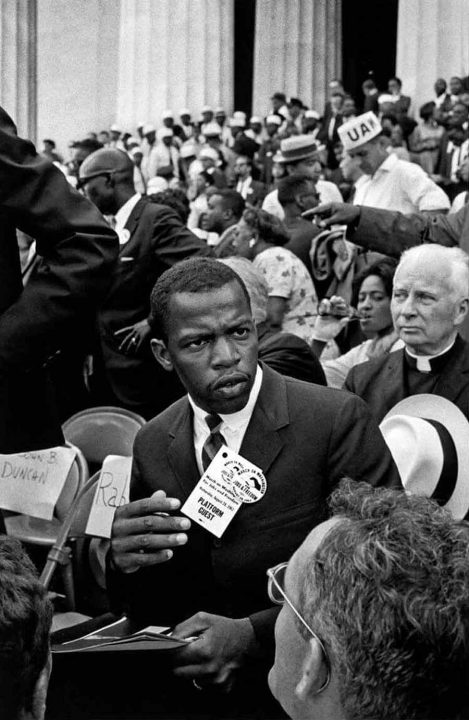
I thought of the March on Washington in 1963, when a 23-year-old John Lewis, a seasoned veteran of the freedom movement by then, stood before a crowd of thousands to deliver one of the keynote addresses. I thought of his years of public service and how his principled stand on human rights, environmental justice, and religious pluralism had become beacons of hope for a wayward society lost in the wilderness of racism, materialism, and moral relativism.
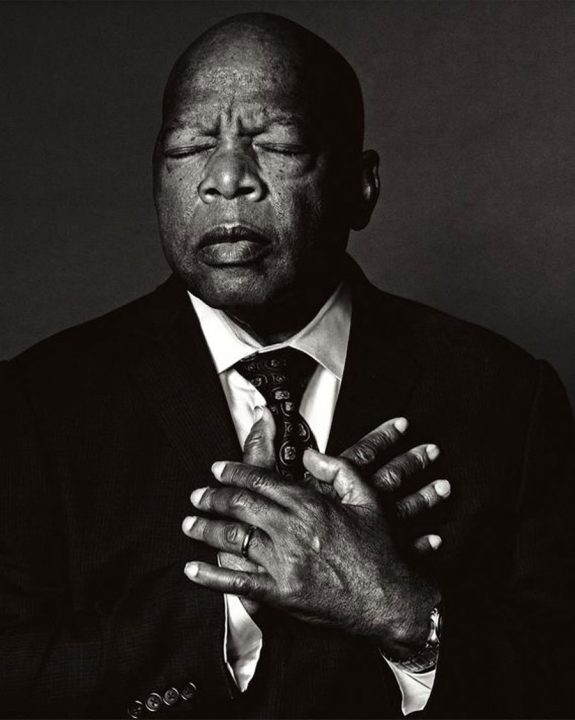
Yes, John Robert Lewis, diminutive in stature yet possessing monumental courage, cast a long shadow that I felt honored to stand in. So, as I waited, my palms sweating in anticipation, I steadied myself to meet a man who had contended with the forces of evil in life’s public arena many times over. The cuts and bruises his body suffered, wounds still visible today, show the scarred evidence of his moral convictions. The desecration of the flesh and the consecration of the spirit makes those scars both painful and beautiful to see.
If you plant a seed in the ground, a tree will become manifest from that seed. The seed sacrifices itself to the tree that will come from it. The seed is outwardly lost, destroyed; but the same seed which is sacrificed will be absorbed and embodied in the tree, its blossoms, fruit and branches. If the identity of that seed had not been sacrificed to the tree which became manifest from it, no branches, blossoms or fruits would have been forthcoming.
When Congressman Lewis finally walked into the room and I rose to greet him, it felt, in some sense, like a confluence of histories. In his seven decades, he had seen and done so much. His life and the lives of many others – some known, some unknown – represented the sacrificial seeds from which my freedoms germinated. My generation entered the world on the worn heels of those who had marched towards a future made from the mystical intercourse of faith and fortitude. We were the children of the midwives of the movement, men and women alike, who birthed us into a world a little less threatening than the one they had known.
As we shook hands and I looked into his deep, knowing eyes, I could sense a kind of stillness, a quiet nobility, the acquired dignity of the tested. That grounding force seemed to anchor him to some unstated principled conviction. In his smile, I saw a calming reassurance. I felt a deeply rooted joy, an earned contentment known only to those who have offered up the best of themselves in service to others. In that same talk, Abdu’l-Baha said:
… man must sacrifice the qualities and attributes of the world of nature for the qualities and attributes of the world of God. For instance, consider the substance we call iron. Observe its qualities; it is solid, black, cold. These are the characteristics of iron. When the same iron absorbs heat from the fire, it sacrifices its attribute of solidity for the attribute of fluidity. It sacrifices its attribute of darkness for the attribute of light, which is a quality of the fire. It sacrifices its attribute of coldness to the quality of heat which the fire possesses so that in the iron there remains no solidity, darkness or cold. It becomes illumined and transformed, having sacrificed its qualities to the qualities and attributes of the fire.
I spent 45 minutes with John Lewis that day, telling him about my artistic vision, how I hoped to bend light and shadow to tell a painful story. Mostly, though, I listened. I listened as he spoke about the cleansing capacity of truth. I listened as he talked about life and legacy — about the bliss of purposeful suffering and the urgent need for courage.
When I was a small boy, one of the first things I learned in art class was how to make a vessel out of clay. I remember stacking coils of red modeling clay, one on top of the other, as I dipped my fingers in water to form a weld between layers. All of the students in the class followed the same painstaking process, yet all of the cups looked slightly different. Some were slim, some were more rotund. Others slumped a little to one side or the other, but the one quality they all had in common was they could all hold water. This essential capacity defined their function.
Spending time with John Lewis reminded me of that important lesson. Leadership has no definitive form. It can reside in anyone. The person embodying it can be large or small, Black or white, male or female, rich or poor, educated or not. If the heart is open, we can recognize its substance and its fundamental irony: the path to leadership runs through the crucible of service, and the road to nobility admits only the sincerely humble.
As I gathered with Congressman Lewis and others for a group photograph before I left, I noticed his powerful posture of submission. He stood there with his hands clasped in front of him, and his head slightly bowed – his face radiant with a beautiful smile. In the photograph, it is evident that I am several inches taller than him, but I knew I was in the presence of a giant.
Ultimately, the proposed memorial wasn’t realized, despite the congressman’s enthusiastic support. The divisive nature of politics can grind many worthwhile projects to a halt, but for me, that isn’t what I remember most. I remember, for a brief moment in time, in an office in an unassuming building in downtown Atlanta, I sat and talked with John Robert Lewis, a servant, a quiet warrior for justice, a humble leader.
…man must become evanescent in God. Must forget his own selfish conditions that he may thus arise to the station of sacrifice. It should be to such a degree that if he sleep, it should not be for pleasure, but to rest the body in order to do better, to speak better, to explain more beautifully, to serve the servants of God and to prove the truths. When he remains awake, he should seek to be attentive, serve the Cause of God and sacrifice his own stations for those of God. When he attains to this station, the confirmations of the Holy Spirit will surely reach him, and man with this power can withstand all who inhabit the earth.
How do we move towards a more inclusive reality beyond the trappings of adversarial partisan politics?
We might want to try these six unity-building principles from the Baha’i teachings. They aren’t answers in themselves, but rather they suggest a new way of looking at the world that can allow for diverse people to contribute to a dynamic process of community transformation.
1. The Oneness of Humanity is a Universal Truth
We as a human race are increasingly coming to recognize our oneness. We are one interconnected human family in the most literal sense: genetic studies prove that every one of us is a distant cousin to every other human being on Earth. We live on one common planetary homeland and share one common biosphere, and we are now living in a moment of intensifying global interdependence. Pollution and war in one part of the world causes ripples that effect every other part of the planet, whether by contaminating a shared water source or by displacing millions of people across borders. We are so deeply connected it is as if we are the cells of one body, and if one part of the human body is sick or distressed, the rest of the body will suffer as well. We need a new model of social organization, so recognizing the fundamental truth of humanity’s oneness is paramount.
2. Humans Have the Capacity for Cooperation
The idea that humans are essentially selfish and must fight for power over others is part of the fabric of the world’s political life. But humans aren’t intractably corrupt, selfish, and aggressive; we also have the capacity for cooperation, reciprocity, and mutual service. What we need, now more than ever, are forums for community development that revolve around consultation and mutual respect. We must seek out new models of governance that reflect the human capacity for altruism.
3. Diversity is Necessary for Unity
Unity does not mean uniformity; instead we need diversity to bring new perspectives and innovation to solving our complex problems. Through a Baha’i model, the voices of those who have been historically the most marginalized must be brought to the center. The colonial and imperial projects that have oppressed masses of people over hundreds of years have their legacy in social structures that still value the privileged few. Real social prosperity can’t be realized until we have a framework that incorporates diverse voices from all segments of society into the work of governing human affairs.
4. Social Change Demands Universal Participation
Today people all over the world are mired in a culture of expecting the “experts” to solve our problems: waiting for elected politicians or other community leaders to make things right. How can we empower each other to see ourselves as agents of change within our local communities and focus on the positive change we can each contribute to? How can we break free from the false dichotomies of “the advanced” and “the backward”, the “developed” and the “underdeveloped?” All people must have a seat at the table, because each person is the real expert of his or her life.
5. History can be Reframed
Just like the development of an individual through stages of infancy, childhood, and adolescence, humanity has evolved from a “childhood” of independent tribal societies through an “adolescence” of more complex and integrated national communities. We now stand at the cusp of a collective coming of age: the emergence of a truly global civilization. More and more, we can see the emergence of worldviews that emphasize humanity’s unity and oneness. Some people still cling to the old narratives that say, “it always has been and always will be this way,” but we are living through a time of advancing global interdependence that has never been seen before. Now everyone on Earth has the choice to learn to accept responsibility for the welfare of the entire human family.
6. Humans Have Both a Spiritual and Material Dimension
Our spiritual dimension is as important our material dimension, and we desperately need social structures that provide for the development of both. This is not an assertion of a particular religious ideology. Rather, it expresses the idea that many people do feel love and connection to the Earth, to other humans, and to that unknowable essence that some people call God. Beyond having basic material necessities for survival, people need spiritual healing. People need to feel loved. The development of spiritual qualities such as love, justice, trustworthiness, patience, and gratitude, help us to connect authentically with each other and to contribute to social progress.
Moving Beyond the Political Divide
The solutions to the complex problems we face will not come easily, and they can’t be reduced to simple slogans. The reality of unity will only emerge organically, in relation to how well we as citizens build authentic bonds of trust, conquer our prejudices and establish new forums for true collaboration.
How long will humanity persist in its waywardness? How long will injustice continue? How long is chaos and confusion to reign amongst men? How long will discord agitate the face of society?… The winds of despair are, alas, blowing from every direction, and the strife that divideth and afflicteth the human race is daily increasing. The signs of impending convulsions and chaos can now be discerned, inasmuch as the prevailing order appeareth to be lamentably defective. – Gleanings from the Writings of Baha’u’llah, p. 216.
We can consume our time rallying against the continual assaults of a defective model of governance, or we can devote our energies towards promoting a new set of values and a new way of relating.
More than ever, we need to replace outdated modes of thought and behavior with a worldview that recognizes the oneness of humanity.