There is a higher court than courts of justice and that is the court of conscience. It supersedes all other courts. – Gandhi
There comes a time when one must take a position that is neither safe, nor politic, nor popular, but he must take it because conscience tells him it is right. – Martin Luther King Jr.
When did your last crisis of conscience happen? Large or small, we all have them. You face a tough decision, and that still small voice inside your soul says “Wait a minute. Am I doing the right thing?”
When your conscience asks you that question, it might be about something minor, something seemingly unimportant; or it might be the most important decision of your entire life.
A friend of mine told me about her recent little crisis of conscience—a vegetarian for years, she had breakfast in a restaurant with her sister, and her sister ordered eggs and bacon. “That bacon on my sister’s plate smelled so good I just could not resist. It was so good, but eating it made me feel terrible,” she said. In response, I had to tell her the old joke about the difference between eggs and bacon: the chicken was involved, but the pig was committed. (In hindsight, however, I suspect that didn’t make her feel any better.)
At the other end of the seriousness spectrum from my friend’s relatively minor crisis, the hundreds of thousands of refugees now pouring into Europe from Syria have generated a major crisis of conscience for millions of Europeans and their governments. As I write this today, Pope Francis just told a joint session of the American Congress that “We must not be taken aback by their numbers, but rather view them as persons, seeing their faces and listening to their stories, trying to respond as best we can to their situation.” This good advice—that a crisis of conscience should always first consider the human beings involved—resonates powerfully with the Baha’i teachings:
O ye beloved of the Lord! The Kingdom of God is founded upon equity and justice, and also upon mercy, compassion, and kindness to every living soul. Strive ye then with all your heart to treat compassionately all humankind… – Abdu’l-Baha, Selections from the Writings of Abdu’l-Baha, p. 158.
This short quote from the Baha’i teachings gives us three clear, specific guidelines for dealing with any crisis of conscience:
Equity and Justice;
Mercy and kindness;
Treat compassionately all humankind.
When you’re having a crisis of conscience, and trying to answer a hard moral question, first ask yourself: What’s fair and just? How could I be most equitable here?
I learned about justice and equity from my mother, who had a terrific way of showing us fairness—when I was a child, and my little brother and I got a treat, we would usually have to split it. A brownie, a candy bar, a banana—no matter what it was, it needed to be shared fairly and equitably. Mom’s rule: one person cuts it in half, the other one chooses. I guarantee it—you’ve never seen such precise and careful measuring. Since I was usually the one to divide the treat, and my brother got to choose first, I made sure each half perfectly reflected the other half. Try it: one cuts, the other chooses.
Once you’ve determined the fairness of the situation, you can begin to apply a liberal personal dose of mercy and kindness. Most crises of conscience are driven not only by questions of justice, but also by questions of kindness. Ask yourself: how could I best respond to this crisis of conscience and act with the most mercy and kindness? This step encourages everyone to consider, when their crisis of conscience comes, the effects their decision will have on the others around them. Our minds all want fairness, but our hearts and souls want love and kindness even more.
One person I know recently faced a crisis of conscience when he had to decide how to respond to an insult. He heard from a third party that a friend—or at least someone he had thought of as a friend—had said something negative about him. He knew that the just and equitable path involved going directly to that friend and asking him about it, but he felt that a direct confrontation would only make things worse—and compromise the one who told him about the insult. So he decided, in the interests of tempering justice with mercy and possibly sustaining the friendship, to increase his efforts to be kind toward his backbiting friend. After a month of that effort, without ever mentioning it, he received an unsolicited apology for the insult, and knew he had made the right decision.
Then, finally, you can consider how your crisis of conscience will reflect the virtue of compassion toward all humankind.
This initially sounds similar to the second decision-making step, with its focus on mercy and kindness, but factoring in compassion toward all involves another, even higher level of consideration. Compassion means deep sympathy, and that emotion allows us to put ourselves in the place of others and then contemplate the long-term results on humanity, on posterity and on the planet. With the third, compassionate step, the Baha’i teachings ask us to consider the impact of our conscience and its decisions on the whole world—to become world-minded.
Here’s a simple example: I have a friend who needed a new car, and after discussing it he realized he had to balance his desire for something fast, low and red with his desire for a livable future for the world’s children. He faced a crisis of conscience between his own warring desires. He wound up with something in between—shiny and red, but also with a very low impact on the environment. That choice, he told me, he saw as the most compassionate toward future generations.
Everyone has decisions to make, and we all have to factor in the impact of our conscience on those decisions. If you use this simple three-step tool to make your moral choices—justice, kindness and compassion for all humanity—it will transform those decisions into ones truly congruent with your innermost values.
If you’ve ever grieved over a major loss in life, you know how profoundly painful it can be – so is there a way to creatively transform that pain into something else, something better?
Grief and loss can trigger many emotions and physical responses, some we can anticipate, some of which we cannot.
But despite how terrible we may feel in our grief and loss, this passage from Abdu’l-Baha humbly reminds us of the deep purpose and power of grief in our own personal development: “Grief and sorrow do not come to us by chance, they are sent to us by the Divine Mercy for our own perfecting.”
Emotions of grief and loss can be triggered through the death of a loved one, but also by the loss of a relationship or a job, or a decline in health, or even from tragedies that happen to others. Oftentimes, when we experience such traumatic events, we feel unlike ourselves, clouded, heavy-hearted and out of sorts with the world. Other issues such as depression, physical illness, and confusion begin to come to the surface. As a result we feel out of control and develop the inability to articulate in words how we feel and how we process our loss or trauma.
Men who suffer not, attain no perfection. The plant most pruned by the gardeners is that one which, when the summer comes, will have the most beautiful blossoms and the most abundant fruit. The labourer cuts up the earth with his plough, and from that earth comes the rich and plentiful harvest. The more a man is chastened, the greater is the harvest of spiritual virtues shown forth by him.
So the next time you find yourself grieving, make art. The arts offer us all a wonderful opportunity to process grief, express our inner thoughts, and channel unspeakable and difficult-to-verbalize feelings.
Participating in a creative activity encourages us to use our imaginations, and detach ourselves from the pain we feel in moments of sadness. Unlike bottling up our feelings inside, the arts invite us to nurture our emotions in creative ways in a safe space. By being creative in times of loss and grief, we give ourselves license to express our imaginative powers and become open to divine inspiration. When we open our hearts to grieving through art and creation, we open ourselves to a conversation, one of meditation and spiritual communion:
A conversation can be held, but not as our conversation. There is no doubt that the forces of the higher worlds interplay with the forces of this plane. The heart of man is open to inspiration; this is spiritual communication. As in a dream one talks with a friend while the mouth is silent, so is it in the conversation of the spirit. – Abdu’l-Baha, Paris Talks
Engaging in any creative process gives us a break from cogitating, talking and doing, to simply being in the moment. By taking part in an artistic practice, it can act as the thread between our heads, hearts and hands. Reflecting on the outcome of our creative process often enables us to tell our story and process our emotions outside the moments of loss and grief.
Creating beauty out of pain can be incredibly cathartic, and also reinforces our resiliency as humans. For many artists, experiences of grief, sorrow, and adversity often lead to some of their greatest works. This is not to say that all artists should attempt to lead miserable lives, or continuously torture themselves, but that adversity could also present future opportunities and a depth in their work that otherwise could not be achieved:
O sincere servant of the True One! I hear thou art grieved and distressed at the happenings of the world and the vicissitudes of fortune. Wherefore this fear and sorrow? The true lovers of [Baha’u’llah], and they that have quaffed the Cup of the Covenant fear no calamity, nor feel depressed in the hour of trial. They regard the fire of adversity as their garden of delight, and the depth of the sea the expanse of heaven. – Abdu’l-Baha, Selections from the Writings of Abdu’l-Baha
Research has shown that the grieving process has various stages. Denial, pain, anger, and depression can transition into an upward turn, reconstruction and acceptance. An artistic practice allows us to experience these extreme emotions in a safe way, and enables us to feel empowered to accept and then process the grief and pain, mobilizing us on the path toward healing. Like any language, art provides the key that enables us to speak the true feelings of the heart:
… the function of language is to portray the mysteries and secrets of human hearts. The heart is like a box, and language is the key. Only by using the key can we open the box and observe the gems it contains. – Abdu’l-Baha, The Promulgation of Universal Peace
By transforming our grief and sorrow into art, we can also pray to the Creator, detaching ourselves from the difficulties of this earthly life and asking for his protection and guidance. After all, Baha’u’llah has blessed those who engage in the arts and handicrafts, considering artistic endeavor as a form of worship – so why not use our pain as a way to grow closer to God, by engaging in creativity?
Blessed is he who in the days of God will engage in handicrafts. This is a bounty from God, for in this Most Great Dispensation it is acceptable in the sight of God for man to occupy himself in a trade which relieveth him of depending upon charity. The craft of every craftsman is regarded as worship. – Baha’u’llah, from a tablet translated from Persian.
Dear readers: I’d love to hear from you and learn about the creative ways you’ve channelled your sadness and grief. Please share in the comments below!
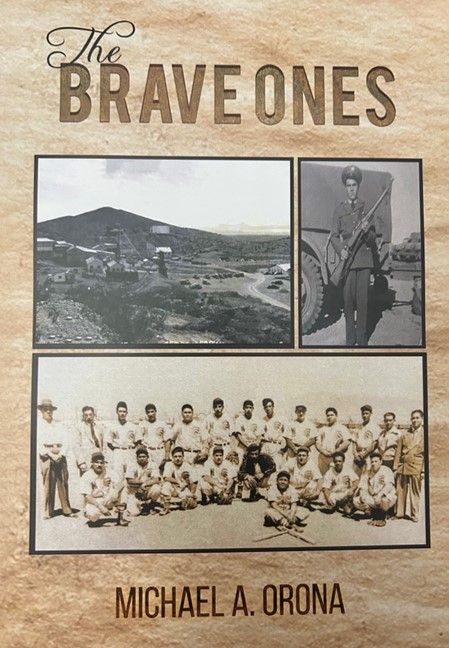
In “The Brave Ones,” Michael Orona’s compelling narrative transcends beyond physical courage and delves into spiritual courage and resilience, highlighting the power of remaining steadfast in the face of oppression. As Baha’u’llah, the prophet and founder of the Baha’i Faith, wrote:
The source of courage and power is the promotion of the Word of God, and steadfastness in His Love.
Inspired by his personal experiences, family history, and the Baha’i teachings, Michael Orona discusses how the characters in his novel embody this spiritual courage and steadfastness, reflects on the ongoing fight for representation, and explores the lessons his book offers for today’s social justice movements.
Michael Orona
Radiance Talley: Hi, Michael! The title “The Brave Ones” suggests acts of courage. How do your characters embody spiritual courage, and how does this align with the Baha’i view of steadfastness in the face of injustice?
Michael Orona: The title “The Brave Ones” carries deep spiritual significance that goes far beyond physical courage. It’s about a profound inner transformation and the courage to reimagine human possibility in the face of systemic oppression.
Spiritual courage, from a Baha’i perspective, isn’t about confrontation, but rather the ability to maintain dignity, hope, and foresight when every system is designed to break your spirit. My characters embody this through their refusal to be defined by their circumstances.
Consider the Baha’i principle articulated by Shoghi Effendi about the American believers’ special calling — to have the “moral courage and fortitude” to address fundamental issues facing humanity. The characters in the book live by this principle. They’re not just fighting against discrimination; they’re creating alternative models for the advancement of not only their own community, but also for the advancement of their oppressors.
The Indigenous peoples in the story — members of the Yaqui Nation from Sonora — represent this beautifully. They could have accepted their limited circumstances. Instead, they dream beyond their immediate reality and then act. Their dreams and the action to make them a reality symbolize hope — a spiritual act of resistance that transcends physical constraints.
Abdu’l-Baha’s teachings profoundly influenced how I conceived spiritual courage. He spoke about the Indigenous peoples of America having the potential to “enlighten the whole world” if properly educated and guided. My characters embody this — they’re not victims waiting to be saved, but transformative agents with inherent spiritual power.
“The Brave Ones” is a testament to this spiritual courage — a celebration of Indigenous peoples who refuse to be broken, who see beyond current realities to potential futures of unity and justice. I believe this embodies us as Native people, it’s who we are.
Radiance: Did you draw from personal experiences, oral histories, or Baha’i teachings on the value of diverse cultures?
Michael: The book is deeply rooted from personal experience, family narratives, and the Baha’i teachings that have shaped my life.
Growing up, I was steeped in my Indigenous cultural heritage in large part to the profound support of my late Apache father, Dr. Joel Orona, and my Yaqui mother, Esther Orona. Storytelling wasn’t just a tradition in our family — it was a way of preserving history, of maintaining cultural identity, and spiritual development. The oral histories my grandparents and elders shared with me as a child were living histories, not just personal narratives but collective experiences of resistance, resilience, and survival. It was through these stories that I was taught the importance of being of service not only to my own community, but to the global community. It was through these stories that I was reminded of the responsibility to honor the legacy of my ancestors.
As a child of the 1970s, I was acutely aware of the lack of diversity and limited representation of Indigenous peoples in the media. I remember watching television or going to the movies and rarely seeing people on screen who looked like me. Those rare times when Indigenous people were portrayed, it was done by non-Native actors in a demeaning manner. The watershed moment for me was watching Alex Haley’s “Roots” on television — a chronicle that brought the history of African Americans to the forefront. The importance of seeing the struggle and unique perspective from another marginalized community gave me hope that someday I would have the opportunity to share the historical challenges and success of my own people.
The Baha’i teachings were instrumental in shaping my perspective on cultural diversity. Baha’u’llah’s message on this topic was revolutionary, it was not about reforming existing social norms, but fundamentally shattering the very notion of racial superiority. This wasn’t just a social justice message, but a message of spiritual transformation.
Abdu’l-Baha’s teachings were particularly profound in the writing of the book. He spoke about the unique spiritual potential of Indigenous peoples, stating we will “enlighten the whole world” and serve as spiritual “standard bearers.” This isn’t patronizing but rather the sincere belief, acknowledgment, and recognition of the inherent spiritual wisdom found within Indigenous communities that have been historically and systematically marginalized.
Ultimately, the book is an embodiment of the Baha’i principle of the oneness of humanity. It’s not just about documenting historical struggles, but about creating a vision of human potential that transcends racial, cultural, and historical divisions.
Radiance: How do the themes of “The Brave Ones” resonate with today’s social justice movements? What lessons can readers draw from this historical narrative?
Michael: The story of “The Brave Ones” is not just a historical account, but a powerful lens through which we can understand the ongoing struggles for equity, solidarity, and human dignity. I believe the narrative of Indigenous peoples fighting for equality in partnership with African Americans speaks directly to the intersectional nature of social justice movements today.
First and foremost, the book illuminates the power of unexpected alliances. At a time of profound racial discrimination, these communities found strength in their shared marginalized experience. Today, we see similar dynamics in modern social justice movements — whether its organizations focused on Indigenous rights, economic empowerment, or struggles against systemic oppression. The lesson is clear: solidarity and collaboration across different marginalized communities is not just possible, but essential.
The book underscores how systemic discrimination creates seemingly insurmountable barriers. Members of the Yaqui community in the book faced limited opportunities, forced to live under difficult circumstances with little hope for advancement. This mirrors the ongoing challenges faced by Indigenous peoples around the world and other communities of color — unequal access to education, economic opportunities, and social mobility. Yet, the story is ultimately one of hope and resistance, showing how collective action can challenge and ultimately transform unjust systems.
Moreover, the narrative underscores the importance of telling our own stories. For too long, Indigenous peoples have been relegated to the margins of historical narratives, our experiences either silenced or misrepresented. “The Brave Ones” is part of a broader movement to reclaim our narrative, to center Indigenous voices and perspectives. This resonates deeply with contemporary calls for authentic representation and self-determination.
The themes of dignity, resilience, and a shared humanity are particularly relevant in our current social and political climate. We continue to grapple with historical injustices, systemic racism, and the ongoing impacts of colonization. The book offers a blueprint for understanding how communities can come together, recognize their common struggles, and work toward collective liberation.
I was inspired to write this story by the experiences shared by my grandparents and their generation — a reminder that our current struggles are deeply connected to historical experiences of oppression and resistance. The book is not just about the past; it’s a call to action for today’s generation to continue the work of building a more just and equitable society.
Ultimately, “The Brave Ones” teaches us that change is possible when we recognize our shared humanity, when we have the courage to challenge the status quo, and when we stand in solidarity with one another. It’s a message of hope that I believe is more crucial now than ever before.
Radiance: A reviewer mentioned that this story “finally broke the barrier” for Indigenous people to tell their own stories. What challenges do Indigenous authors face in having their narratives published and recognized, and how does the Baha’i Faith encourage perseverance in such efforts?
Michael: The publishing world has long been a gatekeeping system that marginalizes Indigenous voices. For generations, our stories have been told through a colonial lens — filtered, misinterpreted, and often romanticized or vilified by non-Indigenous writers. Breaking through these barriers requires persistent courage and a commitment to authentic storytelling.
Indigenous authors face multiple systemic challenges. First, there’s the structural inequality in publishing: limited representation in editorial boards, fewer publishing opportunities, and a publishing industry that historically prioritizes mainstream narratives. Many publishers view Indigenous stories as niche or unmarketable, failing to recognize the universal humanity and complexity of our experiences.
Our narratives are often expected to conform to stereotypical expectations — stories of trauma, historical suffering, or exotic cultural experiences that fit comfortable narratives about Indigenous peoples. But we are not museum artifacts or historical footnotes. We are a living, evolving people with rich, nuanced stories that speak to contemporary human experiences.
The Baha’i Faith has been instrumental in giving me the spiritual strength to persist. The principles of the Baha’i Faith, including the oneness of humanity, universal education, and the independent investigation of truth, are not philosophical concepts, but active guides for my writing and activism. The Faith encourages us to see beyond divisive boundaries, to recognize the inherent worth of every human being, and to work tirelessly for justice and understanding.
When I face rejection or encounter systemic barriers, I draw strength from the Baha’i teachings about perseverance. We believe that true progress comes through consistent, compassionate effort. Just as the members of the Yaqui community in my book refused to be defined by their circumstances, I refuse to let institutional barriers silence our stories.
The process of writing “The Brave Ones” was itself an act of spiritual and cultural resistance. By centering Indigenous agency, showing our community’s resilience, and highlighting our partnerships across racial lines, I’m challenging the dominant narratives that have historically marginalized us.
Moreover, my work is part of a broader movement of Indigenous authors reclaiming our narrative space. Indigenous authors have been instrumental in breaking down these barriers, proving that our stories are not just important — they are essential to understanding the full complexity of the human experience.
My Faith teaches me that every voice matters, that every story has the potential to bridge understanding. By persistently sharing our narratives, we challenge systemic inequities and create opportunities for genuine dialogue and mutual respect.
This is why “The Brave Ones” is more than a book. It’s a testament to the power of storytelling as a form of cultural preservation, resistance, and hope.
Radiance:Thank you, Michael, for sharing your profound insights and reflections. If you all are enjoying this Q&A, be on the lookout for part threewhere we’ll discuss practical actions we all can take to promote justice and harmony!