Sometimes we make mistakes; occasionally we make very serious mistakes. We get angry at ourselves. We kick ourselves for being “so stupid.” We wish we could undo what we’ve done….
Those without a belief in God argue that humans come from nature – that no God exists, just a wondrously capable natural system that has provided the perfect matrix for the development and sustenance of human life.
However, when we study nature we see that all things exist within the constraints of their central tendencies. From the atom to the molecule to the cell to the animal to the sun, each of the elements of nature accords to its prescribed pattern without any statistically meaningful deviation:
Nature is subjected to an absolute organization, to determined laws, to a complete order and a finished design, from which it will never depart… For instance, the nature of fire is to burn; it burns without will or intelligence. The nature of water is fluidity; it flows without will or intelligence. The nature of the sun is radiance; it shines without will or intelligence. – Selections from the Writings of Abdu’l-Baha, pp 1-2.
Only one exception to this binding arrangement exists: the human being. We manifest both will and intellect, and we quite regularly transcend the natural laws that govern our existence on earth:
One of the things which has appeared in the world of existence, and which is one of the requirements of Nature, is human life. Considered from this point of view man is the branch; nature is the root. Then can the will and the intelligence, and the perfections which exist in the branch, be absent in the root? – Selections from the Writings of Abdu’l-Baha, pp 3-4
If nature created us, how can a system that lacks our capabilities be our essence and author?
The extraordinary exactitude of the dynamic complexity that precipitated the natural laws which order our world boggles the mind. We have will and intellect, but can we say we have a thorough or even accurate understanding of our world? No one who has watched another succumb to a virus or an accident, despite the best efforts of the best minds, can subscribe to the illusion of human control, much less claim to fully understand the wonder of the world around us:
Now, when you behold in existence such organizations, arrangements and laws, can you say that all these are the effect of Nature, though Nature has neither intelligence nor perception? If not, it becomes evident that this Nature, which has neither perception nor intelligence, is in the grasp of Almighty God, Who is the Ruler of the world of Nature; whatever He wishes, He causes Nature to manifest. – Selections from the Writings of Abdu’l-Baha, pp 3-4.
We who stand at the apex of understanding in the natural world cannot entirely understand ourselves, much less the world that sustains us. That realization gives us grounds to admit the possibility of an unknown Creator. The great physicist Albert Einstein, when asked if he believed in a Supreme Being, famously used this homely analogy to answer: “When I see a piece of toast, I know somewhere there is a toaster.”
Baha’is believe God is an unknown essence to his creation:
To every discerning and illuminated heart it is evident that God, the unknowable Essence is immensely exalted beyond every human attribute, such as corporeal existence, ascent and descent, egress and regress. No vision taketh in Him, but He taketh in all vision; He is the Subtle, the All-Perceiving. – Gleanings From the Writings of Baha’u’llah, p. 346.
God, as our author and essence, transcends human evaluation. The fact that no one can offer a conclusive proof of the existence or non-existence of God is in itself a particularly elegant proof. Whatever arguments we use, in the final analysis, are creations of our own minds, incapable of completely knowing God. We can, however, elect to believe and act in accordance with what we understand to come from God.
This choice – the conscious selection of faith in the absence of conclusive proof – remains our greatest test as individual human beings.
Didst thou behold immortal sovereignty, thou wouldst strive to pass from this fleeting world. But to conceal the one from thee and to reveal the other is a mystery which none but the pure in heart can comprehend. – The Hidden Words of Baha’u’llah, p. 3
Nevertheless once we make the choice to act on a belief that a seed once planted will bear fruit in the future we have attained the power and blessings of the Kingdom of God in this world and the next. In conclusion consider the passages from the New Testament and the Baha’i Writings.
Truly I tell you, if you have faith as small as a mustard seed, you can say to this mountain, ‘Move from here to there,’ and it will move. Nothing will be impossible for you. Matthew 17:20
“As ye have faith so shall your powers and blessing be. This is the balance. This is the balance. This is the balance.” Baha’i Writings.
When my husband and I first saw the results of the tests on our new baby growing in my womb, we both cried. But after all the excellent advice from friends and relatives and professionals, we started to realize we could do more. I began singing Baha’i prayers for children, like this one:
O God! Educate these children. These children are the plants of Thine orchard, the flowers of Thy meadow, the roses of Thy garden. Let Thy rain fall upon them; let the Sun of Reality shine upon them with Thy love. Let Thy breeze refresh them in order that they may be trained, grow and develop, and appear in the utmost beauty. Thou art the Giver. Thou art the Compassionate. – Abdu’l-Baha, Baha’i Prayers, pp. 34-35.
As I sang I modified the words: “O God educate my child. My child is a plant in thine orchard”, etc.
And I prayed for acceptance and protection, including this one from The Bab:
Immeasurably exalted art Thou, O Lord! Protect us from what lieth in front of us and behind us, above our heads, on our right, on our left, below our feet and every other side to which we are exposed. Verily Thy protection over all things is unfailing. – Selections from the Writings of the Bab, p. 172.
Our wise midwife gave us spiritual guidance, too, advising us to talk to the baby and explain, in facts, what information we had; and to explain that these emotions mommy and daddy feel occur because we are upset and have a lot to process and try to understand.
She suggested my husband and I sit in meditation to:
Connect to our own souls, to see what inner guidance we receive about this situation connect to the baby’s soul, and listen quietly for what the baby’s soul would like to say connect all three of us as a family unit. Talk aloud to each other as parents, talk to the growing baby in utero and simply listen.
When I sat quietly meditating, my newly-blossoming mother’s intuition told me “Everything is going to be fine. Everything is healthy.” I even wrote in my journal one simple sentence on a page during this time: “I know you are perfect.”
When I sat quietly after having talked to my baby’s soul, I silently asked, “Is there anything you’d like to say.” And I heard one, simple, strong reply, “I’m here to live.”
The process of connecting spiritually through both prayer and meditation gave me a solid foundation. Those days and weeks following the testing filled us with high emotions, and from one moment to the next I never knew when tears, fears and sadness would overcome me. In these moments of prayer and meditation, I can now see, I grew my spiritual roots. They cracked down through rock, soil and sediment to root me to a new reality.
Recently, some of the friends I’ve shared our experience with have mentioned, in different ways but with a similar message: the first time our child undergoes anything that can cause harm or interfere with optimal health, we experience how fragile life is and our love deepens. In loving our child more, we experience fear, but we also experience faith. Welcome to parenting, they said.
I couldn’t have asked for a better man alongside whom to start my parenting. In the perinatologist’s office, the darkest picture of the future went through my mind. I cried uncontrollably. My husband hugged me as I wept on his shoulder. He whispered in my ear, “I know. I know. I feel the same way.” And in that moment, I felt such consolation and love.
Through taking the time to process emotions, soak up the love from my husband, family and friends, and connect within through prayer and meditation, our decision for which follow-up test to undergo became clear. I needed that support to follow through and steel myself to go in for the final test.
I want to share with you that everything is okay! The test confirmed that we have a healthy baby, growing in my rapidly-expanding womb. The blood work came back negative, and the follow-up exam indicated healthy, normal growth. I have never had more thrilling news.
My days now fill with a deep gratitude every time I feel this baby move. I am keeping up my healthy eating, walking, exercise; continuing to talk to the baby, pray and write thoughts in a journal that one day, along with these essays, I will look forward to sharing with my first child.
Here we go again! Every time we need to discuss something, we have trouble doing it without fighting. Help! Having effective discussions and reaching peaceful, workable agreements often challenges married…
These days, more and more people are identifying with the term “feminist” to show their support for women. While there is an increased popularity in being a feminist and proclaiming the equality of men and women, I have noticed that in trying to achieve equality, many people either purposefully or accidentally use oppressive standards that can turn into subtle forms of misogyny. Despite their popularity, feminism and gender equality often go misunderstood.
One of the most persistent questions I have had in my thinking about these things is: Does feminism mean holding women to the same skewed standards we’ve historically held men?
The Baha’i Writings emphasize the need for humanity to end the oppression of women so that we can address other issues in our society. In his book “The Promulgation of Universal Peace,”Abdu’l-Baha, the son of Baha’u’llah, the prophet and founder of the Baha’i Faith, wrote: “The world of humanity consists of two parts or members: one is woman; the other is man. Until these two members are equal in strength, the oneness of humanity cannot be established, and the happiness and felicity of mankind will not be a reality.”
It can be hard to understand how different issues interconnect. The widespread oppression of women has all kinds of effects that we aren’t aware of because we’re so used to an unjust reality. For example, Abdu’l-Baha explained that warfare is tied to gender inequality. He said that “equality between men and women is conducive to the abolition of warfare for the reason that women will never be willing to sanction it… There is no doubt that when women obtain equality of rights, war will entirely cease among mankind.”
In contrast, I have seen people push for women to behave in ways men are socialized to act. Men are often socialized to act emotionlessly, over-assertively, and aggressively instead of seeing emotional vulnerability, empathy, and kindness as strengths. Likewise, emotionally available or stereotypically “feminine” women are often seen as less worthy of respect, or “less progressive.”
Regardless of how they present themselves to the world, women receive judgment based on the choices they make in their work, their personal and professional relationships, or the way they dress. Similarly, they might feel pressured to be less emotional or behave in sexually exploitative ways — just as men have historically been encouraged to do — as proof that they are “liberated” from the oppression they face.
Instead of embracing and valuing the wide diversity of personalities all people can have, people mistake equity as holding the same skewed standard for everyone This misunderstanding of feminism just creates a new box around women.
The Baha’i Writings say that as stereotypically feminine values come to the center of our society, many of the world’s issues will begin to heal: “The happiness of mankind will be realized when women and men coordinate and advance equally, for each is the complement and helpmate of the other.”
This requires ending another subtle form of misogyny: when women’s comments are pushed aside or consistently left unaddressed in conversations, simply because they disagree with men’s opinions. When it comes to communicating empathetically and compassionately about their rights, women aren’t meant to carry the brunt of the work.
The Baha’i Writings encourage folks of all different backgrounds and identities to step up to the plate. While men are often socialized to be more combative, stubborn, and argumentative than women, they can work towards more gentle and careful forms of communication, uplifting the voices of women and beginning to bridge the gap between genders.
Abdu’l-Baha explained in a speech in 1911: “In order to find truth we must give up our prejudices, our own small trivial notions; an open receptive mind is essential. If our chalice is full of self, there is no room in it for the water of life.”
When we accept that our gender isn’t tied to our true essence, it becomes easier to move past antiquated gender roles and sharp divides between masculinity and femininity. Our souls do not hold a gender. As Abdu’l-Baha said in a speech in 1912, “In the estimation of God there is no gender. The one whose deeds are more worthy, whose sayings are better, whose accomplishments are more useful is nearest and dearest in the estimation of God, be that one male or female.”
Consider this idea: we have a Creator, and the Creator always speaks to us, whether we’re listening or not. You may believe this idea or disbelieve it, but just give…
A self-identifying atheist acquaintance — I’ll call him Maynard — posted questions about God on his blog encouraging any believers hanging out there to please answer.
How could I resist?
Maynard asked particularly interesting questions, which most religious people don’t think about all that much. I didn’t. Up until the time I was in my late teens, God was like air, something I depended on being there without giving much thought to its composition.
At eighteen, I seriously questioned my assumptions about things, including God. But by the time I answered Maynard’s questions, I’d spent a significant portion of my life contemplating them and researching the answers.
Maynard asked these questions because he felt “the God hypothesis” wasn’t granular enough. He wanted every detail filled in. An interesting request, in view of the fact that few, if any, scientific hypotheses leap fully formed from even the most advanced minds. Least of all do they leap forth proven, or even with enough evidence to satisfy the scientific community.
Anybody remember back when Walter and Louis Alvarez released their first theories about the KT boundary in 1980? Though they had discovered enough evidence that a large mass had struck the Earth and caused the dinosaur die-off — enough that they were convinced of it — many scientists scoffed openly. The evidence for an impact was circumstantial. No one could observe an asteroid striking the Earth to check the evidence. No one could repair to a laboratory to do controlled experiments. Scientists demanded a smoking gun — or, in this case, a smoking crater. The debate became rancorous, to put it mildly.
The Alvarez’s ideas have since come to be widely accepted as scientific fact. This underscores the strength of the scientific method as a means of studying physical reality and building a body of evidence in support of certain beliefs about it. In my own life, faith has also been about studying reality and building a body of evidence for beliefs about the spiritual world and the human psyche — where the material and spiritual meet.
I have heard several clergymen suggest that the mind is a tool of the devil and that real faith is blind faith. I would propose, rather, that since God gave us minds and encouraged us to use them, He would be pleased if we used them to discover Him with as much zeal as we use to discover the physical laws He set in motion.
Indeed, Baha’i scriptures insist that faith should not be blind because such blindness (not knowing why we believe something) can lead to dogma, fundamentalism, schism, and worse. So, without further ado, here are the questions Maynard asked the believers who frequented his blog spot:
Is God a (a) material or (b) non-material entity? (i.e., is God made up of the same kind of stuff like protons, electrons, etc. with properties like mass, charge, spin, etc. that every other thing in the universe is made up of, or is he made of something that is non-material?)
Does God exist everywhere in space?
Is God a sentient being like us, with thoughts and feelings?
Can God change the past?
Does God know the future?
Does God know absolutely everything that happens every moment, including every thought of every being?
Can god intervene in events whenever and wherever, to violate natural laws and change their course (i.e. perform miracles)?
Do you believe that you have a soul or spirit that will continue to exist in some form (perhaps reincarnated) even after you are dead?
As you can see, a number of these questions deal with the concepts of omniscience and omnipotence. Without actually putting it into words, Maynard posed the age-old theological conundrum: Could God create a rock too heavy for Him to lift? (My answer: Why would He want to?)
The questions draw on a number of assumptions around God’s power and abilities, and whether our concept of something being “made” applies to God. Everything we can perceive has been “made” in some way, and it’s a human assumption that things must exist by being made. In other words, the question assumes that God is made just like everything else in our experience.
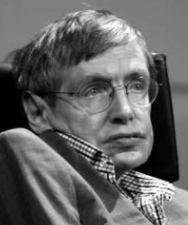
Stephan Hawking
Which, of course, leads to the problem of infinite regression and the question: What created God? Stephen Hawking asks the same question — and answers it — when he says that the universe came into being spontaneously because of gravity.
Okay. If I put that in spiritual terms, he’s saying the universe came into being because of love (attractive force). That sounds right. But whose love and for what?
Baha’u’llah wrote (speaking as an Emissary for the God in question):
“I loved thy creation, hence I created thee.”
Which brings us back to the first question about God: What sort of being might God be?
Tonight Baha’is observe the anniversary of the passing of Abdu’l-Baha, who ascended to the next world more than a hundred years ago – and left the world a legacy of universal love.
In those observances, which will take place sequentially at 1:00 a.m. in each time zone as the planet spins on its axis, the world’s Baha’is will unitedly recognize Abdu’l-Baha’s life of great service and devotion to the Baha’i ideals of peace, love, and unity. For the span of an entire 24-hour day, Baha’is everywhere will pray together, read from Abdu’l-Baha’s writings, and commemorate his unprecedented promulgation of peace.
Simply, Abdu’l-Baha lived to love and serve others. In an informal talk to a group of college students recorded in the Baha’i magazine Star of the West, he defined what any person’s loving legacy might look like — inadvertently describing his own:
Man must so live that he may become beloved in the sight of God, beloved in the estimation of the righteous ones and beloved and praised by the people. When he reaches this station the feast of eternal happiness is spread before him. His heart is serene and composed because he finds himself accepted at the threshold of His Highness, the One. His soul is in the utmost felicity and bliss even if he be surrounded by mountains of tests and difficulties. He will be like unto a sea on the surface of which one may see huge white waves, but in its deeps it is calm, unruffled and undisturbed. If he trusts his happiness to worldly objects and fluctuating conditions he is doomed to disappointment. Should he gain a fortune and anchor his happiness to that he may hypnotize himself into a state of so-called joy for a few days, and then that very fortune will become a mill-stone around his neck, the cause of his worry and melancholy.
But if he lives in accordance with the good-pleasure of the Lord he will be favoured at the court of the Almighty. He will be drawn nigh unto the throne of Majesty. He will be respected by all mankind and loved and honoured by the believers. This fortune bestows eternal happiness. The tree of this fortune is ever green. The autumnal wind does not sear its leaves nor does the frost of winter rob it of its perennial freshness. This is a happiness which is not followed by any misery but is always a source of gratefulness and blessedness. The most great, peerless gift of God to the world of humanity is happiness born of love …
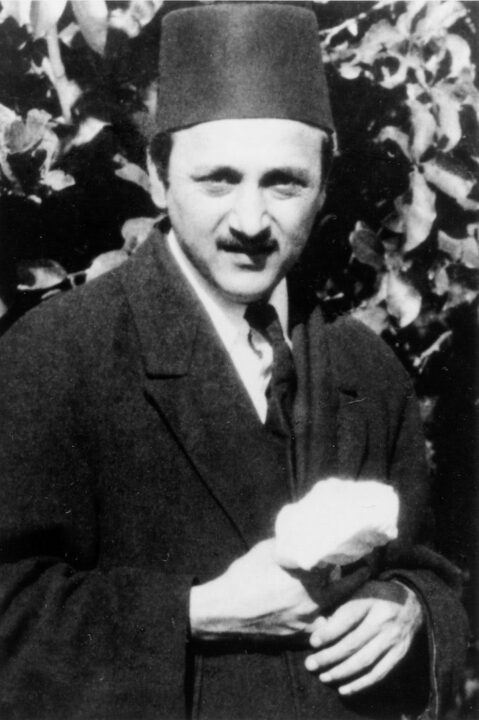
At the age of 77, on November 28, 1921, the leader of the Baha’i community, born Abbas Effendi and fondly called “The Master;” the son of Baha’u’llah, the prophet and founder of the Baha’i Faith, and the Center of his Covenant; dearly loved and revered around the world for his service to humanity and his advocacy for peace and unity; knighted by the British Empire for his work feeding the poor and averting famine in Palestine during World War I; drew his final breath and passed into the next world.
Abdu’l-Baha, a prisoner and an exile for most of his life, never let his imprisonment compromise his joy, his love, or his service to humanity.
His passing unleashed a torrent of profound distress and grief, not just for the Baha’is around the world but for everyone who knew him or knew of him. People from every religion and no religion deeply mourned. Abdu’l-Baha’s funeral service brought together even the divided Holy Land, drawing admirers from every race, religion, age, background, class, and walk of life. A great sense of loss and grief gripped those who attended, and its intensity united them. In the Holy Land, Abdu’l-Baha’s unprecedented impact, and the outpouring of emotion that accompanied it, resulted in an unparalleled funeral.
Abdu’l-Baha was memorialized and laid to rest on Tuesday, November 29th, 1921 on the slope of Mount Carmel in Haifa, Palestine. Thousands upon thousands of people walked up the steep mountainside, “A great throng,” the British High Commissioner of Palestine wrote, “had gathered together, sorrowing for His death, but rejoicing also for His life.”
The Governor of Jerusalem said “I have never known a more united expression of regret and respect than was called forth by the utter simplicity of the ceremony.”
Media observers estimated that more than ten thousand people attended: Arabs, Turks, Persians, Kurds, Armenians, Europeans, Americans, Jews, Catholics, Orthodox Christians, Anglicans, Druze, Muslims, and Baha’is, government officials and clergy and the wealthiest and the poorest, all there to show their abiding respect for the man one newspaper account called “The Personification of Humanitarianism.”
Mourning, moaning, and lamenting, the huge crowd collectively felt such a deep sense of loss that many attendees struggled with their emotions. The sounds of sobbing and weeping filled the air. The mourners wept because they had lost someone so unique and so humble, so wise and selfless and dedicated to the service of others, that they feared they had lost something irreplaceable, something enormously precious, not just a man but a truly heroic and transcendent soul.
Their sorrow was understandable. Many in that gigantic crowd literally owed their lives to Abdu’l-Baha, either for the generous donations he had given the poor for decades, or for the grain he had stored to feed the starving people of Palestine during World War I, or for his long history of tending to the sick regardless of their class or creed, or for the kind spiritual counsel he gave to everyone.
If the old saying that you can judge a man by his funeral is true, then Abdu’l-Baha’s interment produced one of the most spontaneous, profound, and public outpourings of affection, warmth and tenderness the Holy Land had ever seen — and proved Abdu’l-Baha’s teaching that happiness born of love lasts forever.
The principal teaching of the Baha’i Faith is the oneness of humanity. Baha’u’llah wrote, “The earth is but one country and mankind its citizens” over 100 years ago.
By now, we can all see that humanity is essentially interdependent; the oneness of humanity has become a spiritual truth also confirmed by all the sciences of our era. That’s the fundamental purpose of the Baha’i Faith—to “promote the unity of the human race, and to foster the spirit of love and fellowship amongst men.” – Baha’u’llah, Gleanings from the Writings of Baha’u’llah, p. 215.
However, in the United States, like many other countries that rely upon a partisan system of governance, people are accustomed to taking sides. In an extremely heated political climate, the idea of fostering the spirit of love and fellowship with someone across the political divide may seem disingenuous at best, and life-threatening at worst. Our deepest fears and longings related to economics, race equity, immigration, and justice have all tied themselves into the values of our various political parties. Our sense of social progress and justice rests with our hopes for victory over the “other side.”
But if we really want to promote the oneness of humanity, why do we accept any partisan system of social organization that necessarily divides us into camps and pits us against each other? How can we expect to arrive at a state of unity by using a process that inherently creates and fosters disunity?
As a member of the Baha’i Faith and an American, I vote—but I do my best not to identify with any political party, and I avoid engaging in political activity. This doesn’t mean that I don’t have a sense of justice or a vision for real social transformation. I do. I just think that partisanship is fundamentally inimical to the principle of humanity’s oneness, and therefore it cannot logically move us forward to a place where the principle of oneness forms the basis of governance.
The Limits of Partisan Politics
Political polls continually show that Americans are bitterly divided along party lines, but this shouldn’t be surprising to anyone. If anything, it should confirm that the Western liberal democratic tradition of multiparty competition is working as intended.
Our system is built around enormous and deeply questionable assumptions about human reality: primarily that humans are selfish and competitive by nature, and that it is in our own best interest to be antagonistic towards the needs, values, and interests of our political rivals. Partisan politics demands that we always have “winners” and “losers.”
In my country, across all party lines, Americans are cynical towards government and mistrustful of corporate, financial, and political corruption that serves the interests of only a few powerful people or groups. But, to many, no other way of social interaction seems possible. We are literally caught in a frantic cycle of adversarial political backlash, and social media only seems to fuel our anger, fear, and frustration.
Within this narrative, serious social change is framed in terms of rallying against the un-favored party or politician, and then electing the right party or politician who can transform society into what we want it to be. But regardless of whatever party or politician is in power, the real root of the problem is that we are trapped in a divisive “us versus them” framework of competition, with all of its inevitable corruption, which allows for certain voices and interests to be privileged over others, and which paralyzes ordinary citizens from becoming agents of change in their own communities.
The partisan political system itself, with all of its narrow, built-in assumptions about human reality, forms one of the biggest obstacles to realizing the truly united and freely-functioning countries we would all like to see.
So if we want real social transformation, honest change and justice for all, we shouldn’t be looking for the perfect new candidate. We should search for a whole new way of relating to each other, and a bold new vision of society to actively work towards.
Baha’is believe that the only way to really break free of the profound social disunity in our societies—whether politically, racially, religiously, or otherwise—is to build true, authentic human solidarity, in a systematic manner, among all people. If we really want to see positive social change, we have to learn to build unity:
The welfare of any segment of humanity is inextricably bound up with the welfare of the whole. Humanity’s collective life suffers when any one group thinks of its own well-being in isolation from that of its neighbours or pursues economic gain without regard for how the natural environment, which provides sustenance for all, is affected… The world is in desperate need of a shared ethic, a sure framework for addressing the crises that gather like storm clouds. – The Universal House of Justice, March 1, 2017.
Love and unity are the needs of the body politic today. Without these there can be no progress or prosperity attained. – Abdu’l-Baha, The Promulgation of Universal Peace, p. 171.
We spend nearly one-third of our lives sleeping and we can’t function physically without it. But I’ve often wondered if there is also a spiritual reason we need to sleep — and dream.
Does our need for sleep coincide with a desire to enter a world where the spirit can roam free without the limitations of the physical body? Dreams are one of the most fascinating phenomena that we experience in our lives, and the Baha’i writings have an answer for every question I’ve ever had about this subject.
Baha’u’llah, the prophet and founder of the Baha’i Faith, wrote that “God embraceth worlds besides this world, and creatures apart from these creatures.” He explained that the world we live in while we’re awake is completely different and separate from the dream world, which is within us and has “neither beginning nor end.”
Baha’u’llah wrote that when our spirits transcend “the limitations of sleep” and detach from “all earthly attachment,” God lets us travel throughout “a realm which lieth hidden in the innermost reality of this world.” In this dream realm, there may be messages to meditate on and secrets to discover.
It’s fascinating to think of what traveling looks like without physical means. When we are awake, there is a limit to how fast we can travel on public transportation, but, according to the Baha’i writings, we can travel throughout the planet “in sleep, in the twinkling of an eye.” In the early 1900s, Abdu’l-Baha, the son of Baha’u’llah and his designated successor and interpreter of the Baha’i writings, called this “spiritual traveling.”
Abdu’l-Baha explained, “In the time of sleep this body is as though dead; it does not see nor hear; it does not feel; it has no consciousness, no perception—that is to say, the powers of man have become inactive, but the spirit lives and subsists. Nay, its penetration is increased, its flight is higher, and its intelligence is greater.”
It seems like our spiritual powers and abilities are limitless when we dream. To help us understand this freedom we have when our physical bodies are not in charge, Abdu’l-Baha used the analogy of a bird in a cage: “Our body is like the cage, and the spirit is like the bird. We see that without the cage this bird flies in the world of sleep; therefore, if the cage becomes broken, the bird will continue and exist. Its feelings will be even more powerful, its perceptions greater, and its happiness increased.”
Abdu’l-Baha further explained the powers and freedoms our spirits have in the dream world. He said, “in the state of sleep without eyes it sees; without an ear it hears; without a tongue it speaks; without feet it runs.”
So, how much importance should we place on the events that take place in our dreams? If our perceptions and intelligence are greater in this state, can our dreams provide us with worthy insight into the future?
When asked about the immortality of the spirit, Abdul-Baha referenced dreams. He said:
“How often it happens that it [the spirit] sees a dream in the world of sleep, and its signification becomes apparent two years afterward in corresponding events. In the same way, how many times it happens that a question which one cannot solve in the world of wakefulness is solved in the world of dreams. In wakefulness the eye sees only for a short distance, but in dreams he who is in the East sees the West. Awake he sees the present; in sleep he sees the future.”
I know I’ve had dreams that predicted my father’s health scare, and other dreams that predicted the birth of some of my nieces and nephews. Dreams can serve as warnings, reminders, or exciting glimpses into the future. But how can we know which dreams will come true and which won’t? I know I go through times when many of my dreams seem like they could have a lot of merit, and other times, it feels like everything I’m dreaming is complete nonsense. So, is it something we are doing wrong? Do we have control over the accuracy of our dreams?
The Baha’i writings tell us there is no doubt that “truth is often imparted through dreams” but at the same time, dreams and visions are always “influenced more or less by the mind of the dreamer and we must beware of attaching too much importance to them.”
In a letter written in 1925 on behalf of Shoghi Effendi, the Guardian of the Baha’i Faith, he wrote, “The purer and more free from prejudice and desire our hearts and minds become, the more likely is it that our dreams will convey reliable truth, but if we have strong prejudices, personal likings and aversions, bad feelings or evil motives, these will warp and distort any inspirational impression that comes to us.”
So, he advised us to strive to “become pure in heart” and detached from everything that is not good and godly.Then, he wrote, “our dreams as well as our waking thoughts will become pure and true.”
Just because some dreams won’t come true, it doesn’t mean they can’t be coherent, relaxing, or exciting. But, sometimes we have delusions or nightmares — bad dreams that are uncomfortable, scary, or stressful. After speaking with Abdu’l-Baha about dreams, Mrs. May Maxwell, an early American Baha’i, said her conversation with him led her to understand that these dreams result from “various influences like fatigue, fear, etc.” These confusing dreams are created when our bodies influence our souls‚ as opposed to our souls influencing our bodies.
Abdu’l-Baha said that we have three kinds of dreams, and the confused dream is the one type of dream that has no truth or significance. For example, Abdu’l-Baha said, “during the day a man becomes engaged in a quarrel and dispute. Later, in the world of the dream, these same circumstances appear to him. This is a confused dream. It has no interpretation and contains no discoveries. Before the person dreamed, he was overcome with delusions. It is clear that this kind of dream bears no interpretation and is confused.”
As a Baha’i, it gives me so much solace and comfort to know that, as Abdu’l-Baha explained, although “Those who have ascended have different attributes from those who are still on earth, yet there is no real separation.” Since time is an illusion while we are in this earthly realm, what we know of as time does not exist in the afterlife. In addition, prayer helps our spirits transcend the physical limitations we have and connect to our angels and ancestors while we are still here.
Abdu’l-Baha said, “In prayer there is a mingling of station, a mingling of condition. Pray for them as they pray for you! When you do not know it, and are in a receptive attitude, they are able to make suggestions to you, if you are in difficulty. This sometimes happens in sleep.” So, if we pray before we go to bed and are receptive to the wisdom of those who have come before us, we just may meet them and receive guidance in the world of dreams.
Indeed, Abdu’l-Baha wrote, “When thou desirest and yearnest for meeting in the world of vision; at the time when thou art in perfect fragrance and spirituality, wash thy hands and face, clothe thyself in clean robes, turn toward the court of the Peerless One, offer prayer to Him and lay thy head upon the pillow. When sleep cometh, the doors of revelation shall be opened and all thy desires shall become revealed.”
We have all some experience of a feeling, that comes over us occasionally, of what we are saying and doing having been said and done before, in a remote time—of…
Learn from Sadie Oglesby, a historical Black Baha’i from Boston, who understood how urgent it was for everyone to make working for race unity a priority. She and her husband Mabry became Baha’is in 1914 and spoke about what standing up for racial justice and unity entails.
Standing Up for Racial Justice: Sadie and Mabry Oglesby’s Response to the Red Summer of 1919
In the early 20th century, hundreds of thousands of African Americans migrated from the South to the Northeast, Midwest, and West to flee from the racial violence and massacres and the return of the Ku Klux Klan.
A photo of white men stoning an African American during the 1919 Chicago race riot
No less serious is the stress and strain imposed on the fabric of American society through the fundamental and persistent neglect, by the governed and governors alike, of the supreme, the inescapable and urgent duty—so repeatedly and graphically represented and stressed by ‘Abdu’l-Bahá in His arraignment of the basic weaknesses in the social fabric of the nation—of remedying, while there is yet time, through a revolutionary change in the concept and attitude of the average white American toward his Negro fellow citizen, a situation which, if allowed to drift, will, in the words of ‘Abdu’l-Bahá, cause the streets of American cities to run with blood, aggravating thereby the havoc which the fearful weapons of destruction, raining from the air, and amassed by a ruthless, a vigilant, a powerful and inveterate enemy, will wreak upon those same cities.
During this period, as stated by the U.S. National Archives and Records Administration, “the political and legal gains won by African Americans during Reconstruction were dismantled, particularly by denying African Americans their voting rights and legalizing racial segregation, most notably in the 1896 U.S. Supreme Court decision Plessy v. Ferguson, which made racial segregation legal until 1954. In addition to those suffering these political and legal injustices, thousands of African Americans were hanged, burned to death, shot to death, tortured, mutilated, and castrated by white mobs who almost never were prosecuted for their crimes.”
The Red Summer was a pattern of violence that white Americans inflicted on African American individuals, veterans, homes, and communities after World War I during the summer of 1919. More than 24 cities had their own Red Summers, including but not limited to, Elaine, Arkansas, Charleston, Chicago, Houston, and Washington D.C. In Chicago, for example, white rioters burned down at least 1,000 Black homes, and they never faced any consequences.
A photo of an African American family leaving their home that was damaged from the Chicago race riot of 1919
“These hate campaigns are on in every group being fanned into flames so rapidly by the ignorant that it does not require one to be a prophet to see that society is sleeping on an active volcano which shows every sign of eruption at any moment,” wrote Sadie and Mabry Oglesby in their letter dated September 1, 1919, to a fellow Baha’i after the riots in Washington, D.C., and Chicago.
“We believe that the Bahá’ís have a great opportunity as well as a great responsibility to bring this great life-giving information to the world. … To this end we suggest the following for your consideration: 1st. United prayers over a continued period. … 2nd. Conference initiated by Bahá’ís visiting together leaders of races, churches, groups. … We believe that the general unrest at this time properly handled can be used to stimulate great Bahá’í activities everywhere and will be the means of opening many doors for spreading the Cause never before opened. ‘To sit to talk, to listen—there is no virtue in that. To rise, to act, to help—that is a Baha’i life. Deeds are the standard.’”
As Baha’u’llah, the prophet and founder of the Baha’i Faith, wrote:
Let deeds, not words, be your adorning.
Between 1921 and 1936, Baha’is hosted race amity conventions in major cities across the country to bridge the racial divide during segregation.
What Sadie Oglesby Learned About the Importance of Working for Unity in Diversity After Meeting Shoghi Effendi
Sadie and her daughter Bertha made history by being the first African American women to go on a Baha’i pilgrimage and visit Acre and Haifa, Israel in 1927. Sadie was also the first African American to meet Shoghi Effendi during his time in Haifa as the Guardian of the Baha’i Faith.
In Sadie’s first conversation with Shoghi Effendi, he asked her how many Black Baha’is there were in the United States. It’s important to keep in mind that the two major racial demographics during this time in the United States were white and Black people. When Sadie told him that there were very few, he — using the respectful terminology to refer to Black people at the time — said that Abdu’l-Baha, one of the central figures of the Baha’i Faith, “loved the colored people very much and that the Cause needs the colored people and cannot be established without them.”
Shoghi Effendi stressed how important diverse representation was in the Baha’i Faith. According to Sadie’s notes, he said, “a colored believer should be elected upon each committee even if it required that the same one be elected upon each committee.”
Before American scientists widely published data that all humans descend from a common ancestor in Africa, Sadie understood this truth about humanity’s origins. She said, “Shoghi Effendi, it presents itself to me thuswise: since the infancy of the human family, races and nations one after another have arisen and fallen in their long march around the cycles and to maturity and at this time, the oldest race represented upon the earth is the colored race, while the youngest or last to have attained a high civilization is the white race, and in order to close this cycle and save the civilization of this day, the oldest and youngest or first and last, that is the white and colored, or outer ends of the cycle must link together, then the inner, or intermediate races will automatically take their places in the circle.”
Shoghi Effendi said, “That is true, but if we fail to do this, we will be dispersed.”
Shoghi Effendi encouraged her to share the unifying messages of the Baha’i Faith in the South when she felt that she had done everything she could in the Northeast. He also emphasized how important it was for Baha’is to speak up about racism and be perfect examples of race unity.
Sadie recorded her last conversation with Shoghi Effendi. He told her, “You must be earnest and constant in your effort to press to the understanding of the believers the vital need of a perfect unity between the white and colored people. Be eager, earnest and forceful in this matter, and be assured that the invisible concourse will assist you in your work and we will support you, I will pray for you, I will pray for you at the Holy Shrine. I will pray for you. Be confident.”
Sadie did as Shoghi Effendi asked her to when she returned to the U.S. At the 1927 National Baha’i Convention, she spoke extensively about her conversations with Shoghi Effendi about the urgency of working for race unity. She said, “We are not the same people we were before we went away. …So I know what my work is now, as I never knew it before.”
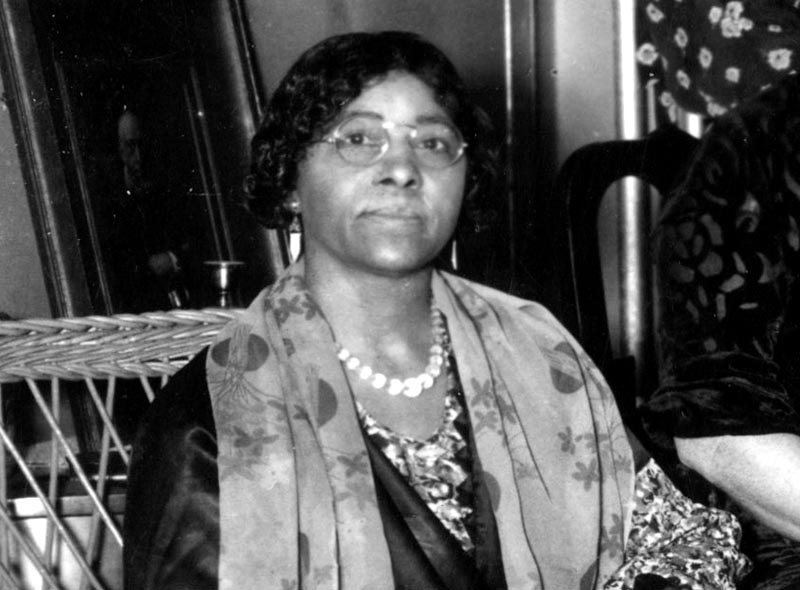
Sadie Oglesby at a meeting among Boston Baha’is in the 1920s. Photo courtesy of National Baha’i Archives.
For the next ten years, Sadie worked tirelessly to bridge the racial divide at a time when it was dangerous to do so in the U.S. She regularly wrote to Shoghi Effendi and updated him about her efforts. And, he always answered her letters and prayed for her success.
In a letter Shoghi wrote to Mabry dated May 23, 1927, he wrote, “My dear co-worker: Just a word that I wish to add in person in order to express my pleasure and delight at having met our dear and devoted Baha’i sister Mrs. Oglesby, whose pure faith, tender devotion and ardent zeal I shall ever remember.”
In a letter written by Shoghi Effendi to the Bahá’ís of North America in 1938, he wrote:
As to racial prejudice, the corrosion of which, for well-nigh a century, has bitten into the fiber, and attacked the whole social structure of American society, it should be regarded as constituting the most vital and challenging issue.
…The ceaseless exertions which this issue of paramount importance calls for, the sacrifices it must impose, the care and vigilance it demands, the moral courage and fortitude it requires, the tact and sympathy it necessitates, invest this problem, which the American believers are still far from having satisfactorily resolved, with an urgency and importance that cannot be overestimated.
May we all heed the wise words of Shoghi Effendi and follow the fearless examples of the Oglesbys in our efforts to work for racial justice and unity today.
If you’ve ever wondered about why we’re here, the Baha’i teachings clearly proclaim that we human beings have a profound, two-fold purpose in this life: The purpose for which mortal…
The Baha’i writings emphatically state that mental health struggles are separate from the life of the soul: “The soul of man is exalted above and is independent of all infirmities of the body or mind.” But there also appears to be a strong correlation between spiritual strength and mental health management.
Even as a mental health professional myself, I’m still seeking to understand the connection between spirituality and mental health, and learning how to apply the spiritual teachings of my faith to my life.
I have experienced anxiety and depression at different points of my life and have come to feel that perhaps such struggles are part of our spiritual journey in this life and preparation for the next. Going through bouts of anxiety and depression were a catalyst for me to reflect on my purpose. I found myself asking: Why am I experiencing these tests and difficulties? Have I done something wrong to deserve this?
At times, these questions led me to question how much I was serving my community and whether I was doing my part as a professional counselor to truly help my clients. They led me to examine my underlying prejudices, my fear of failure and my need to please others.
I have begun to grasp that some things are in my power to change and some are not. Some of my struggles may be biologically inherited, and some may be a consequence of the environments I find myself in — and I may never be able to differentiate between them. But as painful as such challenges can be, the challenges we face can provide opportunities to grow in areas such as patience, forbearance, and tolerance.
The central figures of the Baha’i Faith have shared some wisdom in this regard. In a 1911 speech, Abdu’l-Baha, the son of Baha’u’llah, the founder and prophet of the Baha’i Faith, said: “Test are benefits from God, for which we should thank Him. Grief and sorrow do not come to us by chance, they are sent to us by the Divine Mercy for our own perfecting.”
Coming to this understanding has led me on a path of discovering what virtues I need to work on to grow spiritually. I’m learning to be honest with myself as a human being, as a member of my faith community and as a professional — to acknowledge what I’m capable of, listen to my inner voice, and practice truthfulness, which Baha’u’llahtold us is the “foundation of all human virtues.”
All the prophets of God endured intense persecution and needed to take time to focus on their own wellness, pray, and reflect. For example, Moses went to the mountain, and Christ went to the wilderness. And although these holy figures had spiritual power beyond our capabilities, they were human as well. Shoghi Effendi, the Guardian of the Baha’i Faith, wrote:
“As we suffer these misfortunes we must remember that the Prophets of God Themselves were not immune from these things which men suffer. They knew sorrow, illness and pain too. They rose above these things through Their spirits, and that is what we must try and do too, when afflicted. The troubles of this world pass, and what we have left is what we have made of our souls; so it is to this we must look — to becoming more spiritual, drawing nearer to God, no matter what our human minds and bodies go through.”
Though there’s still stigma surrounding mental illness, it’s important that we move past those attitudes. Seeking help and support from a trained mental health professional can be essential. Therapy provides a safe and confidential space to explore any concerns a person may need to address, and furthermore, most clinicians today understand the importance of incorporating spirituality into their practice.
The skills used in therapy are fundamentally derivative of all spiritual traditions. They incorporate faith over fear as a coping skill, overcoming worries, changing anxious thoughts into peaceful ones, practicing grounding and mindfulness, strength-based methods, redirection, cognitive-behavioral approaches, and the idea that pure thoughts lead to pure actions.
When seeking an appropriate counselor, the initial intake interview can provide you with the opportunity to develop rapport with your clinician and determine if they respect your religious beliefs, and if they are open to using spiritual tools. Remember, the most essential spiritual quality is truthfulness: if you are not capable of being honest with your therapist, progress in counseling will be impossible.
Additionally, taking time to rely on the Divine remedy — the Word of God — has brought me much healing and helped me cope with my own mental health struggles. When we are in pain, we can lose sight that our faith in God can pull us through times of distress. I find comfort in one of my favorite quotes from the Baha’i writings:
“Rely upon God. Trust in Him. Praise Him, and call Him continually to mind. He verily turneth trouble into ease, and sorrow into solace, and toil into utter peace. He verily hath dominion over all things.”
Keeping our thoughts centered on prayer and the Word of God is critical, but we also have physical bodies that require training. Our minds benefit from exercise and training, which is why practices such as meditation and mindfulness better prepare us to be able to cope with the stressors of life.
Have you ever wondered why you exist? Of course you have – that question occurs, at some point, to all of us. Science asks it, too, usually in this macro…
Meet Miami’s first Black millionaire — Dana Albert Dorsey, a real estate magnate, philanthropist, Miami’s most famous early Black resident, and a Baha’i.
Dorsey, a sharecropper’s son, was born in 1872 in Quitman, Fulton County, Georgia, as the first child in his family to be born free — not born into slavery. He had only a fourth-grade formal education, and afterward went on to become a self-made man, a generous and celebrated philanthropist, and a follower of the Baha’i Faith. Therein lies an amazing tale.
As a young man, Dorsey moved to Miami in 1897. A carpenter by trade, he worked for the Florida First East Coast Railroad Company, owned by Henry Morrison Flagler. During this time, he realized that there was a need to provide housing for Black workers — so Dorsey began to invest in real estate.
By custom and Jim Crow-era law, Black people were not allowed to own or rent residences or commercial properties in white-dominated Miami during that time. This racist policy was enforced by race-restrictive covenants in property deeds, prohibiting Black people from purchasing or leasing property in areas where white people lived — and promoting the income inequality that still exists between Black people and other people in the United States today.
In 1896, when the city first incorporated, Miami’s original Charter even called for a separate area to be set aside for African Americans. More than half a century later, on May 3, 1948, in the landmark case of Shelley v. Kraemer, the U.S. Supreme Court ruled unanimously that such racial covenants in housing were unconstitutional.
So, in what was originally and derogatorily known as “Colored Town”— its name was changed in 1937 to Washington Heights, but the area is popularly known today as Overtown — in Miami’s northwest sector, Dana Dorsey purchased his first parcel of land for $25, with income he gained using his carpentry skills. On this small plot of land, in an area near the old Seaboard Station at N.W. 7th Avenue and N.W. 19th Street, Dorsey designed and constructed a small rental house. He continued to buy lots for $25 each, and soon accumulated large blocks of real estate. In this way, Dorsey began to make his fortune as a real estate developer. (For a detailed description of the area’s history, see: Paul S. George, “Colored Town: Miami’s Black Community, 1896–1930,” Florida Historical Quarterly Vol. 56, No. 4 (April 1978), pp. 432–447.)
A newspaper ad for Dana A. Dorsey real estate.
But Dana Albert Dorsey wasn’t only interested in making money. He invested in real estate and built homes with the higher and more altruistic goal of improving the condition of the Black community by providing affordable housing, educational opportunities, and wholesome recreation. In an era of lynching, vicious prejudice, and the patent evils of racism, he exemplified the Baha’i ideal of work as worship, when done in service to humanity:
It is enjoined upon every one of you to engage in some form of occupation, such as crafts, trades and the like. We have graciously exalted your engagement in such work to the rank of worship unto God, the True One. Ponder ye in your hearts the grace and the blessings of God and render thanks unto Him at eventide and at dawn. Waste not your time in idleness and sloth. Occupy yourselves with that which profiteth yourselves and others. …
Hold ye fast unto the cord of material means, placing your whole trust in God, the Provider of all means. When anyone occupieth himself in a craft or trade, such occupation itself is regarded in the estimation of God as an act of worship; and this is naught but a token of His infinite and all-pervasive bounty. – Baha’u’llah, Tablets of Baha’u’llah, p. 26.
Work done in the spirit of service is the highest form of worship. – Abdu’l-Baha, Divine Philosophy, p. 83.
In 1914, Dana Dorsey was listed as the only African American real estate agent in Miami. In 1918, he purchased Elliot Key and the barrier island now known as Fisher Island (today an exclusive luxury island in Biscayne Bay near Miami Beach) so he could provide a public beach for African Americans to enjoy —since “white” beaches did not accept them. That same year, the Miami Daily Metropolis reported that Dorsey had purchased Fisher Island:
… to form a company for the development of the tract as a high-class colored resort and subdivision with a hotel, cottages for well-to-do men of his own race and boats to convey them back and forth between the mainland and the island so there will be no conflict of the races in the project.
The Dorsey House.
Dorsey’s accomplishments not only served Miami’s Black community, but they also soon became historically important. For instance, Dorsey helped organize South Florida’s first Black-owned bank, the Mutual Industrial Benefit and Saving Association. He later owned Florida’s Negro Savings Bank. His Dorsey Hotel was the first Black-owned hotel in Miami. As a community leader, Dorsey served as chairman of the Colored Advisory Committee to the Dade County School Board, and also gave of his time as registrar for Black men during World War I.
Success as a real estate developer led to Dorsey’s legacy as a philanthropist, and his contributions to Miami are lasting and significant. For instance, in the 1930s, Dorsey donated, to the Miami-Dade School District, the property located at Northwest 71st Street and 17th Avenue in the Liberty City area of Miami, on which the Miami Dorsey High School was built in 1936. In 1970, that school was converted to what is now the D.A. Dorsey Technical College (a.k.a. D.A. Dorsey Educational Center), the longest-running successful adult education program in Miami-Dade County.
As a benefactor, Dorsey financially backed the historically Black Bethune-Cookman College (now University), according to one of his granddaughters, LaShonne Edwards. On February 14, 1940, just fifteen days before his death, Dorsey donated the land on which the future Dorsey Memorial Library would be built. Opened on August 13, 1941, the Dorsey Memorial Library was located in segregated Overtown. On January 17, 2018, the city of Miami held a ceremonial groundbreaking to launch a $1.3 million renovation project for the historic preservation of one of the hallmark monuments of Black Miami, saying in its official report:
The Dorsey Memorial Library is significant for its historical associations and stands as a testament to the segregation of the races, and in Miami, the lingering prejudice towards people of color. The building played a key role in the education of many African American citizens who lived in the Overtown area during a time when there were few educational options. In the all-too-recent past, African Americans in Miami suffered egregious treatment and limited civil rights, as they were severely limited in their choices of places to live, socialize, recreate and educate.
But before his library dedicated to the education of Black Miami opened, on Thursday, February 29, 1940, Dorsey died. Flags were flown at half-staff in Overtown, and businesses closed during funeral services when Dorsey’s body was laid to rest in Lincoln Memorial Park, Miami’s African American cemetery during the Jim Crow era. Some 2,000 mourners attended.
By today’s standards, Dana Albert Dorsey would have been a billionaire at the time of his passing. Dorsey owned property not only in Dade and Broward counties, but in Cuba and the Bahamas as well. His extensive land holdings are considered to be the largest ever held by a Black man in Dade County.
To honor Dorsey, Third Avenue in Overtown was renamed “D. A. Dorsey Way” (also designated NW 3rd Avenue Business Corridor). The D. A. Dorsey House (250 NW 9th Street, built in 1913 for his second wife, Rebecca Livingston) in Overtown is a historical landmark. Adding to his legacy is the Dana Dorsey Memorial Park.
This, in brief, highlights what we now know about D.A. Dorsey’s illustrious life and legacy of service to humanity. However, very little is known of Dorsey’s connection with the Baha’i Faith. In “How Miami’s Renowned Black Entrepreneur Became a Baha’i,” I explored D.A. Dorsey’s introduction to the Baha’i teachings of interracial harmony and the oneness of humanity, which he welcomed and readily embraced.
Fearing Friday the 13th, panicking when you see a black cat, or believing that bad luck comes in threes. Superstition is all around us — but are these beliefs really harmless…
Thirteen years ago, I came home sobbing from the latest misogynoir, exclusion, and isolation I experienced at my high school. I expected to seek consolation from my mother, but was surprised when she simply responded with the words: “Good. Write it out.”
Although I had written some poems before, I hadn’t yet learned to see poetry as a therapeutic outlet. However, from then on, I would make a habit of purging my emotions through the most healing art form I have ever experienced.
Every word of thy poetry is indeed like unto a mirror in which the evidences of the devotion and love thou cherishest for God and His chosen ones are reflected.
…Its perusal hath truly proved highly impressive, for it was indicative of both the light of reunion and the fire of separation.
Emotional Purging: Defining Catharsis
I channeled this fire inside my heart as a new light was reflected through my art. Shortly after I began to experience the healing power of poetry, I would learn that there was a word for this releasing of my pain through the written word: catharsis.
Merriam-Webster defines “catharsis” as a “purification or purgation of the emotions (such as pity and fear) primarily through art” and “a purification or purgation that brings about spiritual renewal or release from tension.”
How to Purge Your Emotions in 7 Ways
Unfortunately, we all experience pain in our lives. However, when you don’t release that tension and stuff all of those feelings inside, you suffer — emotionally and physically, worsening your well-being and quality of life.
Catharsis is an important step we must take to heal from our trauma and refresh our mind, heart, body, and soul. Below are seven practices that help me emotionally purge. I believe they can help you all too.
1. Cry It Out
Don’t swallow those tears that have been rising in the back of your throat and welling up your eyes. Purge your emotions by giving yourself permission to cry. There is a Jewish proverb that says, “What soap is for the body, tears are for the soul.”
As long as you’re careful not to get stuck in a depressive state, crying can help relax you, likely because it stimulates the release of endorphins — neurochemicals that mask pain. If you don’t have the energy to cry, let your pen do it for you.
Although writing about and reflecting on your traumatic experiences can be a very emotional process, studies have found that this “expressive writing” leads to extraordinary health benefits in the long term.
According to a journal article titled “Emotional and Physical Health Benefits of Expressive Writing,” published in Advances in Psychiatric Treatment, longer-term benefits of expressive writing are:
Health outcomes
• Fewer stress-related visits to the doctor
• Improved immune system functioning
• Reduced blood pressure
• Improved lung function
• Improved liver function
• Fewer days in hospital
• Improved mood/affect
• Feeling of greater psychological well-being
• Reduced depressive symptoms before examinations
• Fewer post-traumatic intrusion and avoidance symptoms
Social and behavioural outcomes
• Reduced absenteeism from work
• Quicker re-employment after job loss
• Improved working memory
• Improved sporting performance
• Higher students’ grade point average
• Altered social and linguistic behaviour
So, it’s no surprise that the Baha’i writings say, “One hour’s reflection is preferable to seventy years of pious worship.”
Whether you journal, write poetry, or create some other form of art that channels your pain into something useful or beautiful, recording your reflections, experiences, and lessons learned can not only heal yourself, but it can also resonate with and inspire others who are going through what you have experienced.
3. Work Out
When I’m feeling frustrated or distressed, I love to exercise, as it also gives me that euphoric feeling from endorphins. Studies have shown that regular exercise can be just as effective as an antidepressant for your mood.
For example, in 2019, Karmel Choi, a clinical and research fellow at the Harvard T.H. Chan School of Public Health, found that with each significant boost in physical activity, the odds of becoming depressed dropped by 26%. She explained, “This increase in physical activity is what you might see on your activity tracker if you replaced 15 minutes of sitting with 15 minutes of running, or one hour of sitting with one hour of moderate activity like brisk walking.”
The central figures of the Baha’i Faith understood the connection between our physical, mental, emotional, and spiritual well-being. Abdu’l-Baha stated:
Between material things and spiritual things there is a connection. The more healthful his body the greater will be the power of the spirit of man; the power of the intellect, the power of the memory, the power of reflection will be greater.
With every yoga, dance, or pilates workout I do, I can feel my energy levels rising, my mood brightening, and the weight of the stress and tension melting away.
4. Breathe It Out
Certain breathing exercises can be just as effective at calming my nervous system as any exercise routine. I gravitate towards Kundalini yogic breathing techniques, such as the commonly practiced Breath of Fire.
Not only is the Breath of Fire amazing for stress release, but research has also found that it improves digestion and respiratory function as well as enhances mindfulness and concentration. I definitely recommend it for mental clarity and coherence.
5. Tap It Out
EFT (Emotional Freedom Techniques) tapping is a powerful therapeutic method that combines cognitive therapy with acupressure. It’s an easy-to-learn type of acupressure that involves tapping on specific acupressure points on the body while acknowledging the negative thoughts, emotions, and beliefs that you need to release and accepting yourself throughout the process.
According to a journal article titled “Clinical EFT as an Evidence-Based Practice for the Treatment of Psychological and Physiological Conditions: A Systematic Review,” published in Frontiers in Psychology, “RCTs [randomized controlled trials] have found EFT treatment to be effective for (a) psychological conditions such as anxiety, depression, phobias, and posttraumatic stress disorder (PTSD); (b) physiological issues such as pain, insomnia, and autoimmune conditions; (c) professional and sports performance; and (d) biological markers of stress.”
Whenever I do EFT tapping, I notice immediate results.
6. Talk It Out
After crying, writing, exercising, breathing, or tapping has calmed you down and helped you think more clearly, you may want to have a heart-to-heart with the person who has hurt you and tell them how certain words and actions make you feel.
People who care about each other in a relationship usually don’t intend to hurt each other so it’s important to let someone know what you need in a relationship so they can avoid making the same mistakes in the future.
In a letter written on behalf of Shoghi Effendi to an individual Baha’i in 1945, the Baha’is are advised to “overlook each other’s mistakes, apologize for harsh words they have uttered, forgive and forget.”
7. Pray and Meditate for a New Route
In a prayer revealed by the Bab, the forerunner of Baha’u’llah, it says:
O Lord! Thou art the Remover of every anguish and the Dispeller of every affliction.
Pray for healing and help from God as you seek answers to a problem or clarity about a new direction you’d like to take. When you pair prayer with meditation to receive guidance and then follow it up with action, trust that you will be supported as you act on the inspiration that comes from your sincere prayers and meditations.
Moreover, at a talk in Paris in 1911, Abdu’l-Baha said:
If we are hemmed in by difficulties we have only to call upon God, and by His great Mercy we shall be helped. If sorrow and adversity visit us, let us turn our faces to the Kingdom and heavenly consolation will be outpoured. If we are sick and in distress let us implore God’s healing, and He will answer our prayer.
When our thoughts are filled with the bitterness of this world, let us turn our eyes to the sweetness of God’s compassion and He will send us heavenly calm! If we are imprisoned in the material world, our spirit can soar into the Heavens and we shall be free indeed!
I hope these seven tips help you purge those toxic emotions and experience healing and heavenly calm.
In part one, Michael Orona and I explored untold stories of solidarity between Indigenous Yaqui miners and African Americans. In part two, we delved into the power of spiritual courage and resilience. Now, in part three, we turn our focus to how we can promote unity and harmony in society.
The Baha’i writings call us to practice a high standard of love and unity. In a tablet to the Baha’is of the United States and Canada in 1916, Abdu’l-Bahawrote:
The divine friends must be attracted to and enamored of each other and ever be ready and willing to sacrifice their own lives for each other.
Justice is vital to the establishment of unity and harmony at all levels of society, as it provides the standard by which individual conduct and collective effort are judged. A requirement for living a life of service to humanity, then, is constant effort to develop truthfulness, trustworthiness, and justice, ensuring that they are ever-present in thought and action.
Radiance Talley: Hi, Michael! In your novel, “The Brave Ones,” your characters create unity and challenge societal norms through their actions. What Baha’i teachings or personal reflections inspire your vision of unity, and what actions can readers take to promote justice and harmony in their own communities?
Michael Orona: Unity is not just an abstract concept, but a transformative power that can reshape societal structures. In “The Brave Ones,” the unintentional partnership between members of the Indigenous Yaqui community and African Americans represents a profound truth: our shared humanity transcends the artificial boundaries created by racism and discrimination.
The Baha’i teachings of the oneness of humanity are fundamental to my understanding of social transformation. We believe that humanity is like a garden — its beauty lies in its diversity. Just as a garden thrives when different flowers grow together, societies flourish when diverse communities recognize their interconnectedness. This principle guided the development of the characters in my book to look beyond their immediate circumstances and forge a collective path forward.
In my decades of human rights work around the world, I’ve witnessed how unity can emerge from the most challenging circumstances. The Baha’i principle of universal education is crucial here. Education is not just about academic knowledge, but about developing empathy, understanding, and the capacity to see beyond superficial differences. Readers can start by educating themselves about the histories and experiences of marginalized communities.
Michael Orona
Practical Actions to Promote Unity, Justice, and Harmony in Society
Some practical actions for promoting justice and harmony might include:
1. Active Listening:
Truly hear the stories of communities different from your own. Understanding comes before solidarity and collaboration.
2. Amplify Marginalized Voices:
Use your platforms, whether personal or professional, to create space for Indigenous, Black, and other underrepresented narratives. Give these individuals the opportunity to lead discussions and share their unique perspectives.
3. Build Unexpected Partnerships:
Like the characters in my book, seek connections across apparent divides. Unity often emerges from the most unexpected places.
4. Practice Extreme Empathy:
Go beyond sympathy. Develop a genuine commitment to understanding the lived experiences of others. This means spending the time to build lasting friendships.
My Chihene Apache and Yaqui heritage, along with my belief as a member of the Baha’i Faith, has taught me that justice is not a destination but a continuous journey. Each small act of understanding, each moment of genuine connection, contributes to a more harmonious world.
The story of the Yaqui miners is a microcosm of a larger truth: when we recognize our shared humanity, we can challenge even the most entrenched systems of oppression. It’s not about erasing our differences, but about celebrating them while recognizing our fundamental unity.
The well-being of mankind, its peace and security, are unattainable unless and until its unity is firmly established.
This is not just a spiritual principle, but a practical blueprint for social transformation. To the readers of “The Brave Ones,” I say this: Be courageous. Be curious. See the humanity in every person. The most profound revolutions begin with individual acts of understanding and compassion. Our world doesn’t need more division. It needs more bridges.
Radiance: Absolutely, that’s beautifully said. I would also add that this extreme empathy should result in compassionate action, where people speak up and stand up within their spheres of influence to advocate for the rights of marginalized voices and effect meaningful and lasting change. Thank you, Michael, for taking the time to answer my questions with such wisdom and heart.
Since time immemorial, prayers have been offered by individuals during times of sickness and collectively in ceremonies to celebrate the Divine Reality and to ask for blessings.
Current scientific exploration of metaphysical issues — such as the dynamics of prayer and meditation in healing — is fraught with challenges because of our inability to measure non-material aspects of these phenomena. On the other hand, Baha’u’llah, the prophet and founder of the Baha’i Faith, expounded on the future of science and stated that one of the two signs for the coming of age of the human race will be the emergence of science as a “divine philosophy.” “This is an indication of the splendours of the future stupendous expansion of knowledge.” Although we are far from reaching humanity’s coming of age, we might envision the possibility that the expansion of knowledge would include unraveling the spiritual power of prayer and meditation.
“It is the language of the soul to commune with its Creator, a way of giving expression to spiritual aspirations.”
In their 2009 book “How God Changes Your Brain,” neuroscientist Andrew Newberg and therapist Mark Robert Waldman wrote that “Most dictionaries define prayer as the act of communicating with a deity, especially in the form of a request or a petition for help. Meditation, however, is commonly defined as a contemplative reflection or mental exercise designed to bring a heightened level of spiritual awareness.” For people living in ancient times, prayer was the only means of seeking solace and security. It is the language of the soul to commune with its Creator, a way of giving expression to spiritual aspirations.
As to meditation, Abdu’l Baha, the son of Baha’u’llah, said in a speech in 1913, “It is an axiomatic fact that while you meditate you are speaking with your own spirit. In that state of mind you put certain questions to your spirit and the spirit answers: the light breaks forth and the reality is revealed.”
A 2016 Gallup poll of religiosity in the United States revealed that 89% of American adults believe in God or a Universal Spirit. In another survey, 87% of participants said that religion was important in their lives. Additional research shows that 76% of Americans pray daily, with many acknowledging that they turn to prayers for assistance to overcome disease.
Sir Francis Galton
While the adherents of religions exercise the practice of prayer as a matter of faith, scientists have been interested in the health benefits of prayer since at least the 19th century. In 1872 Sir Francis Galton, for instance, conducted a retrospective study of the effects of prayer on the British monarchs. In more recent times, similar research has been vigorously pursued. Its goal is to discover the nature and depth of prayer’s healing effect on distress and disease as well as on people’s well-being. In a carefully designed study of 990 cardiac patients using randomized, controlled, double-blind, and prospective investigation it was found that intercessory prayers may be effective as an addition to standard treatment of these patients. A Swedish study of kidney transplant patients also reported that those patients who were prayed for were better able to cope with stress and had less organ rejection.
However, some people feel that researchers who are seeking hard evidence of the power of prayer have misunderstood its nature, judging its benefits solely by its physical effect on an individual. Prayers, and meditation, for that matter, can be viewed as tools for relaxation and serenity — having neurophysiological effects on the brain, heart, blood pressure, and muscle tension. But from the perspective of religion and spirituality, they may have other effects that are not measurable by means available to science.
Abdu’l-Baha tells us, “There are two ways of healing sickness, material means and spiritual means. The first is by the use of remedies of medicine; the second consists in praying to God and in turning to Him. Both means should be used and practiced.” Medical science uses clinical observation and technology to diagnose and treat disease and to restore health. Prayer is a spiritual process that enhances healing and restores hope and wholeness. Together these two complement one another. In his 2002 book “Inner Quest,” author Pandit Rajmani Tigunait wrote that “Spirituality is a complete science that entails a comprehensive study of the intrinsic nature of the soul and its relationship both to the external world and to universal consciousness.”
In a talk in London in 1913, Abdu’l-Baha stated that“Meditation is the key to opening the doors of mysteries; in that subjective mood he is immersed in the ocean of spiritual life and can unfold the secrets of things-in-themselves. To illustrate this, think of man as endowed with two kinds of sight; when the power of insight is being used the outward power of vision does not see.” Abdu’l-Baha nevertheless draws our attention to the fact that “some thoughts are useless… But if the faculty of meditation is bathed in the inner light and characterized with divine attributes, the results will be confirmed.”
Exploring the mystery of the effect of prayer and meditation on our mind and soul is a daunting task. Research in neuroscience has shown that meditation and prayer have beneficial effects on the frontal cortex and limbic system of the brain, bringing a sense of joy, love, and optimism. The effect of meditation on the brain is particularly important because, as Newberg and Waldman wrote, “it counteracts our biological propensity to react to dangerous situation with animosity or fear. However, it also appears to make us more sensitive to the suffering of others.”
Can science find any pathway of healing through faith and prayers? As Newberg and Waldman also wrote in their book, it has been hypothesized that our neuropeptides — the transmitters of neurons — and immune system are biological pathways that may connect mental processes, including prayer and meditation. In addition, a research study at Harvard University showed that meditation might help to prevent brain degeneration and cognitive decline. The more we meditate on the Word of God, or for a specific objective, the more the thalamus — the center of information processing — in the brain is activated and increases in size. Spiritual practices can have an effect on neurotransmitters. “For example, a 65 percent increase in dopamine was found when individuals practice yoga nidra, a form of meditation in which a person maintains conscious awareness,” wrote Newberg and Waldman
Researchers have found more biologically beneficial effects from meditation than from prayer. This may be partially because there has been more research conducted with respect to the former, but it may also be due to the spiritual nature of prayer, which does not lend itself to scientific measurement. For example, scientific research has found a significant reduction in stress, anxiety, blood pressure, and suppression of the release of cortisol, also known as the stress hormone, in those who regularly meditate. Researchers have also noted a boost to the immune response, positive mood states, relaxation, and more tolerance to pain. However, while meditation and prayer may have positive physical and physiological effects on the body, such changes do not explain the mystery nor define the mechanism of such effects.
Although many research studies on the effect of prayer on healing have been favorable, some others reported negative results. This should not be surprising due to the intangible and spiritual nature of prayer, which is dependent not only on the sincerity of the individual who offers prayers but also on the wisdom of divine intervention. From a Baha’i point of view, while prayer and meditation are important and praiseworthy, people must remain mindful that ultimately it is God’s will that determines whether a cure will be granted or not.
Have you been seeing lime green ribbons tied to trees this month? Those would be in honor of Mental Health Awareness Month.
Mental Health Awareness Month (MHA) was first observed in the United States in May of 1949. Started by the Mental Health Organization, each year the MHA releases a toolkit of materials to facilitate outreach activities for the month.
For 2022, the month’s theme is “Back to Basics,” observed with film screenings, media, and local events, all based on this theme. The goal: to provide “foundational knowledge about mental health and information for anyone whose mental health is a cause for concern.”
So who needs to be concerned about mental health? Everyone!
We should be just as concerned about our mental and spiritual health as the health of any part of our physical body, the Baha’i teachings say. Abdu’l-Bahawrote:
Illness which occur by reason of physical causes should be treated by doctors with medical remedies; those which are due to spiritual causes disappear trough spiritual means. Thus an illness caused by affliction fear, nervous impressions, will be helped more effectively by spiritual rather than by physical treatment. Hence, both kinds of treatment should be followed; they are not contradictory.
We have no trouble going to see the doctor to treat physical illness – yet when it comes to mental or emotional issues, stigmas still exist. Education and frank discussion can help to change this. According to the National Alliance on Mental Illness, 1 in 5 adults in the United States experience mental illness each year. We’ve all had struggles to varying degrees, or have a friend or family member who has.
In an interview, Dr. Christina Rajlal and Director Stacy Kuwahara of Kern Behavior Health and Recovery explain:
“It’s critical to let our community know that it truly is okay to acknowledge their feelings and to reach out for help if needed.” Dr. Rosia said.
Rosia also pointed out that the past 2 years of the pandemic have shown just how important it is to start these conversations around mental wellness, not only with our loved ones and family members, but with the whole community.
Behavioral Health Director, Stacy Kuwahara went on to say:
“Despite the stigmas associated with mental health, I encourage everyone to understand just how normal it is, not only to experience it, but to seek help.”
She said that services addressed should be for total well-being – both mental and spiritual health.
This leads to the conclusion that now, more than ever, it takes a village. Being in touch with our families, friends, and neighbors is no longer a luxury but a necessity. We need to connect with each other on a deep, caring level for the benefit of ourselves and for society. Not only do studies show that socializing, connection, and serving others improves the brain, it also has a profound effect on the spirit.
Baha’is see this process of focusing on the well-being of others as one of the cornerstones of good mental and spiritual health:
Every imperfect soul is self-centered and thinketh only of his own good. But as his thoughts expand a little he will begin to think of the welfare and comfort of his family. If his ideas still more widen, his concern will be the felicity of his fellow citizens; and if still they widen, he will be thinking of the glory of his land and of his race. But when ideas and views reach the utmost degree of expansion and attain the stage of perfection, then will he be interested in the exaltation of humankind. He will then be the well-wisher of all men and the seeker of the weal and prosperity of all lands. This is indicative of perfection.
Thus, the divine Manifestations of God had a universal and all-inclusive conception. They endeavoured for the sake of everyone’s life and engaged in the service of universal education. The area of their aims was not limited — nay, rather, it was wide and all-inclusive.
Therefore, ye must also be thinking of everyone, so that mankind may be educated, character moderated and this world may turn into a Garden of Eden.
So let’s talk about our feelings. No one need struggle in silence. As just one example, don’t hesitate to check up on your children today. Are they having emotional issues around school, bullying, or friendships? What about your mom? Could she be holding back her recent feelings of depression so as not to burden you? Does your partner not want to drain you with sharing their work stresses? Is your postpartum girlfriend struggling? What about your neighbors? How can you be of service if they are in need?
In all cases, if you ever hear any mention of suicide, do take it very seriously.
Let’s not allow mental health awareness to end this month, but keep the green ribbons up and the conversation going, so we can hold this very important issue predominantly in our hearts and minds throughout the year – because no one is an island, and we all need each other.
Free mental health resources:
Change Your Algorithm
A mental wellness program that offers free 1-hour mental health classes online and in Los Angeles, CA. Classes are led by certified mental health therapists that can provide you with the tools needed to take care of your mind during a time of fear and uncertainty. Yes, it’s all free. Their motto:
This free app offers 24/7 chat. It connects you to caring listeners from a variety of online communities that you can explore and join. I joined it just for the great community and fun events. Their takeaway:
Baha’is all around the globe recently celebrated four Baha’i Intercalary Days, also called “Ayyam-i-Ha,” and many dedicated some of the time during those days to serving others. In act, we’ve…
A permanent peace in the world of existence can be established only through the power of the spirit. – Abdu’l-Baha, Divine Philosophy, p. 175.
Do you remember the last time you got really mad?
Consider it for a minute. Try to remember your anger, and recall what caused it. Did it happen when someone cut you off on the highway? When someone intentionally disrespected you? Or did it occur when someone hurt you, whether they realized it or not? Now consider: where did it come from?
Personally, I tend to have a pretty deep well of rage and anger. I’m working on it with prayer and meditation, but I still feel it from time to time. I don’t know why I have it. Maybe my upbringing caused it—I had a violent father, an ex-Marine war veteran who believed that sparing the rod definitely spoiled the child. Or maybe the war I had to go experience, and the things I saw there, made it happen. I’ve always felt a high level of sensitivity to injustice, though, and I’ve tried to re-direct some of my anger toward righting the injustice I see, which seems to help.
Anyway, we all have some of that stored-up pain inside us. In some people it emerges as self-destructiveness, or substance abuse, or criminal behavior. The other day I read about a man whose intense internal anger made him fear he would hurt others; so he got a gun and called the police and threatened them with it. They shot him. The newspaper called it suicide-by-cop; but I could feel his unbearable pain and suffering.
This world can deliver us bucketfuls of that kind of hurt, pain and anger. The Baha’i teachings say:
…the trials which beset our every step, all our sorrow, pain, shame and grief, are born in the world of matter; whereas the spiritual Kingdom never causes sadness. A man living with his thoughts in this Kingdom knows perpetual joy. The ills all flesh is heir to do not pass him by, but they only touch the surface of his life, the depths are calm and serene.
Today, humanity is bowed down with trouble, sorrow and grief, no one escapes; the world is wet with tears; but, thank God, the remedy is at our doors. Let us turn our hearts away from the world of matter and live in the spiritual world! It alone can give us freedom! If we are hemmed in by difficulties we have only to call upon God, and by His great Mercy we shall be helped. – Abdu’l-Baha, Paris Talks, pp. 109-110.
This sounds simple, but of course, it’s not.
“Turn our hearts away from the world of matter,” Abdu’l-Baha advises us, “and live in the spiritual world.” What does that mean?
For Baha’is that task lies at the heart of all religion. It asks us to raise our sights beyond the daily material considerations of life and allow our hearts and souls to seek what they yearn for—a sense of calm, confident inner peace. That divine tranquility means we can move past our trials and troubles, which all come as a result of our attachment to this fleeting physical plane. Only this mystical, transcendent sense of connection to something beyond the material world can give us true peace.
The Baha’i teachings say that the growth of spirituality, in the individual soul and in the world, will bring us that sense of peace:
I want to make you understand that material progress and spiritual progress are two very different things, and that only if material progress goes hand in hand with spirituality can any real progress come about, and the Most Great Peace reign in the world. If men followed the Holy Counsels and the Teachings of the Prophets, if Divine Light shone in all hearts and men were really religious, we should soon see peace on earth and the Kingdom of God among men. The laws of God may be likened unto the soul and material progress unto the body. If the body was not animated by the soul, it would cease to exist. It is my earnest prayer that spirituality may ever grow and increase in the world, so that customs may become enlightened and peace and concord may be established. – Abdu’l-Baha, Paris Talks, pp. 107-108.
Every year, around the vernal equinox, the world seems to come alive. Depending on where you live in the Northern Hemisphere, trees and bushes that were once icy and barren begin to bear buds, leaves, flowers, or fruit. The grass becomes greener, hibernating animals come out to explore, and insects that were burrowed under the ground hatch from their eggs and emerge to the surface.
“In the spring there are the clouds which send down the precious rain, the musk-scented breezes and life-giving zephyrs; the air is perfectly temperate, the rain falls, the sun shines, the fecundating wind wafts the clouds, the world is renewed, and the breath of life appears in plants, in animals and in men,” said Abdu’l-Baha, one of the central figures of the Baha’i Faith. “Earthly beings pass from one condition to another.”
If all of this rebirth and renewal is happening during spring to every plant and animal in the world, what kind of spiritual transformation is happening to people?
The Significance of Spring for Our Spiritual Transformation
I remember my winter during the height of the coronavirus quite clearly…
Just like many other living beings, I spent the winter hibernating and staying cooped up indoors — because I had no interest in being out in the cold unless I had to, and I also happened to be a germaphobe during COVID-19. So, when the clouds disappeared, and the temperature finally hit 70 degrees, I couldn’t help but step outside and take a few long deep breaths. I inhaled and exhaled — the air was so sweet, I felt like I could taste it. As I walked and soaked in the warm heat of the sun, my body felt soothed, and my mind felt at ease. I knew that my spirit was being revived just like the rest of the world.
Abdu’l-Baha said it’s as if the Earth is dead and lifeless during the winter. But when spring comes, “it finds a new spirit, and produces endless beauty, grace and freshness. Thus the spring is the cause of new life and infuses a new spirit.”
I could feel that I was becoming alive with this new spirit. Of course, this spiritual regeneration and renewal didn’t happen like clockwork once the sun came out. I spiritually recuperated for 19 days from the beginning of March until the first day of spring – the Baha’i new year.
During these 19 days, Baha’is fast — we do not eat or drink anything from sunrise to sunset. But this abstention from food is merely symbolic and is, as Shoghi Effendi, the Guardian of the Baha’i Faith, explained, “ a reminder of abstinence from selfish and carnal desires.”
He also wrote that the fasting period is “essentially a period of meditation and prayer, of spiritual recuperation, during which the believer must strive to make the necessary readjustments in his inner life, and to refresh and reinvigorate the spiritual forces latent in his soul. Its significance and purpose are, therefore, fundamentally spiritual in character.”
Every year during March, I make sure to prioritize my spiritual health and tune into my spirit. I engage in self-reflection, clarify what goals I’d like to accomplish in the coming year, and work on breaking old unwanted habits. I thank God for my blessings, ask forgiveness for my wrongdoings, and strive to cleanse and purify my heart and soul. That way, when I emerge from my hibernation, I feel both physically and spiritually refreshed and transformed.
“Jesus Christ said ‘Ye must be born again’ so that divine Life may spring anew within you,” said Abdu’l-Baha at a talk in Bristol, England in 1911.
Be kind to all around and serve one another; love to be just and true in all your dealings; pray always and so live your life that sorrow cannot touch you. Look upon the people of your own race and those of other races as members of one organism; sons of the same Father; let it be known by your behaviour that you are indeed the people of God. Then wars and disputes shall cease and over the world will spread the Most Great Peace.
The Spiritual Meaning of Spring for Humanity
Baha’is believe that world peace is not just a naïve hope or wishful thinking, but it is actually inevitable. We understand that the world is going through very turbulent and trying times, but as Shoghi Effendi wrote:
We stand on the threshold of an age whose convulsions proclaim alike the death-pangs of the old order and the birth-pangs of the new.
“The whole earth,” wrote Baha’u’llah, the prophet and founder of the Baha’i Faith, “is now in a state of pregnancy. The day is approaching when it will have yielded its noblest fruits, when from it will have sprung forth the loftiest trees, the most enchanting blossoms, the most heavenly blessings.”
Just like the Earth goes through different seasons and cycles, Baha’is believe that humanity goes through various stages of development. And in every stage, God sends Messengers (i.e., Zoroaster, the Buddha, Krishna, Moses, Jesus Christ, Mohammed, the Bab, and Baha’u’llah) to reveal more of His unfolding revelation to society.
Right now, humanity is in its turbulent adolescence age. But Baha’is believe that “when the impetuosity of youth and its vehemence reach their climax,” we will reach maturity and enter the stage of adulthood. We believe that the revolutionary teachings of Baha’u’llah — such as the equality of men and women, the harmony of science and religion, the elimination of the extremes of wealth and poverty, the abolition of all forms of prejudice, and the oneness of humanity — will help usher humanity towards maturity.
This period of time is the Promised Age, the assembling of the human race to the “Resurrection Day” and now is the great “Day of Judgment.” Soon the whole world, as in springtime, will change its garb. The turning and falling of the autumn leaves is past; the bleakness of the winter time is over. The new year hath appeared and the spiritual springtime is at hand.
The black earth is becoming a verdant garden; the deserts and mountains are teeming with red flowers; from the borders of the wilderness the tall grasses are standing like advance guards before the cypress and jessamine trees; while the birds are singing among the rose branches like the angels in the highest heavens, announcing the glad-tidings of the approach of that spiritual spring, and the sweet music of their voices is causing the real essence of all things to move and quiver.
This “spiritual spring” is so meaningful and significant because, as Abdu’l-Baha said, it’s the “age of spiritual awakening” where “the world has entered upon the path of progress into the arena of development, where the power of the spirit surpasses that of the body. Soon the spirit will have dominion over the world of humanity.”