“It must be exhausting to be [this tyrant],” my anthropology teacher once said during class while I studied abroad in London. My classmates and I were shocked. We had just…
Prayer need not be in words, but rather in thought and action. But if this love and this desire are lacking, it is useless to try to force them. Words…
If you live in the developed world like I do you enjoy certain advantages that a lot of people in other places do not: electricity, running water, plentiful food and clothing—and particularly jobs.
Why do refugees flee their poor, oppressive or conflict-ridden countries and endure great hardship to make it to Europe or the United States? It’s simple: they want to get to a country where they can live better lives. In their situation, anyone would do the same thing. When refugees arrive in the developed world, with hard work and ingenuity they can get a job or create a business and make a good living—a living that includes a peaceful society, human rights and freedoms, functioning utilities, cars, gyms and a wealth of advantages over their homelands.
However, the developing world uses most of the world’s resources. On average, an inhabitant of North America consumes around 90 kilograms (kg) of resources each day. In Europe, consumption is around 45 kg per day, while in Africa people consume only around 10 kg per day.
All of the wealth in the developed world is used without much thought to this huge disparity. With our dependence on these material things, though, comes the darker side: entitlement. In North America, Europe and certain other developed regions of the world, many people feel entitled to their patterns of over-consumption. They believe their lifestyle is their right. But that sense of entitlement is detrimental to spiritual growth and overall health—mind, body and spirit.
An entitled person feels that he/she deserves to be given something, whether it is a high paying job, financial support or some special privilege—without working hard for it or giving anything back. I don’t know about you, but I’ve known many people like this, who feel they don’t have to work at certain jobs just because they got educated and earned a degree. They are convinced that their degree entitles them to a high paying job right out of school, rather than accepting a more entry-level position.
Actually, I was one of them. So I understand the feelings of having gone to a university, gotten a degree and then smugly nurturing an entitled mindset that I immediately deserved a great job with good pay. I learned a valuable lesson when this did not happen. I learned that my degree was not going to financially support me without a lot more hard work on my part.
I should have known better anyway as my Baha’i parents taught me at an early age that life was not easy and nothing would be handed to me on a platter. I have very loving and kind parents who worked hard, so I saw as I grew up the importance of a good work ethic. In fact, my parents definitely followed the Baha’i teachings to “accustom your children to hardship:”
…Endeavour to rectify the conduct of men, and seek to excel the whole world in moral character. While the children are yet in their infancy feed them from the breast of heavenly grace, foster them in the cradle of all excellence, rear them in the embrace of bounty. Give them the advantage of every useful kind of knowledge. Let them share in every new and rare and wondrous craft and art. Bring them up to work and strive, and accustom them to hardship. Teach them to dedicate their lives to matters of great import, and inspire them to undertake studies that will benefit mankind. – Abdu’l-Baha, Selections from the Writings of Abdu’l-Baha, p. 102.
I was a very headstrong child and as such I wanted to make my own money and have my own job. So I got a job at the age of 14 at a fast-food restaurant. I have pretty much worked ever since, even working two jobs plus full time coursework during my university years. Now I’m not saying everyone should or even can do this—we all have our unique strengths and drives.
I do, however, see quite a bit of this spiritual illness called entitlement with many people and, I often wonder, is it the parents’ fault for not introducing their children to hardship at an early age by making them do chores or some kind of work around the house? Perhaps it is. Of course it is not done out of malice, but instead out of love. Giving your children responsibilities in the household will help them cultivate a sense of work ethic early on. Sadly, though, it doesn’t help the entitled child when everything is done for him or her, but instead thwarts her or his spiritual growth, as well as the child’s mental and physical health and happiness.
Entitled people can burden a community, government and families. They often demand or expect others to finance their lives, while they exert minimal effort at supporting themselves. Somewhere in the midst of growing up, they learned not to be bothered by burdening others, in spite of being quite capable themselves. Sadly, this kind of laziness born of entitlement is detrimental to their spiritual growth, physical attainments, health and even mental capabilities. It will also affect their happiness in the long term, resulting in an eventual drop in self-esteem and self-respect.
This is why it is imperative that children learn at an early age that life is not easy, and that they are not entitled to a free ride. Teaching children not to feel entitled shouldn’t communicate neglect or hold back love from them, but should teach them that hard work will help them to be well-rounded and capable adults who have the potential—with enough hard work and dedication—to transform the world.
The philosophers of Greece — such as Aristotle, Socrates, Plato and others — were devoted to the investigation of both natural and spiritual phenomena. In their schools of teaching they discoursed upon the world of nature as well as the supernatural world. Today the philosophy and logic of Aristotle are known throughout the world. Because they were interested in both natural and divine philosophy, furthering the development of the physical world of mankind as well as the intellectual, they rendered praiseworthy service to humanity. This was the reason of the triumph and survival of their teachings and principles. Man should continue both these lines of research and investigation so that all the human virtues, outer and inner, may become possible. – Abdu’l-Baha, The Promulgation of Universal Peace, p. 322.
OK, ready for some true profundity? Here’s one of humanity’s oldest and deepest questions: How do you think the universe came into being—or did it? Did an all-powerful Creator, or perhaps energy and matter themselves, bring the universe into existence at some specific point in time—or has it always existed? Depending on how you answer those questions, you’re either a “creationist” or an “eternalist.” Let’s examine this essential conundrum, and you can decide for yourself.
In classical philosophy, no debate between two positions has gone on as long as this argument for eternity.
One side of the debate, often called “Creationism ex nihilo,” argues that a Creator brought the entire universe into being ex nihilo, or from nothing.
The other side maintains that the universe has always eternally existed.
No scientific explanation, including the Big Bang Theory, has ever conclusively proven one position or another. Proponents of the Big Bang Theory, including Father Lemaître, the Catholic priest who first promulgated it in 1927, say that it fits the creationist model. Proponents of the eternalist theory say science has proven that something can never emerge from nothing, and that nature abhors a vacuum.
Maimonides
For the most part, the Creationism ex nihilo argument has come from traditional theologians and philosophers who believe in the existence of a God. Jewish, Christian and Islamic philosophers (with a few exceptions like the Muslim philosopher Averroes) and clergy have generally supported this position throughout history. They generally argue that God’s creation had to come into being at some point in time; and that before God’s creation, by definition, nothing existed except God. The revered Jewish theologian and philosopher Maimonides, probably the best known of the creationists, made strong arguments for this position, which he saw as Biblical in its absolute truth.
On the other side of the debate, the chief eternalist, the great Greek philosopher Aristotle, made several compelling scientific and philosophical arguments for eternity. He said “that generation should take place from nothing” was obviously impossible, since we know that matter comes, always, from a pre-existing cause or some other form of matter. He said that the very existence of motion in the universe means that things have always moved. He said that a complete vacuum is a natural impossibility, and therefore nothingness cannot exist, and has never existed.
Several Eastern religions—Hinduism, Buddhism, Jainism—also support the eternalist point of view, their scriptures pointing out that the universe has no beginning.
Kind of makes your head spin, doesn’t it? It sure does for me. I find it incredibly hard to conceive of a timeless universe without beginning or end, and I find it equally hard to imagine a complete void full of absolutely nothing. In fact, I can’t think of too many tougher questions than this one.
The Baha’i answer to this debate, then, might surprise you:
Know that it is one of the most abstruse questions of divinity that the world of existence—that is, this endless universe—has no beginning.
…Know that a lord without vassals cannot be imagined; a sovereign without subjects cannot exist; a teacher without pupils cannot be designated; a creator without a creation is impossible; a provider without those provided for is inconceivable—since all of the divine names and attributes call for the existence of created things. If we were to imagine a time when created things did not exist, it would be tantamount to denying the divinity of God.
Apart from this, absolute non-existence lacks the capacity to attain existence. If the universe were pure nothingness, existence could not have been realized. Thus, as that Essence of Oneness, or divine Being, is eternal and everlasting—that is, as it has neither beginning nor end—it follows that the world of existence, this endless universe, likewise has no beginning. To be sure, it is possible for some part of creation—one of the celestial globes—to be newly formed or to disintegrate, but the other countless globes would continue to exist and the world of existence itself would not be disrupted or destroyed. On the contrary, its existence is perpetual and unchanging. Now, as each globe has a beginning, it must inevitably have an end as well, since every composition, whether universal or particular, must of necessity be decomposed. At most, some disintegrate quickly and others slowly, but it is impossible for something that is composed not to ultimately decompose. – Abdu’l-Baha, Some Answered Questions, newly revised edition, pp. 207-208.
The existence of the universe, the Baha’i teachings clearly say, “is perpetual and unchanging.” However, Baha’u’llah wrote, all creation “is preceded by a cause:”
The one true God hath everlastingly existed, and will everlastingly continue to exist. His creation, likewise, hath had no beginning, and will have no end. All that is created, however, is preceded by a cause. This fact, in itself, establisheth, beyond the shadow of a doubt, the unity of the Creator. – Baha’u’llah, Gleanings from the Writings of Baha’u’llah, p. 161.
Could this answer give us a middle way between creationism and eternalism? What do you think?
Those without a belief in God argue that humans come from nature – that no God exists, just a wondrously capable natural system that has provided the perfect matrix for the development and sustenance of human life.
However, when we study nature we see that all things exist within the constraints of their central tendencies. From the atom to the molecule to the cell to the animal to the sun, each of the elements of nature accords to its prescribed pattern without any statistically meaningful deviation:
Nature is subjected to an absolute organization, to determined laws, to a complete order and a finished design, from which it will never depart… For instance, the nature of fire is to burn; it burns without will or intelligence. The nature of water is fluidity; it flows without will or intelligence. The nature of the sun is radiance; it shines without will or intelligence. – Selections from the Writings of Abdu’l-Baha, pp 1-2.
Only one exception to this binding arrangement exists: the human being. We manifest both will and intellect, and we quite regularly transcend the natural laws that govern our existence on earth:
One of the things which has appeared in the world of existence, and which is one of the requirements of Nature, is human life. Considered from this point of view man is the branch; nature is the root. Then can the will and the intelligence, and the perfections which exist in the branch, be absent in the root? – Selections from the Writings of Abdu’l-Baha, pp 3-4
If nature created us, how can a system that lacks our capabilities be our essence and author?
The extraordinary exactitude of the dynamic complexity that precipitated the natural laws which order our world boggles the mind. We have will and intellect, but can we say we have a thorough or even accurate understanding of our world? No one who has watched another succumb to a virus or an accident, despite the best efforts of the best minds, can subscribe to the illusion of human control, much less claim to fully understand the wonder of the world around us:
Now, when you behold in existence such organizations, arrangements and laws, can you say that all these are the effect of Nature, though Nature has neither intelligence nor perception? If not, it becomes evident that this Nature, which has neither perception nor intelligence, is in the grasp of Almighty God, Who is the Ruler of the world of Nature; whatever He wishes, He causes Nature to manifest. – Selections from the Writings of Abdu’l-Baha, pp 3-4.
We who stand at the apex of understanding in the natural world cannot entirely understand ourselves, much less the world that sustains us. That realization gives us grounds to admit the possibility of an unknown Creator. The great physicist Albert Einstein, when asked if he believed in a Supreme Being, famously used this homely analogy to answer: “When I see a piece of toast, I know somewhere there is a toaster.”
Baha’is believe God is an unknown essence to his creation:
To every discerning and illuminated heart it is evident that God, the unknowable Essence is immensely exalted beyond every human attribute, such as corporeal existence, ascent and descent, egress and regress. No vision taketh in Him, but He taketh in all vision; He is the Subtle, the All-Perceiving. – Gleanings From the Writings of Baha’u’llah, p. 346.
God, as our author and essence, transcends human evaluation. The fact that no one can offer a conclusive proof of the existence or non-existence of God is in itself a particularly elegant proof. Whatever arguments we use, in the final analysis, are creations of our own minds, incapable of completely knowing God. We can, however, elect to believe and act in accordance with what we understand to come from God.
This choice – the conscious selection of faith in the absence of conclusive proof – remains our greatest test as individual human beings.
Didst thou behold immortal sovereignty, thou wouldst strive to pass from this fleeting world. But to conceal the one from thee and to reveal the other is a mystery which none but the pure in heart can comprehend. – The Hidden Words of Baha’u’llah, p. 3
Nevertheless once we make the choice to act on a belief that a seed once planted will bear fruit in the future we have attained the power and blessings of the Kingdom of God in this world and the next. In conclusion consider the passages from the New Testament and the Baha’i Writings.
Truly I tell you, if you have faith as small as a mustard seed, you can say to this mountain, ‘Move from here to there,’ and it will move. Nothing will be impossible for you. Matthew 17:20
“As ye have faith so shall your powers and blessing be. This is the balance. This is the balance. This is the balance.” Baha’i Writings.
Among all the various inner qualities we need right now, patience probably ranks right up there near the top. I know I need it.
We can feel impatient about a host of things today, from the boredom of sheltering-in-place to being unable to freely pursue all the things we value. We could be impatient or unhappy with how the pandemic itself has been dealt with. We can impatiently miss our loved ones, our social lives, our work and our usual recreation, among the many dissatisfactions available to us at the moment.
The Baha’i teachings call on each of us to develop the virtue of patience: “O Son of Man! For everything there is a sign. The sign of love is fortitude under My decree and patience under My trials.” – Baha’u’llah, The Hidden Words
So, to try and work through my own impatient pandemic frustrations I have taken to reading about and studying the lives of some very admirable people, who had it much, much worse.
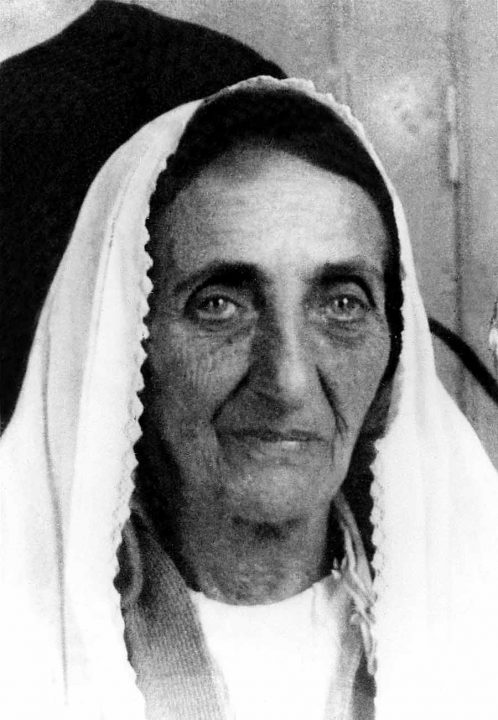
Let me tell you about a woman whose long life of patience and perseverance has to rank among the most enduring and noble examples ever – Bahiyyih Khanum, the daughter of Baha’u’llah, the prophet and founder of the Baha’i Faith.
Portrait of Bahiyyih Khanum, The Greatest Holy Leaf, daughter of Baha’u’llah, c. 1895
Born in Iran in 1846, Bahiyyih Khanum was raised by Baha’u’llah and his wife Navvab in one of the wealthier families of Tehran. She spent the early years of her childhood playing in beautiful gardens with her older brother Abdu’l-Baha, and going to school where she learned Arabic, Persian and Turkish, receiving a formal education unlike most other girls during that time. She also grew up in a tradition of helping and serving others, influenced by her parents’ well-known devotion to society’s most disadvantaged people, indicated by their informal titles, “Mother and Father of the Poor.”
The years immediately preceding and following her birth were also the first years of the Babi Faith, the millennial spiritual movement that took Persia by storm in the 1840s. Her father Baha’u’llah involved himself in that movement from the beginning through correspondence with the Bab, its founder.
The Bab’s progressive teachings soon stirred up the entire nation, alarming the orthodox clerical leaders and the government. With their ties to power the clerics sought to extinguish this revolution of thought and faith. A wave of oppression soon washed over everyone associated with the Bab, so extreme in its violent implementation that accounts reached the chronicles of the West, especially after the Bab himself was martyred by a government firing squad in 1850.
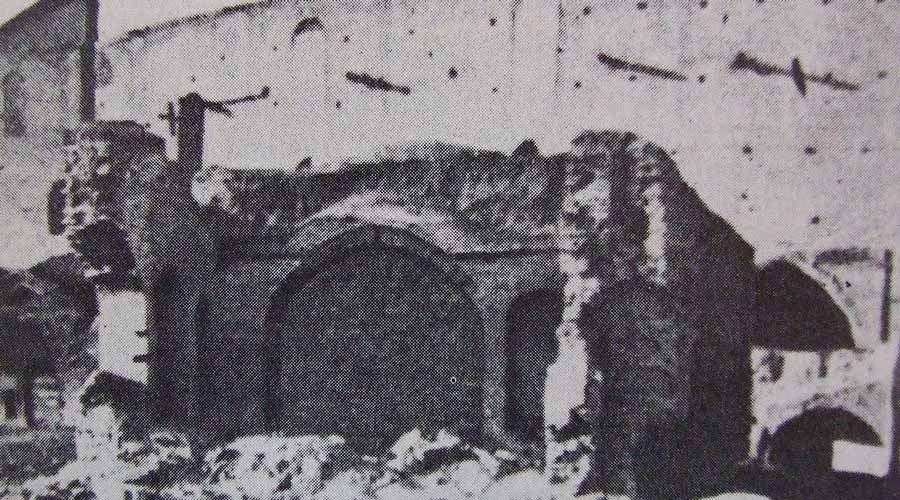
Because he was identified as a Babi leader, the Persian authorities imprisoned Baha’u’llah in Tehran’s notorious, “black pit,” called the Siyah-Chal, in 1852. At the same time his family was stripped of their riches and properties. Baha’u’llah’s wife and children became homeless in a single day. They did not know from one moment to the next whether Baha’u’llah would be executed, the fate so many other Babis had already faced. After four months of torturous confinement, Baha’u’llah was released and exiled to Baghdad. The family, with insufficient attire and few possessions, made the long journey on foot and by mule in the winter over snow-topped mountains to Iraq.
The entrance to the Siyah-Chal (Black-Pit) where Baha’u’llah was imprisoned in Iran.
Thus began the 80 years of Bahiyyih Khanum’s remaining life, living in exile, poverty, and imprisonment. After a number of years in Baghdad, it became evident to many close to him that Baha’u’llah was the messenger of God as foretold by the Bab. His children, all under 10, recognized Baha’u’llah’s station and declared their loyalty and devotion to him.
In 1863 Baha’u’llah announced his new Faith publicly. As his reputation for deep spiritual insight and wisdom grew and his teachings spread, people of all kinds flocked to him and adopted the progressive principles of his Faith. Despite the danger of persecution, thousands became Baha’is. Once more the Faith grew rapidly, at an alarming rate to the enemies of the Faith, who thought they had sufficiently suppressed it. Again the unfounded fears of the Persian and Turkish governments incited by the religious authorities caused them to further banish Baha’u’llah, his family and some core believers, to try to crush the Baha’i Faith.
From Baghdad they were exiled and imprisoned three more times, the last to the prison city of Akka, in Palestine (now Israel). Considered the worst prison in the world at the time, its inhabitants were not expected to live more than a year, which made it a death sentence. His family, imprisoned with him, suffered severe hardships. However, Baha’u’llah lived 24 years there, before passing away in 1892.
Bahiyyih Khanum and her beloved brother Abdu’l-Baha, survived as well, to be freed in their later years when the Ottoman Empire fell apart. Abdu’l-Baha, named by Baha’u’llah as his successor, became the head of his father’s Faith for the next 29 years, until his passing in 1921.
Bahiyyih Khanum, titled the Greatest Holy Leaf
So Bahiyyih Khanum only had six years of childhood, of what we would consider a normal life. She endured her remaining eighty years while facing the greatest imaginable difficulties with a universally-acknowledged nobility, dignity and calmness. In spite of the deplorable living conditions, the frequent lack of potable water, a poverty sometimes so acute her mother had to give her a handful of flour as her sole daily sustenance, and the constant persecution by the authorities, Bahiyyih Khanum persisted patiently. She prevailed through the constant threats on Baha’u’llah’s life and the several unsuccessful attempts that were actually made. She faced the tragic death of her beloved younger brother, Mirza Midhi, while the family was imprisoned. All these and more were her lot in life.
“The Greatest Holy Leaf,” the title given to his daughter Bahiyyih Khanum by Baha’u’llah, exemplified her uncommon attitude about patience. That rare quality, developed through dire tests and trials, can best be described by reading her own advice on the subject:
“… We ought to never be known to complain or lament. It is not that we would “make the best of things” but that we may find in everything, even in calamity, the gems of enduring wisdom. We ought never be impatient. We ought be as incapable of impatience as one would be of revolt. This not being so much long-suffering as quiet awareness of the forces that operate in the hours of dark or years of waiting and inactivity. Always we ought to move with the larger rhythm, the wider sweep, towards our ultimate goal, in that complete acquiescence, that perfect chord which underlies the spirit of the Faith itself.” – Bahiyyih Khanum
I leave it to you to contemplate these powerful thoughts, and hope they give you, as they have given me, a light on how to live under difficulties.
The assurance of an afterlife is by itself hardly a sufficient reason to relinquish a fear of death, since few of us can be absolutely certain how well we have…
I don’t know when I became curious about the purpose of suffering.
Most likely a slow process eased its way into my awareness as I aged, and I started to question why my challenges created such discord within me. Although numerous resources can help explain such things, the one that first caught my attention came from The Hidden Words by Baha’u’llah:
Out of the wastes of nothingness, with the clay of My command I made thee to appear, and have ordained for thy training every atom in existence and the essence of all created things… – The Hidden Words, p. 32.
The word “training” has many levels of implication:
To teach a particular job or activity
To prepare yourself/somebody for a particular activity
To develop a natural ability or quality so that it improves
To make a plant grow in a particular direction
To be taught, prepared, developed and shown how to grow with “every atom in existence and the essence of all created things” is a concept that I find completely and utterly fascinating.
The quote does not say training comes from only “good” atoms and essences. Nor does it exclude the atoms I am composed of, and the essence of who I am. This all boils down to me becoming conscious of the fact that I am an integral part of what exists–as is every other human being, and the rest of creation, too.
From this perspective, I see training as the limitless exchanges an individual has internally and externally; between themselves and someone or something else; both tangible and intangible. All of these exchanges exist on a spectrum from the onerous and downright horrendous to the excellent and wonderful, each varying in level of intensity and complexity from low to high, as well as in length of time from nanoseconds to years.
Because each of us knows our own self far better than anyone else can, how we experience every aspect of our training can only be determined by the person experiencing them. There are billions of people on this planet, and what proves difficult for one person to cope with may not be difficult for someone else:
…on this dusty earth all humankind are suffering… And if a human life, with its spiritual being, were limited to this earthly span, then what would be the harvest of creation? Indeed, what would be the effects and the outcomes of Divinity Itself? Were such a notion true, then all created things, all contingent realities, and this whole world of being — all would be meaningless. God forbid that one should hold to such a fiction and gross error. – Abdu’l-Baha, Selections from the Writings of Abdu’l-Baha, p. 184.
When something makes you suffer, creates unhappiness or causes internal struggle, it is empowering to believe that:
Because I believe that reassuring truth, my perspective has changed from one of bemoaning trials, tribulations, tests and suffering to an increasing acceptance of them–because “every atom in existence and the essence of all created things “ are for our training.
I now try to see my suffering and troubles as a means for cultivation of self, the fine-tuning of character and virtues. In the same way, I hope that our collective suffering has meaning, and will eventually lead humanity to the point that our training will no longer involve war, hunger, poverty and other such man-made difficulties:
God alone ordereth all things and is all-powerful. Why then does He send trials to His servants?
The trials of man are of two kinds. (a) The consequences of his own actions. If a man eats too much, he ruins his digestion; if he takes poison he becomes ill or dies. If a person gambles he will lose his money; if he drinks too much he will lose his equilibrium. All these sufferings are caused by the man himself, it is quite clear therefore that certain sorrows are the result of our own deeds. (b) Other sufferings there are, which come upon the Faithful of God. Consider the great sorrows endured by Christ and by His apostles!
Those who suffer most, attain to the greatest perfection… Men who suffer not, attain no perfection. The plant most pruned by the gardeners is that one which, when the summer comes, will have the most beautiful blossoms and the most abundant fruit.
The laborer cuts up the earth with his plough, and from that earth comes the rich and plentiful harvest. The more a man is chastened, the greater is the harvest of spiritual virtues shown forth by him. – Abdu’l-Baha, Paris Talks, p. 49.
Number four on the list of 5 Astounding Hellacious Things: Hell is a real place. You can visit.
Well, at least hell used to be a real place. Okay, maybe several places.
The word “hell” comes from either the Old Norse or proto-German word “hel” – although several other languages have a similar word. The Anglo-Saxons used the Old English words hel and helle, which both referred to the world of the dead. The same meaning applied to lots of related words from the Old Saxon, Middle Dutch, High German, Danish, Norwegian and Swedish vocabularies. They all described a real place, or at least a mythic place everyone thought was real: Hel.
In Norse mythology, you went to Hel when you died of sickness or old age—as opposed to dying nobly as a warrior in battle, which earned you a one-way ticket to Valhalla. In fact, the ancient curse “Go to Hel” originates from the Viking idea that the only honorable death came in combat. In the myths, Hel was presided over by a woman, also named Hel, the daughter of the legendary trickster Loki. The Norse God Odin appointed Hel to rule over vast mansions in a part of the kingdom called Niflheim, another icy cold place fed by frozen rivers.
This concept of Hel took a significant hold on the far-flung lands the Vikings conquered, and spread widely until it became accepted belief. Then the mythological, pagan concept of Hel slowly transferred to Christian theology and its vocabulary as Europe gradually Christianized over several centuries.
The Judeo-Christian tradition already had its own hell, though, originally called Gehenna—a real place, with very little mythology involved. If you travel to Israel, you can visit hell/Gehenna—it’s located at the base of Mount Zion near a town called Bir Ayyub. I’m told it’s an idyllic little valley today.
Out beyond the city walls of ancient Jerusalem, and identified in the Hebrew Bible as a valley where the son of a man named Hinnom lived, Gehenna reportedly housed apostates and idol-worshippers who sacrificed their own children by fire. This terrible image, hopefully mythical, made the entire valley a cursed landscape where fire consumed the souls of the dead—and that’s how the Aramaic and Hebrew word Gehenna got translated into the Anglo-Saxon word Hell in the King James version of the Bible. Jesus used the word Gehenna many times, describing it symbolically as the opposite to life in God’s kingdom, a place where body and soul burned in “unquenchable fire.” –Mark 9:43. This same place name in Arabic translates as Jahannam, and the Qur’an contains hundreds of references to Gehenna or Jahannam, identifying it as the Islamic hell, a place where sinners receive their eternal punishment.
You can probably see, just by studying and understanding the derivation and origin of these words, places and concepts, how the idea of a hell came about. Originally intended to serve as a metaphor that stood for a bleak, terrible place of the punishment of the dead, and meant as a purely spiritual condition that indicated the torpor of the soul, the clergy of many different religions slowly transformed the cautionary idea of hell from symbolic to real as a way to frighten and control people. Children, the uneducated and the superstitious, who made up the great mass of the populace at the time when many of the ancient religions flourished, understood the stark fear the idea of hell inspired. Religious leaders then used the fear of hell to initially enforce the moral laws of their Faiths, and then, as their religions declined, for their own ends.
But this use of the concept of hell also had some beneficial outcomes at different points in history. Knowing the difference between good and bad, between reward and retribution, is essential to every child’s upbringing. Developing a human moral code which differentiates between conduct that helps others and actions that injure others has always been the purview of religion, and in the historical periods when few people had any education a literal heaven and hell likely gave motivation to many.
The Baha’i writings say that this method of spiritual education always had a wise original intent:
Even the materialists have testified in their writings to the wisdom of these divinely-appointed Messengers, and have regarded the references made by the Prophets to Paradise, to hell fire, to future reward and punishment, to have been actuated by a desire to educate and uplift the souls of men. – Baha’u’llah, Gleanings from the Writings of Baha’u’llah, p. 155.
Today, though, most of us don’t need to believe in a literal hell or heaven. We’ve matured. We typically have the education and intelligence to see those concepts purely as symbols of the soul’s relation to God. To Baha’is, heaven and hell describe a spiritual reality, not a physical one. In this poetic passage describing the new Baha’i revelation from Abdu’l-Baha, heaven and the “Stygian dark” of hell take on that new symbolic meaning:
When the Sun of Reality shed its endless bounties from the Dawning-Point of all desires, and this world of being was lit with that sacred light from pole to pole, with such intensity did it cast down its rays that it blotted out the Stygian dark forever, whereupon this earth of dust became the envy of the spheres of heaven, and this lowly place took on the state and panoply of the supernal realm. The gentle breeze of holiness blew over it, scattering abroad sweet savours; the spring winds of heaven passed by it, and over it, from the Source of all bestowals, were wafted fruitful airs that carried boundless grace. Then the bright dawn rose, and there came tidings of great joy. The divine springtime was here, pitching its tents in this contingent world, so that all creation leapt and danced. – Selections from the Writings of Abdu’l-Baha, pp. 7-8.
If you haven’t already gotten to know Baha’u’llah’s short book “The Hidden Words,” then you might want to get a copy. And if you’re already familiar with it but haven’t given it a close look in a while, I suggest you throw yourself into it.
Made up of 153 brief passages revealed by Baha’u’llah in 1858, as he walked on the banks of the river Tigris in Baghdad, Iraq, “The Hidden Words” is direct and straightforward, yet endlessly nuanced and esoteric. It speaks straight to the reader but always holds new stores of meaning. “The Hidden Words” defies the dry sort of reading that occurs in academic settings or the half-absent scroll-through typical to the social media experience. Instead, it is written in the voice of God, as a divine love letter to the human reader. Here is some of the language of the heart one finds within:
“Thou art My lamp and My light is in thee.”
“I have made death a messenger of joy to thee. Wherefore dost thou grieve?”
“Purge thy heart from malice and, innocent of envy, enter the divine court of holiness.”
“Thy heart is My home; sanctify it for My descent.”
With other books, the main interest of the reader is to obtain information. Reading is just a way of extracting the elements of knowledge contained within its pages. But this book is different. It facilitates experiences of inner transformation. I think the following three passages show this well. In one, Baha’u’llah explains the reason why we were created: “O Son of Man! Veiled in My immemorial being and in the ancient eternity of My essence, I knew My love for thee; therefore I created thee, have engraved on thee Mine image and revealed to thee My beauty.”
He also describes the hidden potentials inside each one of us in this passage: “O Son of Spirit! Noble have I created thee, yet thou hast abased thyself. Rise then unto that for which thou wast created.” And again, in this one: “O Befriended Stranger! The candle of thine heart is lighted by the hand of My power, quench it not with the contrary winds of self and passion. The healer of all thine ills is remembrance of Me, forget it not. Make My love thy treasure and cherish it even as thy very sight and life.”
“The Hidden Words” attracts us into an enveloping experience of spiritual search. It lends itself to moments of meditation we normally have away from a screen or book. It makes us want to soak ourselves in its words. And one of the best ways to experience that is — dare I say it — to memorize them. Fortunately, that doesn’t imply we should memorize the whole thing as a large block! In my experience, moving through too much text too quickly almost certainly hampers meditation. The main thing is to be able to recall individual sayings, which are usually no longer than a handful of sentences, and to be able to let them sink in, even with our eyes off the page.
I’ve recently developed the habit of keeping a tiny paper copy of “The Hidden Words” in my pocket at all times. When the moment feels right, which often happens unexpectedly, I pull it out and choose a passage at random. I focus on it deeply and try to commit its words to memory. Once I think I have it, I close the book, leaving my finger as a bookmark, and repeat the passage to myself until I’m sure I’ve memorized it.
This is something I’ve found works for me; other people might find other methods more spiritually uplifting. What matters is that each of us identify practices that help us hold true to our spiritual path.
Memorizing and meditating on individual passages of “The Hidden Words” has helped make the conversational nature of prayer more concrete for me. On the one hand, I have everything I want to say to God. And on the other hand, in order to hear what God has to say to me, I don’t have to rely on doubtful interpretations of spiritual feelings inside of me or of external events around me: I can focus my attention on what God has revealed for humanity in the sacred writings of Baha’u’llah. There’s always insight that can be gleaned through turning my mind and heart to the word of God.
To be mindful of God’s presence as we think something through is a kind of prayer. I can hold myself in silence as I allow the passage to address me. I can put questions to God about the meaning of specific lines and reflect on its significance and implications for my own life. Before I have any more to say to God, I must remember that he already has so much to say to me. And so much of it is contained in the 153 short messages of love that make up Baha’u’llah’s “The Hidden Words.”
Question: Do Baha’is have an idea of an afterlife? If so what does it consist of? The answer to this question – a very definite and emphatic yes – flows…
Imagine this: you’re a physicist struggling with a major new theory of how the universe works, and you find the answer in a dream. You’re a novelist looking for a big, original idea for your next book, and it comes to you fully-realized in your dreams. You’re an inventor trying repeatedly without success to figure out how to make a new machine work, and you finally see the solution in a dream. You’re a scientist trying to figure out an experiment to demonstrate how the body transmits its nerve impulses, and your dream provides the answer.
Sound far-fetched? Not hardly. It happened to Albert Einstein with his Theory of Relativity; to Mary Shelley before she wrote Frankenstein; to Elias Howe, the inventor of the modern sewing machine; and to Otto Loewi, who won the Nobel Prize in Medicine for his discovery of the chemical rather than electrical transmission of nerve impulses. They each had pondered over their ideas while awake, only to have the answers come to them while asleep.
Probably thousands of discoveries, creative inspirations and inventions have happened this same way. But not every dream, the Baha’i teachings tell us, will be so productive:
The mind and the thought of man sometimes discover truths, and from this thought and discovery signs and results are produced. This thought has a foundation. But many things come to the mind of man which are like the waves of the sea of imaginations; they have no fruit, and no result comes from them. In the same way, man sees in the world of sleep a vision which becomes exactly realized; at another time, he sees a dream which has absolutely no result. – Abdu’l-Baha, Some Answered Questions, p. 252.
So how do we tell the difference? Most of the science of dreams revolves around a solid working base of research which tells us that we can definitely derive meaning from our dreams. But how can we extract that meaning, and how can we trust it? How do we differentiate between a meaningful dream and a random one? The Baha’i teachings offer us some fascinating clues:
The other manifestation of the powers and actions of the spirit is without instruments and organs. For example, in the state of sleep without eyes it sees; without an ear it hears; without a tongue it speaks; without feet it runs. Briefly, these actions are beyond the means of instruments and organs. How often it happens that it sees a dream in the world of sleep, and its signification becomes apparent two years afterward in corresponding events. In the same way, how many times it happens that a question which one cannot solve in the world of wakefulness is solved in the world of dreams. In wakefulness the eye sees only for a short distance, but in dreams he who is in the East sees the West. Awake he sees the present; in sleep he sees the future…
In the time of sleep this body is as though dead; it does not see nor hear; it does not feel; it has no consciousness, no perception — that is to say, the powers of man have become inactive, but the spirit lives and subsists. Nay, its penetration is increased, its flight is higher, and its intelligence is greater… – Abdu’l-Baha, Some Answered Questions, p. 227.
[Abdu’l-Baha] explained that there were three kinds of dreams: dreams that come from some bodily disorder, symbolic dreams, and those in which future events are clearly foretold. When the soul is in a state of perfect purity it is able, He said, to receive a direct revelation from God. Otherwise, it sees in symbols. – Juliet Thompson, The Diary of Juliet Thompson, pp. 178-179.
Spirit in the human world is the discoverer of the realities of existence. All the inventions, all the sciences, all the hidden mysteries are brought to light through the activity of the spirit on the plane of life. While living in the Orient it organizes affairs in the Occident; while living on the earth it discovers the heavenly constellations. These examples ought to show you that the spirit of life is omnipotent, especially when it establishes a communication with God and becomes the recipient of the eternal light – then it transforms itself into a ray of the effulgence of the eternal sun.
This station is the greatest of all stations, for this connection of the spirit of man with God is like unto a mirror and the sun of reality is reflected in it. Thus it becomes the collective center of all the virtues; its emanation is the bestowal of the king of bestowers; its radiations are the manifold splendors of the infinite luminary; its sanctity is from the highest summit of divine essence. This station is the station of heavenly inspiration and is called the station of the divine grace. It signifies that the rays of the sun of reality are resplendent in the mirror and the attributes of the sun of reality are reflected therein. This is the ultimate degree of human perfection, for the attainment of which the thinkers and philosophers of all time have longed and poets have dreamed; it is the mystery of mysteries and the light of lights wherein the spirit becomes eternal, self-subsistent, age-abiding. – Abdu’l-Baha, Divine Philosophy, p. 166.
As to truthful dreams: I beg of God that thy inner eye (insight) may be so opened that thou mayest thyself differentiate between truthful and untruthful dreams. – Abdu’l-Baha, Tablets of Abdu’l-Baha, v1, p. 195.
These passages from Abdu’l-Baha liken the aware, alive and well-developed human spirit to a polished mirror, able to reflect the glory of the sun. “The station of heavenly inspiration,” Abdu’l-Baha calls it, suggesting that the mirror of the human soul has the power to absorb and accurately reflect the light of spiritual truth and guidance—when we continually clean and polish the mirror.
Today, one of the holiest and happiest days in the entire year for Baha’is, the followers and friends of Baha’u’llah will gather with smiles, laughter, and great joy – please join us!
This is much more than a birthday party, though. When Baha’u’llah was born at the hour of dawn on October 27th in 1817, Baha’is believe the means for the establishment of the long-awaited unity of the entire human race came into being.
Baha’u’llah began teaching the newly-revealed Baha’i Faith in the spring of 1863. His revelation promised that the religious, racial, and nationalistic hatreds dividing the peoples of the world would soon be overcome. He said the violence, war, and fanaticism that separated human beings was obsolete. He asked humanity to transcend their prejudices and forget the things that keep them apart. He opened the way for lasting world peace based on a new spiritual foundation. He raised the great call for the unity of all peoples and cultures, all nations and religions, which all the prophets of old had promised would one day appear.
For those profound reasons, and many more, the global Baha’i community enthusiastically and joyously celebrates this day every year – the Birth of Baha’u’llah, the second of the Baha’i Twin Holy Days.
Of course, every religion recognizes the birth of its founder. In the same way that Buddhists celebrate the birth of Gautama Buddha on Vesak each year; in the same way that Christians celebrate the birth of Jesus every year on Christmas; in the same way that every great Faith annually commemorates the birth of its founder, Baha’is mark Baha’u’llah’s birth with joy and happiness.
But this holy day is more than that, because Baha’is view the advent of Baha’u’llah as a major turning point in the world’s evolution. Baha’u’llahwrote:
The Revelation which, from time immemorial, hath been acclaimed as the Purpose and Promise of all the Prophets of God, and the most cherished Desire of His Messengers, hath now, by virtue of the pervasive Will of the Almighty and at His irresistible bidding, been revealed unto men. The advent of such a Revelation hath been heralded in all the sacred Scriptures.
In any age, the birth of a new messenger of God represents hope and joy and the coming of a spiritual springtime, when the whole world begins to awaken to that beautiful new divine message. Baha’is believe that Baha’u’llah, the most recent messenger and founder of a global Faith, represents the latest channel of God’s grace to humanity, the one who brings the unity of all peoples, the fulfillment of the age-old promise of the kingdom of God come to Earth.
Born more than two centuries ago in the capital city of Persia, Tehran, Baha’u’llah grew up as the son of a government minister and nobleman. Rather than pursuing his father’s career, early in his adulthood Baha’u’llah turned to a life of service to the poor and needy. He sought no position or prominence, and accepted the religion of the Bab, which subjected Baha’u’llah and his family to terrible privation, persecution, and imprisonment. Thirteen years after the government’s execution of the Bab in 1850, Baha’u’llah announced that he was the one heralded by the Bab – God’s messenger for humanity’s golden age of unity and peace, foretold in all the world’s scriptures.
However, you won’t find a sense of triumphalism among the Baha’is, because Baha’u’llah taught that no distinction of station exists between any of the messengers of God. No Baha’i claims that the stations of the Bab or Baha’u’llah are superior to the stations of any of God’s previous messengers. In fact, Baha’is view all of the messengers and prophets of God as one.
Baha’u’llah proclaimed that his message is for every human being, intended not for one people or culture, one language or nation, but meant for all peoples. He announced that the coming of age of the human species, the time when the human race has the potential to recognize itself as one, discover its fullness and its common humanity, has arrived.
So the Baha’i Twin Holy Days mark the first universal holy day to be vouchsafed to everyone by a loving God – a shared world celebration.
This is the first day in human history that can be celebrated as sacred by all peoples, no matter what their background. In Baha’u’llah’s birthday Jewish people may discover the birth of the Messiah, and Christians recognize the return of Christ. Muslims might celebrate the reappearance of the Hidden Imam and the birth of the promised Qa’im. The Zoroastrians can rejoice at the birth of their king, the Shah Bahram; Buddhists can find the Maitreya Buddha, the supremely enlightened One. Hindus can recognize in Baha’u’llah the return of Krishna, born to reestablish righteousness on Earth.
So this, the Baha’i teachings say, is the first event in human history that people of all traditions and all cultures can claim as their own. Happy Birthday of Baha’u’llah!
When my husband and I first saw the results of the tests on our new baby growing in my womb, we both cried. But after all the excellent advice from friends and relatives and professionals, we started to realize we could do more. I began singing Baha’i prayers for children, like this one:
O God! Educate these children. These children are the plants of Thine orchard, the flowers of Thy meadow, the roses of Thy garden. Let Thy rain fall upon them; let the Sun of Reality shine upon them with Thy love. Let Thy breeze refresh them in order that they may be trained, grow and develop, and appear in the utmost beauty. Thou art the Giver. Thou art the Compassionate. – Abdu’l-Baha, Baha’i Prayers, pp. 34-35.
As I sang I modified the words: “O God educate my child. My child is a plant in thine orchard”, etc.
And I prayed for acceptance and protection, including this one from The Bab:
Immeasurably exalted art Thou, O Lord! Protect us from what lieth in front of us and behind us, above our heads, on our right, on our left, below our feet and every other side to which we are exposed. Verily Thy protection over all things is unfailing. – Selections from the Writings of the Bab, p. 172.
Our wise midwife gave us spiritual guidance, too, advising us to talk to the baby and explain, in facts, what information we had; and to explain that these emotions mommy and daddy feel occur because we are upset and have a lot to process and try to understand.
She suggested my husband and I sit in meditation to:
Connect to our own souls, to see what inner guidance we receive about this situation connect to the baby’s soul, and listen quietly for what the baby’s soul would like to say connect all three of us as a family unit. Talk aloud to each other as parents, talk to the growing baby in utero and simply listen.
When I sat quietly meditating, my newly-blossoming mother’s intuition told me “Everything is going to be fine. Everything is healthy.” I even wrote in my journal one simple sentence on a page during this time: “I know you are perfect.”
When I sat quietly after having talked to my baby’s soul, I silently asked, “Is there anything you’d like to say.” And I heard one, simple, strong reply, “I’m here to live.”
The process of connecting spiritually through both prayer and meditation gave me a solid foundation. Those days and weeks following the testing filled us with high emotions, and from one moment to the next I never knew when tears, fears and sadness would overcome me. In these moments of prayer and meditation, I can now see, I grew my spiritual roots. They cracked down through rock, soil and sediment to root me to a new reality.
Recently, some of the friends I’ve shared our experience with have mentioned, in different ways but with a similar message: the first time our child undergoes anything that can cause harm or interfere with optimal health, we experience how fragile life is and our love deepens. In loving our child more, we experience fear, but we also experience faith. Welcome to parenting, they said.
I couldn’t have asked for a better man alongside whom to start my parenting. In the perinatologist’s office, the darkest picture of the future went through my mind. I cried uncontrollably. My husband hugged me as I wept on his shoulder. He whispered in my ear, “I know. I know. I feel the same way.” And in that moment, I felt such consolation and love.
Through taking the time to process emotions, soak up the love from my husband, family and friends, and connect within through prayer and meditation, our decision for which follow-up test to undergo became clear. I needed that support to follow through and steel myself to go in for the final test.
I want to share with you that everything is okay! The test confirmed that we have a healthy baby, growing in my rapidly-expanding womb. The blood work came back negative, and the follow-up exam indicated healthy, normal growth. I have never had more thrilling news.
My days now fill with a deep gratitude every time I feel this baby move. I am keeping up my healthy eating, walking, exercise; continuing to talk to the baby, pray and write thoughts in a journal that one day, along with these essays, I will look forward to sharing with my first child.
A colleague sent me an email today lamenting, “I have two lists — one immediate (which grows ever longer) and the regular list which stays the same.” I enjoyed his wit, and…
In his travels through Europe and North America just over a century ago, Abdu’l-Baha spoke continuously of the future society that the practice of Baha’u’llah’s teachings would make possible. He said that commerce, infrastructure, technology, and wealth could not lead, on their own, to a flourishing civilization. Abdu’l-Baha emphasized this key theme: that material progress must be accompanied by the inner life of the soul and the spiritual quality of social relations:
For man two wings are necessary. One wing is physical power and material civilization; the other is spiritual power and divine civilization. With one wing only, flight is impossible. Two wings are essential. Therefore, no matter how much material civilization advances, it cannot attain to perfection except through the uplift of spiritual civilization. – Abdu’l-Baha, The Promulgation of Universal Peace. p. 12.
Though focusing on the inner life to the detriment of material development is just as regrettable, Abdu’l-Baha more often emphasized for his listeners the importance of life’s spiritual dimension. He delivered many of the talks on this theme in some of the wealthiest and most technologically advanced cities in human history. In the century that followed, nearly every country on Earth has followed a path of economic development traced earlier by western cities like London, Paris, and New York. As a result, a narrow focus on industrialization, technology, and mass-market consumerism as the means to individual and collective well-being has become deeply rooted in every corner of human society.
The concept Abdu’l-Baha explained, simple enough in its outline, requires extra thought to see how it sheds light on the many challenges of our time–and illuminates a path toward to a better society. In this short series of essays, I’ve selected five broad themes that illustrate the importance of pursuing spiritual and material development simultaneously and in concert with each other. I’ve mainly focused on correcting for the world’s general neglect of the spiritual dimension, because in recent decades the global community has generally moved in a very materialistic direction. Nonetheless, in some places and contexts it may be more important to correct for an under-emphasis on science and the use of material means. Today, I share the first reason:
1. Material wealth can make people less happy, not more, if they have enough of it already.
Most people share the common understanding that happiness comes from material possessions. The faultiness of this thinking perhaps best reveals itself when we acknowledge the real suffering experienced by those who seem to have it all. In recent years many researchers and social commentators have begun to speak of affluenza, a condition that combines the words affluence and influenza. Though not a disease in a physical or psychological sense, affluenza involves a set of personal problems derived from the lifestyles of the very rich. This article overviews some of the scientific research that has been done on the topic. It can cause higher-than-average rates of depression and addiction, persistent anxiety about status and reputation, or emotional fragility in the face of even mild hardship. For many, the constant acquisition of new possessions becomes a source of pleasure itself, and a strain on their otherwise robust finances. And the more possessions a person has, the more time he or she has to spend cleaning, guarding, maintaining and finding some place to store them. All these material burdens add unnecessary stress to the lives of the wealthy.
Studies show that material wealth contributes to happiness so long as it solves definite personal problems associated with poverty, like malnutrition, homelessness, physical exhaustion, or disease. But once those are solved, wealth becomes less and less efficient at making people happy. For people who are grounded in some body of spiritual teachings, the reason for this seems clear enough. Happiness is an inner condition. Until we get our spiritual house in order, there won’t be much joy or contentment. The spiritual and material bases for human happiness both need to be energetically pursued to make our lives better.
Baha’u’llah, who was himself born into outstanding affluence, wrote frequently about the connection between wealth and spirituality. In this passage from The Hidden Words he warns that riches can withhold someone from communion with God; and at the same time avoids reducing that person’s spiritual condition to the quantity of his or her possessions:
O ye that pride yourselves on mortal riches! Know ye in truth that wealth is a mighty barrier between the seeker and his desire, the lover and his beloved. The rich, but for a few, shall in no wise attain the court of His presence nor enter the city of content and resignation. Well is it then with him, who, being rich, is not hindered by his riches from the eternal kingdom, nor deprived by them of imperishable dominion. By the Most Great Name! The splendor of such a wealthy man shall illuminate the dwellers of heaven even as the sun enlightens the people of the earth! – Baha’u’llah, The Hidden Words, p. 41.
Human happiness cannot be evaluated using economic factors alone. A more comprehensive approach to happiness must also give weight to cultural practices that nurture the soul’s ability to radiate joy and contentment.
Do science and the inner spiritual life ever collide or cohere? Can they work together? The Baha’i teachings answer those questions with a resounding yes.
Although most of my more naturalistic colleagues might strongly disagree, I believe there are enough instances in the history of science where the process of discovery has occurred in a mystical or a revelatory manner that we can no longer dismiss them out of hand.
After all, Einstein’s dreams produced the theory of relativity. Dmitri Mendeleev saw the Periodic Table in a dream, and plenty of dreams, visions and mystical experiences fill our science history books. Also, I think most researchers might want to reflect on how difficult problems at times seemed to be suddenly resolved, or an important insight occurred after a dream or a period of meditative reflection.
Baha’u’llah quotes the Qur’an in the Book of Certitude:
Therefore, hath it been said: “’Knowledge is a light which God casteth into the heart of whomsoever He willeth.’”
Also in the Tablet of Ornaments, Baha’u’llah says:
In this Day whatsoever serveth to reduce blindness and to increase vision is worthy of consideration. This vision acteth as the agent and guide for true knowledge. Indeed in the estimation of men of wisdom keenness of understanding is due to keenness of vision.
When Abdu’l-Baha visited Paris during the early years of the 20th century, he gave a very positive account of the practices of the ancient Persian Illuminati school, where, in addition to standard lectures, they would engage in collective silent meditative reflection on various scientific and spiritual problems. I’ll end this series of essays about spirituality and science with Abdu’l-Baha’s fascinating comments on this subject:
About one thousand years ago a society was formed in Persia called the Society of the Friends, who gathered together for silent communion with the Almighty.
They divided Divine philosophy into two parts: one kind is that of which the knowledge can be acquired through lectures and study in schools and colleges. The second kind of philosophy was that of the Illuminati, or followers of the inner light. The schools of this philosophy were held in silence. Meditating, and turning their faces to the Source of Light, from that central Light the mysteries of the Kingdom were reflected in the hearts of these people. All the Divine problems were solved by this power of illumination.
This Society of Friends increased greatly in Persia, and up to the present time their societies exist. Many books and epistles were written by their leaders. When they assemble in their meeting-house they sit silently and contemplate; their leader opens with a certain proposition, and says to the assembly “You must meditate on this problem.” Then, freeing their minds from everything else, they sit and reflect, and before long the answer is revealed to them. Many abstruse divine questions are solved by this illumination.
Some of the great questions unfolding from the rays of the Sun of Reality upon the mind of man are: the problem of the reality of the spirit of man; of the birth of the spirit; of its birth from this world into the world of God; the question of the inner life of the spirit and of its fate after its ascension from the body.
They also meditate upon the scientific questions of the day, and these are likewise solved.
These people, who are called “Followers of the inner light”, attain to a superlative degree of power, and are entirely freed from blind dogmas and imitations. Men rely on the statements of these people: by themselves—within themselves—they solve all mysteries ….
Baha’u’llah says there is a sign (from God) in every phenomenon: the sign of the intellect is contemplation and the sign of contemplation is silence, because it is impossible for a man to do two things at one time—he cannot both speak and meditate.
It is an axiomatic fact that while you meditate you are speaking with your own spirit. In that state of mind you put certain questions to your spirit and the spirit answers: the light breaks forth and the reality is revealed.
You cannot apply the name “man” to any being void of this faculty of meditation; without it he would be a mere animal, lower than the beasts.
Through the faculty of meditation man attains to eternal life; through it he receives the breath of the Holy Spirit—the bestowal of the Spirit is given in reflection and meditation.
The spirit of man is itself informed and strengthened during meditation; through it affairs of which man knew nothing are unfolded before his view. Through it he receives Divine inspiration, through it he receives heavenly food.
Meditation is the key for opening the doors of mysteries. In that state man abstracts himself: in that state man withdraws himself from all outside objects; in that subjective mood he is immersed in the ocean of spiritual life and can unfold the secrets of things-in-themselves. To illustrate this, think of man as endowed with two kinds of sight; when the power of insight is being used the outward power of vision does not see.
This faculty of meditation frees man from the animal nature, discerns the reality of things, puts man in touch with God. This faculty brings forth from the invisible plane the sciences and arts.
Yes, you certainly do, the sleep researchers all tell us. Whether you remember what you dreamed when you wake up or not, every human being dreams. Even newborn babies have dreams. We all go through periods of rapid eye movement (REM) sleep several times a night, when our most memorable dreams occur. However, sleep studies have recently found that we also dream during non-REM sleep, when brain activity is lower than in REM sleep. Half of all infant sleep occurs in the REM state, when pediatric neuroscientists believe babies’ brains first form the integrated pathways crucial to thought.
Dreaming proves universal, even going beyond the human species. We’ve probably all seen dogs and cats “run” in their dreams. Scientists have found that most mammals and even birds regularly dream. The average person, we now know, has between 3-5 dreams per sleep cycle, and sometimes more, for a total of approximately two hours of dreaming every night. Dreams can last a few seconds, or up to thirty minutes. Some people dream in black and white, others in vivid color. During a normal lifetime, the average adult will spend more than six years dreaming—almost ten percent of their total lifespan.
But so far, despite the universality of dreaming, science has very little knowledge about where our dreams actually originate. Theories abound—just one portion of the brain causes dreams, or multiple portions combine to create dreams, or the entire brain is utilized. No neuroscience researcher has determined which portion of the brain actually dreams. More importantly, no one knows why we dream, or what conceivable purpose dreams might have. The world of dreams, which has always been a mystery since the beginnings of history, continues to baffle us.
We do know this—no human being can live without sleeping and dreaming.
In fact, scientists have recently studied the increasingly proven linkage between sleep deprivation and mental illness, including bipolar disorder and various psychotic conditions. In one 2007 study done at Harvard Medical School and the University of California at Berkeley, researchers used Magnetic Resonance Imaging to scan the brains of sleep-deprived subjects, and found that the loss of sleep “causes the brain to become incapable of putting an emotional event into the proper perspective, and incapable of making a controlled, suitable response to an event.” Scientifically verified, the longest any person has ever stayed awake is eleven days, at the end of which the sleepless subject suffered from paranoia and hallucinations.
Sleep deprivation, and the loss of the ability to dream, actually mimics psychosis.
Another extensive dream study, conducted by Dr. Patrick McNamara at the Boston University School of Medicine, showed that many (but not all) dreams have “elaborate, complex, involuntary and highly-structured formal features” that combine to make up “extraordinarily complex mental simulations.” The researchers in that study learned that dreams often have their own internal logic and cohesiveness, rather than simply representing the random firing of neurons while the brain rests.
In other words, dreams can tell us the truth. Ancient societies know this wisdom, and as a result many native and aboriginal cultures place the dream world on an equal footing with the world of everyday consciousness, making little or no distinction between dreaming and waking states. In ancient times, dreaming may have given us our first human inclination of something beyond this material existence:
Dreams often seem to be experiences of a confused parallel world. Reflecting on this experience, we may speculate that during dreams we travel to a real, alternate realm. It has been suggested that one of the principle sources of this idea—a spiritual world distinct from the physical—is dreams. If this hypothesis is true, even partially, then dreams contribute to one of the basic notions of religion. – James R. Lewis, The Dream Encyclopedia, p. xiv.
The Baha’i teachings view dreams in a complex but essentially spiritual way—as the vehicle the human soul can and often does use to make its most profound discoveries:
When man’s soul is rarified and cleansed, spiritual links are established, and from these bonds sensations felt by the heart are produced. The human heart resembleth a mirror. When this is purified human hearts are attuned and reflect one another, and thus spiritual emotions are generated. This is like the world of dreams when man is detached from things which are tangible and experienceth those of the spirit. What amazing laws operate, and what remarkable discoveries are made! And it may even be that detailed communications are registered… – Abdu’l-Baha, Selections from the Writings of Abdu’l-Baha, p. 108.
This spiritual connection to our unconscious and to the world of the soul can benefit us enormously, if we only pay attention.
In my own quest to understand my post-war dreams, I learned that rehearsing my repeated nightmares might have a positive effect. Here’s how that works: before you go to sleep, you write down the recurring dream, making a short plot summary of what happens each time. Then you change the ending, writing down the way you’d like the dream to end. In my recurring PTSD war nightmare, I had to return to combat forever, so I wrote an alternate ending—that the war had ended, and that peace had come.
This technique didn’t stop or alter the nightmares immediately, but I think consciously changing the ending did eventually help, along with a few other techniques I learned along the way—more about those in the next installment in this series.
So please follow along as we examine the randomness of our dreams, and what each person can do to better understand what happens while they sleep.
In every life we have some trouble, When you worry you make it double Don’t worry, be happy!
~Bobby McFerrin, 1988 song lyrics
Don’t worry, be happy. You may recognize these four words as part of the Bobby McFerrin song or perhaps you know of the famous quote by Indian mystic and sage Meher Baba. Either way, it’s simple, succinct advice. It sounds easy enough, and almost a cliché–can we actually apply it in today’s hustle-and-bustle, high-stress world?
What do we worry about? Well, just about everything: sometimes we worry over excelling in school, being evaluated at work, being good parents, and making friends. We worry about getting enough exercise, getting enough sleep, eating right, and paying the bills. Some of us worry about feeding our families and keeping a roof over our heads. We worry about taking care of our loved ones, taking care of the environment, or even taking care of our spirituality. We worry about the meaning of life.
This anxiety hits everyone–it doesn’t discriminate. Even those who counsel the worriers worry. Psychiatrists, psychologists, social workers, counselors, and other mental health practitioners fall prey to insecurities, worries, and even deep sadness. Rich or poor, young or old, anyone can experience these stressors.
Despite being a psychologist for some 15 years now, I, too, often experience anxiety and worry.
In light of all of this worry present in our lives, our society promotes, advertises and uses a plethora of anti-anxiety and anti-depressant medications. Those prescription medications set new records for sales every year. In the United States alone, anti-depressant use has increased more than 400% in the past twenty years; and one in ten Americans now take medications to combat their anxiety and depression. But what about other approaches? Can we cope with our worries without medication?
Medication is a personal choice, and one best made with the advice of an appropriately-trained (and licensed) medical professional. Some may suffer such extreme anxiety that medication best addresses their trauma. But with the concern over side effects, long-term impacts, and dependency, it behooves us all to research and attempt alternative approaches.
As I mentioned, I have often experienced anxiety and worry in my own life. My alternative to meds? Prayer. My personal daily mantra is my favorite prayer, from the Baha’i Writings:
O God! Refresh and gladden my spirit. Purify my heart. Illumine my powers. I lay all my affairs in Thy hand. Thou art my Guide and my Refuge. I will no longer be sorrowful and grieved; I will be a happy and joyful being. O God! I will no longer be full of anxiety, nor will I let trouble harass me. I will not dwell on the unpleasant things of life.
O God! Thou art more friend to me than I am to myself. I dedicate myself to Thee, O Lord.
Happiness and freedom from anxiety, this prayer seems to say, are conscious choices. Rather than waiting for some future time or condition that will somehow make us happy, we can all make the willful choice to live into our own happiness now.
Besides prayer, there are many other things you can try when you feel anxiety creeping in. Helpful methods include meditation, journaling, counseling, or talking to a supportive friend. Many people find their joy in physical activity–such as walking, swimming, or yoga–as a way of counteracting stress and worry. Limit your caffeine intake. Use lavender oil in your bath. Try gardening. Focus on something positive. Do what you love to do–paint, write, sing, dance. Volunteer or help someone in need; helping others makes a great tool for getting our minds off our own worries.
Pharrell Williams’ Happy
I’ll share a funny story about de-stressing at work. Yes, don’t fret; you can lift your spirits and ease your mind at the office. My coworkers recently started a “happy train.”
No, I’m not kidding: at the start of the work day, someone pulls up Pharrell Williams’ “Happy” song on her iPod, she plays it loudly, and she starts dancing down the hallway, grabbing coworkers on the way. Soon, a long train of happy dancers wiggle their way through the building, spreading cheer and laughter. If that doesn’t succeed in eliminating your worries, it will probably make you laugh with (and at) your silly coworkers, at the very least. Laughter, we all know, can ease pain, erase anxiety and elevate anyone’s mood.
The next time you feel anxious, please try one of these suggestions, or even a combination of them. If you wish, sit somewhere quiet and recite the aforementioned “refresh and gladden prayer” (as I like to call it). Enjoy the great outdoors as you walk or garden. Help out at your local homeless shelter. Or start a “happy train” at work. Make the choice: don’t worry, be happy.
“There’s so much hate right now,” bewailed a friend recently.
Usually one of the most positive and upbeat women I know, she sounded dejected. Deeply concerned about the state of society, especially in the political realm, but in general as well, she worries what the future holds in light of this growing disconnect between people.
… all are servants of the loving and merciful God who has created, nourished and provided for all, therefore why should men be unjust and unkind to each other, showing forth that which is contrary to God? As He loves us why should we entertain animosity and hate? If God did not love all He would not have created, trained and provided for all. Loving-kindness is the divine policy. Shall we consider human policy and attitude superior to the wisdom and policy of God? This would be inconceivable, impossible. Therefore we must emulate and follow the divine policy, dealing with each other in the utmost love and tenderness. – Abdu’l-Baha, Foundations of World Unity, p. 25.
We all know that politicians can’t legislate unity. Hate and distrust will not be broken down via the legal system. I’m not saying we don’t need laws to protect against hate crimes—unfortunately, we do. But laws won’t cure the problem. In order to no longer need such laws, prejudice must be eliminated. That change needs to work from the bottom up, as the lyrics say, “Let there be peace on earth, and let it begin with me.” Ah, but how?
Divine policy calls us to study the Holy Scriptures, meditate on their meanings and join a like-minded, peaceful community of like-minded souls in order to nourish and enlighten our hearts and the world. Our goal: to become true lovers of God and his creation, which includes people, animals and the natural environment. Mere knowledge, however, won’t do much—we must act upon our beliefs. More than that, we must do so with such sincerity and radiant joy that others will be drawn to us and want to know what motivates us, so they in turn will seek their own spiritual confirmations and start to find love rather than hate in their hearts.
I want to make you understand that material progress and spiritual progress are two very different things, and that only if material progress goes hand in hand with spirituality can any real progress come about, and the Most Great Peace reign in the world. If men followed the Holy Counsels and the Teachings of the Prophets, if Divine Light shone in all hearts and men were really religious, we should soon see peace on earth and the Kingdom of God among men. The laws of God may be likened unto the soul and material progress unto the body. If the body was not animated by the soul, it would cease to exist. It is my earnest prayer that spirituality may ever grow and increase in the world, so that customs may become enlightened and peace and concord may be established. – Abdu’l-Baha, Paris Talks, p. 108.
Yes, we humans do have a long history of hatred, so peace and concord sometimes seems remote. The Hatfields and the McCoys, the Montagues and the Capulets, Irish Protestants and Catholics, Middle Eastern Jews and Arabs, the Hutus and the Tutsis—rivalries and conflicts seem to have existed from time immemorial. They cause many folks to believe that’s just the way it is and will always be. No matter what part of the world you live in, you can find groups of people there who mistrust—and truly detest—each other.
A while ago the Arizona Republic published an article by Karina Bland about Magda Willinger’s experiences as a Jew during the Nazi regime, prior to and during her incarceration in concentration camps and in forced labor under the most unforgiving conditions. Today, Willinger worries about what she sees and reads in the news. In fact, Bland’s article ends with these lines:
People say it couldn’t happen again. Not in this era of global communication. Not with the whole world watching.
But Magda has seen genocide in different parts of the world in real time on the news. She sees the refugees fleeing and hears the hateful talk that pits one people against another.
’How can this repeat?’ she asks. ’We can’t let it happen again. We have to learn to accept each other as we are.’
People say it couldn’t happen. Not again. Not now.
Magda is not so sure. – Karina Bland, Arizona Republic, August 19, 2016.
The Jewish people have a rallying cry—Never again!—not just for themselves, but for all people everywhere. Each Holocaust survivor I’ve known or read about says that is the reason they allow themselves to relive their story and undergo the mental anguish the memories bring up. They would like to transcend the pain and suffering. They’d like to forget their first-hand experiences of man’s inhumanity to their fellow human beings. But they endure because they fear others will forget. They realize how many have forgotten. They see the current state of affairs around the world and they work harder because the need is so great. They want to impress on others the need to see each other as children of one loving God.
We can help change Magda’s uncertainty—and our own—by heeding and acting on this Baha’i prayer:
Please God, that we avoid the land of denial, and advance into the ocean of acceptance, so that we may perceive, with an eye purged from all conflicting elements, the worlds of unity and diversity, of variation and oneness, of limitation and detachment, and wing our flight unto the highest and innermost sanctuary of the inner meaning of the Word of God. – Baha’u’llah, The Book of Certitude, p. 160.
A self-identifying atheist acquaintance — I’ll call him Maynard — posted questions about God on his blog encouraging any believers hanging out there to please answer.
How could I resist?
Maynard asked particularly interesting questions, which most religious people don’t think about all that much. I didn’t. Up until the time I was in my late teens, God was like air, something I depended on being there without giving much thought to its composition.
At eighteen, I seriously questioned my assumptions about things, including God. But by the time I answered Maynard’s questions, I’d spent a significant portion of my life contemplating them and researching the answers.
Maynard asked these questions because he felt “the God hypothesis” wasn’t granular enough. He wanted every detail filled in. An interesting request, in view of the fact that few, if any, scientific hypotheses leap fully formed from even the most advanced minds. Least of all do they leap forth proven, or even with enough evidence to satisfy the scientific community.
Anybody remember back when Walter and Louis Alvarez released their first theories about the KT boundary in 1980? Though they had discovered enough evidence that a large mass had struck the Earth and caused the dinosaur die-off — enough that they were convinced of it — many scientists scoffed openly. The evidence for an impact was circumstantial. No one could observe an asteroid striking the Earth to check the evidence. No one could repair to a laboratory to do controlled experiments. Scientists demanded a smoking gun — or, in this case, a smoking crater. The debate became rancorous, to put it mildly.
The Alvarez’s ideas have since come to be widely accepted as scientific fact. This underscores the strength of the scientific method as a means of studying physical reality and building a body of evidence in support of certain beliefs about it. In my own life, faith has also been about studying reality and building a body of evidence for beliefs about the spiritual world and the human psyche — where the material and spiritual meet.
I have heard several clergymen suggest that the mind is a tool of the devil and that real faith is blind faith. I would propose, rather, that since God gave us minds and encouraged us to use them, He would be pleased if we used them to discover Him with as much zeal as we use to discover the physical laws He set in motion.
Indeed, Baha’i scriptures insist that faith should not be blind because such blindness (not knowing why we believe something) can lead to dogma, fundamentalism, schism, and worse. So, without further ado, here are the questions Maynard asked the believers who frequented his blog spot:
Is God a (a) material or (b) non-material entity? (i.e., is God made up of the same kind of stuff like protons, electrons, etc. with properties like mass, charge, spin, etc. that every other thing in the universe is made up of, or is he made of something that is non-material?)
Does God exist everywhere in space?
Is God a sentient being like us, with thoughts and feelings?
Can God change the past?
Does God know the future?
Does God know absolutely everything that happens every moment, including every thought of every being?
Can god intervene in events whenever and wherever, to violate natural laws and change their course (i.e. perform miracles)?
Do you believe that you have a soul or spirit that will continue to exist in some form (perhaps reincarnated) even after you are dead?
As you can see, a number of these questions deal with the concepts of omniscience and omnipotence. Without actually putting it into words, Maynard posed the age-old theological conundrum: Could God create a rock too heavy for Him to lift? (My answer: Why would He want to?)
The questions draw on a number of assumptions around God’s power and abilities, and whether our concept of something being “made” applies to God. Everything we can perceive has been “made” in some way, and it’s a human assumption that things must exist by being made. In other words, the question assumes that God is made just like everything else in our experience.
Stephan Hawking
Which, of course, leads to the problem of infinite regression and the question: What created God? Stephen Hawking asks the same question — and answers it — when he says that the universe came into being spontaneously because of gravity.
Okay. If I put that in spiritual terms, he’s saying the universe came into being because of love (attractive force). That sounds right. But whose love and for what?
Baha’u’llah wrote (speaking as an Emissary for the God in question):
“I loved thy creation, hence I created thee.”
Which brings us back to the first question about God: What sort of being might God be?
Try this for a minute: see if you can remember the last time you felt really afraid. Can you recall it?
If not, good for you—maybe you lead a charmed life, or maybe you’ve conquered your fears. But if you do remember that feeling of abject fear, think about why you felt that way. Did you fear humiliation, or a loss of respect, or poverty, or injury, or even death? Did you fear for yourself, or for someone close to you? Did the fear you felt make you change your behavior or your beliefs?
Fear can powerfully motivate us in life. Because it represents such a primal emotion, it affects us deeply and profoundly. Scientists have determined, though, that most fears aren’t innate—instead, we learn them. We all have early experiences that condition our fear response, and that make us afraid of certain things. My wife won’t ride horses, for example—not because of anything that ever happened directly to her, but because at three years old she saw her older sister fall off a horse.
These cognitive fears, whether rational or irrational, can persist throughout our lives, and even determine the course of our lives. In my own life, I developed an early fear of God, because my parents took me to a church that instilled a fire-and-brimstone version of the Creator in my young mind. God, that church taught, generally represented rage and anger. Unhappy with a sinful mankind, that God tended to punish severely. So I visualized that church’s God as a wrathful, bad-tempered tyrant, who insisted that I be good or suffer terrible consequences. For most of my childhood I feared that particular God, until I learned that I could reject his existence—and did.
For some time, I thought of myself as an atheist, denying the existence of any Creator because I didn’t like or believe the depiction of God I first encountered.
Then I learned about the Baha’i Faith, and I found a completely new conception of God. Instead of an angry, anthropomorphized Supreme Being, I learned that God exists far beyond the conceptual abilities of any human being. The birds of our hearts, I realized, can never reach the heights necessary to understand our Creator:
To every discerning and illuminated heart it is evident that God, the unknowable Essence, the Divine Being, is immensely exalted beyond every human attribute, such as corporeal existence, ascent and descent, egress and regress. Far be it from His glory that human tongue should adequately recount His praise, or that human heart comprehend His fathomless mystery. – Baha’u’llah, Gleanings from the Writings of Baha’u’llah, pp. 46-47.
Any human attempt at understanding the Creator, the Baha’i teachings say, will fail. In fact, Baha’u’llah compares those attempts to a painting trying to comprehend the painter:
He is indeed a true believer in the unity of God who, in this Day, will regard Him as One immeasurably exalted above all the comparisons and likenesses with which men have compared Him. He hath erred grievously who hath mistaken these comparisons and likenesses for God Himself. Consider the relation between the craftsman and his handiwork, between the painter and his painting. Can it ever be maintained that the work their hands have produced is the same as themselves? By Him Who is the Lord of the Throne above and of earth below! They can be regarded in no other light except as evidences that proclaim the excellence and perfection of their author. – Baha’u’llah, Gleanings from the Writings of Baha’u’llah, pp. 336-337.
So maybe you can understand my consternation, years after I decided to become a Baha’i, when I came upon this passage in the Baha’i writings:
The fear of God hath ever been a sure defense and a safe stronghold for all the peoples of the world. It is the chief cause of the protection of mankind, and the supreme instrument for its preservation. – Baha’u’llah, Epistle to the Son of the Wolf, p. 27.
There it was again—the fear of God. As a Baha’i, I had learned that God loves humanity, that God’s love created the very core of our existence. I associated the Baha’i conception of God with mercy and kindness, not fear. So I searched the Baha’i writings for the phrase “the fear of God.” I tried to understand how Baha’u’llah and Abdu’l-Baha used it and what it meant.
I learned that in Arabic, the original language of much of the Baha’i revelation, the word taqwa often gets translated as “fear.” But that simple translation doesn’t fully convey the entire sense of the word’s many meanings. Instead, taqwa can also mean virtue, protection, faithfulness, piety, trust, righteousness and a high level of awareness of your place in the larger scheme of things. Rather than instilling a primal fear of an angry God, this much more complex usage suggests how we should relate to the unknowable essence of God—with the emotions of awe, respect and inspiration:
O people! Fear God, and disbelieve not in Him Whose grace hath surrounded all things, Whose mercy hath pervaded the contingent world, and the sovereign potency of Whose Cause hath encompassed both your inner and your outer beings, both your beginning and your end. Stand ye in awe of the Lord, and be of them that act uprightly. – Baha’u’llah, The Summons of the Lord of Hosts, pp. 40-41.
After I studied the phrase “fear of God” throughout the Baha’i scriptures, I began to develop a completely different understanding of the term. Instead of reacting to it from a child’s fearful point of view, I began to see it from another perspective—a mixture of reverence, wonder and deep deference to that Unknowable Essence who created us all.
Next: The Greatest Divine Bounty: A Confident Heart
In the first part of the near-death experience, those who have died and come back to life describe the dissociation of the mind or conscious self from the body. Many…
So many BahaiTeachings.org readers responded to and liked and forwarded and commended and recommended and tweeted and re-tweeted our New Year’s Day article on spiritual New Year’s resolutions that we…