During this unprecedented time in history, I find myself reflecting on my life’s purpose and my mortality.
More than ever, I feel the need to focus on preparing myself for the next realm of my existence. In searching the Baha’i writings for guidance, I discovered five steps to help in this process:
1. Don’t be afraid
The Baha’i teachings assure us that if we live our lives in accordance with the spiritual guidance the Faith gives us, the world to come is a wonderful place with joys that we could never imagine. In The Hidden Words, Baha’u’llah wrote:
I have made death a messenger of joy to thee. Wherefore dost thou grieve? I made the light to shed on thee its splendor. Why dost thou veil thyself therefrom?
Baha’u’llah’s writings also promise that “Days of blissful joy, of heavenly delight, are assuredly in store for you. Worlds, holy and spiritually glorious, will be unveiled to your eyes.”
2. Practice mindfulness in my daily thoughts and actions
Mindfulness is not my strong suit! When all the esoteric explanations of mindfulness are said and done, the best way for me to understand and practice mindfulness is to simply pay attention. What am I thinking, feeling, and doing right now? How am I speaking and relating to others in any given moment?
Referring to our future transition to the next world, Baha’u’llah advises us to be conscious and accountable for our actions each day and every minute, so that when our time of return comes, we are prepared to stand in the Creator’s presence:
Set before thine eyes God’s unerring Balance and, as one standing in His Presence, weigh in that Balance thine actions every day, every moment of thy life. Bring thyself to account ere thou art summoned to a reckoning, on the Day when no man shall have strength to stand for fear of God, the Day when the hearts of the heedless ones shall be made to tremble.
3. Focus on loving, connection, and service
Our world is in turmoil. Rather than concentrating on the chaos, though, the Baha’i teachings tell me that I can be part of the solution: unity. I can help do that by focusing on developing meaningful relationships in my community and serving others. All that I will take with me after I pass on are the loving connections I fostered in this world, and all that will matter is the love I gave while here on Earth. Abdu’l-Baha wrote:
It is incumbent upon the loved ones of God to exercise the greatest care and prudence in all things, whether great or small, to take counsel together and unitedly resist the onslaught of the stirrers up of strife and the movers of mischief. They must endeavor to consort in a friendly spirit with everyone, must follow moderation in their conduct, must have respect and consideration one for another and show loving-kindness and tender regard to all the peoples of the world.
The fleeting hours of man’s life on earth pass swiftly by and the little that still remaineth shall come to an end, but that which endureth and lasteth for evermore is the fruit that man reapeth from his servitude at the Divine Threshold.
4. Cultivate spiritual qualities
In the life beyond, the Baha’i teachings and the teachings of many other Faiths tell us, our inner virtues become our most important qualities. The more I can deepen, polish, and develop my virtues in this world, the richer I will be in the next.
Just as the fetus grows arms and legs inside the womb in order to thrive here on Earth, we cultivate the spiritual qualities in this material world necessary to navigate the life ahead. The more spiritual virtues I develop here, the better prepared I will be to flourish in the life to come. These virtues include compassion, truthfulness, justice, love, and faith, among many others, as Baha’u’llah said in The Hidden Words:
My first counsel is this: Possess a pure, kindly and radiant heart, that thine may be a sovereignty ancient, imperishable and everlasting.
Holy words and pure and goodly deeds ascend unto the heaven of celestial glory. Strive that your deeds may be cleansed from the dust of self and hypocrisy.
5. Nurture my relationship with God
Each person has their own personal relationship with God. This precious gift, unique to every soul, means that fostering this bond with our Creator, now, is the best preparation for the life to come. This can be accomplished through prayer and meditation and by listening to our intuition—that “small still voice” (1 Kings 19:12) inside. Trust in God, communion, and love for God are our greatest connections with Him, as Baha’u’llah wrote:
Love Me, that I may love thee. If thou lovest Me not, My love can in no wise reach thee. Know this, O servant.
O moving form of dust! I desire communion with thee, but thou wouldst put no trust in Me. The sword of thy rebellion hath felled the tree of thy hope. At all times I am near unto thee, but thou art ever far from Me. Imperishable glory I have chosen for thee, yet boundless shame thou hast chosen for thyself. While there is yet time, return, and lose not thy chance.
If I can follow my own advice, and try my best to care for and develop my own inner spiritual life using these five steps, I feel confident that my “second birth” into the next world will happen in a joyful, loving way.
In his travels through Europe and North America just over a century ago, Abdu’l-Baha spoke continuously of the future society that the practice of Baha’u’llah’s teachings would make possible. He said that commerce, infrastructure, technology, and wealth could not lead, on their own, to a flourishing civilization. Abdu’l-Baha emphasized this key theme: that material progress must be accompanied by the inner life of the soul and the spiritual quality of social relations:
For man two wings are necessary. One wing is physical power and material civilization; the other is spiritual power and divine civilization. With one wing only, flight is impossible. Two wings are essential. Therefore, no matter how much material civilization advances, it cannot attain to perfection except through the uplift of spiritual civilization. – Abdu’l-Baha, The Promulgation of Universal Peace. p. 12.
Though focusing on the inner life to the detriment of material development is just as regrettable, Abdu’l-Baha more often emphasized for his listeners the importance of life’s spiritual dimension. He delivered many of the talks on this theme in some of the wealthiest and most technologically advanced cities in human history. In the century that followed, nearly every country on Earth has followed a path of economic development traced earlier by western cities like London, Paris, and New York. As a result, a narrow focus on industrialization, technology, and mass-market consumerism as the means to individual and collective well-being has become deeply rooted in every corner of human society.
The concept Abdu’l-Baha explained, simple enough in its outline, requires extra thought to see how it sheds light on the many challenges of our time–and illuminates a path toward to a better society. In this short series of essays, I’ve selected five broad themes that illustrate the importance of pursuing spiritual and material development simultaneously and in concert with each other. I’ve mainly focused on correcting for the world’s general neglect of the spiritual dimension, because in recent decades the global community has generally moved in a very materialistic direction. Nonetheless, in some places and contexts it may be more important to correct for an under-emphasis on science and the use of material means. Today, I share the first reason:
1. Material wealth can make people less happy, not more, if they have enough of it already.
Most people share the common understanding that happiness comes from material possessions. The faultiness of this thinking perhaps best reveals itself when we acknowledge the real suffering experienced by those who seem to have it all. In recent years many researchers and social commentators have begun to speak of affluenza, a condition that combines the words affluence and influenza. Though not a disease in a physical or psychological sense, affluenza involves a set of personal problems derived from the lifestyles of the very rich. This article overviews some of the scientific research that has been done on the topic. It can cause higher-than-average rates of depression and addiction, persistent anxiety about status and reputation, or emotional fragility in the face of even mild hardship. For many, the constant acquisition of new possessions becomes a source of pleasure itself, and a strain on their otherwise robust finances. And the more possessions a person has, the more time he or she has to spend cleaning, guarding, maintaining and finding some place to store them. All these material burdens add unnecessary stress to the lives of the wealthy.
Studies show that material wealth contributes to happiness so long as it solves definite personal problems associated with poverty, like malnutrition, homelessness, physical exhaustion, or disease. But once those are solved, wealth becomes less and less efficient at making people happy. For people who are grounded in some body of spiritual teachings, the reason for this seems clear enough. Happiness is an inner condition. Until we get our spiritual house in order, there won’t be much joy or contentment. The spiritual and material bases for human happiness both need to be energetically pursued to make our lives better.
Baha’u’llah, who was himself born into outstanding affluence, wrote frequently about the connection between wealth and spirituality. In this passage from The Hidden Words he warns that riches can withhold someone from communion with God; and at the same time avoids reducing that person’s spiritual condition to the quantity of his or her possessions:
O ye that pride yourselves on mortal riches! Know ye in truth that wealth is a mighty barrier between the seeker and his desire, the lover and his beloved. The rich, but for a few, shall in no wise attain the court of His presence nor enter the city of content and resignation. Well is it then with him, who, being rich, is not hindered by his riches from the eternal kingdom, nor deprived by them of imperishable dominion. By the Most Great Name! The splendor of such a wealthy man shall illuminate the dwellers of heaven even as the sun enlightens the people of the earth! – Baha’u’llah, The Hidden Words, p. 41.
Human happiness cannot be evaluated using economic factors alone. A more comprehensive approach to happiness must also give weight to cultural practices that nurture the soul’s ability to radiate joy and contentment.
During my half-century as a university professor and publishing scholar, I devoted a good deal of time to an obvious but puzzling question: If we presume an omnipotent Creator exists, why did He decide to give a physical dimension to His creation?
Or, stated in more personal terms, if the creation of human beings lies at the heart of the purpose of physical reality—as most religions suppose—then why did the Creator decide that we would benefit from waking up in an environment where we think we are physical beings, when we really aren’t; where we think we own stuff, when we actually don’t; and where we seem to constantly worry about dying, when our conscious self together with all our essential human powers will endure forever as properties of our eternal soul?
My first attempt to get to the heart of this question, a book entitled The Metaphorical Nature of Physical Reality, discussed the premise that physical reality is a poetic or metaphorical expression of abstract virtues and, as such, provides a foundational methodology for human beings to become introduced to a higher, nobler, and more permanent spiritual reality.
In this work, I applied the terms and techniques of literary studies, which describe how metaphor works, to demonstrate that analogical processes provide a useful means for the human mind to be introduced to, acquire, and understand ephemeral or metaphysical realities—making it possible for us to approach the entire physical part of our lives as a dramatic teaching device.
My next book-length study of this subject, The Purpose of Physical Reality: The Kingdom of Names, dealt with the way in which physical reality and our experience in it might correctly be described as a classroom where we prepare for the continuation of personal development after the dissociation of our selves—our soul with all its complement of powers and faculties—from our physical body.
This work concludes by observing that one of the really useful devices this classroom offers us as preparation for that transition—we might think of it as a workshop or “breakout” session—is aging, an ingeniously devised experience in which we gradually watch our skin become wrinkled, feel our joints falter, our organs failing, and the whole organic physical construct become incrementally more dysfunctional until it dies, decomposes, and, according to Walt Whitman, becomes “leaves of grass,” or, in my own case, a bit of crab grass.
The next stage in my study of physical reality as an expression of a coherent and logically structured expression of a divine plan for human education was The Arc of Ascent: The Purpose of Physical Reality II. The central thesis of this book—that individual spiritual development in the context of the physical classroom is inextricably linked to our reality as inherently social beings—led me to the conclusion that all individual virtue is largely theoretical until practiced and developed in the context of human relationships.
For example, a hermit dwelling in a mountain cave may consider himself to be extremely mystical and spiritual, completely kind and selfless, but neither he nor we can be sure he has acquired such virtues unless and until he emerges from his seclusion to help somebody, not once, but enough times that his theoretical virtues become habituated and thus integral attributes of his character.
The thesis of the series of essays you’re reading now came from ideas developed in my third assault on this endlessly fascinating question, entitled Close Connections: The Bridge between Spiritual and Physical Reality. As the title implies, this lengthy and complex discourse analyzes how the gap between the metaphysical and physical aspects of reality is bridged constantly and bi-directionally on both the cosmic and the individual level. Stated axiomatically, this work compares the theory that an essentially unknowable metaphysical being—the Creator—runs physical reality, with the parallel theory that an essentially knowable metaphysical being—the human soul—operates the human body.
As Abdu’l-Baha so clearly pointed out in a talk he gave in Paris, God employs His messengers as intermediaries between Himself and physical reality, even as we employ our brains as intermediaries between our “essential self” and our bodies:
Like the animal, man possesses the faculties of the senses, is subject to heat, cold, hunger, thirst, etc.; unlike the animal, man has a rational soul, the human intelligence, whereby he can think abstractly, or meditate and reflect on philosophical or theological questions.
This intelligence of man is the intermediary between his body and his spirit.
When man allows the spirit, through his soul, to enlighten his understanding, then does he contain all Creation; because man, being the culmination of all that went before and thus superior to all previous evolutions, contains all the lower world within himself. Illumined by the spirit through the instrumentality of the soul, man’s radiant intelligence makes him the crowning-point of Creation.
If this thesis is correct, even as you at this moment read this essay, you and I are conversing soul-to-soul by means of a series of intermediaries.
The written expression of ideas emanated from my conscious mind through the intermediary of my brain. It was then published here at BahaiTeachings.org, and is at this moment being translated by your senses into abstract concepts through the capacity of your brain, which then transforms the complex of symbols that constitute human language into meaning.
Your conscious mind then considers these ideas, and either rejects them as unworthy of being retained or stores them in the repository of your memory and the convictions of your inner being.
So, to put it in terms that contemporary physics might find appealing: how can we defend the thesis that essentially metaphysical beings—and therefore, for the majority of contemporary scientists, nonexistent beings—think themselves capable of operating heavy machinery without hurting anyone?
In Close Connections I discuss critical questions related to evolution, particle physics, astrophysics, history, cosmology, anthropology, medicine, physiology, psychiatry, and all sorts of other fields directly affected by the assertions that metaphysical reality exists and, more important, that there is a strategic and systematic interplay between the metaphysical and physical aspects of reality. Most important in this study is the consideration that these relationships are at the heart of any understanding about how reality works at every level of existence.
My overall objective in Close Connections is to demonstrate an integrative view of reality provided in and corroborated by authoritative Baha’i texts. But since I cannot in a single series of essays discuss all the support for a thesis wrought over ten years, several books, and hundreds of pages of research, I have decided to focus here on one of the fundamental themes in that study: the relationship between the religious axiom that the human purpose is to love God, and the decision of the Creator to make the method by which we can attain this love relationship subtle, indirect, initially physical, poetic, and, consequently, largely hidden and concealed from intuitive knowledge.
In other words, how do we love God when we cannot possibly know the essential reality of God?
This represents a supremely difficult challenge—unless, of course, we are first led out of the cave of ignorance by mentors, and set on the path of willed, self-sustained progress, a process that translates well the Latin verb educare (to lead out) into the English cognate “to educate.”
Coupled with this idea is another equally enigmatic concept: love. Since, according to the Baha’i teachings, the human purpose is to learn to know and to worship God, or to love and to express that love in action, then it is crucial that we understand how both processes work, as neither learning nor loving can be coerced, even by God, because both require us to employ our free will, and our will cannot be free if it is coerced.
So please follow along in this series of essays as we explore what the Baha’i teachings recommend when they ask us to kindle the fire of divine love in our hearts and souls.
This series of essays is adapted from John Hatcher’s address to the 2005 Association for Baha’i Studies Conference titled The Huri of Love, which comprised the 23rd Hasan M. Balyuzi Memorial Lecture.
We spend nearly one-third of our lives sleeping and we can’t function physically without it. But I’ve often wondered if there is also a spiritual reason we need to sleep — and dream.
Does our need for sleep coincide with a desire to enter a world where the spirit can roam free without the limitations of the physical body? Dreams are one of the most fascinating phenomena that we experience in our lives, and the Baha’i writings have an answer for every question I’ve ever had about this subject.
Baha’u’llah, the prophet and founder of the Baha’i Faith, wrote that “God embraceth worlds besides this world, and creatures apart from these creatures.” He explained that the world we live in while we’re awake is completely different and separate from the dream world, which is within us and has “neither beginning nor end.”
Baha’u’llah wrote that when our spirits transcend “the limitations of sleep” and detach from “all earthly attachment,” God lets us travel throughout “a realm which lieth hidden in the innermost reality of this world.” In this dream realm, there may be messages to meditate on and secrets to discover.
It’s fascinating to think of what traveling looks like without physical means. When we are awake, there is a limit to how fast we can travel on public transportation, but, according to the Baha’i writings, we can travel throughout the planet “in sleep, in the twinkling of an eye.” In the early 1900s, Abdu’l-Baha, the son of Baha’u’llah and his designated successor and interpreter of the Baha’i writings, called this “spiritual traveling.”
Abdu’l-Baha explained, “In the time of sleep this body is as though dead; it does not see nor hear; it does not feel; it has no consciousness, no perception—that is to say, the powers of man have become inactive, but the spirit lives and subsists. Nay, its penetration is increased, its flight is higher, and its intelligence is greater.”
It seems like our spiritual powers and abilities are limitless when we dream. To help us understand this freedom we have when our physical bodies are not in charge, Abdu’l-Baha used the analogy of a bird in a cage: “Our body is like the cage, and the spirit is like the bird. We see that without the cage this bird flies in the world of sleep; therefore, if the cage becomes broken, the bird will continue and exist. Its feelings will be even more powerful, its perceptions greater, and its happiness increased.”
Abdu’l-Baha further explained the powers and freedoms our spirits have in the dream world. He said, “in the state of sleep without eyes it sees; without an ear it hears; without a tongue it speaks; without feet it runs.”
So, how much importance should we place on the events that take place in our dreams? If our perceptions and intelligence are greater in this state, can our dreams provide us with worthy insight into the future?
When asked about the immortality of the spirit, Abdul-Baha referenced dreams. He said:
“How often it happens that it [the spirit] sees a dream in the world of sleep, and its signification becomes apparent two years afterward in corresponding events. In the same way, how many times it happens that a question which one cannot solve in the world of wakefulness is solved in the world of dreams. In wakefulness the eye sees only for a short distance, but in dreams he who is in the East sees the West. Awake he sees the present; in sleep he sees the future.”
I know I’ve had dreams that predicted my father’s health scare, and other dreams that predicted the birth of some of my nieces and nephews. Dreams can serve as warnings, reminders, or exciting glimpses into the future. But how can we know which dreams will come true and which won’t? I know I go through times when many of my dreams seem like they could have a lot of merit, and other times, it feels like everything I’m dreaming is complete nonsense. So, is it something we are doing wrong? Do we have control over the accuracy of our dreams?
The Baha’i writings tell us there is no doubt that “truth is often imparted through dreams” but at the same time, dreams and visions are always “influenced more or less by the mind of the dreamer and we must beware of attaching too much importance to them.”
In a letter written in 1925 on behalf of Shoghi Effendi, the Guardian of the Baha’i Faith, he wrote, “The purer and more free from prejudice and desire our hearts and minds become, the more likely is it that our dreams will convey reliable truth, but if we have strong prejudices, personal likings and aversions, bad feelings or evil motives, these will warp and distort any inspirational impression that comes to us.”
So, he advised us to strive to “become pure in heart” and detached from everything that is not good and godly.Then, he wrote, “our dreams as well as our waking thoughts will become pure and true.”
Just because some dreams won’t come true, it doesn’t mean they can’t be coherent, relaxing, or exciting. But, sometimes we have delusions or nightmares — bad dreams that are uncomfortable, scary, or stressful. After speaking with Abdu’l-Baha about dreams, Mrs. May Maxwell, an early American Baha’i, said her conversation with him led her to understand that these dreams result from “various influences like fatigue, fear, etc.” These confusing dreams are created when our bodies influence our souls‚ as opposed to our souls influencing our bodies.
Abdu’l-Baha said that we have three kinds of dreams, and the confused dream is the one type of dream that has no truth or significance. For example, Abdu’l-Baha said, “during the day a man becomes engaged in a quarrel and dispute. Later, in the world of the dream, these same circumstances appear to him. This is a confused dream. It has no interpretation and contains no discoveries. Before the person dreamed, he was overcome with delusions. It is clear that this kind of dream bears no interpretation and is confused.”
As a Baha’i, it gives me so much solace and comfort to know that, as Abdu’l-Baha explained, although “Those who have ascended have different attributes from those who are still on earth, yet there is no real separation.” Since time is an illusion while we are in this earthly realm, what we know of as time does not exist in the afterlife. In addition, prayer helps our spirits transcend the physical limitations we have and connect to our angels and ancestors while we are still here.
Abdu’l-Baha said, “In prayer there is a mingling of station, a mingling of condition. Pray for them as they pray for you! When you do not know it, and are in a receptive attitude, they are able to make suggestions to you, if you are in difficulty. This sometimes happens in sleep.” So, if we pray before we go to bed and are receptive to the wisdom of those who have come before us, we just may meet them and receive guidance in the world of dreams.
Indeed, Abdu’l-Baha wrote, “When thou desirest and yearnest for meeting in the world of vision; at the time when thou art in perfect fragrance and spirituality, wash thy hands and face, clothe thyself in clean robes, turn toward the court of the Peerless One, offer prayer to Him and lay thy head upon the pillow. When sleep cometh, the doors of revelation shall be opened and all thy desires shall become revealed.”
If you’re like me, you’ve spent some time in recent months and years feeling ineffective – because of the seemingly intractable problems we humans face as a result of endemic injustice and disunity.
Those problems, complex and enormous, each tie to all the others like a huge ball of impossibly tangled yarn. As we survey climate change, a global pandemic, racism, civil unrest, inequity, and long-standing wounds on every side, it seems easy to feel small and powerless, and to want to curl into a ball and hide.
Add to these shared communal problems all our individual heartaches — illness, broken relationships, loneliness, work problems, financial woes — and we can feel overwhelmed, as if nothing we do makes a much of a difference. Our world obviously requires a massive amount of change to heal, and so many people feel they can’t muster what it takes.
But the Baha’i writings tell us that in such moments, powerful actions we can each take really do exist. These five inner and outer actions are available to everyone:
1. We can remind ourselves that God is in control and has a plan for humanity:
Like a loving parent, the Baha’i teachings tell us, the Creator has never left humanity without spiritual and practical guidance, and His divine messengers continue to bring a sequential, regularly renewed, and evolving plan for our individual and collective growth at ever higher levels of development. We are on the cusp of our collective adulthood, and adolescence is a turbulent time. We can choose to alleviate our suffering by aligning ourselves with the side of justice. When we act selfishly, outside our collective good, we will suffer and cause the suffering of others, both physically and spiritually.
Baha’u’llahexplained this present era as a necessary part of our transformation as a world citizenry:
… these great oppressions that have befallen the world are preparing it for the advent of the Most Great Justice. … These fruitless strifes, these ruinous wars, shall pass away, and the Most Great Peace shall come.
Understanding our struggles as necessary for our development and learning may give us some perspective and keep us from despair.
2. We can pray for ourselves, for others, for the healing of this world:
We may feel we can do little to help in this world. But God is All-Powerful, and prayer is our link to that power. We can always ask God’s assistance and know that in His mercy, He will provide what we need, and assist others as well.
When I am low and feel helpless, I sometimes recite this short Baha’i prayer to remind me Who is in charge: “Armed with the power of Thy Name, nothing can ever hurt me. And with Thy love in my heart, all the world’s afflictions can in no wise alarm me.”
3. We can focus on what brings us joy and energy, and limit what drags us down:
I find that while I need to be concerned with and aware of what is happening in the world — and working hard to bring positive change — excessive focus on the brokenness of old systems and ways of thinking tends to disempower and drain me. So I’m careful to limit my exposure to negative and divisive media outlets, partisanship on either side, gossip and backbiting, debased entertainment, and shocking clickbait. I don’t feed my body a diet of junk food; why would I fill my head with garbage?
The Baha’i teachings say spiritual reality and our spiritual qualities are the source of joy and energy. Abdu’l-Baha explained:
There is no human being untouched by these two influences [joy and pain]; but all the sorrow and the grief that exist come from the world of matter – the spiritual world bestows only the joy!
We also know that when we are uplifted ourselves, we create happiness in those around us. Abdu’l-Baha encouraged this: “I want you to be happy … to laugh, smile and rejoice in order that others may be made happy by you.”
4. We can look for the signs of the Divine in every aspect of the Creation:
The Baha’i writings say, “Every created thing is a door to the knowledge of God.” The sun speaks to God’s illumination and power. A seed stands for humility, sacrifice, and potential, a flower for beauty and sweetness, a mountain for the Creator’s might and steadfastness. So time spent outdoors may well lift our spirits and help us gain perspective.
With regard to us humans, God has made all these essentially spiritual attributes latent within us. We all have the capacity for steadfastness, humility, generosity, forgiveness, and love. Also, when we look for and recognize others’ divine qualities, we feel hopeful. We can see and nurture these qualities in ourselves, in our children, and in each other. They are the essence of who we are meant to be.
5. Finally, we can look beyond ourselves and dedicate ourselves to serving others:
Our misery is often increased by our focus on our own pain. We might be anxious about the future, or sad about the past. We may have suffered great traumas and losses. This life is full of such tests – but we can alleviate some of our pain by helping someone else. Abdu’l-Baha was reported to have suggested:
Be not the slave of your moods, but their master. But if you are so angry, so depressed and so sore that your spirit cannot find deliverance and peace even in prayer, then quickly go and give some pleasure to someone lowly or sorrowful, or to a guilty or innocent sufferer! Sacrifice yourself, your talent, your time, your rest to another, to one who has to bear a heavier load than you — and your unhappy mood will dissolve …
Serving others can mean volunteering your time and talents for a socially-minded organization, although it can also take many simpler forms: listening to a friend, checking in on someone you haven’t heard from in a while, offering assistance to a neighbor or relative, thinking of your job as the highest service you can render to humanity, and reaching out in love to all who cross your path.
We live in transformative and volatile years of great suffering and great possibilities for real and positive change, personally and collectively. But we are not powerless, and the small things we do to keep our perspective and to spread God’s love and healing message can have a huge effect.
Every year, around the vernal equinox, the world seems to come alive. Depending on where you live in the Northern Hemisphere, trees and bushes that were once icy and barren begin to bear buds, leaves, flowers, or fruit. The grass becomes greener, hibernating animals come out to explore, and insects that were burrowed under the ground hatch from their eggs and emerge to the surface.
“In the spring there are the clouds which send down the precious rain, the musk-scented breezes and life-giving zephyrs; the air is perfectly temperate, the rain falls, the sun shines, the fecundating wind wafts the clouds, the world is renewed, and the breath of life appears in plants, in animals and in men,” said Abdu’l-Baha, one of the central figures of the Baha’i Faith. “Earthly beings pass from one condition to another.”
If all of this rebirth and renewal is happening during spring to every plant and animal in the world, what kind of spiritual transformation is happening to people?
The Significance of Spring for Our Spiritual Transformation
I remember my winter during the height of the coronavirus quite clearly…
Just like many other living beings, I spent the winter hibernating and staying cooped up indoors — because I had no interest in being out in the cold unless I had to, and I also happened to be a germaphobe during COVID-19. So, when the clouds disappeared, and the temperature finally hit 70 degrees, I couldn’t help but step outside and take a few long deep breaths. I inhaled and exhaled — the air was so sweet, I felt like I could taste it. As I walked and soaked in the warm heat of the sun, my body felt soothed, and my mind felt at ease. I knew that my spirit was being revived just like the rest of the world.
Abdu’l-Baha said it’s as if the Earth is dead and lifeless during the winter. But when spring comes, “it finds a new spirit, and produces endless beauty, grace and freshness. Thus the spring is the cause of new life and infuses a new spirit.”
I could feel that I was becoming alive with this new spirit. Of course, this spiritual regeneration and renewal didn’t happen like clockwork once the sun came out. I spiritually recuperated for 19 days from the beginning of March until the first day of spring – the Baha’i new year.
During these 19 days, Baha’is fast — we do not eat or drink anything from sunrise to sunset. But this abstention from food is merely symbolic and is, as Shoghi Effendi, the Guardian of the Baha’i Faith, explained, “ a reminder of abstinence from selfish and carnal desires.”
He also wrote that the fasting period is “essentially a period of meditation and prayer, of spiritual recuperation, during which the believer must strive to make the necessary readjustments in his inner life, and to refresh and reinvigorate the spiritual forces latent in his soul. Its significance and purpose are, therefore, fundamentally spiritual in character.”
Every year during March, I make sure to prioritize my spiritual health and tune into my spirit. I engage in self-reflection, clarify what goals I’d like to accomplish in the coming year, and work on breaking old unwanted habits. I thank God for my blessings, ask forgiveness for my wrongdoings, and strive to cleanse and purify my heart and soul. That way, when I emerge from my hibernation, I feel both physically and spiritually refreshed and transformed.
“Jesus Christ said ‘Ye must be born again’ so that divine Life may spring anew within you,” said Abdu’l-Baha at a talk in Bristol, England in 1911.
Be kind to all around and serve one another; love to be just and true in all your dealings; pray always and so live your life that sorrow cannot touch you. Look upon the people of your own race and those of other races as members of one organism; sons of the same Father; let it be known by your behaviour that you are indeed the people of God. Then wars and disputes shall cease and over the world will spread the Most Great Peace.
The Spiritual Meaning of Spring for Humanity
Baha’is believe that world peace is not just a naïve hope or wishful thinking, but it is actually inevitable. We understand that the world is going through very turbulent and trying times, but as Shoghi Effendi wrote:
We stand on the threshold of an age whose convulsions proclaim alike the death-pangs of the old order and the birth-pangs of the new.
“The whole earth,” wrote Baha’u’llah, the prophet and founder of the Baha’i Faith, “is now in a state of pregnancy. The day is approaching when it will have yielded its noblest fruits, when from it will have sprung forth the loftiest trees, the most enchanting blossoms, the most heavenly blessings.”
Just like the Earth goes through different seasons and cycles, Baha’is believe that humanity goes through various stages of development. And in every stage, God sends Messengers (i.e., Zoroaster, the Buddha, Krishna, Moses, Jesus Christ, Mohammed, the Bab, and Baha’u’llah) to reveal more of His unfolding revelation to society.
Right now, humanity is in its turbulent adolescence age. But Baha’is believe that “when the impetuosity of youth and its vehemence reach their climax,” we will reach maturity and enter the stage of adulthood. We believe that the revolutionary teachings of Baha’u’llah — such as the equality of men and women, the harmony of science and religion, the elimination of the extremes of wealth and poverty, the abolition of all forms of prejudice, and the oneness of humanity — will help usher humanity towards maturity.
This period of time is the Promised Age, the assembling of the human race to the “Resurrection Day” and now is the great “Day of Judgment.” Soon the whole world, as in springtime, will change its garb. The turning and falling of the autumn leaves is past; the bleakness of the winter time is over. The new year hath appeared and the spiritual springtime is at hand.
The black earth is becoming a verdant garden; the deserts and mountains are teeming with red flowers; from the borders of the wilderness the tall grasses are standing like advance guards before the cypress and jessamine trees; while the birds are singing among the rose branches like the angels in the highest heavens, announcing the glad-tidings of the approach of that spiritual spring, and the sweet music of their voices is causing the real essence of all things to move and quiver.
This “spiritual spring” is so meaningful and significant because, as Abdu’l-Baha said, it’s the “age of spiritual awakening” where “the world has entered upon the path of progress into the arena of development, where the power of the spirit surpasses that of the body. Soon the spirit will have dominion over the world of humanity.”
If you haven’t already gotten to know Baha’u’llah’s short book “The Hidden Words,” then you might want to get a copy. And if you’re already familiar with it but haven’t given it a close look in a while, I suggest you throw yourself into it.
Made up of 153 brief passages revealed by Baha’u’llah in 1858, as he walked on the banks of the river Tigris in Baghdad, Iraq, “The Hidden Words” is direct and straightforward, yet endlessly nuanced and esoteric. It speaks straight to the reader but always holds new stores of meaning. “The Hidden Words” defies the dry sort of reading that occurs in academic settings or the half-absent scroll-through typical to the social media experience. Instead, it is written in the voice of God, as a divine love letter to the human reader. Here is some of the language of the heart one finds within:
“Thou art My lamp and My light is in thee.”
“I have made death a messenger of joy to thee. Wherefore dost thou grieve?”
“Purge thy heart from malice and, innocent of envy, enter the divine court of holiness.”
“Thy heart is My home; sanctify it for My descent.”
With other books, the main interest of the reader is to obtain information. Reading is just a way of extracting the elements of knowledge contained within its pages. But this book is different. It facilitates experiences of inner transformation. I think the following three passages show this well. In one, Baha’u’llah explains the reason why we were created: “O Son of Man! Veiled in My immemorial being and in the ancient eternity of My essence, I knew My love for thee; therefore I created thee, have engraved on thee Mine image and revealed to thee My beauty.”
He also describes the hidden potentials inside each one of us in this passage: “O Son of Spirit! Noble have I created thee, yet thou hast abased thyself. Rise then unto that for which thou wast created.” And again, in this one: “O Befriended Stranger! The candle of thine heart is lighted by the hand of My power, quench it not with the contrary winds of self and passion. The healer of all thine ills is remembrance of Me, forget it not. Make My love thy treasure and cherish it even as thy very sight and life.”
“The Hidden Words” attracts us into an enveloping experience of spiritual search. It lends itself to moments of meditation we normally have away from a screen or book. It makes us want to soak ourselves in its words. And one of the best ways to experience that is — dare I say it — to memorize them. Fortunately, that doesn’t imply we should memorize the whole thing as a large block! In my experience, moving through too much text too quickly almost certainly hampers meditation. The main thing is to be able to recall individual sayings, which are usually no longer than a handful of sentences, and to be able to let them sink in, even with our eyes off the page.
I’ve recently developed the habit of keeping a tiny paper copy of “The Hidden Words” in my pocket at all times. When the moment feels right, which often happens unexpectedly, I pull it out and choose a passage at random. I focus on it deeply and try to commit its words to memory. Once I think I have it, I close the book, leaving my finger as a bookmark, and repeat the passage to myself until I’m sure I’ve memorized it.
This is something I’ve found works for me; other people might find other methods more spiritually uplifting. What matters is that each of us identify practices that help us hold true to our spiritual path.
Memorizing and meditating on individual passages of “The Hidden Words” has helped make the conversational nature of prayer more concrete for me. On the one hand, I have everything I want to say to God. And on the other hand, in order to hear what God has to say to me, I don’t have to rely on doubtful interpretations of spiritual feelings inside of me or of external events around me: I can focus my attention on what God has revealed for humanity in the sacred writings of Baha’u’llah. There’s always insight that can be gleaned through turning my mind and heart to the word of God.
To be mindful of God’s presence as we think something through is a kind of prayer. I can hold myself in silence as I allow the passage to address me. I can put questions to God about the meaning of specific lines and reflect on its significance and implications for my own life. Before I have any more to say to God, I must remember that he already has so much to say to me. And so much of it is contained in the 153 short messages of love that make up Baha’u’llah’s “The Hidden Words.”
Do you ever think about improving yourself? Most of us do. We want to become smarter, cooler, funnier, thinner, richer, happier.
But what truly creates happiness? The Baha’i teachings say that all true happiness, instead of coming from the material world, begins in the spiritual kingdom:
…the trials which beset our every step, all our sorrow, pain, shame and grief, are born in the world of matter; whereas the spiritual Kingdom never causes sadness. A man living with his thoughts in this Kingdom knows perpetual joy. The ills all flesh is heir to do not pass him by, but they only touch the surface of his life, the depths are calm and serene. – Abdu’l-Baha, Paris Talks, p. 109.
We all know that we should develop positive spiritual attributes. We want to be trustworthy, dependable, kind, generous, loving, etc. Likewise, we try not to give in to our negative tendencies, which we all have. But what do we consider negative? Greed, jealousy, impatience, hatred and dishonesty quickly come to mind. Now let’s add one to the list that you may not have thought of: backbiting. That onerous and hurtful habit—gossiping about and speaking ill of others behind their backs—should rise to the top of the list of characteristics to avoid. Baha’u’llah says:
…regard backbiting as grievous error, and keep… aloof from its dominion, inasmuch as backbiting quencheth the light of the heart, and extinguisheth the life of the soul. – Gleanings from the Writings of Baha’u’llah, p. 265.
Based on the above quotation plus several others, Diane Iverson, Ronald Tomanio, and Phyllis Ring, in their recently published book With Thine Own Eyes — Why Imitate the Past When We Can Investigate Reality, liken backbiting to spiritual murder. Abdu’l-Baha calls it the “worst human quality:”
How blessed are these aims, especially the prevention of backbiting! I hope that you may become confirmed therein, because the worst human quality and the most great sin is backbiting; more especially when it emanates from the tongues of the believers of God. – Abdu’l-Baha, Star of the West, Volume 3, p. 202.
Overcoming backbiting and gossip, once they’re a part of our character, can be a very difficult task. We may start out chatting with friends when an absent third party gets mentioned in the conversation. Perhaps someone had an upsetting experience with that individual, and the memory continues to bother him or her. They may seek validation for their feelings and thus feel a need to air the grievance. We either listen and say we understand how the perceived injustice would bother them, or worse, we add to the conversation something from our own dealings with the absent person under discussion. The conversation initially seems harmless, private and confidential—but then the absent third party hears about it, which means feelings are hurt and friendships permanently ruined. What can we do to change this harmful dynamic?
We can steer the conversation to another topic. We can state that we don’t wish to talk about someone behind their back. We can insert something positive about that individual. We can leave.
When we’re upset with someone, or simply one of their actions, the Baha’i teachings tell us that rather than expose the faults of others, we should instead ignore them and concentrate on their positive traits:
Whenever you recognize the fault of another, think of yourself: What are my imperfections?-and try to remove them. Do this whenever you are tried through the words or deeds of others. Thus you will grow, become more perfect. You will overcome self, you will not even have time to think of the faults of others. – Abdu’l-Baha, Star of the West, Volume 5, p. 138.
The Baha’i writings warn us:
Breathe not the sins of others so long as thou art thyself a sinner. Shouldst thou transgress this command, accursed wouldst thou be, and to this I bear witness. – Baha’u’llah, The Hidden Words, p. 10.
The authors of With Thine Own Eyes suggest that:
The challenge is to make a transition from a culture of criticism to a culture of encouragement without stopping at some illusory midpoint of silence. It is not enough to be silent and refrain from criticism. We must look carefully for those sometimes hard-to-notice small triumphs of the human spirit, acknowledge them… and demonstrate… that we notice and are appreciative of what they have to offer.
If we can each work towards changing our own behavior, we’ll eventually change our thinking and a conscious, continuing effort won’t be necessary; it will become a natural way of being. As we change ourselves, we influence change in others. This should encourage us to strive to keep life spiritual, uplifting and positive.
My friend is a materialist—that is to say, he accepts as reality only that which can be perceived by the senses. Are you a materialist, too?
If so, along with my friend you may bea follower of the Dutch philosopher Baruch Spinoza (1632 – 1677). He convinced much of the Western world that God and nature are the same. Spinoza wrote “God is no longer the transcendent creator of the universe but Nature itself … because we can reasonably prove the existence of Nature but not of God.“
Baruch Spinoza
Calling upon humans to live by the guidance of reason, Spinoza advocated finding happiness through a rational understanding of a natural system and our place within it.
Growing up in Odessa Texas, I used to love to stargaze during the summer months. In those days, the small city of 80,000 had dry, unpolluted air, such that the brilliance of the celestial spheres greatly affected me. The fixed billion or more stars of the Milky Way, the occasional flashes of comets, and the zigzagging of nearer stellar objects inspired me to reflect how such wonders could exist spontaneously without an intelligent Creator.
Decades later, the Hubble spacecraft would estimate the observable universe at two trillion galaxies. My own vision, like everyone’s, does not have the capacity to recognize this reality.
A massive cluster of galaxies over 4.6 billion light-years away captured by the Hubble Space Telescope.
I saw something endless and timeless in the heavens—and a non-random order that struck me with awe. I also recognized something important about myself: that even the physical, material universe far, far exceeded what I could perceive with my limited senses.
Nature is that condition or reality which outwardly is the source of life and death, or, in other words, of the composition and decomposition, of all things.
This nature is subject to a sound organization, to inviolable laws, to a perfect order, and to a consummate design, from which it never departs. To such an extent is this true that were you to gaze with the eye of insight and discernment, you would observe that all things – from the smallest invisible atom to the largest globes in the world of existence, such as the sun or the other great stars and luminous bodies – are most perfectly organized, be it with regard to their order, their composition, their outward form, or their motion, and that all are subject to one universal law from which they never depart.
When you consider nature itself, however, you see that it has neither awareness nor will. For instance, the nature of fire is to burn; it burns without consciousness or will. The nature of water is to flow; it flows without consciousness or will. The nature of the sun is to shed light; it shines without consciousness or will. The nature of vapor is to rise; it rises without consciousness or will. It is therefore evident that the natural movements of all created things are compelled, and that nothing moves of its own will save animals and in particular, man.
Man is able to resist and oppose nature inasmuch as he discovers the natures of things and, by virtue of this discovery, has mastery over nature itself. Indeed, all the crafts that man has devised proceed from this discovery. For example, he has invented the telegraph, which connects the East and the West. It is therefore evident that man rules over nature.
Now, can such organization, order, and laws as you observe in existence be attributed merely to the effect of nature, notwithstanding that nature itself has neither consciousness nor understanding? It is therefore evident that this nature, which has neither consciousness nor understanding, is in the grasp of the omnipotent Lord, Who is the Ruler of the world of nature and Who causes it to manifest whatsoever He desires.
Some say that human existence is among those things that have appeared in the world of being and that are due to the exigencies of nature. Were this true, man would be the branch and nature the root. But is it possible that there could exist a will, a consciousness, and certain perfections in the branch which are absent in the root?
According to Spinoza and like-minded thinkers, we should live by the guidance of reason. Why then do materialists, reasoning through rational arguments, seldom arrive at a common understanding, diverging in their opinions or changing their conclusions?
In a talk he gave on the philosophy of the materialists in 1912 at New York City’s Ansonia Hotel, Abdu’l-Baha answered this question by saying that the basis for rational understanding is inexact. He mentioned the four accepted criteria for human knowledge: sense perception, reason, tradition and inspiration, but then pointed out that our senses have significant limitations. They aren’t completely reliable, he said, and are often deceived by external movements such as a mirage or shadow. He said that reason is subjected to conflicting opinions, that traditions are based on varying historic interpretations, and that inspiration is only “the influx of the human heart.”
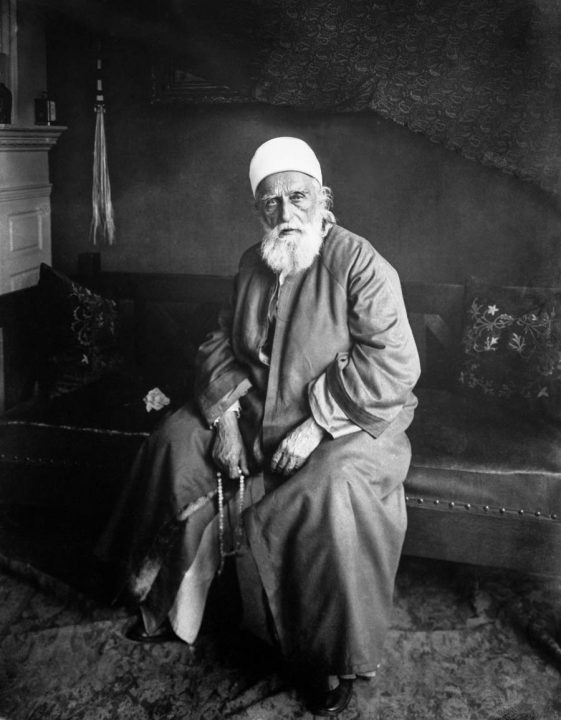
Portrait of Abdu’l-Baha in New York (1912)
That which is certain, he continued, is vouchsafed by the Holy Spirit.
While the Baha’i Faith does not discount these inexact criteria of the senses, Abdu’l-Baha explained in a talk he gave in Chicago that we human beings need a divine educator to quicken our minds and harmonize divergent thoughts:
The prophets of God are the first educator. They bestow universal education upon man and cause him to rise from lowest levels of savagery to the highest pinnacles of spiritual development. … His Holiness Jesus Christ was an educator of humanity. His teachings were altruistic; His bestowal universal. He taught mankind by the power of the Holy Spirit and not through human agency, for the human power is limited whereas the divine power is illimitable and infinite. The influence and accomplishment of Christ will attest to this. … The purpose of this is to show that the holy Manifestations of God, the divine prophets, are the first teachers of the human race. They are universal educators and the fundamental principles they have laid down are the causes and factors of the advancement of nations.
Guided and quickened by the teachings of these prophets and messengers, and inspired by the energies of the Holy Spirit, we gain true knowledge.
The materialist may deny its existence, but Abdu’l-Baha, in a talk he gave in Paris, explained its power to inspire and educate humans:
An humble man without learning, but filled with the Holy Spirit, is more powerful than the most nobly-born profound scholar without that inspiration. He who is educated by the Divine Spirit can, in his time, lead others to receive the same Spirit.
The Baha’i teachings confirm that the foremost favor vouchsafed by the Almighty is this divine gift of knowledge and understanding.
Growing up during segregation in the United States, my grandfather, who was Cherokee, Black, and Irish, had a difficult life, to say the least. But, my mother told me, while he chanted his Cherokee chants, he seemed happy. In fact, that Cherokee chant was one of the few cultural traditions that he passed down to his children.
“It was the string that kept us connected…,” my mother says. She taught me and my siblings this chant and shared a Cherokee story she had learned later in life, one filled with wisdom and guidance — a testament to the enduring spiritual legacy of Indigenous people.
A letter written on behalf of Shoghi Effendi, the Guardian of the Baha’i Faith, to the National Spiritual Assembly of Central America and Mexico echoed this sentiment, highlighting their transformative potential:
If the light of Divine Guidance enters properly into the lives of the Indians, it will be found that they will arise with a great power and will become an example of spirituality and culture to all of the people in these countries.
The Cherokee story emphasized the importance of the choices we make in life in the battle between our higher and lower natures. As Abdu’l-Baha, one of the central figures of the Baha’i Faith, wrote:
For the inner reality of man is a demarcation line between the shadow and the light, a place where the two seas meet…
This timeless truth is beautifully illustrated in the story, which goes as follows:
A young boy, angry with another boy for treating him badly, went to his grandfather, who proceeded to tell him a story. “I too, at times, have felt a great hate for those that have taken so much, with no sorrow for what they do. But hate wears you down, and hate does not hurt your enemy. Hate is like taking poison and wishing your enemy would die. I have struggled with these feelings many times,” he said.
“It is as if there are two wolves inside me; one wolf is good and does no harm. He lives in harmony with all around him and does not take offense when no offense was intended. He will only fight when it is right to do so, and in the right way. But the other wolf is full of anger. The littlest thing will set him into a fit of temper.”
He continued, “He fights everyone, all the time, for no reason. He cannot think because his anger and hate are so great. It is helpless anger, because his anger will change nothing. Sometimes it is hard to live with these two wolves inside me because both of the wolves try to dominate my spirit.”
The boy stared deeply into his grandfather’s eyes and asked, “Which wolf will win, Grandfather?”
Smilingly, the grandfather replied, “The one I feed.”
So, are we feeding the wolf of love, harmony, and hope, or anger, hatred, and hopelessness?
I know that it can be challenging to be optimistic in depressing and dangerous times, but as Louise Profeit-LeBlanc’s grandmother told her, “Whatever you need is around you! It is not what you want, but what you need that will be provided to you.”
Photo of Louise Profeit-LeBlanc, courtesy of Louise Profeit-LeBlanc.
Louise Profeit-LeBlanc, a storyteller, artist, and member of the Nacho N’yak Dän First Nation of central Yukon, Canada, shared that this Native American proverb reminds her that “the Creator provides for us, and it might not be what we want, but it will be what will make us grow.”
She added, “It makes us less material and more appreciative of everything we might need in terms of our livelihood, our well-being, and also, for the happiness and joy we bring to others.”
Native American Proverbs About Oneness
“We are all related” is Nadema Agard’s favorite Native American proverb. A Cherokee, Lakota, and Powhatan artist, educator, consultant, curator, and storyteller, Nadema often highlights this teaching in her work.
Photo of Nadema Agard, courtesy of Nadema Agard.
Moreover, the Baha’i writings emphasize humanity’s oneness and interconnectedness:
This limitless universe is like the human body, all the members of which are connected and linked with one another with the greatest strength. How much the organs, the members and the parts of the body of man are intermingled and connected for mutual aid and help, and how much they influence one another! In the same way, the parts of this infinite universe have their members and elements connected with one another, and influence one another spiritually and materially.
Not only are we all members of one human family, but we are all also connected to the heavenly kingdom. One of Medicine Eagle’s favorite Native American proverbs is from the Hopi people, which states, “The one is the all. The all are the one.”
This Hopi proverb reminds Medicine Eagle — a holistic healthcare practitioner and member of the Anishinaabe nation — that “there is but a veil of separation between us and the spirit realm.”
Photo of Medicine Eagle, courtesy of Medicine Eagle.
He wrote, “We all act as though there is a separation from the divine, yet there is no such thing! All created things come from God, and all things are good. We condition things to be not good through our gift of free will. This is the biggest illusion we face as beings.”
To overcome this illusion, all we have to do is turn towards God and look within ourselves. Baha’u’llah, the prophet and founder of the Baha’i Faith, revealed a powerful admonition, encouraging us to rise to our higher nature:
Turn thy sight unto thyself, that thou mayest find Me standing within thee, mighty, powerful and self-subsisting.
I hope these Baha’i teachings and Native American proverbs inspire you to look within, uncover your strength, and awaken the vast potential waiting to be tapped. These gems of guidance remind us that we are all part of something greater — a divine oneness that unites us with each other and with our Creator. The choice is ours: Which wolf will we feed, and how will we reflect this unity in our lives?
A few words of advice and inspiration: That’s what my co-workers and I were asked to share with the young people we work with in New York City. They’re between the ages of 18 and 24 and are serving the community by maintaining urban farms and giving fresh food and produce to their communities. We supervise their work and see ourselves as their mentors.
To that end, in their remarks, my colleagues mostly echoed each other’s sentiments — we talked about maintaining high expectations, offered encouragement for completing their service, and expressed gratitude for the work they’d already finished. One of the most common comments was focused on the dwindling motivation amongst the young people in the final months of their service term.
As an elaboration on this theme, one staff member discussed discipline, pointing out how motivation and discipline don’t have to be linked. He told the young people how even if our motivation rises and falls, if we practice discipline, we can achieve what we set out to accomplish.
I hadn’t thought much about how these two are different. Motivation is the desire to do something, while discipline is the actual persistence and active component of doing it.
By nature of how many of us were raised, we often can meet expectations and practice consistency when we receive external supervision or support. Unfortunately, many or the structures in our lives that emphasize the creation of disciplined goals do not focus on our more internal or spiritual well-being.
In tracking my own internal development, I have noticed I have a high motivation for many different and great things, but my discipline could use some work. My ability to consistently take steps towards achieving a goal or developing a healthy habit often falters.
As one of the central tenants of the Baha’i Faith is unity in diversity, there is no one specific lifestyle that all Baha’is are expected to lead but, there are clearly stated guidelines for the way we should lead our lives mentioned in Baha’i scriptures. For example, there is an emphasis on praying and reading divine scriptures every morning and evening. Baha’u’llah, the prophet and founder of the Baha’i Faith, wrote, “Recite ye the verses of God every morn and eventide.”
Daily prayer is a standard for all Baha’is, whether we are busy or not, and whether we work in a standard 9-to-5 office setting or have a nontraditional schedule. While reflecting on how to create discipline and approach different goals with consistency, this passage made me realize that no matter how much I have going on, it helps to create some kind of regular structure for whatever it is I am approaching when it comes to my spiritual well-being. This can look like paying attention to my morning ritual and incorporating meditation or prayer, or it might look like taking note every time I feel like I am bending the truth. Whatever my goal may be for internal growth, having structure is something that can help increase our ability to be consistent and disciplined.
While simple, being consistent with prayer and reflecting on writings rooted in spirituality can start and end my day in an intentional way. This intentionality might also set the tone for approaching the many scattered goals I have with a mindset of deliberate consistency. Indeed, Abdu’l-Baha, the son of Baha’u’llah, and his designated successor wrote that “Perseverance is an essential condition. In every project firmness and steadfastness will undoubtedly lead to good results; otherwise it will exist for some days, and then be discontinued.”
Instead of viewing motivation as the precursor to discipline, I have begun to consider the relationship as a much more co-created one. As I am working to become more disciplined in my daily life, I will likely also feel an upsurge in motivation.
When something seems more feasible, we are much more likely to attempt to do it. When something feels impossible, it is more challenging to take action. Being disciplined, even with one or two things, can provide the evidence that we need to regain our confidence. It is then that we can begin planning to do things that seem difficult to accomplish. For example, if I am able to control my spending habits for a few months, I will probably feel more able to consistently connect with my friends to discuss how we can more effectively contribute to the well-being of our community.
The Baha’i writings also suggest we always be vigilant of ways to bring joy to others. We can tap into deeper sources of motivation within ourselves by being disciplined about seeing the world through this lens. As Abdu’l-Baha encouraged us:
Be ye always the source of happiness to the hearts, for the best of men is one who winneth the hearts and refraineth from troubling any soul, and the worst of men is one who vexeth the hearts and causeth people to be grieved. Always endeavour to gladden the people and to rejoice their hearts so that ye may be enabled to guide them.
In order for us to pursue creative pursuits, strengthen our mental health, and be a part of organic community-building efforts through developing healthy relationships and friendships, we have to self-regulate and act as our own supervisors. I am realizing that taking ownership, practicing patience and perseverance, and resisting the tendency to give up will allow for my discipline and motivation to bloom together. I am excited to move past goal-setting and into action.
A self-identifying atheist acquaintance — I’ll call him Maynard — posted questions about God on his blog encouraging any believers hanging out there to please answer.
How could I resist?
Maynard asked particularly interesting questions, which most religious people don’t think about all that much. I didn’t. Up until the time I was in my late teens, God was like air, something I depended on being there without giving much thought to its composition.
At eighteen, I seriously questioned my assumptions about things, including God. But by the time I answered Maynard’s questions, I’d spent a significant portion of my life contemplating them and researching the answers.
Maynard asked these questions because he felt “the God hypothesis” wasn’t granular enough. He wanted every detail filled in. An interesting request, in view of the fact that few, if any, scientific hypotheses leap fully formed from even the most advanced minds. Least of all do they leap forth proven, or even with enough evidence to satisfy the scientific community.
Anybody remember back when Walter and Louis Alvarez released their first theories about the KT boundary in 1980? Though they had discovered enough evidence that a large mass had struck the Earth and caused the dinosaur die-off — enough that they were convinced of it — many scientists scoffed openly. The evidence for an impact was circumstantial. No one could observe an asteroid striking the Earth to check the evidence. No one could repair to a laboratory to do controlled experiments. Scientists demanded a smoking gun — or, in this case, a smoking crater. The debate became rancorous, to put it mildly.
The Alvarez’s ideas have since come to be widely accepted as scientific fact. This underscores the strength of the scientific method as a means of studying physical reality and building a body of evidence in support of certain beliefs about it. In my own life, faith has also been about studying reality and building a body of evidence for beliefs about the spiritual world and the human psyche — where the material and spiritual meet.
I have heard several clergymen suggest that the mind is a tool of the devil and that real faith is blind faith. I would propose, rather, that since God gave us minds and encouraged us to use them, He would be pleased if we used them to discover Him with as much zeal as we use to discover the physical laws He set in motion.
Indeed, Baha’i scriptures insist that faith should not be blind because such blindness (not knowing why we believe something) can lead to dogma, fundamentalism, schism, and worse. So, without further ado, here are the questions Maynard asked the believers who frequented his blog spot:
Is God a (a) material or (b) non-material entity? (i.e., is God made up of the same kind of stuff like protons, electrons, etc. with properties like mass, charge, spin, etc. that every other thing in the universe is made up of, or is he made of something that is non-material?)
Does God exist everywhere in space?
Is God a sentient being like us, with thoughts and feelings?
Can God change the past?
Does God know the future?
Does God know absolutely everything that happens every moment, including every thought of every being?
Can god intervene in events whenever and wherever, to violate natural laws and change their course (i.e. perform miracles)?
Do you believe that you have a soul or spirit that will continue to exist in some form (perhaps reincarnated) even after you are dead?
As you can see, a number of these questions deal with the concepts of omniscience and omnipotence. Without actually putting it into words, Maynard posed the age-old theological conundrum: Could God create a rock too heavy for Him to lift? (My answer: Why would He want to?)
The questions draw on a number of assumptions around God’s power and abilities, and whether our concept of something being “made” applies to God. Everything we can perceive has been “made” in some way, and it’s a human assumption that things must exist by being made. In other words, the question assumes that God is made just like everything else in our experience.
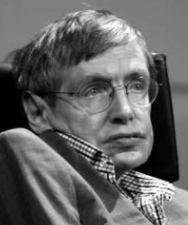
Stephan Hawking
Which, of course, leads to the problem of infinite regression and the question: What created God? Stephen Hawking asks the same question — and answers it — when he says that the universe came into being spontaneously because of gravity.
Okay. If I put that in spiritual terms, he’s saying the universe came into being because of love (attractive force). That sounds right. But whose love and for what?
Baha’u’llah wrote (speaking as an Emissary for the God in question):
“I loved thy creation, hence I created thee.”
Which brings us back to the first question about God: What sort of being might God be?
When a baby is born into this world, she “dies” with respect to the warm comfortable mother’s womb where she has happily lived for nine months.
She leaves that life forever as she enters this life – with no idea that this life even exists. This life, then, represents the afterlife of the mother’s womb.
The sole purpose of the baby being in the mother’s womb is to grow all the organs and limbs she will need in order to function in this life.
Taking this analogy a step further, this life is the womb for the next life.
With all the issues we deal with every day – our health, relationships, careers, finances, possessions, hobbies, you name it – the sole purpose of our being in this womb we call Earth is to develop our souls for the next life, the life of the spirit. Everything else in our lives ends with our deaths. Only our souls go on to the next plane of existence.
So how do we develop our souls for that next life? The Baha’i teachings have answers to that critical question.
First, those teachings recommend that we recognize the message of God for the age we live in; and second, we then “observe every ordinance” that message contains:
The first duty prescribed by God for His servants is the recognition of Him Who is the Dayspring of His Revelation and the Fountain of His laws, Who representeth the Godhead in both the Kingdom of His Cause and the world of creation. … It behoveth every one who reacheth this most sublime station, this summit of transcendent glory, to observe every ordinance of Him Who is the Desire of the world. These twin duties are inseparable. Neither is acceptable without the other. Thus hath it been decreed by Him Who is the Source of Divine inspiration.
Baha’is believe God has revealed His will periodically throughout history through His messengers, the founders of the major world religions – Abraham, Krishna, Moses, Zoroaster, Buddha, Christ, Muhammad, and for this new day in human history, Baha’u’llah, the founder of the Baha’i Faith.
Recognizing the divine authority of a messenger of God requires that we conduct our own independent investigation of truth, willing to let go of all prejudices, superstitions, and beliefs that prevent us from objectively evaluating and accepting that new message. Only when we very humbly open our minds and hearts to the possibility of someone being a messenger of God can we accept his teachings as the Word of God, and understand God’s will.
Also, as the second part of Baha’u’llah’s injunction asks, we must be willing to follow the principles, teachings, and laws revealed by God’s messenger. These “twin duties,” the Baha’i teachings assure us, will help us become more spiritual beings.
Here are just a few ways we can do this:
1. Develop a close relationship with God by praying; loving and praising Him; continually thanking Him for the countless blessings He has bestowed upon us throughout our lives; having faith and trusting in His grace that He is always there for us, loving us and protecting us, at all times and under all conditions.
2. Acquire God-like attributes and strive to make our daily behavior reflect these attributes – such as love, compassion, forgiveness, kindness, justice, patience, trustworthiness, integrity, courtesy, the Golden Rule, etc.
3. Be of service to others. The more we serve other people, the more selfless we become. Moreover, Baha’u’llah said that work performed in the spirit of service is worship.
4. Stay focused on our spiritual nature: our reality is our soul, not our body.
5. Strive to be in unity and harmony with all people, regardless of who they are and what they believe.
6. In this new day, Baha’u’llah taught that all human beings must fully embrace the indisputable fact that humankind is one family. There is only one race – the human race. We are all one beautiful human flower garden. We need to accept and appreciate our diversity, not condemn and destroy it.
As a corollary to this, we must do everything in our power to totally eliminate all our prejudices – racial, religious, gender, cultural, political, national, economic, educational, tribal, etc. Not only does this greatly benefit our souls; it also brings about desperately needed unity and harmony.
All of this requires commitment. Our daily words and actions, based on total unconditional commitment to become deeply spiritual, are the true reflection of who we are as human beings.
Because we’re human, though, we’ll always fall short of these high ideals. But we must keep trying, no matter how difficult or painful. God knows our hearts. He knows how sincere we are in our daily efforts to become the noble spiritual human beings we were created to be.
We must constantly give ourselves love, kindness, gentleness, and forgiveness, and we must appreciate who we are. These two powerful quotations from the writings of Baha’u’llah elaborate further on these exalted themes:
… The nature of the soul after death can never be described, nor is it meet and permissible to reveal its whole character to the eyes of men. The Prophets and Messengers of God have been sent down for the sole purpose of guiding mankind to the straight Path of Truth. The purpose underlying their revelation hath been to educate all men, that they may, at the hour of death, ascend, in the utmost purity and sanctity and with absolute detachment, to the throne of the Most High … – Gleanings from the Writings of Baha’u’llah
… man can never hope to attain unto the knowledge of the All-Glorious, can never quaff from the stream of divine knowledge and wisdom … unless and until he ceases to regard the words and deeds of mortal men as a standard for the true understanding and recognition of God and His Prophets. – The Book of Certitude
In “The Brave Ones,” Michael Orona’s compelling narrative transcends beyond physical courage and delves into spiritual courage and resilience, highlighting the power of remaining steadfast in the face of oppression. As Baha’u’llah, the prophet and founder of the Baha’i Faith, wrote:
The source of courage and power is the promotion of the Word of God, and steadfastness in His Love.
Inspired by his personal experiences, family history, and the Baha’i teachings, Michael Orona discusses how the characters in his novel embody this spiritual courage and steadfastness, reflects on the ongoing fight for representation, and explores the lessons his book offers for today’s social justice movements.
Michael Orona
Radiance Talley: Hi, Michael! The title “The Brave Ones” suggests acts of courage. How do your characters embody spiritual courage, and how does this align with the Baha’i view of steadfastness in the face of injustice?
Michael Orona: The title “The Brave Ones” carries deep spiritual significance that goes far beyond physical courage. It’s about a profound inner transformation and the courage to reimagine human possibility in the face of systemic oppression.
Spiritual courage, from a Baha’i perspective, isn’t about confrontation, but rather the ability to maintain dignity, hope, and foresight when every system is designed to break your spirit. My characters embody this through their refusal to be defined by their circumstances.
Consider the Baha’i principle articulated by Shoghi Effendi about the American believers’ special calling — to have the “moral courage and fortitude” to address fundamental issues facing humanity. The characters in the book live by this principle. They’re not just fighting against discrimination; they’re creating alternative models for the advancement of not only their own community, but also for the advancement of their oppressors.
The Indigenous peoples in the story — members of the Yaqui Nation from Sonora — represent this beautifully. They could have accepted their limited circumstances. Instead, they dream beyond their immediate reality and then act. Their dreams and the action to make them a reality symbolize hope — a spiritual act of resistance that transcends physical constraints.
Abdu’l-Baha’s teachings profoundly influenced how I conceived spiritual courage. He spoke about the Indigenous peoples of America having the potential to “enlighten the whole world” if properly educated and guided. My characters embody this — they’re not victims waiting to be saved, but transformative agents with inherent spiritual power.
“The Brave Ones” is a testament to this spiritual courage — a celebration of Indigenous peoples who refuse to be broken, who see beyond current realities to potential futures of unity and justice. I believe this embodies us as Native people, it’s who we are.
Radiance: Did you draw from personal experiences, oral histories, or Baha’i teachings on the value of diverse cultures?
Michael: The book is deeply rooted from personal experience, family narratives, and the Baha’i teachings that have shaped my life.
Growing up, I was steeped in my Indigenous cultural heritage in large part to the profound support of my late Apache father, Dr. Joel Orona, and my Yaqui mother, Esther Orona. Storytelling wasn’t just a tradition in our family — it was a way of preserving history, of maintaining cultural identity, and spiritual development. The oral histories my grandparents and elders shared with me as a child were living histories, not just personal narratives but collective experiences of resistance, resilience, and survival. It was through these stories that I was taught the importance of being of service not only to my own community, but to the global community. It was through these stories that I was reminded of the responsibility to honor the legacy of my ancestors.
As a child of the 1970s, I was acutely aware of the lack of diversity and limited representation of Indigenous peoples in the media. I remember watching television or going to the movies and rarely seeing people on screen who looked like me. Those rare times when Indigenous people were portrayed, it was done by non-Native actors in a demeaning manner. The watershed moment for me was watching Alex Haley’s “Roots” on television — a chronicle that brought the history of African Americans to the forefront. The importance of seeing the struggle and unique perspective from another marginalized community gave me hope that someday I would have the opportunity to share the historical challenges and success of my own people.
The Baha’i teachings were instrumental in shaping my perspective on cultural diversity. Baha’u’llah’s message on this topic was revolutionary, it was not about reforming existing social norms, but fundamentally shattering the very notion of racial superiority. This wasn’t just a social justice message, but a message of spiritual transformation.
Abdu’l-Baha’s teachings were particularly profound in the writing of the book. He spoke about the unique spiritual potential of Indigenous peoples, stating we will “enlighten the whole world” and serve as spiritual “standard bearers.” This isn’t patronizing but rather the sincere belief, acknowledgment, and recognition of the inherent spiritual wisdom found within Indigenous communities that have been historically and systematically marginalized.
Ultimately, the book is an embodiment of the Baha’i principle of the oneness of humanity. It’s not just about documenting historical struggles, but about creating a vision of human potential that transcends racial, cultural, and historical divisions.
Radiance: How do the themes of “The Brave Ones” resonate with today’s social justice movements? What lessons can readers draw from this historical narrative?
Michael: The story of “The Brave Ones” is not just a historical account, but a powerful lens through which we can understand the ongoing struggles for equity, solidarity, and human dignity. I believe the narrative of Indigenous peoples fighting for equality in partnership with African Americans speaks directly to the intersectional nature of social justice movements today.
First and foremost, the book illuminates the power of unexpected alliances. At a time of profound racial discrimination, these communities found strength in their shared marginalized experience. Today, we see similar dynamics in modern social justice movements — whether its organizations focused on Indigenous rights, economic empowerment, or struggles against systemic oppression. The lesson is clear: solidarity and collaboration across different marginalized communities is not just possible, but essential.
The book underscores how systemic discrimination creates seemingly insurmountable barriers. Members of the Yaqui community in the book faced limited opportunities, forced to live under difficult circumstances with little hope for advancement. This mirrors the ongoing challenges faced by Indigenous peoples around the world and other communities of color — unequal access to education, economic opportunities, and social mobility. Yet, the story is ultimately one of hope and resistance, showing how collective action can challenge and ultimately transform unjust systems.
Moreover, the narrative underscores the importance of telling our own stories. For too long, Indigenous peoples have been relegated to the margins of historical narratives, our experiences either silenced or misrepresented. “The Brave Ones” is part of a broader movement to reclaim our narrative, to center Indigenous voices and perspectives. This resonates deeply with contemporary calls for authentic representation and self-determination.
The themes of dignity, resilience, and a shared humanity are particularly relevant in our current social and political climate. We continue to grapple with historical injustices, systemic racism, and the ongoing impacts of colonization. The book offers a blueprint for understanding how communities can come together, recognize their common struggles, and work toward collective liberation.
I was inspired to write this story by the experiences shared by my grandparents and their generation — a reminder that our current struggles are deeply connected to historical experiences of oppression and resistance. The book is not just about the past; it’s a call to action for today’s generation to continue the work of building a more just and equitable society.
Ultimately, “The Brave Ones” teaches us that change is possible when we recognize our shared humanity, when we have the courage to challenge the status quo, and when we stand in solidarity with one another. It’s a message of hope that I believe is more crucial now than ever before.
Radiance: A reviewer mentioned that this story “finally broke the barrier” for Indigenous people to tell their own stories. What challenges do Indigenous authors face in having their narratives published and recognized, and how does the Baha’i Faith encourage perseverance in such efforts?
Michael: The publishing world has long been a gatekeeping system that marginalizes Indigenous voices. For generations, our stories have been told through a colonial lens — filtered, misinterpreted, and often romanticized or vilified by non-Indigenous writers. Breaking through these barriers requires persistent courage and a commitment to authentic storytelling.
Indigenous authors face multiple systemic challenges. First, there’s the structural inequality in publishing: limited representation in editorial boards, fewer publishing opportunities, and a publishing industry that historically prioritizes mainstream narratives. Many publishers view Indigenous stories as niche or unmarketable, failing to recognize the universal humanity and complexity of our experiences.
Our narratives are often expected to conform to stereotypical expectations — stories of trauma, historical suffering, or exotic cultural experiences that fit comfortable narratives about Indigenous peoples. But we are not museum artifacts or historical footnotes. We are a living, evolving people with rich, nuanced stories that speak to contemporary human experiences.
The Baha’i Faith has been instrumental in giving me the spiritual strength to persist. The principles of the Baha’i Faith, including the oneness of humanity, universal education, and the independent investigation of truth, are not philosophical concepts, but active guides for my writing and activism. The Faith encourages us to see beyond divisive boundaries, to recognize the inherent worth of every human being, and to work tirelessly for justice and understanding.
When I face rejection or encounter systemic barriers, I draw strength from the Baha’i teachings about perseverance. We believe that true progress comes through consistent, compassionate effort. Just as the members of the Yaqui community in my book refused to be defined by their circumstances, I refuse to let institutional barriers silence our stories.
The process of writing “The Brave Ones” was itself an act of spiritual and cultural resistance. By centering Indigenous agency, showing our community’s resilience, and highlighting our partnerships across racial lines, I’m challenging the dominant narratives that have historically marginalized us.
Moreover, my work is part of a broader movement of Indigenous authors reclaiming our narrative space. Indigenous authors have been instrumental in breaking down these barriers, proving that our stories are not just important — they are essential to understanding the full complexity of the human experience.
My Faith teaches me that every voice matters, that every story has the potential to bridge understanding. By persistently sharing our narratives, we challenge systemic inequities and create opportunities for genuine dialogue and mutual respect.
This is why “The Brave Ones” is more than a book. It’s a testament to the power of storytelling as a form of cultural preservation, resistance, and hope.
Radiance:Thank you, Michael, for sharing your profound insights and reflections. If you all are enjoying this Q&A, be on the lookout for part threewhere we’ll discuss practical actions we all can take to promote justice and harmony!
A permanent peace in the world of existence can be established only through the power of the spirit. – Abdu’l-Baha, Divine Philosophy, p. 175.
Do you remember the last time you got really mad?
Consider it for a minute. Try to remember your anger, and recall what caused it. Did it happen when someone cut you off on the highway? When someone intentionally disrespected you? Or did it occur when someone hurt you, whether they realized it or not? Now consider: where did it come from?
Personally, I tend to have a pretty deep well of rage and anger. I’m working on it with prayer and meditation, but I still feel it from time to time. I don’t know why I have it. Maybe my upbringing caused it—I had a violent father, an ex-Marine war veteran who believed that sparing the rod definitely spoiled the child. Or maybe the war I had to go experience, and the things I saw there, made it happen. I’ve always felt a high level of sensitivity to injustice, though, and I’ve tried to re-direct some of my anger toward righting the injustice I see, which seems to help.
Anyway, we all have some of that stored-up pain inside us. In some people it emerges as self-destructiveness, or substance abuse, or criminal behavior. The other day I read about a man whose intense internal anger made him fear he would hurt others; so he got a gun and called the police and threatened them with it. They shot him. The newspaper called it suicide-by-cop; but I could feel his unbearable pain and suffering.
This world can deliver us bucketfuls of that kind of hurt, pain and anger. The Baha’i teachings say:
…the trials which beset our every step, all our sorrow, pain, shame and grief, are born in the world of matter; whereas the spiritual Kingdom never causes sadness. A man living with his thoughts in this Kingdom knows perpetual joy. The ills all flesh is heir to do not pass him by, but they only touch the surface of his life, the depths are calm and serene.
Today, humanity is bowed down with trouble, sorrow and grief, no one escapes; the world is wet with tears; but, thank God, the remedy is at our doors. Let us turn our hearts away from the world of matter and live in the spiritual world! It alone can give us freedom! If we are hemmed in by difficulties we have only to call upon God, and by His great Mercy we shall be helped. – Abdu’l-Baha, Paris Talks, pp. 109-110.
This sounds simple, but of course, it’s not.
“Turn our hearts away from the world of matter,” Abdu’l-Baha advises us, “and live in the spiritual world.” What does that mean?
For Baha’is that task lies at the heart of all religion. It asks us to raise our sights beyond the daily material considerations of life and allow our hearts and souls to seek what they yearn for—a sense of calm, confident inner peace. That divine tranquility means we can move past our trials and troubles, which all come as a result of our attachment to this fleeting physical plane. Only this mystical, transcendent sense of connection to something beyond the material world can give us true peace.
The Baha’i teachings say that the growth of spirituality, in the individual soul and in the world, will bring us that sense of peace:
I want to make you understand that material progress and spiritual progress are two very different things, and that only if material progress goes hand in hand with spirituality can any real progress come about, and the Most Great Peace reign in the world. If men followed the Holy Counsels and the Teachings of the Prophets, if Divine Light shone in all hearts and men were really religious, we should soon see peace on earth and the Kingdom of God among men. The laws of God may be likened unto the soul and material progress unto the body. If the body was not animated by the soul, it would cease to exist. It is my earnest prayer that spirituality may ever grow and increase in the world, so that customs may become enlightened and peace and concord may be established. – Abdu’l-Baha, Paris Talks, pp. 107-108.